INTRODUCTION
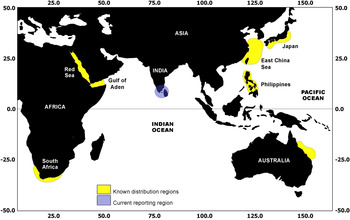
Brotulas are viviparous ophidiform fish found in tropical and subtropical regions of all oceans. They are easily recognized by the single pelvic fin ray, position of the anterior nostril near the upper lip, low number (rarely more than six) of long rakers on the anterior gill arch and the lack of basibranchial tooth patches. The Bythitidae contains 51 genera and 209 species (Nielsen et al., Reference Nielsen, Cohen, Markle and Robins1999; Eschmeyer & Fong, Reference Eschmeyer and Fong2013). The species of Grammonus are partly scaled, with a high head, vertical expansion on the posterior margin of the maxilla and edentate palatines (Nielsen & Prokofiev, Reference Nielsen and Prokofiev2010; Froese & Pauly, Reference Froese and Pauly2013). The genus Grammonus holds 11 valid species and most species of the genus are marine cave dwellers and therefore caught rarely in fishing gears. Grammonus robustus is found on soft bottoms and the known distribution range is limited to the Red Sea and Gulf of Aden (Klausewitz & Uiblein, Reference Klausewitz and Uiblein1995), the Philippines (Smith & Radcliffe, Reference Radcliffe1913 in Radcliffe, 2013), Japan (Masuda et al., Reference Masuda, Amaoka, Araga, Uyeno and Yoshino1984), possibly South Africa, the East China Sea (Nielsen et al., Reference Nielsen, Cohen, Markle and Robins1999) and Australia (Anon, 2014). This is the first record of G. robustus from Indian waters. The only other species of this genus from India is G. ater, which has been reported from the west coast (Venu, Reference Venu, Venkataraman, Sivaperuman and Raghunathan2013).
MATERIALS AND METHODS
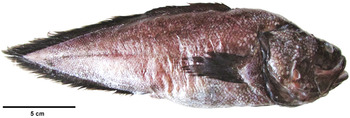
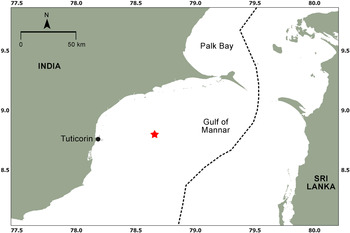
Five specimens measuring 132.6–233.9 mm standard length (SL) were collected from the by-catch landed by a commercial deep-sea trawler at Tuticorin fisheries harbour during January 2013 (Figure 1). The specimens were caught approximately 35–40 km east off Tuticorin fisheries harbour (8.795°N and 78.632°E) from the Gulf of Mannar (Bay of Bengal) at depths of 150 to 200 m (Figure 2). The specimens were identified as G. robustus based on the available taxonomic literature (Nielsen et al., Reference Nielsen, Cohen, Markle and Robins1999; Nielsen, Reference Nielsen2007; Nielsen & Prokofiev, Reference Nielsen and Prokofiev2010; Froese & Pauly, Reference Froese and Pauly2013). Measurements and counts followed the method of Nielsen et al. (Reference Nielsen, Cohen, Markle and Robins1999).
Grammonus robustus (standard length 233 mm) caught off Tuticorin, Gulf of Mannar, India.

Capture location of Grammonus robustus (red star) from the Gulf of Mannar (dotted line indicates maritime boundary of India and Sri Lanka).

RESULTS
SYSTEMATICS
Order OPHIDIIFORMES
Family BYTHITIDAE
Subfamily BYTHITINAE
Genus Grammonus Gill, 1896
Species Grammonus robustus Smith & Radcliffe, Reference Radcliffe1913
SYNONMYS
Grammonus robustus, Smith & Radcliffe, Reference Radcliffe1913 in Radcliffe Reference Radcliffe1913: 168, Pl. 13 (figure 4), Proceedings of the United States National Museum 44; between Cebu and Leyte, 10°38′00″N 124°13′08″E, the Philippines, Albatross Station 5409, depth 189 fathoms. Holotype (unique): Unites States National Museum (USNM) 74149;
Oligopus robustus (Smith & Radcliffe, Reference Radcliffe1913) in Cohen, Reference Cohen1964, 116: 10–11, Proceedings of the United States National Museum;
Grammonus robustus Smith & Radcliffe, Reference Radcliffe1913 in Nielsen J.G., Cohen D.M., Markle D.F. and Robins C.R. (Reference Nielsen, Cohen, Markle and Robins1999), 125: 178 pp.
DESCRIPTION
Body short, deep and posteriorly compressed; head broad, depressed anteriorly and arched posteriorly; snout short and circular; mouth large and oblique. Scales present on the head and body. Mostly cycloid, scale rows are very irregular, overlapping and loosely stacked. Opercle with short concealed spine (in most of the examined specimens spines were covered by skin). Preopercle with no prominent spines as observed in opercle. Lateral line doubled; dorsal one (1st one bending downward) originates somewhat above the hidden opercular spine and ending above middle of dorsal fin or just behind the vent. Ventral one (2nd one bending upward) originates before the vent and forms midline of body to caudal fin. Dorsal and anal fins joined caudal. Dorsal fin originates behind the pectoral fin base and anal fin starts below 30–34th dorsal fin rays. Ventral fins with single ray each, originating close to the level of posterior margin of preopercle.
Dentition
Premaxilla and dentaries with small and numerous pointed teeth (resembles granular teeth forms). Palatines edentate. Vomer with small, loosely-set pointed teeth.
Gill arch
First gill arch total 19; developed long rakers 3 and plate-like rakers 16; three developed gill rakers interspaced with one plate-like raker. First one in angle of the gill arch, i.e. 6th raker where the upper branch ends. Other two are in the lower branch which forms the 8th and 10th rakers.
Colour
Body, head and eyes dark brown; dorsal and anal fins brown anteriorly and dark brown posteriorly. Pectoral base dusky brown, and pelvic and pectoral fins are dark brown.
DISTRIBUTION AND BIOLOGY
The gut contents of the examined specimens were mostly empty except single female specimen which contained deep-sea shrimps, Metapaenopsis andamanensis. The examined specimens included a single mature female (egg diameter range from 525–598 µ) and four males that were either mature or maturing. Biological observations are summarized in Table 1. In addition, other deep-sea species present in the by-catch included various deep-sea shrimps (Metapenaeopsis andamanensis, Aristeus alcocki, Penaeopsis jerryi, Solenocera hextii, Heterocarpus woodmasoni, H. gibbosus and Plesionika spinipes), snake mackerals (Lepidocybium flavobrunneum, L. flavobrunneum, Ruvettus pretiosus, Gempylus serpens, Neoepinnula orientalis and Rexea prometheoides) some ophidiiform fish species (Neobythites multistriatus and N. stefanovi), an un-identified houndshark, Mustelus spp., mantis shrimps Oratosquilla sp. and the gastropod mollusc Biplex spp.
Biological observations# of Grammonus robustus.

# , except total length all the observations were taken from formalin preserved specimens.
DISCUSSION
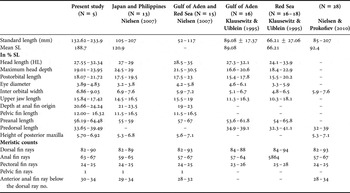
Grammonus robustus has a restricted distribution (Figure 3) and the current report is the first record of G. robustus from Indian waters. In recent years, many new deep-sea species have been recorded from the exclusive economic zone of India (Bineesh et al., Reference Bineesh, Sebastine, Akhilesh and Pillai2010; Reference Bineesh, Akhilesh, Rajool Shanis, Abdussamad and Pillai2012a, Reference Bineesh, Akhilesh, Rajool Shanis, Abdussamad and Pillaib; Kurup et al., Reference Kurup, Cubelio, Joseph and Venu2010; Akhilesh et al., Reference Akhilesh, Ganga, Pillai, Vivekanandan, Bineesh, Rajool Shanis and Manjebrayakath2011, Reference Akhilesh, Bineesh, Ganga and Pillai2013; Ganga et al., Reference Ganga, Rajool Shanis, Manjebrayakath and Akhilesh2012; Zacharia & Kannan, Reference Zacharia and Kannan2012; Kannan et al., Reference Kannan, Joshi, Sajan and Johnson2013a, Reference Kannan, Sajan, Joshi and Zachariab; Rajool Shanis et al., Reference Rajool Shanis, Akhilesh, Ganga and Pillai2013; Venu, Reference Venu, Venkataraman, Sivaperuman and Raghunathan2013). This can be attributed to the intensified deep sea exploratory studies and closer monitoring of by-catch of the deep sea fishery. The present records increase our understanding of the deep-sea fish diversity in the Gulf of Mannar and also present the largest ever recorded size of G. robustus (SL 188.7 ± 37.5 mm). The morphometric and meristic characters of present specimens (Table 2) were consistent with specimens reported from the Red Sea and Gulf of Aden (Klausewitz & Uiblein, Reference Klausewitz and Uiblein1995; Nielsen, Reference Nielsen2007), Japan and the Philippines (Nielsen, Reference Nielsen2007), and those reported by Nielsen & Prokofiev (Reference Nielsen and Prokofiev2010).
Known distribution range of Grammonus robustus from the world (yellow highlights) and present reporting from Indian waters (blue highlight).

Comparison of morphometric and meristic counts of Grammonus robustus from Gulf of Mannar with the examined specimens.

ACKNOWLEDGEMENTS
The authors are grateful to Dr A. Gopalakrishnan, Director, Central Marine Fisheries Research Institute (CMFRI), Cochin and Dr M.S. Madan, Scientist-in-charge, Tuticorin Research Centre of CMFRI for their encouragement during the course of manuscript preparation. We wish to express our sincere thanks to colleagues of CMFRI Tuticorin and fishers of Tuticorin harbour for their help and support.