Introduction
The whitefly Bemisia tabaci (Gennadius) is a worldwide pest of vegetable, ornamental and field crops. It is genetically diverse, being made up of numerous morphologically indistinguishable genetic groups that display very clear patterns of geographic distributions around the globe (Boykin et al., Reference Boykin, Shatters, Rosell, McKenzie, Bagnall, De Barro and Frohlich2007). This level of genetic diversity has seen the identification of at least 33 different biotypes (Perring, Reference Perring2001; Simon et al., Reference Simon, Cenis, Beitia, Saif, Moreno, Fraile and García-Arenal2003a,Reference Simon, Cenis, Demichelis, Rapisarda, Caciagli and Boscob; Qiu et al., Reference Qiu, Ren, Mandour and Wen2006a,Reference Qiu, Ren, Wen and Mandourb; Zang et al., Reference Zang, Jiang, Xu, Liu and Zhang2006). Bemisia tabaci has risen to international prominence since the 1980s due to the global invasion by one member of the species complex, the commonly named B biotype (Brown et al., Reference Brown, Frohlich and Rosell1995; Perring, Reference Perring2001; Boykin et al., Reference Boykin, Shatters, Rosell, McKenzie, Bagnall, De Barro and Frohlich2007; Liu et al., Reference Liu, De Barro, Xu, Luan, Zang, Ruan and Wan2007). The invasive B biotype has caused considerable damage to a range of crops through phloem feeding, transmission of plant viruses, induction of phytotoxic disorders and excretion of honeydew (Brown et al., Reference Brown, Frohlich and Rosell1995; Oliveira et al., Reference Oliveira, Henneberry and Anderson2001; Jiu et al., Reference Jiu, Zhou, Tong, Xu, Yang, Wan and Liu2007). In many regions, the introduction of B has resulted in the displacement of some relatively innocuous indigenous B. tabaci belonging to different genetic groups (Perring et al., Reference Perring, Copper, Rodriguez, Farrar and Bellows1993; McKenzie et al., Reference McKenzie, Anderson and Villarreal2004; Liu et al., Reference Liu, De Barro, Xu, Luan, Zang, Ruan and Wan2007). More recently, the widespread invasion of B has been increasingly matched by the global spread of a second member of the complex, the Q biotype (Horowitz et al., Reference Horowitz, Denholm, Gorman, Cenis, Kontsedalov and Ishaaya2003; Chu et al., Reference Chu, Zhang, Brown, Cong, Xu, Wu and Zhu2006; Ueda & Brown, Reference Ueda and Brown2006; Martinez-Carrillo & Brown, Reference Martinez-Carrillo and Brown2007; McKenzie et al., Reference McKenzie, Hodges, Osborne, Byrne and Shatters2009). In Zhejiang Province of China, the B biotype probably arrived in late 1990s and has been rapidly displacing the indigenous ZHJ1, ZHJ2 and ZHJ3 biotypes (Liu et al., Reference Liu, De Barro, Xu, Luan, Zang, Ruan and Wan2007; Xu, Reference Xu2009). The Q biotype first appeared in 2005, and its rapid spread in the following years changed the composition of B. tabaci in the field (Xu, Reference Xu2009).
While the impact of B. tabaci on world agriculture has been widely recognized, whether this whitefly is a complex species or a species complex has been a subject of debate (Campbell et al., Reference Campbell, Duffus, Baumann, Bartlett, Gawel, Perring, Farrar, Cooper, Bellows and Rodriguez1993; Brown et al., Reference Brown, Frohlich and Rosell1995; Perring, Reference Perring2001; Boykin et al., Reference Boykin, Shatters, Rosell, McKenzie, Bagnall, De Barro and Frohlich2007). Using mitochondrial CO1, the phylogenetic analysis of Boykin et al. (Reference Boykin, Shatters, Rosell, McKenzie, Bagnall, De Barro and Frohlich2007) indicated that B. tabaci contained 12 well-defined genetic groups. More recently, Dinsdale et al. (Reference Dinsdale, Cook, Riginos, Buckley and De Barroin press) conducted a more refined global analysis of genetic boundaries for B. tabaci using 198 unique B. tabaci haplotypes; the results suggested that B. tabaci was a cryptic species complex. Dinsdale et al. (Reference Dinsdale, Cook, Riginos, Buckley and De Barroin press) identified a distinct gap in the frequency distribution of pairwise sequence divergence, and such a gap is indicative of species level differentiation and suggests that individuals with >3.5% divergence belong to different species. The overall analysis suggested that there were at least 24 species making up the complex. Dinsdale et al. (Reference Dinsdale, Cook, Riginos, Buckley and De Barroin press) identified the species level groups as follows (names of associated biotypes are placed in parentheses where applicable): Mediterranean (Q, J, L, Sub-Saharan Africa Silverleaf); Middle East-Asia Minor 1 (B, B2); Middle East-Asia Minor 2; Indian Ocean (MS); Asia I (H, M, NA); Australia/Indonesia; Australia (AN); China 1 (ZHJ3); China 2; Asia II 1 (K, P, ZHJ2); Asia II 2 (ZHJ1); Asia II 3; Asia II 4; Asia II 5 (G); Asia II 6; Asia II 7 (Cv); Asia II 8; Italy (T); Sub-Saharan Africa 1; Sub-Saharan Africa 2 (S); Sub-Saharan Africa 3; Sub-Saharan Africa 4; New World (A, C, D, F, Jatropha, N, R, Sida); and Uganda. The species level groups identified by Dinsdale et al. (Reference Dinsdale, Cook, Riginos, Buckley and De Barroin press) conform to phylogenetic species. However, such species themselves have limited biological significance because their criteria and degrees of difference are intrinsically subjective (Mayr, Reference Mayr, Brenner and Miller2002). The question, therefore, remains whether B. tabaci is a cryptic species complex, i.e. a group of species that satisfy the biological species definition and as such are reproductively isolated from each other but are not morphologically distinguishable (Mayr, Reference Mayr, Brenner and Miller2002). Importantly, the presence of a good delineation of phylogenetic species within a cryptic species complex provides a realistic structure against which the existence of biological species can be tested (Suatoni et al. Reference Suatoni, Vicario, Rice, Snell and Caccone2006; Heraty et al., Reference Heraty, Woolley, Hopper, Hawks, Kim and Buffington2007).
In this study, we conducted reciprocal crossing experiments between members of B. tabaci belonging to three of the putative species identified by Dinsdale et al. (Reference Dinsdale, Cook, Riginos, Buckley and De Barroin press), i.e. the alien invasive Middle East-Asia Minor 1 which we refer to as B, and the indigenous Chinese Asia II 2, referred to as ZHJ1 and Asia II 1, referred to as ZHJ2. The results of our experiments and those of previously reported studies for various putative species were collated to determine whether the pattern of reproductive isolation supported the species structure proposed by Dinsdale et al. (Reference Dinsdale, Cook, Riginos, Buckley and De Barroin press).
Materials and methods
Whitefly cultures and plants
The B biotype (Middle East-Asia Minor 1, GenBank accession no. AJ 867555), ZHJ1 biotype (Asia II 2, GenBank accession no. AJ 867556) and ZHJ2 biotype (Asia II 1, GenBank accession no. AJ 867557) all collected from crops in Zhejiang, China, were used in this study. The details of the methods for maintaining the stock cultures were described in Liu et al. (Reference Liu, De Barro, Xu, Luan, Zang, Ruan and Wan2007) and Luan et al. (Reference Luan, Ruan, Zang and Liu2008). The stock cultures of B, ZHJ1 and ZHJ2 were maintained on cotton, Gossypium hirsutum (Malvaceae) cv. Zhe-Mian 1793, and had been maintained in the laboratory for 30, 22 and ten generations, respectively, when the experiments were conducted. The purity of each of the cultures was monitored every 3–5 generations using the random amplified polymorphic DNA-polymerase chain reaction (RAPD-PCR) technique with the primer H16 (5′-TCTCAGCTGG-3′) (De Barro & Drive, Reference De Barro and Driver1997; Zang et al., Reference Zang, Liu, Liu and Chen2005a,Reference Zang, Liu, Liu, Ruan and Wanb). While RAPD-PCR has been questioned in terms of reliability, its use as a quick diagnostic assay for some genetic groups of B. tabaci has been well-documented and supported. In this case, RAPD-PCR profiles for the three biotypes yielded unambiguous profiles that have been cross-checked using CO1 DNA sequencing (Zang et al., Reference Zang, Jiang, Xu, Liu and Zhang2006).
Cotton plants (cv. Zhe-Mian, 1793) were used in the experiments. Plants were cultivated singly in potting mix (a mixture of peat moss, vermiculite, organic fertilizer, perlite in a 10:10:10:1 ratio by volume) in 1.5-l pots and enclosed in whitefly-proof screen cages. All experiments used plants at the 5–7 fully expanded true leaf stage. In crossing experiments where single-pair mating was conducted, all test adults were placed onto the 3rd to 5th leaves counted from the top. Before the test insects were placed onto the plants, all leaves from each plant were carefully examined using a 20× hand lens to ensure that only insect-free plants were used. All experiments were conducted at 27±1°C, L14:D10 (light 06:00–20:00 hours, 2000–3000 lux of light intensity at the plant canopy provided by fluorescent lights from above), and 70±10% r.h. in computer-controlled climatic rooms.
Collection of newly-emerged virgin adults for initiating crosses
As demonstrated by Luan et al. (Reference Luan, Ruan, Zang and Liu2008), most B and ZHJ1 adults emerged 1–4 h after the start of the photophase, and the earliest copulation events of the two biotypes occurred 2–6 h after emergence. In order to ensure that the adults used in all experiments were virgin, the method described by Luan et al. (Reference Luan, Ruan, Zang and Liu2008) was followed to collect newly emerged virgin adults. Briefly, in the evening of the day before experiments, cotton leaves with whitefly pupae (late fourth instar nymphs with red eyes) were cut from plants, and individual pupae with the attached portion of the leaf were excised and placed singly into 5×0.5 cm glass tubes. The next morning, isolated, newly emerged adults were collected and their sex then determined using a stereo microscope.
Crossing experiments
For crossing experiments involving any two of the three putative species, two types of treatments were conducted. In the first type, one female and two males were used in each replicate, and this type of treatment is referred to as ‘single-pair mating’. The use of two males instead of one in a replicate was to ensure that every female in the intra-putative species crossing treatments was mated because preliminary trials showed that occasionally males would die without successful copulation. In the second type, ten females and ten males were used in each replicate, and this type of treatment is called ‘group mating’. Group mating treatments provide multiple choices for mates and represent a more natural situation for the whiteflies which usually feed in groups on plant leaves. For each of the two types of treatments, reciprocal crosses were performed.
For B and ZHJ2 using single-pair mating, four treatments (table 1) were conducted using clip-cages placed on leaves of cotton plants. The ventilated clip-cage was made from a clear plastic cup, a metal clip and white plastic mesh; the cage measures 30 mm in diameter, 30 mm in height and 5 g in weight, and covers a leaf area of approximately 7 cm2 (Zang et al., Reference Zang, Liu and Liu2005c). Newly emerged adults used to initiate the crosses were introduced into the clip-cages on the morning they emerged. Five days after the adults were introduced into the clip-cages, they were collected using a small aspirator and stored at −20°C for later RAPD-PCR confirmation of identity. All eggs produced were allowed to develop on the caged leaves. At the time when all the progeny were estimated to have developed to adults (about 30 days), the leaves with the adult whiteflies, still enclosed in clip-cages, were removed from plants and stored at −20°C for one day to kill all the adults, and the adults were then counted and sexed.
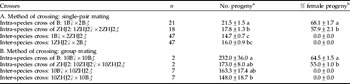
Progeny production of crossing experiments between B and ZHJ2, which belong to the Middle East-Asia Minor 1 and Asia II 1 putative species of Bemisia tabaci.

a Mean±SME number of progeny produced by each female in the four treatments of single-pair mating or mean±SME number of progeny produced by ten females in each replicate in the four treatments of group mating. For each method of crossing, means followed by different letters differ significantly at P<0.05.
b Mean±SME percentages of females in the progeny. For each method of crossing, only the two means of intra-species crossing were compared as no female progeny were produced in the two treatments of inter-species crossing, and means followed by different letters differ significantly at P<0.05.
For group mating involving B and ZHJ2, four treatments (table 1) were conducted in whitefly-proof screen cages (L55×W55×H55 cm, 100 mesh) with one cotton plant in each replicate (cage). Newly emerged adults used to initiate the crosses were introduced into the cages on the morning they emerged. Five days after the introduction of the adults into the screen cages, they were collected using a small aspirator and stored at −20°C for later RAPD-PCR identification. The plant in each cage was then moved out and placed in a new, clean cage, and all eggs deposited on the plant were allowed to develop on the plant. At a time when all the progeny were estimated to have developed to adults (about 30 days), all adult whiteflies were collected and sexed.
For crossing experiments between ZHJ1 and ZHJ2, again four treatments of single-pair mating and four treatment of group mating were performed (table 2), and the procedures followed those used above for crosses between B and ZHJ2.
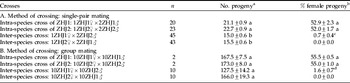
Progeny production of crossing experiments between the ZHJ1 and ZHJ2, which belong to the Asia II 2 and Asia II 1 putative species of Bemisia tabaci.

a Mean±SME number of progeny produced by each female in the four treatments of single-pair mating or mean±SME number of progeny produced by ten females in each replicate in the four treatments of group mating. For each method of crossing, means followed by different letters differ significantly at P<0.05.
b Mean±SME percentages of females in the progeny. For each method of crossing, only the two means of intra-species crossing were compared as no or very few female progeny were produced in the two treatments of inter-species crossing, and means followed by the same letters do not differ significantly at P<0.05.
c In this inter-species crossing treatment, only four of the 45 pairs produced 1–2 female progeny.
d In this inter-species crossing treatment, only four of the ten replicates produced 4–8 female progeny.
Detection and identification of F1 hybrids
When female progeny from a replicate of the between putative species crosses were found, the identity of the ‘parent’ whiteflies as well as all the hybrids was checked by RAPD-PCR. If all the female offspring possessed the bands of only one of the two putative species, then contamination was the explanation. When the bands of both parents were present, then the individual was a genuine hybrid. This procedure presented a risk of missing detection of some real hybrids when female progeny were produced in a replicate but all the females exhibited the bands of only one of the two putative species due to a partial failure in the RAPD-PCR amplification. Thus, in addition to RAPD-PCR, the identities of all females in the offspring were examined by mitochondria CO1 sequencing.
For RAPD-PCR analysis, extraction of the DNA from single individuals was carried out using the method described by De Barro & Driver (Reference De Barro and Driver1997). The RAPD-PCR assay was performed following the procedure of Zang et al. (Reference Zang, Liu, Liu and Chen2005a,Reference Zang, Liu, Liu, Ruan and Wanb, Reference Zang, Jiang, Xu, Liu and Zhang2006).
The mitochondrial CO1 region was amplified using forward primer Cl-J-2195 (5′-TTGATTTTTTGGTCATCCAGAAGT-3′) in combination with reverse primer L2-N-3014 (5′-TCCAATGCACTAATCTGCCATATTA-3′), and the PCR parameters used were those as described by Luo et al. (Reference Luo, Yao, Wang, Yan, Hu and Zang2002). The COI gene fragments were sequenced by Bioasia Bio Technologies Co. Ltd (Shanghai, China). The COI sequences obtained were edited by DNAstar software and then NCBI BLASTing (Basic Local Alignment Search Tool) was performed to analyze similarities between the newly obtained sequences and known sequences in the Nucleotide Collection database.
Data analysis
The number of progeny in the intra- and inter-putative species crossing treatments were analyzed using one-way analysis of variance (ANOVA), and when a significant effect was detected at P<0.05 level the means were compared using a LSD test. The data were tested for their normality prior to ANOVA. The sex ratios in intra-putative species crossing treatments were compared using independent samples t-test, and all proportion data were transformed by arcsine square root before the t-test. All statistical analyses were conducted using the statistical software, STATISTICA (version 6.1) (StatSoft Inc., 2003).
Results
Reciprocal crossing experiments between B and ZHJ2 biotypes
In the reciprocal crossing experiments using single-pair mating, the mean number of progeny was highest in the ‘1B♀×2B♂’ treatment, followed by ‘1ZHJ2♀×2ZHJ2♂’ and ‘1ZHJ2♀×2B♂’, and lowest in ‘1B♀×2ZHJ2♂’ (F 3,129=7.68, P<0.01). Every female in each of the two intra-putative species treatments produced female and male progeny. In contrast, no female progeny were produced in either of the inter-putative species treatments (table 1). In the two intra-putative species treatments, the percentage of B female progeny was significantly higher than that for ZHJ2 (table 1).
In the reciprocal crossing experiments using group mating, results were similar to those obtained using single-pair mating. The mean number of progeny was highest in ‘10B♀×10B♂’ treatment, followed by ‘10ZHJ2♀×10ZHJ2♂’ and ‘10B♀×10ZHJ2♂’, and lowest in ‘10ZHJ2♀×10B♂’ (F 3,13=5.15, P<0.05). Again, no female progeny were produced in either of the two inter-putative species treatments, while both female and male progeny were produced in every replicate in each of the two intra-putative species treatments (table 1). Similar to the results of single-pair mating, the percentage of B female progeny was significantly higher than that for ZHJ2 (table 1).
Reciprocal crossing experiments between ZHJ1 and ZHJ2 biotypes
In the reciprocal crossing experiments using single-pair mating, the mean numbers of progeny of the two intra-putative species treatments were significantly higher than those in the two inter-putative species treatments (F 3,127=26.23, P<0.001). Every female in each of the two intra-putative species treatments produced both female and male progeny, and the mean percentages of female progeny of ZHJ1 and ZHJ2 reached 52.9% and 52.0%, respectively. In contrast, in the 45 replicates of the inter-putative species treatment ‘ZHJ1♀×2ZHJ2♂’, only four produced 1–2 female progeny and the mean percentage of female progeny of all replicates was only 0.7%. In the reciprocal inter-putative species treatment ‘1ZHJ2♀×2ZHJ1♂’, the mean number of progeny was similar, but no female progeny were found (table 2).
In the reciprocal crossing experiments using group mating, there were no significant differences in the mean numbers of progeny produced in the various treatments (F 3,20=1.19, P=0.34). Every replicate in each of the two intra-putative species treatments produced both female and male progeny, and the percentages of female progeny of ZHJ1 and ZHJ2 reached 55.5% and 55.0%, respectively. In the ten replicates of the inter-putative species treatment ‘10ZHJ1♀×10ZHJ2♂’, four produced less than ten female progeny, and the mean percentage of female progeny of all replicates was 1.6%. In the reciprocal inter-putative species treatment, ‘10ZHJ2♀×10ZHJ1♂’, again no female progeny were produced (table 2).
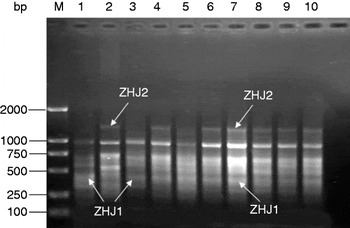
For the four replicates of the inter-putative species treatment ‘1ZHJ1♀×2ZHJ2♂’, as well as the four replicates of the inter-putative species treatment ‘10ZHJ1♀×10ZHJ2♂’ where both female and male progeny were produced, all the adults used to initiate each of the replicates were examined by RAPD-PCR. All females exhibited RAPD-PCR profiles characteristic of the ZHJ1, and all male adults exhibited RAPD-PCR profiles characteristic of ZHJ2. These results confirmed that all adults used in these replicates were from the respective putative species as designed. Of the five F1 hybrid females produced from four of 45 replicates of the ‘1ZHJ1♀×2ZHJ2♂’ cross, every individual showed RAPD-PCR profiles characteristic of both ZHJ1 and ZHJ2; of the 20 F1 hybrid females produced from four of ten replicates of the ‘10ZHJ1♀×10ZHJ2♂’ cross, 19 showed RAPD-PCR profiles characteristic of both ZHJ1 and ZHJ2 (part of the data is presented in fig. 1). In each of the replicates of the inter-species crosses where one or more female progeny was produced, hybrid females were always detected. The results of mtCO1 sequencing showed that the mtCO1 sequence of F1 hybrids were the same as their ‘mother’ ZHJ1 adults (data not shown).
RAPD-PCR profile of F1 progeny from crosses between ZHJ1 female and ZHJ2 male using primer H16. M, DNA marker DL 2,000; 1, ZHJ1 female; 2, ZHJ2 male; 3, male progeny produced in F1 generation; 4–10, female progeny produced in F1 generation. Arrows indicate the characteristic bands of ZHJ1 and ZHJ2.

Discussion
Whiteflies, including B. tabaci, are haplodiploid, producing male progeny from unfertilized eggs and female progeny from fertilized eggs (Byrne & Bellows, Reference Byrne and Bellows1991; Ruan et al., Reference Ruan, Luan, Zang and Liu2007). Reproductive compatibility between populations of B. tabaci, thus, can be examined by comparison of realized fecundity and fertility between intra- and inter-population crosses. In our experiments, no female progeny were produced in crosses between B and ZHJ2, demonstrating complete reproductive isolation (table 1). In the crosses between ZHJ1 and ZHJ2, only few female progeny were produced in one direction (ZHJ1♀×ZHJ2♂) by some of the ZHJ1 females, demonstrating a high level of reproductive incompatibility (table 2). As genome is inherited from both parents and the genes on mitochondria are maternally inherited, the RAPD-PCR profiles (fig. 1) and the CO1 sequences of F1 progeny from crosses between ZHJ1 female and ZHJ2 male indicate that these females were produced by interbreeding between the two putative species. The fertility of the F1 females was not tested. However, because the number of female progeny produced was very low in comparison to that of the intra-putative species treatments, they probably would exert only limited influence on the overall pattern of reproductive isolation between the two putative species even if they were fertile. This speculation is partially supported by the observation that no hybrids have been detected from the field samples taken from 2004–2008 in 19 locations in China where they were seen to occur sympatrically (Xu, Reference Xu2009).
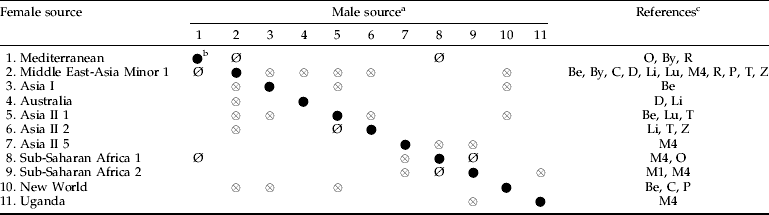
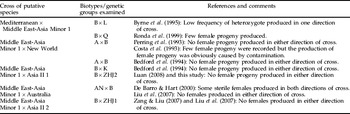
Since the early 1990s, various biochemical and molecular techniques have become available to distinguish between different B. tabaci. Table 3 summarizes the results of crossing experiments that have been reported since 1993, including the data obtained in this study. We were unable to summarize all the crossing experiments reported in the literature because, in a few cases, the reports did not provide adequate information for us to identify the putative species involved, e.g. some crosses in Maruthi et al. (Reference Maruthi, Colvin and Seal2001, Reference Maruthi, Colvin, Thwaites, Banks, Gibson and Seal2004). When the populations/biotypes/genetic groups used in the crossing experiments were grouped (on the basis of either biotype affiliation to known CO1 sequences or CO1 accession details provided in the studies) under the putative species identified by Dinsdale et al. (Reference Dinsdale, Cook, Riginos, Buckley and De Barroin press), we found that reciprocal crossing studies have been conducted among 11 of the 24 putative species (table 3). In all, reciprocal crosses included 15 inter-species combinations, of which 11 demonstrated complete reproductive isolation between species, and only four showed yet some uncertainty of reproductive isolation. We also noted that outcomes of the studies were consistent (table 4). Further, in some of the studies, reproductive isolation was confirmed using direct observations of mating behaviour. For example, the complete reproductive isolation between the Middle East-Asia Minor 1 (B) and New World (A) putative species was confirmed by the lack of between-species copulation (Perring et al., Reference Perring, Copper, Rodriguez, Farrar and Bellows1993; Perring & Symmes, Reference Perring and Symmes2006). Likewise, complete reproductive isolation between Middle East-Asia Minor 1 (B) and Australia (AN) and between Middle East-Asia Minor 1 (B) and Asia II 2 (ZHJ1) was also confirmed by the lack of copulation (Liu et al., Reference Liu, De Barro, Xu, Luan, Zang, Ruan and Wan2007), although De Barro & Hart (Reference De Barro and Hart2000) did observe very occasional production of sterile hybrid female progeny, suggesting that copulation does occasionally occur between B and AN. While the crosses that have been conducted so far account for only a proportion of all possible crosses between the 24 putative species, the overwhelming pattern is one of reproductive isolation. Taken as a whole, the data in tables 3 and 4 provide good evidence that the putative species as delineated by Dinsdale et al. (Reference Dinsdale, Cook, Riginos, Buckley and De Barroin press) are biological species.
Summary of reproductive incompatibility among 11 putative species of the Bemisia tabaci cryptic species complex from published crossing studies.
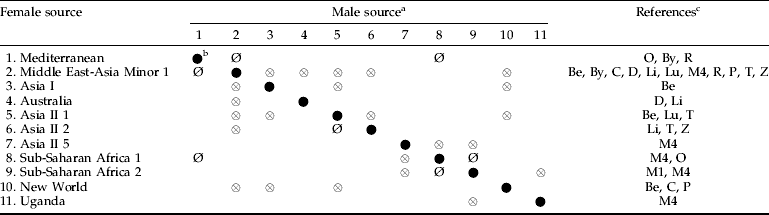
a The codes of male source correspond to those of female source listed in the first column.
b In the table, • Complete reproductive compatibility; ⊗ No reproductive compatibility; Ø Low number of F1 females produced but the fertility of F1 females have not been examined.
c In this column: Be, Bedford et al. (Reference Bedford, Briddon, Brown, Rosell and Markham1994) ; By, Byrne et al. (Reference Byrne, Cahill, Denholm and Devonshire1995) ; C, Costa et al. (Reference Costa, Brown, Sivasupramaniam and Bird1993) ; D, De Barro & Hart (Reference De Barro and Hart2000) ; Li, Liu et al. (Reference Liu, De Barro, Xu, Luan, Zang, Ruan and Wan2007) ; Lu, Luan (Reference Luan2008) ; M1, Maruthi et al. (Reference Maruthi, Colvin and Seal2001) ; M4, Maruthi et al. (Reference Maruthi, Colvin, Thwaites, Banks, Gibson and Seal2004) ; O, Omondi et al. (Reference Omondi, Sseruwagi, Obeng-Ofori, Danquah and Kyerematen2005) ; P, Perring et al. (Reference Perring, Copper, Rodriguez, Farrar and Bellows1993) ; R, Ronda et al. (Reference Ronda, Adan, Cifuentes, Cenis and Beitia1999) ; T, this study; Z, Zang & Liu (Reference Zang and Liu2007).
Details of some of the crossing experiments reported, showing the results of experiments on the same putative species by different authors.

In four of the 15 inter-species combinations, i.e. Mediterranean×Middle East-Asia Minor 1, Asia II 2×Asia II 1, Sub-Saharan Africa 1×Mediterranean and Sub-Saharan Africa 1×Sub-Saharan Africa 2, a low number of F1 female progeny were consistently produced; although, in the case of Asia II 2×Asia II 1, females were produced only in one of the two directions of the cross (tables 2 and 3). However, in all these cases, the fertility and viability of the hybrid females were not critically tested. Thus, whether these putative species are reproductively isolated or still have a low level reproductive compatibility is yet to be examined. In future crossing experiments, more effort should be devoted to examine the fertility and viability of hybrid females when they are produced.
It is well recognized that crosses under favourable laboratory conditions to test the biological species concept is a simplified reduction of the investigation because such experiments test only intrinsic barriers to reproduction (Mayr, Reference Mayr, Brenner and Miller2002; Mallet, Reference Mallet2005). In the last 100 years, many cases have been reported of sympatric species, which rarely or never interbreed in nature but are shown to be partially or even fully compatible in reproduction when kept in captivity (Wang & Dong, Reference Wang and Dong2001; Mayr, Reference Mayr, Brenner and Miller2002; Mallet, Reference Mallet2005). Thus, field investigations are necessary to help interpret the significance of low levels of laboratory-demonstrated reproductive success between putative species. Moya et al. (Reference Moya, Guirao, Cifuentes, Beitia and Cenis2001) analyzed the composition of B. tabaci populations from six locations in southern Iberian Peninsula where both the Mediterranean and Middle East-Asia Minor 1 putative species co-occurred and did not detect any hybrids, suggesting that these two putative species were genetically isolated in the field. Interestingly, the only evidence for inter-species introgression in the field comes from Delatte et al. (Reference Delatte, David, Granier, Lett, Goldbach, Peterschmitt and Reynaud2006) who detected locus-specific introgression between the closely related alien Middle East-Asia Minor 1 (B) and indigenous Indian Ocean (MS) putative species.
According to theories of speciation, reproductive isolation between two species should be more complete in areas where they are sympatric than where they are allopatric (Merrell, Reference Merrell1981). The pattern of reproductive isolation among putative species of the B. tabaci complex revealed so far does not seem to conform to this theory. In most of the crosses between allopatric species no hybrids were produced; yet, in most of the crosses between sympatric/parapatric putative species, a reduced number of F1 female progeny were produced (table 3). The pattern of reproductive isolation within the B. tabaci species complex awaits to be carefully investigated when crosses between more putative species have been conducted and the fertility of any female progeny produced has been investigated.
In our crossing experiments, inter-putative species treatments often produced significantly fewer progeny than the intra-putative species treatments (tables 1 and 2). These results were similar to De Barro & Hart (Reference De Barro and Hart2000), who observed that fewer eggs were produced by females paired with males of a different putative species. Observations of mating behaviour have demonstrated that courtship events between putative species are often frequent even where they do not copulate (Perring et al., Reference Perring, Copper, Rodriguez, Farrar and Bellows1993; Liu et al., Reference Liu, De Barro, Xu, Luan, Zang, Ruan and Wan2007; Luan, Reference Luan2008). De Barro & Hart (Reference De Barro and Hart2000) speculated that frequent courtship events between putative species would interfere with the egg-laying of females. This interference mechanism as proposed by De Barro & Hart (Reference De Barro and Hart2000) was likely to contribute to the reduction of fecundity in the inter-putative species crosses. This inference is based on the following observations: (i) Luan (Reference Luan2008) observed that, in B, ZHJ1 and ZHJ2 whiteflies, females with the presence of males of the same genetic group did not increase or decrease the number of eggs laid in the first five days post emergence, compared to that by females without males, demonstrating that insemination did not affect oviposition; and (ii) recent detailed observations showed that mating behavioural interactions between these putative species were strong and frequent (Liu et al., Reference Liu, De Barro, Xu, Luan, Zang, Ruan and Wan2007; Luan, Reference Luan2008; Luan et al., Reference Luan, Ruan, Zang and Liu2008).
In cryptic species complexes such as the B. tabaci complex, application of the biological species concept is central to the identification of species boundaries (Merrell, Reference Merrell1981; Suatoni et al., Reference Suatoni, Vicario, Rice, Snell and Caccone2006). Our study has provided strong support to the conclusion of the phylogenetic analysis by Dinsdale et al. (Reference Dinsdale, Cook, Riginos, Buckley and De Barroin press) that B. tabaci is a cryptic complex containing at least 24 cryptic species. No doubt that the validity of these putative species will be further tested by interbreeding experiments in the years to come. Correct and reliable recognition of cryptic species will greatly improve our research and management on this species complex.
Acknowledgements
Financial support for this study was provided by the National Basic Research Programme of China (2009CB119203), the National Natural Science Foundation of China (30730061) and The China National Science-Technology Support Programme (2006BAD08A18).