As I reflect on my colonial education, I cannot deny the lingering (in)visible traces of the Eurocentric models of talking, theorising and even living, which have imprinted on my intellect. This is evidenced, for example by the lifestyle that I have adopted which is very different from that of my parents or my siblings who never made it through the prescribed education system. No matter how I try to decolonise myself by reading literature that is written in African languages only, wearing African attire especially when I go to work, eat African foods only, I am still a product of Euro–Canadian–American education. There is a clear tension between my Indigenous African ways and Euro–Canadian modes of thinking (Nathani, Reference Nathani2008, p. 189).
We agree that anti-colonial critique is a fundamental beginning point for unsettling entry-level students' presuppositions about Indigenous-Western relations. However, we argue that the end-point of instating regenerated Indigenous ‘ways’ or ‘traditions’ as the counter-solution to overcoming colonial legacies occurs too hurriedly in some scholarly analysis and in lecture settings (Nakata et al., Reference Nakata, Nakata, Keech and Bolt2012, p. 121).
How can an Indigenous, African and/or Latino studies university course be taught critically in the context of a euro-anglo-centric colonial university system to address Nathani-Wane and Nakata, Nakata, Keech and Bolt's apprehensions? Conversely, and in our case, how can a decolonial Indigenous approaches to knowledge and philosophy course be taught in a colonial system without reproducing the very discourse we aim to critique? From western conceptions of archaeology and anthropology to art, from biology to engineering and so on, Indigenous knowledges and many other non-western perspectives are, in Said's (1978) terms, ‘Orientalist,’ unceasingly constructed within a system that actively discounts Indigenous knowledges, as relics from the past. How can an Indigenous Australian creative writer and a Caribbean decolonial scholar do an accurate job of navigating the complexities of teaching such an important course? Graham hails from the Kokomini nation of Northern Queensland, and Carlos is a Caribbean-Puerto Rican descendant of Indigenous Tainú-Awaraks and African Yoruba freed slaves. Beyond inviting many Indigenous knowledges speakers, something that could be misconstrued as tokenism, we felt we needed to arrive at something more decisive in order to address these questions.
This article aims to describe how we went about activating decolonial discourse and critical creative practice in order to create a space where we could meaningfully engage with Indigenous philosophy in the classroom. By showcasing our pathway, this paper explores a critical-creative pedagogical approach to teaching Indigenous and other decolonial philosophy courses in line with the literature of centring anti-colonial thought and critical race theory (Nakata et al., Reference Nakata, Nakata, Keech and Bolt2012; Gebhard, Reference Gebhard2017), while also using critical creative practice to approach Indigenous theories and western theoretical and philosophical critique on-itself. Drawing on decolonial and postcolonial theories that provide the rationale for our critique of western philosophical discourse from within, we outline the structure of our course and justify our critical creative pathway; for the purposes of this article we are intentionally conflating these vast bodies of literature for practical reasons, a nuanced elaboration of these literatures is seen, for instance in Lins-Ribeiro (Reference Lins-Ribeiro2011). Next we describe our use of art as a vehicle for our critical creative approach by providing some samples of creative craft to exemplify the tasks the students undertake as assessment for the course. Lastly, we touch on the Indigenous Australian philosophies that the students are exposed to when introduced to prominent Indigenous Australian elders-academics-philosophers. By focusing on a decolonial and critical creative approach, and then an Indigenous (or non-purely western) creative and theoretical perspective, we arrive at our goal of meaningfully engaging with decolonial and Indigenous philosophy.
It seems to us that some of the literatures in teaching Indigenous and decolonial themes and courses globally oscillate between asking very difficult questions about teaching practice and aiming to contest ongoing colonising practices within the academy. For instance, Nathani (Reference Nathani2008) insightfully reflects in her colonial education and poses some complex questions to subvert this education. In her article it is suggested that she calls for a pedagogical engagement with Indigenous African and other Indigenous knowledges, in a similar manner that we propose here; however, in this article we specifically focus on describing our teaching approach and the theoretical underpinnings that guide our paedagogy. Like us, she poses the difficult question for teaching Indigenous knowledges, ‘…as a scholar… how do I disrupt this agenda [academic practices in the context of colonisation at large] in a constructive and meaningful way?’ Furthermore, scholars like Gebhard (Reference Gebhard2017) and many others (for instance, Nakata, Reference Nakata2017) argue for a non-tokenistic approach to centring Indigenous knowledges, but one that highlights the complexities of the inequality experienced by Indigenous peoples and peoples of colour, in order to then bring about a meaningful approach to teaching Indigenous knowledges produced from the ‘global south’. Only through a powerful theoretical disruption of colonial educations can a meaningful centring of Indigenous and other southern perspectives be heard and those from the south feel welcomed within the academy.
In order to address the very important issue of the underrepresentation of Indigenous and most people of colour at universities and in order to make courses attractive and therefore inclusive (the literature supports this vastly, for instance see Sonn, Reference Sonn2008; Knaus, Reference Knaus2009; Manning, Reference Manning2012), we must not do it so ‘hurriedly,’ as Nakata, Nakata, Keech and Bolt caution. As Nakata reiterates:
By not engaging with its own theoretical limits, efforts to decolonise Indigenous knowledge production have developed a practice of skipping over the complex entanglements that constitute the myriad layers of the interface between Western and Indigenous meanings… An alternate proposition is that effective teaching strategies for the exploration of contemporary complexities are ones that provide students with more language and analytical tools for navigating, negotiation and thinking about the constraints and possibilities that are open in this challenging interface (Nakata, Reference Nakata2017, p. 4).
Therefore, in the spirit of providing more analytical and conceptual tools that we draw from decolonial and postcolonial theories, as well as providing insight into complex creative crafts and Indigenous philosophies, we aim to lead students to meaningfully engage with decolonial and Indigenous perspectives within the ‘complex entanglements’ of the university system. What follows is a description of our experience teaching Indigenous and decolonial philosophies as a response to the multiple calls to produce a properly staged critical and decolonial education.
Philosophical and theoretical framework
The conceptual approach that informed the content of the course—and arguably the architecture of our academic work—involves a double movement: one constituted by decolonial and postcolonial theory, the other founded in the practical application of theory through creative practice. Mainstream western thought and philosophy are critiqued within the context of the history of colonisation, specifically the history of epistemology in the service of colonisation. This means that on the one hand, we are informed by decolonial and postcolonial theory that diagnoses the problem of colonisation and aims to situate the course within the episteme of, in this case, Indigenous philosophy, and on the other hand, we aim to perform this within the university which is still a very powerful western colonial institution. We will intelligibly sketch this framework a little more in what follows.
Decolonial theoretical starting points
The decolonial and postcolonial conceptualisation we draw from considers the global colonisation processes, often framed as coloniality (Dussel, Reference Dussel and Lander1993; Quijano, Reference Quijano and Lander2000; Maldonado-Torres, Reference Maldonado-Torres2008; Grosfoguel, Reference Grosfoguel2011), as well as the local history of colonisation—in the case of Australia. It is also framed by a settler colonial logic initiated by the original theft of Indigenous territories by the British, justified by the legal fiction of terra nullius (Moreton-Robinson, Reference Moreton-Robinson, Ahmet, Castañeda, Fortier and Sheller2003; Watson, Reference Watson2015). The local Australian diagnosis of the historical, political, psychological and epistemic forms of colonisation has fertile conceptual grounds in settler colonial theory. Whilst Patrick Wolfe is often considered the ‘father’ of settler colonial theory, famously re-examining settler colonial processes as ‘a conceptual structure and not a historical event’ (Wolfe, Reference Wolfe2006, p. 388), a more grounded and powerful diagnosis of settler colonial processes can be found in the work of Indigenous scholar/distinguished professor, Aileen Moreton-Robinson. For instance, she writes:
This [Indigenous] ontological relationship to land is one that the nation state has sought to diminish through its social, legal and cultural practices. The nation state's land-rights regime is still premised on the legal fiction of Terra Nullius… In Australia, Indigenous subjectivity operates through a doubling of marginality and centring, which produces an incommensurate subject that negotiates and manages disruption, dislocation and proximity to whiteness. This process does not erase Indigenous ontology; this suggests that Indigenous subjectivity is processual because it represents a dialectical unity between humans and the earth. It is a state of embodiment that continues to unsettle white Australians (Moreton-Robinson, Reference Moreton-Robinson, Ahmet, Castañeda, Fortier and Sheller2003, p. 35–36).
In other words, settler colonial processes are constituted in Australia by the illegal institution of the Australian nation-state and its relationship with the ontological Indigenous relationship and ownership of their lands. Moreton-Robinson affirms that the illegal origin of Australia has not eliminated Indigenous Australian conceptions of land and subjectivity. Conversely this first or ‘original theft’ through the legal fiction of terra nullius and the incommensurability (for non-Indigenous peoples) of the Indigenous subjectivity and land as constitutive or ontological is what predicates the local colonial processes in Australia. Further Moreton-Robinson argues:
The subsequent legal regimes we all live under are outcomes of post-colonising conditions. Indigenous people's circumstances are tied to non-Indigenous migration and our dislocation is the result of our land being acquired by the new immigrants. We share this common experience as Indigenous people just as all migrants share the benefits of our dispossession… post-coloniality exists in Australia but it too is shaped by white possession (Moreton-Robinson, Reference Moreton-Robinson, Ahmet, Castañeda, Fortier and Sheller2003, p. 37).
In line, yet with more depth, Moreton-Robinson endorses Wolfe's theory about the structural character of Australian settler colonial relations, in this case predicated by race and at the same time structured by the ‘original theft’ of Indigenous lands which benefits all non-Indigenous peoples. With this said, any analysis of colonisation strikes a common chord with other first peoples; after all, the colonisation of Australia was not unique.
The global constitution of decolonial and postcolonial theory that we draw from is informed mainly by a history of colonisation that began at the end of the fifteenth and the beginning of the sixteenth centuries, and whilst postcolonial theory has a lot to contribute to this analysis, coloniality–decoloniality theory explains in more depth how colonialism has survived internationally (Quijano, Reference Quijano and Lander2000; Maldonado-Torres, Reference Maldonado-Torres2008; Grosfoguel, Reference Grosfoguel2011). This macroscopic analysis argues that the modern world's history, or the ‘World/System,’ which has been in a global historical epoch for 600 years was mostly constituted by the initial great accumulation of material and historical wealth that was gained through the colonisation of the Americas. This geopolitical phenomenon formed the class systems that were predicated on the institution of gender and racial categories, and that created a great narrative template of progress and expansion that lies at the heart of capitalism. This narrative encoded an epistemological hierarchy that valorised racialised western knowledges and overwrote non-western cultures and their worldviews (Sousa-Santos, Reference Sousa-Santos2014). Therefore, colonisation, or its more distilled conceptualisation coloniality, is described by coloniality–decoloniality theory as the triple formation of the coloniality of power, knowledge and being (Quijano, Reference Quijano and Lander2000; Castro-Gómez, Reference Castro-Gómez2007); coloniality operates simultaneously with patriarchy, capitalism and modernity at large (Quijano, Reference Quijano and Lander2000). In a sense coloniality is at the heart of colonialism and it becomes exposed with the movements for self-determination from the second half of the twentieth century on. Maldonado-Torres writes:
Coloniality is different from colonialism. Colonialism denotes a political and economic relation in which the sovereignty of a nation or a people rests on the power of another nation, which makes such nation an empire. Coloniality, instead, refers to long-standing patterns of power that emerged as a result of colonialism, but that define culture, labour, intersubjective relations and knowledge production well beyond the strict limits of colonial administrations. Thus, coloniality survives colonialism. It is maintained alive in books, in the criteria for academic performance, in cultural patterns, in common sense, in the self-image of peoples, in aspirations of self and so many other aspects of our modern experience. In a way, as modern subjects we breathe coloniality all the time and every day (Maldonado-Torres, 2007, p. 243).
Notably, for our decolonial Indigenous philosophy course, we focused on the diagnostic of the coloniality of knowledge where decolonial scholars such as Sousa-Santos coin the notion of epistemicide and call for cognitive justice: ‘A massive epistemicide has been underway for the past five centuries, whereby an immense wealth of cognitive experiences has been wasted’ (Sousa-Santos, 2014, p. 34); given that one of the ubiquitous legacies of colonialism is that there now exists a dominant intellectual tradition that is based upon an apparent universalism focusing on western-centric theories. This global cognitive injustice, contends Sousa Santos, must be addressed through an ‘intercultural dialogue’ and engagement with different knowledges: south-centric and north-centric, from all possible locations and subject positions (Sousa-Santos, 2014). Whilst focusing on knowledge, race becomes an important tool for the subalternisation of knowledges; in other words knowledges, such as Indigenous worldview perspectives, become racialised. Therefore, race in colonisation is not only an instrument of domination for the coloniality of power in politics and the coloniality of being in the subalternation of the subjectivity of racialised peoples, but also a tool that privileges and excludes knowledges from certain peoples in various disciplines such as philosophy, psychology, astronomy and so forth.
Race in coloniality–decoloniality studies becomes central (not without diverging views, see Lugones, Reference Lugones2010) to the understanding of the operation of power in coloniality or, as Quijano coins it, the colonial matrix of power. Quijano, addressing race, writes:
From the sixteenth century on, this principle has proven to be the most effective and long-lasting instrument of universal social domination, since the much older principle—gender or intersexual domination—was encroached upon by the inferior/superior racial classifications. So the conquered and dominated peoples were situated in a natural position of inferiority and, as a result, their phenotypic traits as well as their cultural features were considered inferior. In this way, race became the fundamental criterion for the distribution of the world population into ranks, places and roles in the new society's structure of power (Quijano, Reference Quijano and Lander2000, p. 535).
This racial dichotomous hierarchy of inferiority, as opposed to superiority, is what social Darwinism refers to as an ‘inequality of human races’. It is predicated by an anthropocentric approach that puts in the centre and at the top, the very culture that first colonises the Americas and then an even bigger part of the globe: western culture.
Furthermore, whilst we find the coloniality–decoloniality and postcolonial conceptualisation of race in a social Darwinist framework useful, we argue that this conceptual assumption structured in an inferiority–superiority binary doesn't sufficiently explain the way notions of race were produced hundreds of years before Darwinism and Enlightenment thinking at large (Rivera-Santana, Reference Rivera-Santana2017). Cornell West (Reference West2002) in the 1980s pointed towards the aesthetic, particularly the monstrous aesthetic character that the formation of the category of race assumed. However, West's critique does not focus on the role of western aesthetic discourse. One the other hand, Rivera-Santana (Reference Rivera-Santana2017) argues that a discourse of aesthetics, what we term ‘monstrous anthropology,’ was used to project notions of monstrosity onto Indigenous and African peoples in the Americas. We contend that the diagnosis of the phenomena of colonisation benefits not only from the critique of race produced within Social Darwinist anthropologic discourse but also within western and colonial aesthetics.
A critique of western philosophy from a decolonial standpoint
This second section presents the challenge of a decolonial critique to western knowledge, specifically a critique to philosophy, and as a form of counter-discourse and a tool for approaching Indigenous knowledges. To showcase this, we will briefly look at philosophical discourse and its capacity to address the complexities of the colonisation or coloniality of knowledge. At this point it seems to us that philosophical discourse has been unable to properly engage with colonial issues and Indigenous knowledges at large, and at times it has been the intertextual comrade of the discourse of philosophical anthropology (Nakata, Reference Nakata2007). What feature in western philosophical discourse has been problematic to account for non-western knowledges?
In Giorgio Agamben's (Reference Agamben2012) research locates the discourse of western philosophy (henceforth discourse of philosophy) dominated by Aristotelian logic, as one of two big partitions of discursive thought production (Agamben, Reference Agamben2009, Reference Agamben2012). What drives his research on the ‘archaeology of commandment’ is that Agamben argues that almost nothing has been written about commandments as a concept in philosophical texts (Agamben, Reference Agamben2009, Reference Agamben2012) and he wants to know why. Agamben finds a very probable reason why commandments are not discussed in philosophy in the very important text for western philosophy entitled ‘On Interpretation,’ by Aristotle. There, Aristotle excludes most forms of speech and discourse in philosophical thought when he distinguishes between two forms of discourse, apophantic language and non-apophantic language. Apophantic language, according to Aristotle, is the language of the logos, the revealing language of men. Apophantic logos is the language that can be either true or false. It refers to something that is real, which exists or doesn't exist. Aristotle says ‘Not every discourse is apophantic, but only the discourse in which truth and falseness are present’. For example, in prayer the language is not concerned with truthfulness or falseness, as it's also the case of the language of poetics, of narrative, or of commands. Apophantic discourse relies on statements that can be verified empirically if they are true or false; for instance, ‘I am writing this sentence’. This statement can be verified as true or false to determine its validity; however, non-apophantic discourse, such as the command, ‘Leave my land’ remains valid as a command regardless of its being obeyed or not; its validity relies on the realm of political or legal power, such as authority or the legal right to utter a command. Therefore, for Aristotle the non-apophantic discourse belongs to the realm of theology and poetics because the object of philosophy is true ‘logos’. The discipline of philosophy then mostly cares about the discourse in which utterances can be false or true; it does not care about narrative, poetics, prayer, commandments, etc.
The problem for the discourse of philosophy, particularly in Aristotelian logic, is its incapacity to engage with other discourses, particularly discourses that are not produced within western culture (Graham, Reference Graham2008) because at its heart it discards any non-apophantic language, even though most language forms and activities are non-apophantic. Furthermore, important questions can remain elusive to mainstream philosophy, according to Agamben, such as, What is prayer? What is narrative or story? What is song? These questions and others can be regarded as not the concern of western philosophy. At this point it must be evident that the decision to divide language and discourse into these big partitions is not only significant for philosophical discourse, but also very influential within western culture at large. With this in mind, non-apophantic discourse has been mainly ignored in the discourse of philosophy, and apophantic language, particularly in anthropology, determines what language accounts for knowledge and power/knowledge in the modern episteme. It seems to us that a more productive way of accounting for the colonial complexities of Australia and other countries is to engage with Indigenous knowledges through non-apophantic language, whether it is through an analysis of the pure function/operation/mechanism of the commands of a colonial state and to forge a creative counter-discourse founded in coloniality–decoloniality theory or by an even more radical engagement with the language of poetics, narrative and the arts. What would it look like to use and truly frame philosophical discourse in non-western and non-apophantic language? How would thinking framed in non-western and non-apophantic discourse, and targeting the complexities of colonial discourse, and even the layered complexities of Indigenous philosophy, look like? What are the available Indigenous non-apophantic resources that we could engage with that can guide us towards a decolonial pathway to Indigenous philosophies? In the next section, we describe creative practices that we use to expose and re-think decolonial praxis.
Art and creative writing as vehicles to Indigenous philosophies: a praxis to decolonial thinking
Indigenous Art, particularly in Australia, has been a productive space to express the complexities of contested colonial histories between non-original inhabitants and Indigenous peoples. It demonstrates their worldview divergences and convergences, as well as the contemporary Indigenous political expressions in various institutions such as universities. A contemporary example of this was ‘Courting Blakness: Recalibrating Knowledge in the Sandstone University’ which was an art exhibition displayed in the Great Court of the University of Queensland from 5 to 28 September 2014. As the title suggests, it re-examined and invited the public to re-examine, the place of Indigenous Australian knowledge production in universities, a historically colonial space adverse to the ontologies, cosmologies and epistemologies of Indigenous peoples. The exhibition was integral to our developing pedagogical practices that use art as a strategy for engagement in Indigenous issues. It served both as a site of resistance and reclamation in light of the history of colonisation in Australia and the ongoing role which the system of tertiary education—particularly the elite Group of Eight universities—plays in reinforcing those colonial epistemological values. Professor Larissa Behrendt states that:
Part of the power of the Courting Blakness project was the bringing together of the intellectual work being done within the Indigenous academy and by Indigenous visual artists, allowing conversation, meditation and reflection. At the same time, it reasserted Indigenous ownership, presence and knowledge within places that were created to reinforce power and elitism, even challenging the domain physically with installations that spoke to the surrounding space (The University of Queensland, 2015, p. 66).
The Courting Blakness exhibition was an example of how Indigenous postcolonial critique and thought can engage with art as a vehicle for reflection and reclamation of space. In a similar vein, we sought to critically and creatively work with Indigenous fine art and photography by analysing works, engaging in honest conversations, and then establishing new narratives through creative writing exercises, in order to challenge our students. By using such paedagogy to accompany Indigenous knowledges and philosophies, we intended to subvert, co-opt and challenge the dominant western worldview.
Art can be viewed as a lucid and liminal site of resistance against ongoing colonial representations and views of Indigenous Australians. Therefore, in our course, we attempted to establish an epistemological framework and site that privileges Indigenous voices by having our students engage with Indigenous art through ekphrasis. ‘Ekphrastic poetry, or poetry inspired by visual art, has a well-established history dating back to Homer's description of the Shield of Achilles in The Iliad’ (Moorman, Reference Moorman2006, p. 46). It is well documented that when students engage with writing and the visual arts they engage with diverse worldviews and different ways of knowing (Moorman, Reference Moorman2006, p. 50). There is also a precedence in using ekphrastic poetry as a learning tool:
Calling students' attention to the work of an artist seemed to put them in tune with the intentionality of the creative process. I also found that introducing ekphrastic poetry to students helped them become more observant in their reading and writing and in their study of visual images (Moorman, Reference Moorman2006, p. 50).
Through observations and conversations over diverse interpretations of art pieces, students best engaged with sometimes difficult themes. At the beginning of the course, in order to enhance their understanding of issues surrounding Indigenous subjectivity and experiences of colonisation, we developed two learning exercises. The first was a problem-based learning task that involved ekphrasis in response to and in collaboration with contemporary Indigenous art. The second was the implementation of a creative writing assessment piece, accompanied by an exegetical component that detailed engagement with the critical material that informed their creative writing practice. In the next section, we describe more closely some dimensions of these approaches in the course.
A critical creative approach: what we did
The pedagogical approach that we used, and are proposing here, was/is framed as a creative-destructive and destructive-creative approach. What is meant by this in the decolonial context is to creatively review the ways in which colonial institutions and colonising practices have been thought differently by critical scholarship such as coloniality/decoloniality, critical race and whiteness and critical Indigenous studies. The second part of the course addresses the content through a destructive creativity in which Indigenous philosophy, thought and knowledge feature in the role of protagonist through creatively destructively means—destructive to colonial western frameworks—yet simultaneously students are encouraged to engage with the colonial complexities of western thought. These complexities are mainly deployed from Indigenous worldviews to counter the dominating western worldview and, also, aim to create new forms of thinking from western and non-western views alike. The destructive creative–creative destructive character of this paedagogy not only aims to critique western thought through Indigenous art and philosophies, but it also encourages new thinking stimulated by creative means.
What follows describes the main elements of the course, not necessarily in any chronological order or order of importance. We do not claim or aim to provide a ‘procedure’ to teach critical Indigenous or any critical ethnic studies courses; if anything these dimensions might serve as a partial model that can be adapted in specific institutional, cultural and social contexts.
Framing decolonial critique
We started with a decolonial approach that aimed to de-construct, and perhaps start to destroy the colonial thinking edifice upon which the academy university is built, and we made very clear that the second phase intended to creatively re-construct a platform upon which Indigenous voices/thought could be more meaningfully engaged, so the direction of the course and the intention to critique was clear from the outset. In the very first day of class, we problematised the very architecture of The University of Queensland (UQ). We reviewed and re-examined (through an actual ‘decolonial tour’) colonising practices and imagery that are symbolically, and at times explicitly, carved in stone at the UQ main court building, and then performed an extensive review of the history of colonisation of Australia and its relationship with the global western praxis of colonisation. The overarching goal of this critical/decolonial approach (the first part of the course) was to invite the students to critically question ideas and concrete situations from a decolonial perspective and in a potentially destructive manner so Indigenous Australian perspectives and philosophies would be appreciated. Indigenous knowledges are characteristically layered with multiple meanings, and outside or diametrically opposed to western thinking schemas. The creative decolonial/destructive approach re-visits the history of western culture and its relationship with colonisation (or coloniality), capitalism, patriarchy and the formation of race.
Framing a destructive creativity: a language for decolonial and Indigenous thought
Considering the global and local colonial edifice within which the course on Indigenous philosophies was located, in particular the western language that on the one hand, Indigenous thought can be subjected to—in the discourse of philosophical anthropology, for example—and on the other hand, in the language of western philosophy (dominated by apophantic Aristotelian logic), we endeavoured to consciously use the medium of non-apophantic logos (as well as apophantic logos), to engage with Indigenous philosophies. The non-apophantic discourse (as Agamben coins this bi-polar linguistic partition) that we chose to use was creative narrative, Indigenous contemporary art and poetry. This meant that our semesters included invited speakers, as well as us, speaking about Indigenous thought expressed through creative writing, the different types of crafts of Indigenous arts, Indigenous curation of exhibitions, engagement with actual art pieces and exhibitions through the UQ Art Museum, and also required students to engage with traditional discursive or argumentative essays (using the dominating language of apophantic thinking) as well as poetry, visual analysis of art pieces and creative writing. By focusing on non-apophantic logos, we were able to use non-western media where complex Indigenous thought could be engaged with, despite its location in a (western) institution that determines what is worthy of thought, how it should be expressed, and where it is located. In other words, within non-apophantic thought space and practice we were able to better engage with the complexities of Indigenous thought in a decolonial manner.
Decolonial aesthetics in pedagogical practice
The importance of Indigenous self-representation in resistance to anthropological categorisation and documentation was a key element to our teaching, as self-representation through art production has great potential to divest the ongoing trauma and political discourses of colonial constructs. Writing in particular ‘as a medium of communication that involves the active use of imagination—on the part of the reader as well as the author—is one of the key sites at which the social order can be imaginatively examined and reshaped’ (Ehrenworth, Reference Ehrenworth2003, p. 29). By examining and reshaping classical representations of Indigenous peoples through art and written narratives, we see people, Indigenous and non-Indigenous alike, actively engaging in different perspectives and worldviews. This engagement has the potential to alter one's perceptions of the current social order.
For instance, in one of the courses, we used a contemporary Indigenous photography exhibition ‘Over the Fence,’ shown at the University of Queensland Art Museum from August 2015 through to October 2015. Photography is a powerful tool to colonise as well as to speak back to colonial, and particularly, anthropological representations and categorisations of Indigenous peoples. However, it can also be used as a powerful weapon against misrepresentation ‘because of the association of the medium with ideas of capturing reality and the presentation of authenticity, photography lends itself as the ideal platform to resolve a creative idea’ (UQ Art Museum, Reference Watson2014, p. 69). When put to use by Indigenous artists, photography can be an illuminating site of creativity and resistance.
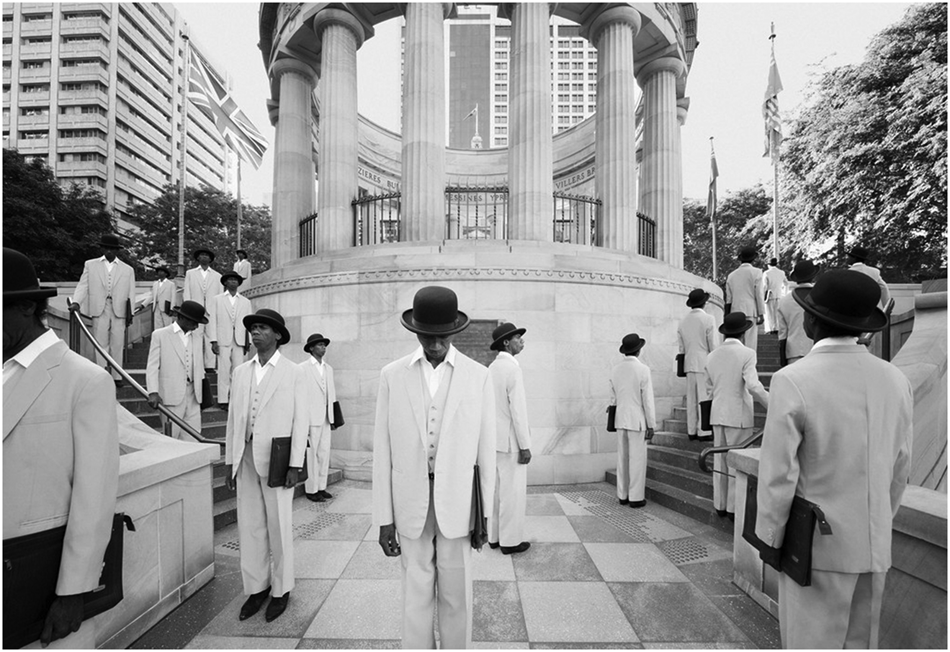
Graham was commissioned by UQ Art Museum to respond to five contemporary Indigenous photographic works using ekphrasis. The poetry was then displayed next to each art piece adding another layer of meaning. The exhibition and my involvement with the UQ art gallery was timely as it afforded us the opportunity to engage with the photographic art works as part of a problem-based learning exercise. Graham was also able to give a first-hand account of his own creative process during a guided tour of the gallery. One of the art pieces he worked with was ‘Majority Rule’ by Michael Cook (figure 1). What follows is a non-student example of what a critical creative pedagogical approach would look like. We could not include samples of student's work given that it is unethical to share student's assessments through this piece (however some went on to publish the pieces they produced in class). The teaching of this course was not a research action one, and we also critically reflected that we would not use the course for inquiry purposes because of the potentially colonising outcomes of traditional research, as decolonising researchers have stated over and over again, such as Smith (Reference Smith2000) in Decolonising Methodologies. Our course also included Indigenous students and we did not want to harvest their work and other students as ‘data’ to be displayed in any publication of ours. However, some students have submitted their creative work to other forums.
Michael Cook, Majority Rule (Memorial) 2014, inkjet print on paper. Reproduced courtesy of the artist and UQ Art Museum.

Michael Cook's photographs represent an alternative history in which Aboriginal people triumphed over colonial settlement. He asks, ‘What if things had been different?’
When the English first established their colony on the site of modern-day Sydney, the new arrivals were greatly outnumbered by the Indigenous locals. In his series ‘Majority Rule,’ Cook imagines a very different modern Australia: ‘What if Aboriginal people were 96 percent of the Australian population and white people were the four percent?’ In this world, Indigenous people comprise the majority of citizens who actively engage in contemporary city life (‘Over the Fence’ catalogue). ‘Domain’ engages with this piece:
Domain
By Graham Akhurst
Light glimmers off the opaque sandstone memorial. I sit. Open the news.
Murri Mail elicits another occurrence of White Face disturbing:
‘When will the arts sector learn…no cultural appropriation…no racial profiling…White Face shouldn't happen these days’.
There'll be a protest. No doubt.
And I, the Aboriginal, glimpse familiarity in dark faces—
majority—
I ponder the poor whites. I rallied once. Something about health. Maybe I'll give a donation, be tax deductible.
I went to high school with one—what was his name? Great at accounting, but aren't they all…
I (Graham) really wanted to play with Michael Cook's intentions for ‘Majority Rule’. Not only have I placed the word majority into the piece, but I have also tried to deepen this idea of a fictional alternate history by building a protagonist whose thought patterns are subtly racist. I thought of what it may be like for a white person in our reality. Seeing news articles that chronicle racist occurrences and what they think of as protest/art. This poem is the outcome of that thought process. (For more creative examples of ekphrasis by Graham Akhurst see ‘Over the Fence: Contemporary Indigenous Photography from the Corrigan Collection’ exhibition catalogue at the UQ Art Museum website.)
Our students engaged in a similar manner with various art works on display for the exhibition. They were then asked to present their poetry in class, as part of a problem-based learning exercise, whilst also explaining their creative process and engagement with the artwork's initial message. This prompted the students to think critically about their creative practice and artistic engagement. It is essential to note that as the majority of our students were non-Indigenous, it was important to discuss issues of cultural appropriation in artistic works. We stressed the importance of acknowledgement and understanding and being mindful of their artistic rendering and portrayal of Indigenous people and culture.
For the final assessment item, the students were required to write a 1500-word creative piece on a subject and theme of their choosing. This was to be accompanied by a 500-word exegetical component linking the critical with the creative. Although the creative piece could be in the form of fiction, creative non-fiction, or poetry, we did urged students to consider creative non-fiction as a medium. Our course does not sit within the creative writing program, which meant that predominantly, this was the students first ever creative writing assessment piece at a tertiary level, and from my own experience as a writer and teacher the clarity of novice writing is better when rendering true events rather than fictionalised ones. It was also a profound way for the students to engage with the critical material by relating it to their own social histories. We found the level of creative expression very high in response to the critical creative paedagogy in which we framed the learning experience. Then by directly linking their creative expression with their critical learning through an additional exegetical component, the students became more accountable for their creative decision-making. We also found that their critical engagement was enhanced by their creative engagement and set the conditions for students to be able to meaningfully engage with Indigenous philosophy at this point.
Indigenous knowledges: an anti-philosophy
There never was and there never will be a paradise—neither an Indigenous one, a religious or moral one, a worker's futuristic, technological, or even physical one. This is important to understand, because the hierarchical structure of many societies gives the impression that one is always on the way to some destination, to a better position, life or world. Although this is an illusion, westerners were (and still are) habituated to the notion of ‘travelling’, metaphorically, toward some great unknown where they hope that what might be waiting for them is, if not Heaven, then maybe, Happiness, Love, Security, a Theory Explaining Everything (Graham, Reference Graham2008, para 20).
The course was built towards a ‘crescendo’ that, after all the decolonial and critical work was engaged with, Indigenous thinkers would be better received. To that end, we were able to bring Indigenous intellectuals and specialists, such as Associate Professor and Aunty Mary Graham, the author of the above quote from a piece about Indigenous philosophies in Australia. We cannot reproduce nor have the authority, at any level, to convey Indigenous knowledges in this section or article at large; however, we can briefly discuss some elements that make these knowledges relevant to teaching decolonial and Indigenous study courses. For instance, the philosophical essay entitled ‘Some Thoughts about the Philosophical Underpinning of Aboriginal Worldviews’ gestures towards the central tenet of our course, that Western philosophical discourse, dominated by specific types of logics, are useful but that Indigenous Australian knowledges assume another logic that is, to an extent, counter-Aristotelian and can be claimed to be anti-philosophical. We would say that the course was a philosophy course, but more accurately more of an anti-philosophy course in its contestation of the dominating way that knowledge counts, as understood by western culture. Lectures, like the one by Associate Professor and Aunty Mary Graham, aimed to show in practice what decolonial thinking looks like in presentations. And happily students reported that they were aware of the nuances and complexities conveyed in these lectures. For instance, students readily noticed the ways in which knowledges can vary and that western knowledge or truth has a colonial legacy that is constituted by Aristotelian logic. By way of contrast, Indigenous Australian logics contested the heart of what counts for knowledge in society and particularly in universities. Graham teaches us:
Aboriginal logic is very different to Western logic. Western logic rests on the division between the self and the not-self, the external and the internal. This means that it is the viewpoint of the human individual that is taken to be the window between the external world of fact and the internal world of beliefs. Within the terms of such a division, and the ‘viewpoint’ which it produces, things can only ever appear as either true or false if they are to appear to ‘be’ at all; this is the law of the Excluded Middle… Aboriginal logic maintains that there is no division between the observing mind and anything else: there is no ‘external world’ to inhabit (Graham, Reference Graham2008, para 23–24).
This notion of the ‘One’, ‘the unitary self’ or ‘the entangled’ has certainly been present in continental, postmodern, contemporary and post-structural philosophy; however, Graham is contenting that this logic has been in Indigenous worldviews for tens of thousands of years. Whilst this is not the space to elaborate on histories of the world's philosophies, it is important to notice this feature of Indigenous Australian knowledges is just as complex as knowledge schemes articulated by well-celebrated western scholars. We do not mention this here, and we did not discuss in class that we should ‘replace’ western thinkers with Indigenous philosophies, rather we critically discussed these entangled histories to produce a complex history of thought that enables critical thinking and also creative and decolonial thinking alike.
Lastly, it is important to state that the course did not teach Indigenous knowledges, as knowledge is understood by Indigenous peoples, as universities and other western institutional practices are not the place to ‘teach’ or more specifically pass on knowledge. The course instead examines the ways to approach Indigenous knowledges through the tools of decolonial and critical creative pedagogies. This entails mapping where the course is positioned in the ‘world’—in a colonial and western university—and then enacting an advance to see knowledge production and practice differently. Indigenous knowledges and the humanistic endeavour are not too different from western universities, certainly not opposites, yet with other underlying complexities. Graham explains it better:
Over vast periods of time, Aboriginal people invested most of their creative energy in trying to understand what makes it possible for people to act purposively, or to put it another way, what is it exactly that makes us human? What Aboriginal people have done is to map the great repertoire of human feeling to such an extent that its continuities with the psychic life of the wider world become apparent; Aboriginal Law is grounded in the perception of a psychic level of natural behaviour, the behaviour of natural entities. Aboriginal people maintain that humans are not alone. They are connected and made by way of relationships with a wide range of beings, and it is thus of prime importance to maintain and strengthen these relationships (Graham, Reference Graham2008, para 21).
In this article, we have given the blueprint of a decolonial and Indigenous studies course that responds to the various calls to meaningfully engage with decolonial and Indigenous philosophies. Through a critical and creative pedagogical approach, we argue that this meaningful engagement can happen by giving special attention to decolonial and postcolonial theories, critical approaches to western perspectives from inside of a given discipline, creative craft such as contemporary art and creative writing, and Indigenous philosophies as the heart of the course. In this specific course, we re-examined global and local theories of colonisation and its decolonial views, engaged in a critique of the discourse of mainstream philosophy by including non-apophantic expressions, engaged with contemporary art and creative expressions, and produced a course capable of hearing more acutely Indigenous Australian philosophies. We view this critical theoretical and creative work as one that can inform many other teaching practices that aim to incorporate knowledges from the ‘global south’ into the colonial university framework, yet we do not think that this ‘blueprint’ can be used as a ‘recipe’, for a critical creative paedagogy needs to be tailored to a given context and to a type of knowledge. This blueprint, formed for a creative critical paedagogy for decolonial and Indigenous studies (and other southern knowledges courses), can never be a set ‘destination’ where a ‘Theory of Explaining Everything’ awaits us.
Carlos Rivera Santana is currently a research associate at Hunter College, City University of New York (CUNY) in decolonial studies, race and aesthetics. He holds a PhD from The University of Queensland, and a Masters and a Bachelors from the University of Puerto Rico. Before being a research associate at CUNY Dr. Rivera Santana was based in Australia for over seven years where he completed his PhD and was a lecturer specialising in Indigenous and postcolonial studies at The University of Queensland (UQ). His book ‘Archaeology of Colonisation: From Aesthetics to Biopolitics’ (2019) was published by Rowman & Littlefield International.
Graham Akhurst is an Aboriginal writer hailing from the Kokomini of Northern Queensland. He has an Honours degree in creative writing and an Mphil in creative writing from the University of Queensland where he was also an Associate Lecturer in Indigenous Studies. He has been published in Australia and America for poetry, short fiction, and creative non-fiction. His debut YA novel Borderland will be released in 2020 with Hachette. Graham is the recipient of the W.G. Walker Fulbright Scholar, the Nomad Two Worlds Foundation Indigenous Arts Scholarship with the American Australian Association, and an Australia Council of the Arts Professional Development award to complete an MFA in fiction at Hunter College, CUNY. He currently lives and studies in New York.