Introduction
In 2019, the Centers for Disease Control and Prevention reported that antimicrobial-resistant pathogens caused over 2.8 million infections annually, with over 1% of those infections resulting in death. 1 Antimicrobial stewardship programs (ASPs), which seek to improve the use of antibiotics as well as patient outcomes, are a key component of efforts to prevent antimicrobial resistance. Ideally, physicians and pharmacists with training in Antimicrobial Stewardship should lead ASPs but there are not enough of these experts to meet this critical need. Reference Barlam, Cosgrove and Abbo2–4 Telehealth offers a viable solution to extend the reach of professionals with training in infectious diseases (ID), including the principles of Antimicrobial Stewardship, to areas with limited access to local ID specialists. Reference Livorsi, Abdel-Massih and Crnich5 A recent survey, however, found that fewer than 1 in 8 hospitals reported providing or receiving tele-stewardship services. Reference Hawes, Greene, Ratz, Fowler, Kendall and Patel6
Previously, we described using telehealth to extend ID expertise to VA medical centers (VAMCs) without local ID consultative services. Reference Jump, Bej and Vivo7 The program consisted of regularly scheduled meetings between a multidisciplinary team at a rural VAMC with an ID-trained physician who joined by videoconference, collectively forming a Videoconference Antibiotic Stewardship Team (VAST). Based on promising outcomes from a pilot study, we disseminated VAST for implementation at additional sites across the VA. Reference Stevenson, Banks and Stryczek8 During the 15-month intervention period, eight ID consultants partnered with ten rural VAMCs to discuss clinical cases with an emphasis on the principles of Antimicrobial Stewardship. Participants indicated that the program met an important need and improved the quality of Veteran care. This manuscript expands on our previous work by describing the recommendations made during VAST sessions and the proportion accepted by clinicians at the rural VAMCs, including stratification by the clinical syndromes discussed.
Methods
Study design and data sources
From September 2021 through February 2024, ID physicians from eight VAMCs partnered with ten rural VAMCs to form Videoconference Antimicrobial Stewardship Teams (VASTs), designated VAST A-H, with rolling starts in this window. The research study period was the first 15 months of each partnership. These multidisciplinary teams typically met for an hour each week to discuss cases. Reference Jump, Bej and Vivo7 During the 15-month study period, field research assistants at each site attended VAST meetings and collected data about each case. The research team used the VA Informatics and Computing Infrastructure to access the VHA Corporate Data Warehouse (CDW) to collect demographic information about Veterans discussed during VAST sessions. The VA’s Central Institutional Review Board (IRB) approved the study protocol. This study was registered with ClinicalTrials.gov (ClinicalTrials.gov identifier: NCT05319561).
Data collection and analysis
For each case discussed, field research assistants noted the patient name, medical record number, date of birth, syndromes discussed, and recommendations made during the VAST session into a case report form (Appendix 1). Cases noted by the field research assistants for whom a corresponding record could not be found within the electronic health record (EHR) and CDW were excluded. This primarily affected cases discussed by VAST G for which the EHR system used by the rural VAMC and that of the ID physicians differed. Cases without any recommendations recorded in the case report form or documented within the EHR were also excluded. All cases underwent a second, independent review by research assistants on the core study team.
The syndromes were grouped into the following broad categories: respiratory tract; skin and skin structure; bone and joint; urinary tract; gastrointestinal; other infections; and non-infectious concerns. Individuals could have more than one syndrome. To assess the quality of care provided by the VASTs, ID physicians not associated with any of the VAST teams (JN and FP) reviewed 5% of the UTI, cellulitis, and pneumonia cases from each VAST to determine if recommendations aligned with evidence-based clinical practice guidelines for common infectious syndromes or, for cases not addressed by guidelines, with good clinical practice. Reference Stevens, Bisno and Chambers9–Reference Gupta, Hooton and Naber14
Recommendations were broadly categorized as related to antibiotics or as other recommendations. Chart review was used to determine if recommendations documented in the ID consultant note were accepted, partially accepted, not accepted, or not applicable within one week of the VAST sessions. Recommendations that could not be carried out within one week were considered accepted if a relevant order was placed, such as for a consultation request or follow-up imaging study, or if the provider caring for the patient documented acceptance in their notes. Partial acceptance involved acting upon some but not all aspects of the recommendation (e.g., a recommendation made on day 2 of a planned 14-day course was to stop antibiotics altogether; the antibiotics were stopped on day 7). Conditional “if-then” recommendations (e.g., if the culture is negative, then continue current antibiotics) and recommendations for actions not typically recorded in the EHR (e.g., patient education or supportive care) were considered unable to be assessed and categorized as not applicable. Differences between the research assistants’ assessments were resolved through discussion or, when that was not possible, through review by an ID physician (RJ or FP). For analysis purposes, we considered only fully accepted (excluding partially accepted) recommendations in the numerator. The denominator included all recommendations (i.e., accepted, partially accepted, not accepted, and not applicable).
Qualitative data and analysis
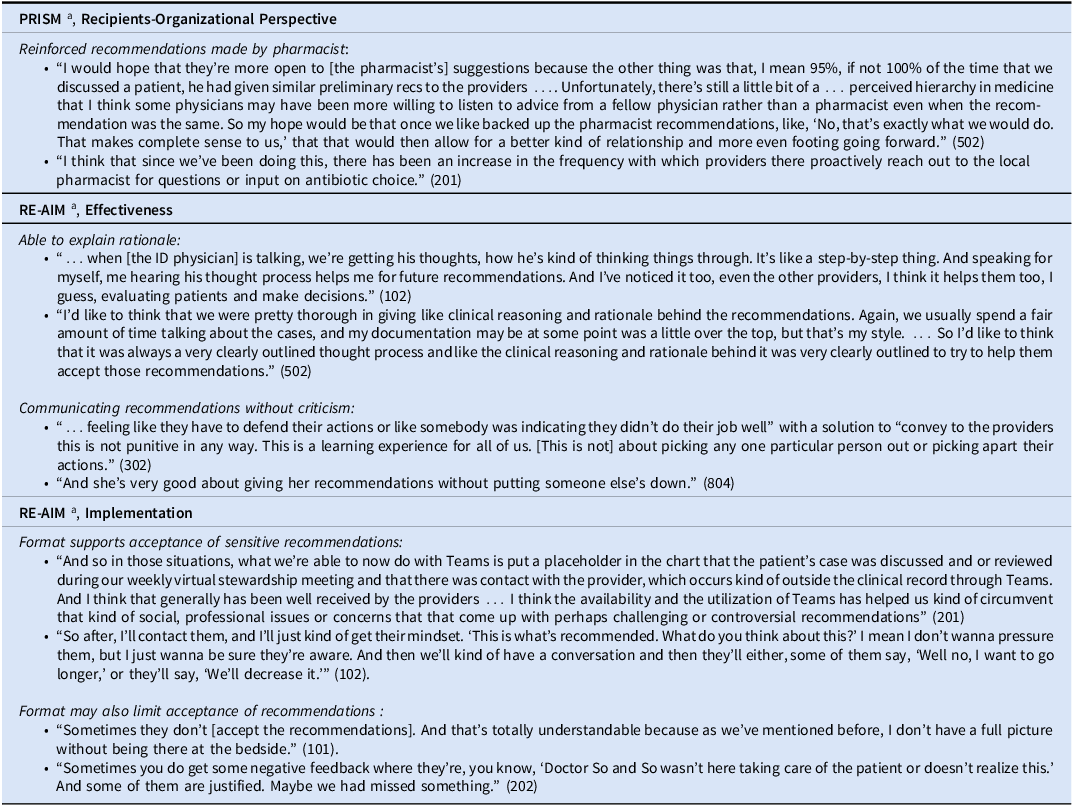
Six months after the intervention began at a given site, we conducted semi-structured interviews to assess participants’ perceptions of the VAST. All ID physicians and rural champions who were approached agreed to be interviewed (n = 24) with an average interview time of 30 minutes (range 11–57 minutes). Qualitative findings regarding the response to recommendations were considered within the Practical, Robust Implementation and Sustainability Model (PRISM) and Reach, Effectiveness, Adoption, Implementation and Maintenance (RE-AIM) frameworks, with salient themes identified as previously described. Reference Jump, Bej and Vivo7 Findings described here focus on the Recipients-Organizational Perspective of PRISM and the effectiveness and implementation elements of the RE-AIM.
Results
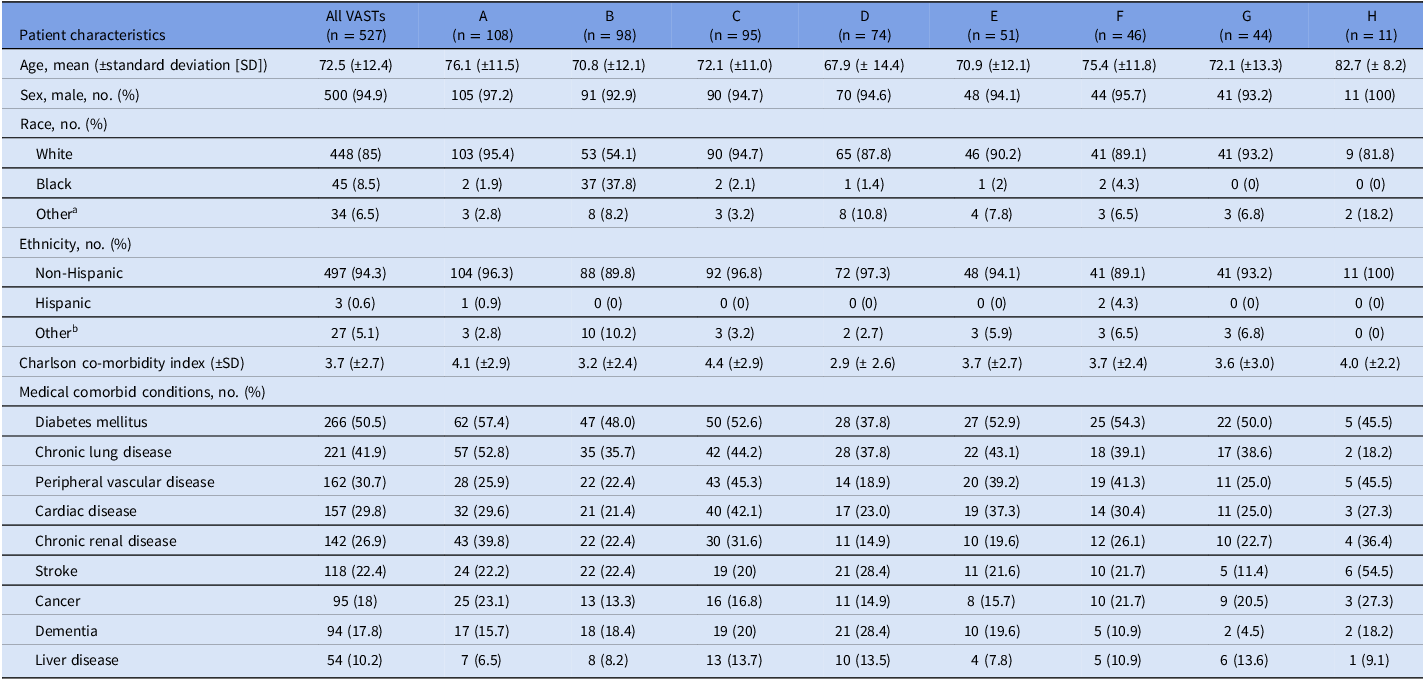
During the 15-month study window, VASTs A-H discussed 626 cases among 527 unique patients; some individuals were discussed at more than 1 session. The patients discussed were predominantly male (95%) with a mean age of 72.5 (±12.4) years (Table 1). The most prevalent medical conditions were diabetes mellitus (51%) and chronic lung disease (42%). The leading clinical syndromes addressed by the VASTs were respiratory tract (27%), urinary tract (23%), and skin and skin structure infections (18%) (Figure 1A). The specific infections discussed most frequently were pneumonia (11%), cystitis (8%), wounds (8%), cellulitis (7%), and exacerbations of chronic obstructive pulmonary disease (6%) (Table S1). Among the 5% sample (n = 31) cases reviewed for guideline-concordant recommendations (6 pneumonia, 9 skin and skin structure, and 16 urinary tract infection), 29 aligned with evidence-based guidelines or, when not applicable, good clinical practice. Expert ID reviewers noted that in the remaining two cases, which addressed cystitis and cellulitis, the ID expert provided a framework for a more judicious approach to antibiotic use and may have reflected recommendations that arose from a negotiated discussion with other team members. Among the 973 recommendations made by VASTs, 71% (692/973) of recommendations were accepted within 1 week of the VAST session (Figure 1B). VASTs A and D had the lowest overall acceptance rate for recommendations (68% and 47%, respectively); VASTs E and H had the highest (84% and 87%, respectively).
The number of clinical syndromes and recommendations made by Videoconference Antimicrobial Stewardship Teams (VASTs). A. Syndromes were grouped by organ systems involved. Other syndromes related to infectious diseases included localizing or specific clinical diagnoses (n = 48), clinical signs and symptoms (n = 57), and questions related to antibiotic use (n = 29). These are delineated further in Table S1. Individual cases could have more than one syndrome. B. One week after recommendations were made, responses were assessed and categorized as accepted, partially accepted, not accepted, or not applicable. Partial acceptance refers to adopting part but not all elements of a recommendation (e.g., in response to a recommendation to stop both antibiotics, only one was discontinued). Recommendations for actions that are not typically noted in the electronic health record were noted as not applicable (e.g., elevating legs to help reduce edema in an individual with cellulitis; reinforce hand hygiene prior to intermittent self-catheterization).

Figure 1 Long description
Panel A: A vertical bar graph shows the number of syndromes grouped by organ systems involved. The x-axis represents different VASTs labeled A through H, and the y-axis represents the number of syndromes ranging from 0 to 250. The syndromes are categorized into Respiratory Tract, Urinary Tract, Skin & Skin Structure, Bone & Joint, Gastrointestinal, Other Related to Infectious Diseases, and Other Not Related to Infectious Diseases. Each bar is segmented by these categories, showing varying numbers of syndromes for each VAST. Panel B: Another vertical bar graph displays the number of recommendations made by VASTs, categorized as Accepted, Partially Accepted, Not Accepted, and Not Applicable. The x-axis represents different VASTs labeled A through H, and the y-axis represents the number of recommendations ranging from 0 to 250. Each bar is segmented by these categories, showing varying numbers of recommendations for each VAST.
Characteristics of patients discussed by each VAST team

a Includes American Indian, Alaska Native, Asian, Native Hawaiian or Pacific Islander, multiple, and unknown.
b Includes unknown.
Overall, 570 (59%) recommendations pertained to antibiotics while 403 (41%) addressed other concerns (Table S2). Clinicians accepted 80% (457/570) of recommendations related to antibiotics compared to 58% (235/403) for other recommendations. Specific to antibiotics, recommendations to avoid starting (51/55; 93%) or to continue current antibiotics (108/118, 92%) were accepted in greater proportions than those to stop (100/126; 79%), change (169/232; 73%), or start antibiotics (26/36; 72%; Figure 2). When considered by syndrome, the proportion of antibiotic-specific recommendations accepted was highest for bone and joint (41/46, 89%) and lowest for respiratory tract infections (110/154; 71%; Figure 3, Table S3).
The proportions for the types of recommendations made and the response from clinical teams, stratified by those recommendations (A) related to antibiotics or (B) pertaining to other actions. Numbers within the bars indicate the number of recommendations within each category.

The proportion of recommendations accepted for clinical syndromes, stratified by those (A) related to antibiotics or (B) pertaining to other actions. Numbers within the bars indicate the number of recommendations within each category. The total number of recommendations shown is 950; recommendations made without an associated syndrome (n = 23) are not shown.

Figure 3 Long description
Panel A: A horizontal stacked bar chart compares the number of recommendations accepted for various clinical syndromes related to antibiotics. The horizontal axis represents the number of recommendations, while the vertical axis lists the syndromes: Respiratory Tract, Urinary Tract, Skin and Skin Structure, Bone and Joint, Gastrointestinal, and Other Syndromes. Each bar is divided into segments representing Accepted, Partially Accepted, Not Accepted, and Not Applicable recommendations. The color scheme includes blue for Accepted, light blue for Partially Accepted, gray for Not Accepted, and dark gray for Not Applicable. The Respiratory Tract has 110 Accepted, 4 Partially Accepted, 26 Not Accepted, and 14 Not Applicable recommendations. The Urinary Tract has 99 Accepted, 2 Partially Accepted, 13 Not Accepted, and 4 Not Applicable recommendations. The Skin and Skin Structure has 102 Accepted, 6 Partially Accepted, 8 Not Accepted, and 4 Not Applicable recommendations. The Bone and Joint has 41 Accepted, 3 Partially Accepted, 3 Not Accepted, and 2 Not Applicable recommendations. The Gastrointestinal has 26 Accepted, 1 Partially Accepted, 3 Not Accepted, and 2 Not Applicable recommendations. The Other Syndromes has 69 Accepted, 7 Partially Accepted, 10 Not Accepted, and 4 Not Applicable recommendations. Panel B: A horizontal stacked bar chart compares the number of recommendations accepted for various clinical syndromes pertaining to other actions. The horizontal axis represents the number of recommendations, while the vertical axis lists the syndromes: Respiratory Tract, Urinary Tract, Skin and Skin Structure, Bone and Joint, Gastrointestinal, and Other Syndromes. Each bar is divided into segments representing Accepted, Partially Accepted, Not Accepted, and Not Applicable recommendations. The color scheme includes green for Accepted, light green for Partially Accepted, white for Not Accepted, and gray for Not Applicable. The Respiratory Tract has 58 Accepted, 4 Partially Accepted, 15 Not Accepted, and 17 Not Applicable recommendations. The Urinary Tract has 36 Accepted, 2 Partially Accepted, 7 Not Accepted, and 18 Not Applicable recommendations. The Skin and Skin Structure has 44 Accepted, 3 Partially Accepted, 13 Not Accepted, and 27 Not Applicable recommendations. The Bone and Joint has 29 Accepted, 1 Partially Accepted, 7 Not Accepted, and 11 Not Applicable recommendations. The Gastrointestinal has 17 Accepted, 1 Partially Accepted, 3 Not Accepted, and 6 Not Applicable recommendations. The Other Syndromes has 47 Accepted, 2 Partially Accepted, 9 Not Accepted, and 13 Not Applicable recommendations.
Themes that emerged from the interviews using the PRISM framework highlighted the Recipients—Organization Perspective, which focuses on organizational views towards individuals (Table 2). Respondents noted preexisting barriers related to hierarchy that permeated the medical culture, specifically related to pharmacist recommendations. The ID experts providing recommendations that were the same or similar to those given preliminarily by the rural champion pharmacist may have helped some providers be more open to recommendations made by their pharmacist colleagues.
Illustrative quotations identified from the semi-structured interviews with ID consultants and rural champions

a PRISM, Practical, Robust Implementation and Sustainability Model; RE-AIM, Reach, Effectiveness, Adoption, Implementation and Maintenance.
Within the RE-AIM framework, respondents emphasized effectiveness stemming from the professional relationship between the ID consultant and rural sites. Specifically, hearing the ID physicians explain their rationale was helpful and could be used in the care of other patients. Positive communication and framing recommendations as a learning experience helped mitigate concerns that the ID consultant was criticizing providers or their clinical decisions. Some participants reported that the VAST format that provided time and means for discussion, influenced acceptance, and thus implementation, of recommendations. The collaborative nature of the VAST supported shared decision making, with one participant stating, “we would hash that out,” so the rural provider could bring up any hesitations or discomfort with recommendations and come to a consensus with the VAST team before the meeting ended. In some cases, the discussion supported better acceptance of sensitive recommendations, such as questioning if an antibiotic was necessary, which could be viewed as a critique of the provider’s diagnostic skills. Others indicated that the format imposed some limitations because the ID consultant was not at the bedside to examine or directly engage with the patients being discussed.
Discussion
For this VA-specific tele-stewardship program, providers at rural VAMCs accepted most recommendations made during VAST sessions, with greater responsiveness to those specific to antibiotics compared to other recommendations. The format of the VAST, which fostered interactive discussion, as well as hearing the rationale provided by the ID consultant, may have contributed to providers accepting recommendations. These collaborative interactions might be framed as coaching, previously reported to have a positive effect on skills, knowledge, and confidence related to Antimicrobial Stewardship. Reference Khumra, Mahony, Stewart, Bergen and Elliott16 The results indicate that VASTs have been successful in supporting Antimicrobial Stewardship activities at VAMCs that do not have ID-trained physicians or pharmacists on staff.
VASTs are one of many approaches that leverage telehealth to support Antimicrobial Stewardship activities. Designed as a provider-to-provider program, most VAST sessions were scheduled, synchronous discussions, though ad hoc and asynchronous consults also occurred. Reference Jump, Bej and Vivo7 VASTs benefited from advantages described for integrated tele-ASPs, including a local stewardship team that can engage clinicians while also accessing expertise from off-site ID consultants. Reference Kassamali Escobar and Shively15 By working within the same federal healthcare system, VASTs may have mitigated challenges that other tele-stewardship programs face around gaining clinician trust and negotiating contracts and fees.
Consistent with other tele-stewardship interventions, including our pilot study, clinicians accepted the majority of recommendations made. Reference Stevenson, Banks and Stryczek8,Reference Morquin, Ologeanu-Taddei, Koumar, Bourret and Reynes17–Reference Livorsi, Sherlock and Cunningham Goedken19 Both face-to-face communication and working in concert with local ASPs are associated with higher acceptance rates. Reference Pierce and Stevens20 Our qualitative data suggests that collaborative discussions that occurred during VAST sessions may have influenced actions taken. The difference in responsiveness to antibiotic-specific compared to other recommendations may reflect the cases selected for discussion as well as expectations from clinicians participating in VAST sessions. Recommendations that concurred with the existing approach to antibiotics, either to continue or not start antibiotics, were accepted at higher proportions compared to recommendations that called for a change, including to stop or start antibiotics. One reason for this may simply be that staying the course is inherently easier to accept compared to changing a management plan. Another intriguing possibility is that widespread efforts to promote Antimicrobial Stewardship across healthcare systems have shifted clinical practice such that Antimicrobial Stewardship principles are embedded into routine care patterns.
Considering aspects of clinical care other than antibiotics, limitations in laboratory tests, imaging modalities, and consultative services offered at the rural VAMCs may have reduced apparent responsiveness to recommendations not directly related to medications. For example, laboratory tests that are run locally at some VAMCs may be send-outs for others, which increases turnaround time with responses possibly happening after the prespecified seven-day assessment window. Potential reasons for differences in the acceptance of recommendations based on the clinical syndrome are less clear. The acuity of the infection may have influenced the response, with respiratory tract infections perceived as potentially more severe or urgent compared to bone and joint or skin and skin structure infections, which may present as more indolent problems in clinically stable patients.
Limitations
Our study has limitations. First, this work was conducted within the VHA, which has established processes for telehealth services and a robust infrastructure, including a common EHR, that supports interprofessional consultation and workload capture. This may limit generalizability to non-VA settings. Second, while the patient populations were similar among VASTs, the number of patients, types of cases discussed, and recommendations varied. These differences may reflect contextual factors that influenced local implementation for which neither our quantitative nor qualitative data accounted. Third, beyond clinical syndromes and whether recommendations were specific to antibiotics or not, we did not collect further data that might include factors associated with acceptance of recommendations. While the qualitative data yielded some insights, measuring quantitative factors associated with the response to VAST recommendations was beyond the scope of our study, designed to focus on dissemination and implementation. Finally, to account for the limitations of using chart review to determine the response to recommendations, we did not include partially accepted recommendations in the overall proportion of recommendations accepted. This conservative approach may have underestimated the proportion of recommendations accepted compared to other reports that included modified acceptances. Reference Shively, Jacobs, Moffa, Schorr and Walsh18
Conclusions
Our study can inform the implementation of telehealth to enhance ASPs in healthcare settings without local ID expertise. Integrating the off-site ID consultants into the existing ASP team can help build trust that is inherent to strong professional relationships. Prioritizing discussions about antibiotics and other medications, particularly during the early phases of implementation, may aid in building those relationships, as clinicians were generally most accepting of those recommendations. As teams become established and interactions more routine, greater familiarity with resources available locally may enhance the relevance and feasibility of non-antibiotic recommendations. Notably, the challenges specific to the VAST dyads with different EHRs underscores the importance of informatics compatibility between sites for effective telehealth implementation. Future adaptations of VASTs might consider incorporating telehealth-enabled interactions between the ID consultant and patients into some sessions, particularly for assessment of skin and skin structure concerns.
Supplementary material
The supplementary material for this article can be found at https://doi.org/10.1017/ice.2026.10443.
Acknowledgements
None.
Author contribution
Drs. Jump and Evans had full access to all of the data in the study and took responsibility for the integrity of the data and the accuracy of the data analysis.
Concept and design: Evans, Jump, Crnich, and Livorsi
Acquisition, analysis, or interpretation of data: Bej, Vivo, B. Wilson, G. Wilson, S. Song, S. Abdelrahim, Milner, Nguyen, Michaels, Beyer, Rodriguez, Amundson, Ewers, Sheeti, Tate, and Walkner
Drafting of the manuscript: Vivo, Bej, B. Wilson, Jump, and Evans
Critical revision of the manuscript for important intellectual content: All authors
Statistical analysis: Bej
Obtained funding: Jump, Evans
Administrative, technical, or material support: Kowal, Bej, Vivo, and Song
Supervision: Jump, Evans, Perez, Webster, Epstein, Sabzwari, Narayan, Livorsi, Epstein, Drekonja, Burnham, Bajema, Pfeiffer, and Rodriguez
Financial support
This work was supported by the United States (U.S.) Department of Veterans Affairs (VA) Health Systems Research Merit Award Number I01 HX003364 (RJ and CE) and Research Career Scientist RCS 20-192 (CE). It was also supported by funds and facilities provided by the TECH-Geriatric Research Education and Clinical Center (GRECC) at the VA Pittsburgh Healthcare System and the GRECC at the VA Northeast Ohio Healthcare System.
Competing interests
None of the authors has relevant conflicts of interest to disclose. RJ has received research funding from AbacusLabs, Pfizer, and Merck; she has also participated in advisory boards for Pfizer, Merck, and GlaxoSmithKline.
Role of the funder/sponsor
The funders had no role in the design and conduct of the study; collection, management, analysis, and interpretation of the data; preparation, review, or approval of the manuscript; and decision to submit the manuscript for publication.
Disclaimer
The findings and conclusions in this document are those of the authors, who are responsible for its content and do not necessarily represent the views of the VA or the US Government.