Introduction
Tropical montane ecosystems are biologically highly diverse and provide many ecosystem services to humankind (Brandon, Reference Brandon2014). Despite the significance of these ecosystems, they are being threatened by various anthropogenic and natural disturbances (Doumenge et al., Reference Doumenge, Gilmour, Perez, Blockhus, Hamilton, Juvik and Scatena1995; Cayuela et al., Reference Cayuela, Golicher, Benayas, Gonzales-Espinosa and Ramirez-Marcial2006). In particular, the predicted increase in temperature and drought makes montane ecosystems highly vulnerable to climate change (Premalal, Reference Premalal, De Costa, Nissanka, Mohotti and Weerakoon2009). Climate change may affect the regeneration of montane plant species because many of them produce seeds that require exposure to specific environmental conditions to break dormancy (Athugala et al., Reference Athugala, Jayasuriya, Gunaratne and Baskin2021).
High emphasis needs to be given to the conservation of these valuable ecosystems to preserve their ecological benefits for the future. Restoration, rehabilitation, propagation in botanical gardens and germplasm conservation through genebanks or seed banks are some of the conservation activities that can be used to conserve the species in threatened ecosystems (Maunder et al., Reference Maunder, Havens, Guerrant, Falk, Guerrant, Havens and Maunder2004; Hamilton and Hamilton, Reference Hamilton and Hamilton2006). Seed desiccation sensitivity (DS) or desiccation tolerance (DT) is one of the key determinants of seed storage behaviour. Thus, knowledge on seed DS/DT assists both in situ and ex situ conservation of plant species (Hong and Ellis, Reference Hong and Ellis1996), and this information is essential for making appropriate decisions in handling and storing seeds for conservation programmes (Chen et al., Reference Chen, Chien, Baskin and Baskin2010).
Furthermore, knowledge on the occurrence of seed DS/DT in a plant community provides insight for understanding the environmental conditions under which these seed traits have evolved (Tweddle et al., Reference Tweddle, Dickie, Baskin and Baskin2003), and it enables scientists to compare their relative importance in different ecosystems. However, much less attention has been given to seed DS and DT studies both at the species and plant-community levels compared to seed dormancy studies (Jayasuriya et al., Reference Jayasuriya, Wijetunga, Baskin and Baskin2013).
Seed storage behaviour has been defined based on the degree of DT of seeds and longevity under different storage conditions (Hong and Ellis, Reference Hong and Ellis1996; Daws et al., Reference Daws, Garwood and Pritchard2006). Roberts (Reference Roberts1973) defined two seed storage behaviour types, recalcitrant and orthodox, while a third category, intermediate storage behaviour, was defined by Ellis et al. (Reference Ellis, Hong and Roberts1990). Orthodox seeds are desiccation tolerant [i.e. from a practical point of view, they survive the reduction of seed moisture content (MC) to <10%] and can be stored for long periods of time, especially at low temperatures such as −20°C. The longevity of orthodox seeds is increased by decreasing their MC and the storage temperature. Recalcitrant seeds are desiccation sensitive, that is, they lose viability when seed MC is reduced to <15–45%, depending on the species. Recalcitrant seeds can be stored for only a short period of time. Most recalcitrant seeds, especially those of tropical species, also do not tolerate low temperatures <15°C. The only promising method for the storage of recalcitrant seeds is through cryopreservation at −197°C. Thus, sophisticated equipment is required for storing recalcitrant seeds. Furthermore, the embryonic axis of most recalcitrant seeds may not be suitable for cryopreservation, and thus the cryopreservation of other meristematic tissues is needed to conserve these species. Intermediate seeds lose viability when seed MC is reduced to <10%, and they do not tolerate storage at low temperatures <5°C (Hong and Ellis, Reference Hong and Ellis1996; Daws et al., Reference Daws, Garwood and Pritchard2006). Thus, knowledge on the level of sensitivity of seeds to desiccation is very important in determining the type of storage behaviour and thus in identifying the proper storage conditions to maintain viability (Hong and Ellis, Reference Hong and Ellis1996). Despite this need, information on seed LSDS and seed storage behaviour is available for only about 8% of the seed-producing plant species, and it is limited to only some families or genera with high economic and ecological significance (Daws et al., Reference Daws, Garwood and Pritchard2006).
According to available information, a large proportion of tropical species produces desiccation-sensitive seeds, and they are categorized as either recalcitrant or intermediate (Vazquez-Yanes and Orozco-Segovia, Reference Vazquez-Yanes, Orozco-Segovia, Bawa and Hadley1990; Daws et al., Reference Daws, Garwood and Pritchard2005; Wyse and Dickie, Reference Wyse and Dickie2017). In vegetation regions outside the tropics, as the amount of precipitation decreases, the number of species producing desiccation-sensitive seeds decreases and the number of species producing desiccation-tolerant seeds increases. The Kew seed information database (Royal Botanic Gardens Kew, 2020) lists the seed storage behaviour for 19,676 species, of which 93.9% are described as having orthodox seed storage behaviour; relatively few are described as having recalcitrant (2.8%) or intermediate (0.8%) seed storage behaviour (Hay and Probert, Reference Hay and Probert2013). Tweddle et al. (Reference Tweddle, Dickie, Baskin and Baskin2003) have analysed the seed storage behaviour data for 886 tree and shrub species belonging to 93 families in 15 different vegetation zones in the world. They reported orthodox behaviour as the most common type of storage behaviour in all ecosystems studied. They concluded that in tropical rainforests, about 47% of the species produced recalcitrant seeds, while 2% produce intermediate seeds. Daws et al. (Reference Daws, Garwood and Pritchard2006) studied the seed storage behaviour of 104 woody species from a semi-deciduous tropical forest in Panama and found that only 26% of them produced recalcitrant seeds. Although several other studies (Ng, Reference Ng1973, Reference Ng1980; Ng and Asri, Reference Ng and Asri1979) have investigated the seed storage behaviour of tropical species, they did not clearly categorize seed storage behaviour. However, based on studies of individual species, it can be suggested that species producing recalcitrant seeds occur in a variety of ecosystems throughout the world (Dickie et al., Reference Dickie, Pritchard, Black, Pritchard, Black and Pritchard2002). Thus, the objective of this research was to assess the DS/DT of 28 selected tropical montane forest species in Sri Lanka and to categorize their possible storage behaviour types.
Materials and methods
Study species
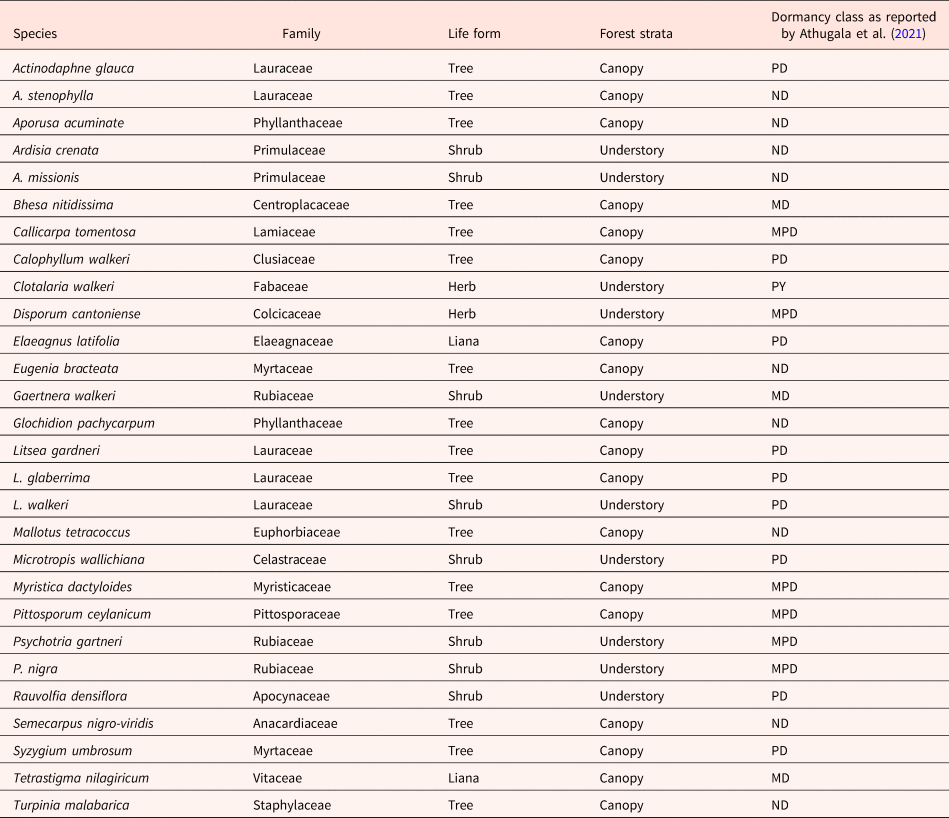
Species for this study were selected among the tropical montane species of Sri Lanka representing all montane forest strata. Species were selected based on their abundance in the montane forests and seed availability during the study period. Information about family, life form, forest strata and seed dormancy of the study species is presented in Table 1.
Family, life form, forest strata and seed dormancy of the study species

MD, morphological dormancy; MPD, morpho-physiological dormancy; ND, non-dormancy; PD, physiological dormancy; PY, physical dormancy.
Fruit/seed collection and preparation
Fruits/seeds for the experiments were collected from montane forests at Knuckles, Horton plains and Hantana in the central highlands of Sri Lanka above 1000 masl. Seeds were extracted from mature fruits, washed to remove other debris, air-dried (1–3 h at room temperatures) and stored in closed plastic bottles at ambient laboratory temperature conditions until used. Fruits were washed to remove the debris that might otherwise promote the growth of pathogens during seed incubation. Air drying was done to remove surface water from the seeds in preparation for determining their MC, which was done as soon as the seed surface appeared dried. It was assumed that air drying did not affect the internal water status of the seeds. Laboratory experiments were initiated within 3 d after seed collection.
Standard germination
Three replicates of 15 seeds each for each species were placed in 9 cm diameter Petri dishes on tissue papers moistened with water and incubated at 25°C in light/dark (14 h/10 h) conditions (hereafter light). Seeds were observed at 2-d intervals for 90 d. The emergence of the radicle to a length of 1 mm was the criterion for germination. After 90 d, non-germinated seeds were cut into halves, and the embryo was observed for viability (white-firm viable embryo vs dark soft non-viable embryo).
Thousand seed weight and seed MC
Mass of 15 seeds of each of the 28 species was measured individually before and after oven drying for 3 h at 120°C (ISTA, 2008), from which the thousand seed weight (TSW) was derived. MC is expressed on a fresh basis. Based on their initial MC, seeds were categorized into two groups: MC ≥15% as ‘high MC’ and MC <15% as ‘low MC’.
Effect of desiccation on seed germination
This experiment was conducted for 17 of the 23 species (Table 2) that produce seeds with a high MC (>15%). Three replicates of 15 seeds each were rapidly dried (within 3 d) in a silica gel desiccator until their MC was reduced to 5–10%. Then, the dried seeds were incubated on moistened tissue papers in Petri dishes in light at 25°C. Germinated seeds were counted at 2- to 3-d intervals for 90 d. At the end of the experiment, non-germinated seeds were dissected to evaluate embryo viability, as described above. Results from the standard germination tests were the control for these treatments. Germination percentages of fresh and dried seeds were compared to determine storage behaviour.
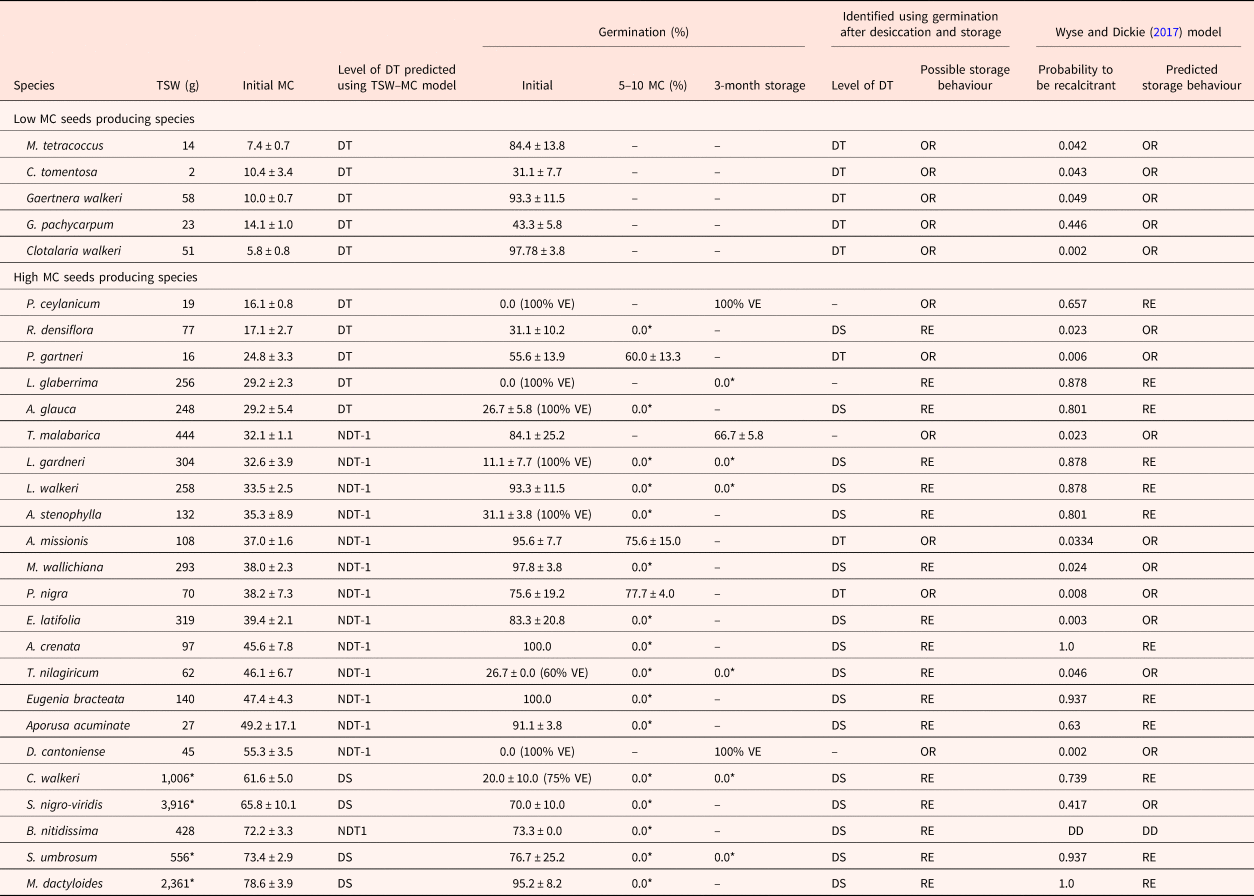
Initial MC, forest strata, life form, dormancy, percentage germination in the initial test after MC was reduced and after 3 months of storage and possible storage behaviour of 28 tropical montane forest species in Sri Lanka

The symbol ‘–' denotes that experiment was not conducted. DD, data deficient; DS, desiccation sensitive; DT, desiccation tolerant; NDT-1, non desiccation tolerant type 1; OR, orthodox storage behaviour; RE, recalcitrant storage behaviour; VE, viable embryo.
* indicate significant difference from the control p < 0.05.
Effect of storage on seed germination
This experiment was conducted for nine of the 23 species that produce seeds with a high MC (Table 2). Three replicates of 15 seeds each were stored for 3 months at their initial MC at 25°C in sealed polyethylene bags. After the storage period, three replicates of 15 seeds each for each species were incubated on moistened tissue papers in Petri dishes in light at 25°C. Germination and viability of embryo were checked, as described above. The germination of the stored seeds was compared with that of fresh seeds.
Classification of the level of DS
Using the TSW–MC method
The LSDS of all 28 species was predicted by the TSW–MC method as described by Chin et al. (Reference Chin, Hor and Lassim1984), which, Hong and Ellis (Reference Hong and Ellis1996) suggested, was a possible method to predict the seed DS. Accordingly, seeds with TSW >1000 g and MC >30% were predicted to be desiccation sensitive. Moreover, if seeds have MC >30% and TSW <500 g, they were classified as non-desiccation-tolerant type I (NDT-I) and those with MC <30% and TSW >500 g as non-desiccation-tolerant type II (NDT-II).
Using germination, seed moisture and desiccation data
If seeds had an initial MC <15% and germinated or >50% of them were viable, they were categorized as desiccation tolerant. If seeds had an initial MC ≥15%, did not germinate or had viability <25% when their MC was reduced, they were categorized as desiccation sensitive. Seed storage behaviour was predicted using the information on LSDS and the percentage of viability after 3 months of storage. Seeds were predicted to be orthodox if they were desiccation tolerant or exhibited >50% viability after 3 months of storage in sealed bags at 25°C.
Phylogenetic affiliation
The list of taxonomic names for the species used in this study was prepared as a cvs file and uploaded to the taxonomic name resolution service (Boyle et al. (Reference Boyle, Hopkins, Lu, Juan Garay, Mozzherin, Rees, Matasci, Narro, Piel, Mckay, Lowry, Freeland, Peet and Enquist2013) accessed on 17 January 2021). The taxonomic name resolution service dataset was analysed with the Wyse and Dickie (Reference Wyse and Dickie2017) model, which predicts the probability of being recalcitrant. If the probability value was ≥0.5, seeds were categorized as recalcitrant; otherwise, they were considered as orthodox.
Seed storage behaviour versus seed dormancy, life form and forest strata
Seed dormancy information for the 28 species was obtained from Athugala et al. (Reference Athugala, Jayasuriya, Gunaratne and Baskin2021), and information about forest strata and life form was taken from Dassanayake and Fosberg (Reference Dassanayake and Fossberg1980, Reference Dassanayake and Fossberg1981a, Reference Dassanayake and Fossbergb, Reference Dassanayake and Fossberg1983), and Dassanayake and Clayton (Reference Dassanayake and Clayton1997, Reference Dassanayake and Clayton1998, Reference Dassanayake and Clayton1999, Reference Dassanayake and Clayton2000). A binomial logistic regression analysis was conducted using seed storage behaviour as the response variable to determine the relationship between seed storage behaviour type and dormancy, life form and forest strata.
Data analysis
The germination percentage data were statistically analysed with the Binary Logistic Regression procedure using the Minitab 16.0 statistical software (Minitab® 16.2.3, Minitab Inc., USA). Weibull four parameter sigmoidal curves were fitted to germination time courses using the Sigmaplot 10.0 software (Sigmaplot for windows version 10.0, Dundas software Ltd, ©wpcubed GmbH, Germany) to identify the germination patterns. Means and standard deviations were calculated.
Results
Standard germination test
Twelve species had >80% germination after the 90-d period, and most of the non-germinated seeds were dead (Table 2). Four species had 70–80% germination after the 90-d period, and ≥75% of the non-germinated seeds had a white-firm viable embryo, suggesting that they were viable. Seeds of seven species germinated to 25–55% and five species to <25%. However, seeds of these 13 (7 + 5) species (Callicarpa tomentosa, Glochidion pachycarpum, Rauvolfia densiflora, Psychotria gartneri, Actinodaphne glauca, Actinodaphne stenophylla, Tetrastigma nilagiricum, Pittosporum ceylanicum, L. glaberrima, Litsea gardneri, Disporum cantoniense and Calophyllum walkeri) had a white-firm viable embryo at the end of the experiment. Only <5% of the seeds of these species died during the experiment.
TSW and seed MC
The TSW of Semecarpus nigro-viridis, Myristica dactyloides, C. walkeri and Syzygium umbrosum was >500 g, while that of the other 24 species <500 g. The highest TSW was for S. nigro-viridis (3916 g), while the lowest was for C. tomentosa (2 g). Five of the species had seeds with low MC, whereas 23 had seeds with high MC (Table 2). The lowest initial seed MC (7.4 ± 0.6%) was for Mallotus tetracoccus, and the highest MC (78.6 ± 3.8%) was for M. dactyloides.
Effect of desiccation on seed germination
Seeds of 15 species lost the ability to germinate when their MC was reduced to 5–10% (Table 2). The initial germination (95.5%) of Ardisia missionis was decreased significantly to 75% (P = 0.002, G = 9.891) as a result of desiccation. Seeds of P. gartneri (P = 0.669, G = 0.182) and P. nigra (P = 0.803, G = 0.062) germinated equally well at low MC and at their initial MC.
Effect of storage on seed germination
Seeds of T. nilagiricum, C. walker, S. umbrosum, L. glaberrima, L. gardneri and Litsea walkeri did not germinate after 3 months of storage at their initial MC; all non-germinated seeds were dead. The germination of Turpinia malabarica seeds was not significantly different (P = 0.166, G = 1.917) after 3 months of storage compared with that from the initial germination test (Table 2). Although seeds of P. ceylanicum and D. cantoniense stored for 3 months did not germinate during the 90-d germination period, their embryos were viable.
Classification of the level of DT and storage behaviour
Using the TSW–MC method
Only seeds of S. nigro-viridis, M. dactyloides, C. walkeri and S. umbrosum had TSW >500 g, and their initial MC was >30%. Thus, these four species were predicted to be desiccation sensitive. Fourteen species produced seeds with a TSW <500 g, and MC was 30%. According to the TSW–MC method, they were categorized as ‘NDT-I’ seeds. All the other species produced seeds with a TSW <500 g and MC <30% were categorized as desiccation tolerant. None of the species had seeds with TSW >500 g and MC <30%, and thus, none of them were categorized in the NDT-II category.
Using germination, moisture and desiccation data
Among the 24 study species, 8 were categorized as having desiccation-tolerant seeds, either because their initial MC was <10%, and exhibited high viability (germination + viable embryo) at this initial MC or because >75% of them germinated after desiccation (Table 2). Seeds of 16 species were identified as producing desiccation-sensitive seeds since none of the desiccated seeds were viable.
Phylogenetic affiliation
According to the Wyse and Dickie (Reference Wyse and Dickie2017) model, 15 species had <0.5 probability to be recalcitrant (Table 2). Thus, they were categorized as orthodox seeds. Twelve species were categorized as recalcitrant since they had >0.5 probability to be recalcitrant. No probability was calculated for Bhesa nitidissima since the Kew seed storage database has no reports on species phylogenetically affiliated with this species. Thus, this species was categorized as data deficient.
Seed storage behaviour versus seed dormancy, life form and forest strata
There was a significant relationship between the level of DT and forest strata in which the species occur (χ2 = 4.85, P = 0.028). A higher number of canopy than understory species produced desiccation-sensitive seeds (Table 3), but no relationship between life form (Table 3; χ2 = 4.61, P = 0.202) and the level of DT or the class of dormancy (Table 4) and the level of DT (Table 4; χ2 = 9.2, P = 0.056) was found.
Distribution of different levels of DT of seeds among life form types and forest strata

Values within the parenthesis give the number of species with corresponding storage behaviour within each life form or strata.
Distribution of different levels of DT of seeds among species having different dormancy classes

Values within the parenthesis give the number of species with corresponding storage behaviour within each life form or strata.
Discussion
This study determined the level of DT in seeds from 28 tropical montane species in Sri Lanka. The seed storage behaviour of only two of these species (Ardisia crenata and M. dactyloides) confirmed their recalcitrant behaviour as reported in the Millennium Seed Bank seed information database (Royal Botanic Gardens Kew, 2020). According to our results, 16 (61%) of 24 species produced desiccation-sensitive seeds. This observation concurs with previous surveys showing that many tropical species produce recalcitrant or intermediate seeds (Vazquez-Yanes and Orozco-Segovia, Reference Vazquez-Yanes, Orozco-Segovia, Bawa and Hadley1990; Tweddle et al., Reference Tweddle, Dickie, Baskin and Baskin2003; Daws et al., Reference Daws, Garwood and Pritchard2005).
According to the TSW–MC method (Chin et al., Reference Chin, Hor and Lassim1984), only 4 of the 28 species studied could be categorized as being desiccation sensitive. All the other seeds in our study have a TSW <500 g, and thus are not predicted to be recalcitrant according to the TSW–MC criterion. However, according to this criterion among the species having a seed TSW <500 g, 14 species were categorized as NDT-1. According to Chin et al. (Reference Chin, Hor and Lassim1984), NDT-1 are not desiccation sensitive and have an intermediate sensitivity to desiccation. When the predicted desiccation level was compared with that determined by our experiments, it was only 55% accurate. According to the prediction using phylogenetic affiliation to species with known storage behaviour, only 53% of the species were predicted to have recalcitrant storage behaviour. Since the phylogenic affiliation method of Wyse and Dickie (Reference Wyse and Dickie2017) predicted the seed storage behaviour with >75% accuracy, we recommend this method for predicting the seed storage behaviour of species where there are limited seed supplies for experiments.
The seed storage behaviour of P. ceylanicum, R. densiflora, Microtropis wallichiana, Elaeagnus latifolia, T. nilagiricum and S. nigro-viridis predicted by the phylogenetic affiliation model is different from that determined by our experiments. The storage behaviour of P. ceylanicum was determined as orthodox, while it was predicted to be recalcitrant by the phylogenetic affiliation model. However, some Pittosporum species have been reported to have orthodox seeds in the Kew seed information database (Royal Botanic Gardens Kew, 2020). According to our experiments, all the other species mentioned above were determined to have recalcitrant seeds, while the phylogenetic affiliation model predicted them to have orthodox seeds. The seed storage behaviour of none of the species of Microtropis (Celastraceae) was reported in the Kew information database, while several species of Celastraceae were reported to have orthodox seeds. Several species of Rauvolfia, Elaeagnus, Tetrastigma and Semecarpus were reported to have seeds with orthodox storage behaviour. However, most of these species were not tropical species. It has been shown that species inhabiting different habitats can have seeds with different storage behaviour types, as adaptations to their habitats (Tompsett, Reference Tompsett1983; Hong and Ellis, Reference Hong and Ellis1996; Jayasuriya et al., Reference Jayasuriya, Wijetunga, Baskin and Baskin2012). We think that similar to phylogenetic affiliation, habitat conditions also play a significant role in determining seed storage behaviour. Thus, if habitat factors could be incorporated into the phylogenetic affiliation model, higher accuracy in predicting seed storage behaviour type would result.
We found a significant relationship between forest strata and the level of DT. Most canopy species produced desiccation-sensitive seeds (Table 3). As far as we know, the relationship between forest strata and the level of DT has not been reported elsewhere. The ecological significance of this phenomenon is not clear. We speculate that canopy species have a higher chance of dispersing their seeds to a longer distance compared to understory plants because fruits of canopy species are more visible to animal dispersers. Also if wind dispersed, seeds are released from a much higher point than those of understory species (Den Ouden et al., Reference Den Ouden, Jansen, Smit, Forget, Lambert, Hulme and Vander Wall2005). Dispersal of seeds of the understory species to a long distance may require secondary means, which would require additional time between shedding and germination when conditions are favourable for seedling establishment. DT would therefore represent an adaptive strategy for long-distance dispersal for understory species. Our study included a low number of species compared to the total number of montane forest species in Sri Lanka. Thus, we cannot rule out the possibility that the relationship between DS and forest strata is fortuitous. Wyse and Dickie (Reference Wyse and Dickie2017) showed that variation in DS among angiosperms was significantly explained by phylogenetic relationships among species instead of ecological or environmental factors. Since DT is a complex trait and involves many cellular processes, phylogenetic relationships among species with DS may be related to the low probability that these complex processes would become re-established if they were ever lost from a lineage (Marques et al., Reference Marques, Buijs, Ligterink and Hilhorst2018).
Acknowledgements
We thank Dr. John B. Dickie for conducting the phylogenetic affiliation model to predict the seed storage behaviour for the study species.
Financial support
The National Foundation of Sri Lanka (Grant No. NRC 13-91) provided funding for this research.
Conflict of interest
None declared.