Introduction
The British Society of Otology stipulates that all patients undergoing tympanomastoid surgery should be assessed post-operatively for complete sensorineural hearing loss, or a ‘dead ear’, given the risk of damage to the inner ear or the stapes footplate intra-operatively.Reference Buckland, Geyer, Maleki and Mitchell1 This is typically assessed by performing Weber's test with a 512 Hz tuning fork, to ensure sound is detected in the operated ear.
Weber's test indicates a conductive hearing loss when the sound lateralises to the pathological ear; indeed, if the ear is dead, this will not be the case. It is believed that a packed external auditory canal, which thereby simulates a conductive hearing loss, will augment any vibratory stimulation and therefore the stimulus will be detected louder in the functioning ear. However, evidence to substantiate this is scarce.
Tuning forks are frequently inaccessible on hospital wards, resulting in this examination being omitted from patients’ assessment, especially if a patient is transferred back to a non-ENT ward.Reference Iacovidou, Giblett, Doshi and Jindal2 Subsequently, the patient may miss a critical window of opportunity in which the issue can potentially be mitigated.
Our objective was therefore to establish a suitable, more readily available alternative. We hypothesised that smartphone-based vibration applications can provide equivalent accuracy to tuning forks when performing Weber's test for the assessment of conductive hearing loss and inner-ear function, thus providing a reliable alternative to the tuning fork. The aim is for the application to be used clinically, following tympanomastoid surgery, to detect those patients with a profound sensorineural hearing loss, or, more frequently, a conductive loss secondary to the procedure and post-operative packing.
Materials and methods
Data were collected prospectively on 20 random lay participants with no previously diagnosed hearing impairment. A questionnaire was used to confirm that none of the participants had any subjective hearing loss, had a history of otological conditions or had undergone previous ear surgery. No formal pure tone audiogram was used to assess hearing prior to the study.
Earplugs were used to simulate a conductive hearing loss, similar to that of the packing following aural surgery. Both the right and left ears were tested with the iBrateMe© vibration application on an iPhone and with a 512 Hz tuning fork. Each device was placed in the centre of the forehead, with firm pressure to ensure adequate contact with the skin. The participant was then asked to identify in which ear the sound was perceived loudest: the right, the left or both the same. This describes Weber's test, where, in cases of a unilateral conductive hearing loss, sound will lateralise to the test ear; however, if the patient has suffered a dead ear on that side, the sound will be transmitted to the contralateral ear. The edge of the phone was cleaned with chlorhexidine 2 per cent wipes between each individual's participation, to ensure decontamination. In this study, all participants were tested by the same practitioner using the same technique, to avoid inter-rater unreliability.
The chi-square test was used for statistical analysis; the significance level was taken as p < 0.05.
Results
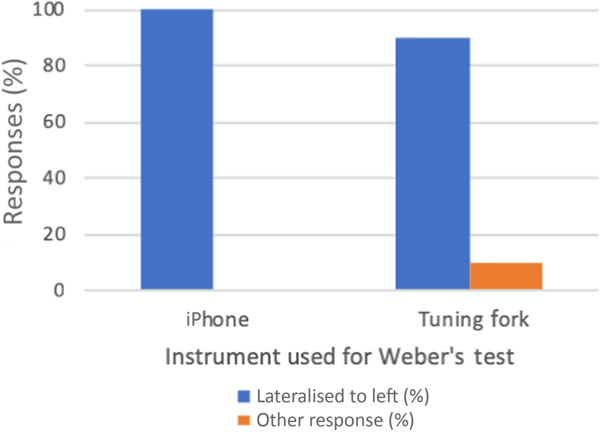
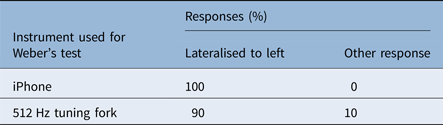
On occlusion of the left ear canal, sound from the tuning fork lateralised to the left in 18 out of 20 cases, demonstrating a sensitivity of 90 per cent. In 20 out of 20 cases, sound lateralised to the left with the iPhone application, demonstrating 100 per cent sensitivity (chi-square test, p = 0.147) (Table 1 and Figure 1).
Graph outlining subjects’ responses when the left external auditory canal was occluded and Weber's test was performed using tuning fork and iPhone.

Subjects’ responses when left ear canal was occluded

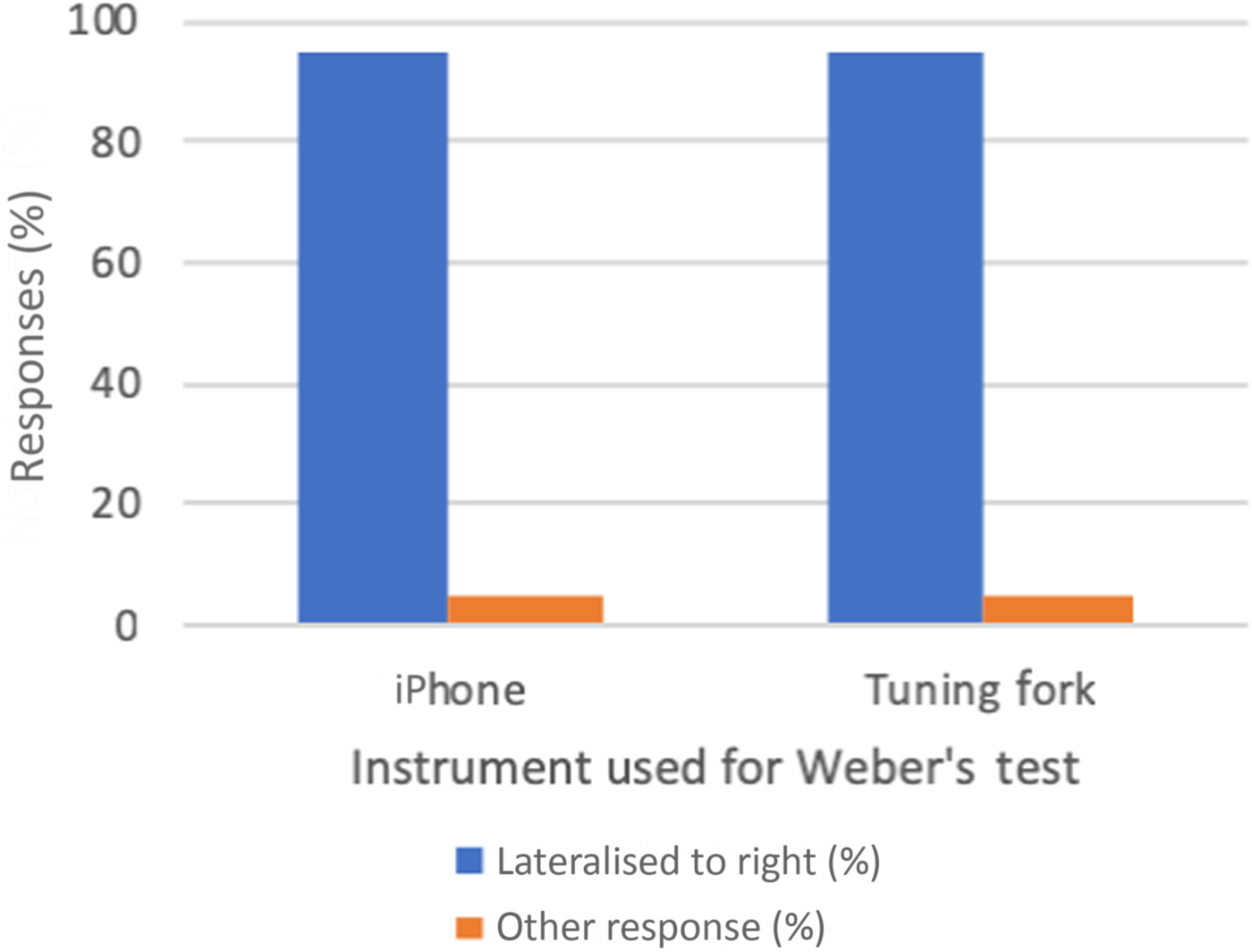
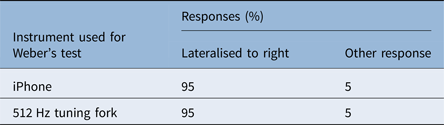
On occlusion of the right ear, sound from the tuning fork lateralised to the right in 19 out of 20 cases, demonstrating a sensitivity of 95 per cent. In 19 out of 20 tests, sound lateralised to the right with the iPhone, providing a sensitivity of 95 per cent (chi-square test, p > 0.999) (Table 2 and Figure 2).
Graph outlining subjects’ responses when the right external auditory canal was occluded and Weber's test was performed using tuning fork and iPhone.

Subjects’ responses when right ear canal was occluded

Discussion
These findings substantiate the sensitivity of Weber's test with tuning forks in determining a simple conductive hearing loss.Reference Miltenburg3 Furthermore, they demonstrate an equivalent accuracy of vibration applications built into smartphones and used for the same purpose. Regarding the benefits of this, a single smartphone may eventually be used to perform a myriad of clinical functions on the otolaryngology ward round. There is scope for practitioners to use phone torches for examining the throat and Ishihara charts for assessing colour vision, and companies such as Cellscope™ have developed otoscope attachments to allow ear examination with teaching and training potential.
The use of vibration-based applications could provide a useful adjunct and prevent the requirement for multiple pieces of kit to be carried on the ward round. With regard to test sensitivity, this paper corroborates results from other studies that found vibration detection to be a viable alternative to tuning forks, when assessing for conductive hearing loss.Reference Buckland, Geyer, Maleki and Mitchell1,Reference Iacovidou, Giblett, Doshi and Jindal2
The ‘scratch test’ has been posited and validated by Buckland et al.Reference Buckland, Geyer, Maleki and Mitchell1 and Iacovidou et al.Reference Iacovidou, Giblett, Doshi and Jindal2 The patient's head bandage is scratched in the midline, and they are asked whether they can hear it and which side is loudest. The first of these two studies demonstrated an equivalent sensitivity for the scratch test in differentiating between hearing and non-hearing ears, when compared with traditional tuning forks, with each demonstrating 100 per cent sensitivity.Reference Buckland, Geyer, Maleki and Mitchell1 The second study provided more of a clinical perspective; it demonstrated that the scratch test had 89.3 per cent sensitivity for determining the operated ear following tympanomastoid surgery, a sensitivity superior to that of the traditional Weber's test.Reference Iacovidou, Giblett, Doshi and Jindal2
One advantage of using the vibration application over the scratch test is its applicability to multiple clinical situations where the aim is to establish conductive hearing loss. The scratch test requires a head bandage for vibration transmission and is therefore limited to post-operative cases.
One limitation of this study is that we used healthy subjects with presumed normal hearing. In reality, many patients have underlying conditions that affect hearing, which can have implications for the accuracy of tuning fork examinations.Reference Miltenburg3,Reference Stankiewicz and Mowry4 Given the lack of formal audiometric assessment in this study, it may transpire that some subjects have mild hearing loss. This would adversely impact the reliability of tuning fork tests, as the undiagnosed hearing loss may be detected. Moreover, power calculations reveal this study to be underpowered, consequently increasing the risk of a type II statistical error. Further work is required, utilising an adequate sample size. Nevertheless, the initial results are encouraging.
Conclusion
Smartphone-based vibration applications represent a viable, more accessible alternative to tuning forks when using Weber's test to assess for conductive hearing loss. By extension, they may be useful in assessing patients following tympanomastoid surgery, to confirm whether a dead ear is present. This is a simulated trial; the next stage will involve transferring this technique to post-operative patients, to determine whether our results can be substantiated in clinical practice.
Acknowledgement
The authors would like to acknowledge and thank all the individuals who agreed to participate in the study.
Competing interests
None declared