Background
Congenital heart disease is the most common cause of acute renal failure in infants.Reference Moghal, Brocklebank and Meadow1 Acute renal injury after cardiac surgery is a serious adverse event which can significantly impact patient morbidity and mortality. It is also a costly complication resulting in increased intensive care unit and overall length of stay and expenditure of additional resources.
The physiological stress of surgery causes a decrease in renal blood flow, a decrease in the glomerular filtration rate, vasopressin release resulting in fluid accumulation, and a shift of blood flow from the renal cortex to the medulla. Aldosterone production and the fractional excretion of sodium are increased as well. In addition to these events that result from any major operation, there are additional stressors specific to cardiac surgery. The duration of cardiopulmonary bypass is a risk factor for renal dysfunction. Hypothermia causes a decrease in renal blood flow.
Although renal dysfunction and renal failure are known risks of congenital cardiac surgery, accurate estimates of the incidences of these complications are limited. This is in part due to the lack of uniform definitions.Reference Bellomo, Kellum and Ronco2–Reference Bellomo, Ronco and Kellum4 The Multi-Societal Database Committee for Pediatric and Congenital Heart Disease chose to address this issue by convening a multidisciplinary group to review existing definitions and propose consensus definitions for renal complications following congenital cardiac surgery.Reference Jacobs5
Consensus definitions
Numerous definitions and an assortment of terminology for renal failure and renal dysfunction have been proposed.Reference Bellomo, Kellum and Ronco2–Reference Bellomo, Ronco and Kellum4 Professional organizations and governmental agencies use a variety of definitions for coding the adverse event of acute renal injury after cardiac surgery. As the initial part of the process of creating the definitions proposed in this manuscript, a number of these definitions were reviewed.
The Society of Thoracic Surgeons maintains voluntary national clinical databases for the purposes of supporting national, regional, and local quality improvement efforts as well as research. The Society of Thoracic Surgeons Congenital Cardiac Database version 2.50 currently has two defined complications for renal failure and no defined complications for renal dysfunction. Acute renal failure requiring temporary dialysis is defined as “New postoperative need for temporary dialysis. This includes peritoneal and/or hemodialysis.” Acute renal failure requiring permanent dialysis is defined as “New postoperative need for permanent dialysis.”6 The Society of Thoracic Surgeons Adult Cardiac Database defines renal failure as acute or worsening renal failure resulting in an “increase of serum creatinine to greater than 2.0 milligrams/decilitre and 2 times greater than the most recent preoperative creatinine level” and/or “a new requirement of dialysis postoperatively.”7
The American College of Cardiology National Cardiovascular Data Registry defines the complication of renal failure as “acute or worsening renal failure during the cath lab visit or after lab visit until discharge (or before any subsequent visits) resulting in one or more of the following: 1. Increase in serum creatinine to greater than 2.0 milligrams/decilitre and two times the baseline creatinine level, 2. A new requirement for dialysis.”8
The American College of Surgeons National Surgical Quality Improvement Program defines progressive renal insufficiency as “The reduced capacity of the kidney to perform its function as evidenced by a rise in creatinine of greater than 2.0 milligrams/decilitre from preoperative value, but with no requirement for dialysis.” Acute renal failure requiring dialysis is defined as “In a patient who did not require dialysis preoperatively, worsening of renal dysfunction postoperatively requiring hemodialysis, peritoneal dialysis, hemofiltration, hemodiafiltration, or ultrafiltration.” The complication is to be coded even if the patient required dialysis, but the treatment was not instituted due to patient refusal.9
The Acute Dialysis Quality Initiative (www.adqi.net) group, an interdisciplinary collaboration, has defined the range of acute renal dysfunction using the so called “RIFLE classification system”, which defines three grades of increasing severity of acute renal dysfunction and two outcomes:
• Risk (R) – 1.5 fold increase in serum creatinine, greater than 25% decrease in glomerular filtration rate, or urine output of less than 0.5 millilitres/kilogram/hour for 6 hours
• Injury (I) – 2 fold increase in serum creatinine, greater than 50% decrease in glomerular filtration rate, or urine output of less than 0.5 millilitres/kilogram/hour for 12 hours
• Failure (F) – 3 fold increase in serum creatinine, serum creatinine of greater than 4 milligrams/decilitre, greater than 75% decrease in glomerular filtration rate, urine output of less than 0.3 millilitres/kilogram/hour for 24 hours, or anuria for 12 hours
• Loss (L) – persistent acute renal failure defined as the need for renal replacement therapy for greater than 4 weeks
• End stage renal disease (E) – need for renal replacement therapy for more than 3 months.Reference Bellomo, Ronco and Kellum4
The MultiSocietal Database Committee for Pediatric and Congenital Heart Disease has divided renal complications into two general categories: renal dysfunction and renal failure. To differentiate these conditions from pre-existing renal dysfunction and failure, the definitions specify that the complications of acute renal dysfunction and acute renal failure are of new onset, in the time interval defined as the “operative or procedural time interval” as used to track operative or procedural morbidity.Reference Jacobs, Jacobs and Mavroudis10 “An operative or procedural complication is any complication, regardless of cause, occurring (1) within 30 days after surgery or intervention in or out of the hospital, or (2) after 30 days during the same hospitalization subsequent to the operation or intervention. Operative and procedural complications include both intraoperative/intraprocedural complications and postoperative/postprocedural complications in this time interval.”Reference Jacobs, Jacobs and Mavroudis10
The MultiSocietal Database Committee for Pediatric and Congenital Heart Disease offers the following definitions for acute renal dysfunction and acute renal failure:
“Acute renal dysfunction is defined as the new onset oliguria with sustained urine output < 0.5 cc/kg/hr for 24 hours and/or a rise in creatinine > 1.5 times upper limits of normal for age (or twice the most recent preoperative/preprocedural values if these are available), with eventual recovery of renal function without needing dialysis (including peritoneal dialysis and/or hemodialysis) or hemofiltration. Acute renal dysfunction that will be counted as an operative or procedural complication must occur prior to hospital discharge or after hospital discharge but within 30 days of the procedure. (An operative or procedural complication is any complication, regardless of cause, occurring (1) within 30 days after surgery or intervention in or out of the hospital, or (2) after 30 days during the same hospitalization subsequent to the operation or intervention. Operative and procedural complications include both intraoperative/intraprocedural complications and postoperative/postprocedural complications in this time interval.)”
“Acute renal failure is defined as new onset oliguria with sustained urine output < 0.5 cc/kg/hr for 24 hours and/or a rise in creatinine > 1.5 times upper limits of normal for age (or twice the most recent preoperative/preprocedural values if these are available), with eventual need for dialysis (including peritoneal dialysis and/or hemodialysis) or hemofiltration. Acute renal failure that will be counted as an operative or procedural complication must occur prior to hospital discharge or after hospital discharge but within 30 days of the procedure. (An operative or procedural complication is any complication, regardless of cause, occurring (1) within 30 days after surgery or intervention in or out of the hospital, or (2) after 30 days during the same hospitalization subsequent to the operation or intervention. Operative and procedural complications include both intraoperative/intraprocedural complications and postoperative/postprocedural complications in this time interval.) The complication is to be coded even if the patient required dialysis, but the treatment was not instituted due to patient or family refusal.”
Thus, renal dysfunction refers to transient azotemia and transient oliguria not requiring dialysis or haemofiltration. Renal failure includes acute renal failure requiring temporary haemofiltration, temporary dialysis or permanent dialysis. Urine output amounts and increases in laboratory values, such as creatinine, have been indexed to body mass in order to accommodate the age and size range of the congenital cardiac population.
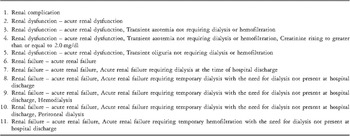
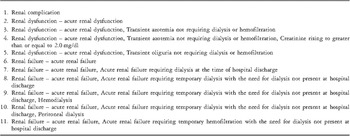
Table 1 presents the terms in the final list of renal complications developed by The MultiSocietal Database Committee for Pediatric and Congenital Heart Disease. These terms in the final list are all also listed in Part 4 of this Supplement with their official definitions.
The final list of renal complications. Precise definitions for these complications are given in Part 4 of the Supplement.
Interaction with the cardiac system
Renal complications following congenital cardiac surgery may be primary in nature; however, commonly they are secondary to cardiac complications. Low cardiac output and cardiac arrest can result in acute renal dysfunction or failure. In addition, intravenous medications such as inotropes and oral medications such as acetylcholinesterase inhibitors and cyclosporine, which may be necessary to improve or maintain cardiac function, can have deleterious renal consequences. Mechanical support such as ventricular assist devices and extracorporeal membrane oxygenation may improve renal function by augmenting cardiac output; however, their use may be accompanied by renal injury as well. The proposed definitions do not distinguish the cause of renal injury, but instead are meant to standardize reporting of the end result.
Discussion
The proposed definitions for renal dysfunction and renal failure after congenital cardiac surgery are the result of the effort of a multidisciplinary group of experts representing the various specialties and professions involved in the care of congenital cardiac patients. They are meant to be complex enough to differentiate between gradations of acute renal injury than may result in different morbidity, mortality, and resource utilization, yet simple enough to be used in the daily collection of data by trained personnel. Further research will need to be done to validate these definitions and determine their utility in achieving the desired goals.
Acknowledgement
We thank The Children’s Heart Foundation (http://www.childrensheartfoundation.org/) for financial support of this research.