Introduction
Phonosurgical vocal fold augmentation has become increasingly popular for voice rehabilitation. In 1915, Professor Erwin Payr described the first external approach vocal fold medialisation procedure, after noting that a young soldier with dysphonia following thyroidectomy had significant voice improvement with compression of the elastic thyroid cartilage. Payr designed a trapdoor procedure of the thyroid cartilage which forced the paralysed vocal fold medially, effecting better approximation and vocal restoration.Reference Payr1
Modern day thyroplasty surgery was first developed and categorised by Professor Nobuhiko Isshiki in the 1970s. Isshiki and colleagues described four types of thyroplasty: lateral compression (type one), lateral expansion (type two), shortening (type three) and lengthening (type four). When describing type one thyroplasty, Isshiki et al. stated that ‘complications such as stridor or dyspnoea were nil’.Reference Isshiki, Okamura and Ishikawa2
Thirty years on, and with the addition of arytenoid fixation and adduction to the laryngologists' arsenal, several authors have published their series and complication rates. Some series have reported no airway compromise with type one thyroplasty alone.Reference Netterville, Stone, Luken, Civantos and Ossoff3–Reference Tucker, Wanamaker, Martin and Douglas7
This study reviews the senior author's experience with complications following type one thyroplasty (without arytenoid involvement) and investigates whether day-case surgery is a possibility in these patients.
Patients and methods
A database was created, into which were entered data for all patients who had undergone external approach vocal fold medialisation laryngeal framework surgery between April 2003 and April 2006 at the Royal Sussex County Hospital, Brighton. Only patients who had undergone type one thyroplasty without arytenoid surgery were included. The following data were documented: patient demographics, aetiology and side of vocal fold pathology, presenting symptoms, previous phonosurgical procedures, post-operative outcome, short and long term complications, and follow-up period. Subjective patient assessment included factual history, VHI 10 (Voice Handicap Index 10) score, physical examination, and either rigid or flexible fibre-optic laryngoscopy. A pre-operative estimation of the glottic gap between the two true vocal folds at the posterior commissure was made.
The authors performed type one thyroplasty as follows. Intravenous sedation was achieved using a mixture of 50 ml 1 per cent propofol, 1 mg alfentanyl and 50 mg ketamine, delivered via a target-controlled infusion pump at 2 µg/ml. Adequate sedation was signalled by the onset of ptosis and monitored using phonatory feedback. Oxygen was delivered by nasal cannulae with CO2 monitoring. When sedated, 5 ml 1 per cent lidocaine was infiltrated into the dermis overlying the thyroid lamina on the side of the affected vocal fold. Local anaesthetic was then infiltrated through the platysma to anaesthetise the underlying strap muscles. The surgical field was prepared with a betadine solution and the patient was draped, leaving the head uncovered. An incision was made in a skin crease overlying the lower third of the thyroid lamina. Inferior and superior subplatysmal flaps were elevated to expose the underlying strap muscles. These were separated in the midline to expose the thyroid lamina. The inferior and superior borders of the cartilage were identified, and the upper margin of the cartilaginous window was incised using a sharpened Freer's elevator or an otological burr. The cartilaginous incision was made, halfway between the superior thyroid notch and the lower border of the thyroid cartilage, in line with the lower border. The critical point was measured using either a male or female thyroplasty pitchfork. The thyrotomy window was excised, preserving the inner perichondrium, and a pocket was created between the inner perichondrium and the inner thyroid cartilage, ensuring that the larynx was not breached. An individually sized implant was fashioned from a Silastic block with a ‘keel’ and wedged into position, medialising the anterior two-thirds of the vocal fold. Implant size and position were altered according to the quality of live phonatory feedback. As the patient was conscious, they were able to judge their own voice quality intra-operatively. Occasionally, a flexible laryngoscope could be passed to check the position of the medialised fold; however, we did not perform this routinely. An implant which was too large, leading to airway compromise, could be identified immediately using this local anaesthetic technique. Meticulous haemostasis was ensured, and the strap muscles were approximated with absorbable sutures. The skin was closed with interrupted prolene. The authors did not routinely place a drain or use steroids or antibiotics.
Results
Fifty-seven patients who had undergone type one (lateral compression) thyroplasty were identified from theatre lists, the patient administration system and speech and language therapy files. The mean patient age was 62 years and there was a male predominance (65 per cent). The majority of patients underwent left-sided thyroplasty (74 per cent), as expected due to the intrathoracic course of the left recurrent laryngeal nerve and the large number of patients with unilateral vocal fold paralysis secondary to intrathoracic malignancy. We noticed an increase in the number of patients with right-sided paralysis following cervical spine surgery, which is becoming more popular and involves an orthopaedic approach through the right side of the neck.
Discussion
Over the past three decades, there has been a steady reduction in the average length of in-patient stay for all surgical patients, including those undergoing ENT procedures. Consequently, the proportion of day surgery to in-patient surgery has increased. Politicians are aware of this and, conscious of pressures on public spending, have incorporated day-case treatment centres as part of their health strategy. In a 1993 press release (Department of Health H93/977), the Chief Medical Officer set a target of 50 per cent day surgery by the year 2000, following recommendations from the Royal College of Surgeons of England laid out in Guidelines for Day Surgery.8 This target was reached, and in the National Health Service plan of 2000 (published by the Department of Health), a new target of 75 per cent was set.
The Royal College of Surgeons of England publication Guidelines on Day Surgery recommends an admission rate of not more than two to three per cent for any specified day-case operation.8
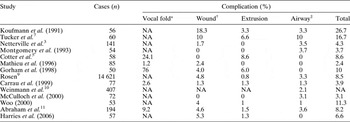
Airway compromise after phonosurgery is uncommon. Several authors have reported no airway complications in their series.Reference Netterville, Stone, Luken, Civantos and Ossoff3–Reference Isshiki, Shoji, Kojima and Hirano6 Tucker et al. reported six cases of airway obstruction requiring tracheostomy, all as a result of post-operative haematoma following type one thyroplasty. These authors suggested that all patients be observed routinely for at least one night after surgery.Reference Rosen9
Rosen conducted a postal questionnaire survey of members of the American Academy of Otolaryngology – Head and Neck Surgery. Despite the bias and limitations inherent in these types of studies (not least a 33 per cent response rate), they found that ‘…airway complications requiring intervention occurred more frequently after arytenoid adduction than medialisation laryngoplasty’. The reported tracheostomy rates were 1.7 and 0.35 per cent, respectively. A statistically significant increase in complication rate was seen for surgeons who performed less than two procedures per year or who had a total career experience of less than 10 cases.Reference Rosen9 This observation strengthens the case for specialised, multidisciplinary phonosurgical centres in the UK, similar to the model for head and neck cancer.
Published Complications Following Laryngeal Framework Surgery

Data are shown in comparison with other series. *Limited to transient oedema. †Haematoma, seroma or localised sepsis. ‡Significant respiratory distress requiring hospital admission or tracheostomy. NA = not assessed
• Isshiki type one medialisation thyroplasty is an accepted treatment for a unilateral immobile vocal fold
• The objective of this study was to assess the incidence and timing of post-operative complications and to evaluate whether patients undergoing this operation could, in future, be treated as day cases
• The only complications in this series were in patients taking anticoagulation medication, undergoing revision surgery or in whom the laryngeal tissue was atrophic or absent
• With careful patient selection, type one thyroplasty for unilateral or bilateral vocal fold paralysis is a suitable procedure for day-case surgery
In Weinmann and Maragos' series, five patients required tracheostomy as a result of peri-operative airway compromise following type one thyroplasty for unilateral vocal fold paralysis; however, all of these cases underwent concurrent arytenoid adduction. Subsequently, all patients underwent successful decannulation. In four of the five patients, the airway compromise occurred within 18 hours of surgery.Reference Weinman and Maragos10 Unlike Tucker et al. Reference Tucker, Wanamaker, Martin and Douglas7 Weinmann and Maragos therefore advocated overnight hospitalisation only for patients undergoing thyroplasty with arytenoid adduction.Reference Weinman and Maragos10 Increased laryngeal oedema in patients undergoing simultaneous arytenoid adduction necessitates longer hospitalisation and closer observation in the post-operative period, in order to monitor for airway compromise. In a study by Abraham et al., 12 out of 96 patients (11.5 per cent) undergoing type one thyroplasty with arytenoid adduction developed significant transient laryngeal oedema, compared with six out of 98 (5.8 per cent) patients who underwent type one thyroplasty alone.Reference Abraham, Gonen and Kraus11
In our series of 57 type one thyroplasty patients, there were three wound-associated complications. One 56-year-old man (undergoing revision surgery) developed a small haematoma following right-sided thyroplasty, which resolved with conservative management and did not affect his discharge timing or follow-up result. Another patient, a 62-year-old man taking anticoagulation medication, developed a superficial wound infection which resolved with oral antibiotics alone. A third patient, undergoing revision surgery, returned three days post-operatively with a wound infection, which resolved on antibiotics and did not require removal of the implant. One patient had an initial good result but returned with hoarseness at three months. This patient had undergone previous radiotherapy, and the thin, atrophic laryngeal musculature had allowed the implant to extrude through the laryngeal mucosa. We have now modified our technique in these patients, using a local muscle flap in an attempt to prevent late extrusion of the implant. Patients taking warfarin or those undergoing revision thyroplasty may be unsuitable as day cases. However, in the vast majority of patients, day surgery is a feasible option. None of the patients who underwent unilateral or bilateral type one thyroplasty experienced airway compromise in the post-operative period, requiring medical intervention.
Conclusion
When describing type one thyroplasty, Isshiki et al. stated that ‘…complications such as stridor or dyspnoea were nil’.Reference Isshiki, Okamura and Ishikawa2 Having reviewed 30 years of subsequent published experience, few appear to have achieved the same high standard. However, airway compromise is uncommon, and the readmission rate for type one thyroplasty certainly falls well below the 2–3 per cent incidence suggested in the Royal College of Surgeons of England publication Guidelines on Day Surgery.8
The use of local anaesthesia and sedation enables intra-operative phonatory feedback and decreases the time spent in the recovery room. Additionally, and importantly, it should prevent any airway compromise. We would always attempt to carry out this procedure under local anaesthesia for the above reasons.
The only complications in this series were in patients taking anticoagulation medication, undergoing revision surgery or in whom the laryngeal tissue was atrophic or absent. Careful patient selection to exclude any of the above should reduce the complication rate. Therefore, we would advocate type one thyroplasty for unilateral or bilateral vocal fold paralysis as a suitable candidate procedure for day-case surgery within our department.
Acknowledgement
The authors are grateful to Dr Chris Child, Consultant Anaesthetist, Brighton Universities Hospitals Trust, for his assistance in writing this article.