1. Introduction
There has been no shortage of studies on the interaction between power elites and the emergence of secular government in pre-modern Europe. Ever since the 1980s and 1990s, historians have begun to nuance what had become the traditional view: that the persistence of noble warfare and independent seigneurial law courts in the medieval period were counterproductive to the centralised power of the state and its associated institutions.Footnote 1 The main contribution of the revisionist scholarship of the end of the twentieth century was its departure from this emphasis on absolute power and institutional development, focusing instead on the social aspects of pre-modern politics. Historians began to argue that European states actually arose in a constant dialogue with their social elites.Footnote 2 Jeremy Black has characterised this revisionism as ‘an interpretation centred on crown-élite consensus, in which the crucial political question becomes that of the crown issuing orders that it knows will meet with a ready response, in large part because it is reacting to élite views’.Footnote 3
So far, this reinterpretation revolving around state-elite cooperation has primarily extended to the development of fiscal and military apparatuses, which are widely recognised as two crucial pillars in the process of state formation.Footnote 4 But a vital third pillar, governance, or the practical application of political power and juridical authority, remains underexamined. For the late medieval and early modern periods, the key concept in this regard is lordship. Rightly called ‘the “master noun” in the medieval lexicon of power’, lordship may refer to a varied range of power relations. However, within that spectrum, the seigneurial lordship, or the seigneurie, forms a concrete institutional benchmark. This paper chiefly addresses that institution, rather than the more versatile relational components of lordship.Footnote 5 Thus, the focus is not so much on normative aspects of governance, or the manner of governing itself, but on the institutional outlines of government. The central institution in this study, the seigneurial lordship, arose in slightly different forms throughout Europe in the medieval period. It can be broadly defined as the private ownership of public authority, embodied by the lord's legal court.Footnote 6 The seigneurial exercise of justice has long been considered problematic to state formation because most historians adopt versions of Max Weber's 1919 definition of the modern state as the organisation with a ‘monopoly’ on the legitimate use of force.Footnote 7 The ‘private’ law courts of seigneuries would have detracted from this exclusive right to coercion. Several more recent studies about late medieval state formation still support this view, arguing that ‘noble justice was in retreat as princely institutions drew business out of private courts and noblemen's role in those centralising tribunals simultaneously declined’.Footnote 8 By that rationale, one would expect falling numbers of seigneurial lordships towards the end of the middle ages. However, these claims about the erosion of justice in seigneurial courts are not substantiated by empirical evidence.
What is more, a growing number of studies show that the relationship between seigneurial governance and the pre-modern state could actually be characterised by collaboration and mutual respect. According to this reinterpretation, late medieval and early modern monarchies persistently outsourced key aspects of governance (taxation, justice, keeping the peace) to the level of the seigneurie and lordly law court. Much of this scholarship is focused on the kingdom of France, following on from Pierre Charbonnier's 1980s and 1990s seminal works on the Basse-Auvergne.Footnote 9 More recently, historians have found the same pattern in other French regions such as Languedoc and early modern Normandy.Footnote 10 But this was not a distinctly French phenomenon: in her 2016 book The shape of the state, Alice Taylor demonstrates that a similar kind of cooperation existed in the high medieval kingdom of Scotland. According to Taylor, ‘the growth of governmental institutions’ in Scotland was buttressed by aristocratic power and did not take form in opposition to ‘a private sphere, occupied by lordship’.Footnote 11
These studies have firmly challenged and nuanced the centralisation paradigm. Yet there have been few attempts to quantify the long-term evolution of aristocratic institutions in relation to the expanding state. This hiatus applies especially to the late medieval German Empire, including the larger part of the Low Countries. A complicating factor here is the Empire's polycentric nature; despite its official royal or imperial core, in practice, sovereignty was divided between the various principalities. This has largely forestalled their analysis as medieval ‘states’.Footnote 12 However, a promising case in this regard is the Low Countries, which covered parts of present-day Belgium, the Netherlands, France, and Germany. The political history of the Low Countries provides a useful contrast to the trajectories of ‘strong’ European states with clear medieval antecedents, such as the kingdoms of England and France.Footnote 13 Although progressively unified under the rule of the dukes of Burgundy during the fifteenth century, the various Netherlandish principalities retained much of their own political traditions and institutional structures. Accordingly, some historians have labelled the political system of the late medieval Low Countries a ‘composite monarchy’, whereas others consider it a mere subsection of the ‘Great Seigniory of Burgundy’, that is, a short-lived polity cobbled together from French and German principalities that never gained political coherence.Footnote 14
The present article offers a contribution to this debate through a quantitative analysis of the seigneuries within one specific principality of the Low Countries in the period between 1325 and 1570. At this point, it is important to note that the Low Countries, like the German Empire more generally, was not as a rule completely covered by seigneuries. This marks a contrast with regions like late medieval France or Norman England, which were blanketed with seigneuries (France) or manors (England).Footnote 15 By 1300, large stretches of the Netherlandish countryside were in fact governed by communities of free peasants, which recognised no lord beyond the regional prince. These non-seigneurial localities existed alongside the seigneuries – where, incidentally, the majority of inhabitants were also legally free, and not of villein or serf status as was common in England – and the relatively numerous, enfranchised urban centres.Footnote 16 Because of this variety, charting the seigneuries is a crucial first step towards understanding the relationship between seigneurial and other forms of governance in the Low Countries. The long-term evolution of this relationship is relevant, because even though the lordship was an institutional container of power – which may suggest immutability – it still constituted a power relation. Most seigneuries were held in fief from princes, who could occasionally alter the conditions of infeudation. The lords and ladies themselves had an analogous relationship with their own fief-holders, seigneurial officers and residents. Therefore, it is far from certain that a given lordship came with the same powers of governance in 1325 as it did in 1570.
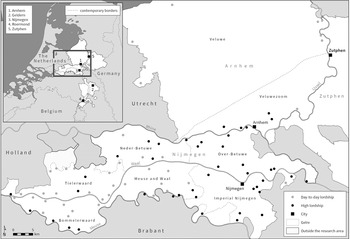
The case study that will be central to the analysis is the principality of Guelders, in the north-eastern part of the Low Countries (Figure 1). The extant records relating to the seigneuries of Guelders is exceptionally rich, up to the point that they allow a reconstruction of the entire seigneurial landscape and its evolution between c. 1325 and c. 1570. The foundation for this reconstruction derives from contemporary registers kept by the princely administration of Guelders, which list all known fief-holders at a particular moment in time. These registers enable ‘snapshot’ surveys of the number of seigneuries in four sample years (c. 1325, c. 1475, c. 1540, c. 1570), which in turn allow us to infer quantitative developments in the interim.Footnote 17
Guelders and its seigneuries, 1325–1570 (Quarters of Arnhem and Nijmegen)
Sources: see Table 1. Map by Hans Blomme, Ghent University.

Guelders is a prime example of the political polycentrism characteristic of the late medieval Low Countries. The principality may therefore serve as a microcosm of the German Empire in general, and concomitantly provides an ideal point of comparison with better-known regions in France and the British Isles. That said, even within the Low Countries, the different principalities show marked variation in their development of governmental institutions. Therefore, the seigneurial evolution in Guelders cannot be automatically projected onto other regions such as the county of Flanders, the county of Holland, or the duchy of Brabant. Guelders is simply the first Netherlandish region to be studied in this way, but the expectation is that future research could – and should – determine to what extent this principality's late medieval seigneurial development compared to other regions in the Low Countries.Footnote 18 Still, as an extreme example of Netherlandish governmental polycentrism, Guelders is ideally suited to foreground such an analysis of the relationship between aristocratic power and political institutionalisation in the late medieval Low Countries – even while it is often left out of general political histories of the Low Countries.Footnote 19
The shadow of Max Weber looms large in the historiography on late medieval Guelders. Most specialists have been hesitant to call the principality a state, precisely because of the persistence of decentralized political units such as seigneurial lordships.Footnote 20 In what follows, I develop a different perspective, proceeding from the hypothesis that seigneurial governance was not necessarily inimical to princely power or to the effective maintenance of law and order.Footnote 21 In order to test this hypothesis, the present article departs from a (partly comparative) study of two sub-regions within the principality of Guelders. The first of these areas, the so-called ‘Quarter’ (Kwartier) of Arnhem, has been noted for its predominance of self-governed peasant communities – where the only lord was the remote prince of Guelders – whereas historians have emphasised the prevalence of elite power in the second sub-region, the Quarter of Nijmegen.Footnote 22 One objective of this study is to determine whether the number of lordships in these areas conforms to the same sub-regional divergence. Yet the underlying goal is to examine the impact of seigneurial law courts on princely authority and on the performance of the political system.
To that end, the second section of this article offers a brief introduction to the political landscape of late medieval Guelders, before presenting the results of the quantitative survey of seigneuries in the two sub-regions. As will become clear, the Quarter of Nijmegen had a far higher number of these seigneurial jurisdictions than the Quarter of Arnhem. On the whole, though, the number of lordships in both regions remained remarkably stable between the early fourteenth and later sixteenth century. What is more, the breadth of lordships' powers of jurisdictions evinces the same pattern of stability, even showing signs of increasing strength. Sections three and four sketch the possible explanations for this continuity, first from the perspective of lords and seigneurial communities, and secondly from the viewpoint of the princely administration of Guelders. Finally, the conclusion explores some of the broader implications of this case-study for how we might conceptualise state formation in the context of late medieval Europe in general.
2. Stability of seigneurial governance, c. 1325–c. 1570
While technically part of the German Empire, Guelders was an independent principality for much of the fifteenth and sixteenth centuries. The power base of its princes stemmed from a collection of Carolingian counties spread around the various corners of what would later become Guelders's four ‘Quarters’ (Kwartieren). Around 1100, the core region still lay in the area around the town of Gelre (Geldern), after which the comital dynasty would come to style itself. But in the course of the next two centuries, the counts of Guelders managed to extend their influence over the cities of Zutphen, Nijmegen, Roermond, Arnhem, and their hinterlands. In the fifteenth century, these cities became the capitals of synonymous Quarters, with each Quarter subdivided into several shires (ambten) (Figure 1). By the early fourteenth century, Guelders had taken the physical shape it would more or less retain until the later sixteenth century, even as the emperor raised its status from a county to a duchy in 1339.Footnote 23 However, the principality's political ties to the Empire declined over time. The de facto independence was consolidated in 1423, when Emperor Sigismund (1411–1437) put forth a successor to the empty ducal seat but the cities and nobility of Guelders supported a rival claimant from the House of Egmont. The latter candidate ended up duke, despite the Empire's refusal to recognise the Egmont claim as legitimate. This remained the official imperial stance until 1538.Footnote 24
The princes' fragile legitimacy contributed to a polycentric political system with a prominent role for the towns and seigneurial lords of Guelders. Neither a brief takeover by the Valois Dukes of Burgundy (1473–1477) nor Guelders' incorporation into the Habsburg Netherlands (1543–1581) brought significant change in this regard. To be sure, these foreign administrations sped up the process of political institutionalisation, especially through the growing role of the ducal Chamber of Accounts (Rekenkamer) and the central Court of Guelders (Hof van Gelre en Zutphen).Footnote 25 But the urban and rural elites had secured privileges in the fifteenth century that secured their autonomy in the long term. Among other things, the duke could not institute direct taxes without the consent of the Estates assemblies, which were composed of representatives of the Cities (Steden), Knighthood (Ridderschap) and Lords-Banneret (Bannerheren). This meant that the aristocracy was represented by two out of three Estates – a contrast with most other Netherlandish regions (e.g. Flanders, Brabant), where the clergy was also represented. Furthermore, although the Knighthood officially consisted of armigerous men of established noble lineage, these men often possessed a seigneurie, while each Lord-Banneret also held at least one lordship with its own seigneurial tribunal.Footnote 26 In other words, the lords of Guelders took a prominent part in duchy-wide politics through their strong presence at these assemblies, as well as at the Ducal Council.Footnote 27
However, the size and scope of seigneurial jurisdictions in Guelders could vary considerably from one case to the next. The most powerful seigneuries were those with their own criminal courts: so-called ‘high lordships’ (hoge heerlijkheden).Footnote 28 All sanctions fell within the remit of these seigneuries, including torture and capital punishment.Footnote 29 This raised high lordships above the so-called ‘day-to-day lordships’ (dagelijkse heerlijkheden). In the latter, adjudications of the lord concerned ‘daily’ affairs like financial malpractice, local water management and the wounding of livestock. But day-to-day lords shared jurisdiction over non-lethal violence (e.g. fist fights) with the regional princely officer.Footnote 30 The geographic range of these seigneurial jurisdictions is difficult to quantify because contemporary descriptions tend to omit precise boundaries. For the most part, however, seigneurial jurisdictions extended to one or a few villages, and the number of people subjected to their authority differed accordingly. So, in 1569, the lord of Poederoijen reported to the ducal administration that his seigneurie counted around 200 parishioners, which he considered ‘a very small number’.Footnote 31 Estimates based on hearth counts of the fourteenth and fifteenth centuries nonetheless suggest that populations of a few hundred people were fairly typical for the seigneuries of Guelders.Footnote 32
The political landscape of Guelders was a mixture of these seigneuries, of semi-autonomous towns, and of jurisdictions that were governed by local village officers but that were overseen by one ducal ‘reeve’ (ambtman) who was in charge of all such villages in the entire shire (ambacht). In terms of their governmental powers and function, the seigneuries of Guelders were therefore largely analogous with these shires, with two important distinctions: firstly, instead of a ducal reeve, the chief governmental agent in the seigneurie was the lord or lady, who was not elected by the prince (at least not in that crude sense); secondly, shires proper tended to have a larger area of jurisdiction that usually included over a dozen villages, whereas seigneurial jurisdiction mostly extended to only one or a few localities – as illustrated by the example of Poederoijen in 1569 (see above). Because of this, strictly in terms of their physical range and demographic scope, seigneuries were more akin to villages than shires. In Guelders, as in the Low Countries more generally, these village communities – be they seigneurial or not – enjoyed a relatively high degree of self-governance from around 1300 onwards. As a rule, the village's bench of aldermen had the authority to oversee civil suits, while criminal justice rested either with the ducal reeve or with the lord and his officers.Footnote 33 In the high lordship of Oudewaard in the Quarter of Nijmegen, for example, the seigneurial seneschal (drost) and aldermen upheld justice and collected taxes which ended up in the lord's treasury. The duke had little to no direct power of governance in localities like this one. But directly bordering on this seigneurie was the village of Kesteren, which was not held by a local lord. In this jurisdiction, the reeve of Neder-Betuwe collected direct taxes (schattinge) at the behest of the duke and oversaw legal hearings, as well as appeals for the wider region.Footnote 34
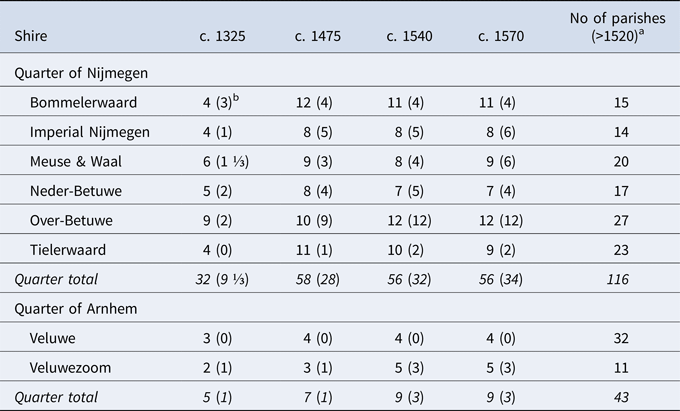
The quantitative evolution of Guelders' seigneuries suggests a stable coexistence of seigneurial institutions and the princely government from the early fourteenth to the later sixteenth centuries. This result is based on four cross-sections (c. 1325, c. 1475, c. 1540, c. 1570) of seigneurial jurisdictions in the Quarters of Nijmegen and Arnhem (Table 1). The selection of these sample years has been motivated by their states of documentation: they coincide with the princely administration's periodic overviews of the region's fief-holders. The Feudal Chamber (Leenkamer) of Guelders generally updated this documentation whenever a new ruler succeeded to the principality. As a consequence, regime changes tend to coincide with particularly rich records on Guelders' seigneuries, even more so when the new ruling administrations was ‘foreign’, as with the Burgundian and Habsburg takeovers of 1473 and 1543. The bulk of the research for this article is based on four such registers of around 100 folios each, drafted by the princely administration's ‘feudal stadtholders’ (leenstadhouders) and preserved in nos. 102 (c. 1326), 116 (1473–74), 14 G (1538), and 22L (1569) of the Feudal Chamber of Guelders – a subsection of the Ducal Archives kept in the Dutch city of Arnhem (see also Table 1). As opposed to other serial feudal records that show a tendency to simply reproduce the names of fief-holders listed in earlier registers, it is clear that these tomes were consistently updated.Footnote 35 Of course, most of these overviews only contain the feudal lordships, and only those held from the princes of Guelders themselves. Therefore, seigneurial jurisdictions held in fief from foreign princes, along with ‘allodial’ courts (in seigneuries without a feudal overlord), are generally omitted from these records.Footnote 36 Also, the fourteenth-century overview, which constitutes the first top-down attempt by the prince to record the current fief-holders of Guelders, is definitely incomplete.Footnote 37 These problems have been countered by supplementing the Feudal Chamber's registers with separate infeudation letters produced by the counts and dukes of Guelders, as well as charters and registers kept by foreign administrations – approximately 60 additional original documents in total. To name one example, the high lordship of Homoet in the shire of Over-Betuwe was a fief of the lords of Oosterhout in the duchy of Brabant before becoming an allod of the lords of Bergh in 1486. As a consequence, it does not feature in the records of Guelders' Feudal Chamber. Nonetheless, its status can be followed throughout the research period through charters preserved in the archives of the lords of Bergh.Footnote 38
Quantitative survey of seigneuries in Guelders (14th–16th century)

a These figures do not include the urban parishes. Based on: M. G. Spiertz & R. W. A. Megens, Gids voor de studie van reformatie en katholieke herleving in Gelderland 1520–1620 (Utrecht, 1986).
b The first number in each column denotes the total number of seigneuries in the shire, the second number (between brackets) signifies which of that number were lordships with high (criminal) justice.
Sources: GA 0002, Nos. 1A, 2B, 4D, 12, 14G, 16, 22, 102, 115, 116; 0124, Nos. 983/14, 2280, 4346, 4923/49; 0243, Nos. 947, 1918; 0379, No. 557; 0632, No. 170; 0609, No. 744; 0583, No. 77; 0397, No. 3; 0375, No. 2; 0392, No. 8; 0426, No. 1; 0525, No. 160; 0522, Nos. 81, 193; 0383, No. 61; 0430, Nos. 107, 141; 0520, No. 288/11; 0382, Nos. 1, 2, 70; 0533, No. 3; 0370, Nos. 100, 6002; 0012, Nos. 368, 591, 2198; 0510, No. 104; 1172, Nos. 619, 620, 622A, 685/A, 1052; 0390, Nos. 2, 12; 0376, No. 38; 0448, No. 1; 0396, No. 5; 0447, No. 200; 's-Hertogenbosch, Brabants Historisch Informatie Centrum 286, No. 468; AHB 0214, Nos. 270, 474, 510, 1113, 3286, 4948, 5668, 5770, 6112; The Hague, Nationaal Archief 3.19.11, Nos. 2.1, 2.2; 3.19.02, Nos. 93, 102; 3.01.01, No. 69; Utrecht, Utrechts Archief 1240, Nos. 10, 12, 17; 85-1, No. 376; RDO_OA, No. 1446.0; 218-1, No. 560; P. N. van Doorninck and J. S. van Veen eds., Acten betreffende Gelre en Zutphen, 1107-1415 (Haarlem, 1908); van Doorninck, Het oudste leenactenboek; D. Graswinckel, ’Hulhuizen’, BM Gelre, 27 (1927), 1–29, Appendices; Th. Ilgen ed., Quellen zur inneren Geschichte der rhenischen Territorien: Herzogtum Kleve, 2 Vols. (Bonn, 1921–1925); Theod. Jos. Lacomblet ed., Urkundenbuch für die Geschichte des Niederrheins, etc., Vols. 3–4 (Düsseldorf, 1853–1858); Nijhoff, Gedenkwaardigheden, Vols. 1–6; Sloet and van Veen, Register op de Leenaktenboeken, Het Kwartier van Arnhem; Het Kwartier van Nymegen.
The resultant survey reveals that, taken as a whole, the number of seigneuries in the Quarters of Nijmegen and Arnhem remained more or less stable between 1325 and 1570 (Table 1). There are slight variations throughout the years, but these are primarily caused by gaps in the source material – especially for the fourteenth-century sample year. Note, however, that continuity in the number of lordships does not always mean that it was the same seigneurial courts that persisted alongside princely authority. For example, in 1342, the ducal administration permanently absorbed the village of Velp in the shire of Veluwezoom, which had been a high lordship up until then. Numerically, this balanced out in the long term (1325–1570), but that is because Duke Charles of Egmont turned another jurisdiction in the area – the high lordship of Roozendaal – into a fief in 1516.Footnote 39 But these are exceptions. The overall pattern is clearly one of seigneurial stability.
Strikingly, this stability holds true especially for lordships with high justice. These exalted seigneurial jurisdictions actually increased in number from the later fifteenth century onwards. This belies older interpretations of state formation in which princely administrations are thought to have developed a monopoly on legitimate violence. According to that view, the progressive political institutionalisation of Guelders, especially from the Burgundian interregnum onwards, should have gone hand-in-glove with a decline in the number of seigneurial courts (with their own ‘license to kill’). This was far from the case, however. In the decades before and after 1500, the ducal administration even raised the number of seigneuries with high justice in Guelders, either by creating new jurisdictions or by expanding the juridical license of existent lordships. The pattern is most clearly visible in the Quarter of Nijmegen, where Duke Charles of Egmont (1492–1538) augmented the prerogatives of the seigneuries of Dalem (1505), Doornik (1507), Gendt (1506), Waardenburg (1504) and Zoelen (1506), all within the first decade of the sixteenth century.Footnote 40 This phenomenon was by no means exclusive to Guelders, but rather a common strategy among Netherlandish princes who sought to consolidate their alliances with powerful aristocrats.Footnote 41
Of course, the persistence of these seigneurial institutions does not necessarily imply a stability of governance. Another way to measure the continuity of the seigneurial system is to look at who possessed these lordships. Now, it is well known that the late medieval aristocracy in general had a high rate of turnover, especially when studied over longer periods of time. In the county of Flanders, also a Netherlandish principality, only around 42 per cent of the 228 noble lineages that had been active in the second half of the fourteenth century persisted up until the turn of the sixteenth century – even while the total number of active families remained roughly the same.Footnote 42 In a similar vein, most historians hold that the seigneuries of the late medieval Low Countries, and of the Burgundian power zone more generally, were gradually appropriated by an ever-smaller group of powerful families. For example, Raymond Van Uytven has demonstrated that a sample of 55 lordships in the duchy of Brabant that were held by 55 lords in 1415, were held by 44 lords in 1490, by 36 in 1525, and had come to be concentrated in the hands of only 33 lords in 1565.Footnote 43
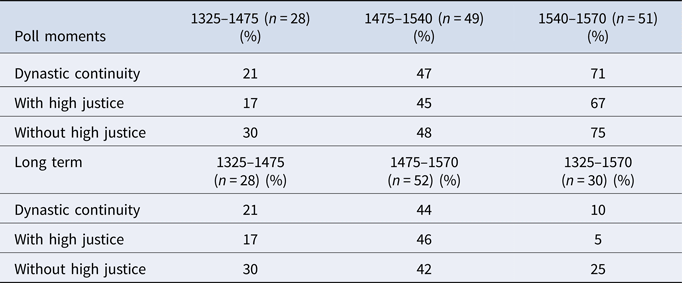
On the one hand, late medieval Guelders fits into this pattern to some extent, with a slight concentration of seigneurial estates in the hands of a select number of families (Table 2). On the other hand, the evidence does not really support a pattern where a few powerful individuals amassed several of these jurisdictions: with a few exceptions, even by 1570, most lords held only a single seigneurie.Footnote 44 The records further reveal a degree of long-term stability of ruling seigneurial families in Guelders.Footnote 45 Looking at the persistence of members of the same lineages as lords of a given seigneurial jurisdiction in between the best-documented sample years, 1475 and 1570, it becomes clear that c. 44 per cent of the seigneuries continued to be governed by the same family over the course of almost a century (Table 3). This is reminiscent of what Pierre Charbonnier found for the Basse-Auvergne, where around 45 per cent of 100 seigneuries were held by the same families in the early fifteenth century as they had been in the early fourteenth, and 51 per cent (of 158 seigneuries) were still ruled by the same family in 1587 as they had been in 1488.Footnote 46 In fact, these turnover rates of seigneurial families roughly correspond to the rate of extinction Frederik Buylaert found through a detailed study of the noble lineages in the county of Flanders (see above). As the seigneurial families of Guelders also predominantly stemmed from the duchy itself, we may tentatively conclude that there was a relatively high degree of dynastic continuity in the region's seigneurial system. In that respect, Guelders may have differed from those areas of the Low Countries where the influence of the Burgundians (and later the Habsburgs) was more pronounced, as these show signs of the emergence of an overarching ‘state nobility’ from the second half of the fifteenth century onwards. This does not mean, however, that these other Netherlandish regions did not also know a stability of seigneurial institutions.Footnote 47

Dynastic continuity of seigneurial families (Quarters of Nijmegen and Arnhem)

n = number of lordships with known seigneurial families for both sample years
Sources: see Table 1.
That said, the survey for Guelders does reveal an uneven spatial distribution of seigneuries between the studied Quarters, which is a warning against projecting subregional trends in the seigneurial landscape onto polities as a whole. Based on Guelders' political sub-division into Quarters, the Nijmegen district emerges as far more lordship-dense than the Arnhem region (Figure 1). At its peak, the Quarter of Nijmegen (c. 1300 km2) counted around 60 seigneurial courts, more than half of which had powers of high justice. In fact, the area counted more high lordships than any other in Guelders.Footnote 48 By contrast, the Quarter of Arnhem (c. 3000 km2) continuously had fewer than 10 seigneuries, only 3 of which had high jurisdiction (Doorwerth, Rosande and Roozendaal).Footnote 49
This subregional variation is not altogether surprising when viewed from an environmental and socioeconomic perspective. Bas van Bavel has argued that subregional variations in the landscape led to diverse economic trajectories in different parts of the Low Countries between the early middle ages and early modern period.Footnote 50 Guelders was no exception in this regard. The rivers Meuse, Rhine and Waal created fertile soils that led to a flourishing of agriculture in the Nijmegen region. The landscape of the Arnhem Quarter, by contrast, was far less suitable for arable production because the larger part of the countryside was dominated by sloping hills and sand drifts. These natural factors also meant that Nijmegen's rural hinterland was more densely populated than the Arnhem region. During the fifteenth and sixteenth centuries, the average population density in the countryside of the Quarter of Arnhem hovered around 11 inhabitants per km2, whereas the rural part of Nijmegen's Quarter had already counted more than 25 per km2 in 1369.Footnote 51 The more fertile environment and greater concentration of people created better opportunities for manorial surplus extraction in the Nijmegen area during the high medieval period. This is implicitly corroborated by the sparse number of seigneuries in the Arnhem Quarter, most of which were located in fertile areas bordering on waterways (Figure 1).Footnote 52
The demographic contrast between the two Quarters can further be inferred from their total number of settlements: the Nijmegen district counted more than twice as many parishes as the Arnhem region (Table 1). Even allowing for this difference, however, the proportion of seigneurial communities was still far higher in the Quarter of Nijmegen than in the Quarter of Arnhem. By the beginning of the sixteenth century, when reliable overviews of the number of localities (kerspels) per shire become available, the proportion of seigneurial localities in the former Quarter was 48 per cent – ranging from 39 per cent in Tielerwaard to 73 per cent in Bommelerwaard. In the Arnhem region, only 21 per cent of all rural parishes were (partly) ruled by a local lord.
Notwithstanding these subregional differences, the overall pattern in both Quarters nevertheless reveals a long-term stability in the number of seigneuries and ruling families, and, by implication, a stability of seigneurial governance. The quantitative evidence leaves little doubt that this institutional benchmark of lordship persisted in Guelders for the duration of the research period. So, even while Guelders witnessed a progressive political institutionalisation from the fifteenth century onwards, seigneurial courts apparently continued to play a prominent role in governing its rural populace.
3. The seigneurie from the perspective of lords and local communities
The persistence of seigneuries in Guelders between 1325 and 1570 suggests an alternative path of state formation to the dominant narrative of progressive governmental centralisation. Clearly, the statement that ‘princely institutions drew business out of private courts’ does not hold unequivocally for this Netherlandish principality.Footnote 53 This raises the question how and why seigneurial institutions of governance continued to define the political status quo for such a long time; that is, within this specific part of the Low Countries, but the question has a broader relevance, as earlier studies on Scotland and several French regions have shown similar patterns. To address this issue, the next two sections will discuss the function of the seigneurie in Guelders' political system from the perspectives of different political actors, as a means to uncover the institution's lasting raison d’être. As will become clear, seigneurial lordships continued to play an important role in governance for three interrelated reasons: first, their legitimacy in the eyes of the various parties involved; secondly, their familiarity to those same parties; and thirdly, the relative accessibility of seigneurial offices to the inhabitants, which facilitated the employment of local expertise.
First of all, from the perspective of the lords and ladies themselves, the exercise of seigneurial justice was a fundamental aspect of their social status. Lordship, after all, entailed a formal license to rule over others. Throughout the late medieval Low Countries, the possession of a seigneurie with high justice was also one of the few guarantees of membership to the regional nobility.Footnote 54 And so, despite its relatively high maintenance cost, the right to a seigneurial tribunal remained a desired privilege in Guelders.Footnote 55 The clear stability in the survey bears this out, for one thing. For another, the desirability of semi-independent justice is supported by anecdotal evidence. The lords and ladies of Waardenburg in the shire of Tielerwaard, for instance, fought a protracted legal battle (1538–1570) before the Court of Guelders to secure title to their own seigneurial tribunal. They were almost certainly motivated by status concerns, because these particular lords could offer few concrete examples of having exercised criminal justice in practice.Footnote 56
Thus, seigneurial lords and ladies derived their exalted social status from their position as rulers over local subjects. At the same time, the seigneurie encompassed a contractual relationship between these lords and their subjects, with the potential to benefit both sides. From the point of view of local communities, this contractual basis of rule was useful because it offered protection in several ways. In medieval political ideology, lords and ladies were actually obliged to protect their communities in order to retain a legitimate claim to their jurisdictions. The very obedience of subjects was conditional upon the lords' compliance to the ideology of ‘Good Lordship’.Footnote 57 Conforming to the precepts of this ideal was to protect the interests of the seigneurial community in a general sense. So, a popular song of 1450, about the pilgrimage of three Netherlandish lords to the Holy Land, admonished these lords to use their power for the protection of merchants, widows and orphans. The lord of Batenburg in the shire of Meuse and Waal was one of the protagonists of this song. Therefore, the song's popularity probably boosted the status of subsequent lords and ladies of Batenburg. But at the same time, the song served as a constant reminder of these lords' obligations to their subjects.Footnote 58 Indeed, there are various examples of late medieval lords who guarded the commercial interests of resident craft guilds and trade organisations.Footnote 59
This does not mean that seigneurial governments were categorically more benevolent to their subjects than officers appointed by the princes of Guelders, and the fifteenth- and sixteenth-century legal records also show examples of lords abusing their powers.Footnote 60 However, seigneurial communities specifically benefited from the contractual relationship embodied by the seigneurie because their lord or lady could be called upon to protect their formal privileges. In 1568, for instance, the lord of Gendt submitted an official protest to the Court of Guelders to absolve his subjects from a financial contribution to the fortifications of the city of Arnhem.Footnote 61 Other examples relate to lords' formal prerogative and duty to police their own subjects. As the Habsburg rulers began to clamp down on the upsurge of Protestantism in the Low Countries in the mid-sixteenth century, certain lords interfered on behalf of their dependents, many of whom nurtured Protestant sentiments. So, in 1569, the lord of Poederoijen assured the Habsburg administration that his subjects had always followed the statutes and ordonnances of the Roman Church. The lady of Batenburg went one step further and actively blocked the Habsburg repression of Protestants in her lordship in 1566.Footnote 62 Thus, lords could act as powerful mediators, occasionally even challenging the princely government itself. To be sure, the precepts of Good Lordship applied as much to princes and kings as they did to seigneurial lords.Footnote 63 In fact, the ‘violation of lordly values’ was a central accusation levelled against King Philip II of Spain in the Act of Abjuration, signed by the Estates of several Netherlandish provinces – including Guelders – in 1581, marking the beginning of the end of Habsburg rule in these provinces.Footnote 64 But late medieval subjects probably had a less palpable experience of their contractual relationship with far-flung princes than with their local lord or lady.
Indeed, from the perspective of local residents, the legitimacy of the seigneurie was further bolstered by its familiarity. As lords maintained bonds with the princely dynasty, so local fief-holders and prominent landowners had personal ties with the lord and his officers.Footnote 65 Because of this, the seigneurie was at once more familiar and more accessible to rural landholders than the overarching political framework of the duchy of Guelders. Seigneurial communities associated justice and power first and foremost with physical structures that were close at hand. In seigneuries, this was the lord's fortified residence, often a castle, which also served as a base of operations for his legal personnel. This building loomed over the seigneurial village, and residents frequently passed it in their daily lives. In Guelders, most lords were furthermore entitled to elect the parish priest, thereby also forging a link with the local church edifice – arguably the cornerstone of social interactions in the countryside. Some lords and ladies, like those of Batenburg, even had the authority to mint their own coins. These gave even more ‘currency’ to the lords' authority; especially because the low denomination of the coins of Batenburg suggests people used them on a frequent basis.Footnote 66
These tangible elements of seigneurial authority left a stronger imprint on local populations than the remote princely institutions. To be sure, the reeves and especially the local bailiffs (schouten or richters) of the princes of Guelders were usually nearer at hand, and therefore more familiar to subjects, than the ruler's own court. But their authority was not symbolically buttressed by a towering structure such as a castle. Also, the wider radius of their jurisdictions – even of the bailiffs, whose juridical zones could encompass half of an entire shire – posed practical obstacles to local residents. People who belonged to the jurisdiction of the court of Kesteren, for example, could only redeem debts on their properties by submitting a formal request at the residence of the bailiff (schout) in that village. If they lived towards the outer bounds of the shire (e.g. in Dodewaard, Echteld), this meant that they had to travel for several hours to file for such a debt redemption.Footnote 67 As we have seen, seigneurial jurisdictions tended to be more limited in their geographic scope. Their inhabitants will consequently have encountered fewer problems in this regard.
Through its bottom-up legitimacy and familiarity, the seigneurie became a fulcrum of local knowledge, thereby supporting Guelders' political system in general. Seigneurial officers were well-versed in the daily affairs of their village because they were recruited locally. Surviving legislations of lordships dating from the fifteenth and sixteenth centuries reveal that the position of alderman (schepen) was not reserved for village elites but was accessible to men with medium-sized landholdings. What is more, the statutes dictated that the aldermen had to hail from the local community.Footnote 68 In this regard, seigneurial legislations mirrored privileges secured by the cities and nobility of Guelders in the fifteenth century, which stipulated that all ducal reeves had to be born in the duchy.Footnote 69 Yet, as mentioned above, these reeves and even the princely bailiffs had to oversee the affairs of several villages all at once. The officers of the seigneurie, by contrast, were solely charged with matters that concerned their own locality. Therefore, they were well-equipped to deal with everyday matters, certainly not less so than princely agents in non-seigneurial communities were. This inclusivity of local offices remained an integral part of Guelders' polycentric political system until well into the early modern era. During the seventeenth and eighteenth centuries, no less than 45 per cent of male heads of household in the seigneuries of Bommelerwaard had taken up a local office at one time during their lifetime. And, by this later period, even a small landholding was sufficient to be eligible for office.Footnote 70
One could even hypothesise that the contractual relationship between lord and subjects made the governance over non-daily affairs more effective in seigneuries than in non-seigneurial villages. A good example is criminal justice. The infrequent need for criminal prosecutions within a single seigneurie – serious crimes were no everyday occurrence – might suggest that ducal officers in charge of a wider area also had more relevant experience in this regard. Yet ducal agents were not as versed in local custom as were officers sourced from the villages themselves. Take the example of the non-seigneurial villages of Brummen, Oosterbeek, Rheden and Velp in the shire of Veluwezoom. In an apparently inclusive legal ritual, each village had to send their own representatives whenever the ducal bailiff (richter) executed criminals from any of these communities. Indeed, the delegates from Oosterbeek were literal ‘stake-holders’, charged with keeping in place the wooden poles of the gallows.Footnote 71 However, the bailiff faced practical difficulties in getting the villages to participate. Because he was unfamiliar with the idiosyncrasies of local custom, the villagers were able to evade their duties and stall the legal process.Footnote 72 Although lords did not necessarily have superior knowledge of the relevant customs either, their local representatives – who had a smaller area of jurisdiction than the princely bailiff – did. So, when the Habsburg administration requested information about the details of criminal litigation in the seigneuries of Guelders in 1569, the most detailed testimonies came from local alderman and other seigneurial officers.Footnote 73
4. The seigneurie from the perspective of princely and urban administrations
Localised authority in seigneuries has an understandable appeal from the perspectives of lords and ladies who derived their authority from it. To some extent, the same applies to the bottom-up perspective of countryfolk in Guelders, but probably throughout the Low Countries, as Netherlandish village communities had their own voice in local politics from around 1300.Footnote 74 But what of princely administrations; were they simply incapable of centralisation or were there perhaps specific benefits to a polycentric system? Earlier interpretations of state formation in Guelders can best be summed up by the statement that ‘a tendency to centralization was doomed to fail’.Footnote 75 However, the idea that centralisation was a key ambition of princely governments is a questionable assumption. In fact, a polycentric system that included seigneuries had advantages in its own right to the prince and his officials. A common problem of pre-modern states was that they lacked the administrative clout to govern without the cooperation of local powerbrokers and organisations (e.g. parish priests, guilds).Footnote 76 Outsourcing certain aspects of governance to the seigneurie may have offered a practical solution to this problem, because lords and their officers had the ‘boots on the ground’ that the prince (and, to some extent, his officers) lacked. Beyond this practical consideration, the princes of Guelders may simply have considered the seigneurie a legitimate basis of power.
In fact, the prince of Guelders would have had to accept the legitimacy of the seigneurial system, because he was a lord himself and derived his own authority from the same ideological basis.Footnote 77 Nonetheless, the princes of Guelders were able to legitimate their superior position by explicitly presenting themselves as primus inter pares, the ‘prince’ or ‘first among all other lords’ of Guelders. This self-fashioning can be clearly observed in the feudal records produced during the reign of Duke Charles of Burgundy (1473–1477). As part of his take over in Guelders, the Burgundian duke ordered an overview of the financial potential of his various fief-holders.Footnote 78 In the draft version of this ledger, the duke's title originally read ‘highly revered lord’ but the words have been crossed out and replaced by ‘very high and very powerful prince’ (my emphasis). The latter title was also kept in the final version.Footnote 79 The example exposes the deliberate self-fashioning of this ‘prince’ of Guelders in relation to the lords of his duchy.
When the princes of Guelders did interfere in the seigneurial framework, the usual effect was not a corrosion of seigneurial authority but rather its consolidation. But then, the seigneurie could provide practical advantages to the state beyond the benefits of legitimacy. Duke Charles of Egmont (1492–1538), for one, appears to have consciously exploited the military and financial assets of Guelders's seigneurial system. Continuously faced with external threats to his reign, this duke rewarded loyal supporters with high lordships or expanded the purviews of their existing jurisdictions. This may have helped to redirect the proliferous seigneurial warfare that marked his reign to serve the duke's interests.Footnote 80 A clear example of Duke Charles of Egmont's seigneurial policy was the lordship of Zoelen in the shire of Neder-Betuwe. Because Lord Willem van Rossem had ‘stood by, aided and served [Duke Charles] until the very end’, in 1506, the duke awarded him ‘the parish of Zoelen with high lordship, where he and his forefathers had held day-to-day lordship’.Footnote 81 By outsourcing seigneurial justice to his allies in this way, the duke concomitantly sub-contracted loyal lords to maintain the military strongholds that most high lordships possessed. Through the so-called ‘law of opening’ (ius aperturae), meanwhile, these lords could be forced to open their castle to princely troops, should the need arise. In any case, even the high lordships of Guelders were obliged to answer the princes' military summonses (clockenslach ind dijenst).Footnote 82
The financial component of this strategy was straightforward; the burden of maintaining (seigneurial) fortifications fell to the lord. This alleviated the state's costs of military upkeep, while simultaneously saving on the expenses of local criminal litigation.Footnote 83 Take the example of the castle of Roozendaal in the Quarter of Arnhem. Duke Charles of Egmont first granted this castle with high justice to his officer Gerrit van Scherpenzeel in 1516, again, as a reward ‘for repeated loyal service’. Now, Van Scherpenzeel was entitled to Roozendaal's seigneurial revenues, but also had the responsibility to rebuild the decrepit stronghold. When Gerrit died in 1536, Duke Charles allowed Van Scherpenzeel's son Willem to inherit the lordship on two conditions. The first was that the fief could only stay within the family through Van Scherpenzeel's direct descendants (in linea descendenti). This might have ensured its swift return to the dukes of Guelders, were it not for the fecundity of the Van Scherpenzeel family.Footnote 84 But another precondition was that the prince gained control of the castle of Coldenhove (Kaldenhoeve) in return. This was a stronghold that Willem had previously bought from none other than the duke himself, and that he had ‘thoroughly improved’ in the meantime.Footnote 85 In a similar vein, the duke enfeoffed another member of the Van Scherpenzeel family with the toponymic Scherpenzeel estate in 1522, ‘to improve the fief’, which in this case meant to turn its burnt-down forest into proper sowing land.Footnote 86 This policy with regards to seigneurial fortifications and lands thereby served the duke's financial as well as his military interests.
Of course, this does not mean that certain princes of Guelders did not aspire to centralisation and greater control over their territory. Especially the Burgundian (1473–1477) and Habsburg (1543–1581) reigns were marked by efforts to streamline the political institutional framework of Guelders. But these foreign administrations consistently recognised the need to take the duchy's seigneuries as a starting point. What is more, their attempts to partially reform the seigneurial framework were mostly unsuccessful. The princely perspective was marked by a tension in this regard; on the surface, the seigneurie was a recognisable institution of governance, but underneath this basic familiarity hid distinctly heterogeneous local customs that required the involvement of those in the know. Thus, Charles of Burgundy's feudal overview of 1473 served both to gauge the military and fiscal potential of Guelders, but also to understand the duchy's governmental structure. As the duke's officers converted the fiefs' local taxes from diverse levies in kind into a single currency, so, too, did they translate the seigneurial terminology from Middle-Dutch into French. In practice, however, the seigneuries of Guelders were by no means uniform units of governance, and the princes knew it. This is exemplified by the Habsburg rulers' attempts to integrate the criminal justice system of their Netherlandish principalities in 1569. Recognising the importance of seigneurial governance in Guelders, the ducal administrators first ordered an overview of the duchy's lordships with high (i.e. criminal) justice. But they subsequently used this overview to request information about the finer details of local criminal procedure from the relevant parties in situ: that is, the lords and their officers.Footnote 87 The Habsburg administration notably failed to merge these various customs into the same institutional mould of their other territories. In fact, local aversion to this top-down standardisation attempt would be one of the reasons why the northern provinces – including the greater part of Guelders – sought independence from the Habsburg Low Countries in the 1580s.Footnote 88
This notwithstanding, the seigneuries of Guelders may have indirectly contributed to the integration of the principality's legal system, namely through the codification of local legal custom. Only a handful of these legal codes have survived for Guelders. The seigneurial legislations that remain, however, were clearly modelled on similar laws designed by the princely government at the shire level.Footnote 89 Despite their juridical independence, therefore, seigneuries could function as a basis for legal integration, since their inhabitants were more or less subject to the same laws as their countrymen who were answerable to the duke's reeves. Moreover, much like their ducal equivalents at the shire level, these proto-constitutional documents (called Landbrieven) were a product of negotiations between the lord and his subjects. Because of this, they contributed to a consensual basis of local governance (these were the documents that stipulated among other things that offices within the lordship could only be filled by local residents).Footnote 90
The broader implication is that in terms of legislature as well, the seigneurie can be seen as a conduit of governance between the prince and the local community – perhaps even as a mouthpiece for the state. Guelders was not altogether exceptional in this regard: in the county of Holland, for example, local village courts had also come to form an integrated legal framework by the sixteenth century, despite the pronounced decentralisation of the Dutch political system.Footnote 91 In Guelders, a criminal case of 1570 suggests that, by that time, even legally independent lordships were already integrated into an overarching – if ad hoc – legal framework. In October of that year, a man living in the seigneurial jurisdiction of Waardenburg stole two pigs off a dyke in the lordship of Dalem. The lady of Waardenburg had the culprit captured, but her agents subsequently transported him to the ducal Court in Arnhem, and it was there that he was prosecuted. The lord of Dalem – whose seigneurie incidentally had its own Landbrief – remained uninvolved in the entire affair. This case suggests that by the later sixteenth century at least, the independence of seigneurial law courts in Guelders was perhaps more discursive than practical. At the same time, the episode emphasises how seigneuries possessed the local clout that the princely administration often lacked. Thus, the seigneuries and princely institutions of this Netherlandish region formed a more or less harmonious system, similar to the integration of aristocratic and royal power previous studies have unveiled for different regions in the British Isles.Footnote 92
It is worth pausing for a second here and consider how Guelders's sub-regional disparity in the spread of seigneuries affected this legal integration (Table 1). In a sense, the smaller number of seigneurial courts in the Quarter of Arnhem could have facilitated a more uniform legal framework in this area than in lordship-dense Nijmegen. Juridical authority over Arnhem's countryside was chiefly divided between the ducal seneschal (drost) of Veluwe and the bailiff (richter) of Veluwezoom. The rural and urban judiciaries in this Quarter also had recourse to a total of only three appellate courts, respectively, in the cities of Arnhem and Zutphen, and at the central ducal court of Engelanderholt. This degree of legal centralisation coincided with the dukes' preference for permanent residence in the Quarter's capital city of Arnhem from the second half of the fifteenth century onwards.Footnote 93 In the Quarter of Nijmegen, by contrast, such judicial ties were more diverse. For one thing, the more numerous shires each had their own ducal reeve who passed sentence in a separate tribunal. For another, Nijmegen's seigneurial law courts were entangled with various appellate courts. In some lordships, such as Ressen in the shire of Over-Betuwe, the court of appeals even lay outside Guelders altogether.Footnote 94 These juridical offshoots potentially made for a ‘leakier’ state in the Quarter of Nijmegen. From what we have seen, however, the evidence can also be interpreted in the opposite way; through copying state legislation, the lordships in the Quarter of Nijmegen potentially formed a basis for the area's integration into the duchy's political system. At the same time, the bailiff of Veluwezoom apparently encountered problems in the administration of criminal justice because he had to juggle the local customs of various localities all at once (see above).
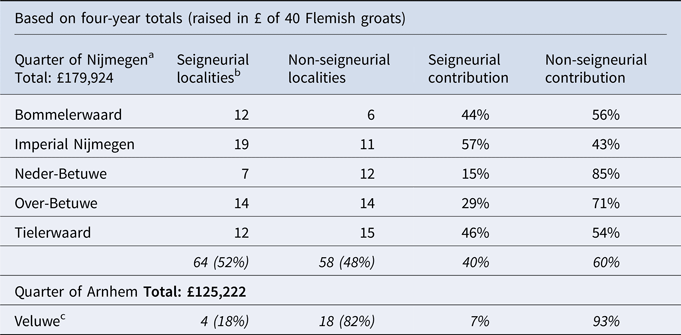
This ambiguity also applies to the role of seigneuries in the principality's fiscal integration. A recent study has shown that late medieval Guelders differed from other regions in the Low Countries in the organisation of its tax system. Where these other Netherlandish principalities (Brabant, Holland, Luxembourg) left the apportioning of fiscal duties up to the regional authorities (towns, shires), the tax burdens of the people of Guelders – based on individual wealth – were recorded at a central level.Footnote 95 This could mean that the subregional differences in seigneurial landscape had little impact on Guelders's fiscal integration. That said, the actual procedure of tax collection still fell to the prince's regional officers, who may have faced more practical obstacles to executing their tasks in a region with a marked seigneurial presence, such as the Quarter of Nijmegen, than in areas where princely authority was more absolute. On the whole, however, the fiscal contribution of the Quarter of Nijmegen does not appear to have suffered from the relative abundance of seigneurial jurisdictions in this subregion. In 1570, a duchy-wide tax acceded to the government of King Philip II generated more revenue in the Nijmegen area than in the Quarter of Arnhem (respectively £179,924 and £125,222 Flemish groats). To be sure, the fiscal contribution of Nijmegen's lordships was lower than that of its non-seigneurial villages and towns (40 per cent), even though seigneurial communities slightly outweighed other communities in their number (Table 4). But this picture is shaped by the greater population numbers and concentrations of wealth in certain towns and larger non-seigneurial villages. As we have seen, lordships such as Poederoijen only counted around 200 people at this time, and this is reflected in their smaller contributions (£568 1s 3d Flemish groats over 4 years).Footnote 96 Furthermore, the way in which this ‘central’ fiscal record is structured, suggests that lords and seigneurial officers took up the task of local tax collection in their seigneuries; localities that shared the same lord were recorded in a single entry – even when they did not border on each other, such as Oyen and Dieden.Footnote 97 This implies that the levying of taxes was effectively outsourced to seigneurial governments as well.
Fiscal contributions of localities (urban and rural) in 1570

a The shire of Meuse & Waal is not listed separately in the source.
b These are the localities as distinguished in the source.
c The source does not distinguish between different shires for the Quarter of Arnhem.
Source: GA, Handschriften Rijksarchief in Gelderland, No. 409 (‘Verclaringhe van de taxe oft quoten der Steden, Heerlickheyden, Dorpen und Ampten des Furstendoms Gelre und Graeffschap Zutphen…’).
In a similar vein, seigneuries may have benefited the political integration of Guelders. Part of the reason for this is that lordships with high justice were represented by their lords at the Estates assemblies. Much like the prince and seigneurial communities, the cities and towns therefore recognised the political legitimacy of the seigneurie. As a consequence, these rural localities were drawn into duchy-wide politics by proxy, even if they did not have a direct voice. So they acquired a formal political status alongside the towns of Guelders, which had to take their position into consideration. The high lordships of Guelders could thereby operate on a similar footing to the smaller towns – not counting those exceptional seigneuries that were actual towns, like Batenburg and Gendt.Footnote 98 Villages without a lord lacked this kind of representation. The non-seigneurial countryside was certainly not without political influence, as its noble fief-holders were eligible for membership of the Estate of the Knighthood. But the latter were not nominal intermediaries for a local community. In other words, they did not operate on the same contractual basis as their seigneurial fellows who were identified by their lordship at the assemblies. What is more, through the intercession of lords, seigneurial jurisdictions inside the territorial bounds of Guelders but without feudal ties to the prince were nonetheless represented at the Estates meetings. This becomes more significant when one realises that around half of the high lordships in the Quarter of Nijmegen were either fiefs of neighbouring princes or were juridically independent allods. Through their seigneurial status, the interests of these legally ambivalent localities were still looked after at the Estates assemblies.Footnote 99 Put the other way around, their seigneurial status drew these places into the framework of Guelders' state.
5. Conclusion: seeing like a seigneurie?
This article has suggested that the persistence of seigneurial governance was not necessarily counterproductive to state formation in the late medieval Low Countries and, by extension, in the principalities of the German Empire more generally. This conclusion is borne out by empirical evidence for the Netherlandish principality of Guelders. The analysis has expressly departed from the still dominant narrative of a progressive centralisation of state power and the requisite decline of ‘private’ courts of justice by the end of the middle ages. The evidence has shown that, far from declining, the number of seigneuries and their associated tribunals remained constant in Guelders between 1325 and 1570. These jurisdictions were ruled by seigneurial families with a degree of long-term dynastic continuity similar to other European regions where seigneurial institutions remained ingrained in the political system (e.g. the Basse-Auvergne in France). What is more, the number of lordships charged with criminal justice – which supposedly undercut the state's monopoly on licit violence – actually increased between the end of the fifteenth and the middle of the sixteenth century.
Contrary to the centralisation thesis, I have argued that this persistence of seigneurial justice was not so much a consequence of elite resistance or a failure on the part of the state to siphon off the power of regional elites. Rather, it was an effect of active collaboration between the princely administration and the lords of Guelders, based on a shared interest in the legitimisation and facilitation of governance. So, the foreign Duke Charles the Bold explicitly positioned himself as the ‘principal’ lord (prinche) of Guelders as a means to legitimate his authority when he became duke of Guelders in 1473. Likewise, Duke Charles of Egmont (1492–1538) pursued a veritable policy of expanding seigneurial jurisdictions in the early 1500s because this served the practical interests (financial, military) of the state. The lords themselves, meanwhile, derived exalted social status from exercising justice in their own seigneurial courts. This seigneurial status also granted them access to duchy-wide politics through participation at the assemblies of the Three Estates. To the inhabitants of Guelders, seigneurial governance enabled a direct involvement in local politics; partly through their contractual relationship with the lord, based on the contemporary ideology of Good Lordship; partly because of the familiarity of seigneurial institutions, buildings, and personnel; and ultimately because political offices were within reach even of local landowners with a mere medium-sized holding (and pointedly not to outsiders). This bottom-up consent to seigneurial governance fed back positively into the legitimacy of the overarching political system, thereby benefiting the state.
The findings of this study therefore tie in closely with a growing body of scholarship that emphasises the mutualistic relationship and institutional integration of medieval state administrations and their elites. Firstly, the Netherlandish case of Guelders is reminiscent of the enduring juridical, military, and political relevance of seigneurial institutions in the late medieval Basse-Auvergne as demonstrated by Pierre Charbonnier in the 1980s and 1990s. Secondly, the seigneurial system of Guelders between 1325 and 1570 bears close resemblance to that of Scotland in the high middle ages. As Alice Taylor has recently argued, in the kingdom of Scots, ‘the institutions of royal government developed with and alongside the jurisdictional power that kings expected aristocrats to exercise in their own lands’.Footnote 100 This is very similar to Guelders' stability of seigneurial governance alongside the evolving princely institutions.
Scotland and Guelders show a further parallel in the sense that their political developments have largely been explained in connection with the influence of external governmental structures: what is called ‘Anglicization’ in the Scottish case, or ‘Burgundisation’. (Bourgondisering) in the case of Guelders.Footnote 101 This confrontation between external and internal systems of governance recalls parts of the analysis in James C. Scott's 1998 book Seeing like a State. According to Scott, the pitfall of modern states lies in their attempt to forcefully make local societies ‘legible’, that is to say, to superimpose standardised grids (e.g. of taxation, military conscription) throughout their territories. Scott considers these schemes of the modern state doomed to failure because they ignore the fundamental localised ‘knowledge that can only come from practical experience’.Footnote 102 As we have seen, certain princely administrations of late medieval Guelders also tried to standardise the diverse local practices in their principality. Most prominently, Charles the Bold attempted to streamline Guelders' feudal administration in the late fifteenth century, while his Habsburg followers strove for a homogeneous criminal system during their reign (1543–1581). In keeping with Scott's thesis, however, these pre-modern efforts of the state were ultimately ineffective.Footnote 103
This is where the seigneurie fulfilled a pivotal role in the operation of principalities as late medieval versions of states. As I have argued, the seigneurie functioned like an interface between the top-down perspective of the princely administration and the bottom-up viewpoint of local communities. Virtually a pan-European institution, the seigneurie was superficially familiar (or legible) to late medieval princely administrations. So, notwithstanding some minor attempts at standardisation, the princes of Guelders predominantly followed the path of least resistance and outsourced governmental tasks to the level of the seigneurie. This level of governance was both familiar and legitimate, or legible, in the eyes of local populations. Equally important, the lord and his locally sourced officers were perhaps in a better position to understand (or ‘read’) the specific circumstances and customs of these local societies than princely agents with a wider geographic remit. By outsourcing aspects of governance to the seigneurie, the late medieval state of Guelders thus avoided the ‘modern mistake’ of ignoring the fundamental expertise of the local populace. As suggested by a recent study, this inclusivity of seigneurial politics only increased in Guelders during the seventeenth and eighteenth centuries.Footnote 104
To be clear, I by no means wish to suggest that late medieval lordship and its associated institutions were somehow ‘right’, or even efficient, forms of government.Footnote 105 I have merely entertained the notion that seigneurial institutions of governance may have been ‘optimal’ under the specific historic circumstances in which they persisted for the better part of two-and-a-half centuries: a consequence of the convergence of interests between, and practical restrictions of, the most important political stakeholders. Together, the princes, seigneuries, non-seigneurial localities, and towns of late medieval Guelders formed a political system that shows clear signs of institutional integration between the early fourteenth and later sixteenth century. Insofar as we can label this form of government a state, it was certainly a different kind of state than envisioned by the disciples of Max Weber.
Thus, as historians re-examine pre-modern states with an eye to this kind of historical particularism, the ‘ideal type’ state based on centralisation and the monopoly of force increasingly turns out to be atypical. It might therefore be fruitful for future studies of pre-modern state formation to start from a default hypothesis based on the interrelation of state and elite power, rather than one based on opposition between centralisation and ‘private’ forms of power. Although long-term quantifications of seigneurial power may not always be possible, it is certainly feasible to broaden the analytical viewpoint as I have tried to do here, viewing governance as much through the eyes of lords and seigneurial communities as from the top-down perspective of the ruling administration.
Acknowledgements
This research was conducted as part of the project STATE – Lordship and the Rise of the State in Western Europe, 1300–1600, funded by the European Research Council (ERC), and led by Frederik Buylaert at Ghent University. I am principally indebted to Frederik for his encouragement and help. I also want to thank my team members, Erika Graham-Goering, Ysaline Bourgine de Meder, and Gert-Jan Van de Voorde, as well as Miet Adriaens from the Vrije Universiteit Brussels, for commenting on an earlier version of this article. I am further grateful to Jaap Ligthart for providing me with a copy of his unpublished PhD-thesis. Finally, I wish to thank the anonymous peer reviewers and editors of this journal for their expedience and insightful comments.