Fear and Fascination
An Ottoman poem and its Latin translation feature prominently in a collection of notes written by a thirteen-year-old schoolboy in the small central German city of Quedlinburg in 1596.
Birichen bes on eiledum derdumi
Out of my one tribulation, I made five or ten.
Iaradandan istemiscem iardumi
I asked for the creator's help.
Terch eiledum zahmanumi gurdumi
I left my patria, my home.
Ne ileim ein iemezum gunglumi
What shall I do? I cannot vanquish my mind [sic, for heart].Footnote 1
This surprising archival finding appears to be unique. This is because traditionally researchers have emphasized that the Ottomans were a “threat,” the “terror of Europe,” instilling fear in central Europeans.Footnote 2 Recently, historians questioned this discourse's underlying dichotomous, simplistic, and moral implications regarding the legitimacy of power and conquests. “Where can the Ottomans be found that allegedly threatened ‘the entirety of Europe’ except in the Balkans and in the Mediterranean,” Almut Höfert asks. “Where is the maritime power that attacks England, and that is then heading off for Scandinavia? Where are the Ottoman armies that threaten Paris, Rome, Cologne, or Prague?”Footnote 3 In light of such questions, historians have become aware of issues of scaling and turned to uncover the cross-cultural and global dimensions of early modern German history.Footnote 4 Habsburg-Ottoman interactions then are not to be limited to military rivalry, but were parts of broader Eurasian interactions: cross-cultural experiences and multi-dimensional translational ventures in response to the increasing mobility of people, artifacts, and ideas across the Ottoman-Habsburg frontier, which impacted broader cultural landscapes.Footnote 5 Treating such phenomena “as translations places,” as Alexander Bevilacqua and Helen Pfeifer argue, “them at the heart of the process whereby early modern Europeans came to understand Ottoman culture.”Footnote 6 Aligning with such succinct analysis, recent work has shown the extent to which the “Turkish menace,” a still well-established trope, often builds in unreflective ways on current political ideas on a supposed “clash of civilizations,” as well as on the rhetoric established in early modern prints on the Ottomans.Footnote 7 At least 2,500 of these turcica were published in sixteenth-century Europe alone.Footnote 8 Even the “first product of the printing press …was not the Bible,” as is widely assumed, “but a turcicum.”Footnote 9 Given the sheer quantity of central European prints on the Ottomans, the existence of linguistic exchanges—so long silenced by dominant dichotomous narratives of the “Turkish menace”—should no longer be surprising. In fact, what should be asked instead is why the inhabitants of early modern Germany would not have been interested in Ottoman culture and language given that prints informing about the Ottomans circulated widely in response to the Habsburg-Ottoman military rivalry.Footnote 10
In this article, I present new evidence from archives, libraries, private collections, and booksellers that details the extent to which sixteenth- and seventeenth-century inhabitants of the Holy Roman Empire actively engaged in learning the Ottoman language. Among them are findings that shed a different light on the authorship of the very first printed Ottoman grammar ever. Such evidence on Ottoman language teachers, speakers, and students opens up a new field of inquiry that has the potential to reconsider the impact of the Ottoman language on the German-speaking lands in relation to—but in fact reaching far beyond—the traditionally known story of military conflicts, religious juxtaposition, and diplomatic exchanges encapsulated in the notion of “the Turkish menace.”Footnote 11 Ottoman language learning took place in different spaces: at universities and schools, in homes, in people's cabinets, on the streets, and in the tents of military camps. Such engagement with the Ottoman language never became a mass phenomenon in early modern Germany. By presenting the variety of biographies of some of those who did learn Ottoman, or at least tried to do so—pupils, theologians, professors, noblemen, imperial and diplomatic agents—this article shows that early Ottoman language studies are an important but thus far neglected element in understanding the cultural and intellectual landscape of central Europe during the early modern period.
Just as “Arabic was studied more widely in the Protestant areas of Germany than in any other European country,”Footnote 12 so was the Ottoman language. Examining the relationships between Ottoman as well as Arabic, Hebrew, and Greek studies, this article argues, firstly, that some early modern Germans indeed cultivated an excitement for the Ottoman language.Footnote 13 This linguistic fascination juxtaposes traditional accounts about the fear of “the Turks.” Ottoman language enthusiasm is here seen as a consequence of the prevalence of the narrative of the “Turkish menace” in early modern Germany. This long-lasting discourse, however, also led to a silencing of such innovative and often adventurous early Ottoman language studies since they became to be considered as non-academic enterprises generating useful knowledge in light of military conflicts.
Secondly, this article shows that early Ottoman studies were cultivated in certain circles of Lutheran scholarship and Protestant progressive education movements. Reformation debates about the origins of early Christianity and the foundations of Christian practices increased the interest of academically trained Lutherans in Orthodox Greeks living in the Ottoman Empire. Protestant theologians not only established contacts with the Orthodox patriarch of Istanbul,Footnote 14 but became interested in evaluating the impact of Ottoman on sixteenth-century Greek language usage.Footnote 15 Among Lutherans that cultivated an innovative approach to the production of useful knowledge, but also within reformed circles of progressive educational movements, the Ottoman language could arouse immense curiosity.
This article argues, thirdly, that early modern Germans’ innovative approach to and curiosity about Ottoman language studies resulted from dynamics unfolded through interactions in the Habsburg-Ottoman border area. The frontier engendered the mobility of people, artifacts, and languages, and thereby broadened the Habsburg-Ottoman contact zone in geographical and cultural terms. This article therefore highlights the necessity to examine academic alongside non-academic and oral milieus of Oriental language studies. For unbundling early modern Germans’ fascination with the Ottoman language, it is important to leave the traditional field of scholarly humanism and to study the role of fieldwork and face-to-face interactions between students, scholars, teachers, readers, captives, travelers, and pilgrims that lead to a constant re-inquiring and challenging of knowledge production, as well as Ottoman language studies.
Studying thus far unknown paper trails, this article charts an expansive understanding of the emotional resonance of Ottoman language learning in early modern Germany. I argue that engagement with Ottoman materials evoked an emotional response that further stimulated scholarly studies of Oriental languages, such as the sudden increase in printed Ottoman grammars and dictionaries in seventeenth- and eighteenth-century Germany, which in turn engendered, as John-Paul Ghobrial put it, “the impulses and agendas of early modern orientalism.”Footnote 16 John Considine states that “dictionaries can be read as, to some extent, works of the imagination, and as presences in the imaginative lives of their readers.”Footnote 17 The question is thus which imaginative responses were elicited by Ottoman texts, Ottoman language-learning materials, and central European scholars’ treatises on Oriental languages. As it turns out, some German-speaking readers responded to such texts less with fear than with excitement and dedication.
The rising quantity of publications of Christian Arabists throughout the early modern period clearly stirred imaginations.Footnote 18 The increasing scholarly appreciation of Arabic studies made those who studied Ottoman desire to achieve similar appreciation. In fact, such tendencies transformed Ottoman language learning into cutting-edge research. In a society that valued complex arithmetic calculations as exceptional forms of subtlety and cultural refinement,Footnote 19 mastering a sophisticated language like Ottoman enthralled people's minds, tempting them to explore and solve linguistic riddles, as much as it instilled high ambition—such as people's wishes to write Ottoman dictionaries or grammars.
The early modern period did see a significant expansion of lexicographical works on languages.Footnote 20 This coincided with a rising esteem of humanist lexicographers who praised their endeavors as painstaking research and heroic enterprises. Henri Estienne, for instance, called his dictionary of Cicero's Greek words a “heroic and indeed Herculean work.”Footnote 21 Keeping such contexts of scholarly appreciation and community-making in mind is crucial to evaluate the enthusiasm that the Ottoman language was capable of evoking in the minds of early modern central Europeans. What may appear to be experimental approaches to solve linguistic riddles on first glimpse was in fact grounded in deep enthusiasm and fascination for Ottoman language learning shared among a community of semi-scholarly aficionados.Footnote 22
Forgotten Experiments in the Production of Useful Knowledge
The cultural role of Ottoman language learning has not been addressed in research on the Holy Roman Empire, despite the fact that turcologists have used Ottoman materials recorded by early modern German speakers to study linguistic, morphological, and phonetic developments of the Ottoman language.Footnote 23 Even Franz Babinger's seminal 1919 article does not touch upon the everyday contexts of German-speaking inhabitants of the Holy Roman Empire learning Ottoman.Footnote 24 Ottoman language proficiency has mainly been observed in diplomatic contexts.Footnote 25 In light of research on early modern Christian Orientalists,Footnote 26 recent research on Dutch scholars’ interest in Ottoman is a crucial advancement in the field.Footnote 27 Elsewhere I have presented a first systematic study of the interest in the Ottoman language cultivated among a group of Lutheran scholars at the University of Tübingen around 1600.Footnote 28 Still missing further research on Ottoman language learning is the reason that the engagement of early modern German scholars with Ottoman—Wilhelm Schickard and Johann Jakob Redinger in particular, two seventeenth-century Ottoman-language aficionados whose work is discussed in more detail in this article—appeared as the pastimes of “geniuses,” dabblers, or even “lunatics.”Footnote 29
To become attuned to the cultural role of Ottoman language learning in the Holy Roman Empire, historians need to broaden the traditional focus on academic scholarship that has proven useful in studying the emergence of Arabic studies in central Europe. While the late sixteenth and seventeenth centuries saw a sudden rise in the foundation of Arabic chairs in European universities,Footnote 30 Ottoman studies did not experience a similar academic grounding.Footnote 31 Arabic became an important element of biblical studies and a means to establish ties with Near Eastern Christianity.Footnote 32 Even though early modern Christian Orientalists did heavily discuss the often contested and unclear relationships among Ottoman, Persian, Hebrew, and Arabic, a similar argument could not have been made convincingly by those studying Ottoman.Footnote 33 A Turkish language of striking social and geographical variety that prominently incorporated and adapted Arabic and Persian elements, Ottoman was seen as useful, especially as the Holy Roman Empire maintained a direct frontier with the Ottomans. In the letter of dedication published in the first Ottoman grammar printed in German lands, Hieronymus Megiser addressed Matthias of Austria, the soon-to-be-crowned Holy Roman emperor, describing the Ottomans as “barbarians” whose “barbarous” language is worth learning in order to negotiate with and convert the Holy Roman Empire's military enemy.Footnote 34
Framing the study of the Ottoman language in accordance with the “Turkish menace,” thus, transformed precarious knowledge into useful knowledge and allowed authors like Megiser to present Ottoman studies as scholarly valuable work.Footnote 35 No wonder, then, that late-seventeenth-century diplomatic interpreters at the Viennese court presented the most impressive scholarly achievements of early Ottoman studies.Footnote 36 Exactly the prominence of the discourse of the “Turkish menace,” however, also excluded Ottoman language studies from the canonization of Oriental language studies in early modern Europe. The achievements of early central European enthusiasts in Ottoman language learning were hardly mentioned at all in the bio-bibliographical compendia that German Orientalists composed. When following examples of similar compendia of French, Italian, and Spanish Orientalists, late- seventeenth- and eighteenth-century German scholars tended to define the canon of Orientalists according to academic merits. Ottoman language proficiency, which has predominantly been presented as useful but not as an academic or scholarly achievement, did not rate among the criteria of a developing discipline.Footnote 37 In these printed compendia, German-speaking Orientalists are praised for their Arabic, Aramaic, Hebrew, Persian, Syriac, and Qur'anic studies, but Ottoman language expertise is hardly mentioned. If so, then rather to foreground the scholar's general polyglotism.Footnote 38 The late-seventeenth- till early-nineteenth-century canonization of Oriental language studies in academic contexts, thus, silenced the scholarly achievements of Ottoman-language studies in early modern Germany—in part also because the discourse of the “Turkish menace” facilitated such readings.
Early modern German advancements in Ottoman studies, those related to rather academic as well as less academic milieus, relied on the everyday culture of multilingualism, as well as on the vibrancy of and the mobility engendered by the Habsburg-Ottoman contact zone. In a world generally constituted by multilingual, connected, and mobile communities,Footnote 39 the Habsburg-Ottoman contact zone constituted a particularly vivid “‘middle ground,’ a place where people, commodities, ideas and cultures met in a rather more accepting and multi-layered atmosphere and which therefore contributed significantly to wider cultural exchanges.”Footnote 40 In such contexts of commercial exchange, diplomatic contacts, and military confrontations, linguistic proficiency became crucial. Local and mobile interpreters traversed and reshaped a variety of boundaries in such settings.Footnote 41 German pilgrims engaged in ethnographic comparisons in the Levant, publishing word lists of Oriental languages after their return.Footnote 42 Central European captives and slaves living in the polyglot Ottoman Empire needed to maneuver the realities and cultural implications of language learning.Footnote 43 Some Ottoman manuscripts were looted during military campaigns; others arrived in central Europe with travelers returning from the Levant.Footnote 44 Austrian noblemen like Hieronymus Beck von Leopoldsdorf brought Ottoman manuscripts back from Istanbul that rate among the first published German translations of Ottoman texts.Footnote 45 The Imperial embassy in Istanbul, a microcosm of mobile artifacts, people, and ideas, connected the German lands with the material worlds of the Ottoman Empire and the broader Mediterranean—also manuscripts and language-learning materials circulated via this dynamic microcosm.Footnote 46 Events at the frontier, thus, engendered interactions that shaped the degree to which linguistic studies could prosper across Europe.
The repercussions of such mobile, oral, and material worlds of linguistic exchanges for the empire's “fragmented territories,” however, still require further study.Footnote 47 Central European scholars’ engagement with Oriental languages needs to be contextualized within this highly mobile and oral world.Footnote 48 Therefore, this article expands the range of who we think of as Ottoman language learners in the German lands. It reframes how Orientalists’ linguistic encounters occurred by foregrounding face-to-face interactions with Ottoman speakers, as well as the orality of language-learning practices themselves. The following subchapters lead the reader to the fields of learning, reading, and speaking, exploring how they were shaping linguistic encounters in schools, scholarship, and actual fieldwork.
Ottoman Language Learning at German Latin Schools
The Ottoman poem cited at the very beginning of this article, found in the late sixteenth-century notes of a thirteen-year-old German schoolboy, was copied from one of the most popular genres of prints: captivity narratives. A variety of central Europeans traveled the Mediterranean and were taken captive in this hub of human trafficking. According to recent estimates, about 2.5 million slaves lived in early modern continental Europe, whereas around 5 million slaves served in the Ottoman Empire. Another 850,000 European slaves lived in North Africa. Christians and Muslims of all social backgrounds were taken captive and served as household servants, galley slaves, public and menial workers, or sex slaves.Footnote 49 After their return, captives often wrote about their time in servitude, and undoubtedly also felt social pressure to explain their proficiency in Arabic and Ottoman, widely associated with conversion to Islam, as a necessary means to survive and indeed as a scholarly venture.Footnote 50
As a consequence, captivity narratives circulated widely and contained detailed information about Ottoman grammar and vocabulary. The captivity narrative of George of Hungary, for instance, was read by Hartmut Schedel, author of the famous Nuremberg Chronicle. When the alleged brother of Sultan Mehmed II visited Nuremberg in 1487, Schedel invited the pseudo-Ottoman who confirmed the accuracy of the content of the captivity narrative.Footnote 51
One of the most famous captivity narratives, written by the Croatian Bartolomej Đurđević, and translated as well as reprinted numerous times throughout the early modern period, contained particularly detailed information on the Ottoman language.Footnote 52 When Đurđević's narrative was reprinted in Strasbourg in 1558, the text was dedicated to the local bishop's steward Wolfgang Stultz for his interest in foreign languages.Footnote 53 Plenty of marginalia in copies of such works confirm that early modern readers approached captivity narratives with pencil in hand, also noting Latin transcriptions of Ottoman words.
In 1596, one of the many editions of Đurđević's text fell into the hands of the aforementioned thirteen-year-old German schoolboy who copied the text with the poem. His name was Johann Gerhard. He later became one of the leading authorities in Lutheran Orthodoxy: studying in Wittenberg, Jena, and Marburg before becoming a professor of theology at the University of Jena in 1616. Gerhard decided to study theology at the age of fifteen, while still attending classes at the Latin school in Quedlinburg. Here, he became acquainted with polyglotism, the ars excerpendi, and the significance of exegetical methods that became a distinctive feature of Gerhard's later theological writings.Footnote 54
What was the role of the Ottoman language in this early modern German pupil's school lessons and notes? Ann Blair and Martin Mulsow show that Renaissance note-taking was both a means to acquire knowledge about the Near East and a practice that connected the worlds of scholars and students.Footnote 55 Pupils drafted such notes under the supervision of teachers. Gerhard's teachers in Quedlinburg—Johann Eckstadt, Martin Hortulanus, Jacob Diegk, Andreas Filder, Johannes Harwigk, Friedrich Abstorff, Johann Weidling, and Heinrich Faber—were leading Lutheran intellectuals and progressive educational theorists who considered Latin poetry as well as Greek and Hebrew crucial elements of Lutheran education. Faber even wrote the preface of Heinrich Decimator's German-Latin-Greek-Hebrew dictionary in 1580.Footnote 56 The thirteen-year-old Gerhard had these teachers in mind when stating that he copied Đurđević's captivity narrative, as is evidenced because it contains useful information on “the Turks’ various customs.”Footnote 57 Indeed, the text contains detailed descriptions of Ottoman society, court, military, language, and religion—crucial information at a time when the Holy Roman Empire had already been at war with the Ottomans for three years.Footnote 58 The schoolboy makes use of a similar argument that scholars like Megiser shall present some years later: studying the Ottoman language means to acquire knowledge that was useful in light of the prevalent discourse of the “Turkish menace.”
Gerhard's copy is part of a manuscript that also contains German, Latin, and Greek loci communes of ancient and contemporary textual authorities, the pupil's comments on poetry, and the copy of another print on the Gethsemane story.Footnote 59 This paratextual framing hints at the pedagogical intention of reading Đurđević's captivity narrative and its Ottoman passages in religious terms. The notes, however, had a far larger impact on the pupil's future. In the Loci Theologici, his nine-volume magnum opus, Gerhard built on the Melanchthonian loci approach as a method of achieving and structuring Christian knowledge.Footnote 60 In writing the volumes, Gerhard also made use of his notebooks from school. As a pupil, Gerhard had added an index and used different colors when writing down his loci communes, all means that facilitated future consultation and information management.Footnote 61
When consulting the keyword language, we find a number of telling quotes that inform us about Gerhard's understanding of language usage and learning. One entry concerns the moral implications stating that talking should not run ahead of thinking, a sentence often used by Philipp Melanchthon and Helius Eobanus Hessus, both leading humanist authorities extensively read by Gerhard.Footnote 62 The schoolboy copied further quotes, originally from Cicero, from a pedagogical sourcebook published in 1587: they inform the reader that every language needs to be used in moderated and careful ways.Footnote 63 It is important to consider such entries seriously as a comparative and reflective approach to language usage, and to relate it to the significance of the loci for Gerhard's general interest in the Ottoman Empire—every language, including Ottoman, is worth reflecting upon.
The schoolboy's notes mirror this sixteenth-century pedagogical understanding: Gerhard copied the 1558 edition of Đurđević's captivity narrative. Published in Leiden, this print emphasized its polyglot character by printing Ottoman, Arabic, Slavonic, and Greek transcriptions in italics. These typographical characteristics were lost in Gerhard's handwritten copy.Footnote 64 By copying the text, Gerhard appropriated and integrated such foreign vocabulary into the syllabus. Above all, he acquired considerable knowledge about the Ottoman language. He copied hundreds of Ottoman words as well as information about Ottoman polyglotism—the usage of Arabic, Ottoman, and Greek in the Ottoman Empire. The fact that young Gerhard did not get introduced into the use of Persian, a language particularly popular at the court and in higher circles, exemplifies the degree to which early modern Germans’ understanding of Ottoman polyglotism relied on captives’ experiences of maneuvering a complex and diverse oral world. Much of the Ottoman vocabulary that Gerhard copied from Đurđević was used mainly in the Balkans.Footnote 65
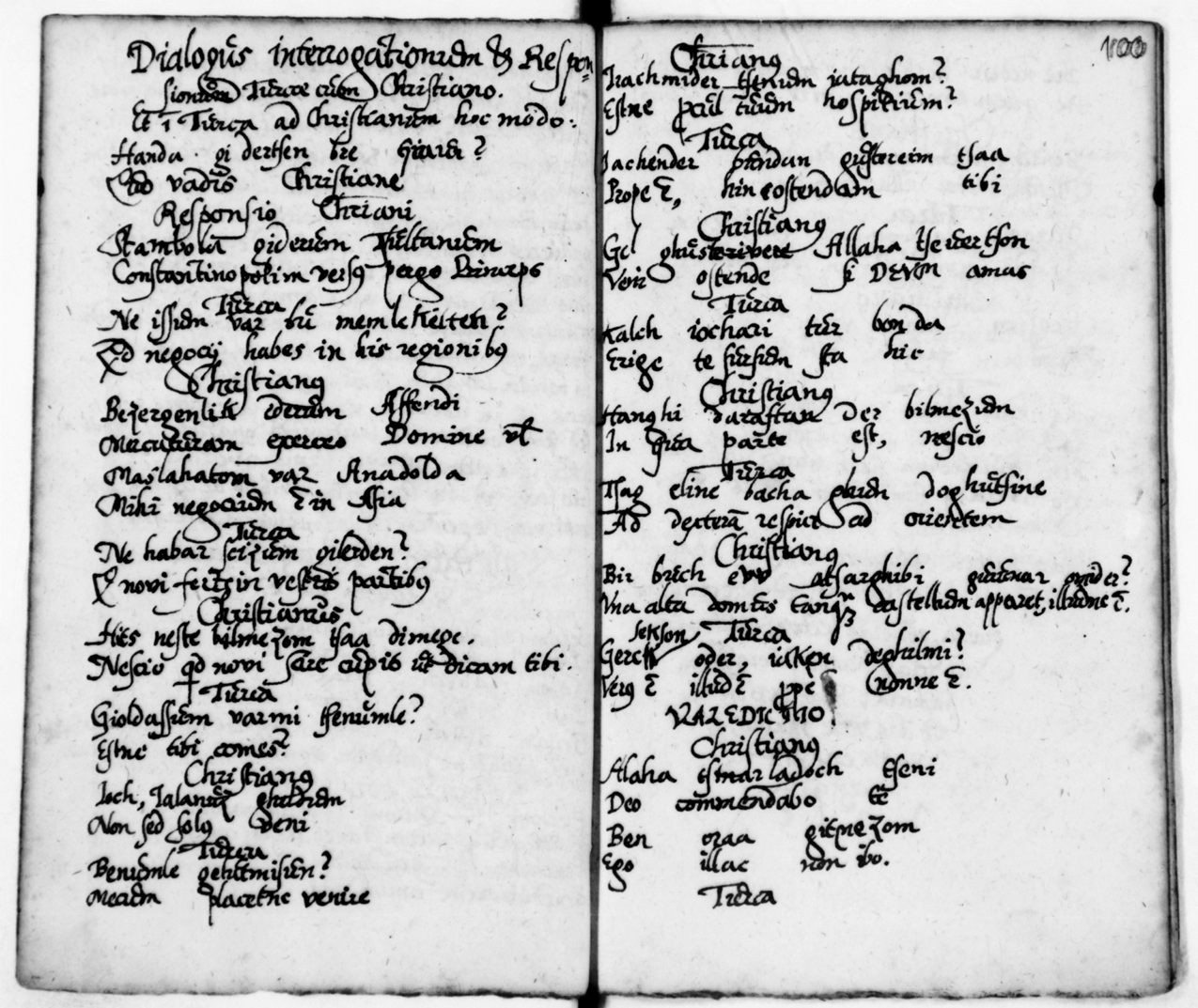
When copying Đurđević's information about Ottoman school lessons, Gerhard surely recognized parallels in topics and didactic methods. Grammar, poetry, and philosophy featured prominently into the curriculum of Ottoman madāris and German Latin schools. When copying prayers and creeds in Arabic, Ottoman, and Slavonic, as well as Ottoman religious poems, Gerhard could have noticed further parallels with Lutheran devotional literature. He also meticulously copied a fictional Ottoman-Latin dialogue between a Christian and Muslim.Footnote 66
We can barely imagine how this would have stirred the young Gerhard. Did he greet his parents in the Ottoman Selam alēk baba and Selam alēk ana, as recommended in Đurđević's text? What we do know for sure is that young Gerhard read such Ottoman texts at least twice. He even corrected Ottoman misspellings (figure 1), a fact that documents this schoolboy's interest in linguistic correctness.Footnote 67 The Latin school equipped Gerhard with skills and confidence when dealing with polyglotism, which led this early modern German teenager to engage with transcriptions of Ottoman texts.
Johann Gerhard's copy of an Ottoman-Latin dialogue printed in the captivity narrative of Đurđević. © Universitäts- und Forschungsbibliothek Erfurt/Gotha, Chart. B 906, fol. 99vf.

When Gerhard died, the school notebooks were passed down to his son, Johann Ernst, who was just fifteen years old at the time. Like his father, Johann Ernst decided to study theology, became a professor of theology in Jena in 1655, and developed a fascination for Oriental languages.Footnote 68 Johann Ernst published language treatises on Hebrew, Arabic, Aramaic, and Ge‛ez,Footnote 69 and he was also at least somehow interested in the Ottoman language. When purchasing Ottoman manuscripts from the library of the Altdorf Orientalist Daniel Schwenter in 1641, he scribbled notes regarding the content of these texts.Footnote 70
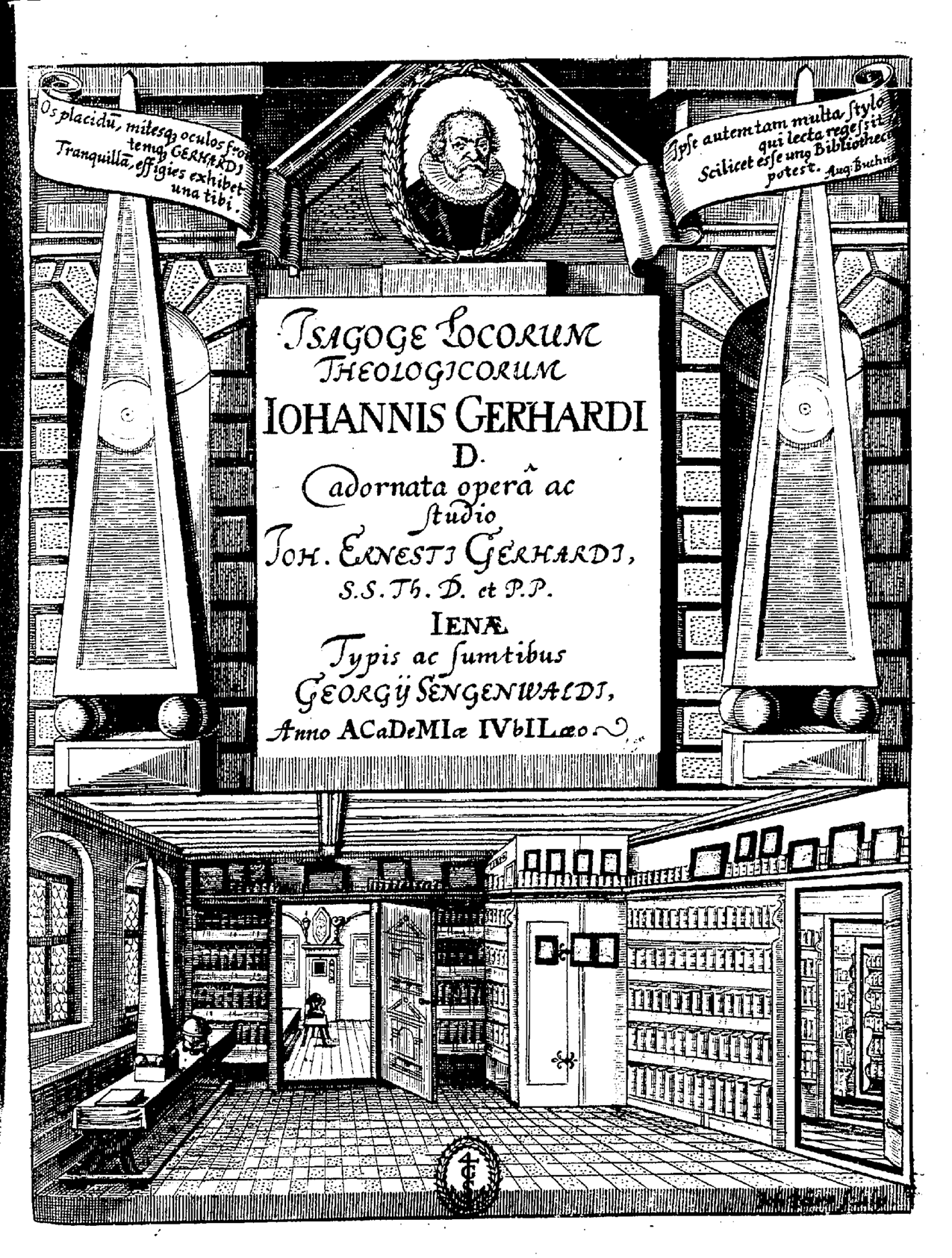
We are left wondering whether his interest in Ottoman first awakened when reading his father's school notebooks, as he consulted these manuscripts various times throughout his life—for instance, when preparing an annotated introduction to his father's Loci Theologici upon the latter's death (figure 2).Footnote 71 The example of Gerhard introduces us to a world of Lutheran orthodoxy that cultivated a cross-generational fascination for the Ottoman language deriving from lessons at school. The question to what extent such engagement with Ottoman was a meaningful and sustained interest is at the core of the debate discussed in the next section.
Title page of Johann E. Gerhard, Isagoge Locorum Theologicorum (…) (Jena, 1658) showing a portrait of the father. © Universitäts- und Landesbibliothek Sachsen-Anhalt, Halle, AB 38 5/k, 2.

New Perspectives on the Rise of Ottoman Language Studies
Given that most school notebooks have not survived, we have no idea whether such readings were common in early modern German schools.Footnote 72 However, the fact that the pupils of the early-seventeenth-century Latin School of Zwickau, Saxony, engaged in Arabic language learning is a striking parallel. Responding to the outbreak of the bubonic plague, the school's headmaster, Johann Zechendorff, introduced new readings like the Penitential Psalms in Arabic, as well as the Qur’ān, a work considered having been composed by the so-called “Arab Cicero.” The parallels between this example and Gerhard's materials demonstrate Oriental studies’ embeddedness in late humanist scholarship and the latinate culture of the day. Intriguingly, Zechendorff also maintained correspondence with Johann Ernst Gerhard.Footnote 73 In certain contexts, thus, Arabic and Ottoman language-learning materials could become acceptable teaching materials in Latin schools in early modern Germany.
While anything more precise can hardly be stated with the currently available evidence, we know for certain that Tübingen, Leipzig, and Wittenberg scholars became increasingly attracted to the Ottoman language around 1600.Footnote 74 Johann Melchior Mader, a student of the Tübingen Hebrew professor Michael Beringer, bridged the world of scholarship and schools.Footnote 75 His album amicorum shows that he went to Leiden and Paris, where he studied Oriental languages with Thomas Erpenius, as well as the Maronites Sionita and Hesronita.Footnote 76 After his return to Germany in 1617, Mader wrote a successful petition asking the Augsburg municipal council to offer lessons in Oriental languages to the sons of local citizens. According to his letter, Mader was proficient in Arabic, Ethiopic, Hebrew, Latin, and Ottoman.Footnote 77 His inaugural lecture on the usefulness of the Arabic language, as well as a collection of polyglot poems, went into print with the support of the art dealer Philipp Hainhofer.Footnote 78 Hainhofer maintained close contacts with the Duke of Pomerania, to whom Mader had dedicated his prints. We have thus reasons to assume that Mader intended to attract the duke's patronage—to no avail as the duke died soon after the print's publication. After just a couple of months, Mader left Augsburg for Linz, where he met Hieronymus Megiser, likewise a former Tübingen student. In the meantime, Megiser had published the very first printed Ottoman grammar in 1612, and he proudly wrote a note into the album amicorum of Mader with whom Megiser shared a fascination for the Ottoman language.Footnote 79
People like Megiser and Mader made the seventeenth century a transformative period for Ottoman language learning in Europe. In 1612, Megiser published the very first printed volume of explanations on the Ottoman alphabet, grammar, vocabulary, dialogues, and proverbs.Footnote 80 Megiser's substantial grammar was used by many future generations of Orientalists such as Johann Christoph Wagenseil.Footnote 81 One of its earliest readers was Mader himself, whose heavily annotated personal copy has been in the collection of the Viennese bookseller Antiquariat Inlibris Gilhofer Nfg. GmbH until recently.Footnote 82
This copy is particularly fascinating given Mader's comments suggest that the Carinthian nobleman Hector von Ernau, Megiser's patron, was the actual author of the Ottoman grammar printed in 1612. When reading this grammar in 1620, things had changed for Mader. Three years earlier, he had still rated Megiser among the elite of Europe's Orientalists.Footnote 83 Two years after having personally met Megiser in Linz, however, Mader took his personal copy and crossed out the title page reference to authore Megiser, calling him instead the volume's descriptore.Footnote 84 In another marginalia, Mader calls Megiser a liar: “This is a pack of lies. Hector von Ernau it is [the author], but not you.”Footnote 85 Already in 1609, Megiser worked in similar ways when preparing his Malagasy-German glossary of approximately two thousand entries that were translated from a Dutch source.Footnote 86 In fact, Megiser must have understood himself primarily as a collector of language variety. A polyglot in this humanist sense, his Specimen quinquaginta linguarium from 1603 is “a dictionary of nearly 1600 octavo pages, which claims to document forms in about four hundred languages [in fact, far less given dialects are registered as separate languages], following its Latin headwords with as many synonyms as possible … and the number of forms given must be about a hundred thousand.”Footnote 87 Instead of praising Megiser for having been “just about the only person in the world who had a good acquaintance with Slovene, Turkish and Malagasy,”Footnote 88 Mader's personal marginalia prompt us to think about Megiser's scholarly as well as non-academic networks that connected him with the Habsburg-Ottoman contact zone: Protestant nobleman Hector von Ernau was the administrator (Landeshauptmannschaftsverweser) of Carinthia.Footnote 89
Mader, who is today remembered—if at all—as an early Arabist, was well capable of judging Megiser's claim for authorship. His personal networks, as the album amicorum shows, linked the worlds of scholars and noblemen, and Mader's personal copy proves that his Ottoman proficiency surpassed Megiser's knowledge. The densely annotated copy contains Mader's corrections and additions to Megiser's insufficient and sometimes incorrect statements, for example, Mader's specifications on the vowel signs sükūn and tešdīd.Footnote 90 Mader harshly rejects Megiser's comments about the use of difficult and rather artificial ligatures, stating that such ligatures are correct according to the ordo naturalis Alphabeti, and similar to Hebrew and Arabic. Mader realized that Megiser must have taken some examples from Ottoman poems, which prompted Mader to add a few comments on their rhythmicity and verse structure.Footnote 91 Interleaved pages in Megiser's dictionary provided Mader with plenty of space for further additions and corrections. He referenced the Ottoman names of the months, and he also added missing Ottoman synonyms. When Megiser lists fakür (فقير) as Ottoman for “poor” (pauper), Mader adds muflis (مفلس), which literally means “a bankrupt.” When Megiser's dictionary contained wrong translations—a mine for minerals (معدن), for instance, was wrongly translated as stomachus—Mader crossed them out and added their correct translation.Footnote 92 Thus, Mader must be considered a largely forgotten figure of early Ottoman studies who had good contacts with Ottoman and Oriental language enthusiasts all over Europe—in Augsburg, Austria, Leiden, Paris, Pomerania, and Tübingen—crucial networks for the ambitious career of an Ottoman language student and teacher.
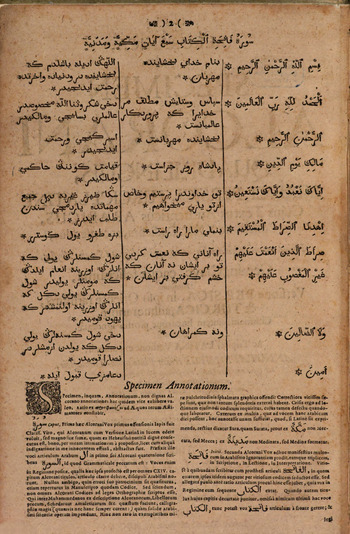
The publication of the very first printed Ottoman grammar was just the starting point of a broader development: seventeenth- and eighteenth-century Europe faced an increase in scholarship on Ottoman language studies that relied on an intensification of face-to-face interactions in Christian-Muslim contact zones. Born in the northwest German territory of Lippe and having developed an interest in Oriental languages during his uprising in Bremen, Levinus Warner enrolled at the University of Leiden and spent approximately two decades in Istanbul.Footnote 93 Having learned Ottoman during his diplomatic service in the Levant and in Egypt, André du Ryer published his own Ottoman grammar in Paris in 1630. This grammar, especially the use of Arabic characters throughout the volume, was “an improvement” to the print of Megiser.Footnote 94 Breslau pastor Andreas Acoluthus had worked on his famous Arabic, Persian, Ottoman, and Latin Qur’ān specimen since the late 1670s (figure 3), when a returning soldier presented an enslaved young Ottoman woman to the Lutheran scholar. Having been the wife of an imām in Belgrade, the young woman was surely proficient in both Ottoman and Arabic, and must have had some novel information about the Qur’ān that the Lutheran scholar was longing to hear. The fact that she took flight only six months after her arrival—despite her being emancipated by Acoluthus—hints at her possible experience of such a linguistic encounter as a troubling transgression of personal, religious, and gender boundaries.Footnote 95
Andreas Acoluthus, Tetrapla Alcoranica, sive specimen Alcorani quadrilinguis, arabici, persici, turcici, latini (…) (Berlin, 1701), 2. © Bayerische Staatsbibliothek München, 2 A.or. 38, S. 2, urn:nbn:de:bvb:12-bsb10210801-0.

In nearby Brandenburg, the Hungarian Jakab Harsányi Nagy published his collection of Ottoman dialogues in 1672—this is, again, a story of moving speakers’ impact on the development of Ottoman language studies in central Europe. Harsányi had studied in Leiden, but he must have gained Ottoman proficiency when serving as a scribe at the Greater Chancellery of the Principality of Transylvania, and later on as an interpreter at the embassy in Istanbul. Harsányi started translating diplomatic correspondence and participating at negotiations after approximately three years of language studies under the supervision of a local hoca. Harsányi did not miss the opportunity to foreground his practical expertise when publishing his textbook as the court councillor in Brandenburg seventeen years later. The development of early Ottoman studies, thus, heavily relied on mobile speakers and their investments into face-to-face interactions and manuscript encounters.
Early Modern Ways of Reading Ottoman Grammars
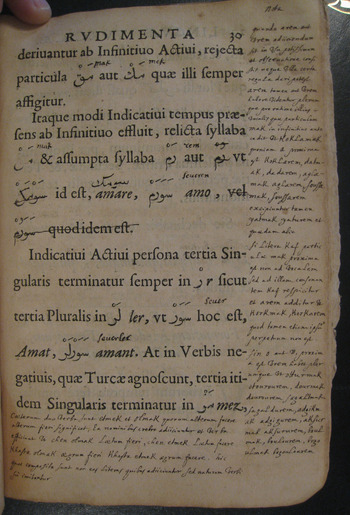
How did the increasing availability of printed Ottoman grammars impact early modern language learning? The Arcadian Library holds a fascinating copy that helps answer this question. The second edition of André du Ryer's Ottoman grammar, published in 1633, dedicated to Cardinal Richelieu, and heavily annotated by either a late seventeenth- or an eighteenth-century reader, illustrates that readers approached such grammars with pen in hand (figure 4).Footnote 96 Here, note-taking served as a means to promote careful and detailed readings, to acquire knowledge, and to facilitate its memorization.
A reader's comments in André Du Ryer, Rvdimenta grammatices lingvæ tvrcicæ (…) (Paris, 1633). © The Arcadian Library, 16656, 30.

Du Ryer's reader added Latin transcriptions of Ottoman words. The reader also applied grammatical rules, for instance, when conjugating the passive forms of sevmek (to love, سومك) and oqumaq (to read, اوقومق) or when inserting Ottoman proverbs that the reader copied from Megiser's print.Footnote 97 Such notes and marginalia in printed Ottoman grammars should not be considered mere additions, but rather crucial tools to acquire proficiency in the Ottoman language and, more precisely, in Ottoman proverbial speech.
It was exactly such colloquial skills that prompted scholarly appreciation. When Đurđević—whose print contained sample dialogues that were later studied by the young Gerhard—visited Wittenberg, he was invited to tell Melanchthon some “histories on the Turkish matters.” On that occasion, as Melanchthon stated in a letter written to the Thuringian reformer Justus Menius, eleven languages were spoken in his house: Latin, Greek, Hebrew, German, Hungarian, Wendish, Ottoman, Arabic, Greek vernacular, and even some Spanish and “Indian” (Indica, maybe a form of Hindi, Sanskrit, or a New World language). In a special certificate that was also printed in the German translation of the captivity narrative in 1545, Melanchthon and Martin Luther attested to the veracity of Đurđević's account.Footnote 98
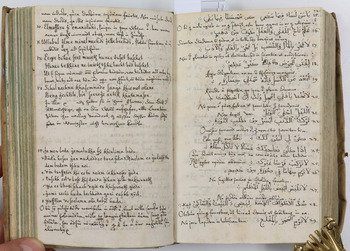
Ottoman language learning thus also aimed at dropping Ottoman bons mots among scholars in appropriate social contexts. This echoed the broader humanist appreciation of proverbs and also the increasing availability of translated collections of Arabic, Ottoman, and Persian proverbs in seventeenth-century central Europe.Footnote 99 It is therefore no surprise that central European readers of early printed Ottoman grammars focused on such details. In his personal copy of Megiser's grammar, Mader added plenty of Ottoman proverbs in more than twenty-six interleaved pages (figure 5). Hundreds of Ottoman proverbs were given in transcription or the original, and Mader added Latin, Italian, or German translations. He seems to have extracted some of the sayings from the Qur’ān.Footnote 100 Mader also added explanations of when to use proverbs like “Did the camel hit your mouth?,” which shall be said toward “somebody who is silent when he should speak up.”Footnote 101 Mader also corrected proverbs and added the Ottoman writings of some of them.Footnote 102 The aforementioned reader of Du Ryer's grammar, however, was fonder of Megiser's collection of proverbs and copied them into the volume of Du Ryer's grammar in order to develop his skills in Ottoman paroemiae. Early modern readers of printed Ottoman language-learning materials, thus, considered their orality key.
Interleaved pages with Ottoman proverbs, transcriptions, and translations that Mader added into his copy of the Institutiones linguae turcicae (1612/20). © Antiquariat Inlibris Gilhofer Nfg. GmbH Vienna, now at Princeton University Library, C0938, no. 835.

Beyond achieving skills in proverbial speech and erudition, the validation of information on linguistic correctness was crucial. The reader compared the book's information with other texts and corrected the mistakes he or she found in Du Ryer's grammar. For instance, the reader improved savmaq (سومق) to sevmek (سومك), and even corrected the conjugation of olmaq (to be, اولمق) in the negated form of the preterite optative, thus, the adequate form to express a negation of a wish or hope in the past.Footnote 103 The reader also criticizes Du Ryer's comments on the genitive. In the Ottoman language, the character kef (ك, -iñ, -üñ) forms the genitive of a noun. If the noun ends with a vowel, however, the consonant nūn (ن) is used. Du Ryer wrongly extends this rule by explaining that words like beğ (بك) require the usage of nūn as their final character, where kef is pronounced like a vowel. The anonymous reader harshly comments that “this rule is absolutely false since beig is declined like all other words ending in consonants.”Footnote 104 The example illustrates the degree to which comparative readings of seventeenth-century prints, and maybe even available manuscript materials, allowed early modern Europeans to critically engage with and improve their knowledge of Ottoman grammar when comparing and updating such prints.
Given the significance of comparative readings for Ottoman language learning in early modern central Europe, the earliest German readers of the first printed Ottoman grammar are worthy of study. When Megiser's Institutiones linguae turcicae was published in Leipzig in 1612, no further materials allowed readers to compare this print. A certain “J. F. de Stauff et Unterach” experienced this problem in 1620, when reading his personal copy of Megiser's Ottoman grammar that is now preserved in the British Library.Footnote 105
The owner of this copy was presumably Johann Ferdinand von Stauffer und Unterach, a member of an Upper Austrian Protestant noble family.Footnote 106 During the seventeenth century, some of this reader's relatives are mentioned in Nuremberg prints. Elias von Stauffer und Unterach is documented as a writer and student of politics and philosophy at the University of Altdorf, a Lutheran academic center of Oriental language studies. His daughter, Helena Catharina, married in Nuremberg in 1673. His son, (a different) Johannes Ferdinand, was inscribed in Altdorf in 1664 and published his juridical dissertation in Strasbourg in 1675.Footnote 107
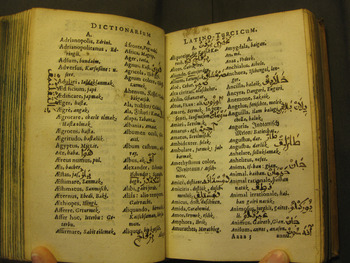
Stauffer carefully read Megiser's text. As Arabic characters were extremely expensive to cut, Megiser used the Arabic types of the Breslau Arabist Petrus Kirstenius, whom Mader also called “my unique friend.”Footnote 108 However, only the first part of the grammar contains Arabic characters; the rest of Megiser's grammar is composed of Latin transcriptions. Stauffer obviously considered this a shortcoming, and therefore added the Arabic spellings of hundreds of Ottoman words into his personal copy (figure 6). By doing so, Stauffer realized that Megiser's Ottoman thesaurus relied on a number of unidentified Italian sources. In fact, Megiser must have had access to Venetian materials given that he published Giovanni Baptista Ramusio's edition of the journeys of Marco Polo in a German translation just one year earlier.Footnote 109 This resulted in Megiser's German transcriptions being imprecise if the Ottoman word contained the character “g.” Depending on the sequence of characters, the Ottoman characters kef (ك), ǧīm (ج), and čīm (چ) were pronounced as [ka:], [ge:], [ɲ], [ʤ], [t͡ʃ], [j], or [:]. Relying on his Italian sources, however, Megiser transcribed all these Ottoman characters by using the Latin character “g.” Depending on the following vowel, “g” is either pronounced [g] or [t͡ʃ] in Italian. A German readership, however, would have read all of these transcriptions as a [g]. For example, the Ottoman word for “chef,” aşçı (اشجى) was transcribed as achtgi. Although the Italian pronunciation [aktʤi] somehow matches the Ottoman word, a German would have wrongly pronounced the transcription as [a:χtɡi:]. Stauffer realized such discrepancies, and he became seriously concerned as they put all his learning efforts at stake. He underlined the “g” in Megiser's entry achtgi and noted “Ital[ian]” next to it. He also corrected a number of Megiser's transcriptions and specified the actual pronunciation of Ottoman words.Footnote 110 Orality, thus, was key for this early modern reader of an Ottoman grammar.
Stauffer's notes in the Ottoman grammar and dictionary Institutiones linguae turcicae (1612/20). © British Library London, 621.a.18.(1.), fol. Aaaa2vf.

Stauffer's enthusiastic and time-consuming engagement with Arabic spellings and Latin transcriptions also made him realize his own limits, as he encountered a series of problems when writing down Ottoman vocabulary. Even the most common ligatures like lām-elif caused Stauffer serious trouble. The words lālā (لالا) and penǧere (پنجره) are written in clumsy and almost illegible handwriting.Footnote 111 The writing flow is interrupted, presumably, as Stauffer had to compare his own attempts with templates.
In fact, many of Stauffer's Ottoman spellings are simply wrong. He transferred Megiser's transcriptions verbatim, sometimes even neglecting the sentence's correct reading direction from right to left.Footnote 112 Furthermore, he deduced the spellings from phonetics. When transcribing Megiser's question Ne istersen, Quid vis? Stauffer was aware of the correct spelling of the infinitive of istemek (to wish, استمك), yet he did not know the correct spelling of the second person singular of the aorist. Instead of using the correct suffix (سك), Stauffer used a different spelling that resembled the correct sound (نه استرسين)Footnote 113. This evidences the difficulties of learning Ottoman in early modern Germany. Even increasingly available printed Ottoman grammars and dictionaries gave its ambitious readers severe headaches.
Linguistic Fieldwork in Hungary, Tübingen, and Zurich
The following two examples from seventeenth-century Tübingen and Zurich illustrate the length central Europeans were willing to go to become trained in Ottoman, even without such rare printed resources at hand as discussed previously. Their fascination with this puzzling language overcame considerable obstacles and could even result in proto-linguistic fieldwork—acts of “collecting data in its natural environment” and “study[ing] a language in the place where it is spoken, by the people who usually speak it.”Footnote 114 Early modern central European lexicographers with ambitions in collecting Ottoman data had an important geographical area to conduct fieldwork in: the southern and eastern European areas of the Ottoman Empire.Footnote 115 It is thus crucial to ask what wider repercussions the Habsburg-Ottoman border zone had as a driving force of linguistic exchange and translational enterprises of both written and spoken words in central Europe. “Dirty-feet linguists provide the fodder upon which many armchair linguists depend,” read modern guidebooks on linguistic fieldwork. In fact, “There is a kind of halfway house in linguistic fieldwork between sitting in the armchair and getting dirty feet.”Footnote 116 Early modern German-speaking central Europeans were willing to explore, test, and expand the cultural and geographical boundaries of such halfway studies between working with books and in the field when engaging in Ottoman language learning.
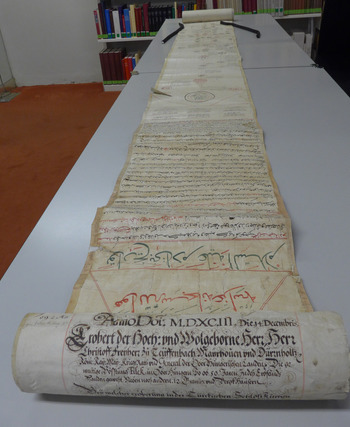
Frontier interactions caused the mobility of people and artifacts, which promoted the curiosity in Ottoman in central Europe. When Habsburg imperial troops looted the Hungarian border zone and the castle of Fil'akovo, Veit Marchtaler, a soldier and citizen from Ulm, took a fascinating Ottoman manuscript: a “45 werkschuch long” scroll of unknown content (figure 7).Footnote 117 The appearance of this impressively long manuscript scroll composed out of circa thirteen-meters-long shimmery cotton or rice paper was fascinating, also due to the calligraphic features that were written in beautifully regular hand in black, green, and red inks. Contemporary German-speaking central Europeans must have been puzzled by the beauty and regularity of Ottoman calligraphy especially given it evoked the aesthetics of master calligraphers trained in so-called Schreibmeisterschulen throughout the German lands. In August 1664, therefore, one of these master calligraphers active in Kassel crafted himself a text in the Ottoman language and presented this “Turkish prayer” to the Lutheran Duke Ernest I of Saxe-Gotha.Footnote 118 Judging from the similarity of the title, this Ottoman text could have been a copy of the anti-Habsburg prayer that was found with an Ottoman soldier who was taken captive while fighting the Holy Roman Empire some months earlier; a discovery that led to the publication of the “Turkish prayer” and “the Turks’ evilness” in German translation around the same time.Footnote 119 Such examples highlight that military encounters and printed turcica could provoke artistic and cultural exchange that was grounded in a shared aesthetic appreciation of calligraphy beyond the religious divide. This cross-culturally shared, bodily and sensory engagement with the materiality of words should prompt historians to reconsider the broader cultural resonances of circulating manuscripts, as well as the aesthetic and emotional appeal such Ottoman manuscripts were able to evoke in central Europe.Footnote 120 The fascination for Ottoman calligraphy was further increased given Ottoman manuscripts, despite their circulation, remained a rarity in late-sixteenth- and early-seventeenth-century central Europe. The library of the Nuremberg pastor Adam Rudolph Solger (1693–1773), for instance, comprised approximately ten thousand volumes, with fifty-two Hebrew, ten Syriac, nine Arabic, and only two Ottoman books and manuscripts among them.Footnote 121
The beginning of Yūsuf ibn ʿAbd al-Laṭīf's Tavarich Beni Adam (تواريخ بني آدم ) including a reference to the looting of the manuscript by Habsburg troops. © Herzog August Bibliothek Wolfenbüttel: Cod. Guelf. 111 Aug. 4°.

Marchtaler sent the unique Ottoman manuscript looted at the Hungarian castle of Fil'akovo to Wilhelm Schickard, a professor of Hebrew at Tübingen since 1619. At that time, a generation of Greek and Hebrew scholars had cultivated an interest in the Ottoman language at that university. Greek scholar Martin Crusius, for instance, had tried to estimate the “corruptive” impact of Ottoman onto the language usage of Greek subjects of the sultan by drawing a number of visiting Greeks into conversations about their language—not unlike the face-to-face interactions that had encouraged the development of Ottoman language studies.Footnote 122 In addition to Greek visitors, the publication of translated works of more recent Greek authors such as Laonikos Chalkokondyles made Ottoman sources and vocabulary more known to central European readers.Footnote 123 The early academic interest in Ottoman studies cultivated at the University of Tübingen must have further triggered the scholarly ambitions of Schickard, whom contemporaries admired for his knowledge in astronomy, geography, mathematics, and Arabic.Footnote 124 It is only recently that studies have uncovered Schickard's “considerable mistakes” both in transcriptions and translations of Arabic words.Footnote 125 In the meanwhile in Tübingen, the rare Ottoman manuscript caused Schickard both excitement and despair. He contacted leading European Orientalists, but none of them had access to Ottoman language-learning materials. Johannes Buxtorf sen., the famous Hebrew scholar from Basel, informed Schickard that he had seen an Ottoman grammar, presumably the one printed by Megiser, in the shelves of the Frankfurt printers and booksellers Johannes Langen and heirs six years prior. Buxtorf also recommended Schickard to contact Dutch scholars and printers for similar materials.Footnote 126
Some weeks later, however, Schickard received news that no Oriental texts could be sent from Frankfurt am Main.Footnote 127 The Lebanese-Maronite scholar Gabriel Sionita informed Schickard that no Ottoman language-learning materials were available in Paris.Footnote 128 The Viennese librarian Sebastian Tengnagel, himself a fervent student of an Ottoman version of al-Jannābī's famous chronicle, was similarly of no help.Footnote 129 After several months, Tengnagel sent a promising response stating that he would send useful Ottoman, Arabic, and Persian materials to Tübingen, yet such documents never arrived and Schickard waited in vain.Footnote 130 Somehow, he managed to read Megiser's grammar, but Benedictus Bakai, a Hungarian living in Ulm, was of more help when sending notes regarding Ottoman grammar.Footnote 131
Notwithstanding all these efforts, Schickard did not acquire proficiency in Ottoman, a necessity to fully comprehend the content of the striking manuscript—the Tavarich Beni Adam, a genealogy of the sons of Adam leading to Sultan Murad III, written by Yūsuf ibn ʿAbd al-Laṭīf.Footnote 132 Despite his failure to learn Ottoman, Schickard composed a 248-page Latin treatise on this Ottoman manuscript in less than three months.Footnote 133 By focusing on Arabic-influenced wordings, for example, the title or names, Schickard was able to reconstruct the genealogy, and he filled the gaps of illegible Ottoman descriptions with information he found in European prints.Footnote 134
When explaining the manuscript's title Tavarich Beni Adam (The Story of the Sons of Adam), Schickard widely explained its relationship with Hebrew—ta'arikh (תאריך)—and Arabic—ta’rīḫ (تاريخ)/tawārīḫ (تواريخ)—vocabulary. Being able to read the Arabic cartouche of Kain, Schickard inserted missing information taken from the Bible as well as Hebrew, Greek, and Kabbalistic materials.Footnote 135 This approach was grounded in Schickard's implicit assumption of a linear development of languages after God had punished humanity for the Tower of Babel by introducing linguistic diversity. According to this understanding, Hebrew, Arabic, Ottoman, and German would have been considered cognates because they formed a line of linguistic development that allowed scholars to deduce meanings based on assumed phonetic kinship among Hebrew, Arabic, Ottoman, and German. For instance, Schickard considered the German word Erde (earth, soil) to be derived from the Arabic ’arḍ (ٲرض), and Hammel (mutton) akin to ḥamel (حمل), Schickard's misreading of the handwritten ḥaulī (حولى).sFootnote 136 Making use of this approach to decipher the meanings of Ottoman words echoes again Schickard's difficulties to access the writings of Megiser. In his Ottoman grammar from 1612, the author explained that Ottoman is not related to Arabic but to the Persian and Tartar languages.Footnote 137 In his Thesaurus polyglottus (1603), Megiser had grouped all languages known to him into nine different families: Ottoman, Persian, and Tartar, together with other languages, in an “Asian” family distinct to a “Germanic” and “Hebrew” family that also contained Arabic.Footnote 138 Though Megiser might have wondered about Schickard's way to approach the task of learning Ottoman, other contemporaries considered such a comparative engagement completely logical. Approximately four decades after the publication of Schickard's Tarich (1628), between 1663 and 1685, the Danish Lutheran minister Peder Syv experimented with linguistic comparisons between biblical languages and Sami, as well as between Danish and Ottoman vocabulary noting phonetic similarities between Ottoman karga (correct قارغه) and the Danish karge—which both translate as “crow.”Footnote 139
The ways that Schickard responded to the availability of the Tavarich Beni Adam, above all, show that the sheer existence of such a remarkable Ottoman manuscript aroused the scholar's desire for merit—even his failure to learn Ottoman could not deter his writing about it. This case captures the emotional qualities of Ottoman language learning in early modern Germany, not just with this Tübingen scholar. Veit Marchtaler actively distributed Schickard's print, and even Gotha Orientalist Hiob Ludolf, Wolfenbüttel librarian Gottfried Wilhelm Leibniz, and Helmstedt professor Jacob Paul Bruns studied this particular Ottoman manuscript decades later.Footnote 140
Schickard's “armchair”Footnote 141 enterprises resulted from the broader vibrancy of cultural exchanges in the meeting point of two empires: the Habsburg-Ottoman border zone in Hungary. It was a crucial site of exchange that engendered the wider circulation of written and spoken Ottoman. A fascinating case from seventeenth-century Zurich illustrates the contexts that made central Europeans actively engage in linguistic fieldwork in the Habsburg-Ottoman border zone. Born in the area of Zurich, Johann Jakob Redinger graduated from the Latin school there and studied theology. Being a Lutheran priest in Urdorf, his vehement support of the Lutheran case made the Zurich municipal council discharge Redinger, who then went to Amsterdam. In the Netherlands, Redinger made a life-changing acquaintance with Czech pedagogue and theologian John Amos Comenius. Redinger translated Comenius's visionary literature and installed his pedagogical doctrine as a school rector in Palatine Frankenthal. When Redinger lost his job, he not only tried to convince the elector palatine and the king of France of the correctness of Comenius's prophetical writings; in 1664–1665, he even traveled to Hungary, where he wanted to meet the Ottoman grand vizier in order to fulfill a crucial element of the prophecies of Comenius: the conversion of “the Turks” to Christianity.Footnote 142
An autobiographical report, written in the direct aftermath of his Hungarian travels in Dresden, Berlin, Kassel, and Frankenthal in 1665, allows us to reconstruct Redinger's personal perspective on his journey. In accordance with the Lux tenebris, the prophecies edited by Comenius, Redinger believed that God would lead the Ottomans toward a victory over Rome and Vienna. After the collapse of the papacy, Christians would start to act in truly Christian ways, and the Ottomans, Jews, and “heathens” would convert to Christianity.Footnote 143
In order to turn these prophecies into reality, Redinger went to Hungary to present the Lux tenebris to Köprülüzade Fazıl Ahmed Pasha. In that context, language proficiency became a crucial tool. Redinger spoke Latin and German with Hungarian peasants and Italian with priests and soldiers in Transylvania.Footnote 144 When presenting the Lux tenebris in an audience to the surprised grand vizier, Fazıl Ahmed called for a German servant and an Orthodox Greek interpreter
who asked me many things in detail, among others also which languages I am trained in. I replied that I understand some Hebrew, Greek, Italian, and French. Consequently, I had to say some things in Hebrew: I started to recite the first chapter of the Book of Genesis. He (the interpreter) spoke some Greek and Italian with me. Once I announced that the Turks shall convert to the Christian faith, he and the other gentlemen looked at me in a serious way and he asked me whether I want to become a Turk. I was smiling and said “No, I cannot as I am convinced that the Turks will turn Christian within a few years.”Footnote 145
Redinger fails to convince the grand vizier of his plans to fulfill the prophecies of Comenius, but he nevertheless becomes aware of the significance of Ottoman language learning. Redinger's copy of the prophecies was illustrated with an engraving showing a man presenting a book to the Ottomans. Presenting the Lux tenebris in an audience, the self-proclaimed prophet states that the engraving shows the Bible, which will soon be printed in Ottoman in the Netherlands. Redinger was apparently aware of Levinus Warner's enterprise, funded by Comenius, who believed that an Ottoman translation of the Bible would facilitate the spread of Christianity. Redinger also describes the Ottoman interpreter as desperately waiting to read this text.Footnote 146
It is in his failure to convince the grand vizier and his servants that Redinger realizes the persuasive power of linguistic proficiency. For the fulfillment of the prophecies, Redinger asked to “travel to Constantinople” to “learn the Turkish language and help the Turks with interpreting the Turkish Bible when it will be sent along.”Footnote 147 Redinger never arrived in Istanbul, though he needed to escape the camp, but fulfilled part of his plan by spending time in Nové Zámky and Belgrade: “Every day, I went out of the tent to (visit) the foot soldiers nearby … and I learnt around fifty Turkish words per day.”Footnote 148 In this way, Redinger fashioned himself as a successful fieldworker who gained Ottoman language proficiency in order to safeguard Christianity—at least, what he believed to be “true” Christianity.
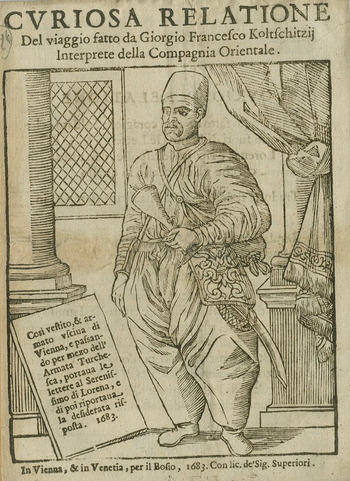
Though framed in religious terms, the narrative is somewhat reminiscent of the circulating print of the Habsburg Ottoman interpreter Koltschitzij, who made use of his language proficiency to pass Ottoman military lines, dressed in Ottoman clothes, and deliver a message that finally “rescued” Vienna (figure 8).Footnote 149 Stories of border-crossing heroes who could speak Ottoman circulated widely and drummed up enthusiasm for language learning as a means to ambitious ends—in the case of Redinger, his goal of bringing about the final prophecies of God, unveiled through Comenius's writings.
Depiction of Koltschitzij's adventurous enterprise. © Országos Széchényi Könyvtár, App H 1028.

After his return to Zurich, Redinger was arrested and spent the rest of his life in chains in the hospital, which amounted to more than twenty years. Historians have long labeled Redinger a lunatic fantasist.Footnote 150 Recently, however, Sundar Henny suggests a new approach to Redinger's autobiographical narratives as auto-prophetical writings—not being granted citizenship of Zurich and not recorded in the city's Book of Citizens, Redinger decided to enroll into the Book of Heaven and promote God's plans, as prophesized through the writings of Comenius and realized through his own deeds.Footnote 151 According to this logic, Redinger's autobiographical claims can be understood as a means to fulfill prophetical expectations. It is thus no coincidence that Redinger praises the Ottomans as being better Christians than many central Europeans.Footnote 152 His remarks on Ottoman language learning also led him to dub himself “German prophet,” a moniker by which he came to known among Ottoman soldiers.Footnote 153
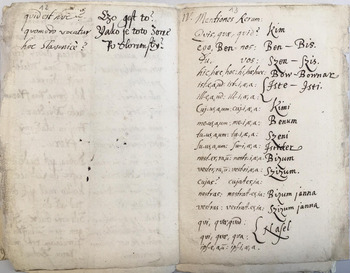
Redinger's notebook of Ottoman language studies, composed in Transylvania in 1664, shows his rather desperate efforts to learn Ottoman—he notes the difficulties of vowels not being indicated and drafts detailed charts of conjugations and wordlists.Footnote 154 His notebook reflects the oral nature of his experiences. Redinger praises Ottoman as these “people's vernacular,” and he seems to have made use of circulating Hungarian-Latin dictionaries that contained a few notes on conjugations. When having trouble understanding syllables, he made his own assumptions when transcribing the word.Footnote 155 Other times, he simply took for granted that a soldier's Slovak responses are actual Ottoman.Footnote 156 A list of names of different Hungarians and their places of origin may indicate those with whom Redinger had maintained notable conversations. Among them were also converts, as well as a certain “Georgio Literati” from Istanbul who might have taught Redinger some basic Ottoman; it seems as if they maintained their conversation through Greek, Albanian, and Italian. A certain Pataki is recorded to have cursed Redinger as a heretic.Footnote 157 The meaning of the brief entry “Jacabus Harsani, envoy, was here” remains a mystery for now. Did some of Redinger's acquaintances—maybe a relative such as “Georgius Harsani” who is likewise mentioned in the list—recommend Redinger to get in contact with the former diplomatic representative of the exiled voivode of Moldavia at the Diet of Hungary in 1662? By the time of Redinger's language exercises in Hungary, Jakab Harsányi was about to finish his stay in Stockholm in order to move forward to Pomerania—Harsányi published his Latin-Ottoman textbook only eight years after Redinger's Ottoman exercises, and it might be the case that Redinger planned, in vain, to get in contact with the Hungarian expert in Ottoman language after his return to central Europe.Footnote 158 Redinger's notes, thus, clearly resemble the complex oral layers of his Ottoman language studies.
Above all, however, the records show that Redinger understood his learning as deeply embedded in his Lutheran-prophetical and religious worldview.Footnote 159 Redinger's actual method of learning Ottoman, in fact, followed the pedagogical instructions of Comenius that he himself had translated and published in a textbook for the pupils of the Latin School in Frankenthal in 1659. After recording observations regarding Ottoman characters, nouns, adjectives, and conjugated verbs, Redinger engaged in drafting synoptic tables of personal, possessive, and demonstrative pronouns, as outlined in the Komenische Sprach-Lehr, the Comenian textbook published by Redinger five years earlier (figure 9).Footnote 160 This observation is striking because it conceptualized the very act of Ottoman language learning as a Lutheran pedagogical practice: the application of the methods of Comenius, who had reformed the Latin School in Sárospatak, Hungary, according to his pansophic principles and methods.Footnote 161
Redinger's Comenian table of Ottoman pronouns. © StA ZH A 24.1, Consilium de Lingva Turcica, 13.

Redinger, who understood his own deeds as acts that helped fulfil the prophecies of Comenius, considered his Ottoman linguistic fieldwork in Transylvania as a way of following in the footsteps of Comenius. Ottoman language learning, according to that logic, helped to turn these prophecies into reality, and it also proved the veracity of Redinger's prophecies to sceptics in Zurich—among them Johann Wilhelm Simmler, the uncle of Redinger's wife. Simmler worked against Redinger in a variety of ways, once publicly declaring that one cannot understand any Ottoman word the very same year Redinger started to learn the language using Comenian methods.Footnote 162 It was the Hungarian nexus between the Habsburg and Ottoman Empires, as well as the broader oral and non-academic contexts of early Ottoman studies, that transformed Ottoman language learning into a powerful tool to position oneself in such inner-Zurich personal and confessional conflicts.
Fascination and Translation
This article has charted a thus far unknown dimension of prints about the Ottoman Empire circulating in early modern central Europe. Pamphlets, captivity narratives, and similar turcica engendered fantasies, excitement, and curiosity as much as they encouraged some Germans to engage with the Ottoman language in more detail. This productive and creative side of the so-called “Turkish menace” has been overlooked, if not silenced, in historiography since the canonization of Oriental studies in increasingly academic contexts from around 1700 onward. When modern philologists then reconsidered the foundations of the discipline, the work of Ottoman language enthusiasts discussed here had hardly been studied because their activities went beyond the academic contexts that are traditionally taken into consideration.Footnote 163
In early modern Germany, however, Ottoman language learning took place in a diverse range of settings. By reconstructing the cultural contexts and socially diverse milieus of Ottoman language learning in early modern Germany, the article demonstrates the important role of the Ottoman language in the history of early modern central Europe. In sixteenth- and seventeenth-century Augsburg, Hungary, Leipzig, Nuremberg, Saxony, Thuringia, Tübingen, Upper Austria, Vienna, and Zurich, the Ottoman language could increasingly attract people such as diplomats, noblemen, scholars, students, and theologians. This observation should prompt us to look beyond the realm of classical scholarship when studying Ottoman language learning in early modern Europe.Footnote 164
In contrast to Arabic language learning, which was predominantly stimulated by biblical studies that led to the foundation of academic chairs, Ottoman language learning took place in everyday forms of humanist culture that became heavily affected by the broadened circulation of turcica, Ottoman materials, people, and knowledge engendered by the vibrancy of the Habsburg-Ottoman contact zone. Despite these protagonists’ different backgrounds, they shared certain emotional responses to Ottoman: failure and despair, as they often failed to gain linguistic proficiency, but also the astonishment and excitement that the language provoked in some early modern central European minds.
As a consequence, people were willing to invest plenty of time, money, and effort in learning Ottoman. They purchased rare and expensive printed dictionaries and grammars, and they engaged in the difficulties of making sense of their complicated and often corrupted content; they collected, structured, and studied fragmented information on Ottoman scattered across countless pamphlets and captivity narratives, and they were eager to make use of every possible chance to speak to actual native speakers; or they engaged themselves in linguistic fieldwork in one way or another. Among such German-speaking enthusiasts, Ottoman texts, words, and language-learning materials elicited pure excitement and fascination. Learning Ottoman made Renaissance men aware of their own desires and shortcomings. The ambivalence of fascination and failure, ambition and reality, bridged the worlds of scholarship and everyday life.
Understanding this fascination for Ottoman language learning in more comprehensive terms as part of broader cultural translations helps to address the reasons for such emotional responses. Bevilacqua and Pfeifer argue that “Ottoman culture offered an attractive vocabulary” and possibilities of “imaginative identification” to early modern Europeans.Footnote 165 In this sense, Ottoman language learning also provided sixteenth- and seventeenth-century central Europeans with a cultural vocabulary that went beyond translating words to staging identificatory concepts. Therefore, Ottoman language-learning experiments could become prominent elements of progressive and innovative Protestant learned circles in central and eastern Germany, Tübingen, and Zurich, as well as in Hungary, Transylvania, and Denmark. Ottoman language aficionados in early modern central Europe celebrated their linguistic efforts as they sought the appreciation of communities of humanist scholars, Orthodox Lutherans, Reformed cities, and Lutheran pedagogical reformers and teachers. In that sense, the translational universe of Ottoman Europe, and of the Hungarian border zone in particular, is a vibrant part of central European history.