


Introduction
Extant studies suggest that accuracy of heartbeat perception (HBP) is increased in patients with Panic Disorder (PD) without or with Agoraphobia (PDA) compared to normal controls, patients with palpitations, infrequent panickers, patients with specific phobias, or depressed patients (Ehlers and Breuer, Reference Ehlers and Breuer1992; Van der Does, Antony, Ehlers and Barsky, Reference Van der Does, Antony, Ehlers and Barsky2000; for a review see Domschke, Stevens, Pfleiderer and Gerlach, Reference Domschke, Stevens, Pfleiderer and Gerlach2010). According to the cognitive-behaviour model of PD, this increased awareness of cardiac (and other interoceptive) sensations, together with PD patients’ tendency to catastrophically misinterpret intense somatic cues, may contribute to the development and maintenance of panic attacks and agoraphobic avoidances (Clark, Reference Clark, Hawton, Salkovskis, Kirk and Clark1998; Craske and Barlow, Reference Craske and Barlow2007).
Available evidence suggests that HBP-accuracy is a trait-marker of PD/PDA, since it does not change after successful therapeutic interventions (Antony, Meadows, Brown and Barlow, Reference Antony, Meadows, Brown and Barlow1994; Ehlers, Breuer, Dohn and Fiegenbaum, Reference Ehlers1995). Moreover, a naturalistic follow-up study indicates that in patients treated for PD/PDA (among other diagnostic categories, e.g. infrequent panickers), increased HBP-accuracy is associated with worse one-year outcome of panic attacks (Ehlers, Reference Ehlers1995). Patients in this study underwent various treatments from different therapists in the community. As a result, treatments were not under the control of investigators. More precisely, the participants received whatever community-based treatment was available to them at the time, and about half of them did not receive cognitive behaviour therapy (CBT), while only one in every three patients with full-blown PD/PDA at baseline (31.8%; 7 patients among a total of 22 patients) received exposure therapy.
To the best of our knowledge, no studies are as yet available on the possible association between baseline HBP-accuracy and clinical measures of the short-term outcome of CBT for PD/PDA. The aim of this study is to explore the potential differential associations between baseline HBP-accuracy as a trait-marker of PDA and the short-term outcome of a brief CBT for the acute treatment of PDA in a structured fashion, namely through the use of a standard CBT protocol implemented by the same therapist. Our hypothesis was that a negative association would emerge between baseline HBP accuracy and the reduction in the number of panic attacks at post-CBT. Moreover, we hypothesized that this negative association would extend to other domains of PDA symptomatology, specifically agoraphobic avoidant behaviours and related beliefs.
Method
The protocol of the study was approved by the Ethics Committee of our Hospital. Patients were recruited from our Department's Outpatient Clinic and gave written informed consent following a comprehensive explanation of the procedure. Initial clinical evaluation, including a Structured Clinical Interview for DSM-IV (SCID) (First, Spitzer, Gibbon and Williams, Reference First, Spitzer, Gibbon and Williams1998), was always performed by the first author, a psychiatrist. The diagnosis according to DSM-IV-TR criteria (American Psychiatric Association (APA), 2000) was definitely established through common agreement of three of the research group's senior psychiatrists (PO, DP, NV), all Associate Professors of Psychiatry.
Taking into consideration that more accurate HBP seems to be restricted only to those PD patients exhibiting agoraphobic avoidant behaviours (Ehlers and Breuer, Reference Ehlers and Breuer1996), only PD patients suffering comorbid Agoraphobia (PDA) according to DSM-IV-TR criteria (APA, 2000) were included in the study. Other inclusion criteria were: current exacerbation of panic/agoraphobic symptoms; psychotropic drug-free for at least one month prior to baseline evaluation; has never undergone CBT for PDA. Exclusion criteria were: concurrent medical/psychiatric comorbidity; major medical/psychiatric (e.g. psychosis, bipolar disorders, recurrent major depression) disorders in the past; currently undergoing any pharmacotherapy/psychotherapy; score in the Hamilton Depression Rating Scale (17-item) >10; substance abuse disorder except smoking; pregnancy. Patients had to be declared healthy by an internist and a cardiologist and should have normal routine blood tests (including thyroid function-tests), brain-computed tomography and electroencephalogram.
Psychotherapy was started within the first week after the completion of patients’ baseline assessment. Likewise, posttreatment assessment was performed within the first week after the last psychotherapeutic session.
Evaluation of heartbeat perception
Evaluation of heartbeat perception (HBP-test) followed the “mental tracking” paradigm (Schandry, Reference Schandry1981) and was always performed by the first author (examiner), a psychiatrist. Prior to the HBP-test (performed at around 08:00), patients had been instructed to abstain from coffee and any food/beverage/drug containing caffeine (cited in a typewritten list) for at least 15 hours, from alcohol (36 h) and from smoking (3 h). At the baseline phase of the HBP-test, the State-Trait Anxiety Inventory-Trait subscale (STAI-T) (Spielberger, Gorsuch and Lushene, Reference Spielberger, Gorsuch and Lushene1970) was completed. Each HBP-test consisted of three trials for a period of 25, 35 and 45 sec respectively, with a 2 min interval between each (Ehlers et al., Reference Ehlers, Breuer, Dohn and Fiegenbaum1995). The beginning and end of each counting phase was signalled by the examiner (“begin” and “stop”, respectively) who used a stopwatch. Participants were requested to concentrate on their heart functioning and count their heartbeats. The instruction given was “silently count all heartbeats you feel in your body” (Ehlers and Breuer, Reference Ehlers and Breuer1992). Patients were instructed not to take their pulse or attempt any manipulation that could facilitate their heartbeats’ perception. Prior to the test, the patient's watch was kindly removed. During the HBP-test the patient remained seated and an electrocardiogram was performed concurrently, with the electrodes attached only on her/his limbs. Baseline heart rate was obtained through the electrocardiogram. For each HBP-trial, the reported number of heartbeats was compared to the actual number shown in the electrocardiogram. No information was given to the patients concerning the length of each HBP-trial and their HBP-accuracy status.
Calculation of the percentage-mean error and the percentage-mean accuracy (HBP-accuracy) of heartbeat perception
For each patient, the percentage-error for each of the three HBP-trials (25, 35, 45 sec) was calculated as follows: the absolute value of perceived heartbeats minus actual heartbeats was divided by actual heartbeats. This was then multiplied by 100, resulting in a percentage error score (Ehlers et al., Reference Ehlers, Breuer, Dohn and Fiegenbaum1995; Van der Does, Van Dyck and Spinhoven, Reference Van der Does, Van Dyck and Spinhoven1997). Next, the mean of the three percentage-errors was computed and this was considered as the percentage-mean error of heartbeat perception. Finally, the percentage-mean error of the HBP-test was subtracted from 100 and the result was the patient's percentage-mean accuracy in the three HBP-trials, which from this point onward will be referred to as “HBP-accuracy”. For example, a patient with a mean-percentage error in the three HBP trials = 40%, had a HBP-accuracy = 60%. Thus, higher values of the HBP-accuracy index reflect patient's higher accuracy in the HBP-test.
Brief cognitive-behaviour therapy
All patients underwent brief-CBT by the second author, a psychologist and certified CBT-therapist, under supervision on a weekly-basis by the third author, a psychiatrist and CBT-therapist with a 30-year experience in treating anxiety disorders with behavioural/cognitive methods. Both were blind to the HBP-accuracy status of the patients.
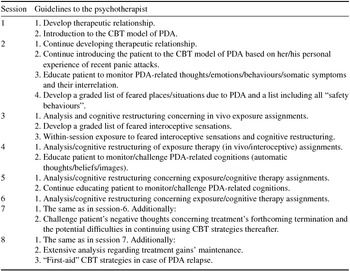
The psychotherapy administered was a brief form of standard CBT for PDA. It consisted of eight weekly sessions, highly structured, of 1 hour duration each. Therapist's CBT interventions in each session were based on standard instructions included in a manual provided to her. This manual was formed by the research team and was based entirely on evidence-based CBT protocols (Clark, Reference Clark, Hawton, Salkovskis, Kirk and Clark1998; Bennett-Levy et al., Reference Bennett-Levy, Butler, Fennell, Hackmann, Mueller and Westbrook2004; Craske and Barlow, Reference Craske and Barlow2007). After each session patients were given standard typewritten “homework” assignments, also included in the manual. In line with previous reports regarding brief-CBT for PD/PDA (e.g. Otto et al., Reference Otto, Tolin, Nations, Utschig, Rothbaum and Hofmann2012), breathing retraining and relaxation training techniques were excluded from our protocol. Furthermore, patients were informed about CBT's brief duration and were consistently encouraged to demonstrate high commitment in practising daily the CBT skills. For this purpose, typewritten daily diaries were provided to them after each session.
The psychotherapeutic intervention consisted of psychoeducation concerning PDA, in vivo exposure, interoceptive exposure techniques and cognitive strategies. Exposure techniques were introduced with both the “behavioural” and the “cognitive” rationale, i.e. as a means of both habituation and as a “behavioural experiment” in order to test and change maladaptive panic- and agoraphobia-related beliefs. Both overt avoidances and subtle “safety behaviours” were screened from the beginning of treatment and were constantly monitored throughout therapy. Patients were instructed to perform exposure assignments unaccompanied and using no safety-behaviours. The structure of the psychotherapy, in the form of guidelines to the therapist in each CBT session, is succinctly presented in Table 1.
Structure of brief cognitive behaviour therapy (in the form of guidelines to the psychotherapist in each CBT session)

Outcome measures
Study's outcome measures included: 1) The Mobility Inventory (MI)-Alone subscale (Chambless, Caputo, Jasin, Gracely and Williams, Reference Chambless, Caputo, Jasin, Gracely and Williams1985), a self-rated scale assessing the severity of agoraphobic avoidance of 27 places or situations when alone (total score-range = 27–135). 2) The number of full-symptom panic attacks during the last week (PA-7d). This is included in the MI scale (Chambless et al., Reference Chambless, Caputo, Jasin, Gracely and Williams1985), together with a brief definition of a “panic attack”. Additionally, before completing it, the examiner provided a brief description of panic attack's meaning using examples of the patient's own experiences. 3) The Agoraphobic Cognitions Questionnaire (ACQ) (Chambless, Caputo, Bright and Gallacher, Reference Chambless, Caputo, Bright and Gallacher1984), a self-rated, 14-item scale assessing thoughts of physical catastrophe due to anxiety symptoms or thoughts of mental, social, and/or behavioural disaster from loss of control (total score-range = 14–70).
Statistical analysis
The SPSS 17.0 (SPSS Inc., Chicago, Illinois) software was used for data-analysis. Owing to the non-normal distribution of the data, we used non-parametric tests for the analysis. More precisely, Spearman's rank correlation analyses were performed to explore associations between degree of HBP-accuracy and patients’ baseline scores on other continuous variables. Mann-Whitney U tests were performed to explore associations between degree of HBP-accuracy and patients’ baseline scores on categorical variables. For the evaluation of treatment outcome, Wilcoxon signed-rank tests were performed in order to compare baseline and posttreatment scores on all three outcome measures. Additionally, the respective effect sizes (Cohen's d) were calculated.
Furthermore, we used the “residual gain scores (RGS)” technique (Steketee and Chambless, Reference Steketee and Chambless1992) for the exploration of the association between HBP-accuracy and clinical outcome measures. Of note, calculating RGS helps control for both initial differences and measurement error inherent in the use of repeated measures on the same instrument (Steketee and Chambless, Reference Steketee and Chambless1992). To compute RGS, pre- and posttreatment raw scores of the psychometric evaluation are first converted to Z scores. Then, RGS is calculated by subtracting the pre-treatment score (Z1), multiplied by the correlation between pre- and posttreatment scores (r12), from the posttreatment score (Z2), i.e. RGS = Z2 – [Z1 X r12].
Finally, Spearman's rank correlation analyses were performed to explore the strength of associations between patients’ degree of HBP-accuracy and their residual gain scores in each clinical outcome measure. All correlation analyses conducted were two-tailed.
Results
Subjects and baseline measurements
Twenty-five (20 female, 5 male) consecutively referred, medication-free, CBT-naïve outpatients with a definite DSM-IV-TR (APA, 2000) diagnosis of PD with Agoraphobia, confirmed by a SCID-Interview (First et al., Reference First, Spitzer, Gibbon and Williams1998), participated in the study.
Patients’ mean age was 36.1 years (SD = 3.9), their mean duration of illness was 56.3 months (SD = 48.8), their mean body mass index (BMI) was 21.0 (SD = 3.1) and the mean number of cigarettes smoked daily was 14.0 (SD = 10.6) Overall, three patients had received only pharmacotherapy, four only other-than-CBT psychotherapy, and three patients had undergone combined treatment in the past. Previous treatments had been terminated at least 21 months before the study's baseline measurements. At the baseline phase of the HBP-test, patients had a mean STAI-T score of 55.3 (SD = 9.3) and their mean heart rate was 77.3 beats/min (SD = 13.3). Patients’ mean baseline HBP-accuracy was 52.4% (SD = 30.8%).
Associations between heartbeat perception and baseline variables
No associations emerged between HBP-accuracy and the following variables: age (p = .22), gender (p = .78), past pharmacotherapy (p = .16) or psychotherapy other than CBT (p = .11), duration of illness (p = .57), BMI (p = .12), number of cigarettes smoked daily (p = .30) and STAI-T (p = .26). There was a tendency for patients with lower heart rate to demonstrate higher HBP-accuracy, but the association did not reach statistical significance (rho = −0.354, p = .07).
Treatment outcome
Patients demonstrated statistically significant improvements on all outcome measurements:
PA-7d: pre-CBT = 1.6±0.9, post-CBT = 0.6±0.6, z = −3.834, p<.001;
ACQ: pre-CBT = 31.4±5.8, post-CBT = 26.1±6.9, z = −2.526, p = .012 (p<.05);
MI-alone: pre-CBT = 64.3±19.4, post-CBT = 56.1±27.5, z = −2.742, p = .006 (p<.01).
The respective effect sizes (Cohen's d) were large for PA-7d (d = 1.31) and ACQ (d = 0.83), but small regarding MI-alone (d = 0.34).
Associations between baseline heartbeat perception and residual gain scores on clinical outcome measures
No significant association emerged between baseline HBP-accuracy and post-CBT panic attacks’ reduction (p = .27). By contrast, higher baseline HBP-accuracy was associated with greater improvements on both ACQ and MI-alone measures. The respective Spearman's rho correlation coefficients were of medium size for ACQ (rho = 0.502, p<.01) and large for the MI-alone scale (rho = 0.795, p<.01).
Discussion
Our initial hypothesis was that in PDA patients, higher HBP-accuracy at baseline – as this is reflected in the “mental tracking” evaluation (Schandry, Reference Schandry1981) – would be an impediment to their gains regarding the short-term outcome of a brief-CBT. This hypothesis was not confirmed. Overall, our sample's PDA patients demonstrated at post-CBT significant improvement concerning all outcome measures, i.e. number of panic attacks, agoraphobic avoidance behaviours, and agoraphobic beliefs. However, higher baseline HBP-accuracy was not associated with worse short-term outcome concerning post-CBT reduction in the number of panic attacks. What is more, higher baseline HBP-accuracy was associated with larger therapeutic gains concerning agoraphobic behaviours and beliefs.
An explanatory hypothesis concerning our results may be derived from the cognitive-behaviour model of the pathogenesis and treatment of PDA (Clark, Reference Clark, Hawton, Salkovskis, Kirk and Clark1998; Craske and Barlow, Reference Craske and Barlow2007). According to this model, it is expected that during exposure to agoraphobic situations higher HBP-accuracy will be positively associated with higher levels of fear and psychophysiological arousal via the misinterpretation of the more intensely perceived heartbeat. Consequently, with regard to symptomatic PDA patients not undergoing therapy, higher HBP-accuracy will be associated with a higher probability to suffer panic attacks in agoraphobic situations, reinforcing thus their agoraphobic avoidances.
A similar mode of psychophysiological reaction is expected when PDA patients undergo exposure in agoraphobic situations in the context of CBT. However, during CBT exposure assignments, patients are instructed not to escape, but to remain in agoraphobic situations for a certain amount of time despite being in a state of marked fear and psychophysiological arousal, so as to enhance habituation and/or to test and challenge their maladaptive PDA beliefs (Clark, Reference Clark, Hawton, Salkovskis, Kirk and Clark1998; Bennett-Levy et al., Reference Bennett-Levy, Butler, Fennell, Hackmann, Mueller and Westbrook2004; Craske and Barlow, Reference Craske and Barlow2007). Subsequent cognitive analysis and restructuring may result in the change of the personal meaning of this increased perception, namely in the understanding that increased cardiac-related cues do not have catastrophic consequences. Thus, this change at a cognitive level may “neutralize” the increased HBP-accuracy as a risk-factor for increased panic attacks and may lead to reductions in panic attacks similar to those seen in patients with lesser HBP-accuracy.
What is more, in the context of well-prepared, structured exposure assignments performed in CBT, higher HBP-accuracy may become an “advantage” that can be used by the therapist to further promote therapeutic change. More precisely, during exposure assignments, PDA patients are instructed to monitor somatic and other PDA symptoms and not to distract themselves from the PDA-related intense emotional experience by indulging to safety behaviours, in order to maximize therapeutic gains from the exposure procedure (Sloan and Telch, Reference Sloan and Telch2002; Telch et al., Reference Telch, Valentiner, Ilai, Young, Powers and Smits2004). Electroencephalographic studies have previously suggested significant and strong positive associations between higher HBP-accuracy and the intensity of emotional experience as well as the central processing of emotional stimuli (Herbert, Pollatos and Schandry, Reference Herbert, Pollatos and Schandry2007). Furthermore, higher HBP-accuracy seems to be positively associated with better performance in measures of attentional processing (Matthias, Schandry, Duschek and Pollatos, Reference Matthias, Schandry, Duschek and Pollatos2009), while increased attention to heartbeat perception seems to enhance conditioning procedures (Raes and De Raedt, Reference Raes and De Raedt2011). Thus, the enhanced processing of fear-related cues and the more intense emotional experience that more accurate heartbeat perceivers demonstrate during exposure in the context of CBT, may facilitate habituation and cognitive change, provided that interoceptive and in vivo exposure assignments are well-prepared and are followed by meticulous cognitive analysis and restructuring (Bennett-Levy et al., Reference Bennett-Levy, Butler, Fennell, Hackmann, Mueller and Westbrook2004). Furthermore, PDA patients with increased HBP-accuracy may perhaps perceive better not only heart rate's increases, but also heart rate's decreases, which occur while insistently remaining in the feared situation during exposure. This can provide patients with additional evidence to challenge the validity of their agoraphobic/panic beliefs.
Further support for this explanatory hypothesis may be adduced from studies of habituation through feedback techniques. Indeed, these studies have provided preliminary indications that by increasing awareness of HBP through heart rate biofeedback strategies, habituation during interoceptive exposure therapy is enhanced (Nunes and Marks, Reference Nunes and Marks1975; Telch, Valentiner, Ilai, Petruzzi and Hehmsoth, Reference Telch, Valentiner, Ilai, Petruzzi and Hehmsoth2000; for a review see Domschke et al., Reference Domschke, Stevens, Pfleiderer and Gerlach2010). More precisely, visual heart rate feedback significantly facilitated habituation during exposure session in patients with animal phobia (Nunes and Marks, Reference Nunes and Marks1975). Furthermore, in patients with claustrophobia who underwent exposure treatment trials, heart-rate feedback was associated with greater between-trial habituation across treatment trials and lower levels of fear at posttreatment (Telch et al., Reference Telch, Valentiner, Ilai, Petruzzi and Hehmsoth2000).
As already mentioned, a previous naturalistic follow-up study indicates that in patients treated for PD/PDA (among other diagnostic categories, e.g. infrequent panickers), increased HBP-accuracy is associated with worse one-year outcome of panic attacks (Ehlers, Reference Ehlers1995). A potential explanation for the discrepancy between the findings of the Ehlers’ study (Reference Ehlers, Breuer, Dohn and Fiegenbaum1995) and those of the present study might be that our findings are limited to the short-term outcome of structured brief-CBT for PDA. However, this explanation is not very plausible as outcomes are usually maintained after CBT. A more plausible explanation of this discrepancy pertains to the treatment packages implemented. More precisely, increased HBP-accuracy may be associated with a higher risk for treatment failure or relapse if misinterpretations of bodily sensations are not addressed by interoceptive exposure or behavioural experiments, as suggested by Ehlers’ study (Reference Ehlers, Breuer, Dohn and Fiegenbaum1995). By contrast, treatments that provide plausible alternative benign interpretations for feeling one's heartbeat, such as the treatment delivered in this study, may help reduce avoidance and cognitions that maintain PDA.
Although statistically significant, improvement in avoidant behaviours – as reflected in patients’ scores on the MI-alone scale – had a small effect size. This finding might be explained by the short duration of CBT. More precisely, the amount of exposure included in an 8-session CBT might be insufficient for patients to master their avoidant behaviours. Besides, patients were re-assessed immediately upon CBT-completion. In this respect, our results are more representative of early or immediate treatment response, rather than of treatment outcome in general.
The main limitation of our study was the lack of a control group. The non-inclusion of a control group was motivated by our objective to keep patients completely medication-free throughout the study and our conviction that this would not be feasible for the PDA patients of the control group. Other limitations of this study include its small patients’ sample and the predominance of female patients. Female sex has been associated with poorer heartbeat perception (Ehlers and Breuer, Reference Ehlers and Breuer1992), which may further deteriorate under stress conditions (Fairclough and Goodwin, Reference Fairclough and Goodwin2007). Moreover, we did not use a time-estimation task to control for time-guessing effects. However, the possibility that participants in HBP-trials estimate the duration of the trials and then make an educated guess about the number of heartbeats, has been ruled out in several studies (Ehlers and Breuer, Reference Ehlers and Breuer1992; Van der Does et al., Reference Van der Does, Antony, Ehlers and Barsky2000). At any rate, future follow-up controlled studies in larger and more representative patient-samples are warranted in order to replicate this study's results, addressing its limitations.
In conclusion, our results suggest that in PDA patients undergoing brief-CBT for the acute treatment of their symptoms, higher baseline HBP-accuracy is not associated with worse short-term outcome concerning post-CBT reduction in the number of panic attacks. What is more, higher baseline HBP-accuracy may be associated with enhanced therapeutic gains concerning agoraphobic behaviours and beliefs.
Acknowledgments
None of the authors report any conflict of interest.



Comments
No Comments have been published for this article.