Lactobacillus-containing probiotics are increasingly used as a dietary supplement in patients with gut disorders to promote gut flora. Reference Wieers, Verbelen and Van Den Driessche1 However, the safety of probiotics in immunocompromised patients has not been established. In November 2019, a cluster of Lactobacillus bacteremia was investigated at a pediatric oncology and hematopoietic cell transplant (HCT) center. Here, we report the findings of the cluster investigation and its relation to probiotics use.
Methods
Potential sources were identified by chart review and staff interview. Patients with Lactobacillus bacteremia from January 2017 to December 2019 were identified using microbiology records. This study was approved by the institutional review board.
In July 2018, the Pharmacy and Therapeutics Committee approved a high-potency probiotic use in HCT patients with gut graft-vs-host disease (GVHD), multidrug-resistant organism (MDRO) colonization, or Clostridioides difficile infection. This probiotic (product 1) was used until March 2019 and contained 112.5 billion colony-forming units (CFU) per capsule of a proprietary blend of Streptococcus thermophilus, Bifidobacterium breve, B. lactis, Lactobacillus acidophilus, L. plantarum, L. paracasei, and L. helveticus. In March 2019, due to shortage, product 1 was replaced by product 2 which contains the same composition. In October–November 2019, both products were available for patient use. Percent probiotic utilization in hospitalized HCT patients was calculated as the number of probiotic days divided by the number of patient days ×100. Probiotic days was defined as the total number of hospitalized HCT patients receiving probiotics per day over the month.
The remaining patient supply and unopened bottles of products 1 and 2 were cultured at an environmental laboratory (Aerobiology Laboratory Associates, Washington, DC). Probiotic lot numbers were not recorded in the patients’ records. However, only 1 lot each of product 1 and 2 were used during the cluster period. Lactobacillus was selectively isolated from the probiotic products and was sequenced along with Lactobacillus blood isolates at the hospital molecular laboratory. Relatedness between the clinical and probiotic Lactobacillus isolates was evaluated using core-genome multilocus sequence-typing pipelines Ridom SeqSphere+ (Ridom Bioinformatics, Münster, Germany). The L. paracasei pipeline included 1,604 core targets, 1,010 accessory targets, reference strain ATCC334 (NC_008526.1), and 26 query genomes. The L. plantarum pipeline included 1,262 core targets, 1,713 accessory targets, reference strain WCFS1 (NC_004567.2), and 98 query genomes. Minimum spanning trees for each pipeline were created using 2,614 (L. paracasei) and 2,975 (L. plantarum) columns for distance calculation. Isolates with <20 allele difference were considered related.
Results
Overall, 6 patients with Lactobacillus bacteremia from August to November 2019 were identified as hospitalized HCT patients receiving Lactobacillus-containing probiotics. During the cluster period, 34 hospitalized HCT patients received at least 1 day of probiotics, of whom 6 (17.6%) developed Lactobacillus bacteremia. For baseline, only 1 patient (rate, 0.22 per 1,000 patient days) developed Lactobacillus bacteremia in 2017, 4 patients (1.04 per 1,000 patient days) developed Lactobacillus bacteremia in 2018, and none in January–July 2019. This incidence increased to 6 patients (4.7 per 1,000 patient days) who developed Lactobacillus bacteremia in August–November 2019 (Supplementary Fig. S1). Since July 2018, 20%–80% of hospitalized HCT patients have used probiotics compared to none before then (Supplementary Fig. S2).
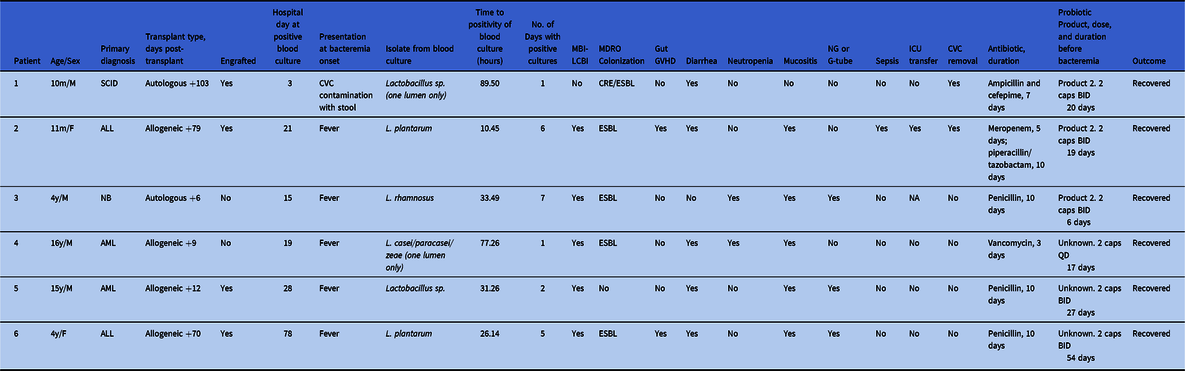
Table 1 lists patient characteristics. The median age was 4 years (range, 0.8–16). Patients were at median day +41 (range, 6–103) after transplant and developed Lactobacillus bacteremia at median hospital day 20 (range 3–78). Upon review of common exposures, including shared personnel, medications, locations, equipment, and products, probiotics have been administered in all cases. Also 3 patients (2.35 per 1,000 patient days) used probiotics for MDRO colonization, and 2 patients (1.57 per 1000 patient days) used probiotics for both MDRO colonization and gut GVHD, and 1 patient had no clear indication for probiotics. None of the cluster patients had gut GVHD as the only indication for probiotic use. None of the Lactobacillus bacteremia cases before August 2019 had received probiotics, and only 1 patient was an HCT recipient (data not shown).
Description of Hematopoietic Cell Transplant Recipients with Lactobacillus Bloodstream Infections due to Probiotics

Note. M, male; F, female; SCID, severe combined immune deficiency; ALL, acute lymphoblastic leukemia; NB, neuroblastoma; AML, acute myeloblastic leukemia; MBI-LCBI, mucosal barrier injury laboratory confirmed bloodstream infection; MDRO, multidrug-resistant organism; CRE, carbapenem-resistant Enterobacterales; ESBL, extended spectrum β-lactamase; GVHD, graft-versus-host disease; ICU, intensive care unit; CVC, central venous catheter; QD, once daily; BID, twice daily.
Patients 1, 2, and 3 received probiotic product 1. It was unclear which product the other 3 patients received. Six probiotic Lactobacillus isolates (LB001 and LB002 from product 1, LB003 and LB004 from product 2, and LB005 and LB006 from patient 5 supply) and 5 blood Lactobacillus isolates (LB008 to LB012 from patients 2 to 6, respectively) were analyzed. The isolate from patient 1 was not available. Only 2 Lactobacillus spp (L. plantarum and L. paracasei) were isolated from probiotics. Sequencing of L. paracasei isolate from LB005 recategorized it as L. plantarum. Isolate LB009 was identified as L. rhamnosus and was not included in the analysis.
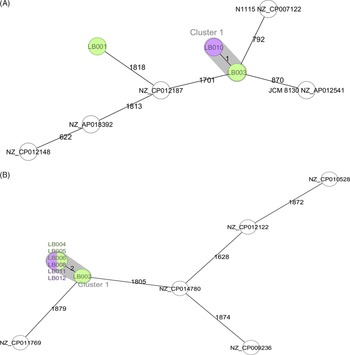
Two trees for relatedness were created (Fig. 1A and 1B). Of L. paracasei isolates, LB003 and LB010 differed by 1 allele. LB001 was unrelated (Fig. 1A). Of L. plantarum isolates, LB008, LB011, and LB012 were identical to LB004, LB005, and LB006, and all were closely related to LB002 (Fig. 1B). Furthermore, Lactobacillus isolates from patients 2, 5, and 6 were proven to be related to products 1 or 2, and an isolate from patient 4 to was related to product 2.
Minimum spanning trees for lactobacillus isolates sequenced by core genome multilocus sequence type. Green circles represent probiotic isolates. Purple circles represent patient blood isolates. White circles are NCBI reference isolates. Line numbers represent distance (number of alleles difference) between the isolate and its nearest neighbor. Isolates with less than 20 alleles difference from nearest neighbor are considered related. (A) Lactobacillus paracasei and (B) L. plantarum.

Discussion
We report a cluster of Lactobacillus bacteremia related to probiotic use in pediatric HCT recipients. Probiotics generally contain 106 CFU per gram of viable organisms, but the probiotic dose required for clinical effects have not been not well established. Reference Boyle, Robins-Browne and Tang2,Reference Doron and Snydman3 Also, significant differences in bacterial viability, activity, purity, and composition may exist among preparations because probiotics, in contrast to drug requirements, are marketed as dietary supplements and do not undergo premarket safety review by the US Food and Drug Administration. 4
Although our investigation provided evidence for relatedness of the clinical to probiotic Lactobacillus isolates, it did not confirm the mechanism of bacteremia. We present 3 potential explanations. First, all cluster patients had compromised mucosal barrier integrity due to diarrhea, mucositis, neutropenia, or gut GVHD. Therefore, translocation of the probiotic Lactobacillus from the injured gut mucosa to bloodstream is a likely mechanism in immunocompromised patients. The second hypothesized mechanism is potential central venous catheter (CVC) contamination at the time of probiotic administration. A probiotic supplement taken by a hospitalized patient have been reported the source of S. boulardii sepsis in neighboring patients who had not received the supplement, possibly due to contamination of vascular catheters. Reference Hennequin, Kauffmann-Lacroix and Jobert5 A third potential mechanism for Lactobacillus bacteremia is CVC contamination with stool which was the likely explanation in patient 1. Most cases of reported probiotics-related infections have resolved with appropriate antimicrobial therapy. Reference Ambesh, Stroud and Franzova6–Reference Sherid, Samo, Sulaiman, Husein, Sifuentes and Sridhar9 Lactobacillus spp was reported as the most common cause of bacteremia among HCT recipients taking probiotics, mostly occurring before day+100. Reference Cohen, Woodfield, Boyle, Stednick, Boeckh and Pergam10 However, there was no attributable mortality in that study, similar to our findings. The use of the probiotic product in hospitalized HCT patients in our center was discontinued after this investigation.
This study had several limitations. This study provided evidence for probiotics being the source of Lactobacillus bacteremia in HCT recipients. However, the mechanism for positive blood cultures remains speculative. We described a case series but did not include controls. A retrospective cohort study of HCT recipients is ongoing at our center to evaluate the incidence and relative risk for Lactobacillus infections. Also, the probiotic product received by 3 patients could not be specified by record review and sequencing.
In summary, we describe a cluster of pediatric HCT recipients with Lactobacillus bacteremia with genomic evidence of relatedness to their use of probiotics. Well-designed clinical trials and robust oversight of the probiotic manufacturing process are needed to evaluate the safety of probiotic use in transplant recipients and other immunocompromised patients. Until these data become available, use of probiotics in immunocompromised patients should be avoided.
Supplementary material
To view supplementary material for this article, please visit https://doi.org/10.1017/ice.2021.515
Acknowledgments
The authors acknowledge Ronald Dallas, PhD, for his help in regulatory submission of the study application to the institutional review board.
Financial support
No funding support was received for the work described in this article.
Conflicts of interest
All authors report no conflicts of interest relevant to this article.