BACKGROUND
High-quality information retrieval is the base of each systematic review and health technology assessment. In practice, planning and executing information retrieval is mostly performed by information specialists and checked for quality by researchers. That calls—in addition to the philosophy of HTA concerning completeness and transparency—for comprehensive and repeatable reports of the whole information retrieval process. This is supported by the requirements outlined in numerous statements and tools (e.g., PRISMA [formerly QUOROM], AMSTAR, AGREE, MOOSE), which have been developed and introduced into practice in the last years and address the reporting and evaluation of systematic reviews and HTAs (Reference Liberati, Altman and Tetzlaff11;Reference Shea, Grimshaw and Wells16;Reference Stroup, Berlin and Morton18;19).
The quality of reporting of the information retrieval process in technology assessments and systematic reviews has improved in recent years, but several surveys stated that common practice is still heterogeneous and does not fulfill the demand for comprehensiveness and repeatability in an optimal way. In addition to evaluation, updating is more laborious in incomplete retrieval reports (3;Reference Golder, Loke and McIntosh8;Reference Patrick, Demiris and Folk12;Reference Roundtree, Kallen and Lopez-Olivo13;Reference Yoshii, Plaut, McGraw, Anderson and Wellik23).
AIMS
Our aim is to promote good information retrieval practices by (i) presenting the conceptualization of retrieval and transcription of complex search strategies in a transparent way, readable to others than information specialists, and (ii) documenting more accurately the search strategies effectively processed.
METHODS
The starting point of our project was a comprehensive database search in LISA®, The Cochrane Library®, MEDLINE®, EMBASE®, Science Citation Index®, PsycInfo®, Journals@OVID®, LocatorPlus®, and two library catalogues (Cologne University library, German Central Library of Medicine). These sources were searched in April 2010 for current state-of-the-art literature on reporting and presenting information retrieval processes. We then condensed the results into graphics and tables, tested the feasibility of these tools, and finally defined recommendations on comprehensive documentation of retrieval results.
RESULTS
Current State-of-the-Art
Our comprehensive literature search initially resulted in 923 hits and a few additional monographs on visualization techniques. After eliminating duplicates and congress abstracts, and a screening by one reviewer, only a few dozen relevant articles remained. Most of these were tools for assessing the quality of published search strategies. These remaining publications were reviewed in full text.
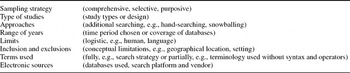
Few experts currently study issues of information retrieval practice specifically adapted to HTA. Only one author has presented a proposal for reporting: the STAndards for reporting LITErature searches (STARLITE) (Reference Booth1); its elements are listed in Table 1.
Reporting Elements According to STARLITE (Reference Booth1)

Various publications on how to write a systematic review or health technology assessment offer guidance on reporting information retrieval processes. These include the “CRD's guidance for undertaking reviews in health care,” the ECHTA Working Group 4 “Best practice in undertaking and reporting health technology assessments,” The Campbell Collaboration “Information Retrieval Policy Brief,” and “Systematic Review Information Retrieval Checklist,” as well as INAHTAs “Checklist for health technology assessment reports” (Reference Busse, Orvain and Velasco2;5;9;20;21). The recommendations on reporting information retrieval processes in HTAs are heterogeneous in these papers. For example, the CRD statements on search date, also recommended by DACEHTA (6), or on a minimum of editing provider-reported strategies without removing the number of hits identified are not covered by STARLITE. The Cochrane Collaboration calls for reproducible transcripts of all search strategies for all databases and for “all information found on the internet, such as information on ongoing trials. . .” (22).
Further handbooks on synthesizing research evidence, for example, Sandelowski and Barroso or Kitchenham (Reference Kitchenham10;Reference Sandelowski and Barroso15), complement this collection. Guidelines on writing systematic reviews, for example, PRISMA, contain only few sentences on reporting information retrieval such as “describe all information sources (e.g., databases with dates of coverage, contact with study authors to identify additional studies) in the search and date last searched” and “present full electronic search strategy for at least one database, including any limits used, such that it could be repeated” (Reference Liberati, Altman and Tetzlaff11). MOOSE requests more details (see Supplementary Table 1, which can be viewed online at www.journals.cambridge.org/thc2010030).
Tools for assessing the quality of systematic reviews such as AMSTAR or AGREE (Reference Shea, Grimshaw and Wells16;19) include statements on reporting information retrieval processes. For AMSTAR, the report must “include years and database used, key words and/or MeSH® terms must be stated and where feasible the search strategy should be provided” (Reference Shea, Grimshaw and Wells16). For AGREE, “details of the strategy used to search for evidence should be provided, including search terms used, sources consulted, and dates of the literature covered” (19).
Proposal for Reporting and Presenting Information Retrieval Processes
Common practice in reporting information retrieval processes is to describe in the methods section what has been done, and to transcribe full search strategies in appendices of HTA reports or on journal Web pages. This description and transcription procedure refers to the step-by-step workflow commonly performed in HTA information retrieval, consisting of eight steps: Step 1: Translating the research question into a search question; Step 2: Concept building by modeling search components; Step 3: Identifying synonyms; Step 4: Selecting relevant information sources; Step 5: Designing search strategies; Step 6: Executing the search; Step 7: Saving retrieval results, standardized documentation and presentation; and Step 8: Final quality check, calculation of precision and recall.
As the procedure is not self-explanatory, it should be presented step by step including some illustrations. A systematic and comprehensive information search aiming at highly sensitive results with highest possible precision calls for such in-text documentation of the information retrieval process: for a complete and comprehensive transcription of search components and the concept model as well as of the search strategies and other search routines used, and finally, of the results retrieved.
In-Text Documentation of the Information Retrieval Process. In-text documentation of information retrieval processes is heterogeneous and often incomplete or not sufficiently detailed. The most detailed recommendations regarding in-text descriptions have been published in The Cochrane Handbook for Systematic Reviews of Interventions (22). The recommended elements are as follows: List of all databases searched; Dates of the last search for each database and period searched; Notes on any language or publication status restrictions; List of gray literature sources; List of individuals or organizations contacted; List of journals and conference proceedings specifically hand-searched; and List of any other sources searched.
Citing issues are not addressed by The Cochrane Handbook. The in-text documentation of information retrieval processes should include information on the use of filters, also specifying whether standard filters were used (e.g., Cochrane Highly Sensitive Search Strategy for identifying randomized controlled trials [RCTs]) or strategies were acquired partly or completely from published work. Additional definitions pertaining to the conceptualization of information retrieval, referring to the components and model of the search, would be helpful but are currently not common practice.
DEFINING SEARCH COMPONENTS ACCORDING TO PICO
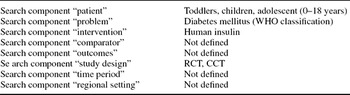
A translation of the research question into a searchable question should be presented using the PICO structure (Patients, Intervention, Comparator, Outcome) of clinical questions (4), see Table 2. Because the final search components are seldom identical to predefined inclusion criteria applied in trial (screening) searches, presenting information retrieval specifications will promote understanding. The list of components can easily be extended but not all components are mandatory for information retrieval.
PICO Definitions of the Example “Effectiveness of Human Insulin in Diabetic Patients Aged <18 Years”

DEFINING THE SEARCH MODEL
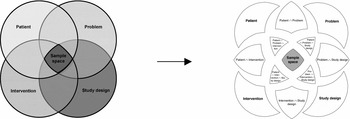
Graphical presentation of the search model or models is still an uncommon practice in reporting information retrieval processes and their results. This information would, however, be very helpful to researchers and other non-information specialists. The more complex the search question, the more helpful the graphical presentation. If a search model is presented, Venn diagrams are preferred (see Figure 1). In Boolean logic, the search model of our example reads as follows: (search component “patient”) AND (search component “problem”) AND (search component “intervention”) AND (search component “study design”).
Venn diagram and Info-Crystal development on the example “Effectiveness of human insulin in diabetic patients aged <18 years.”

The sample space usually covers the hits of interest. If the search model is more complex and further subsets are of interest, for example, the intersection of the search components “intervention” and “problem,” an Info-Crystal (Reference Spoerri, Card, MacKinlay and Shneiderman17) might be more suitable. Info-Crystals are enhanced Venn diagrams where each intersection is defined as a sample space of its own and could thus be addressed separately (see Figure 1). Info-Crystals are often appropriate to presentations of ethical or legal issues or, in some cases, economic evaluations of health technologies.
As Venn diagrams are restricted to three or four search components, search models with more components require an alternative presentation method. One alternative could be derived from the Unified Modeling Language (UML) (7). A UML-derived model on our example is presented as Supplementary Figure 1, which can be viewed online at www.journals.cambridge.org/thc2010030.
Appendix/Additional Materials Transcribing the Information Retrieval. Lately, documentation of the information retrieval process including a full transcription of search histories has become more common and is regarded as state-of-the-art in HTA. However, reporting practices are still unsatisfactory. Incomplete reporting, lack of detail and the missing peer-reviewed procedures render evaluation and repetition of search strategies difficult. Accurate reporting is also needed for updating. However, when updating searches, merely reprocessing existing strategies is insufficient, as it is necessary to check for changed or new indexing of medical terms etc. Hence, updating purposes are a concern, but not a primary one.
Several studies on the completeness and accuracy of information retrieval processes and results have found poor reporting of search processes in published systematic reviews and HTAs. Various authors have called for improvements in reporting or demanded an international consensus on reporting standards; some suggest peer-reviewing as improvement (3;Reference Golder, Loke and McIntosh8;Reference Liberati, Altman and Tetzlaff11–Reference Sampson, McGowan, Tetzlaff, Cogo and Moher14;Reference Yoshii, Plaut, McGraw, Anderson and Wellik23). Few publications transcribe the full search in an appendix of the report or “additional material” on Web pages.
While PRISMA (Reference Liberati, Altman and Tetzlaff11) recommends reporting the full search strategy “for at least one major database . . .” (not including number of records per query line), state-of-the-art practice in HTA is to report all full search strategies, including number of records. The INAHTA checklist (9) suggests providing detailed materials optionally, “on request.” This option results in less transparency and impedes evaluating the methodology and credibility of search strategies. Hence, this option is not recommended in publications (such as HTA reports) where page restrictions are less important.
In the context of this common—suboptimal—practice, we developed templates to present the information retrieval workflow, conceptualization process (defining the question using the PICO scheme and additional components), retrieval model, database selection and other sources of information, additional hand-searching, and templates for structured presentation of complex and lengthy search histories. No single template fits all conceptualizations, but a few can be applied to most of the common retrieval processes. Our templates proved to be practical in selected research questions and more easily understandable than common practice today.
RECOMMENDATIONS FOR REPORTING INFORMATION RETRIEVAL PROCESSES IN DETAIL
The whole information retrieval process should be presented in a comprehensive manner (cf. Appendix 3 in CRD's guidance [5]). For better understanding of the proposed reporting and presentation, a complete set of transcriptions on autologous stem cell transplantation in breast cancer is added to this article as an example (Supplementary Figure 2, which can be viewed online at www.journals.cambridge.org/thc2010030).
According to our concept, the steps in the retrieval process include defining search components and models, selecting information sources, and transcribing search strategies.
1. Defining search components using PICO and additional components. If the search components are not documented in the text, they should be presented at this stage as described earlier in detail.
2. Defining the search model(s). Likewise the search model(s), if not documented yet, should be presented at this stage. If different models were processed this should also be stated, for example, different models for primary studies and secondary literature, different languages, adverse events, quality of life, ethical or legal issues, or economic evaluation.
3. Selection of information sources. All selected information sources should be listed in appropriate detail which varies by source as shown below.
Databases. Searched bibliographic and full-text databases, including gray literature and library catalogues, should be presented using their full name, including the name of the provider and search interface. If appropriate, the time range covered by the database should also be specified. A template for presenting database selection is shown in Supplementary Table 2, which can be viewed online at www.journals.cambridge.org/thc2010030.
Registers. All searched registers should be listed. A template for describing these searches is shown in Supplementary Table 3, which can be viewed online at www.journals.cambridge.org/thc2010030.
Hand Searching. A list of all journals, conference proceedings, Internet search engines or other Internet sources, as well as any other information resources used in the retrieval process should be compiled. A template for describing hand searching sources is shown in Supplementary Table 4, which can be viewed online at www.journals.cambridge.org/thc2010030.
Additional searches of reference lists in publications should be explicitly mentioned. This could be achieved by marking all publications retrieved in this manner. If all publications in an assessment are hand searched, a separate list of resulting new references could be provided.”
Regulatory Institutions. Searches for regulations or guidelines should be listed and described. A template for documenting relevant regulations and guidelines is shown in Supplementary Table 5, which can be viewed online at www.journals.cambridge.org/thc2010030.
Routine Collected Statistics. If general statistics sources were included, they should be listed. A template for describing sources of statistical data is shown in Supplementary Table 6, which can be viewed online at www.journals.cambridge.org/thc2010030.
Other Sources of Information. Any other sources of information used should also be listed. These may include contacts to manufacturers, patient groups, researchers etc. A template for describing such sources is shown in Supplementary Table 7, which can be viewed online at www.journals.cambridge.org/thc2010030.
If Web pages of a group of institutions (such as HTA units) were searched, a list of the institutions’ names should be presented.
Original Primary Data. If the researchers collected primary data that are not published elsewhere or already described within the text, at least the method and results should be stated in a separate appendix, for example. If a survey was performed, the questionnaire should similarly be presented as an appendix.
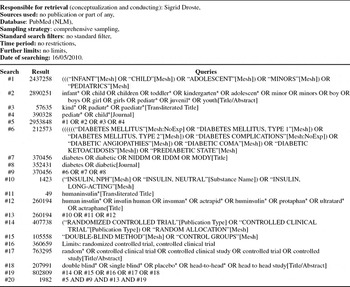
4. Transcripts of search strategies. For all searched databases and registers, full search strategies should be reported including additional information on the following items: The searcher; Citation of sources used; Name of the database (if metafiles were searched, the names of all databases included in the search process should be listed) Interface used; Sampling strategy (comprehensive sampling, selective sampling, purposive sampling); Standard search filters used; Time period restrictions (even though defined by the search component); Any further limits, for example, language restrictions (which are not state-of-the-art for information retrieval, but if they were introduced, they should be mentioned at this stage); and Date of searching. The search strategies should be reported according to the defined search components and the search model in all applications where possible. A structured conduct of search queries is a prerequisite for structured and complete reporting. The full search protocol should include a running number for each query line, the number of records identified, and the query text line by line.
The search histories as transcribed by the provider should be corrected as little as possible. If relevant terms resulted in no records, these lines should remain in the search history—except where this was caused by typing errors. In the interest of readability, the number of records identified should be reported in a separate column left of the query text, and the index terms searched and Boolean operators used should be written in capitals while all other query text should be written in lower cases.
A template search on “Effectiveness of human insulin in diabetic patients aged <18 years” was designed as shown in Table 3. This design is simple in structure and does not fit all search strategies, but further strategies can be designed along these lines.
Full Search Strategy Reporting of the Example “Effectiveness of Human Insulin in Diabetic Patients aged <18 Years”

REPORTING UPDATING INFORMATION RETRIEVAL
As information retrieval is conducted at the beginning of the assessment process, it is usually necessary to update the search to identify relevant publications that were published or indexed after the initial search date. No common practice exists for reporting updates. State-of-the-art could be as follows: (i) If the information retrieval update used identical search strategies with the primary search, it suffices to report the date of the update and the number of additional records (overall and by information source). (ii) If the update introduced one or two new or modified query lines while all other lines were identical, reporting additional or changed query line(s) is sufficient. The date of the update should be reported by adding the new or modified query line using the format in which initial strategies were reported. A detailed description of the location of newly introduced text is required and modified query lines should be named. (iii) If more than one or two lines were inserted or modified, the whole search strategy should be presented including the date of update.
PROCESS-BASED VERSUS ENTRY-BASED REPORTING OF SEARCH STRATEGIES
The application of published search strategies to different database user interfaces yields markedly different results. In addition to incomplete or faulty documentation, all commonly used search engines merely provide documentation of the exact query string input entered. Database interface providers do not readily document the queries actually processed. PubMed® (http://www.ncbi.nlm.nih.gov/sites/entrez) does, however, provide a special frame called “Details” showing the actual search query as processed by PubMed® algorithms. Thus, in PubMed® the huge difference between queries entered and those processed can be observed. Because background algorithmic transformations can change frequently, the reader of a published search history cannot necessarily determine what was actually searched. In consequence, state-of-the-art in reporting search strategies should be, wherever possible, to transcribe the queries processed instead of those entered. Copying each query from “Details” in PubMed® is more laborious, but adhering to these details ensures transparency and facilitates evaluation of the information retrieval.
An example on the different records between queries entered and those processed is shown in PubMed® when entering “information retrieval” in the query line. The search history in PubMed® Advanced Search reports this search term only. The “Details” window reports the query translation processed: “INFORMATION STORAGE AND RETRIEVAL”[MeSH Terms] OR (“information”[All Fields] AND “storage”[All Fields] AND “retrieval”[All Fields]) OR “information storage and retrieval”[All Fields] OR (“information”[All Fields] AND “retrieval”[All Fields]) OR “information retrieval”[All Fields].
QUALITY CONTROL IN REPORTING INFORMATION RETRIEVAL PROCESSES
PRISMA authors and others ask for a peer review of search strategies (e.g., Reference Liberati, Altman and Tetzlaff11;Reference Patrick, Demiris and Folk12). Not only the strategies themselves but also their reporting should be checked for quality purposes. This can be done by applying the Peer Review of Electronic Search Strategies (PRESS) checklist® (3, Appendix G). This validated instrument is available for evaluating the accuracy and completeness of reported search strategies, for example, checking for insufficient translation of the search question, missing thesaurus terms, misused Boolean operators, spelling variants, and typing errors.
CONCLUSIONS
High-quality information retrieval is an essential basis for any systematic review or health technology assessment. Improving common documentation practice toward a more transparent and understandable one is especially useful to others than information specialists. This seems doable by using suitably adapted graphs and tables. We also recommend reporting the queries processed wherever possible. If information retrieval processes were comprehensively reported more often, this would facilitate quality control of information retrieval and published search histories will become more reproducible. These advances would be a big step toward the development of an internationally accepted standard for sound information retrieval practices.
SUPPLEMENTARY MATERIAL
Supplementary Table 1
Supplementary Table 2
Supplementary Table 3
Supplementary Table 4
Supplementary Table 5
Supplementary Table 6
Supplementary Table 7
Supplementary Figure 1
Supplementary Figure 2
CONTACT INFORMATION
Christina Niederstadt, MPH (Christina@medinf.org), Medical Reviewer, Department of Consulting, Medical review board of the German statutory health insurances, Hildesheimer Str. 202, Hannover, Niedersachsen, 30519, Germany
Sigrid Droste, Dipl.-Geogr. (Sigrid.droste@iqwig.de), Research Fellow, Department of Quality in Healthcare, Institute for Quality and Efficiency in Healthcare (IQWiG), Dillenburger Strasse 27, Cologne, 51105, Germany
CONFLICT OF INTEREST
Both authors report having no potential conflict of interest.