INTRODUCTION
On the basis of recent European Directives, the indices which provide information on the functionality and resilience of an ecosystem have to be implemented. In particular, the Water Framework Directive (WFD, 2000/60/EC) has established the concept of ecological quality status (EQS) as a way to assess the biological quality of the waters (see for review Schratzberger, Reference Schratzberger2012). So far, the ecological status of a habitat has been evaluated by means of macrofauna (e.g. AMBI, BENTHIX, M-AMBI indices) (Borja et al., Reference Borja, Franco and Pérez2000; Simboura & Zenetos, Reference Simboura and Zenetos2002; Borja et al., Reference Borja, Mader, Muxika, Germán Rodríguez and Bald2008). This is because macrofauna are ecologically important, widespread and easily identifiable thanks to numerous taxonomic keys which are the result of a wide availability of data on macrofaunal spatial and temporal distribution (Vanaverbeke et al., Reference Vanaverbeke, Merckx, Degraer and Vincx2011). In contrast, few attempts to use meiobenthic assemblages (individual body size 45–500 µm) in EQS assessment have been carried out, in spite of the fact that meiofauna features are good indicators of environmental conditions, and changes in density, diversity, structure and functioning of the meiofauna assemblage may give information on ecosystem health (Moreno et al., Reference Moreno, Semprucci, Vezzulli, Balsamo, Fabiano and Albertelli2011; Alves et al., Reference Alves, Adão, Ferrero, Marques, Costa and Patrício2013). The response of meiofaunal organisms are, in fact, complementary to those observed in macrofauna (Semprucci et al., Reference Semprucci, Frontalini, Covazzi-Harriague, Coccioni and Balsamo2013a). Meiofauna, due to their direct benthic development and generation times as short as 1 month, may reveal possible environmental effects over very small spatial and short temporal scales (Kennedy & Jacoby, Reference Kennedy and Jacoby1999). Furthermore, meiofaunal assemblages are more sensitive to different types of environmental disturbances than macrofaunal ones are, so allowing their use as bioindicators (Balsamo et al., Reference Balsamo, Semprucci, Frontalini, Coccioni and Cruzado2012).
The coastal areas offer numerous resources including food and energy, they help to regulate the climate and they host commercial and recreational activities. However, an increasing number of disturbances (habitat destruction, over-exploitation of natural resources, loss of biodiversity and introduction of alien species) at both global and local scale may compromise the integrity and functioning of these habitats (Danovaro & Pusceddu, Reference Danovaro and Pusceddu2007).
The Adriatic Sea, due to its particular features, is strongly influenced by meteorological conditions and river run-off (Occhipinti-Ambrogi et al., Reference Occhipinti-Ambrogi, Savini and Forni2005; Balsamo et al., Reference Balsamo, Albertelli, Ceccherelli, Coccioni, Colangelo, Curini-Galletti, Danovaro, D'Addabbo, Leonardis, Fabiano, Frontalini, Gallo, Gambi, Guidi, Moreno, Pusceddu, Sandulli, Semprucci, Todaro and Tongiorgi2010), and is therefore more sensitive to human impact and climatic variations than other areas of the Mediterranean Sea. This highlights the need for multi-annual data series assessing temporal changes in the meiofaunal assemblages, thus providing information on the EQS of the coastal areas and also a baseline for the effects of stress agents over time.
Data on the meiofaunal assemblages of two rivers (Foglia and Metauro), close to the Natural Park of Monte San Bartolo (Marches, Italy) have been collected by Semprucci et al. (Reference Semprucci, Boi, Manti, Covazzi Harriague, Rocchi, Colantoni, Papa and Balsamo2010a, Reference Semprucci, Frontalini, Covazzi-Harriague, Coccioni and Balsamo2013a) since 2002. In particular, changes in the meiofaunal structure, abundance and diversity have been analysed in relation to several environmental parameters.
The aims of this study were to evaluate the EQS of the coastal areas in front of the two river mouths and their spatial and temporal variations through the analysis of the meiofauna assemblage, and to verify the importance of meiofauna as a bioindicator. Indeed, meiofauna have not yet been sufficiently considered in the current national and international programs for the monitoring of marine ecosystems despite the fact that they could be of great importance for this purpose.
MATERIALS AND METHODS
Study area and sampling sites
The north-western coast of the Adriatic Sea is a semi-enclosed and very shallow basin with peculiar characteristics: its coastline is extremely long and morphologically complex, so creating a high diversity of hydrodynamic and sedimentary habitats; moreover, it is strongly influenced by the River Po inputs that deeply affect the nutrient load and patterns of the sediment texture of the basin (De Wit & Bendoricchio, Reference De Wit and Bendoricchio2001; Wang & Pinardi, Reference Wang and Pinardi2002). However, at a local scale, some small rivers may also have important effects on the coastal areas (Frontalini & Coccioni, Reference Frontalini and Coccioni2008). Even if water circulation causes a surprisingly fast water turnover in the Adriatic Sea, bottom sediments store a significant amount of pollutants in some coastal areas, which might be partially released to the overlying waters or affect the benthic fauna (Frascari et al., Reference Frascari, Frignani, Guerzoni and Ravaioli1988).
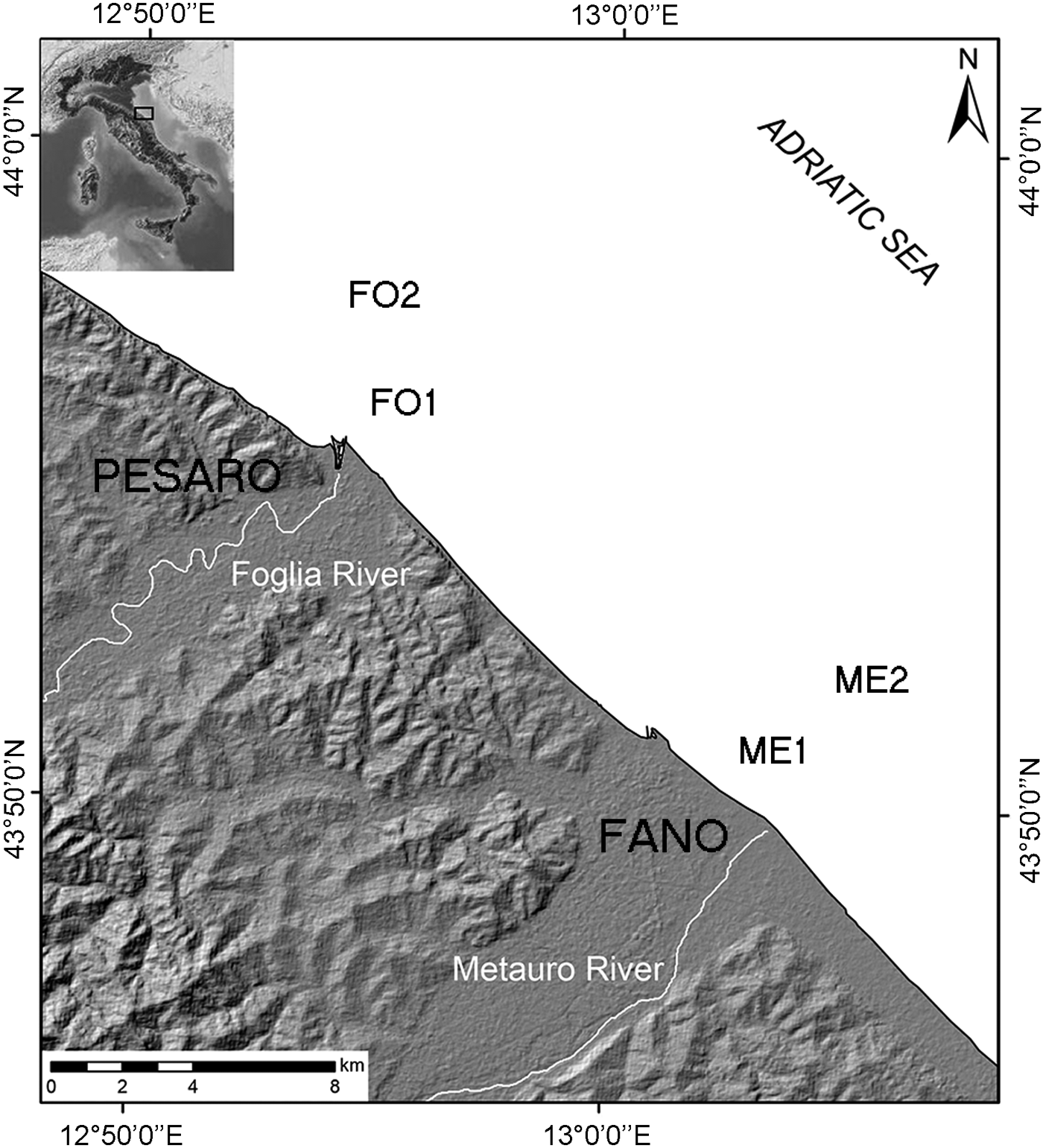
The investigated area is located in the Central Adriatic Sea, along the coast of the Natural Park of Monte San Bartolo (Marches) (Figure 1).
Geographical map of the study area and location of the sampling stations.

For this temporal comparison, data obtained from two previous investigations (Semprucci et al., Reference Semprucci, Boi, Manti, Covazzi Harriague, Rocchi, Colantoni, Papa and Balsamo2010a, Reference Semprucci, Frontalini, Covazzi-Harriague, Coccioni and Balsamo2013a), and integrated with more recent information, were used. In detail, the periods analysed were: 21 May 2002, 8 June 2004 and 7 June 2012 (Semprucci et al., Reference Semprucci, Boi, Manti, Covazzi Harriague, Rocchi, Colantoni, Papa and Balsamo2010a, Reference Semprucci, Frontalini, Covazzi-Harriague, Coccioni and Balsamo2013a).
Sampling collection was carried out at the mouth of the two largest rivers of the area: Foglia (FO) and Metauro (ME). At each site, samples were collected from two distinct stations, one at 500 m from the coastline (Station 1, depth 5 m) and the second at 3000 m (Station 2, depth 12 m). During the sampling, depth, temperature, salinity, dissolved oxygen concentration (DO), pH, oxidation-reduction potential (ORP) and chlorophyll-a (Chl-a) content in the water column were measured using a multi-parametric probe (IDRONAUT). The sediment samples were collected by a modified Van Veen grab (20 l volume). This modified model permits the insertion of a Plexiglas corer from the central part of the grab, enabling portions of almost completely undisturbed sediment to be captured. For the study of meiofauna three replicate cores (surface area 6 cm2 each) were taken down to the depth of 9 cm; samples were then treated with 7% MgCl2 to promote tissue relaxation, and finally fixed with 4% neutralized formalin in seawater and stained with rose Bengal (0.2 g l−1). Two aliquots of sediments were taken for the grain size and total organic matter (TOM) determinations, and were stored at −20°C.
Environmental parameters
The TOM content was determined gravimetrically after loss on ignition (Buchanan & Kain, Reference Buchanan, Kain, Holme and McIntyre1971). The sediment samples were first dried at 60°C for 6 h and weighed in a Scaltec SBC21 (accuracy 0.1 mg) to obtain their dry weight. Then, they were calcined in a muffle furnace (550°C for 4 h) and weighed again to determine the ash weight (inorganic fraction). The organic fraction content was calculated by subtracting the ash weight from the total weight. Grain size analysis was performed by separating the coarse fraction (sand) from the mud fraction by washing. The sandy fraction was then determined by dry-sieving, while a sedigraph (Sedigraph 5200, Micrometric) was used for quantifying the mud fraction (<63 µm).
Meiofauna analysis
In laboratory, the samples were carefully washed through two nested mesh nets (500–45 µm). The first was used to exclude macrofauna, while the second one was essential to retain the meiofaunal organisms. The residual fraction obtained in this way was centrifuged three times with Ludox HS 30 colloidal silica (density 1.18 g cm−3) for specimen extraction (McIntyre & Warwick, Reference McIntyre, Warwick, Holme and McIntyre1984). Meiofauna were counted and identified at the major taxa level, and their density was standardized as abundance 10 cm−2. Shannon's diversity (H′) and evenness (J) indices (both using log-base 2) were calculated to describe the meiofaunal assemblage structure.
Statistical analysis
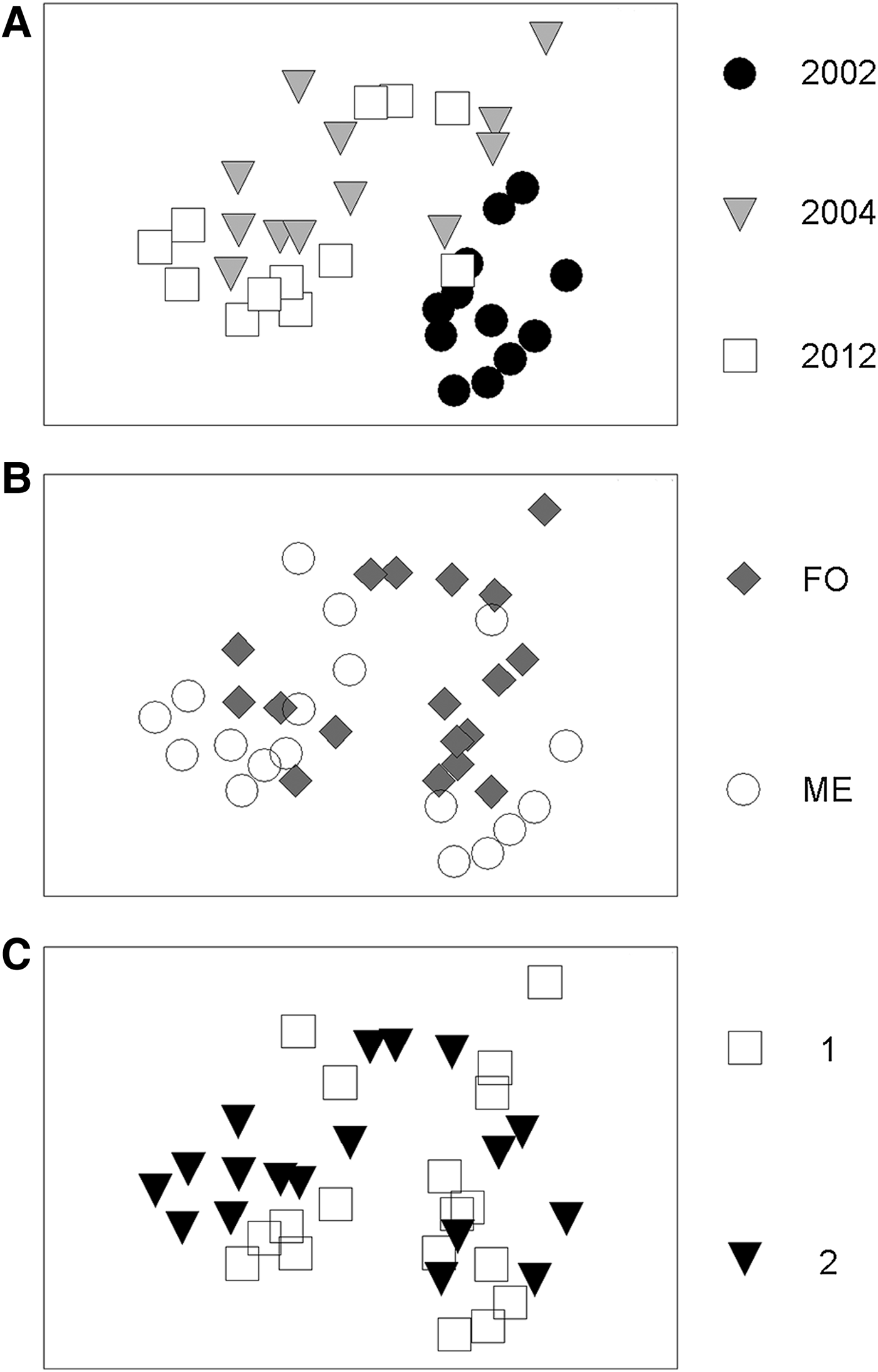
Non-metric multi-dimensional scaling (nMDS) ordinations derived from Bray–Curtis similarity matrices were used to view differences in the structure of meiofaunal assemblage between stations, sites and years (on fourth root transformed data). A two-way nested ANOSIM (analysis of similarities) was used to assess the statistical significance of any difference between sites and stations. A two-crossed ANOSIM was used to determinate the possible site × year and station × year. The SIMPER test (cut-off of 90%, on fourth root transformed data) was utilized to determine the contribution of each meiofaunal taxon to the total dissimilarity. All of the analyses referred to above were performed using the software package Primer v.5 (Clarke & Gorley, Reference Clarke and Gorley2001; Clarke & Warwick, Reference Clarke and Warwick2001).
Analysis of covariance (ANCOVA) models were used in order to evaluate relationships between some abiotic parameters (considered as independent variables) and the basic faunal parameters (i.e. total meiofaunal abundance, S, H′, J, considered as dependent variables, in four different models). nMDS ordination with superimposed circles of increasing size representing the levels of the abiotic variables was used in order to visualize possible relationships between the abiotic variables and the meiofaunal assemblage structure.
RESULTS
Environmental parameters
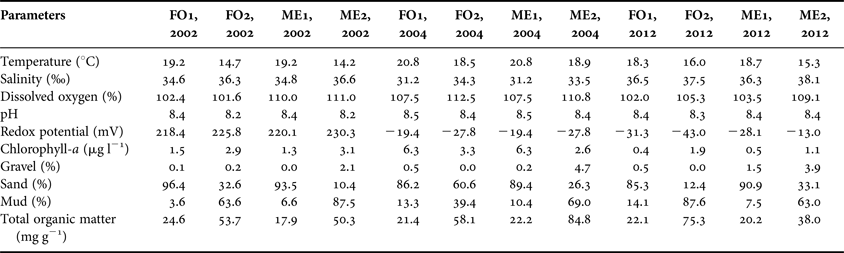
The environmental parameters measured in the water column are summarized in Table 1. Temperatures showed ranges from 14.2°C (Station ME2, 2002) to 20.8°C (Stations FO1 and ME1, 2004). The salinity ranged from 31.2‰ (Stations FO1 and ME1, 2004) to 38.1‰ (Station ME2, 2012). DO ranged from 101.6% (Station FO2, 2002) to 112.5% (Station FO2, 2004). The pH was alkaline in all the stations, and ranged from 8.2 (Stations FO2 and ME2, 2002) to 8.5 (Stations FO1 and ME1, 2004). ORP showed the lowest value at Station FO2, 2012 (−43.0 mV) and the highest at Station ME2, 2002 (230.3 mV). Chl-a ranged from 0.4 µg l−1 (Station FO1, 2012) to 6.3 µg l−1 (Stations FO1 and ME1, 2004). In the study area the sediments may be classified as medium–fine sands. Gravel showed the highest percentage, 4.7%, at Station ME2, 2004 and the lowest (0%) at the Stations ME1, 2002, FO2, 2004 and FO2, 2012. Sand showed the highest value, 96.4%, at Station FO1, 2002, and the lowest, 10.4%, at Station ME2, 2002. Mud ranged from 3.6% (Station FO1, 2002) to 87.6% (Station FO2, 2002). The TOM content ranged from 17.9 mg g−1 (Station ME1, 2002) to 84.8 mg g−1 (Station ME2, 2004) (Table 1).
Environmental parameters measured in the study area.
Meiofaunal parameters
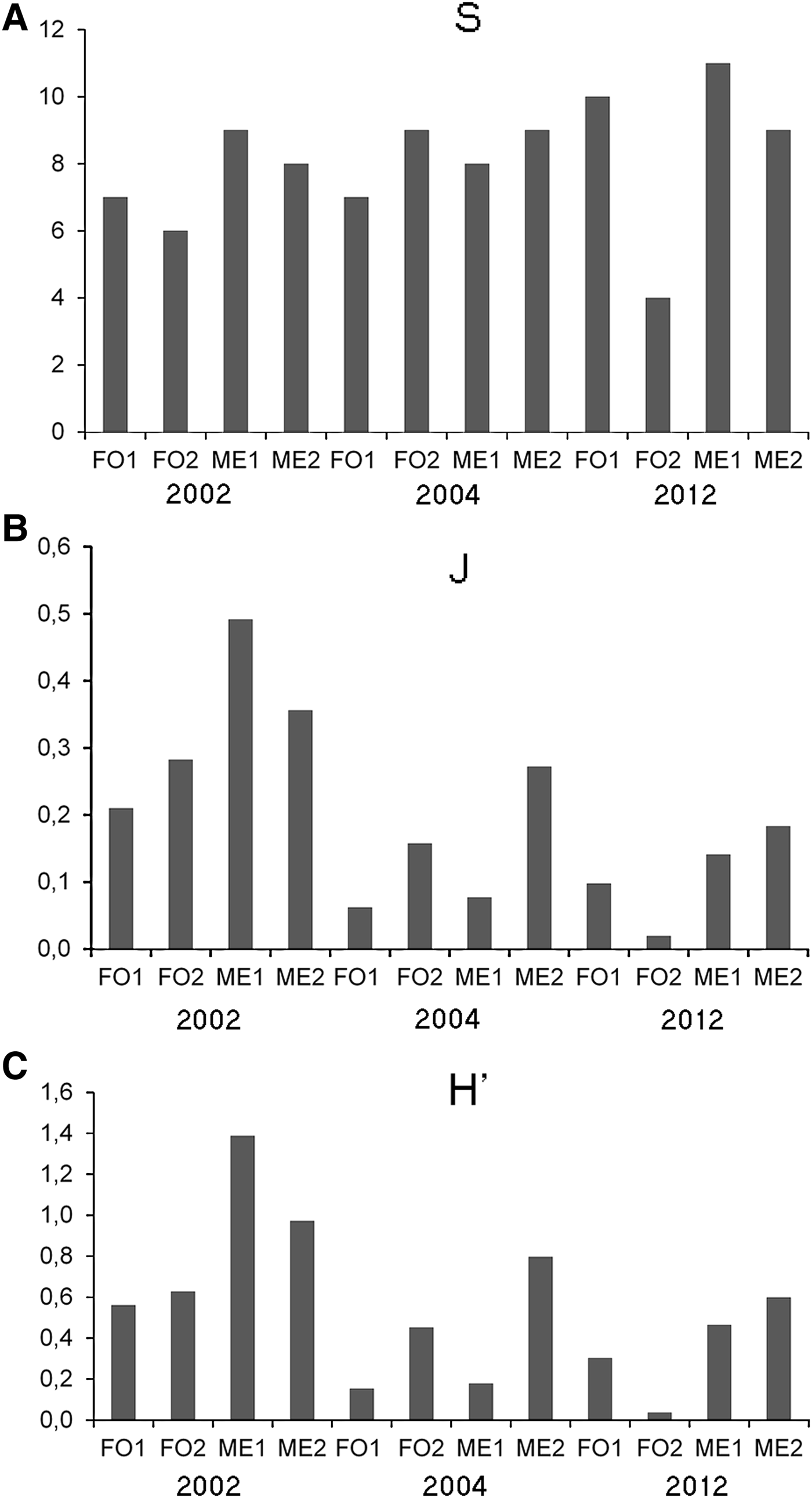
Meiofaunal assemblage was overall represented by 16 major taxa (richness, S): nine found in 2002, 12 in 2004 and 13 in 2012. The number of major taxa ranged from four (Station FO2, 2012) to 11 (Station ME1, 2012) (Appendix A, Supplementary material, Figure 2A). An overall lower number of taxa was detected in the 2002 than in the 2004 and 2012, while the meiofauna at ME resulted richer than at FO (Figure 2A).
Richness of taxa (A), Pielou index (B) and Shannon index (C) of the meiofaunal assemblages from the studied locations.
The J index varied from 0.0 (Station FO2, 2012) to 0.5 (Station ME1, 2002), while the H′ index ranged between 0.0 (Station FO2, 2012) and 1.4 (ME1, 2002) (Figure 2B, C). Both indices showed on the whole higher values at ME than at FO, and lower values from 2004 to 2012 (Figure 2B, C).
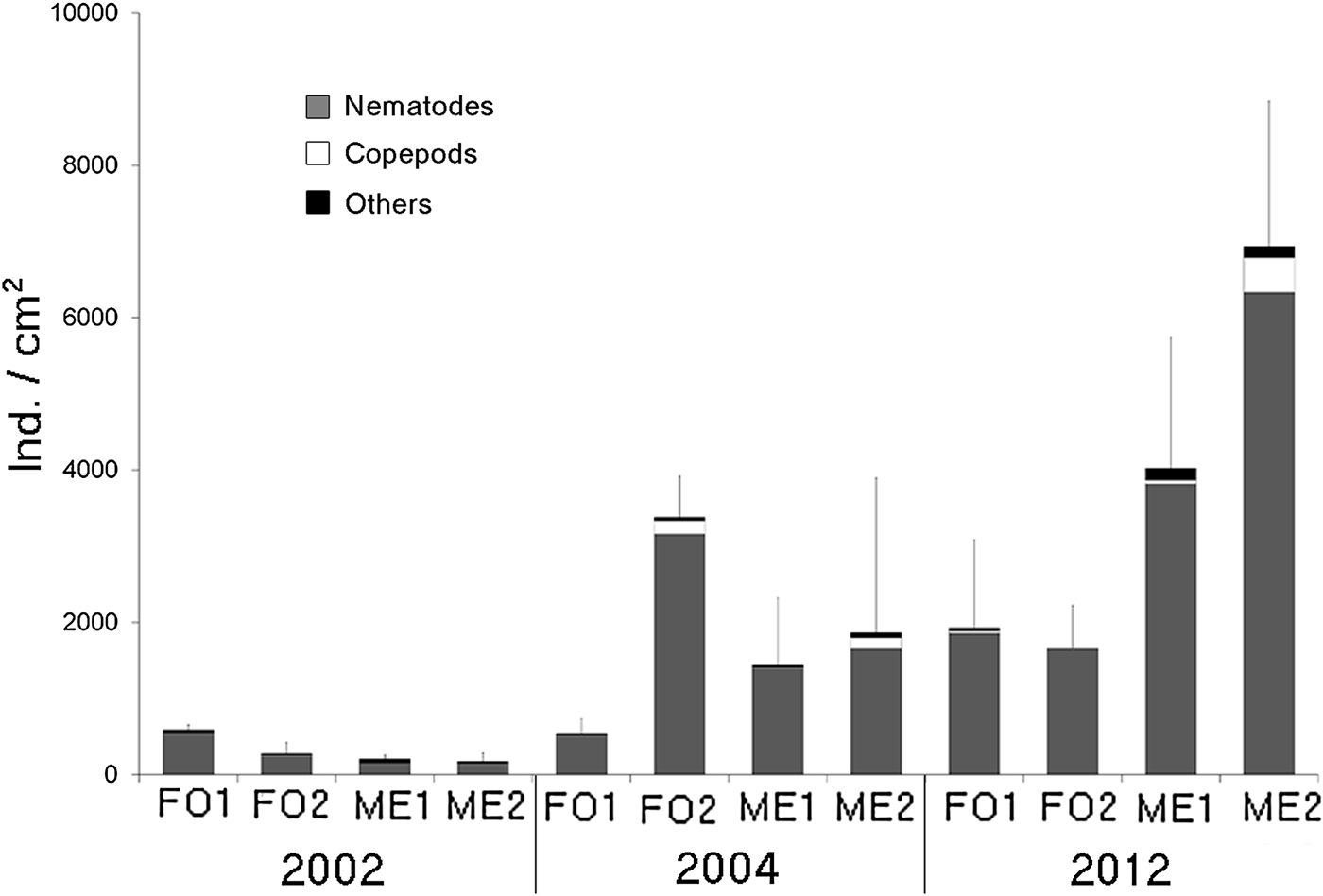
The average meiofaunal abundances varied between 210.0 ± 54.9 and 4025.6 ± 1713.9 ind. 10 cm−2 (Station ME1 both in 2002 and 2012) at Station 1, and between 175.5 ± 108.3 and 6934.7 ± 1907.4 ind. 10 cm−2 (Station ME2, in 2002 and 2012, respectively) at Station 2 (Figure 3). On average, the highest values were recorded offshore (2381.0 ± 862.7 ind. 10 cm−2); while the lowest ones were recorded at Station 1 (1453.5 ± 683.8 ind. 10 cm−2). An overall increase in meiofaunal abundance was observed over the 10 years at both depths (Appendix A, Supplementary material).
Meiofaunal abundance values at the study area during the 2002–2012 decade.
Nematodes were the dominant taxonomic group at both depths (92.1 and 91.6% of the total meiofauna at Stations 1 and 2, respectively). At Station 1, nematodes were followed in abundance by polychaetes (2.9%), platyhelminthes (1.3%) and oligochaetes (1.1%). Offshore the other dominant taxa were copepods (4.0%), polychaetes (1.2%) and platyhelminthes (1.1%). All of the other taxa of meiofauna (gastrotrichs, halacarida, mollusks, rotifers, ostracods, amphipods, isopods, cumaceans, nemertines, kinorhynchs and archianellids) counted for less than 1% of the total assemblage (Appendix A, Supplementary material).
Statistical analysis
Two-way nested ANOSIM did not reveal significant differences of the structure of the meiofaunal assemblage in the site × station interaction (P > 0.05). In contrast, significant differences were detected both in the station × year and site × year interactions (two-way crossed ANOSIM) (Table 2), a trend partially visible also in the plots obtained by nMDS (Figure 4). However, the highest differences in the meiofaunal structure were detected in the station × year interaction. In particular, pair-wise comparisons highlighted greater differences in 2002 in comparison with 2004–2012. SIMPER test (cut-off 90%) revealed that the differences in 2002 were due to the higher abundances of annelids (both oligochaetes and polychaetes), and the lower abundances mainly of nematodes and only secondly of copepods (on the base of the SIMPER results copepods represented a quarter of nematode abundances in this temporal range).
nMDS plot of meiofaunal assemblages. The labels represent the year (A), site (B) station factors (C).
Results of the ANOSIM carried out on the structure of the meiofaunal assemblage (st., stations; si., sites; ye., years).
The differences between the sites were less significant and mainly related to the higher abundance of all the meiofaunal taxa in the ME river, with the only exception of the oligochaetes, more abundant in the FO river (SIMPER, 90%). Ostracods, oligochaetes, gastrotrichs, platyhelminthes and bivalves were more abundant at the coastal stations, whereas all the others taxa increased offshore (SIMPER, 90%).
Among the abiotic variables considered to explain the structure changes of the meiofaunal assemblage, only the TOM content seemed to show temporal variations (Figure 5f, Supplementary material). An overall higher mud and gravel percentages were detected at ME (Figure 5g, i, Supplementary material), while TOM and sand appeared more abundant at FO (Figure 5f, h, Supplementary material).
In spite of the significance of the ANCOVA model on the total meiofaunal abundance (F = 10.8; P < 0.001) and S (F = 6.31; P < 0.001), none of the predictor parameters showed a significant association. Instead, predictor variables explaining the significant differences in the J value (F = 8.68; P < 0.001) were Chl-a (P < 0.001), salinity (P < 0.01) and the distance from the coast (P < 0.01), followed by TOM, gravel percentage, ORP, pH and the year (P < 0.05), all parameters negatively related to the J index. The H′ index showed a similar trend (F = 7.68; P < 0.001), but the independent significant variables in this case were only salinity, Chl-a and the distance from the coastline (P < 0.05), all showing a negative association.
DISCUSSION
The overall biodiversity, especially of macrofauna, of the Adriatic Sea does not seem to have suffered a substantial decrease during recent years. That seems mainly due to the introduction of alien species, which has masked the overall species loss, but has also altered the balance between the various trophic levels and the functioning of the whole marine ecosystem (e.g. Occhipinti-Ambrogi, Reference Occhipinti-Ambrogi, Leppakoski, Gollasch and Olenin2002, Reference Occhipinti-Ambrogi2007; Giani et al., Reference Giani, Djakovac, Degobbis, Cozzi, Solidoro and Fonda Umani2012).
If it is relatively easy to document a change of the macrofaunal assemblage over time, it is more difficult to do the same for the meiofauna. That is because macrofauna organisms have been studied for a long time, so that a greater amount of data on their spatial and temporal variations is available (e.g. Vanaverbeke et al., Reference Vanaverbeke, Merckx, Degraer and Vincx2011; Semprucci, Reference Semprucci2013). However, given the crucial role of meiofauna in the marine ecosystems, temporal series of data on this benthic component are fundamental and may give new insights on the health status of the Adriatic Sea (Balsamo et al., Reference Balsamo, Albertelli, Ceccherelli, Coccioni, Colangelo, Curini-Galletti, Danovaro, D'Addabbo, Leonardis, Fabiano, Frontalini, Gallo, Gambi, Guidi, Moreno, Pusceddu, Sandulli, Semprucci, Todaro and Tongiorgi2010).
According to the most recent classifications of the ecological quality (Danovaro et al., Reference Danovaro, Dell'Anno and Pusceddu2004; Pusceddu et al., Reference Pusceddu, Gambi, Manini and Danovaro2007; Moreno et al., Reference Moreno, Ferrero, Gallizia, Vezzulli, Albertelli and Fabiano2008), the data analysed in the present study suggests from Sufficient (2002) to Good (2004–2012) conditions of the studied ecosystems. However, the richness parameter takes into account only the number of taxa and not their relative abundances, which could be a basic limit for a faunal descriptor. Instead, the diversity indices (namely H′ and J) may be more informative and efficient for summarizing the composition and structure of the benthic assemblages, which is really a crucial point for using meiofauna in accordance with WFD. The Directive, in fact, highlights the necessity to create and/or to calibrate community-based indices, which can be more efficiently applied to identify the EQS class of an ecosystem. In this study, the trend of H′ and J appeared completely opposite to the richness one, showing a significant change of the assemblage structure over the decade. In detail, the 2002 campaign was characterized by assemblages less dominated by nematodes, as the increase of H′ and especially of J values clearly showed. Among the taxa characterizing this period were essentially annelids (namely polychaetes and oligochaetes), a generally not abundant meiofaunal component considered as tolerant (Netto et al., Reference Netto, Warwick and Attrill1999; Vezzulli et al., Reference Vezzulli, Marrale, Moreno and Fabiano2003; Pusceddu et al., Reference Pusceddu, Gambi, Manini and Danovaro2007; Losi et al., Reference Losi, Montefalcone, Moreno, Giovannetti, Gaozza, Grondona and Albertelli2012). This last hypothesis was confirmed by a detailed study of the macrofaunal assemblage, dominated in 2002 by Owenia fusiformis (Frontalini et al., Reference Frontalini, Semprucci, Coccioni, Balsamo, Bittoni and Covazzi-Harriague2011), a species considered to be resistant to stress and typical of shallow waters with well-sorted sandy substrates (Pérès & Picard, Reference Pérès and Picard1964; Simboura & Zenetos, Reference Simboura and Zenetos2002). However, due to the highest levels of H′ and J, the overall EQS in 2002 can be considered Good.
On the contrary, the most abundant meiofaunal groups in 2004 and 2012 were nematodes followed by copepods. These two taxa show very different auto-ecological features (Raffaelli & Mason, Reference Raffaelli and Mason1981). Nematodes are well known to increase in terms of abundance with the enhancement of the sediment fine fraction and the organic content (Steyaert et al., Reference Steyaert, Garner, Gansbeke and Vincx1999, Reference Steyaert, Vanaverbeke, Vanreusel, Barranguet, Lucas and Vincx2003, Reference Steyaert, Moodley, Vanaverbeke, Vandewiele and Vincx2005; Vanaverbeke et al., Reference Vanaverbeke, Gheskiere, Steyaert and Vincx2002; Semprucci et al., Reference Semprucci, Boi, Manti, Covazzi Harriague, Rocchi, Colantoni, Papa and Balsamo2010a, Reference Semprucci, Colantoni, Baldelli, Rocchi and Balsamob). Instead, copepods, which generally are more abundant in coarse and well oxygenated sediments (Wetzel et al., Reference Wetzel, Fleeger, Powers, Rabalais and Turner2001; Semprucci et al., Reference Semprucci, Colantoni, Baldelli, Rocchi and Balsamo2010b; De Troch et al., Reference De Troch, Roelofs, Riedel and Grego2013), generally show a high sensitivity to environmental perturbations (Raffaelli, Reference Raffaelli1987; Coull & Chandler, Reference Coull and Chandler1992; Lee et al., Reference Lee, Correa and Castilla2001; McLachlan & Brown, Reference McLachlan and Brown2006; Ansari et al., Reference Ansari, Lyla, Ajmal Khan, Manokaran and Raja2013). The usefulness of copepods as bioindicators of the human disturbance from riverine inflows has been previously documented by Semprucci et al. (Reference Semprucci, Boi, Manti, Covazzi Harriague, Rocchi, Colantoni, Papa and Balsamo2010a). In this respect, also the general increase of copepods offshore, otherwise a less suitable micro-habitat for its physical–chemical features, could suggest a greater human impact on these coasts (Semprucci et al., Reference Semprucci, Boi, Manti, Covazzi Harriague, Rocchi, Colantoni, Papa and Balsamo2010a).
The increasing dominance of nematodes led also to a significant decrease of the overall meiofaunal diversity. The reduction of this faunal descriptor in response to anthropogenic disturbance has already been documented by several authors (e.g. Coull & Chandler, Reference Coull and Chandler1992; Kennedy & Jacoby, Reference Kennedy and Jacoby1999; Mirto et al., Reference Mirto, La Rosa, Danovaro and Mazzola2000; Vezzulli et al., Reference Vezzulli, Marrale, Moreno and Fabiano2003; Semprucci et al., Reference Semprucci, Boi, Manti, Covazzi Harriague, Rocchi, Colantoni, Papa and Balsamo2010a), and accordingly a decline of the EQS of the area may be inferred.
It is often difficult to establish which may be the causes of the temporal variations of the benthic assemblages because changes may be due to both human impact and natural factors. However, among the environmental parameters used as predictor variables (see ANCOVA results), Chl-a and TOM appeared to negatively affect the J and H′ indices. In particular, Chl-a can be an indicator of a trophic resource of high quality, the sedimentation of which may represent an important resource for benthic assemblages (Boon & Duineveld, Reference Boon and Duineveld1998). However, the enhancement of nutrients such as phosphorus and nitrogen may also lead to an excessive increase of the microalgal bloom, with a consequent increase of the amount of Chl-a to the point of the occurrence of intense eutrophication events, as documented in the study area by Penna et al. (Reference Penna, Cappellacci and Ricci2004). Eutrophication phenomena may cause also hypoxia or anoxia in the bottom (Penna et al., Reference Penna, Cappellacci and Ricci2004), and establish an assemblage mainly represented by opportunistic species (Vanaverbeke et al., Reference Vanaverbeke, Soetaert and Vincx2004a, Reference Vanaverbeke, Steyaert, Soetaert, Rousseau, Van Gansbeke, Parent and Vincxb; Carriço et al., Reference Carriço, Zeppilli, Quillien and Grall2013). In line with this hypothesis there is a significant negative relation with J and Chl-a and TOM.
Phytoplankton blooms, which are often associated with the discharges of the Adriatic rivers, are usually more significant in the spring and autumn periods (Giani et al., Reference Giani, Djakovac, Degobbis, Cozzi, Solidoro and Fonda Umani2012), and have been revealed to have a strong influence on the meiobenthic and nematode assemblages (Semprucci et al., Reference Semprucci, Boi, Manti, Covazzi Harriague, Rocchi, Colantoni, Papa and Balsamo2010a, Reference Semprucci, Moreno, Sbrocca, Rocchi, Albertelli and Balsamo2013b). It is noteworthy that the temporal range analysed by ANCOVA did not reveal a negative impact of the low salinity, and therefore, arguably, of the local riverine inputs, on the composition of meiofaunal biodiversity. However, if the sampling campaigns are considered one by one, it clearly appears that the lowest salinity values in 2004 were associated with the highest peaks of Chl-a and very low values of the J and H′ indices (Figure 5e, Supplementary material). Accordingly, even if a direct and unequivocal association between local riverine discharges, eutrophication phenomena, organic supply and decrease of biodiversity cannot be proven beyond all doubt, an important role for these factors in structuring the meiofaunal assemblages may be inferred.
The higher percentage of gravel in the offshore sediments can be explained by the effect of storm events or other intense hydrodynamic conditions that deposit coarse material far from the coastline, and which regular wave action is not able to rework (Semprucci et al., Reference Semprucci, Boi, Manti, Covazzi Harriague, Rocchi, Colantoni, Papa and Balsamo2010a). The negative association of gravel and meiofaunal diversity was unexpected, because the presence of this large fraction of sediment generally confers a greater heterogeneity in their micro-habitat (Raes & Vanreusel, Reference Raes and Vanreusel2006; Semprucci et al., Reference Semprucci, Boi, Manti, Covazzi Harriague, Rocchi, Colantoni, Papa and Balsamo2010a). However, the high presence of silt and clay offshore reduced drastically the permeability of sediments, leading to OM accumulation and possible oxygen deficiency in the sediment (Albertelli et al., Reference Albertelli, Covazzi-Harriague, Danovaro, Fabiano and Fraschetti1999; Covazzi-Harriague et al., Reference Covazzi-Harriague, Gaozza, Montella and Misic2006; Frontalini et al., Reference Frontalini, Semprucci, Coccioni, Balsamo, Bittoni and Covazzi-Harriague2011; Semprucci et al., Reference Semprucci, Frontalini, Covazzi-Harriague, Coccioni and Balsamo2013a). The observation of black spots in the cores taken as well as the increase of TOM at Station 2 could confirm this hypothesis.
The differences between the FO and ME rivers were not strong. However, the overall higher levels of all the faunal descriptors (namely richness, H′ and J indices) at ME suggested a better ecological quality of this river, in agreement with previous studies (Semprucci et al., Reference Semprucci, Boi, Manti, Covazzi Harriague, Rocchi, Colantoni, Papa and Balsamo2010a, Reference Semprucci, Frontalini, Covazzi-Harriague, Coccioni and Balsamo2013a; Frontalini et al., Reference Frontalini, Semprucci, Coccioni, Balsamo, Bittoni and Covazzi-Harriague2011).
Methods to assess EQS of the coastal ecosystems in accordance with the WFD using meiofauna have already been suggested by Moreno et al. (Reference Moreno, Semprucci, Vezzulli, Balsamo, Fabiano and Albertelli2011), but this classification was based on the use of faunal parameters at genus level (namely nematode genera). The opportunity to obtain a good response of meiofauna, also at a high taxonomic level, to human disturbance, may represent a great advantage because its analysis is not excessively time consuming and does not require taxonomic experts (Kennedy & Jacoby, Reference Kennedy and Jacoby1999; Balsamo et al., Reference Balsamo, Albertelli, Ceccherelli, Coccioni, Colangelo, Curini-Galletti, Danovaro, D'Addabbo, Leonardis, Fabiano, Frontalini, Gallo, Gambi, Guidi, Moreno, Pusceddu, Sandulli, Semprucci, Todaro and Tongiorgi2010).
This study confirms that the analysis of meiofauna can give a valuable contribution to the knowledge about coastal ecosystems, and, especially if additional meiofaunal descriptors of EQS are introduced, it may become a basic, integrative tool for the routine protocols currently applied to macrofaunal assemblages for investigating and monitoring marine ecosystems.
Supplementary materials and methods
The supplementary material referred to in this paper can be found online at journals.cambridge.org/mbi.