INTRODUCTION
Symptoms of depression are well documented among individuals with advanced disease and their families (Chentsova-Dutton et al., Reference Chentsova-Dutton, Shucter and Hutchin2000; Hotopf et al., Reference Hotopf, Chidgey and Addington-Hall2002; Oliver et al., Reference Oliver, Albright and Washington2013). For particularly distressed individuals, these symptoms may include thoughts of suicide (also referred to as “suicidal ideation”), suicide attempts, or death by suicide. While the incidence of suicide and the prevalence of related thoughts and behaviors among seriously ill patients and their families is unknown (Fairman et al., Reference Fairman, Thomas and Whitmore2014), documented accounts of such occurrences suggest that this issue warrants concern (Adelman et al., Reference Adelman, Tmanova and Delgado2014; Fairman & Irwin, Reference Fairman and Irwin2013; Fairman et al., Reference Fairman, Thomas and Whitmore2014; O'Dwyer et al., Reference O'Dwyer, Moyle and Zimmer-Gembeck2015). The growing acceptance of physician-assisted suicide (sometimes referred to as “physician aid in dying”), as evidenced in the United States by an increasing number of states legalizing the practice (Clodfelter & Adashi, Reference Clodfelter and Adashi2016), further underscores its importance.
As researchers interested in hospice and palliative care, we routinely include depression as an outcome of interest in our studies, most recently measuring depression among hospice family caregivers using the nine-item Patient Health Questionnaire (PHQ–9) (Kroenke et al., Reference Kroenke, Spitzer and Williams2001). The final item of the PHQ–9 asks respondents to indicate how often in the most recent two weeks they had thoughts that they would be better off dead or thoughts of hurting themselves. Per our research safety protocols, affirmative responses to this item (i.e., having had these thoughts several days or more often in the most recent two weeks) require notification of the hospice social worker for further assessment and potential intervention. Upon making this notification, we have observed a wide range of responses from social workers, who have reported variable degrees of experience and competence in working with individuals exhibiting the warning signs of suicide.
Research on social workers' perceived competence in assessing and responding to suicide risk is scant. To the best of our knowledge, this topic has rarely been studied among hospice and palliative social workers, with the exception of research on physician-assisted suicide and other means of hastened death (e.g., Ganzini et al., Reference Ganzini, Harvath and Jackson2002; Miller & Hedlund, Reference Miller and Hedlund2005). Among social workers broadly, studies indicate that the likelihood of encountering a client at risk of suicide is high (Feldman & Freedenthal, Reference Feldman and Freedenthal2006; Joe & Neidermeier, Reference Joe and Neidermeier2008; Osteen et al., Reference Osteen, Jacobson and Sharpe2014), and, despite limited formal education on suicide as part of their educational preparation, social workers generally feel competent in their knowledge and skill set related to suicide assessment and prevention (Feldman & Freedenthal, Reference Feldman and Freedenthal2006). In one of the only studies on suicide competencies specific to the field of hospice and palliative care, social workers' self-efficacy to address issues related to suicide was significantly enhanced by a brief training experience, suggesting that any existing deficits in suicide-related knowledge and skills could be addressed efficiently and with limited resource expenditure (Matthieu & Swensen, Reference Matthieu and Swensen2014).
Study Aims
Our professional experiences, coupled with a dearth of research about social workers' encounters with suicide in hospice and palliative care, led us to propose a study with the following aims: (1) to determine the frequency with which hospice and palliative social workers encounter patients, family caregivers, and other clients at risk of suicide; and (2) to determine the extent to which hospice and palliative social workers feel prepared to address issues related to suicide in their professional practice. Consistent with these aims, we also sought to determine the perceived adequacy of suicide content in social work education and continuing professional development efforts and the extent to which hospice and palliative social workers believe that additional instruction on this topic would benefit their professional practice.
METHODS
We conducted a cross-sectional survey of hospice and palliative social workers, recruiting a convenience sample of volunteer respondents through advertisements at professional conferences, listservs, and via social media accounts associated with national organizations (e.g., the Social Work Hospice and Palliative Care Network), state hospice and palliative care associations, and individual healthcare professionals. Social workers who were recruited face to face at conferences and other events were given the option of completing the survey questionnaire using a paper form or by accessing an online version using their personal web-enabled electronic devices; all other respondents completed the questionnaire online. To be eligible for the study, respondents were required to be currently employed as social workers in hospice or palliative care settings. Social workers in administrative roles who did not work directly with patients and families were considered eligible for the study; however, they were instructed to skip specific items that would not be pertinent to their role on the healthcare team. Prior to starting the study, the University of Missouri Health Sciences Institutional Review Board approved all research procedures and materials.
Questionnaire Development
We developed our survey questionnaire in three phases. First, two members of our research team met face to face to develop a set of preliminary item stems and response choices based on our study aims, specific research questions, and a review of the literature. Next, we shared the items with the remainder of the research team, seeking input on the face validity of items and the organization of the questionnaire. After making recommended revisions, we asked six experienced healthcare professionals (three hospice social workers, two mental health social workers, and a mental health clinician who specializes in suicide prevention) to assess the content validity of the items included in the questionnaire using a structured tool created specifically for this study. These content experts scored each item based on its clarity and representativeness using a 4-point Likert-type scale, where 1 = not at all clear (or representative) and 4 = clear (or representative) as written. Written instructions on the assessment tool informed content experts that items with a high degree of clarity would likely be easy for respondents to understand because their meaning was clear, whereas responses to items with a high degree of representativeness would be likely to shed light on the specific constructs we hoped to learn more about. Most of the items (85.1%) received a score of 3 or higher from all assessors for both clarity and representativeness on the first review. We revised items that received a score of 2 or less from any assessor for either clarity or representativeness, returning revised items to all assessors for additional review. The final version of our survey instrument contained 47 items, all of which received scores of 3 or higher on all evaluative criteria.
Data Management and Analysis
Data were entered or imported into SPSS (v. 21.0) software prior to analysis. Some 36 incomplete cases (defined as questionnaires submitted with responses missing for 50% or more items) were deleted prior to analysis. Cases retained in the final data set had little missing data. Three respondents elected not to provide the following demographic information: gender, race, age, state. Two of these respondents also declined to provide information about the inclusion and sufficiency of suicide-related content in their social work education and continuing professional education (CPE), the type(s) of social work degree(s) they had earned, and their years of social work experience. A different respondent did not report how many hours of suicide-related CPE she had received in the past year, while another did not indicate the extent to which she agreed that she had sufficient skills to intervene when she recently encountered a caregiver exhibiting the warning signs of suicide. Responses were provided to all other items. Data analysis consisted of calculation of basic frequencies and, for continuous demographic variables, measures of central tendency.
RESULTS
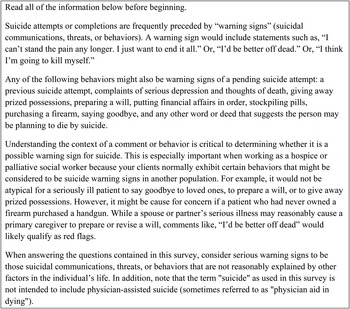
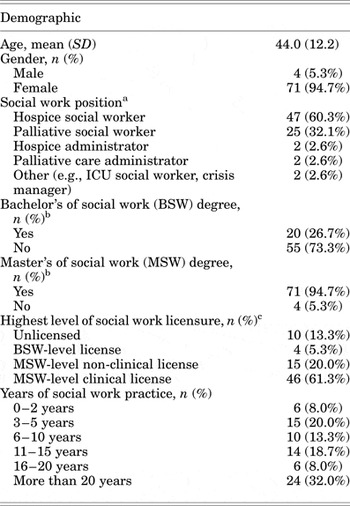
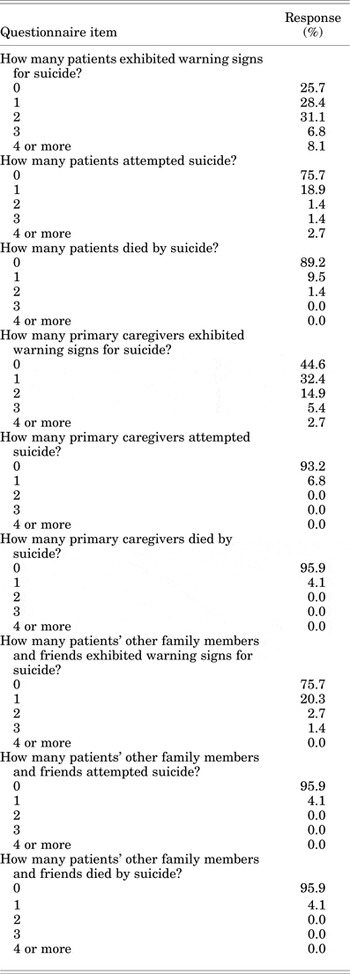
A total of 78 hospice and palliative social workers from 23 states and 1 foreign country provided complete responses to our survey. Respondent characteristics are summarized in Table 1. Of the 74 respondents in direct practice (vs. administrative roles), 74.4% had, to the best of their knowledge, served at least 1 hospice patient in the prior 12 months who had exhibited warning signs of suicide (survey instructions, provided in Figure 1, provided a detailed definition of “warning signs of suicide”). Fewer respondents (24.4%) indicated that one or more of their patients had attempted suicide, and 10.9% reported that a patient they served had died by suicide in the prior year. Respondents also reported experience working with primary caregivers (defined as the patient's family member or friend whom the social worker would contact first in the event of an emergency) and patients' other family members and friends who had exhibited the warning signs of suicide, had attempted suicide, or had died by suicide in the prior year. Detailed results are provided in Table 2.
Survey respondent instructions.

Respondent demographics (N = 78)

Note: Three respondents elected not to provide demographic data; thus, n = 75 for most categories presented here. Due to rounding, the total percentage is not equal to 100% for some categories.
aAll respondents provided this information (N = 78).
bRespondents indicated all social work degrees earned; some had earned both BSW and MSW degrees or equivalent degrees (e.g., BASW, MSSW).
cGiven the focus of our study, clinical licensure was classified as a “higher” licensure category than nonclinical licensure.
Hospice and palliative social workers' exposure to clients at risk of suicide (N = 74) a

Note: All items began with the qualifier “To the best of your knowledge,” and indicated that respondents should indicate the number of clients they had served in the past 12 months who fit the provided description. Due to rounding, total percentage is not equal to 100% for some categories.
aFour respondents did not complete these items because they had administrative vs. direct practice professional roles.
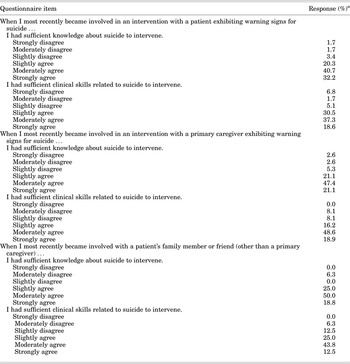
Of the social workers who had encountered at least one patient who exhibited the warning signs of suicide in the previous year, nearly all (95.2%) became involved in an intervention to support the individual at potential risk of suicide. Most of these social workers reported that they had adequate knowledge about suicide and had sufficient skills in working with clients at risk of suicide to intervene in these situations. Specific responses are detailed in Table 3.
Hospice and palliative social workers' self-efficacy to intervene with clients at risk of suicide

Note: Due to rounding, total percentage is not equal to 100% for some categories.
aPercentages include only respondents who indicated that they had become involved in an intervention with the specified type of client in the previous 12 months.
Of the respondents who could remember whether content on suicide was included as part of their social work degree programs, 87.7% indicated that it had been, although 21.3% of those who had been exposed to this content indicated that it did not sufficiently prepare them to work as a hospice or palliative social worker. The majority of respondents (69.9%) indicated that they had received some CPE focused on suicide; just over half (55.6%) had received at least an hour of CPE related to suicide in the prior year. Over 90% of respondents slightly (14.5%), moderately (31.6%), or strongly (47.4%) agreed that learning more about suicide would be valuable for their professional social work practice.
When asked about their assessment practices, the majority (74.3%) of respondents indicated that they somewhat infrequently, rarely, or never used standardized scales to assess patients' emotional well-being. The percentage of social workers who reported infrequent/rare/nonexistent use of standardized scales was higher with regard to assessment of primary caregivers (77.0%), and higher still with regard to assessment of patients' other family members and friends (89.2%). The Geriatric Depression Scale was the instrument most commonly reported to have been used as an assessment tool; however, no instrument was listed by more than eight respondents. Two respondents provided information about their use of standardized scales in the open-text field in which they were asked to list the instruments they had used in practice. They cited barriers to instrument use, including personal preference (“I do not use many scales, even those that are considered psychometrically valid, as my personal practicing belief is [that] quantifying human experience and individual challenges is not the best practice”) and patient/family response (“There are so many other questions I have to ask during an assessment that I find trying to get [patients and families] to [assign a number to their experiences] is exhausting for them and disrupts the normal flow of the interview”).
DISCUSSION
These study results suggest that suicide-related competencies are important in the practice of hospice and palliative social work. Most respondents indicated that they had encountered patients and primary caregivers who had exhibited the warning signs of suicide during the past year, with a smaller number reporting suicide attempts and deaths in the same time period. Warning signs, suicide attempts, and deaths by suicide were reported to be encountered less often among patients' other family members and friends, though this may be related to social workers' less frequent contact with these individuals.
Most respondents indicated that they had sufficient knowledge and clinical skills to address issues related to suicide in their professional practice, having received instruction as part of their social work education and during CPE. At the same time, over 90% agreed that learning more about suicide would be valuable for their professional social work practice, suggesting that this topic would not be unwelcome in future CPE sessions and events.
Ensuring that social workers and other members of the interdisciplinary team are equipped with the knowledge and skills to prevent suicide has obvious benefits for patients and families receiving hospice and palliative care, but research suggests that it may also benefit healthcare professionals themselves, who have been found to experience intrusive memories and feelings of guilt and self-doubt in response to completed patient suicides (Fairman et al., Reference Fairman, Thomas and Whitmore2014). Such negative responses do not appear to be universal, however. Other end-of-life care providers have reported viewing suicide through a lens of patient autonomy for those with life-limiting illnesses (Dennis et al., Reference Dennis, Washington and Koenig2014; Fairman et al., Reference Fairman, Thomas and Whitmore2014). In all likelihood, these responses would differ considerably in response to suicide risk among family caregivers and patients' other family members and friends who are not diagnosed with life-limiting conditions.
It is important to note that, in our survey, we asked respondents about their perceived levels of competence. Previous research (Osteen et al., Reference Osteen, Jacobson and Sharpe2014) has shown that perceived knowledge about suicide does not necessarily reflect suicide-related knowledge as measured by objective testing. However, perceived knowledge, as opposed to objectively measured knowledge (e.g., scores on fact-based tests), has been shown to be correlated with actual practice behaviors, such as asking clients about suicide in response to warning signs and asking depressed clients about suicide (Osteen et al., Reference Osteen, Jacobson and Sharpe2014), underscoring the importance of self-efficacy in social work practice.
Our finding that many hospice and palliative social workers do not routinely use standardized instruments to assess patients' or caregivers' well-being is consistent with previous research (Oliver et al., Reference Oliver, Wittenberg-Lyles and Washington2009). While the clinical benefits and/or drawbacks of this approach are beyond the scope of our study, there are a number of abbreviated tools that exist and that could be adapted into routine practice, should social workers be interested in using them. The two-item version of the Patient Health Questionnaire (Kroenke et al., Reference Kroenke, Spitzer and Williams2003), for example, has been identified as a useful preliminary screen for depression, and could be easily folded into a more conversational approach to assessment and, if indicated, further clinical attention. Similarly, given patients' and caregivers' likely familiarity with using 10-point scales to rate symptoms such as physical pain, options such as the four-item Caregiver Quality of Life Index–Revised (Courtney et al., Reference Courtney, Demiris and Oliver2005), which facilitates a brief assessment of physical, social, emotional, and financial quality of life, would be useful to consider. Social workers can play a key role in supporting the emotional well-being of patients and families, and routine use of such tools may help them identify individuals who would benefit from additional intervention.
Study Limitations
A number of study limitations warrant attention. First, despite implementing a wide variety of recruitment strategies across a two-year timeframe, our final sample size of 78 is quite modest for a national study. Second, social workers included in our convenience sample cannot be assumed to be representative of the full population of hospice and palliative social workers in the United States (Rubin & Babbie, Reference Rubin and Babbie2014). It is our hope that, as hospice and palliative social work evolves as a specialty practice area, we can continue to explore opportunities to involve a greater number of social workers in building an evidence base for practice with seriously ill patients and families. Third, while we did not include them in our final analytic sample, the number of respondents who completed less than half of the questionnaire (36 of 114 original submissions) is concerning. It is noteworthy that all of the incomplete questionnaires were completed online. While conducting surveys online has a number of advantages (e.g., low cost, ability to reach a broad audience), the fact that respondents can easily quit in the middle of a questionnaire is a significant disadvantage of this approach, as is the reality that researchers retain decidedly little control over the quality of the data provided by respondents (Sue & Ritter, Reference Sue and Ritter2012). Future studies would be significantly enhanced by development of a national network of hospice and palliative social workers committed to high-quality research in this field; inclusion of social work practitioners in such networks would be particularly valuable to those studying practice behaviors and outcomes.