Introduction
The expression ‘developmental programming’ is described as the programming of various bodily systems and processes by a stressor of the maternal system during pregnancy or during the neonatal period.Reference Reynolds, Borowicz and Caton 1 It has also been termed as ‘Fetal Programming’, ‘The Barker Hypothesis’, or ‘developmental origins of health and disease’.Reference Caton and Hess 2 The effects of this process are evident at the offspring level in changes in litter size, sex ratios, fetal or neonatal development, and in key organ systems and functions, especially reproductive capacity, health and behavior.Reference Ashworth, Toma and Hunter 3 One of these stressors is maternal nutrition, especially around conception, which is known as the ‘periconceptional period’. In a recent review,Reference Bloomfield 4 it has been indicated that maternal periconceptional undernutrition is related to altered development and an enlarged danger of adverse neurodevelopmental and metabolic consequences in childhood and later life, suggesting that environmental signals acting during early development may result in epigenetic changes, which may play a role in the relationship between early life vulnerability and adult phenotype. The importance of nutrition during certain windows of physiological processes, in the context of the livestock industry, have led to create the term ‘focus feeding’, which is based on using short periods of nutritional supplements that are precisely timed and specifically designed for stages of the reproductive process.Reference Martin, Rodger and Blache 5 The accessibility to pasturage resources in a particular year can produce situations of deprivation and subnutrition, a circumstance that is normal in sheep flocks under extensive farming systems such as those found in the Mediterranean area that extensively rely on natural forage resources. It has been widely demonstrated that undernutrition affects sheep reproduction,Reference Forcada and Abecia 6 so that together with season, undernutrition becomes one of the main environmental factors affecting lamb production.
Maternal undernutrition around conception has numerous effects on several aspects of the physiology of offspring. A low level of nutrition from −45 days to 6 days after conception is sufficient to change the amount of key factors regulating cardiac growth and metabolism and this may increase the capacity to develop cardiovascular diseases in later life,Reference Lie, Sim and McMillen 7 or cause a suppression of the pituitary glucocorticoid receptor expression at the end of pregnancy.Reference Zhang, Williams-Wyss and MacLaughlin 8 At the reproductive level, maternal feed restriction causes a delay in fetal ovarian development in sheep.Reference Rae, Palassio and Kyle 9
Undernutrition, or even specific nutrient deficiency, before conception and during the periconceptional period can also alter the behavior of the resultant offspring. Thus, in sheep, a significant decrease in voluntary physical activity in adult offspring has been observed after a periconceptional undernutrition of the ewes,Reference Donovan, Hernandez and Matthews 10 and offspring from undernourished ewes suppress behavioral reactions and cortisol secretion in response to isolation stress.Reference Hernandez, Matthews, Oliver, Bloomfield and Harding 11 Moreover, when ewes were undernourished from 61 days before until 30 days after conception, offspring plasma cortisol was suppressed, producing a prolonged, sex-dependent effect on adrenal function in the offspring.Reference Oliver, Bloomfield and Jaquiery 12 Sub-clinical cobalt deficiency in embryo donor ewes resulted in lambs that spent less time interacting with their dams than lambs from embryos donated by cobalt-adequate ewes.Reference Mitchell, Robinson and Watt 13 Such observations confirm the importance of the nutritional status of the oocyte and/or early cleavage-stage embryo on postnatal behavior. It has been suggestedReference Erhard, Boissy and Rae 14 that prenatal undernutrition can have long-term adverse effects on the animals’ responses to normal husbandry procedures, indicating that extensive management systems, in which pregnant ewes are often subjected to periods of low food supply, have the potential to produce offspring with higher levels of emotional reactivity.
The aim of this study was to determine the effect of periconceptional undernutrition in sheep on behavioral characteristics of the offspring and on their reproductive traits at 30 days of age. Thus, some cognitive and emotional responses of the offspring, and the number and quality of the oocytes recovered from ewe lambs born as a result of the window under study have been examined. Moreover, the capacity of these oocytes to become embryos after in vitro maturation (IVM) and fertilization (IVF) techniques were also investigated.
We used Rasa Aragonesa sheep, which is a native Spanish breed with a short seasonal anestrous period (<100 days) between May and July,Reference Forcada, Abecia and Sierra 15 and is well adapted for intensive production systems and an accelerated lambing rate (typically, three lambings in two years).
Methods
Animals and experimental procedures
The study was conducted at the experimental farm of the University of Zaragoza, Spain (41°N). In mid-November, 80 mature Rasa Aragonesa ewes were synchronized in estrus (day 0) using intravaginal sponges that contained 30 mg fluorogestone acetate (Chronogest, MSD Salud Animal, Madrid, Spain), which were inserted for 14 days. Upon sponge withdrawal, 480 IU eCG (Folligon, MSD Salud Animal, Madrid, Spain) were administered. Ten fertile rams were introduced into the flock 24 h after sponge removal, and kept for 72 h. At the time of sponge insertion, ewes were allocated to one of two groups to be fed diets that provided either 1.5 [control group (C); n=40] or 0.5 [low group (L); n=40] times the daily requirements for maintenance. Diets consisted of 0.80 or 0.50 kg of barley straw and 0.55 or 0.10 kg of pellets, for C and L groups, respectively. The pelleted diet consisted of barley (85%) and soy bean (15%). The animals had unrestricted access to water and mineral supplement. At day 7, all ewes were regrouped and fed the control diet until lambing.
Liveweight (LW) and body condition (BCS; on a scale of 0–5, where 0=emaciated and 5=obese)Reference Russel, Doney and Gunn 16 were determined at time of sponge insertion (day −14), at withdrawal (day −1) and at day 7, the end of the differential diet period. The reproductive parameters assessed at lambing were fertility rate (number of ewes lambing per 100 ewes presented to rams), prolificacy (mean number of live and dead lambs born per ewe lambing) and fecundity (number of live and dead lambs born per ewe presented to the ram). Ratio male/female born and mean pregnancy lengths were also calculated. Lambs were weighed at lambing and weaning (45 days of age).
Approximately 1 month after lambing, 32 lambs (C: 9 males, 8 females; L: 8 males, 6 females) with a mean (±s.e.m.) LW of 7.9±0.1 kg (C: 7.7±0.1; L: 8.1±0.1 kg) and a mean age (±s.e.m.) of 27.0±0.5 days (C: 27.2±0.5; L: 26.8±0.6 days) were selected to be exposed to T-maze, isolation and novel object tests. Lambs were selected from those born in a 3-day interval. A blood sample was collected 48 h before the tests to determine plasma concentrations of some metabolic indicators of stress and energetic activity [cortisol, glucose, creatine kinase (CK) and lactate].
Ten days after the behavioral and cognitive tests, six ewe lambs (3 C, 3 L) born the same day, with a mean LW (±s.e.m.) of 10.8±0.6 kg (C: 10.6±0.6; L: 11.0±0.5 kg) and a mean age (±s.e.m.) of 36.0±0.0 days were euthanized using an i.v. injection of a commercial euthanizer (T-61, MSD, Salamanca, Spain). Ewe lambs were selected on the basis of a similar LW, being born the same day and being twins. None of them participated in the behavioral tests. Their ovaries were recovered and stored at 39°C until they were processed, not later than half an hour after ovariectomy.
T-maze test
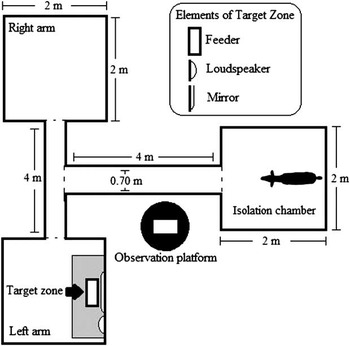
Lambs were subjected to a cognitive test in two consecutive rounds. A T-maze adapted from Marín et al. Reference Marín, Arce and Martijena 17 for lambs, built with plastic panels 1.40 m in height (Fig. 1) was used. The T-maze test was developed as a learning paradigm for young chicksReference Gilbert 18 and to assess emotionality on the basis of escape behavior.Reference Marin and Arce 19 It consisted of a start box, and an isolation chamber (2×2 m) joined on one of its sides to a T-corridor. The start box was fully closed but large enough to enable an individual to move around. The T-corridor consisted of a 2×0.80 m path linked to two perpendicular arms (1.65×1.65 m each). A mirror (70×30 cm) and a loudspeaker were located in the target zone on the left arm. An observation platform was placed 3 m above the ground adjacent to the T-maze apparatus, so as not to influence animal movement.Reference Ortiz-Plata, De Lucas-Tron and Miranda-de la Lama 20 The apparatus was kept in a soundproof room (9×6 m) maintained at constant temperature and humidity during the test.
T-maze apparatus used in the experiment. Dimensions are expressed in meters. The discontinuous lines create the imaginary divisions used to count traversed areas.

The sounds used in the experiment were a playback of ewe and lamb vocalizations during a short-time separation. They were recorded at a distance of 50 cm from the sound source using a Handy Recorder H1 (Zoom Corporation Tokyo, Japan) numeric recorder (sampling rate: 44.1 kHz). Sounds were then imported into a computer at a sampling rate of 44.1 kHz and saved in WAV format at 16-bit amplitude resolution.Reference Briefer and McElligott 21 The Audacity® audio software was used to prepare the sound sequences that were played back. A sample of these sounds was combined to produce a 5 min segment and a random portion of this segment was played at each trial. The noise was played and measured using a Bioblock Scientific Sound Level Meter, type 50517, at a set volume that ensured lambs were exposed to 81 dB of intensity through the majority of the T-maze. For each trial, the sounds were played back using a Handy Recorder H1 connected to a loudspeaker located at floor level on the left arm in the target zone. Before entering the T-maze, the lambs were kept in a holding pen for 60 min. After this adaptation period, each individual was separated from the group and moved to the entrance of the test pen. The procedure was designed to ensure that the handling protocol applied to the animals between the holding and test pen was as standardized as possible and was performed quietly by the same person each time to avoid arousal before the test. Lambs from different treatment groups were tested alternately, so that the treatment factor was not confounded with the order of testing. All of them stayed in the start box for 20 s before a guillotine door was lifted to allow entrance into the arena. After the lamb left the start box, the guillotine door was quietly closedReference Langbein 22 and recorded sounds were played back. Each individual was filmed and the time taken in reaching the target zone (always on the left side), with a mirror (social cue) and the sound source (sound clue), was recorded. The latency to leave the start box and the number of areas traversed (see Fig. 1) was calculated. Each animal was given a maximum of 5 min to solve the maze. No animal exceeded that time limit.
Isolation test
Lambs underwent an isolation test to measure fear in novel environments and response to separation. The test pen represented a novel environment in which the tested animal was visually isolated from other members of the group. The lambs were tested in an arena measuring 4×4 m, marked out in a grid of 0.50×0.50 m. Water and familiar food were placed in the arena in a familiar bucket against the wall facing the entrance door. Before testing, groups of lambs were moved to a holding pen, where they stayed for 30 min. After this adaptation period, each individual was separated from the group and moved to the entrance of the test pens. The procedure was designed to ensure that the handling protocol applied to the animals between the holding and test pen was standardized as far as possible and was performed quietly by the same person each time to avoid arousal before the test. Lambs from different treatment groups were tested alternately, so that the treatment factor was not confounded with the order of testing. All of them stayed in the start box for 20 s before a guillotine door was lifted to allow entrance into the arena. After the lamb left the start box, the guillotine door was quietly closed.Reference Langbein 22 The lamb to be tested entered the arena, remaining there for a 5 min period. All behavioral responses were recorded on videotape using an overhead color camera, and a microphone was used to record vocalizations. The time each animal spent walking, exploring, standing, attempting to escape (i.e. jumps: four legs leaving the ground), the latency to leave the start box, the latency to leave the test once the test was over, and the number of bleats were recorded.
Novel object test
This test was designed to examine the initial reaction of a lamb when exposed to a novel object (1 min) and when exposed to the same object for a second time (1 min), 1 min after the first exposure. Five minutes after opening the swing doors, right after the end of the isolation test, a novel object consisting of a blue plastic ball connected to a rope was lowered from the ceiling to the floor at the center of the arena. When it hit the floor, it was left in that position for the first 1 min novel object test; then it was lifted up and after 1 min, the same procedure was repeated. The distance to the novel object in the 30th second of the test (two measurements), and the time taken to approach the novel object in each exposure were measured. The total number of times an animal touched the object during the whole test was also recorded.
In vitro procedures
A combination of puncture and slicing techniques were used to collect oocytes, which were classified based on their cumulus cells and cytoplasm morphology, as: good (all oocytes with a lot of complete layers of granulose cells and homogeneous cytoplasm), fair (all oocytes with few or incomplete layers of granulose cells and homogeneous cytoplasm) or poor (oocytes with few or absence of granulose cells and non-homogeneous cytoplasm). Only good and fair oocytes (healthy oocytes) were selected for IVM. At the end of IVM, the oocytes were denuded from the cumulus cells and transferred to the fertilization medium. On the same day of fertilization, the semen collected from two Rasa Aragonesa rams was pooled, diluted 1:10 in a saline medium and kept at 15°C until IVF. Highly motile spermatozoa were selected by swim-up technique and added to the fertilization medium that contained the oocytes at a final concentration of 1×10⁶ spermatozoa/ml, covered with mineral oil and incubated for 24 h at 39°C in an atmosphere of 5% CO2 and saturated humidity. After 24 and 36 h, presumptive zygotes were assessed for cleavage. Non-cleaved oocytes were observed to assess their maturation stage. Oocytes showing the first polar body were considered mature, and oocytes with two polar bodies were considered fertilized but not cleaved. After fertilization, cleaved embryos were placed in a culture medium for 8 days. Media used for oocyte collection and IVM, IVF and embryo culture have been previously described.Reference Forcada, Buffoni and Abecia 23
Plasma assays
Plasma glucose (mg/dl) and CK (UI/l) concentrations were determined with a Multichannel Technicon Analyser (RA-500), using reagents for RA Technicon systems (Bayer Diagnostics, Spain; glucose, Ref. T01-1492-56; CK Ref. T01-1885-01). Plasma cortisol levels (ng/ml) were determined in duplicate by enzyme immunoassay.Reference Chacón, Garcia-Belenguer, Illera and Palacio 24 The concentration of lactate (mg/dl) was determined in fluoride oxalate plasma using a Sigma Diagnostic Kit (Lactate no. 735-10) and a spectrophotometer (Lamda 5, Perkin Elmer). The intra-assay coefficients of variation were 10%, 8%, 14% and 5% for glucose, CK, cortisol and lactate, respectively.
Statistical analysis
The rate of mature and fertilized oocytes, cleaved embryos and blastocysts were expressed as a percentage for each group. Maturation and cleavage rates were calculated over the number of healthy oocytes, fertilization rate was based on the number of matured oocytes, and blastocyst rates were based on the number of cleaved embryos or oocytes. They were evaluated statistically using χ 2 or Fisher Exact tests, as appropriate. To integrate the percentages in the model, to determine whether they were influenced by the effects considered, individual proportions were arcsine-transformed before being subjected to statistical analysis. Total number and classification of oocytes recovered and the number of healthy oocytes selected for maturation, and the rest of the reproductive and growth parameters were also subjected to ANOVA. T-maze variables were subjected to repeated-measures ANOVA that examined the main effects of treatment (control and undernourished), T-maze trial (first and second T-maze escape; the repeated measure), and their interaction. To better fit the assumptions of the ANOVA, latency to leave the start box data was transformed to ranks. A one-way ANOVA was used to determine differences between control and undernourished lambs in open-field variables. Within novel object test, the distance to the novel object and the time to approximate the object were subjected to a repeated-measures ANOVA that examined the main effects of treatment (control and low), novel object trial (first and second; the repeated measure) and their interaction. Because the number of times the object was touched was evaluated only once, differences between control and undernourished lambs were evaluated using a one-way ANOVA. Where appropriate, Fisher LSD tests were used for post-hoc comparisons of means. Results were expressed as mean±standard error of the mean (s.e.m.). The probability level for statistical significance was set to P<0.05 and trend to significance to P<0.10.
Results
Liveweight and body condition
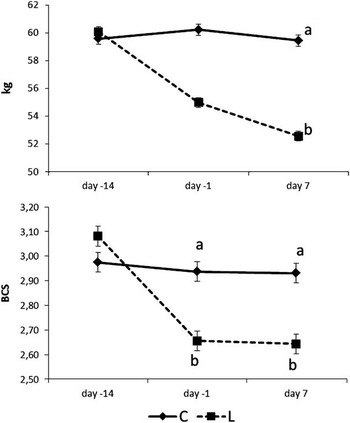
During the experimental period, the mean LW of C ewes did not change, L ewes presented a reduction in their initial LW (Fig. 2), with significant differences at day 7, in comparison with C ewes (P<0.05). Accordingly, L ewes experienced a significant reduction in their BC in comparison with C ewes (P<0.05). After pessary withdrawal (14 days after the onset of the experimental diets), mean LW and BC of L ewes were significantly lower than those of C ewes (P<0.05).
Mean liveweight (LW; upper panel) and body condition score (BCS; lower panel) (±s.e.m.) at sponge insertion (day –14), sponge withdrawal (day –1) and at the end of the experimental diet period (day 7) of Rasa Aragonesa ewes, fed to provide 1.5 (C) or 0.5 (L) times the daily requirements for maintenance, from sponge insertion to day 7 (estrus=day 0). a, b: P<0.05.

Reproductive parameters
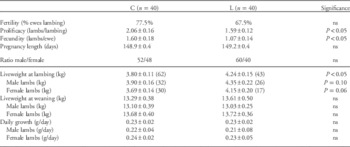
Periconceptional undernutrition up to the 7th day of pregnancy resulted in a significant reduction in prolificacy and fecundity (P<0.05) in comparison with the control group (Table 1). Fertility rate of the L group was 10% lower than the C group, although this difference did not reach statistical significance. No significant differences between groups were observed for mean pregnancy length and the ratio male/female born (Table 1).
Reproductive performances of Rasa Aragonesa ewes synchronized in estrus and fed to provide 1.5 (C) or 0.5 (L) times the daily requirements for maintenance from sponge insertion to day 7 (estrus=day 0), and liveweights and growth rate of the offspring (mean±s.e.m.; number of animals)

Lamb growth
Mean LW at the lambing of lambs born from L mothers was significantly higher than that of C lambs (P<0.05; Table 1). When male and female lambs were compared separately, the differences between groups presented a statistically significant trend (P=0.10 and P=0.06, respectively). Mean liveweight at weaning and mean growth rate was not different between the groups.
Plasma concentrations
No significant differences between the groups for plasma glucose, CK, cortisol and lactate concentrations of the blood samples collected 48 h before the tests were observed (glucose: 101.4±1.8 v. 103.6±2.8 mg/dl; CK: 332.8±49.2 v. 302.4±65.5 UI/l; lactate: 16.1±2.0 v. 19.3±1.5 mg/dl; cortisol: 26.9±3.6 v. 20.5±3.8 ng/ml, for C and L lambs, respectively.
T-maze, isolation and novel object tests
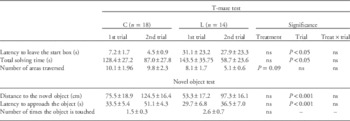
No significant differences between groups were observed in the T-maze test conducted on the lambs (Table 2), although a trend toward significance (P=0.09) was observed for the number of areas traversed by control lambs in comparison with L lambs. Both the latency to leave the start box and the total time spent in the maze were significantly lower in the second trial and similar in both groups.
Results of the T-maze and the novel object tests conducted on 1-month-old lambs born from Rasa Aragonesa ewes synchronized in estrus and fed to provide 1.5 (C) or 0.5 (L) times the daily requirements for maintenance, from sponge insertion to day 7 (estrus=day 0; mean±s.e.m.)

Regarding the novel object tests, no differences between the groups were detected (Table 2). Significant differences between trials (P<0.001) for the distance to the novel object and the time taken to approach the object were observed in both the groups, indicating a larger distance and time to approach the object in the second trial.
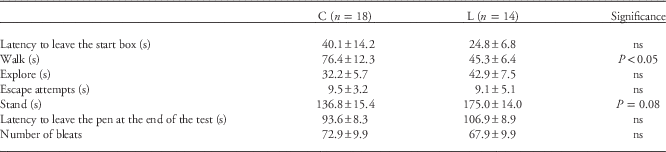
Results of the isolation test reveal that lambs born from control ewes spent more time walking than lambs from undernourished ewes (P<0.05), with L lambs remaining more time standing than C lambs (P<0.10; Table 3). No differences between the groups were observed for the rest of the parameters under study.
Results of the isolation test conducted on 1-month-old lambs born from Rasa Aragonesa ewes synchronized in estrus and fed to provide 1.5 (C) or 0.5 (L) times the daily requirements for maintenance, from sponge insertion to day 7 (estrus=day 0; mean±s.e.m.)

Oocyte quality
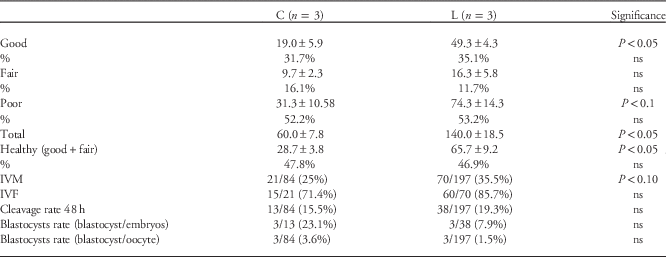
Ovaries from ewe lambs born from undernourished ewes had a total population of oocytes that was 2.3 times higher than that of the ovaries from control ewe lambs [Table 4 (P<0.05)]. Furthermore, they had more (P<0.05) structures in the ‘good’ and ‘healthy’ categories of oocytes, and tended (P<0.10) to have more ‘poor’ oocytes. However, the percentage of oocytes in each category was similar, with a mean distribution of 34% good, 13% fair and 53% poor oocytes.
Number (mean±s.e.m.) of good, fair or poor oocytes per ewe lamb recovered from the ovaries of 1-month-old ewe lambs born from Rasa Aragonesa ewes synchronized in estrus and fed to provide 1.5 (C) or 0.5 (L) times the daily requirements for maintenance, from sponge insertion to day 7 (estrus=day 0), and results of the IVM and IVF procedures

IVM, in vitro maturation; IVF, in vitro fertilization.
IVM and IVF
Oocytes recovered from ewe lambs born from the L group had a slightly higher percentage of IVM (P<0.10), although no differences between groups were observed in the subsequent procedures, that is, IVF, cleavage rate and blastocyst rates (Table 4).
Discussion
Despite the lack of differences in the percentage of oocytes in each quality class, ewe lambs from undernourished ewes presented a significantly higher amount of oocytes than control animals. There are few comparable studies that have examined the effect of maternal nutrition on the quality of lamb oocytes. It has been reported, for instance, that maternal nutrition during pregnancy significantly influences the number of oocytes harvested from resulting lambs as well as the in vitro developmental capacity of these oocytes.Reference Kelly, Kleemann and Walker 25 As several diets were compared through the whole pregnancy, it was concluded that these effects were a consequence of significant interactions that occur between diet and stage of pregnancy, indicating that nutrition plays a complex role in the regulation of fetal oogenesis and foliculogenesis. A possible explanation for the higher amount of oocytes in the L ewe lambs could be owing to effects of the maternal undernutrition on the ovarian development of the offspring. Thus, it has been observed that maternal feed restriction caused a delay in fetal ovarian development in sheep.Reference Rae, Palassio and Kyle 9 This effect was not limited to the cells and tissues present only during the period of underfeeding, indicating that a nutritional challenge imposed at an early stage of fetal development can have effects at later stages. On the other hand, the ovaries of fetuses of undernourished dams at 47 days of pregnancy contained significantly more oocytes than those of well-fed fetuses, suggesting that the process of oogonial degradation, and the associated reduction in germ cell concentration, may have been reduced or delayed in the ovaries of these fetuses.Reference Borwick, Rhind, McMillen and Racey 26 The degree of staining of the tissues at day 62 of gestation observed by these authors indicated that there was greater nuclear DNA activity in the undernourished ovaries than in the control ones, which in turn suggests that the arrest of meiotic activity had been delayed in the ovaries. Undoubtedly, more studies are needed with a larger number of animals to confirm the results obtained in this study, with only three animals per group.
The lower reproductive performances reached by the undernourished group were accompanied by a significant reduction in both LW and BC. This is in agreement with previous studies by our group, applying exactly the same experimental diets in the same location and with the same breed.Reference Sosa, Abecia and Forcada 27 , Reference Sosa, Abecia and Carriquiry 28 , Reference Abecia, Forcada and Palacín 29 We have also observed that this level of undernutrition for the same period as that of the present experiment increases NEFA and decreases leptin concentrations in the undernourished ewes, indicating an increase in the lipolytic activity.Reference Abecia, Forcada and Palacín 29 Although studying the reproductive performance of the ewes after the experimental undernutrition was not the main objective of this study, it is remarkable that control ewes presented 0.53 more lambs born/ewe than the L group.
Lambs born from undernourished dams were heavier at lambing than lambs from the control group. In sheep, the effects of maternal undernutrition on birth weight and fetal adipose tissue mass have been inconsistent and depend on the timing, level and length of dietary restriction.Reference Bispham, Gopalakrishnan and Dandrea 30 A more consistent observation in lambs from undernourished ewes is that the characteristics of the fetal adipose tissue are altered. Other studies have documented that total visceralReference Gardner, Tingey and Van Bon 31 and perirenalReference Ford, Hess and Schwope 32 adiposity of the offspring of undernourished mothers is increased, which is accompanied by insulin resistance compared with progeny from well-nourished ewes.Reference Caton and Hess 2 , Reference Gardner, Tingey and Van Bon 31 , Reference Ford, Hess and Schwope 32 Supporting these observations, it has been recordedReference Jaquiery, Oliver and Honeyfield-Ross 33 that a brief period of undernutrition around the time of conception in sheep alters adult phenotype in male offspring, including an increase in the relative amount of body fat. The presence of abnormally large calves and lambs has been detected after several manipulations of the embryo before the stage of hatched blastocyst.Reference Young, Sinclair and Wilmut 34 The ‘large offspring syndrome’ has been described after in vitro embryo transfer programs, and it has limited the large-scale use of in vitro embryo production technologies. Progesterone is a putative factor involved in some in vivo and in vitro perturbing treatments. It has been suggested that progesterone may indirectly influence embryo development in vivo via its effect on the reproductive tract.Reference Wilmut, Sales and Ashworth 35 Increasing the maternal concentration of progesterone during the first 6 days of pregnancy increases fetal growth and development.Reference Walker, Hartwich and Seamark 36 Although progesterone concentrations have not been measured in this experiment, it has been consistently demonstrated that undernutrition provokes a reduction in plasma progesterone concentrations through a reduction in its hepatic metabolism,Reference Sosa, Abecia and Forcada 27 , Reference Lozano, Abecia, Forcada, Zarazaga and Alfaro 37 so that this could be one of the mechanisms involved in the heavier lambing weight of lambs born from undernourished ewes. Some changes in the composition of the maternal diet have also been shown to result in large progeny size. Ewes fed excess amounts of non-protein nitrogen in the form of urea from 21 days before mating to day 63 of gestation resulted in oversized lambs at birth.Reference McEvoy, Robinson, Findley, Aitken and Robertson 38
Some studies have determined an influence of maternal nutrition on the sex ratio of the offspring,Reference Rosenfeld and Roberts 39 so that dams in poor body condition give birth to proportionately more females. Evidence in sheep is scarce, and no differences in the ratio of male/female born have been detected in the present experiment.
Both the T-maze test and the isolation tests have evidenced a reduction in the physical activity of lambs born from undernourished dams, determined by the lower number of areas traversed by L lambs in the T-maze test and the shorter period of time spent walking in the isolation test. This is in agreement with previous studies,Reference Donovan, Hernandez and Matthews 10 which demonstrated that periconceptional undernutrition in sheep from 60 days before conception to 30 days of pregnancy leads to a significant decrease in the voluntary locomotor activity of 18-month-old lambs in a natural environment. The absence of differences in the rest of cognitive and emotional tests conducted is in agreement with Simitzis et al.,Reference Simitzis, Charismiadou and Kotsampasi 40 who concluded that prenatal undernutrition during different periods of pregnancy had no effect on fear-related behavior. This is also supported by the absence of differences in the plasmatic hormonal and metabolic indicators measured in this experiment, mean age and LW also being similar between the groups, indicating that lambs from both the groups reached the behavioral tests in similar physiological conditions. It is also likely that the developmental window studied in this experiment was not long enough to produce momentous changes in the cognitive development of the offspring.
In summary, a low plane of nutrition around conception in sheep significantly reduces the number of lambs born per ewe, increases birth body weight of the offspring and the oocyte population of 30-day-old ewe lambs. Specific alterations of the locomotor activity of lambs have also been evidenced. The absence of differences in the cognitive test conducted suggest that prenatal undernutrition during the window under study had no effect on cognitive performance of the offspring.
Acknowledgments
The authors thank the staff of the ‘Servicio de Experimentación Animal’ of the University of Zaragoza for their help in the care of the animals, and Julie Cohen for the English revision of the manuscript. M. Pascual-Alonso thanks Government of La Rioja (Spain) for a PhD Scholarship.
Financial Support
This study was supported financially by grants AGL2010-15004/GAN and AGL2012-37219/GAN from MICINN (Spain).
Conflict of Interest
None.
Ethical Standards
The authors assert that all procedures contributing to this work comply with the Spanish Policy for Animal Protection RD1201/05, which meets the European Union Directive 86/609 on the protection of animals used for experimental and other scientific purposes, and have been approved by the in-house Ethic Committee for Animal Experiments from the University of Zaragoza under Project License PI05/10.