Introduction
Parthenium hysterophorus Linnaeus (Asteraceae) is a toxic weed of agricultural farms, pastures, and wastelands. The weed is indigenous to tropical America but is found abundantly in the Caribbean, North America, South America, and major parts of Asia, Africa, and Australia (Navie et al. Reference Navie, McFadyen, Panetta and Adkins1996). Chemically, P. hysterophorus contains an allelochemical of sesquiterpene lactones group known as parthenin, which inhibits the growth of nearby plants (Mersie and Singh Reference Mersie and Singh1988) and causes severe health problems in humans like asthma, hay fever, and allergies (McFadyen Reference McFadyen1995; Das et al. Reference Das, Reddy, Krishnaiah, Sharma, Kumar, Rao and Sridhar2007). The weed affects the chemical and physical properties of the soil and reduces the fertility of agricultural fields (Batish et al. Reference Batish, Kohli, Singh and Saxena1997).
Biological control of P. hysterophorus was first initiated in Australia in 1977. Amongst the known exotic insect species that were introduced to Australia for biological control trials, only Zygogramma bicolorata Pallister (Coleoptera: Chrysomelidae) was found to be cost-effective in suppressing the growth of the weed. Following its introduction, the insect readily established and soon became abundant, causing significant reductions in the density of the weed in localised areas (Dhileepan et al. Reference Dhileepan, Madigan, Vitelli, McFadyen, Webster and Trevino1996; Dhileepan and McFadyen Reference Dhileepan and McFadyen1997). In south Asia, the biological control of P. hysterophorus was initiated in 1984 with the introduction of Z. bicolorata to India from Mexico as a classical biocontrol agent (Jayanth Reference Jayanth1987). The beetle became established that year and is now found abundantly throughout the major areas of India and Nepal (Dhileepan and Strathie Reference Dhileepan, Strathie, Muniappan, Reddy and Raman2009; Dhileepan and Wilmot Senaratne Reference Dhileepan and Wilmot Senaratne2009).
Both larvae and adults of Z. bicolorata feed voraciously on the aerial parts of the weed (Omkar and Afaq Reference Afaq2011; Hasan and Ansari Reference Hasan and Ansari2016a, Reference Hasan and Ansari2016b) and cause its destruction by excessive defoliation, and reduced seed and flower production (see McConnachie Reference McConnachie2015; Chidawanyika et al. Reference Chidawanyika, Nyamukondiwa, Strathie and Fischer2017). Host-specificity tests have confirmed that Z. bicolorata is specialised to feed on P. hysterophorus rather than cultivated crops. Although there are reports of adult beetles feeding on a few cultivated crops (e.g., Ambrosia confertiflora Candolle (Asteraceae), Guizotia abyssinica (Linnaeus) Cassini (Asteraceae), Helianthus annuus Linnaeus (Asteraceae), Heliotropium indicum Linnaeus (Boraginaceae), Jasminum grandiflorum Linnaeus (Oleaceae), and Xanthium strumarium Linnaeus (Asteraceae)), damages to host plants were negligible (McClay Reference McClay and Delfosse1985; Jayanth and Nagarkatti Reference Jayanth and Nagarkatti1987; Bilashini et al. Reference Bilashini, Lokeshwari, Singh and Gautam2011; Mersie et al. Reference Mersie, Alemayehu, Strathie, McConnachie, Terefe, Negeri and Zewdie2019). Thus, the largely host-specific nature of Z. bicolorata to exploit and detoxify weed alkaloids and toxins makes this beetle the most promising biocontrol agent of P. hysterophorus.
Apart from Z. bicolorata, phytophagous sap-sucking insects like Aphididae (Hemiptera) (primarily Aphis craccivora (Koch), Aphis gossypii (Glover), and Aphis fabae (Scopoli)) (Amin et al. Reference Amin, Mahmood and Bodlah2017), and their coccinellid predators (Coccinella septempunctata (Linnaeus) and Menochilus sexmaculatus (Fabricius); Coleoptera: Coccinellidae), also coexist on P. hysterophorus (Kumar et al. Reference Kumar, Singh, Prasad, Tiwari and Kumar2017; Patel et al. Reference Patel, Singh, Patel, Kumar and Kumar2019). Our recent study demonstrated that coccinellid predators searching for aphids on the weed deposit semiochemical tracks on the host plant (Patel et al. Reference Patel, Singh, Patel, Kumar and Kumar2019). These tracks are primarily composed of long-carbon-chain alkanes and alkenes and are dominated by methyl-branched and straight-chain hydrocarbons (Hemptinne et al. Reference Hemptinne, Lognay, Doumbia and Dixon2001; Magro et al. Reference Magro, Ducamp, Ramon-Portugal, Lecompte, Crouau-Roy, Dixon and Hemptinne2010). The semiochemical tracks were found to deter the fourth instars and adult females of Z. bicolorata from defoliating the weed, thus impeding weed biocontrol (Patel et al. Reference Patel, Singh, Patel, Kumar and Kumar2019). The coccinellid beetles therefore appear to serve as indirect pests sustaining the weed in agricultural farms.
Chemical analyses have shown that the tracks of different species vary greatly (Hemptinne et al. Reference Hemptinne, Lognay, Doumbia and Dixon2001; Michaud and Jyoti Reference Michaud and Jyoti2007) and may act as signals for predators to identify the previously searched areas and cues for prey species to detect their predators (Swihart et al. Reference Swihart, Pignatello and Mattina1991; Ferrero et al. Reference Ferrero, Lemon, Fluegge, Pashkovski, Korzan and Datta2011). In this investigation, we assessed stage-specific feeding attributes, assimilation of nutrients, and development of immature stages of Z. bicolorata in the presence of semiochemical tracks of the most abundant coccinellid beetles (i.e., Coccinella septempunctata and Menochilus sexmaculatus) in Parthenium abundant agroecosystems. We hypothesised that in the presence of the semiochemical tracks of coccinellid beetles, the larvae of Z. bicolorata would have reduced feeding attributes on P. hysterophorus. This would further result in reduced nutrient assimilation and slower larval development. We anticipate that the study will be helpful in developing future strategies for weed biocontrol in Parthenium-inhabited agroecosystems.
Materials and methods
Stock maintenance
Adult males and females of C. septempunctata (n = 30), M. sexmaculatus (n = 35), and Z. bicolorata (n = 40) were collected from the P. hysterophorus weed growing in agricultural farms of Varanasi, India (25°20ʹN, 83°0ʹE). The adults were paired in plastic Petri dishes (dimensions: 9.0 × 1.5 cm2) and reared under controlled abiotic conditions (temperature: 27 ± 2 °C; humidity: 65 ± 5%; photoperiod: 14:10 light: dark hours) in biochemical oxygen demand incubators (NSW-152; Narang Scientific Works, New Delhi, India). The adults of C. septempunctata and M. sexmaculatus were reared on medium-sized instars of the bean aphid, A. craccivora collected from bean plants (Dolichos lablab Linnaeus; Fabaceae). Adults of Z. bicolorata were raised on leaves of P. hysterophorus, which were replenished daily.
Adults were allowed to mate, and the eggs laid by females of each species were collected daily and observed until their hatching. While the neonates of Z. bicolorata were used for further experimentation, the larvae of coccinellid beetles were raised on a daily replenished supply of bean aphids until the point of adult emergence. Ten days after their emergence, the adults were ready to be used in subsequent experiments. The voucher specimens from this study were deposited in the Entomology Research Laboratory, Department of Zoology, Banaras Hindu University (Varanasi, India).
Experimental protocol
Feeding attributes and development
Newly emerged first instars of Z. bicolorata (n = 210) were extracted from the stock culture and categorised into three groups, each group comprising of 70 larvae. The groups were as follows: (i) control group, where Z. bicolorata larvae had no exposure to semiochemical tracks; (ii) treatment group 1, in which the larvae were exposed to M. sexmaculatus semiochemical tracks; and (iii) treatment group 2, in which the larvae were exposed to C. septempunctata semiochemical tracks. In order to deposit the chemical tracks, 10-day-old adults of either C. septempunctata or M. sexmaculatus (starved for 12 hours) were taken out from the stock culture and kept in plastic Petri dishes (n = 140 per species; two conspecific coccinellid adults per Petri dish; 14.0 × 1.5 cm2) containing P. hysterophorus twigs (fresh young leaves with 2–3 branches; biomass 750 mg) for a duration of two hours. During this time, Petri dishes were kept under observation to ensure that coccinellids walked on the leaves. Subsequently, the coccinellid beetles were removed, and preweighed first instars of Z. bicolorata (using analytical balance: RA-200; Roy Electronics, Varanasi, India; 0.01 mg precision) were introduced to the Petri dishes to feed on the leaves for the following 24 hours under controlled abiotic conditions (previously described) in the biochemical oxygen demand incubator.
After 24 hours, the individual biomasses of first instars and those of the remaining P. hysterophorus twigs were recorded. Thereafter, 12 first instars were removed from each treatment group for biochemical analysis, while the remaining first instars were individually transferred to new Petri dishes containing fresh P. hysterophorus twigs with deposited semiochemical tracks. This process was repeated every 24 hours, with Petri dishes carefully examined for larval moults each day. As soon as the larvae metamorphosised to their second, third, or fourth instars, 12 larvae per developmental stage per treatment group were removed for biochemical analysis, while the remaining larvae were allowed to continue their development. The developmental duration for each larval stage was recorded for each treatment group, and the experiment continued until the point at which all individuals had emerged as adults.
The consumption rates, conversion efficiencies, and growth rates of Z. bicolorata larvae per developmental stage per treatment group were calculated using the following formulae (Patel et al. Reference Patel, Kumar and Kumar2018):
1. Consumption rate (mg day−1) =
 ${{{\rm{Leaf \ biomass \ consumed \ by \ the \ larva}}\left( {{\rm{mg}}} \right)} \over {{\rm{Feeding \ duration \ of \ the \ larva}}\left( {{\rm{days}}} \right)}}$
2. Conversion efficiency =
${{{\rm{Increased \ biomass \ of \ the \ larva}}\left( {{\rm{mg}}} \right)} \over {{\rm{Leaf \ biomass \ consumed \ by \ the \ larva}}\left( {{\rm{mg}}} \right)}}$3. Growth rate (day−1) =
${{{\rm{Fresh \ mass \ gain \ of \ larva}}\left( {{\rm{mg}}} \right)} \over {\left[ {\left( {{\rm{Feeding \ duration}}\left( {{\rm{days}}} \right)} \right) \times {\rm{}}\left( {{\rm{Mean \ biomass \ of \ larva}}\left( {{\rm{mg}}} \right)} \right)} \right]}}$



In the control groups, all recordings were performed in the same way, and conditions were kept identical to those of the treatment groups, the only difference being that Z. bicolorata larvae were supplied with leaves that had not come into contact with coccinellid beetles. To assess the natural reduction in biomass of P. hysterophorus twigs (if any) in the absence of Z. bicolorata larvae, the twigs (with and without coccinellid tracks; n = 10 each) with weighed biomass, that is, 750 mg, were placed in Petri dishes and kept under identical conditions for 24 hours before being reweighed. The average loss of twig biomass, if any, was used to normalise the data on consumption prior to calculating the various parameters.
Biochemical estimation
Lipids
Lipid quantification in whole body homogenates of Z. bicolorata larvae was performed using coupled colorimetric assay (Tennessen et al. Reference Tennessen, Barry, Cox and Thummel2014). Using a homogeniser, 12 larvae per developmental stage per treatment group were homogenised individually in 1.5-mL centrifuge tubes containing 200 µL of cold phosphate-buffered saline + 0.05% Tween 20. Homogenates were centrifuged in a cooling centrifuge machine (NEYA 16 R refrigerated centrifuge high speed [Remi Lab world, Mumbai, India], four times 175 mL, 16 000 rpm) at 12 000 rpm for two minutes. The supernatant was collected and kept in a water bath at 70 °C for 10 minutes and thereafter immediately transferred to a −20 °C mini cooler (525030; Tarsons, Kolkata, India). From each sample, 2 µL of supernatant were transferred to a flat bottom 96-well microplate (941196; Tarsons) using a micropipette (transferpette S digital 0, 5–10 µL). In addition, 2 µL of standard (triglycerides standard 200 mg/dL) were transferred to two wells of each microplate.
To each well containing a sample or the standard solution, 200 µL of triglyceride enzyme reagent (S13G; Beacon, Navsari, India) was added. 200 µL of the reagent was also added to two empty wells of the plate to serve as blanks. Microplates were sealed with aluminium foil to prevent evaporation and incubated for 10 minutes at 37 °C. Total absorbance was measured at 490 nm using a microplate reader (ELX 800; Biotek Instruments, Winooski, Vermont, United States of America), and the total triacylglycerol concentration was determined for each sample by subtracting the absorbance value of the blank well from the absorbance value of the sample well. The triacylglycerol content of each sample was calculated using the formula:
 $${\rm{Concentration \ of \ triglycerides \ (mg/dL) = }}\,{{{\rm{Absorbance \ of \ sample}}} \over {{\rm{Absorbance \ of \ standard}}}}{\rm{ \times 200}}$$
Proteins
Protein quantification in whole body homogenates of Z. bicolorata larvae was performed using a Bradford protein assay (Bradford Reference Bradford1976). Bradford reagent was prepared using Coomassie Brilliant Blue G-250 and orthophosphoric acid. Using a homogeniser, 12 larvae per developmental stage per group (control/treatment) were homogenised individually in 1.5-mL centrifuge tubes containing 200 µL of cold phosphate-buffered saline. Homogenates were centrifuged in a cooling centrifuge machine at 12 000 rpm for two minutes. The supernatant of each sample was collected in fresh centrifuge tubes and transferred immediately to a mini cooler at −20 °C.
Preparation of the protein standard
Protein standards were created by serially diluting 1 mg/mL bovine serum-albumin protein standard. Preparation of sample solution: Sample solutions were prepared by adding 1 µL of the respective sample to 9 µL of distilled water in centrifuge tubes. Using a microplate, 10 µL of each sample solution was transferred to a flat bottom 96-well microplate. To separate wells on the same plate were also added the diluted bovine-serum-albumin protein standards (10 µL each) and two blanks comprising 10 µL of distilled water. To each well containing sample solutions, standard solutions, or blanks, 200 µL of Bradford reagent were added and mixed thoroughly. Microplates were sealed with aluminium foil to prevent evaporation, and plates were incubated for eight minutes at 25 °C. Total absorbance at 595 nm was measured using a microplate reader. Standard curves were prepared by plotting net absorbance versus protein concentration of each bovine-serum-albumin protein standard. The total protein concentration in each sample was determined by comparing unknown samples to the prepared standard curves.
Glucose
Glucose quantification in whole body homogenates of Z. bicolorata larvae (n = 12 per developmental stage per treatment) was performed using coupled colorimetric assay (Tennessen et al. Reference Tennessen, Barry, Cox and Thummel2014). Using a homogeniser, larvae were homogenised in 1.5-mL centrifuge tubes containing 200 µL of cold phosphate-buffered saline. Homogenates were centrifuged in a cooling centrifuge machine at 12 000 rpm for two minutes. The supernatant from each sample was collected and kept in a water bath at 70 °C for 10 minutes before being centrifuged at 12 000 rpm for a further two minutes. The supernatant from each sample was transferred to a fresh centrifuge tube and stored at −20 °C for later analysis.
Preparation of glucose standards
These were prepared by diluting a 1 mg/mL glucose standard to 0.16, 0.08, 0.04, 0.02, and 0.01 mg/mL standards. Using a micropipette, 30 µL of the supernatant from each sample was transferred to wells in a flat bottom 96-well microplate. Thirty microlitres of the glucose standard and 30 µL of phosphate-buffered saline were also transferred to two wells of the microplate to act as a standard and blank, respectively. To each well containing the sample, standard solution, or blank, 100 µL of glucose reagent (GAHK20; Sigma, St. Louis, Missouri, United States of America) were added. Microplates were sealed with aluminium foil to prevent evaporation and incubated for 15 minutes at room temperature. Total absorbance at 340 nm was measured using a microplate reader. Standard curves were prepared by plotting net absorbance versus glucose concentration of each glucose standard. Total glucose concentration per sample was determined by comparing unknown samples to the prepared standard curves.
Statistical analysis
The experimental data were checked for normality and homogeneity of variance using the Kolmogorov–Smirnov and Bartlett tests, respectively. Due to variations in the body size of larvae at each developmental stage, the consumption rates of larvae and the concentrations of triacyl glycerol, proteins, and glucose in the larval body (dependent factors) were subjected to a two-way analysis of covariance followed by Tukey’s post hoc comparison of means. Treatment group, feeding stage, and their interaction were treated as independent factors, and mean body biomass was included as a covariate (general linear model).
The conversion efficiency, growth rate, and mean body biomass of larvae (dependent factors) were analysed using two-way analysis of variance followed by Tukey’s post hoc comparison of means, with treatment group, feeding stage, and their interaction as independent factors. The data on immature development (dependent factor) were subjected to a one-way analysis of variance with treatment group as the independent factor. Mean values were compared using Tukey’s post hoc analysis. All statistical tests were performed using Minitab version 16 (Minitab, State College, Pennsylvania, United States of America).
Results
Feeding attributes and developmental durations
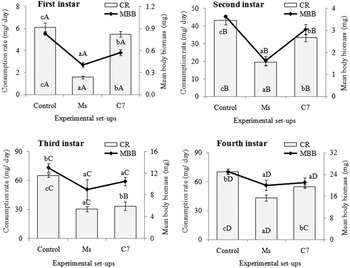
Food consumption rates of Z. bicolorata larvae were significantly influenced by mean body biomass of larvae (F = 9.45, P = 0.003, df = 1, 143; covariate), presence/absence of species-specific semiochemical tracks (study set-ups; F = 111.99, P < 0.0001, df = 2, 143), feeding stages (F = 94.93, P < 0.0001, df = 3, 143), and their interaction (F = 13.55, P < 0.0001, df = 6, 143). Tukey’s post hoc comparison of means showed that larvae had lower consumption rates in the presence of semiochemical tracks (treatment groups) than in their absence (control). The feeding deterrent effects of semiochemical tracks of M. sexmaculatus were significantly higher than those of C. septempunctata. Amongst the larval stages, fourth instars displayed higher consumption rates than the other instars (Fig. 1).
Effects of semiochemical tracks on consumption rate (mg/day) and mean body biomass (mg) of instars of Zygogramma bicolorata (values are mean ± standard error; small and large letters represent comparison of means among study set-ups and among feeding stages, respectively). CR, consumption rate; MBB, mean body biomass; Ms, Menochilus sexmaculatus; C7, Coccinella septempunctata.

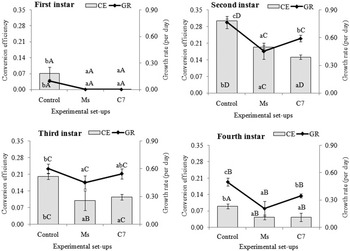
Food conversion efficiency, growth rate, and mean body biomass of Z. bicolorata larvae were also significantly influenced by the presence/absence of species-specific semiochemical tracks (F = 11.64, P < 0.0001, df = 2, 143; F = 16.17, P < 0.0001, df = 2, 143; and F = 11.70, P < 0.0001, df = 2, 143, respectively) and feeding stages (F = 26.07, P < 0.0001, df = 3, 143; F = 68.74, P < 0.0001, df = 3, 143; and F = 481.85, P < 0.0001, df = 3, 143, respectively), but not by the interactions between the two independent factors (F = 0.71, P = 0.643, df = 6, 143; F = 1.18, P = 0.319, df = 6, 143; and F = 1.79, P = 0.106, df = 6, 143, respectively). A comparison of means revealed that the food conversion efficiencies, growth rates, and mean body biomasses of larvae were higher in control group than the treatment groups. Further, the semiochemical tracks of M. sexmaculatus were more effective in lowering the conversion efficiencies and growth rates and reducing the mean body biomass of Z. bicolorata larvae than those of C. septempunctata. Across all treatment groups, fourth instars were the heaviest, while the first instars were the lightest. Moreover, the fourth instars had lower conversion efficiencies and growth rates than the second and third instars (Figs. 1–2).
Effects of semiochemical tracks on conversion efficiencies and growth rates (per day) of Zygogramma bicolorata larvae (values are mean ± standard error; small and large letters represent comparison of means among study set-ups and among stages, respectively). CE, conversion efficiencies; GR, growth rate; Ms, Menochilus sexmaculatus; C7, Coccinella septempunctata.

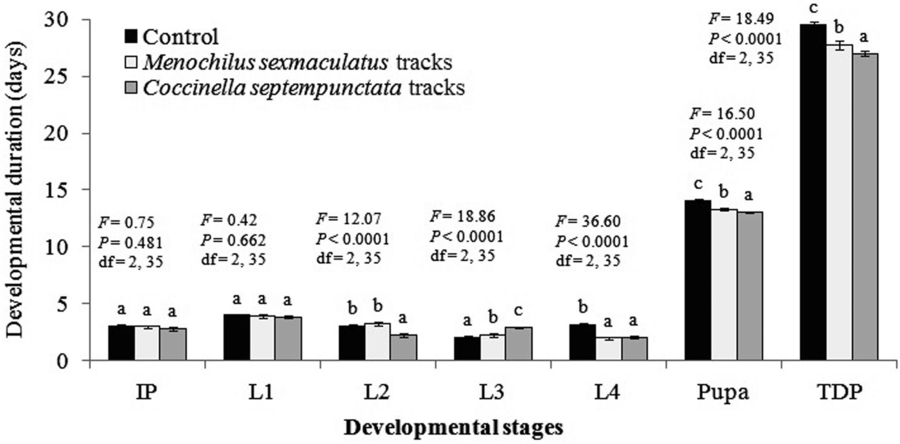
One-way analysis of variance values revealed significant effects of the presence of semiochemical tracks on the development of immature stages of Z. bicolorata. The immature stages developed faster in the presence of semiochemical tracks, but no species-specific effect of coccinellid semiochemicals was recorded for the development of immature stages of Z. bicolorata (Fig. 3).
Effect of semiochemical tracks on developmental duration (days) of immature stages of Zygogramma bicolorata (values are mean ± standard error; F values significant at P < 0.05; small letters represent comparison of means amongst immature stages). IP, incubation period; L1, first instar; L2, second instar; L3, third instar; L4, fourth instar; TDP, total development time.

Biochemical estimates
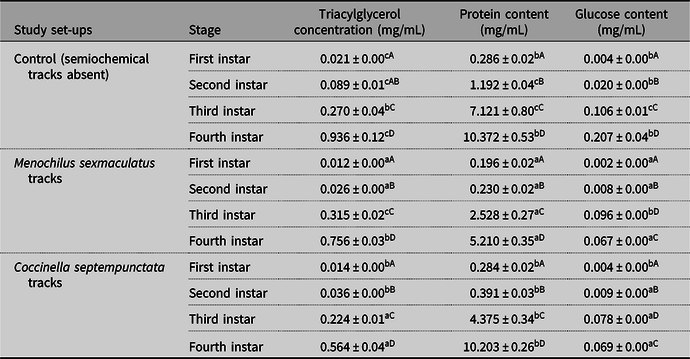
Two-way analysis of covariance values revealed that the influence of body biomass of larvae on the assimilation of nutrients (glucose: F = 0.00, P = 0.953, df = 1, 143; proteins: F = 0.12, P = 0.733, df = 1, 143; triacylglycerols: F = 0.48, P = 0.492, df = 1, 143) was an artefact. Instead, it was the species-specific semiochemical tracks, feeding stages, and their interaction that modulated the accumulation of glucose (F = 18.96, P < 0.0001, df = 2, 143; F = 15.48, P < 0.0001, df = 3, 143; and F interaction = 11.61, P < 0.0001; df = 6, 143), proteins (F = 44.14, P < 0.0001, df = 2, 143; F = 51.66, P < 0.0001, df = 3, 143; and F interaction = 28.36, P < 0.0001, df = 6, 143), and triacylglycerols (F = 9.11, P < 0.0001, df = 2, 143; F = 25.38, P < 0.0001, df = 3, 143; and F interaction = 4.90, P < 0.0001, df = 6, 143) within the body of Z. bicolorata larvae during development. A comparison of means revealed that irrespective of mean body biomass, the larvae accumulated less glucose, proteins, and triacylglycerols in the presence of semiochemical tracks. The assimilation of nutrients was lower in the presence of M. sexmaculatus semiochemical tracks than the semiochemical tracks of C. septempunctata. Moreover, the fourth instars assimilated higher amounts of nutrients than the other instars (Table 1).
Effect of semiochemical tracks on food reserves of Zygogramma bicolorata larvae (values are mean ± standard error; small letters represent comparison among study set-ups, while large letters compare accumulation of food reserves among feeding stages; F values significant at P < 0.05).

Discussion
Our study has demonstrated that the presence of semiochemical tracks of coccinellid beetles on P. hysterophorus leaves reduce the feeding attributes and nutrient assimilation of Z. bicolorata larvae. Chemically, the coccinellid tracks contain volatile hydrocarbons with N-pentacosane as a major component (Hemptinne and Dixon Reference Hemptinne and Dixon2000; Ninkovic et al. Reference Ninkovic, Feng, Olsson and Pettersson2013). The presence of long-chain saturated hydrocarbons protects the semiochemical tracks from quick oxidation, making them highly stable. These hydrocarbons spread easily on hydrophobic cuticle of plants and leave large signals (Weier et al. Reference Weier, Stocking and Barbour1974; Hemptinne and Dixon Reference Hemptinne and Dixon2000). Olfactory receptors associated with mouth parts enable insect herbivores to detect and discriminate between volatile molecules (Van Naters and Carlson Reference Van Naters and Carlson2006; Ali et al. Reference Ali, Diakite, Ali and Wang2015; Wang et al. Reference Wang, Pentzold, Kunert, Groth, Brandt and Pasteels2018), and the larvae of Z. bicolorata are able to use these olfactory receptors to detect the chemical cues and avoid foraging on areas where semiochemical footprints of coccinellids are present. This may be a strategy for reducing predation risk, but the trade-off is a reduced feeding rate and assimilation of nutrients. As a result, this diminishes the potential of Z. bicolorata larvae to control P. hysterophorus. Similar avoidance of semiochemical tracks of coccinellid beetles has previously been reported for Rhopalosiphum padi (Linnaeus) (Hemiptera: Aphididae) (Ninkovic et al. Reference Ninkovic, Feng, Olsson and Pettersson2013).
Detection and avoidance of the semiochemical tracks of coccinellid beetles by the larvae/adults of other coexisting coccinellids resulting in reduced foraging have also been reported by Ruzicka and Zemek (Reference Ruzicka and Zemek2008), Moser et al. (Reference Moser, Haynes and Obrycki2010), and Kumar et al. (Reference Kumar and Mishra2014b). Apart from foraging, larval or adult coccinellid tracks have also been reported to deter female coccinellids from ovipositing (Ruzicka Reference Ruzicka2006, Reference Ruzicka2010; Michaud and Jyoti Reference Michaud and Jyoti2007; Mishra et al. Reference Mishra, Singh and Shahid2012b). Our findings are in agreement with those of Patel et al. (Reference Patel, Singh, Patel, Kumar and Kumar2019), who have reported feeding deterrent behaviour in both the fourth instars and adult females of Z. bicolorata in the presence of coccinellid tracks. Despite having lower feeding attributes, the larvae developed faster in the presence of semiochemical tracks than in the absence of these tracks. This may possibly be a survival strategy, allowing Z. bicolorata larvae to overcome food stress conditions by completing their development faster than larvae reared in the absence of semiochemical tracks. Owing to the short developmental durations in the presence of coccinellid semiochemicals, the emerging Z. bicolorata adults were small and had lower consumption rates and decreased food use efficiencies.
The reduced food consumption and accumulation of lower concentrations of glucose, proteins, and triacylglycerols by Z. bicolorata larvae when exposed to semiochemical tracks of M. sexmaculatus further demonstrates that the feeding deterrent effects of semiochemical tracks are species specific. The volatile hydrocarbons of certain coccinellid species (like M. sexmaculatus in the present study) may exhibit a higher degree of feeding deterrent than other coccinellid species. Differential feeding and developmental attributes as a result of species-specific semiochemical tracks have previously been reported in coccinellid beetles by Kumar et al. (Reference Kumar and Mishra2014b) and are consistent with the present findings.
Amongst the larval stages, fourth instars displayed higher consumption rates and were heavier than early instars. In addition, the fourth instars accumulated higher concentrations of glucose, proteins, and triacylglycerols per body biomass than the other instars. Such findings may be a result of the large body size of the fourth instars and the high energy demands required for pupation and subsequent metamorphosis. Further, the lower food conversion efficiencies and growth rates of fourth instars over the early instars (second and third) in the present study may be a result of the large size and increased metabolic costs of the fourth instars. Previous studies in beetles have also shown that the fourth instars are voracious feeders and have reduced food conversion efficiencies and growth rates than the early instars (Jalali et al. Reference Jalali, Tirry and Clercq2009; Omkar and Afaq Reference Afaq2011; Mishra et al. Reference Mishra, Kumar, Shahid and Singh2011, Reference Mishra, Kumar and Pandey2012a; Hodek et al. Reference Hodek, Van Emden and Honek2012; Kumar et al. Reference Kumar, Bista and Mishra2014a, Reference Kumar and Mishra2014b).
In conclusion, the present study reveals that (i) the presence of coccinellid semiochemicals on P. hysterophorus diminishes the feeding attributes of Z. bicolorata larvae on the weed. As a result, the larvae accumulate fewer food reserves in their body and develop faster than those reared in the absence of semiochemical tracks. (ii) The feeding deterrent effects of semiochemical tracks are species specific, and certain coccinellid species may have a higher degree of feeding deterrent effects than others. (iii) Fourth instars display higher food consumption rates and mean body biomasses but have lower conversion efficiencies and growth rates than the other instars.
Present findings, therefore, suggest that the presence of coccinellid semiochemicals on P. hysterophorus impedes augmentative biological control of this weed by the larvae of Z. bicolorata. While the present study has not analysed the chemical or biochemical nature of semiochemical tracks, future studies may benefit from investigating these factors. Future investigations may be carried out to assess the reproductive attributes of Z. bicolorata adults and the fitness of their progeny in the presence of semiochemical tracks of coccinellid beetles. Experiments may also be conducted using different temperatures to calculate lower developmental threshold and sum of effective temperature values and identify whether semiochemical tracks further affect the rate of development in chrysomelid beetles or not. Field-based studies are still needed to validate these findings.
Acknowledgements
The authors are thankful to Dr. Thomas Timberlake, University of Bristol (United Kingdom) for critically going through the manuscript and provide valuable suggestions, including English language correction. The authors also thank Department of Zoology (University Grants Commission under Career Advancement Scheme and Department of Science and Technology Fund for Improvement of Science and Technology Infrastructure funded), Banaras Hindu University, Varanasi, India, for providing laboratory facilities, and University Grants Commission Basic Scientific Research start-up grant for financially assisting the research work.