


INTRODUCTION
Since the first description of an outbreak of Legionnaires' disease (LD) among the participants of the American Legion Convention in Philadelphia in 1976 [Reference Fraser1] many more reports of outbreaks of LD have been published in the scientific literature (e.g. [Reference Joseph2]). Among these, outbreaks of LD in passengers of cruise ships are a specific subset [Reference Jernigan3–Reference Kura7]. These passengers are often at higher risk than the general population of acquiring LD because of their higher age, underlying illnesses and physical conditions. In addition the ship's water system may not be maintained to control Legionella contamination [Reference Edelstein and Cetron8]. On average, the incubation period is between 2 and 10 days, therefore, detection of these outbreaks is rather difficult as passengers on short trips develop symptoms only after they return home. The attending general practitioner would only see a single patient and may not suspect an outbreak or an epidemiological link to the cruise ship. Therefore, only in a small number of incidents can a clear epidemiological and microbiological link to the cruise ship be established [Reference Pastoris9]. A European-wide surveillance scheme for travel-associated legionellosis was established in 1987 to collect data from individual patients and identify clusters among tourists [10].
We report an outbreak of LD involving eight confirmed cases, including one death, that occurred during a 17-day cruise departing from Reykjavik (Iceland) in August 2003.
Description of the outbreak
A cruise from 6 to 23 August 2003 visited Greenland, Iceland and Scotland with a total of 359 passengers. They came from Germany (215), France (87), Switzerland (38) plus other nationalities (19). Eight cases of LD were subsequently identified among the German passengers, but not among passengers from the other nationalities.
After disembarking at Cuxhaven in Germany, three passengers were admitted to hospital where LD was diagnosed by detection of Legionella pneumophila antigen in their urine. Following the criteria for the definition of an outbreak in the European Guidelines [Reference Joseph11] an outbreak was declared. As far as possible all remaining passengers were contacted by the ship's tour operators to inform them of the outbreak and to request that they seek urgent medical treatment if they developed symptoms compatible with LD in the 10 days after the end of the cruise. In addition the same message was broadcasted as an emergency alert over German radio stations.
The cruise liner left German territories for Dover (UK) on 24 August without taking any new passengers, it berthed at Harwich (UK) where members of the Tendring District Council Port Health Authority, the Health Protection Agency (HPA, London, UK) and the Maritime Coastguard Agency inspected the ship and took environmental samples.
METHODS
Epidemiological investigation
An unmatched case-control study was conducted to identify the source and risk factors for infection. A standardized questionnaire was developed to ascertain the potential risk factors and behaviour which included the use of whirlpool baths, spa pools, air conditioning, showers and other activities on board as well as during the excursions.
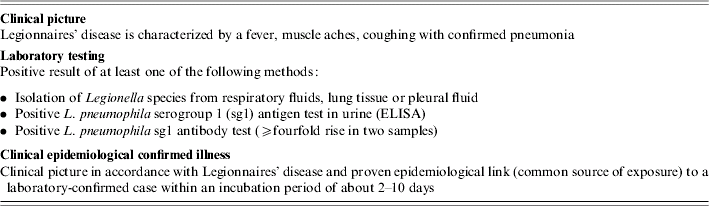
A confirmed case of LD was defined as a cruise-passenger fulfilling the German surveillance case definition (see Table 1).
German surveillance case definition in force until end of December 2003
Suspected cases were defined as passengers developing fever and one of the following symptoms: chills, non-productive cough, difficulty in breathing, head or muscle aches, but with no positive laboratory result.
All passengers without symptoms of LD living in the German states of Lower Saxony and Bremen of whom addresses were available served as controls. Self-administered questionnaires were sent to all eight cases and to 46 controls. To ensure correct classification, a L. pneumophila antibody test was offered to the controls, 6 weeks after the end of the cruise.
Epidemiological analysis was carried out first for confirmed cases only, and second, for all cases, i.e. confirmed and suspected cases, in relation to controls, respectively. When confirmed cases were independently analysed, suspected cases were excluded from the group of controls.
For risk analysis, each potential factor was considered by its odds ratio (OR) estimate using the maximum likelihood estimate (MLE) and the 95% confidence interval (CI). P values were considered statistically significant below 5%. Due to the sparse data, P values were calculated using Fisher's exact test and P values below 10% were regarded as meaningful. Data entry and analysis was performed by using Epi Info™ version 3.3 (CDC, Atlanta, GA, USA).
Environmental investigation
Staff from the Tendring District Council Environmental Health Department (UK) began their inspection on Monday, 25 August. Independent agents from Land and Marine Environmental Ltd checked the water system on board. Risk assessment was conducted by monitoring water temperatures, reviewing policies, systems and procedures for Legionella prevention and control, reviewing maintenance and monitoring regimes and records and interviewing key personnel. A total of 183 samples from the ship were taken; 80 were collected by Land and Marine Environmental Ltd on Monday, 25 August and analysed at the Chelmsford HPA Food, Water and Environment Laboratory, 73 were collected by the HPA Water and Environmental Microbiology Reference Unit (WEMRU), on Sunday, 31 August and a further 30 samples were collected by WEMRU on Friday, 12 September. Samples collected by WEMRU were analysed by the HPA London Regional Food, Water and Environment Laboratory. The vessel was also revisited on 31 August and on 12 September by the Dover District Council Port Health Authority.
Water samples were collected from showers and taps on baths and washbasins, bidets and whirlpools. Swab samples were also taken from fixtures and fittings of the hot and cold water systems, spa pools and whirlpools. Samples collected by the HPA investigators were taken after disinfection had already begun and while there were readily detectable levels of hydrogen peroxide silver disinfectant at the outlets.
Laboratory investigation
Cultures of clinical samples were performed on selective and non-selective buffered charcoal yeast extract agars according to standard protocols [Reference Lück, Helbig and Schuppler12]. Urinary antigen was detected by using commercially available ELISA tests [Reference Helbig13]. The indirect immunoflourescence test (IFT) was used for determining the antibody titres against all serogroups of L. pneumophila. Antibody titres of >1:256 were considered as indicative for an acute infection [Reference Lück, Helbig and Schuppler12].
Water samples were analysed for the presence of Legionella according to the International Standard method [14]. Isolated Legionella strains were further typed using monoclonal antibodies (mAb) [Reference Helbig15]. In addition, DNA sequence-based typing (SBT) was applied to compare the allelic profiles of clinical isolates against the European Working Group on Legionella Infections Sequence Based Typing Database (http://www.hpa.org.uk/cfi/bioinformatics/ewgli/ewglisbt.htm) and with environmental isolates using the six gene targets flaA, pilE, asd, mip, mompS and proA [Reference Gaia16].
RESULTS
Epidemiological investigation
In total, eight passengers, one of them identified during the study, fulfilled the case definition of a confirmed case.
The rates of response to the questionnaire were 100% (8/8) for the cases and 93% (42/45) for the controls. Forty-one controls (91%) agreed to the serological test. According to the information provided, four controls reported fever and symptoms of respiratory infection and were therefore reclassified as suspected cases.
The following analysis was based on data from eight confirmed cases, four suspected cases and 38 controls who were on the same cruise (see Table 2 for further case details).
Line listing of confirmed and suspected cases
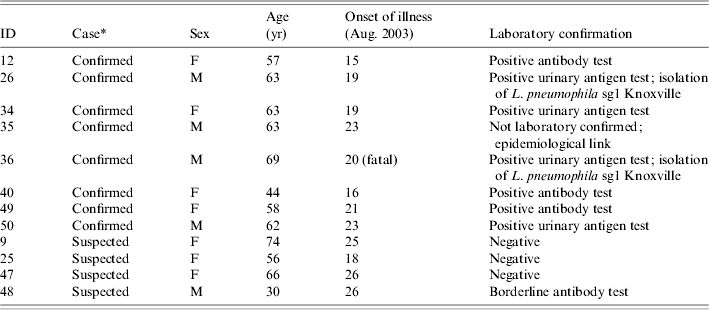
M, Male; F, female; sg, serogroup.
* Case classification according to the case definition provided in the text.
Epidemic curve
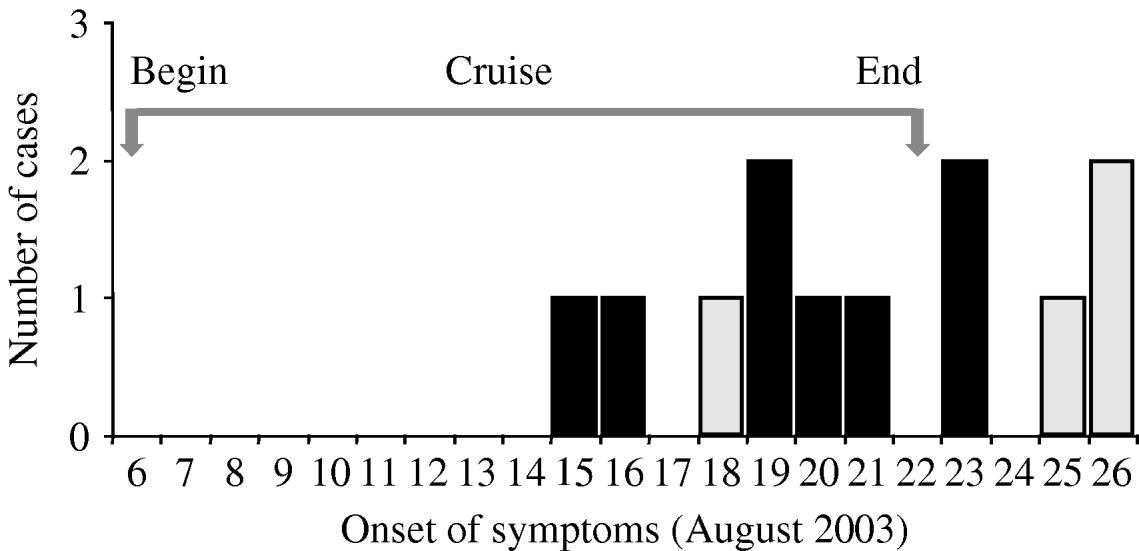
As displayed in Figure 1 the first case of LD occurred on the tenth day of the cruise. The majority of cases became ill at the end of the cruise and after returning home.
Epidemic curve of the Legionnaires' disease outbreak on a cruise ship in August 2003. ■, Confirmed cases; , suspected cases.
Four of the confirmed cases, including the deceased case attended the ship's physician for severe respiratory illness. According to the medical records, three additional passengers from Germany (outside the study region), Switzerland and France, attended the ship's physician for the same symptoms. However these passengers were not followed up.
Age and sex distribution
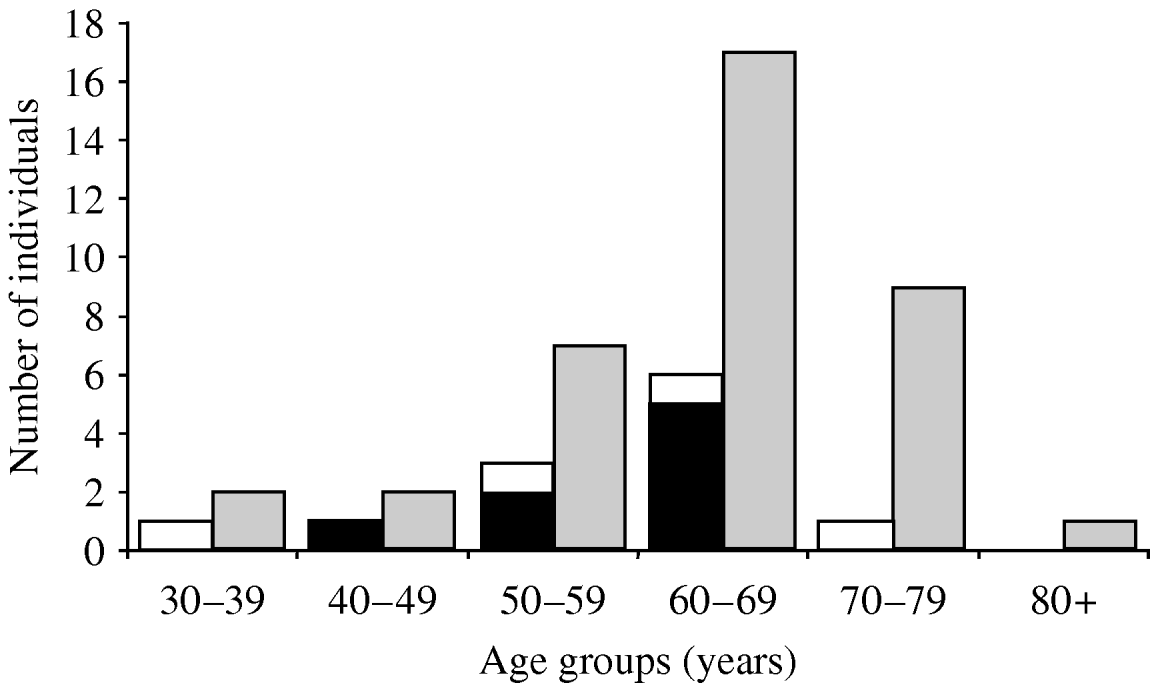
The mean age was 59·9 years (range 44–69 years) for confirmed cases, 56·5 years (30–74 years) for suspected cases and 62·3 years (35–85 years) for controls (see Fig. 2 for age distribution).
Age distribution of confirmed cases (■), suspected cases (□) and controls ().
Of the confirmed cases four were male and four female, for suspected cases three were female and one was male. In the control group 18 were female and 20 were male.
Attack rate
The attack rate (AR) among the 215 German passengers was estimated at 3·7% (8/215) of confirmed cases and 5·6% (12/215) of confirmed and suspected cases. The highest AR of 6·8% was found in the 60–69 years age group.
Exposure analysis
Exposure to the spa pool, i.e. use of or staying close to, for a prolonged period of time (more than 5 h) during the cruise, was associated with an elevated risk of infection (OR 4·9, P=0·09). Taking both the confirmed cases and the suspected cases into the analysis the OR increased to 5·8 (P=0·03) (see Table 3).
Results of univariate analysis of selected risks of exposure for confirmed cases in relation to the group of controls
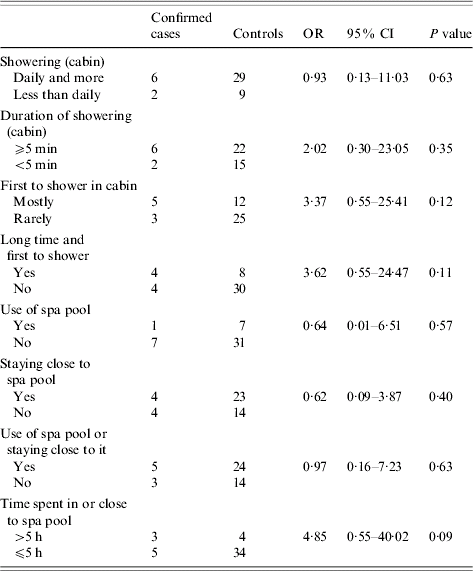
OR, Odds ratio; CI, confidence interval.
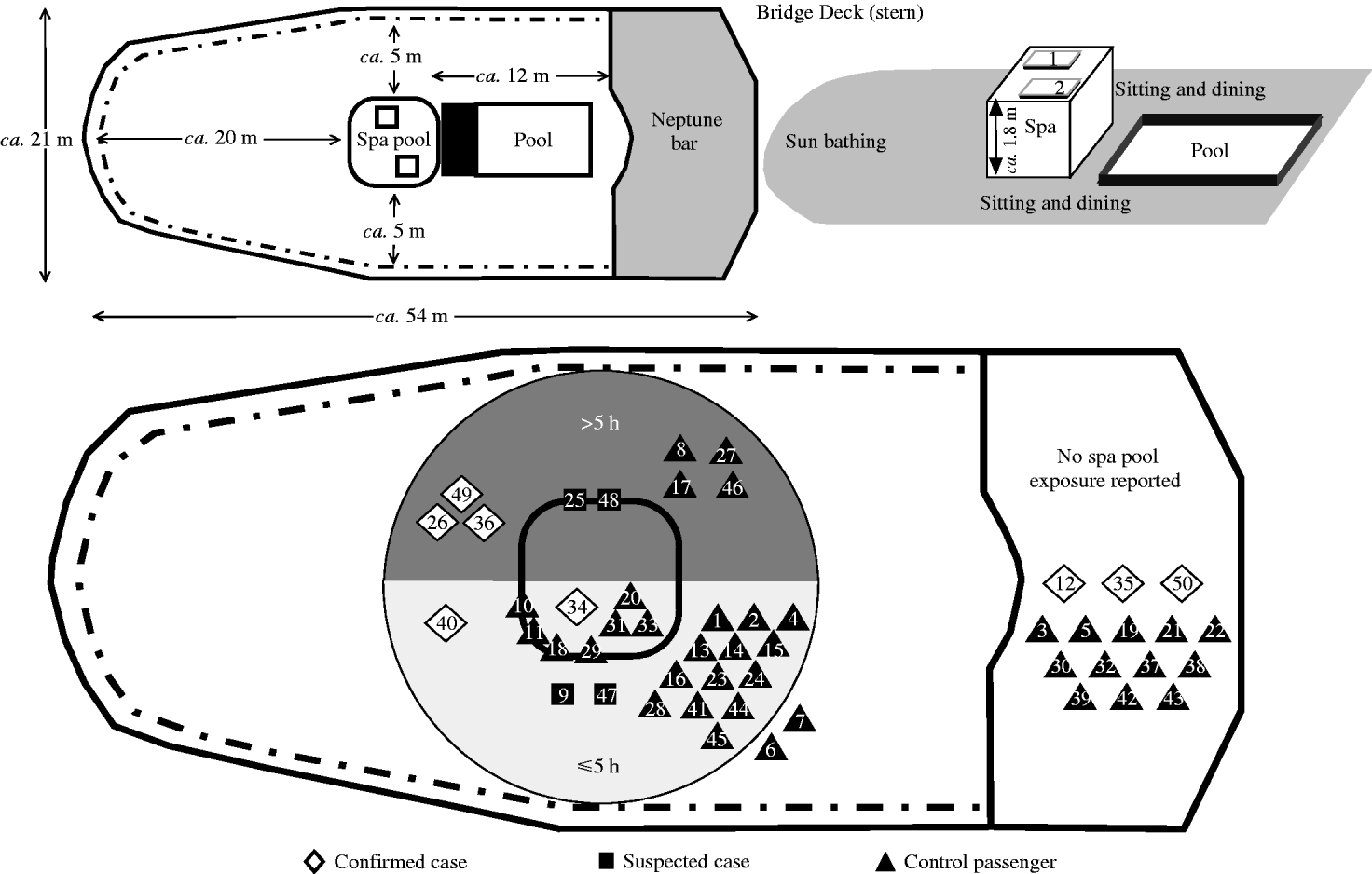
The qualitative information of having used the spa pool or not and having spent time close to it or not, was not associated with a risk of infection (OR 0·64, P=0·57 and OR 0·62, P=0·40, respectively). The OR increased to 1·46 (P=0·45) and 1·21 (P=0·53), respectively, when confirmed and suspected cases were analysed together, however, results did not reach statistical significance (see also Fig. 3).
Bridge Deck (stern): schematic of spa pool area and representation of passengers' duration of stay close to the spa pool as reported in the self-administered questionnaire. Symbols are arranged in groups and do not represent the real position of a person on board the ship. Symbols on the spa pool line indicate that these persons used the spa and in addition spent some time close to it. Number of symbol corresponds to the study ID number.
Smoking was also associated with an increased risk of disease (OR 4·9, P=0·09). Similar results were obtained for confirmed and suspected cases (OR 4·1, P=0·08). Both results were not statistically significant.
Past medical history did not reveal a particular predisposition of cases towards acquiring LD. Only one confirmed case and five control passengers were reported as having any chronic underlying diseases. Serious previous illnesses were mentioned by one suspected case and three controls.
All other possible exposures included on the questionnaire such as showering, use of facilities in the beauty centre or having one's hair washed at the hairdresser's and the use of air conditioning were not associated with an elevated risk of infection. In addition, the location of the patient's cabin on the vessel was not a significant factor as the cabins of cases and controls were randomly distributed on all passenger decks with no observable clusters of cases associate with location. Several shore excursions were offered, but hints on possible exposure to Legionella during these activities were not detected. During the cruise all nights were spent aboard. However, a pre-cruise programme was offered including two nights in a hotel in Reykjavik preceding the beginning of the cruise. Of our study group only four of the affected individuals, three confirmed cases and one suspected case took part in that programme.
Laboratory investigation
The isolates of L. pneumophila serogroup 1 (sg1) from patients were typed at the consulting laboratory at the Technical University of Dresden as mAb subgroup ‘Knoxville’. Furthermore the SBT profile of both isolates was determined. Environmental isolates of L. pneumophila sg1 were typed at the HPA Atypical Pneumonia Unit at Colindale. The isolates of L. pneumophila sg1 from the water systems belonged to mAb subgroup ‘Knoxville’ or ‘Oxford/OLDA’. After exchanging the sequence data via the internet it was determined that the ‘Knoxville’ isolates from both patients and the environment were indistinguishable yielding the SBT profile 3, 4, 1, 1, 1, 9.
The L. pneumophila-antibody testing of the controls did not reveal any elevated titres. All titres were ⩽1:64. Second blood samples to detect any rise in antibody levels were not available.
Environmental investigation
Of the environmental samples taken on 25 August 18/40 (45%) of cold water, 2/31 (7%) of hot water and 8/9 (89%) of tepid water samples contained Legionella. On 31 August 12/26 (46%) of cold and 2/25 (8%) of hot water samples contained Legionella. On 12 September 5/15 (33%) of cold and 0/15 (0%) of hot water samples contained Legionella. Generally, the numbers of Legionella detected were low with a few notable exceptions.
L. pneumophila sg1 was only detected in nine samples. In most of these samples there were low numbers of colonies growing and all available L. pneumophila sg1 colonies were selected for typing. In seven samples the origin was cold water, and the mAb subgroup was Oxford/OLDA. Six of the seven samples had <100 c.f.u./l and the remaining sample had 520 c.f.u./l of L. pneumophila sg1 and 210 c.f.u./l of L. pneumophila sg10; the temperature of the cold shower water was 30°C. In two samples the mAb subgroup detected was ‘Knoxville’. One of these was from a swab of an air jet taken from one of the two spa pools which had already been disinfected and drained. The other was from a sample of hot water collected from the shower used to wash clients' hair in the beauty salon which contained 2600 c.f.u./l of L. pneumophila sg1 mAb subgroup ‘Knoxville’ and 30 000 c.f.u./l of non-sg1 L. pneumophila. This was the most contaminated sample collected despite the fact that disinfectant (hydrogen peroxide and silver combined) was readily detectable at that point. The other most contaminated sample was also collected from a shower in the beauty salon. The non-sg1 strains of L. pneumophila detected were a mixture of serogroups 3, 5 and 10.
DISCUSSION
Through close cooperation between British and German authorities, a clear epidemiological and microbiological link of the LD outbreak and the cruise liner was established. The epidemiological information showed an association between contracting LD and the spa pools. The typing results of clinical and environmental isolates clearly support this conclusion.
The outbreak strain was only detected at the hair-washing station in the beauty salon and in one of the air jets from one of the spa pools. The effectiveness of combined hydrogen peroxide and silver disinfectants has been questioned previously [Reference Armon17] and our isolation of Legionella from the water systems, and hair-washing station in particular, despite the presence of disinfectant provides further practical evidence casting doubt on the effectiveness of hydrogen peroxide silver combinations for emergency disinfection. Samples from the spa pools were heavily contaminated with other organisms, which would have reduced the sensitivity of the detection and may have made L. pneumophila impossible to detect. The isolation from the air jet of the spa pool after it had been cleaned and disinfected clearly indicates the problems of effectively disinfecting the air channels of spa pools which has been discussed elsewhere [18]. The presence of Legionella after disinfection also indicates that the organisms could have been present in much higher numbers while the pool was in operation and could therefore have been a source of infection for the patients. The results of the sampling of the ship's water system need to be viewed with caution since all of the samples were collected after thermal and chemical control measures had been initiated. Thus, the epidemic strain was probably present in other sources at the time of the outbreak although it was not detectable at the time of sampling.
The hairdresser's was deemed to be an unlikely source during this cruise as none of the cases made use of this service. However, the findings from this investigation highlight the potential risk that may arise from hair-washing stations. In this particular case the hair-washing station may have been more heavily colonized, or remained more heavily colonized, than other parts of the water system because it contained a high proportion of plastic and flexible components which are known to be more susceptible to colonization [18]. The water flowing to the showerhead went through a simple manually controlled blender. In normal use it would be unusual to have hot water at a temperature that might have had some disinfecting effect flowing through the showerhead and flexible piping because it would be too hot for the client to stand. Therefore, it is important to install a programme of good maintenance with regular monitoring of water temperatures, flushing with hot water, surveys of deadlegs or blind ends, and the regular disinfection of showerheads and hoses. This is particularly necessary if devices are used infrequently as may be the case for hairdressers' services during cruise trips.
Interestingly spa pool exposure could not be identified for all confirmed cases. Three of the confirmed cases denied any spa pool exposure. According to the information provided in the questionnaire there are no indications that these passengers had an exposure to the other site that tested positive for the outbreak strain, i.e. the hair-washing station at the hairdresser's.
However, aerosols can travel appreciable distances and may be sucked into other parts of the vessel either through air intakes or open doorways. It is feasible that even though the patients did not recall spending time adjacent to the spa pools they could have been infected elsewhere in the vessel by aerosols originating from the spa pools. As demonstrated by the environmental investigation, Legionella spp. were detected in many water samples taken from various sites of the vessel. One can therefore also speculate that at some time during the cruise the outbreak strain was present in other sites of the ship, too. Unfortunately, clinical specimens of these three confirmed cases without spa pool exposure were not available. Therefore, a further microbiological determination of the causative Legionella spp. in each individual case was not possible.
According to explorative interview with some cases, sitting in the wind-sheltered area close to the wall of the elevated spa pool was quite popular. This clearly indicates a possible route of transmission via inhalation of aerosols from the spa pool, which could be demonstrated in other outbreaks (e.g. [Reference Jernigan3, Reference Kura7]). The fact that only a few passengers used the outdoor spa pools and the majority of these persons did not become ill, can perhaps be explained by the fact that this was a cruise to the Nordic Sea and that only healthy and active people having per se a lower risk of acquiring LD would use an outdoor spa in rather cold temperatures. The lower average age of spa pool users compared to the other passengers enrolled in the study supports this hypothesis.
Although staying in the hotel during the pre-cruise programme was conspicuous, the hotel was ruled out as a possible source of infection. First, because the incubation period was exceeded (even though longer incubation periods have been reported [Reference Den Boer19]). Thirteen days elapsed between the end of the hotel stay and beginning of symptoms. Second, only one of the two culture-positive patients participated in the pre-cruise programme. It is possible but unlikely that this L. pneumophila strain was present both in the hotel and in the cruise liner.
The statistical power of the case-control study is somewhat limited because of the relatively low number of cases in this outbreak. As the direct or indirect evidence of Legionella has to be notified on a named-patient basis and the public attention to this outbreak was relatively high it is believed that all German cases were finally notified according to the German Protection against Infection Act. We did not receive any information on cases of LD among passengers from the other nationalities nor were any cases belonging to this outbreak reported to the European-wide surveillance scheme for travel-associated legionellosis, although a European alert was sent to all EWGLI (European Working Group for Legionella Infections) [10] countries for case searching. Therefore, it seems likely that all cases were detected and that they occurred among Germans simply because they were the largest national group on the ship.
The epidemiological part of this study is based on a retrospective design and therefore recall bias may have been a problem that should not be underestimated and should be considered when interpreting the results. However, the completeness of the questionnaires, the high response rate and the fact that a cruise is supposed to be a well remembered life event appear to minimize effects of recall, selection and observer bias, respectively.
CONCLUSIONS
This outbreak investigation clearly showed the importance of epidemiological and microbiological collaborations to better understand the true mechanisms that caused the outbreak. Especially the sequence-based typing approach of patient and environmental isolates and the rapid exchange of these data via the internet proved to be very useful. As 75% of confirmed cases already had symptoms aboard the ship and had attended the ship's medical service, we recommend that better training of doctors on board and better diagnostic equipment such as urine antigen tests to detect early and adequately treat passengers with LD be considered.
It is also important that the correct maintenance of hot and cold water systems on board is carried out. In particular, the spa pools. Clientele of cruise liners that in general may be more vulnerable to LD due to their age, underlying illnesses and physical condition, need proper and on-going protection.
Therefore, guidelines for the control and prevention of Legionella infections on cruise ships must be developed and reinforced at the national and international level. Enforcement of health and safety on ships is made difficult because cruise ships are in dock for relatively short periods, often move from country to country and sail under foreign flags. Ideally there would be an internationally accepted programme of certification of vessels to agreed sanitation standards. No doubt this would take an appreciable time to develop. A practical approach in the short term might involve tour operators only commissioning cruises when they are satisfied that the ship has up-to-date risk assessment, an ongoing Legionella control programme with appropriate temperature-monitoring records and medical staff trained in recognition of LD on board.
ACKNOWLEDGEMENTS
We express our gratitude to the Public Health Department of Bremen for participating in the case-control study as well as all other involved Public Health institutions for their organizational and technical support. We acknowledge the work of the laboratory staff at the Technical University of Dresden, at the Governmental Institute of Public Health of Lower Saxony, at the London Food, Water and Environmental Laboratory, Local and Regional Services, Colindale, UK, Respiratory and Systemic Infection Laboratory, Health Protection Agency, Centre for Infections, UK and at Chelmsford Health Protection Agency Food Water and Environmental Laboratory, UK. In addition, we also acknowledge the epidemiological advice of J. Seydel, Head of the Department of Epidemiology at the Medical School Hannover, Germany and the assistance of Harwich and Dover Port Health Authorities, UK.
DECLARATION OF INTEREST
None.



