During influenza seasons, hospital-acquired influenza cases are regularly reported Reference Stott, Kerr and Carman1–Reference Li, Wang, Xie, Hou, Liu and Yin4 and they are linked with the incidence rate of influenza in the community. Reference Vanhems, Voirin and Roche5,Reference El Guerche-Séblain, Amour and Bénet6 Individuals aged >65 years, those with chronic disease, pregnant women, and healthcare workers (HCWs) are target populations for yearly vaccination campaigns in France. Reference Fiore, Uyeki and Broder7
Hospital-acquired influenza (HA flu) is associated with significant morbidity and mortality in hospitalized patients and high costs for these facilities. Reference Salgado, Farr, Hall and Hayden3 Infection control measures and identification of potential secondary cases are determinants to control nosocomial viral spread. The prevention and the control of HA influenza is based on hygiene measures, Reference Salgado, Farr, Hall and Hayden3,Reference Bridges, Kuehnert and Hall8 but vaccination remains a key preventive factor for patients Reference Potter, Stott and Roberts9 and HCWs. For the more fragile patients susceptible to be hospitalized, the vaccine would also contribute to a protective effect against HA influenza and death. Reference Monto, Hornbuckle and Ohmit10,Reference Armstrong, Mangtani and Fletcher11
Regarding HCWs, the influenza vaccine is strongly encouraged for individual protection, for reduction of patient mortality, Reference Carman, Elder and Wallace12 and to prevent transmission among HCWs. However, yearly vaccine coverage is ∼15%–20% in France Reference Guthmann, Fonteneau and Ciotti13 for HCWs, which is considered low. The reasons for vaccine hesitancy or reluctance have been already reported. Reference Verger, Collange and Fressard14
Nevertheless, results from retrospective studies suggest than a rate of at least 40% of vaccination in HCWs might generate an initial effect in reduction of HA influenza in patients. Reference Bénet, Régis and Voirin15 Randomized clinical trials would be the gold standard to provide responses to demonstrate a causal relationship between the rate of vaccine coverage of HCWs and the reduction of HA influenza incidence among patients. However, their implementation is highly challenging. Reference Carman, Elder and Wallace12 In this context, prospective observational studies are useful to report contributive results on the effect of influenza vaccination among HCWs on the prevention of HA influenza in patients. In addition, the results between clinical trials and observational studies were consistent on that topic. Reference Benson and Hartz16
The objective of this study was to estimate the effect of the HCW influenza vaccination rate on the risk of confirmed HA influenza in patients hospitalized in France during influenza seasons.
Methods
Study design and population
This case–case negative control study was nested within a prospective multicenter cohort. The study was conducted in 2 French university hospitals of the Rhône-Alpes region, Saint-Etienne and Lyon, during the influenza seasons 2013–2014 and 2014–2015. This study was anchored to the surveillance of HA influenza, which started in the 2004–2005 season Reference Vanhems, Voirin and Roche5 at the Lyon center and is still active. All voluntary short-stay units in Saint-Etienne university hospital and Edouard Herriot University Hospital in Lyon were asked to participate. A written agreement was obtained from the head of each participating unit.
In this study, we included adult patients (aged ≥18 years) with influenza-like illness with onset during a hospital stay in a participating unit. The patients with influenza (prevalent cases) at admission were excluded for risk calculation, but information was retained for identification as potential infection source for incident cases. Each patient who agreed to participate in the study signed a consent form after reading the information sheet.
Identification of cases
Influenza-like illness (ILI) was defined as fever ≥37.8°C in the absence of antipyretic medication and/or cough or pharyngeal pain during the epidemic influenza season defined by the National Institute of Public Health (Santé Publique France, formally known as Institut de Veille Sanitaire). A confirmed case of influenza was any patient with ILI who had a polymerase chain reaction (PCR) test positive for influenza virus. A control individual was any patient with ILI and a negative PCR test. An HA influenza case was a patient with positive influenza PCR and onset of symptoms 72 hours or more after admission to the ward. Reference Monto, Hornbuckle and Ohmit10 Patients aged <18 years and for whom nasal swab and/or virological testing was not performed were excluded.
Surveillance and data collection
Overall, 4 clinical research assistants (2 per center) visited all participating hospital wards twice daily to collect incident and prevalent cases of ILI in patients. After presentation of the study, a nasal swab was taken from each patient presenting predefined ILI and who had signed the consent form. For each case with an ILI clinical presentation, a questionnaire was completed with demographics, medical history, and clinical and biological data related to the influenza episode. Information on potential influenza sources in the ward was also systematically collected. A “potential source of influenza in the ward” was defined as at least HCW or patient with PCR-confirmed influenza in the same ward within 5 days before influenza or ILI occurrence during hospital stay. Individual vaccine status was collected for both patients and HCWs in a declarative manner by the investigators.
Confirmation of HCW vaccination data from participating units was provided by the occupational medicine departments and by the care supervisor of each unit. Data on the number of patients hospitalized during the study were collected via the informatics system of both hospitals.
Virological diagnosis
Patients were sampled as soon as symptoms were detected by swabbing a nasal cavity with a Sigma Virocult swab (Medical Wire, Corsham, UK). Each in-hospital laboratory performed the analyses according to its usual procedures. The detection of influenza virus was performed using real-time reverse transcriptase-PCR (RT-PCR) and cell culture isolation according to standard procedures.
Statistical analysis
The continuous variables were reported as mean and median, and the categorical variables were reported percentages. The comparisons were based on the χ2 test, the Fisher exact test, or the nonparametric Mann-Whitney test, as appropriate.
To evaluate the effect of influenza vaccination of HCWs on HA influenza, a logistic regression was performed with the dependent variable as to be a case or a control. After univariate analysis, variables with P < .1 were considered in the mixed-effect multivariate logistic regression analysis with hospital and ward as random effects to account for the difference in HCW influenza vaccination. A mixed-effect multivariate analysis was performed for each influenza vaccine coverage (IVC) threshold (ie, ≥20%, ≥30%, ≥40%, and over) as an independent variable with adjustments on patient sex, age, the presence of a potential source of influenza in the ward 5 days prior the onset of the ILI, type of the ward and influenza season. A backward stepwise model was then fitted. All of the tests were 2-tailed. P < .05 was considered the statistical significance threshold. EpiData Entry (Epidata, Buenos Aires, Argentina) was used for data entry, and Stata version 13.0 software (StataCorp, College Station, TX) was used for data analysis.
Ethics
The study was approved by the Regional Ethics Committee (January 30, 2013, Comité de Protection des Personnes Sud-Est II; ID no. 2012-043), the French National advisory committee on information handling in health research (July 11, 2013, Comité Consultatif sur le Traitement de l’Information en matière de Recherche dans le domaine de la Santé; ID no. 13.416). The study conformed to the reference methodology MR-001 of the French Data Protection Authority (November 15, 2013, Commission Nationale de l’Informatique et des Libertés; ID no. DR-2013-534).
Results
Population characteristics
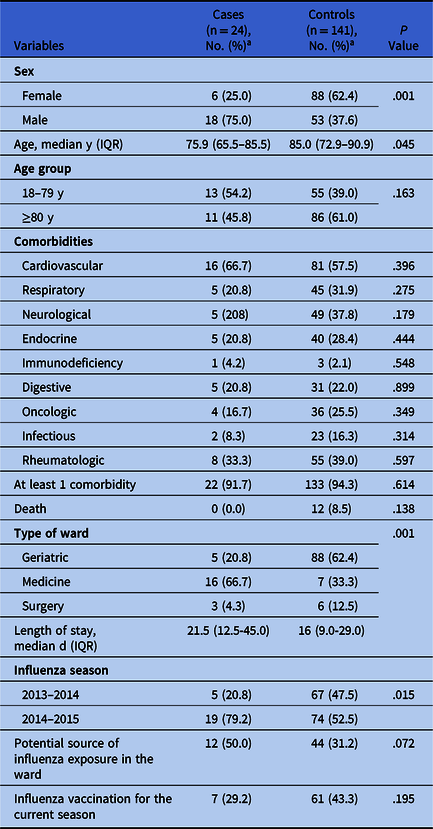
In total, 165 patients hospitalized in 21 participating units were included: 24 hospital-acquired influenza cases and 141 controls. The median age of patients was 84 years; 94 (57%) were female; and 68 (41%) had been vaccinated against influenza (Table 1). The proportion of male was significantly higher among cases compared to controls (75% vs 38%, respectively; P = .001). The cases were younger than controls, with a median age of 76 years versus 85 years, respectively (P = .045). No differences we detected between cases and controls with respect to comorbidities and death. The influenza vaccine coverage (IVC) was higher among controls than cases (43% vs 29%, respectively; P = .195). The presence of a potential source of influenza was 50% for cases versus 31% for controls (P < .10). The overall HA influenza attack rate was 1.9 per 1,000 hospitalized patients with a significant increase between the 2 seasons: 0.7 in 2013–2014 versus 3.1 in 2014–2015 (P < .001).
Characteristics of Controls and Cases with Hospital-Acquired Influenza Cases and Control Patients at St-Etienne and Lyon University Hospitals, France, 2013–2015 (n = 165).

Note. IQR, interquartile range.
a Units unless otherwise specified.
Impact of influenza vaccine coverage of HCW on the risk of HA influenza in patients
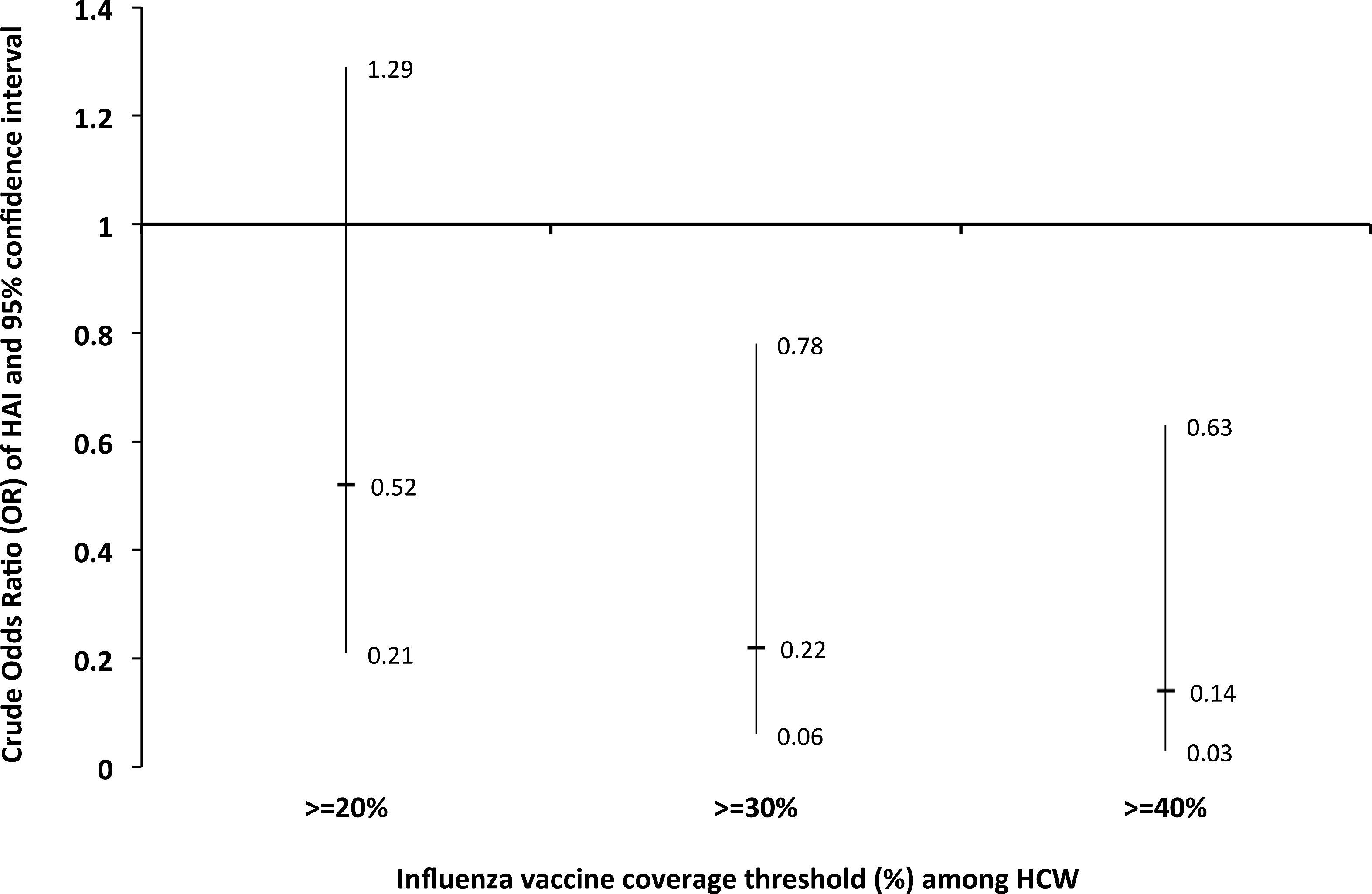
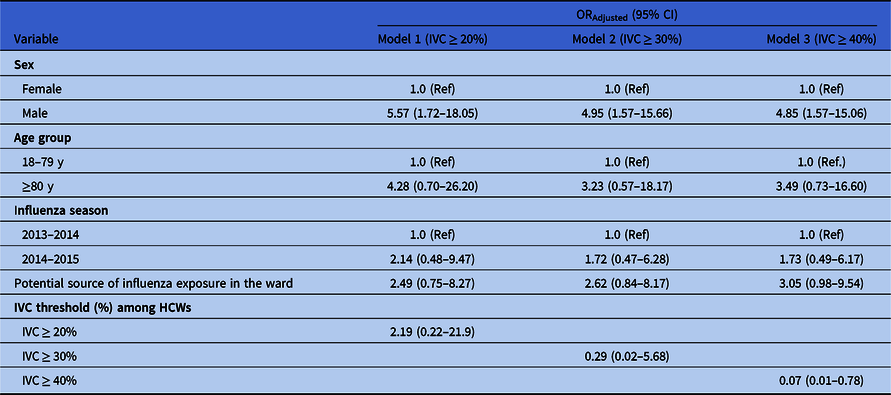
The median IVC of HCWs in the wards was 18% (range, 1%–71%) with a mean of 32%. On average, the IVC of HCWs was 14% in wards with HA influenza cases, compared to 18% in wards with controls (P = .02). Among the paramedical staff, IVC was lower in wards with HA influenza cases than in wards with controls (5% and 12%, respectively; P < .01). Among medical staff, IVC was not significantly different between the wards that included cases and controls (41% and 56% respectively; P = 0.054). The ORcrude for being a case decreased from 0.52 (95% confidence interval [CI], 0.21–1.29) to 0.14 (95% CI, 0.03–0.063) when the IVC threshold of HCWs increased from 20% to 40% (Fig. 1). After adjustment, the OR decreased from 2.19 (95% CI, 0.22–21.90) to 0.07 (95% CI, 0.01–0.78) (Table 2). An IVC >40% might be explored because of the limited sample size; no change was deteceted regarding the % of wards with IVC >40%.
Crude odds ratio of hospital-acquired (HA) influenza according to the threshold of influenza vaccine coverage of healthcare workers, Lyon and St-Etienne University Hospitals, France (2013–2015). Note. N = 21 wards: 5 of 21 wards had an IVC threshold ≥20%; 3 of 21 had an IVC threshold ≥30% and 1 of 21 had an IVC threshold ≥40%.

Adjusted Risk of Hospital-Acquired Influenza Among Patients by Influenza Vaccine Coverage Threshold Among Healthcare Workers, Lyon and St-Etienne University Hospitals, France (2013–2015) a

Note. OR, odds ratio; CI, confidence interval; IVC, influenza vaccine coverage; Ref, reference; HCW, healthcare worker.
a Mixed-effect multivariable logistic regression (with hospital and ward as random effect) with all variables included in each model.
Discussion
The objective of the study was to report the protective effect of IVC of HCWs on the risk of HA influenza among patients. The results suggested a trend toward an increase of protective effect to HA influenza in patients when IVC increased in HCWs. These results are consistent with our previous findings in a monocentric pilot study. Reference Bénet, Régis and Voirin15 In addition, the median IVC rate was lower in HA influenza cases than in controls (13.5% vs 18%, respectively; P = .02). The difference was more significant among paramedical staff (4.8% among HA influenza cases vs 11.9% among controls; P < .01). Previous results reported the protective impact of vaccine among HCWs Reference Bénet, Régis and Voirin15 for HA influenza in patients, but a threshold of percentage of vaccinated HCWs by ward for patient protection is rarely advanced outside modelization. Reference van den Dool, Bonten, Hak, Heijne and Wallinga17,Reference van den Dool, Bonten, Hak and Wallinga18
A study conducted with sensors in a geriatric ward showed that paramedics had the highest duration and frequency of contact with patients. Reference Voirin, Payet and Barrat19 They were also the ones who had frequent contact with each other but also with the physicians on the ward. It was not possible at this stage to calculate an optimal IVC threshold to achieve herd immunity. Most of the participating services had vaccination coverage <50%.
The low IVC of HCWs reported in that study in some wards was not unexpected. Similar results had already been reported in France, Reference Guthmann, Fonteneau and Ciotti13 which underscored the high vaccine hesitancy for French HCWs. Reference Verger, Collange and Fressard14 Since the study, the rate has increased to 35%. Reference Vaux, Fonteneau and Pefau20
This study had several limitations. The study was observational because randomized clinical trials are complicated to implement on that issue and the sample size was modest. The protective effect was identified for IVC >40% and was not detected below this threshold, perhaps because of the sample size. The vaccine coverage and the implementation of preventive measures are associated with sites and the mixed-effects model might have accounted for these confounders only partially. The lack of effect of a low vaccine coverage will underscore the need to reach high rate of vaccination of HCWs for prevention transmission in hospitals, which is a complementary message of the individual benefit of the vaccine. The vaccine effectiveness was reported more completely in HCWs than in patients, Reference Vanhems, Baghdadi and Roche21 which highlights that HCWs are key determinants for patient protection. Reference Perl and Talbot22 The prospective design is an added value of this study because the team has been involved in HA influenza surveillance for many years. Reference Vanhems, Voirin and Roche5 All cases were virologically confirmed, which increased validity compared to ILI cases without confirmed diagnosis. A complementary analysis was carried out using the 24-hour and 48-hour periods after hospitalization for the definition of HA influenza because the study definition might be considered too restrictive. Reference Munier-Marion, Bénet and Vanhems23 In both cases, we identified a protective effect of the IVC rate of HCWs with increasing threshold (data not shown).
Most studies report the rate of vaccination in HCWs; however, studies of the rate of vaccination in HCWs and its impact on patients are rare. Reference Bénet, Régis and Voirin15,Reference Amodio, Restivo, Firenze, Mammina, Tramuto and Vitale24,Reference Williams, McGuire, Katz and Leis25 Our data suggest that a threshold of a 40% rate of vaccinated HCWs as a start for detection of an impact on HA influenza incidence in hospitalized patients. However, a 40% vaccination rate among HCWs, which seems to reduce the potential risk of HA influenza in patients, but this does not mean that this level is sufficient to prevent HA influenza in patients. A much higher rate of vaccination is needed. Reference Perl and Talbot22,Reference Schumacher, Salmanton-García, Cornely and Mellinghoff26 Influenza vaccine for HCWs along with contact precautions, droplet precautions, isolation, and social distancing will contribute to a reduction of HA influenza. An influenza vaccination policy for HCWs should be integrated into a global program including infection control measures and surveillance, along with regular epidemiological information as feedback to the wards. Education to reduce vaccine hesitancy Reference Perl and Talbot22,Reference Hickler, Guirguis and Obregon27 and information on the risk of infection among immunocompromised and elderly patients will also provide optimal functioning during outbreaks and pandemics.
In conclusion, vaccination and infection control measures are key determinants for patient and HCW safety considering potential mismatches between circulating viruses and strains targeted by a vaccine according to flu season. Influenza vaccine for HCWs complemented by rigorous contact and droplets precautions will contribute to a reduction of HA influenza. A minimum threshold of vaccinated HCWs enhancing a protection of patients against HA influenza would be a helpful communication skill but will be reinforced by a potential dose–response effect with the goal to increase IVC for HCWs in hospitals.
Better IVC on the ward could prevent the risk of HA influenza in hospitalized patients. The improvement of the IVC rate in hospital units must be improved by reinforcing influenza vaccination campaigns within health institutions. More research is needed to determine the link between the IVC rate among HCWs and the risk of HA influenza in hospitalized patients.
Acknowledgments
We thank the following clinical wards heads and their healthcare workers for their close cooperation: Edouard Herriot university hospital (Lyon)—Dr B. Comte, Prof. C. Burillon, Dr B. Coppéré, Prof. R. Chapurlat, Prof. D. Fouque, Prof. P. Lermusiaux and Prof. X. Barth; Saint-Etienne university hospital (Saint-Etienne)—Prof. J. Porcheron, Prof. F. Cambazard, Prof. E. Alamartine, Prof. J.-N. Albertini, Prof. J.-M. Vergnon, Prof. K. Isaaz, Prof. M. Darmon, Prof. F. Lucht, Prof. O. Tiffet, Prof. J.-M. Phelip, Prof. C. Auboyer, Prof. P. Cathebras and Prof. N. Mottet. We also thank Ms. Michelle Grange for editing the manuscript. The funders had no role in the design and conduct of the study, collection, management, analysis, and interpretation of the data; preparation, review, or approval of the manuscript; and decision to submit the manuscript for publication.
Conflicts of interest
All authors reported no conflict of interest related to this study.
Financial support
This study was funded by the French Ministry of Health in a Programme Hospitalier de Recherche Clinique Interégional (protocol no. 2012-041).