Introduction
The concept of mild cognitive impairment (MCI) is important for the identification of earlier phases of dementia. At first, MCI was considered a transitional state between normal aging and dementia with high prognostic variability (Petersen et al., Reference Petersen, Smith, Waring, Ivnik, Kokmen and Tangelos1997). The studies that evaluated MCI trajectories – i.e. rates of conversion – showed that some patients remained cognitively stable within the observation period (Wolf et al., Reference Wolf1998; Ganguli et al., Reference Ganguli2011), a significant proportion improved (Larrieu et al., Reference Larrieu2002; Matthews et al., Reference Matthews2008; Ganguli et al., Reference Ganguli2011) and others converted to dementia (Petersen et al., Reference Petersen, Smith, Waring, Ivnik, Kokmen and Tangelos1997; Jack et al., Reference Jack2004; Schmidtke and Hermeneit, Reference Schmidtke and Hermeneit2008). This variability has been related to the sample characteristics (community-based or specialized clinic) and to MCI definitions.
There are several MCI criteria which have changed over the time. The original MCI Mayo Clinic criteria emphasized memory deficits and complaints (Petersen et al., Reference Petersen, Smith, Waring, Ivnik, Kokmen and Tangelos1997) and the subsequent revised criteria were expanded to include other cognitive domains (Winblad et al., Reference Winblad2004). Other MCI definitions did not require subjective memory complaints or specific objective memory deficit (Bozoki et al., Reference Bozoki, Giordani, Heidebrink, Berent and Foster2001; Devanand et al., Reference Devanand2007). More recently, new MCI criteria have emphasized specific impairment of episodic memory characteristic of amnesic syndrome of hippocampal type. This approach assumed the concept of MCI as prodomal Alzheimer's disease (AD) or MCI of Alzheimer type (Dubois and Albert, Reference Dubois and Albert2004). In the same way, the 2007 research criteria for probable AD proposed a change in NINCDS-ADRDA criteria for AD requiring the presence of early and significant episodic memory impairment associated with structural and functional neuroimaging changes and abnormal cerebrospinal fluid (CSF) biomarkers (Dubois et al., Reference Dubois2007). Functional impairment was not needed to fulfill these criteria. Therefore, the MCI concept was incorporated in this new proposal.
The impact of different definitions on observed variability can be exemplified by rates of progression to dementia. Higher values were observed with definitions that highlighted memory deficit, such as the original amnestic criteria (Petersen et al., Reference Petersen, Smith, Waring, Ivnik, Kokmen and Tangelos1997; Larrieu et al., Reference Larrieu2002; Ganguli et al., Reference Ganguli2011), the amnestic multiple domain MCI subtypes (Petersen et al., Reference Petersen2001; Ganguli et al., Reference Ganguli2011) and the MCI amnestic syndrome of the hippocampal type (Sarazin et al., Reference Sarazin2007). Inversely, higher rates to reversion to normal cognition were observed in subjects with nonamnestic MCI (Palmer et al., Reference Palmer, Wang, Backman, Winblad and Fratiglioni2002; Ganguli et al., Reference Ganguli2011). When the number of cognitive domains is taken into account, patients with one single domain impaired were at higher risk of reverting to normal cognition (Manly et al., Reference Manly, Tang, Schupf, Stern, Vonsattel and Mayeux2008; Ganguli et al., Reference Ganguli2011).
Another source of variability is the study setting. Rates of progression from MCI to dementia were consistently higher in specialty clinic than in community settings (Bruscoli and Lovestone, Reference Bruscoli and Lovestone2004; Hansson et al., Reference Hansson, Zetterberg, Buchhave, Londos, Blennow and Minthon2006; Mitchel and Shiri-Feshki, Reference Mitchell and Shiri-Feshki2009). Length of follow-up in longitudinal studies was another factor that might explain the heterogeneity of MCI outcomes, however little effect of this variable on annual conversion rates was reported in a systematic review (Bruscoli and Lovestone, Reference Bruscoli and Lovestone2004).
Annual conversion rates to dementia in people with mild cognitive impairment according to different operational criteria and settings varied from 1.6% to 28% (Bruscoli and Lovestone, Reference Bruscoli and Lovestone2004; Jack et al., Reference Jack2004; Schmidtke and Hermeneit, Reference Schmidtke and Hermeneit2008; Artero et al., 2009; Mitchel and Shiri-Feshki, Reference Mitchell and Shiri-Feshki2009). Overall, the annual conversion rate to AD and dementia was approximately 10% (Bruscoli and Lovestone, Reference Bruscoli and Lovestone2004; Mitchell and Shiri-Feshki, Reference Mitchell and Shiri-Feshki2009). However, the majority of population-based studies showed significant proportions of individuals remaining cognitively stable (ranging from 5.4% to 92%) (Larrieu et al., Reference Larrieu2002; Mitchel and Shiri-Feshki, Reference Mitchell and Shiri-Feshki2009; Ganguli et al., Reference Ganguli2011) or even reverting to normal cognition (6–53%) (Larrieu et al., Reference Larrieu2002; Matthews et al, Reference Matthews2008; Mitchel and Shiri-Feshki, Reference Mitchell and Shiri-Feshki2009; Ganguli et al., Reference Ganguli2011).
Besides rate of progression and its variability, when the risk of developing dementia was compared in MCI and cognitively normal individuals, MCI subjects showed significantly higher risk (Bruscoli and Lovestone, Reference Bruscoli and Lovestone2004; Matthews et al., Reference Matthews2008; Palmer et al., Reference Palmer, Backman, Winblad and Fratiglioni2008; Ganguli et al., Reference Ganguli2011).The pooled relative risk of MCI progression was 8.9 for AD when comparing with healthy elderly individuals in a meta-analysis (Mitchell and Shiri-Feshki, Reference Mitchell and Shiri-Feshki2009). The MCI relative risk of conversion to AD varied from 2.77 (Ishikawa et al., Reference Ishikawa, Ikeda, Matsumoto, Shigenobu, Brayne and Hirotaka2006) to 63.49 (Dickerson et al., Reference Dickerson2007).
Around 24 million people have dementia worldwide. Of those with dementia, 60% live in developing countries, with this number estimated to rise to 71% by 2040 (Ferri et al., Reference Ferri2005). Considering the close relation of MCI and AD, epidemiologic studies about MCI and its longitudinal course should be carried out in these world areas. Nevertheless, there are few studies concerning this issue in these regions. One study carried out in Brazil showed an MCI incidence rate similar to the rates found in developed areas of the world (Chaves et al., Reference Chaves, Camozzato, Godinho, Piazenski and Kaye2009a). MCI amnestic prevalence in India was similar to those observed in developed countries and that of the multiple domain type was lower (Das et al., Reference Das2007). Chinese MCI subjects showed lower conversion rates to both dementia of Alzheimer type and vascular dementia when compared with American MCI subjects (Huang et al., Reference Huang2005).
The aim of the study was to evaluate the trajectory of MCI of Alzheimer type in a population-based elderly cohort in southern Brazil. We also estimated the risk for development of probable AD in comparison to healthy subjects.
Methods
Data were derived from an ongoing cohort study known as the PALA (Porto Alegre Longitudinal Aging) study, originally designed to evaluate healthy aging and dementia (Chaves et al., Reference Chaves, Camozzato, Eizirik and Kaye2009b). At baseline, there were 345 community-dwelling subjects aged 60 years or more, who were healthy and cognitively intact. Those participants who fulfilled criteria for the healthy aging study and consented to participate were evaluated with a detailed clinical interview composed of demographica, clinical and social variables. The Montgomery-Åsberg Depression Rating Scale (MADRS), the Self-Reported Questionnaire – WHO (SRQ), the Diagnostic and Statistical Manual of Mental Disorders (DSM-IV) criteria for major depression, the Mini-Mental State Examination (MMSE) and the Clinical Dementia Rating (CDR) were also applied. Additionally, independence for daily living activities was assessed with the Activities of Daily Living (ADL) scale. A detailed study design has already been published (Chaves et al., Reference Chaves, Camozzato, Eizirik and Kaye2009b).
Of these 345 baseline subjects, 18 went on to develop dementia; 22 developed MCI, 245 remained without cognitive impairment and 60 dropped-out (54 were not traceable and 6 refused to participate) at follow-up after a maximum of 10 years. Participants for the current study are the above 22 MCI incident cases and the 245 subjects who did not have cognitive impairment established at that time. These 267 subjects were additionally followed for the maximum of 70 months to evaluate the MCI outcomes and the relative risk of developing dementia. Of the 22 MCI subjects, one dropped out (through refusal to participate). Of the 245 participants without cognitive impairment, five declined to participate and 20 were not traceable. At least one additional follow-up assessment to ascertain diagnosis was completed for the 241 participants. All baseline instruments were re-applied at each follow-up assessment and participants underwent a standardized neuropsychological and a neurological evaluation. They were interviewed in their home environment by trained medical students and physicians.
The diagnostic criteria for “MCI of Alzheimer-type” (Dubois and Albert, Reference Dubois and Albert2004) were applied as follows: (1) memory complaints reported by the patient or the family; (2) progressive onset; (3) normal or mildly impaired complex activities of daily living; (4) amnestic syndrome of the “hippocampal type” defined by very poor free recall despite adequate (and controlled) encoding; decreased total recall because of insufficient effect of cueing or impaired recognition; numerous intrusions; (5) persistence of memory changes at a subsequent assessment; (6) absence of the fully developed syndrome of dementia; and (7) exclusion of other disorders that may cause MCI, with adequate tests, including neuroimaging. The MCI diagnosis was determined by a senior researcher (a clinician specialized in geriatric psychiatry/behavioral neurology) using the above criteria.
The diagnosis of probable AD was ascertained with the DSM-IV and the NINCDS/ADRDA criteria by a senior researcher (a clinician specialized in geriatric psychiatry/behavioral neurology). For those who had died by the time of the follow up, retrospective data were obtained through a structured telephone interview with a knowledgeable close source focusing on dementia diagnosis. We also carried out the AD8 (an eight-item informant interview) during the same telephone interview (Galvin et al., Reference Galvin, Roe, Xiong and Morris2006).
Data obtained through the standardized neuropsychological and neurological evaluation, MMSE, CDR, ADL, MADRS, SRQ and DSM-IV criteria for major depression all gave support to both diagnoses (MCI and AD).
MCI trajectories assessment
Outcomes for this analysis were progression to probable AD (conversion); remaining in the MCI category (stability); and improving to the previous cognitive status (reconversion).
Risk estimation for the conversion to AD
The outcome variable for this analysis was an AD diagnosis. MCI was the main factor. Age, sex, education, family income, major depression, clinical illness, MMSE scores were co-variates.
The study was approved by the Ethics Committee for Research of the Hospital de Clínicas de Porto Alegre. All subjects and/or their proxies signed an informed consent.
Statistical analysis
Baseline demographic and clinical variables from the original sample, from the sample evaluated in this study and from those subjects who did not meet entry criteria for the present study or dropped out at follow-up were compared by analysis of variance (ANOVA) and χ2 association test.
The cumulative conversion rate was calculated as the number of MCI cases that progressed to probable AD during follow-up divided by the total number of MCI participants. The annual conversion rate was calculated as the quotient of the percentage of MCI subjects who converted to probable AD at follow-up and the mean delay to follow-up. The MCI annual reconversion rate was calculated as the quotient of the percentage of MCI subjects who improved to their previous cognitive status at follow-up and the mean delay to follow-up.
The Cox proportional hazard models and the survival curve were derived from the Kaplan-Meier's method. The univariate Cox proportional hazard model was first used to estimate the relative risks and corresponding 95% CI of developing dementia in relation to baseline MCI diagnosis, age, sex, education, family income, major depression, MMSE scores and minor clinical illness. Baseline MCI diagnosis was entered as a dichotomous variable (yes vs. no). The multivariate Cox proportional hazards model was used to examine the age, education, MMSE and sex adjusted risk of MCI for the outcome of probable AD. All analyses were performed using the Statistical Package for the Social Sciences (SPSS, Version 14.0).
Results
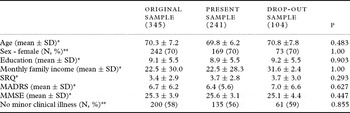
The age of participants ranged from 68 to 96 years (69.8 ± 6.2, mean SD), educational level ranged from 0 to 35 years of study (8.9 ± 5.5, mean ± SD) and the monthly family income ranged from 1 to 121 minimum wages (22.5 ± 28.3, mean ± SD) (1 minimum wage = U$ 353.00). Of the 241 participants, 169 (70%) were female, 135 (56%) reported no minor clinical illness (Table 1).
Comparison of baseline demographic and clinical variables among the original (N = 345), the present (N = 241) and the drop-out (N = 104) sample.

* ANOVA analysis of variance; ** χ2 association test.
MMSE = Mini-Mental State Examination; MADRS = Montgomery-Åsberg Depression Rating Scale; SRQ = self-report questionnaire.
In order to ensure similarity, we carried out a comparison of baseline clinical and demographic variables among the original cohort sample (N = 345), the present sample (N = 241) and the group composed of subjects who did not meet entry criteria for the present study or who dropped out at follow-up (N = 104). The groups did not differ (Table 1).
MCI trajectories
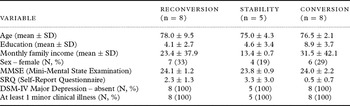
Of the 21 MCI subjects, eight (38%) progressed to probable AD, five (24%) remained stable and eight (38%) improved their cognition returning to the previous performance during the mean follow-up of 45.1 months (19–70 months). Table 2 shows the demographic and clinical data of the three MCI groups. Of the 220 normal participants, three (1.3%) developed dementia, 17 (7.7%) developed MCI and 200 (91%) remained cognitively intact. The dementia cases were all probable AD.
Demographic and clinical variables of the three MCI outcomes groups: descriptive analysis

The MCI annual conversion rate to AD was 8.5% (CI 95% 3.9–16.1) and the MCI annual reconversion rate was 8.5% (CI 95% 3.9–16.1). The annual conversion rate to AD for participants who did not have cognitive impairment was 1.8% (CI 95% 0.1–8.8).
MCI as risk factor for AD
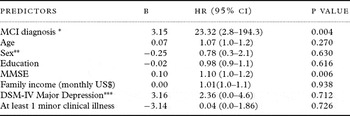
Age, sex, education, family income, major depression and minor clinical illness did not influence the risk of progressing to Alzheimer's disease in the univariate Cox regression model (Table 3). Lower baseline MMSE scores and MCI were risk factors for AD in the univariate model (HR = 1.10, p = 0.006, and HR = 23.3, p = 0.004, respectively).
Cox regression – univariate analysis: variables MCI diagnosis, MMSE, age, sex, education, monthly family income, Major Depression and presence of minor clinical illness for the outcome progression to probable AD

* MCI diagnosis (yes is the reference).
** Female sex is the reference.
*** Presence of Major Depression is the reference.
MCI = mild cognitive impairment; MMSE = Mini-Mental State Examination; AD = Alzheimer's disease.
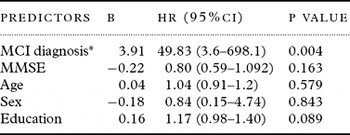
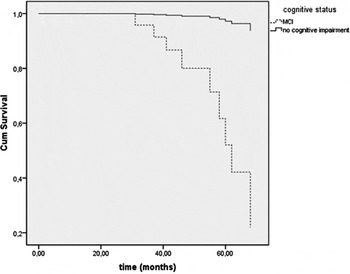
The MCI group was associated with significant risk for AD compared to the group that was not cognitively impaired (HR = 49.83; p = 0.004) after the adjustment for age, education, sex and MMSE (Table 4). Figure 1 illustrates the survival rate for the outcome of AD according to MCI diagnosis, showing higher risk of conversion of MCI subjects.
Cox regression – multivariate analysis: MCI diagnosis as main factor, variables age, sex, education, and MMSE as co-variates for the outcome progression to probable AD

* MCI diagnosis (yes is the reference).
HR = hazard rate; CI = confidence interval; MCI = mild cognitive impairment; MMSE = Mini-Mental State Examination.
Survival rate for the outcome of Alzheimer's disease

Discussion
The present investigation was derived from an ongoing longitudinal evaluation of community-living elderly individuals in southern Brazil – the PALA study. In this region of Brazil, pala in Portuguese also designates part of the typical garment worn by gauchos, a cape. The aims of this study were to evaluate the trajectory of MCI and to estimate the MCI risk for the development of AD in comparison with healthy subjects. We used MCI criteria that emphasize episodic memory impairment (MCI of Alzheimer type) that could be more associated with development of AD. We found heterogeneity of MCI outcomes, with the same cumulative proportion of conversion to AD and reconversion to normal cognition (38%) and lower cumulative proportion of stability (24%). The majority of individuals from this study did not convert (62%), which is similar to findings in other investigations (Larrieu et al., Reference Larrieu2002; Matthews et al., Reference Matthews2008; Mitchel and Shiri-Feshki, Reference Mitchell and Shiri-Feshki2009; Ganguli et al., Reference Ganguli2011). The similarity between conversion and reconversion to normal rates could be explained by the sample's characteristics. The higher proportion of no conversion could be attributed to the community-based sample that has been already related to lower conversion rates (Mitchel and Shiri-Feshki, Reference Mitchell and Shiri-Feshki2009; Ganguli et al., Reference Ganguli2011). Despite the utilized MCI criteria which emphasize that memory impairment is associated with higher conversion to AD (Larrieu et al., Reference Larrieu2002; Petersen et al., Reference Petersen, Smith, Waring, Ivnik, Kokmen and Tangelos1997; Sarazin et al., Reference Sarazin2007; Ganguli et al., Reference Ganguli2011), these criteria are classified as single cognitive domain type and have been associated with higher rates of reconversion (Manly et al., Reference Manly, Tang, Schupf, Stern, Vonsattel and Mayeux2008; Ganguli et al., Reference Ganguli2011). Previous studies have shown that 6%–53% of the MCI cohort could revert back to normal after initially being diagnosed (Larrieu et al., Reference Larrieu2002; Matthews et al, Reference Matthews2008; Mitchel and Shiri-Feshki, Reference Mitchell and Shiri-Feshki2009; Ganguli et al., Reference Ganguli2011). Participants from our study who improved and returned to their previous cognitive status could present some degree of visual or hearing impairment, depressive symptoms and use of medications as the cause of the memory deficit. Additionally, intra-individual variability could explain these results.
Regardless of heterogeneity of the outcomes, MCI participants from this cohort showed significantly higher risk of developing probable AD as compared to those who were cognitively intact (HR = 49.83), even after the adjustment for age, education, MMSE and sex. The risk range in previous studies varied from 2.77 to 63.49 (Bruscoli and Lovestone, Reference Bruscoli and Lovestone2004; Ishikawa et al., Reference Ishikawa, Ikeda, Matsumoto, Shigenobu, Brayne and Hirotaka2006; Dickerson et al., Reference Dickerson2007; Palmer et al. Reference Palmer, Backman, Winblad and Fratiglioni2008; Matthews et al., Reference Matthews2008; Mitchell and Shiri-Feshki, Reference Mitchell and Shiri-Feshki2009; Ganguli et al., Reference Ganguli2011) and therefore the observed risk can be considered high. The chance of developing AD during six years of follow-up of an elderly subject with MCI is 49 times higher than for a cognitively intact participant. Given that the application of MCI of Alzheimer type criteria increases the probability of identifying individuals during the prodromal stages of AD, one might expect higher risk estimates because the emphasis on long-term episodic memory impairment seems to add predictive value for these criteria, since AD neuropathological changes can be early present in areas critical for this type of memory such as mesial temporal regions (Dubois and Albert, Reference Dubois and Albert2004). This finding exemplifies the importance of the new MCI approach. However, if all MCI identified were prodromic AD, the estimated risk would be even higher. To increase criteria specificity, the inclusion of other measures seems to be essential. These criteria are in conformity with the newly research criteria for the diagnosis of AD which require an episodic memory deficit as the core clinical criterion (criterion A) and the presence of at least one biological marker of the disease, either by structural imaging (criterion B), CSF (criterion C), molecular imaging (criterion D) or dominant mutation within the immediate family (criterion E) to establish a positive diagnosis (Dubois et al., Reference Dubois2007).
Because age, sex, education, income, baseline MMSE scores, and other clinical variables might affect the progression to probable AD, we performed Cox regressions with all these variables. MCI diagnosis and MMSE scores were kept in the final model in the univariate design. However, the well-established relation of age, sex and education with AD (Solfrizzi et al., Reference Solfrizzi, Panza and Colacicco2004; Chaves et al., Reference Chaves, Camozzato, Eizirik and Kaye2009b) demanded their inclusion in the Cox multivariate model. The higher multivariate hazard of the MCI diagnosis could be explained by some interaction with these other variables reinforcing the association with the progression to AD. This finding suggests that education separately, besides age and sex, did not influence progression to probable AD among individuals supposedly in their earliest stages of the disease. Furthermore, among older individuals from less economically advantaged regions, with average lower levels of education than people from developed countries, their education did not affect the trajectory from MCI to AD. Lower educational levels found in developing countries could be a confounder for the MCI evaluation. Overestimation of MCI rates and lower MCI conversion rates to dementia could be observed because of the higher false positive rates produced by the lower educational level. However, the current findings rejected this hypothesis. In a previous investigation (Chaves et al., Reference Chaves, Camozzato, Godinho, Piazenski and Kaye2009a), we observed a similar MCI incidence rate to those found in the majority of the studies carried out in developed countries (Kukull et al., Reference Kukull2002; Larrieu et al., Reference Larrieu2002; Matthews et al., Reference Matthews2008; Ganguli et al., Reference Ganguli2011).
Some limitations of our study should be considered: the proportion and conversion rates were based on relatively few MCI participants given the community origin of the sample. However, this number was sufficient to allow the estimation of risk. As already mentioned, one problem of detecting cases at time intervals is the underestimation of the outcome (Solfrizzi et al., Reference Solfrizzi, Panza and Colacicco2004). In the case of MCI, subjects could present this condition during the interval period and at interviews when they have already converted to dementia. Another limitation was the drop-out rate (around 30%) during the follow-up, which prevents estimation of the impact of this loss on the results. However, by comparing the baseline clinical and demographic variables among the original cohort sample, the sample evaluated in this study and the drop-out group we minimized this limitation because no difference was observed.
The strengths of the study include the use of a population-based sample evaluated comprehensively; the length of follow-up; the use of internationally accepted instruments validated locally; and the diagnosis according to international and recent criteria together providing representative information about older residents living in urban areas in Brazil.
Finally, because we are following this elderly sample in our community, we can help plan for the future through evaluation of additional refinements to MCI measures and the validation of the research criteria for AD in Brazil.
Conflict of interest
None.
Description of authors' roles
Claudia Godinho and Marcia Chaves formulated the research question, designed the study, and wrote the paper. Ana Luiza Camozzato analyzed the data and helped write the paper Diego Onyszko collected part of the data and helped with the references.
Acknowledgment
This study was supported by grants from CNPq (350027/1995-1 and 306458/2004-7).