


Introduction
Pteropods (holoplanktonic mollusks) are exclusively marine gastropods adapted to pelagic life (Lalli and Gilmer, Reference Lalli and Gilmer1989), which are widespread in the present open oceans. However, the preservation and fossilization of pteropods requires specific conditions. Fossil pteropods are uncommonly found in pre-Eocene beds, and “Only the genus Heliconoides was previously known from pre-Eocene sediments, with a single Campanian specimen and one latest Paleocene species” (Janssen et al., Reference Janssen, Sessa and Thomas2016, p. 1). Although some gastropod faunas have been reported from Tibet by Yu (Reference Yu1982), Yang and Wang (Reference Yang and Wang1985), Yang and Qian (Reference Yang and Qian1988), Han et al. (Reference Han, Yu, He, Meng, Zhu, Meng, Shao and Yang2012), and Meng et al. (Reference Meng, Ji, Yao, Wu, Su, Liao and Pan2017), there is no previous report on pteropods. This is the first study of Paleogene pteropods in China. Prior to this study, the systematic reports of Eocene pteropods near Tibet were from the Ghazij shales of the Zinda Pir section in Pakistan (Eames, Reference Eames1952) and the Upper Disang Formation in the Assam-Arakan Basin, northeastern India (Lokho and Kumar, Reference Lokho and Kumar2008). This new discovery of a pteropod assemblage is potentially significant because it enhances our understanding of the distribution and faunal evolution of the Cenozoic pteropods in Tibet, and provides new paleontological data for paleogeographical reconstruction of the Neo-Tethys residual basin.
The Yadong region was once situated within the Tethys residual basin, where a set of Paleocene to Eocene marine sequences was exposed (Jiang et al., Reference Jiang, Aitchison and Wan2016). This is one of the most important areas for studying the marine Paleogene biostratigraphy of Tibet because the study on this area may provide valuable information about the late evolutionary history and closing of the Tethys residual basin. The Eocene Zhepure Formation in this area consists of the Limestone Member and the overlying Sand-Shale Member (Li and Wan, Reference Li and Wan2003). The Gulupu section in Tüna was first investigated in 2015, and samples collected for later analysis. Abundant benthic and planktic foraminifers, radiolarians, ostracodes, calcareous nannofossils, calcareous algae, charophytes, dinoflagellates, and sporopollen (Li, Reference Li2015; Niu et al., Reference Niu, Li and Wang2016; Niu, Reference Niu2017; Zhang and Li, Reference Zhang and Li2017; Li and Li, Reference Li and Li2019; Yao et al., Reference Yao, Li, Zhang, Li, Lv, Han, Li, Xiu and Guo2019; Zhang et al., Reference Zhang, Li, Yao, Li, Wang, Li, Li, Xie, Shi, Guo and Kang2019; Wang et al., Reference Wang, Li, Aitchison and Sheng2020) were recovered. Five samples (samples G65–G69) from the lower Sand-Shale Member yielded pteropods. The aim of this study is to provide the first taxonomic description of the early Eocene pteropods preserved in the Gulupu section, and discuss their paleobiogeographical significance.
Geological setting
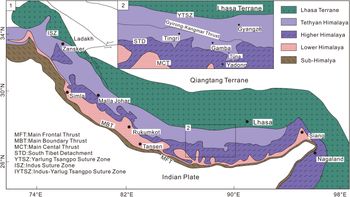
The Himalaya between the Indian shield and the Lhasa Terrane is usually divided on the basis of major fault systems into four litho-tectonic units, from south to north: the Sub-Himalaya, the Lower Himalaya, the Higher Himalaya, and the Tethyan Himalaya (Yin, Reference Yin2006). The Tethyan Himalaya can be further subdivided by a regional Tingri-Gamba thrust into two sub-belts of different lithological compositions (Burg et al., Reference Burg, Leyreloup, Girardeau and Chen1987; Li et al., Reference Li, Jiang, Hu and Wan2009). The Southern Tethyan Himalaya is characterized by unmetamorphosed shallow-water deposits (Liu, Reference Liu1992; Willems et al., Reference Willems, Zhou, Zhang and Gräfe1996; Li and Wan, Reference Li and Wan2003, Reference Li and Wan2004; Li et al., Reference Li, Wan and Liu2005, Reference Li, Jiang, Hu and Wan2009) and the Northern Tethyan Himalaya by slightly metamorphosed outer shelf, continental slope, and deeper-water deposits (Wan and Ding, Reference Wan and Ding2002; Liu and Aitchison, Reference Liu and Aitchison2002; Li et al., Reference Li, Wan, Jiang, Hu, Goudemand, Han and Chen2007, Reference Li, Jansa, Wan, Pan, Xiu and Xie2011). The Gulupu section is located in the Southern Tethyan Himalaya Sub-belt (Fig. 1), ~2 km west of Tüna town of Yadong at 28°03'55"N, 89°11'29"E, where a Paleocene–Eocene stratigraphic sequence is exposed.
Generalized maps of the Himalaya orogeny and the Yadong region. (1) Generalized map of the Himalaya orogeny; (2) generalized map of the Yadong region (Modified from Yin, Reference Yin2006; Aitchison et al., Reference Aitchison, Ali and Davis2007).

Material and methods
For micropaleontological investigation, 157 samples were collected from the Zhepure Formation of the Gulupu section, with samples G1–G63 from the Limestone Member, and samples G64–G157 from the Sand-Shale Member. Five samples (samples G65–G69) from the lowermost part of the Sand-Shale Member yielded pteropods. Most of the specimens are poorly preserved as internal molds, and in most cases the umbilical area is obscured by matrix.
Shale and silty shale samples were soaked in 10% Na2SO4 solution, and the mixture stirred every three days. After ~15 days, the mixture was washed with fresh water, and the processed sample screened through a 40 mesh (425 μm) followed by a 250 mesh (63 μm) stainless sieve, and the residues dried. Pteropods were picked out from the dried 40 mesh residue under a binocular microscope with 20 × magnification. The well-preserved pteropods were mounted on stubs, coated with platinum, and imaged using a Field Emission Scanning Electron Microscope (Carl Zeiss SUPRA 55).
Repository and institutional abbreviation
All the materials are housed at the State Key Laboratory of Environmental Geology and Biogeology, China University of Geosciences, Beijing (CUGB).
Systematic paleontology
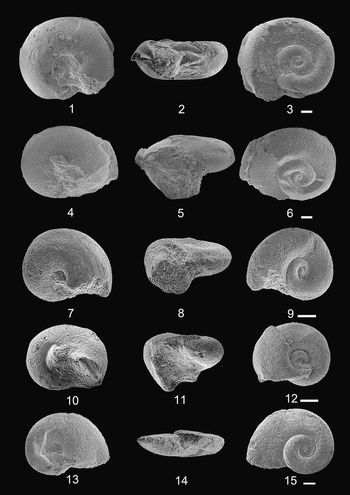
The holoplanktonic mollusks obtained from samples G65–G69 are abundant, however, due to the poor preservation, most specimens cannot be identified to species level. Based on the morphologies exhibited by these specimens, only four species of two pteropod genera were identified in this study (Fig. 2). Families and higher taxa were largely based on relevant data from Schander et al. (Reference Schander, Aartesen and Corgan1999) and Bouchet et al. (Reference Bouchet, Rocroi, Hausdorf, Kaim, Kano, Nützel, Parkhaev, Schrödl and Strong2017).
Scanning electron micrographs of pteropods (molds) recovered in Gulupu section. (1–3) Heliconoides mercinensis (Watelet and Lefèvre, Reference Watelet and Lefèvre1885), G68, (1) umbilical view, (2) apertural view, (3) top view; (4–6) aff. Limacina canadaensis Hodgkinson Hodgkinson et al., Reference Hodgkinson, Garvie and Bé1992, G68, (4) umbilical view, (5) apertural view, (6) top view; (7–9) aff. Limacina canadaensis, G67, (7) umbilical view, (8) apertural view, (9) top view; (10–12) aff. Heliconoides pyrenaica Janssen in Cahuzac and Janssen, Reference Cahuzac and Janssen2010, G66, (10) umbilical view, (11) apertural view, (12) top view; (13–15) Limacina yadongensis n. sp., G65, (13) umbilical view, (14) apertural view, (15) top view. Scale bar = 100 μm.

Order Pteropoda Cuvier, Reference Cuvier1804
Suborder Euthecosomata Meisenheimer, Reference Meisenheimer1905
Superfamily Limacinoidea Gray, Reference Gray1840
Family Limacinidae Gray, Reference Gray1840
Genus Heliconoides d’Orbigny, Reference d'Orbigny1836
Type species
Atlanta inflata d’Orbigny, Reference d'Orbigny1835 = Heliconoides inflatus (d’Orbigny, Reference d'Orbigny1835), by subsequent designation (Hermannsen, Reference Herrmannsen1846) (Recent).
Remarks
Janssen (Reference Janssen2003) discussed systematics of the family Limacinidae and seven genera were recognized. In his classification, unornamented umbilicated limacinid species with apertural reinforcements are included in Heliconoides, which includes a wide range of shell shapes, varying from helical to discoidal, in which the columella is simple or with torsion.
Heliconoides mercinensis (Watelet and Lefèvre, Reference Watelet and Lefèvre1885)
Figure 2.1–2.3
- Reference Watelet and Lefèvre1885
Spirialis mercinensis Watelet and Lefèvre, p. 102, pl. 5, figs. 2a–c.
- Reference Janssen, Schnetler and Heilmann-Clausen2007
Heliconoides mercinensis; Janssen et al., p. 163, figs. 7, 8.
- Reference Janssen2010
Heliconoides mercinensis; Janssen in Cahuzac and Janssen, pl. 9, fig. 1.
Holotype
No holotype or paratypes were designated by Watelet and Lefèvre (Reference Watelet and Lefèvre1885). Six syntypes should be present in Watelet's collection, housed in the Musée de Soissons, France, but could not be traced. No lectotype was fixed.
Description
Specimen poorly preserved, shell small (height 0.37 mm, diameter 1.00 mm), sinistral, almost planispiral, with ~3.5 rounded whorls in regular spiral, but laterally somewhat flattened. Initial whorl hardly or not protruding, apical plane slightly concave. Aperture rounded in frontal view, upper margin at the same height or only very slightly lower than penultimate whorl. Basal part of the aperture lowered beyond base of foregoing whorl. Umbilicus deep and wide, occupying four-tenths of total diameter.
Materials
A total of 7 specimens from samples G68 and G69.
Remarks
Heliconoides mercinensis has a stratigraphical range from the latest Paleocene to the earliest Lutetian, and was originally described from the “Cuisian” of the Paris Basin. In terms of general shape and size, these specimens from Tüna are identified to be H. mercinensis. However, the Tüna specimens are flatter, which may reflect dorso-ventral rock compression.
aff. Heliconoides pyrenaica Janssen in Cahuzac and Janssen, Reference Cahuzac and Janssen2010
Figure 2.10–2.12
- Reference Cahuzac and Janssen2010
Heliconoides pyrenaica Janssen in Cahuzac and Janssen, p. 41, pl. 3, fig. 4, pl. 9, fig. 7.
Holotype
BMNH GG. 21266/1, from Marnes de Gan (Tuilerie) of Ypresian age. BMNH: The Natural History Museum, Paleontology Department, London (UK).
Description
Shell small (height 0.37 mm, diameter 0.43 mm), sinistral, with planorboid shape, consisting of three convex whorls with the last whorl increasing particularly rapidly in diameter. Aperture large, lunate, produced downward, upper margin not reaching above penultimate whorl. Base gradually rounded with narrow umbilicus.
Materials
A total of 5 specimens from sample G66.
Remarks
The specimens usually have matrix obscuring the aperture and umbilical area. However, a part of the reinforced apertural structure of the specimens is visible. It resembles H. pyrenaica in the general shape of teleoconch and whorl profile. The major difference is the shape of aperture, which is larger and rounder in H. pyrenaica.
Genus Limacina Bosc, Reference Bosc1817
Type species
'le Clio hélicine’, Clio helicina Phipps, Reference Phipps1774 = Limacina helicina (Phipps, Reference Phipps1774), by monotypy (Recent).
Remarks
Distinguishing characters of Limacina are as follows: shell small, thin, glassy, little or no exterior ornamentation. Trochoid to nearly planispiral, hyperstrophic coiling with rounded, closely wound whorls. Last whorl larger. Aperture wide, rounded, prolonged at base; umbilicus broad and deep or almost absent.
aff. Limacina canadaensis Hodgkinson in Hodgkinson et al., Reference Hodgkinson, Garvie and Bé1992
Figure 2.4–2.9
- 1992
Limacina canadaensis Hodgkinson in Hodgkinson et al., p. 16, pl. 2, figs. 4–6.
Holotype
USNM 180487, from well locality 19 (5,380 ft). USNM: National Museum of Natural History, Smithsonian Institution, Washington, D.C. (USA).
Description
Shell small (height 0.37–0.62 mm, diameter 0.43–0.93 mm), sinistral, low spired, consisting of four convex whorls in a regular spiral. Almost only body whorl visible in an umbilical view. Suture strongly impressed. Aperture large, semicircular, occupying more than half of the shell diameter.
Materials
A total of 10 specimens from samples G67 and G68.
Remarks
The whorl profile indicates a close affinity with Limacina canadaensis Hodgkinson in Hodgkinson et al., Reference Hodgkinson, Garvie and Bé1992, but less convex than that species. The major difference of the Tüna specimens from L. canadaensis is the more involute whorls profile almost covering the juvenile whorls. Due to the generally unfavorable preservation, these specimens are described in open nomenclature.
Limacina yadongensis new species
Figure 2.13–2.15
Holotype
Sample G65-1 (Fig. 2.13–2.15), Ypresian, from Lowermost Sand-Shale Member, Zhepure Formation, Gulupu section, Tüna, Yadong, housed at CUGB.
Diagnosis
Limacina of planorboid and lenticular shape, with three convex whorls, lower H/W-ratio (holotype 33.7). Body whorl widening rapidly. Aperture triangular, apertural margin not reinforced, upper margin lower than penultimate whorl.
Description
Shell small (height 0.28 mm, diameter 0.83 mm), sinistral, planispiral, with a depressed, lenticular shape, width about three times height. Shell consisting of three slightly convex whorls, increasing rapidly in width, with distinct acute carina located just above suture, apical plane slightly raised. Aperture triangular, upper margin lower than penultimate whorl. Base slightly convex, with a very narrow umbilicus.
Etymology
After the name of the town, where the specimens were collected.
Materials
A total of 5 specimens from samples G65 and G66.
Remarks
The specimens exhibit some similarity to Limacina aegis Hodgkinson in Hodgkinson, Garvie, and Bé, Reference Hodgkinson, Garvie and Bé1992 from Nova Scotian shelf, offshore eastern Canada (early Eocene), but differ by having a lower spire, fewer whorls, and a more rapidly increasing last whorl. The H/W-ratio of the recovered specimens is lower than that of L. aegis, and their lateral view is flatter.
Discussion
The age of the pteropod fauna
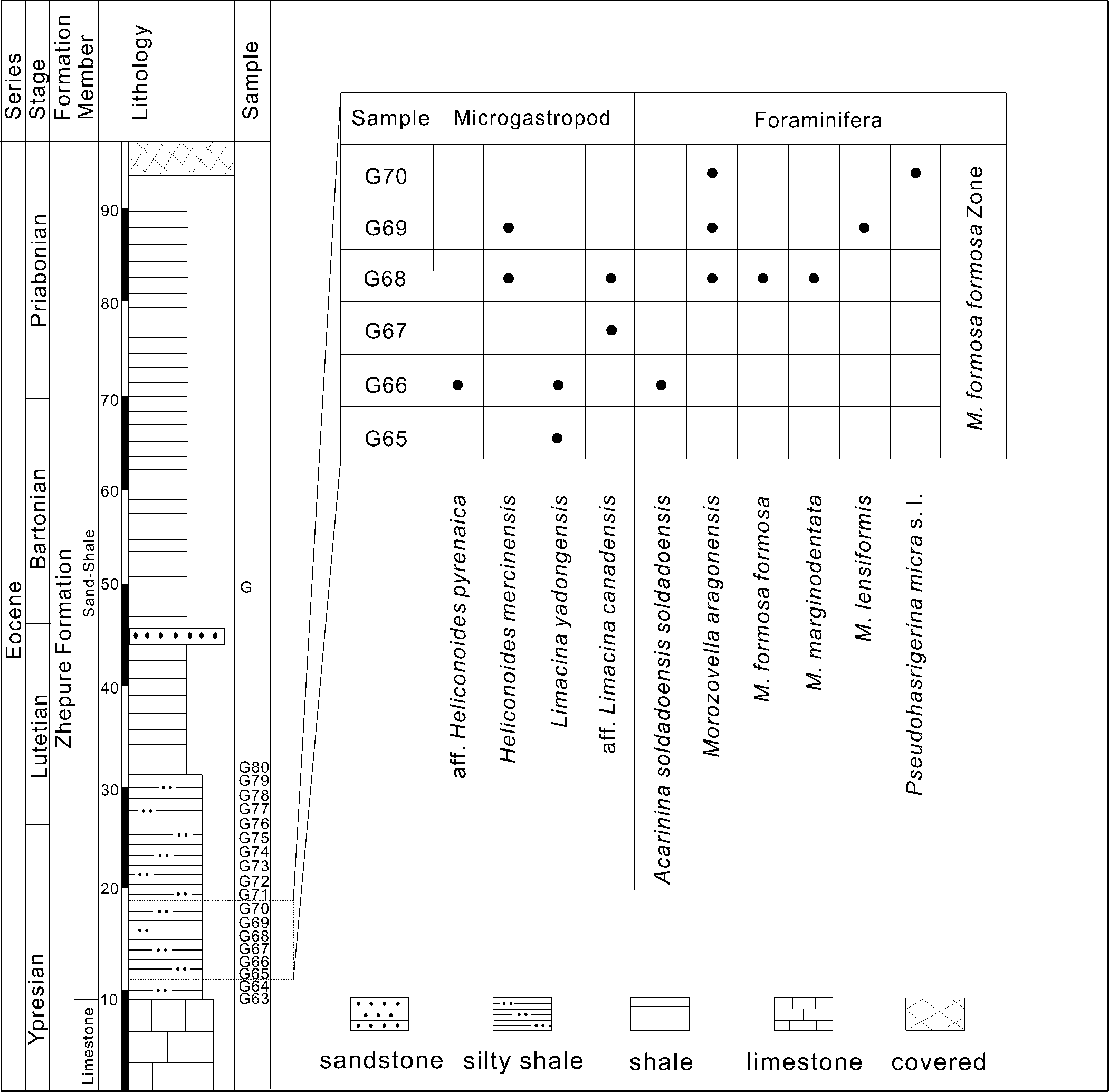
Heliconoides pyrenaica was reported from middle–late Ypresian sediments of Gan, southwest France (Janssen in Cahuzac and Janssen, Reference Cahuzac and Janssen2010). Heliconoides mercinensis is long ranging, from the latest Paleocene to the early Lutetian (Janssen et al., Reference Janssen, Schnetler and Heilmann-Clausen2007; Janssen, Reference Janssen2010). Limacina canadaensis was described from lower Eocene strata in the Gulf and eastern coasts of North America (Hodgkinson et al., Reference Hodgkinson, Garvie and Bé1992). Although the Tüna holoplanktonic mollusks (pteropods) are not well preserved, they are tentatively correlated with these species in terms of morphological characteristics. The Tüna pteropods lived in association with well-preserved foraminifers (Fig. 3) from samples G66–G70, where the Morozovella formosa formosa zone and Acarinina soldadoensis soldadoensis (Brönnimann, Reference Brönnimann1952) are recognized. The Morozovella formosa formosa zone is an interval zone named by Bolli (Reference Bolli1957). In the Gulupu section, the base of this zone is marked by the first occurrence of M. aragonensis (Nuttall, Reference Nuttall1930) in G68 and the top is denoted by the first occurrence of Pseudohastigerina micra s. l. (Cole, Reference Cole1927) in G70. The age of this zone is referred as middle early Eocene. Moreover, the first occurrence of A. soldadoensis soldadoensis is in sample G66, and is of early Eocene age. Therefore, the age of the associated planktic foraminifers indicates that the pteropod fauna should be of early Eocene age (middle–late Ypresian).
Distribution of the pteropods and co-occurred planktic foraminifers (Li, Reference Li2015) from the Zhepure Formation in Tüna, Yadong, Tibet.

Paleoenvironment and paleogeography
The Paleogene is an important period in the evolution of the Tibetan Tethys. The collision of India with Eurasia is one of the most significant tectonic events during the Cenozoic (Butler, Reference Butler1995). According to Li and Wan (Reference Li and Wan2003), after the India-Asia collision, the Tibetan Tethys entered the stage of residual basin. During this stage, the evolution of the Tethys sedimentary environment in Tibet was controlled not only by the rise and fall of global sea level, but also by plate collision, which became more and more important over time. However, there are still controversies about the paleoenvironment and late evolutionary history of Neo-Tethys after the collision (Wang et al., Reference Wang, Li, Hu and Jansa2002; Li and Wan, Reference Li and Wan2003; Ding et al., Reference Ding, Kapp and Wan2005, Reference Ding, Qasim, Jadoon, Khan, Xu, Cai, Wang, Baral and Yue2016; Li et al., Reference Li, Wan and Liu2005).
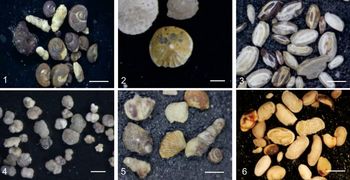
The marine strata of Tethyan Himalaya of the Tüna (Yadong, Tibet) represent the sedimentary development of the passive northern continental margin of the Indian Plate (Jiang et al., Reference Jiang, Aitchison and Wan2016; Niu et al., Reference Niu, Li and Wang2016; Wang et al., Reference Wang, Li, Aitchison and Sheng2020) and document the narrowing and closure of the Neo-Tethys (Wang et al., Reference Wang, Li, Aitchison and Sheng2020). The lower part of the Sand-Shale Member consists of greenish-gray calcareous marls with some green-colored sandstones, indicating a shallow-marine sedimentary environment. In this study, the gastropod-bivalve biofacies was identified from this member, spanning the interval from G65 to G69. The biofacies is characterized by holoplanktonic and benthic gastropods, microbivalves, planktic and benthic foraminifers, and ostracodes (Fig. 4). This biofacies is similar to the BF-23 of Zhou et al. (Reference Zhou, Willems and Zhang1997), who described 24 biofacies from the marine Cretaceous–Paleogene successions of southern Tibet. This biofacies is also similar to the BF-13 of Paleogene southern Tibet (Li et al., Reference Li, Wan and Liu2005). Both biofacies indicate a restricted lagoonal paleoenvironment. In the Tüna area, the major difference compared to the two biofacies is the appearance of the pteropods and planktic foraminifers. This indicates a similar environment that was somewhat more open. Herein, we consider that, as a result of plate collision, the Tüna area has experienced uplift. A semi-enclosed and semi-open restricted gulf was formed in the Tüna area in early Eocene (Ypresian), and the pteropod fauna was transported into the Tüna area.
Photographs of the faunal assemblage in the lowermost part of the Sand-Shale Member. (1) Gastropods; (2) benthic foraminifers (Nummulites); (3) benthic foraminifers (Quinqueloculina); (4) planktic foraminifers; (5) gastropods and microbivalves; (6) ostracodes. Scale bars = 500 μm.

Surveys of the associated benthic foraminiferal fauna can provide a basis for interpreting the paleo-depth. Nummulitids and Alveolinids lived as habitants of soft bottoms and areas in depth <90 m (Reiss and Hottinger, Reference Reiss and Hottinger1984). Some of the Nummulites are similar to N. venosus (Fichtel and Moll, Reference Fichtel and Moll1798), which inhabits water depths of 15–80 m, with maximum accumulation at 50 m. In the warm tropical and sub-tropical shallow waters, Quinqueloculina lived at depths from 0 to ~100 m (Luczkowska, Reference Luczkowska1974). Meanwhile, based on the study of the characteristics of the Eocene calcareous algal assemblages in Tüna, Niu et al. (Reference Niu, Li and Wang2016) concluded that during the Eocene the Tüna area was a shallow shelf environment with a water depth <30 m. In addition, the fossils are found with radial-fibrous ooids, which are typical indicators of a shallow marine environment.
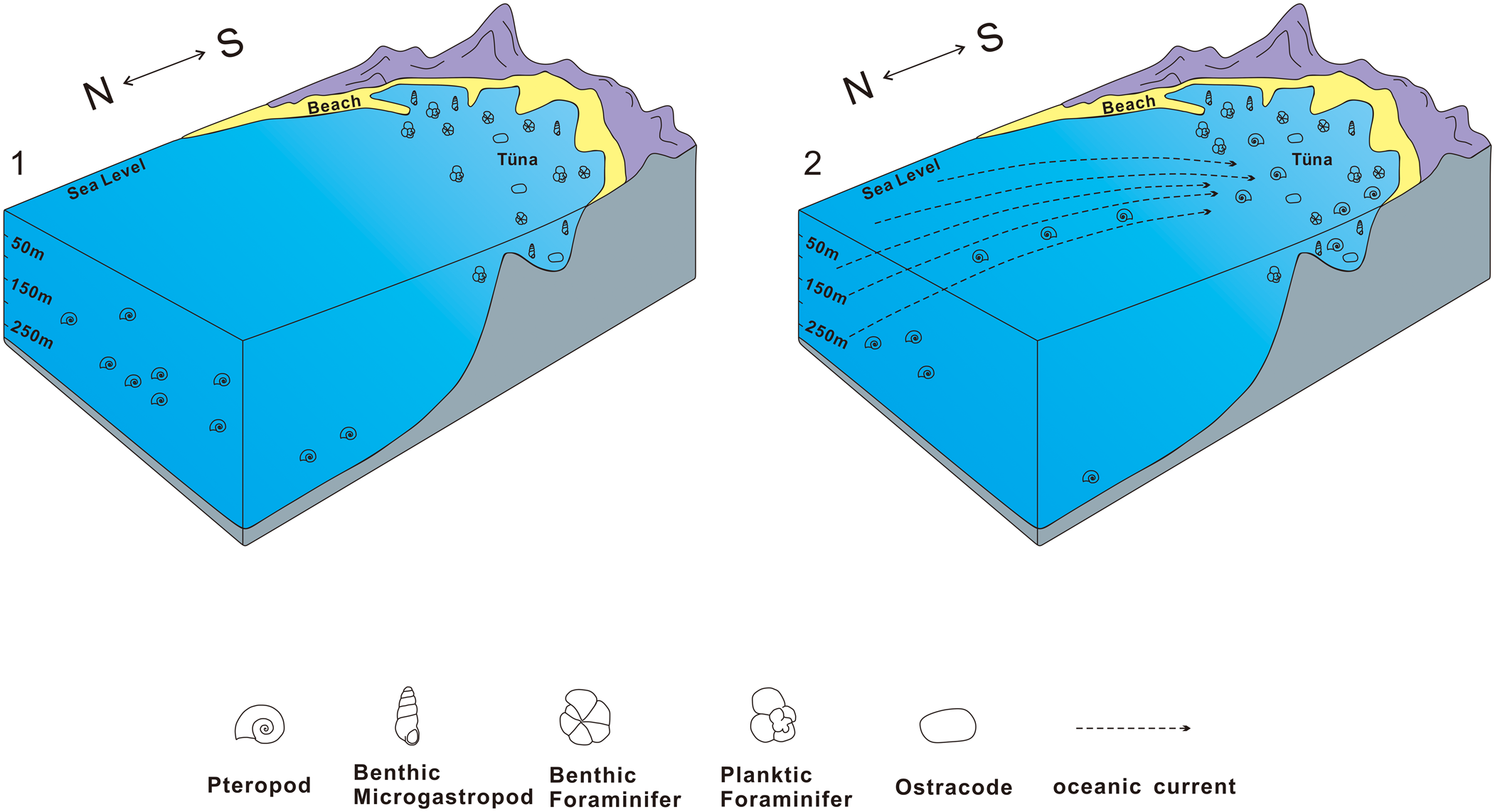
Pteropods are very sensitive to the marine environment and have been widely used for paleoceanographic and paleoclimatic reconstructions (Herman and Rosenberg, Reference Herman and Rosenberg1969; Singh and Singh, Reference Singh and Singh2010). In present-day oceans, most living pteropods predominantly inhabit water depths of 200 m or more, and therefore the occurrence of a pteropod fauna co-existing in shallower environment (gulf) may reflect transport from an open marine basin, via oceanic currents (Fig. 5).
(1, 2) The interpretation of pteropods co-existing with other faunas in Tüna gulf.

Here we present a plausible hypothesis for the occurrence of the pteropod fauna in shallower water environment: with the collision between the Indian and Eurasian plates, the Tethyan Himalaya was gradually closed, and the paleo-depth of the Tethyan Himalaya became shallower. However, the collision was diachronous (Rowley, Reference Rowley1996), with deeper open marine environment still existing in some parts of the Tethyan Himalaya during the early Eocene, the Tüna area evolved into a semi-closed restricted gulf with some connections to the exterior open environment. The pteropods, which previously lived in an open marine basin near the Tüna gulf, were brought to the gulf by the oceanic currents and buried in the same sediments as other shallow water faunas. The transport may also contribute to the poor preservation.
Pteropod assemblages recovered from shallower environments have also been documented from other places, such as the Ypresian New Jersey core sections of the New Jersey Coastal Plain, deposited in middle-outer shelf (Janssen et al., Reference Janssen, Sessa and Thomas2016), the shallow water sediments of the lower Miocene in the Aquitaine Basin, southwest France (Cahuzac and Janssen, Reference Cahuzac and Janssen2010), the Ypresian Reklaw Formation of Texas, with a water depths of 30–90 m (Garvie, Reference Garvie1996), and the Joseph Bonaparte Gulf, off the NW coast of Australia, with an estimated paleo-depth greater than 20 m (Yokoyama et al., Reference Yokoyama, Deckker, Lambeck, Johnston and Fifield2001). The occurrence of pteropods in these shallow marine areas may also be explained by transportation from deeper water environments via oceanic currents.
Regional comparison of holoplanktonic fauna
During the early to middle Eocene, marine shelf deposition was widespread in the Himalayan region. Fossil holoplanktonic mollusks are also preserved in neighboring areas in southwest China, such as Pakistan and India (Eames, Reference Eames1952; Lokho and Kumar, Reference Lokho and Kumar2008). The pteropods from Pakistan consist of only limacinoids, which were recovered from the lower Eocene Ghazij shales of the Zinda Pir section. The material from Eocene sediments of the Assam-Arakan Basin, northeastern India is more diverse, including Limacinoidea and Cavolinioidea. Therefore, the pteropod assemblage from China is more similar to that of Pakistan.
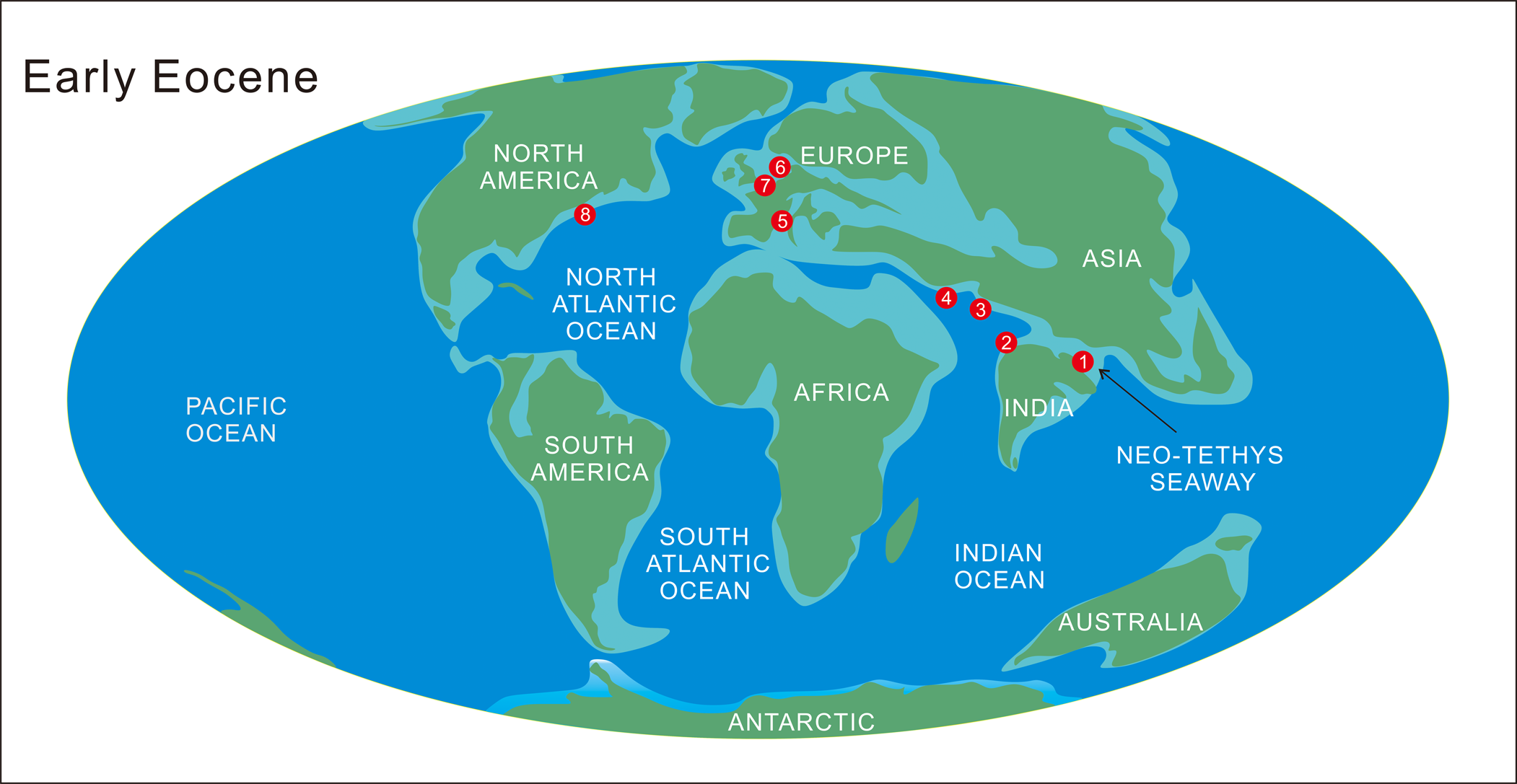
Prior to this study, the genera Heliconoides and Limacina had been reported from lower Eocene beds from areas such as southwest France, Iran, Pakistan, Uzbekistan, Netherlands, Denmark, and North America (Fig. 6). Pteropods are useful proxies of environments, which are very sensitive to water temperature, salinity, and depth (Berger, Reference Berger1977). Based on this, we suggest that these faunas probably shared the same habitat during the early Eocene. The occurrence of pteropods in Yadong supports the existence of a Tethys seaway in southern Tibet connecting the above areas during the early Eocene (Ypresian).
Sketch map of the global paleogeography during early Eocene (Modified after Scotese, Reference Scotese2013). The figure depicts the distribution of Heliconoides and Limacina during early Eocene. (1) Tüna, Yadong, southern Tibet; (2) Zinda Pir area, Kohat District, Pakistan (Eames, Reference Eames1952); (3) Dzheroi and Tashkura, central Uzbekistan (Janssen et al., Reference Janssen, King and Steurbaut2011); (4) Soh area, north of Isfahan, north-central Iran (Janssen et al., Reference Janssen, Jagt, Yazdi, Bahrami and Sadri2013); (5) Aquitaine basin, southwest France (Cahuzac and Janssen, Reference Cahuzac and Janssen2010); (6) Lillebælt area, Denmark (Kai and Heilmann-Clausen, Reference Kai and Heilmann-Clausen2011); (7) E55 borehole, Rotterdam, Netherlands (Janssen, Reference Janssen2010); (8) New Jersey Coastal Plain, United States (Janssen et al., Reference Janssen, Sessa and Thomas2016).

Although pteropods are widespread in the present oceans, their thin and fragile aragonitic shells are relatively susceptible to chemical and mechanical damage, which means that pteropods are often absent from strata. Fortunately, some empty pteropod shells are frequently filled by other minerals that can be preserved as internal molds in strata. This study presents the first stratigraphical record of pteropods in Tibet, China. Our knowledge of the pteropods in Tibet is still in its infancy and it can be expected that further progress of pteropod biostratigraphy will be made in future. This study is a part of an ongoing research on the pteropods in southern Tibet.
Conclusions
The holoplanktonic mollusks (pteropods) were recovered from the early Eocene Sand-Shale Member of Zhepure Formation in the Gulupu section, Yadong, southern Tibet for the first time. Most of specimens are incomplete, with their identities at genus or species level undetermined. However, from the perspective of biostratigraphy and paleogeography, the documentation of this collection is undoubtedly of great significance. Four species (including Limacina yadongensis n. sp.) of two pteropod genera were identified in this work. A gastropod-bivalve biofacies was identified. The analysis of the paleoenvironment and paleogeography may indicate that after the initial collision between India and Eurasian plates, there was a semi-closed restricted gulf in the Tüna area, and the pteropod fauna was likely transported into the gulf from some nearby open marine basin by oceanic currents. Meanwhile, according to the correlation of the pteropod fauna with other reported assemblages, the existence of a widespread Tethys seaway can be reconstructed for the early Eocene (Ypresian).
Acknowledgments
We appreciate the constructive comments from the reviewers and the editors. We are grateful to A.W. Janssen and the anonymous reviewer for their comments on the earlier manuscript, and we especially thank A.W. Janssen for his earlier recommendations regarding the pteropods. This research is supported by the National Natural Science Foundation of China (41972031, 41272030, 40972026), the Strategic Project of Science and Technology of Chinese Academy of Sciences (XDB03010403), the National Basic Research Program of China (2012CB822001), IGCP608 and 679.