Introduction
The use of bark-paper screenfold books by the Classic-period (AD 200–900) southern lowland Maya is attested by representational and archaeological evidence: depictions of such books on murals and painted ceramic vessels, epigraphic references to ‘paper’ or ‘books’ (hu'n) and ‘writers’ (aj tz'ib), and archaeological finds of bark beaters and scribal residences (Fash Reference Fash2001: 136; Stuart Reference Stuart, Golden, Houston and Skidmore2012: 119; Rossi et al. Reference Rossi, Saturno and Hurst2015: 123). Visual representations of such manuscripts in Classic Maya art show folded paper protected by covers of wood and jaguar hide; these would have been displayed and inscribed in royal courts as precious, venerated objects: the province of an educated elite. Sixteenth- and seventeenth-century Spanish authors indicate that Maya people in the Yucatán Peninsula and northern Petén had books of history, prophecy and astrology, sometimes kept in large archives (e.g. López de Cogolludo Reference López de Cogolludo1688; Landa Reference Landa1978: 13, 82–83). These images and descriptions, evocative of an ancient Maya world filled with books, are in stark contrast with the paucity of surviving examples. The hot, humid climate of the Maya lowlands, and the Colonial Spanish perception of Maya books as particularly blasphemous objects, has made them among the rarest and most treasured pre-Columbian artefacts. Only four significantly intact Maya manuscripts—the Dresden, Grolier, Madrid and Paris Codices—are currently known, and all date to the Postclassic period (AD 1000–1519). Data on the manufacture, use and deposition of codices in the Classic period have, however, been largely circumstantial and inferential.
The authors report here their investigation through multispectral imaging of fragments of an Early Classic (c. AD 400–600) Maya codex, first described by Robert Smith (Reference Smith1937: 216–17) of the Carnegie Institution of Washington. Excavating a human burial in the central monumental group A of Uaxactun, in the Department of Petén in Guatemala, Carnegie investigators recovered what they identified as pieces of a bark-paper book, complete with hieroglyphic writing on coloured backgrounds. These thin flakes of painted stucco, now located in the Peabody Museum of Archaeology and Ethnology at Harvard University (inventory number 33-99-20/3468), were recently examined by the authors under magnification in multiple light spectra. The results of that examination support the identification of the fragments as remains of a bark-paper page covered in plaster and bearing writing and figural painting. Direct investigation of the codex revealed two distinct layers of plaster painted with different designs, demonstrating that the manuscript was resurfaced and repainted in antiquity. Although such acts of erasure and re-inscription have previously been documented for much later, non-Maya codices and Classic Maya mural paintings, they have not hitherto been attested for ancient Maya manuscripts. These findings not only shed some light on the crafting and curation of books in the Early Classic southern Maya lowlands, but also connect those practices to larger Mesoamerican scribal traditions and to Classic Maya production of, and interaction with, texts and images in other media.
Archaeological context of the Uaxactun codex fragments
From 1923–Reference Smith1937, the Carnegie Institution of Washington executed a major excavation project at Uaxactun. First reported to the Institution by local chicle (Manilkara chicle: gum) harvesters, Uaxactun was selected for investigation because it had the earliest-dated stone monuments then known in the southern Maya lowlands, and the Institution's work there constituted the first intensive, scientific excavations of a Classic Maya site in Petén (Weeks & Hill Reference Weeks and Hill2006: 10). The project advanced scholarly understandings of the time-depth of Maya civilisation and led to a ceramic chronology for the region, based first on ceramic wares and modes, and later on type-variety classifications (Smith Reference Smith1955; Smith et al. Reference Smith, Willey and Gifford1960; Willey et al. Reference Willey, Culbert and Adams1967). While pioneering and rigorous by the standards of its day, the Carnegie expedition could be cavalier in its treatment of ancient architecture and art—trenching buildings and removing entire late phases—and documentation is at times fragmentary. The Institution's field records (R. Smith Reference Smith1932) and eventual report (Smith Reference Smith1937: 216–17, pl. 5) include descriptions, a sketch and a photograph of some of the codex fragments, but there are no photographs or drawings of the intact painting and partial glyphs described as being present. The written description of the intact pieces nonetheless makes clear how much of the document has been destroyed since its discovery.
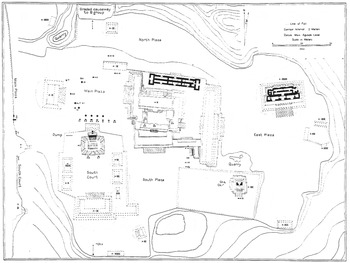
The fragments were encountered in 1932 during excavations of structure A-I, a pyramidal building that occupies the north end of the south court at Uaxactun, facing northward onto the main plaza (Figure 1). Seven stelae stand in a row north of the building, at the foot of the south-court platform. Six are blank, but two bear poorly legible dates in the Maya Long Count calendar that probably correspond to the late eighth century AD. Stela 7, at the base of structure A-I's northern stairs, bears a carved Long Count date of 9.19.0.0.0, i.e. 29 June AD 810 using the 584286 correlation between the Maya and Christian calendars (Smith Reference Smith1937: 193; Martin & Skidmore Reference Martin and Skidmore2012). The building thus appears as a focal space for royal calendrical rites at the end of the Classic period.
Plan of group A at Uaxactun (by R.E. Smith Reference Smith1937; reproduced courtesy of the Peabody Museum of Archaeology and Ethnology, Harvard University).

Structure A-I was built in six successive phases, the oldest of which dates to the Late Preclassic period (probably AD 1–250). No skeletal remains were recovered from the fill of the earliest or latest phases, designated pyramids A and F by the Carnegie project. The first reconstruction of the building—the Early Classic pyramid B—included the burial of an adult, placed directly on the first-phase platform floor and accompanied by a single ceramic bowl (Smith Reference Smith1937: 219). The three subsequent phases all included human burials, ranging from the very simple (a body placed on the steps of pyramid C, the third phase, and covered over by the fill of pyramid D), to the plausibly royal (a crypt in pyramid E containing multiple skeletons and ceramic offerings) (see A. Smith Reference Smith1932). Each major construction stage probably included a masonry or pole-and-thatch superstructure, in some cases modified several times before being dismantled and buried under the next phase of the building (Smith Reference Smith1937: 196–223).
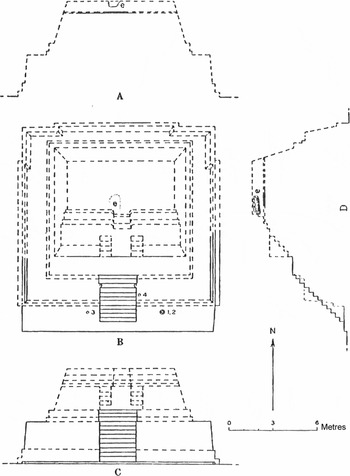
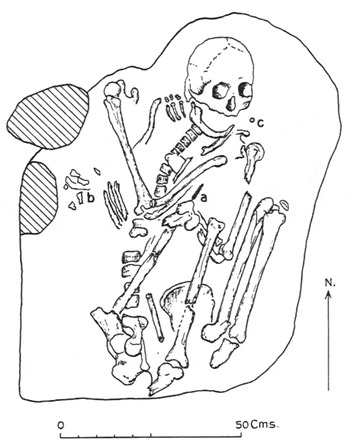
The upper platform of pyramid C was modified three times after its initial construction (Figure 2). The Uaxactun codex fragments came from a burial (burial A6) in the latest of these sub-phases, which is believed, based on stratigraphy and Tzakol phase ceramics, to date to the fifth or sixth century AD. Midway through the construction of a platform at the building's summit—the uppermost surface of the last sub-phase of pyramid C—a crypt (number 4) with mortared stone walls and a plastered floor was constructed in the platform fill just west of its north–south axis. The decedent (an elderly man) was deposited in a flexed position along with offerings that, while few in number, point to his special social status. These include a stingray spine, a jade bead and a stuccoed object, the remains of which are considered in the present study (Figure 3). Two capstones covered the crypt; the floor of the summit platform was laid down just above them (Smith Reference Smith1937: 214–17, 225–26).
Plan and sections of Uaxactun structure A-I, pyramid C, phases 3 and 4 (by R.E. Smith 1937; reproduced courtesy of the Peabody Museum of Archaeology and Ethnology, Harvard University).

Plan of burial A6, crypt IV, showing: a) a stingray spine; b) codex fragments; and c) a jade bead (by R.E. Smith Reference Smith1937; reproduced courtesy of the Peabody Museum of Archaeology and Ethnology, Harvard University).

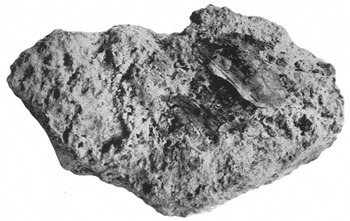
At some point after the crypt was sealed, a stone from the wall or ceiling fell on the plastered object, crushing it. Some fragments of the stucco coating adhered to the stone, with the result that portions of that coating were preserved even as the backing disintegrated over time. Excavation notes mention other pieces left on the floor of the crypt beneath the stone, as well as the remains of bark-paper (R. Smith Reference Smith1932). The sole photograph of the codex fragments by the Carnegie project (Figure 4) shows scraps of plaster still stuck to the stone, with only their interior surfaces exposed and no painted text or images visible. Excavators later removed the fragments, which Robert Smith described as bearing hieroglyphs “painted in black on green or red backgrounds” (Reference Smith1937: 216). Since then, no further investigation to confirm Smith's description has been attempted.
Photograph of the Uaxactun codex fragments stuck to a fallen stone (by R.E. Smith Reference Smith1937; reproduced courtesy of the Peabody Museum of Archaeology and Ethnology, Harvard University).

Rediscovery and analysis of the fragments
No further investigation occurred until present author Carter happened upon a reference to the Uaxactun burial A6 codex (Smith Reference Smith1937: 216) while researching another extraordinaryobject from a burial in structure A-I, the famous Vase of the Initial Series, recovered from the tomb in pyramid E. A subsequent visit by both authors to the Peabody Museum confirmed that the pieces of the codex existed and did actually bear fields of red and green. Yet the state of the fragments was disappointing. What remains of them now is a single wafer of plaster about 30mm across at the widest part, plus several smaller flakes less than 5mm wide, and dozens of tiny fragments with maximum diameters of 1mm or less. No bark-paper now survives, nor do any of the plaster fragments bear whole glyphs or diagnostic parts of glyphs visible to the naked eye. This condition comes as no surprise: the act of detaching the fragments from the rock may have damaged them, and there are no photographs to indicate the quantity or condition of the pieces that arrived at the Peabody Museum for accession. The subsequent storage of the fragments for over 70 years in a non-climate-controlled facility, apparently in a matchbox with a wad of cotton, probably led to extensive further damage, obliterating most of the writing described by Smith (Reference Smith1937: 216).
With no writing or pigment clearly visible, multispectral imaging was selected as a method to ascertain whether any had survived. With permission from the Peabody Museum, the fragments of the burial A6 codex were viewed and photographed using a Foster & Freeman Video Spectral Comparator 5000 in the Straus Center for Conservation and Technical Studies at the Harvard Art Museums. The codex fragments were examined at 4.64×, 7.98×, 10.93×, 11.22×, 14.7× and 16.71× magnification under white, infrared and infrared fluorescent light. Selected pieces were also examined using a Dino-Lite AD413T-I2V microscope and imaged with a Nikon D300 dSLR camera frame-mounted for photomicrography.
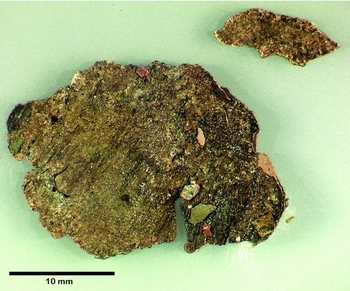
Examination of the largest piece of stucco, designated fragment 1, began with the interior surface photographed by the Carnegie project. Close inspection of this surface confirmed that none of the original backing was present, although roughly parallel striations on the stucco are consistent with its having been painted over amate paper made from fig or mulberry bark (Figure 5). The striations on fragment 1 are closely comparable to the bark-paper of the Postclassic Yucatec Maya Madrid Codex (Buti et al. Reference Buti, Domenici, Miliani, García Sáiz, Gómez Espinoza, Jímenez Villalba, Verde Casanova, Sabía de la Mata, Romani, Presciutti, Doherty, Brunetti and Sgamellotti2014: fig. 3a). They are far less similar to the impressions on plaster on the interior surfaces of gourds from an EarlyClassic household at Cerén, El Salvador (Beaubien Reference Beaubien1993: fig. 5), and a Late Classic tomb at Baking Pot, Belize (Audet Reference Audet2005: fig. 23), or to those on stucco that covered wooden or gourd objects in a fourth-century AD royal tomb at El Zotz, Guatemala, about 27km south-west of Uaxactun (Magee & De Alarcon Reference Magee, de Alarcon, Houston, Newman, Román and Garrison2016: fig. III.6). These observations support the Carnegie team's interpretation of the object as a fragment of a paper document and are in keeping with ethnographic and ethnohistoric descriptions of Mesoamerican paper production.
Interior surface of layer A, fragment 1, in white light at 7.98× magnification, showing parallel impressions from bark-paper (gift of the Carnegie Institution of Washington, Peabody Museum of Archaeology and Ethnology, Harvard University, PM# 33-99-20/3468; image: Straus Center for Conservation, Harvard Art Museums © President and Fellows of Harvard College).

According to Spanish observers, Central Mexican paper producers at the time of the Conquest soaked the branches of Ficus spp. trees in water overnight, removed the bark instrips and scraped off the outer layers. The inner bark was pounded with grooved stones, breaking up the longer fibres, then cut into strips that were laid out and beaten into coherent sheets with smooth stone hammers. Similar techniques have been documented ethnographically among the Otomi (Von Hagen Reference Von Hagen1977: 57). Polished with a third stone, then covered with finely sifted plaster, the paper was ready to be written on, and multiple pieces could be glued together into a long strip (MacNutt Reference MacNutt1912: 40; Hernández Reference Hernández1942: 90). Folded into pages of regular size and inscribed on one or both sides, the manuscripts could be opened like a bound book to show two pages, or extended to show many pages at once. All four of the surviving Postclassic Maya codices were made using Ficus or Morus bark-paper prepared in a similar way and covered with calcium carbonate or gypsum paste; the striations on the burial A6 plaster fragment are consistent with this method of construction (Schwede Reference Schwede1912; Ruvalcaba et al. Reference Ruvalcaba, Zetina, Calvo del Castillo, Arroyo, Hernández and Sotelo2008; Buti et al. Reference Buti, Domenici, Miliani, García Sáiz, Gómez Espinoza, Jímenez Villalba, Verde Casanova, Sabía de la Mata, Romani, Presciutti, Doherty, Brunetti and Sgamellotti2014: 171–72).
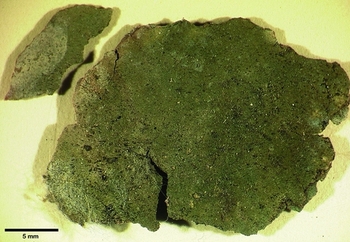
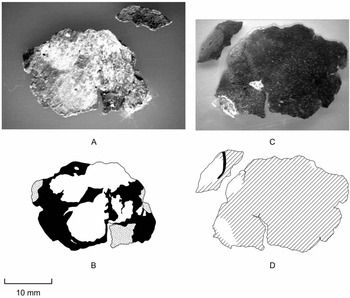
In contrast to the single plaster layers observed on the intact Postclassic Maya codices, flaking at the edges of fragment 1 revealed two distinct layers of stucco. Further investigation indicated that such layering is present in all of the known fragments of the burial A6 codex. The first, layer A, was applied to the bark-paper. Sometime later, it was covered over with a second coat, layer B, so that, except at the edges of fragment 1, only the reverse of layer A and the obverse of layer B can be seen. The alternative to this scenario, that layer B isthe plaster surface of a second page pressed against the obverse of layer A, was disproven by examining the opposite face of the fragment. This presents an originally smooth surface, now somewhat warped and speckled with accretions but lacking any bark-fibre impressions. In normal light, contrasting zones of cream and brownish green—presumably the green fields noted by Robert Smith (Reference Smith1937: 216)—are visible on this side (Figure 6).Although the obverse of layer A is thus concealed, contrasting dark and light areas appeared on the reverse under infrared fluorescent light (Figure 7a & b). Four pale, roughly circular zones are separated by darker lines, some parts of which are just visible in normal light. Pigment is unlikely to have passed fully through the stucco; instead, the colour contrast may be due to differential diagenesis in areas with and without ink and paint. What appears on the reverse of layer A, then, would be a mirror image of the original figure on its obverse. The scale and form of the dark lines are consistent with their comprising one or more signs in the Maya hieroglyphic writing system, but insufficient detail survives to permit their conclusive identification as hieroglyphs or iconography. What is more certain is that they represent intentional marks: the obverse of layer A was painted with an image or a text.
Exterior surface of layer B, fragment 1, in white light at 11.22× magnification, showing a smooth surface with contrasting zones of cream and brownish green (gift of the Carnegie Institution of Washington, Peabody Museum of Archaeology and Ethnology, Harvard University, PM# 33-99-20/3468; image: Straus Center for Conservation, Harvard Art Museums © President and Fellows of Harvard College).

a) Interior surface of layer A, fragment 1, in infrared fluorescent light, showing pale zones surrounded by darker lines; b) line drawing of (a); c) exterior surface of layer B, fragment 1, in infrared fluorescent light, showing inked lines partially overlain by greenish pigment; d) line drawing of (c). Photographs (a) and (c) are gifts of the Carnegie Institution of Washington, Peabody Museum of Archaeology and Ethnology, Harvard University, PM# 33-99-20/3468; images: Straus Center for Conservation, Harvard Art Museums © President and Fellows of Harvard College.

After layer B had been applied to the page, smoothed and allowed to dry, fine lines were drawn on it in black ink. Strongly visible in 1000nm infrared light, these lines are consistent with carbon-rich ink akin to that used in the Madrid Codex (Buti et al. Reference Buti, Domenici, Miliani, García Sáiz, Gómez Espinoza, Jímenez Villalba, Verde Casanova, Sabía de la Mata, Romani, Presciutti, Doherty, Brunetti and Sgamellotti2014: 171). The inked lines define the borders of the cream-coloured areas, which probably represent the unpainted surface of layer B. The greenish pigment covering the rest of layer B was then applied, covering some of the inked preparatory lines (Figure 7c & d). The same technique can be observed in the polychrome painted panels of the Dresden Codex, where the figures of gods were drawn in black ink before fields of other colours were painted on, with zones of unpainted plaster incorporated into the design (Sächsische Landesbibliothek—Staats- und Universitätsbibliothek Dresden 2015).
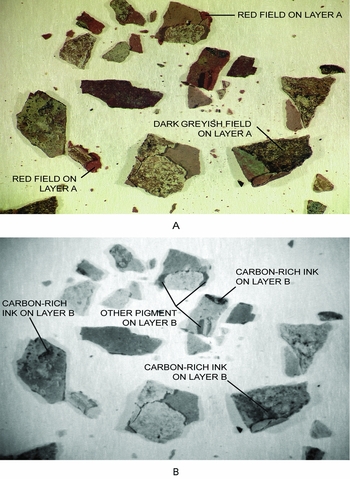
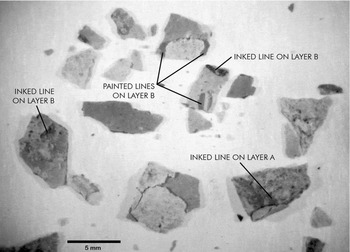
Several of the smaller Uaxactun codex fragments yielded further information. On some of these pieces, parts of layer B had flaked away, revealing dark greyish or red fields on the painted surface of layer A (Figure 8). Fine lines of carbon-rich ink, readily visible in near infrared and visible light, were observed on some of those fields (Figure 9). The inked lines on layers A and B are similar in dimension and consistent with inscription using a quill pen, such as the hieroglyphs and line drawings of the four Postclassic codices. Tiny, reflective particles in the red pigment on layer A suggest that it may contain cinnabar or specular haematite. The greyish fields on the same layer may have undergone some colour change as a result of diagenesis over time: now quite dark in white light, they do not contain much carbon as they are much lighter in near infrared light, contrasting with the inked lines (see Figure 8a & b). Some other lines on layer B, similar in proportion and execution to the inked ones, may also have been drawn on with a quill, but as they appear medium grey under near infrared light, they must represent a different, less carbon-rich pigment (see Figure 8b).
Assorted fragments of the Uaxactun codex in white light at 11.22× magnification, showing painted fields and inked lines on layers A and B (gift of the Carnegie Institution of Washington, Peabody Museum of Archaeology and Ethnology, Harvard University, PM# 33-99-20/3468; image: Straus Center for Conservation, Harvard Art Museums © President and Fellows of Harvard College).

Assorted fragments of the Uaxactun codex in near infrared light at 11.22× magnification, showing inked and painted lines on layers A and B (gift of the Carnegie Institution of Washington, Peabody Museum of Archaeology and Ethnology, Harvard University, PM# 33-99-20/3468; image: Straus Center for Conservation, Harvard Art Museums © President and Fellows of Harvard College).

Discussion
Close visual inspection, including under near infrared and infrared fluorescent light, confirms that the fragments considered above are the remains of a bark-paper object covered in painted plaster, consistent with a codex. Tiny and damaged though they are, the burial A6 fragments are thus among the earliest remains of a Maya bark-paper manuscript ever to be securely identified, pointing to a thousand years or more of technical continuity in Maya bookmaking. They connect elite mortuary rites at Uaxactun to funeral practices at other Early Classic Maya and non-Maya sites. Further, they place Early Classic Maya ways of using and producing books within a broader Mesoamerican tradition of manuscript repainting or revision.
The practice of interring screenfold books with ritual specialists was described for the Yucatec Maya at the time of the Spanish Conquest by Fray Diego de Landa (Landa Reference Landa1941: 130), and archaeological evidence extends this practice back to the Early Classic period at the latest. A second potential codex at Uaxactun was excavated from burial A29 in structure A-V. Dating to the late fifth or early sixth century AD, burial A29 was richer than burial A6, with a masonry vault, 25 ceramic vessels and abundant red ochre on the floor and bones. The putative codex consisted of thin flakes of plaster in a corner of the tomb, with motifs “in black, green, blue, red, yellow, and brown on [a] background of yellow and green” (Kidder Reference Kidder1947: 70; Smith Reference Smith1950: 97). This description may be more consistent with the remains of a stucco-painted gourd than of a typical screenfold book, given that coloured backgrounds in the Dresden manuscript are generally of a single hue. Carnegie excavators found additional fragments of stucco coating in a tomb at Nebaj, Guatemala—one fragment was said to have borne the figure of ‘a priest or ruler in costume’—and in a Late Classic grave at San Agustín Acasaguastlán (Kidder Reference Kidder1935: 112; Smith Reference Smith, Weeks and Hill2006 [1949]: 448). These fragments appear never to have been photographed and their present locations are unclear. Another decayed codex was encountered in a lavishly appointed Early Classic royal burial at Altun Ha (Pendergast Reference Pendergast1979: 77–78, fig. 16), in spatial association with 2 small ceramic dishes and 13 obsidian flakes of the type used in ritual bloodletting. Two additional codices come from Early Classic mortuary contexts at the site of Mirador in the municipality of Jiquipilas, in a historically non-Maya, Zoquean-speaking area of Chiapas. Both codices are blocks of fused plaster, their backings rotted away. A bar-and-dot numeral 11 observed on a flake of plaster from one codex would be consistent with the Maya or the Isthmian hieroglyphic scripts (Agrinier Reference Agrinier1975: 62–64). The Uaxactun burial A6 codex thus fits within a well-established, if rarely instantiated, mortuary custom for Maya and other Mesoamerican elites.
The presence of two, differently painted layers of plaster in the burial A6 codex fragments has additional important implications for understanding Classic-period scribal traditions and records management. Mesoamerican books, maps and cartographic histories often had multiple authors, who collaborated on a document or modified existing manuscripts for a variety of reasons, but the occlusion and replacement of previous versions of a document has not been noted in the four Postclassic Maya codices. The Venus tables in the Dresden Codex contain calendrical notations apparently inscribed later than the rest of the material and meant to ensure the tables’ future use as the observable phases of Venus shifted relative to the 365-day haab year (Merrill Reference Merrill1947), but these notes supplement the earlier information rather than replacing it. While the Yucatec Maya Madrid Codex was produced by nine scribes, who drew on earlier Maya and Central Mexican documents in painting successive portions of the book dealing with different religious and astronomical themes, there is no indication that the authors altered earlier sections (Lacadena García-Gallo Reference Lacadena García-Gallo2000: 45; Hernández & Vail Reference Hernández, Vail, Vail and Hernández2010). Some centuries earlier, Late Classic scribes at the northern Petén site of Xultun had repeatedly painted minute texts on an interior wall of a workshop, plastering over earlier inscriptions to make space for new ones. Reminiscent of tables in the Dresden Codex, these notations probably represent astronomical and calendrical calculations undertaken as part of codex production (Saturno et al. Reference Saturno, Stuart, Aveni and Rossi2012), not the textual correlates of a disagreement among scribes.
By contrast, Postclassic and Colonial Mixtec manuscripts, which emphasised political history over religious ideas, were sometimes subject to erasure and the revision of earlier historical claims. For instance, some personal names and portions of the pictographic narrative in the Postclassic Mixtec Codex, Colombino-Becker—itself painted by multiple scribes—were deliberately effaced, probably for political reasons (Troike Reference Troike1974: 99–106). The Codex Azoyú 1, from the town of Azoyú in Guerrero, and the Codex Selden, from Jaltepec in Oaxaca, were likewise edited and partially repainted by indigenous scribes in the context of legal and social disputes over land and sovereignty during the sixteenth century (Smith Reference Smith and Zeitlin1994; Gutiérrez Mendoza Reference Gutiérrez Mendoza, Jansen and van Broekhoven2008: 92–95). The Codex Vaticanus B, produced in Central Mexico or Oaxaca during the Late Postclassic period, was retouched multiple times and in many places as its paint wore away over long years of use; the final revisions involved the complete replacement of five painted panels, rendered in a style contrasting with that of the rest of the manuscript (Cassidy Reference Cassidy2004: 121–37). The different designs on layers A and B of the Uaxactun fragments extend such practices of revision or replacement back in time, even though the reasons for the repainting and the informational content of both layers are now obscure.
The results discussed here illustrate the potential of multispectral visual analysis to reveal information from pre-Columbian documents that would otherwise have remained hidden. Future analysis of the pieces will focus on identifying the chemical composition of the plaster, inks and pigments. Even without such analysis, the Uaxactun burial A6 fragments already provide crucial information about Early Classic Maya scribal and mortuary practices.
Acknowledgements
The authors gratefully acknowledge the assistance of Anne Driesse, conservator of works of art on paper with the Straus Center for Conservation and Technical Studies at the Harvard Art Museums, and T. Rose Holdcraft, senior conservator at the Peabody Museum of Archaeology and Ethnology, in facilitating visual study of the Uaxactun codex fragments (Peabody inventory number 33-99-20/3468); Genevieve Fisher, registrar at the Peabody Museum, approved that study. Emily Pierce, curatorial assistant at the Peabody Museum, made possible an initial examination of the pieces. Patricia Kervick, Peabody Museum archivist, was instrumental in finding the original excavation records produced by the Carnegie Institution. Tina McDowell, editor at the Carnegie Institution, granted permission for the use of Carnegie-owned images. Walter Witschey and Clifford Brown of Maya GIS generously made their cartographic data freely available for publication. William Fash, Stephen Houston, Katharine Lukach and two anonymous reviewers offered helpful comments on the findings presented here and suggested fruitful directions for supplementary research.