Nowadays, corporate social responsibility (CSR) actions are considered important ways to solve the problems caused by coronavirus disease 2019 (COVID-19), such as food shortages and economic depression, Reference Serafeim, Rischbieth and Koh1–Reference Asante Antwi, Zhou and Xu3 as companies perform a variety of social functions. CSR is defined as “the responsibility of enterprises for their impacts on society” by European Commission. Reference Hiswals, Hamrin and Vidman4,5 During COVID-19, CSR actions included all the actions of companies aiming to prevent the public from any problems due to the crisis or mitigate the harm as far as possible. In China, a massive number of e-commerce platforms implemented various CSR actions during the early stage of COVID-19 (ESCOVID-19). Reference Guo, Liu and Shi6,Reference Chang and Meyerhoefer7 For instance, Buy Together, a well-known platform of online retailing, slapped a ban on profiteering from the maliciously upward price of masks and other medical supplies in February 2020.
E-commerce platforms are special companies in business society. They are different from traditional companies in 3 aspects. First, they do not sell goods directly but act as trade bridges linking the sellers (service providers) and consumers in online 2-side peer-to-peer markets. Their main business is to safeguard the effectiveness of e-commerce between them. Second, using their monopolistic or oligopolistic power due to the advantage of information technology and market resources, many platforms can dominate and regulate the sellers and the consumers easily. Reference Li8,Reference Etter, Fieseler and Whelan9 Third, COVID-19 impelled more consumers to online transactions, strengthening the status of the platforms that had walked into nearly all areas of daily life. The characteristics of “intermediaries” and dominant power as well as high participation in daily life indicate that the CSR actions of e-commerce platforms were distinctive and more effective to overcome some problems that stemmed from COVID-19. Conducting a probe into their CSR actions is necessary for our society to understand, promote, and support these actions, and then improve the CSR effectiveness of the whole business community for future public health crises.
Previous studies have focused on CSR practices during COVID-19 from various viewpoints. At the macro-level, some analyzed the general challenges and opportunities to the firms regarding CSR, Reference He and Harris2,Reference Asante Antwi, Zhou and Xu3,Reference Lee10–Reference Maani, Van Schalkwyk and Petticrew12 calling for CSR actions to solve social problems. Other research at the macro-level intended to elucidate the factors influencing general CSR actions. Reference Chen, Liu and Liu13,Reference Zhu, Yang and Lv14 In addition, there were studies on the micro-level CSR practices in different companies and industries, such as hotels, Reference Gurlek and Kilic15 the media, Reference Thomas, Wilson and Tonkin16 telecoms corporations, Reference Storeng and de Bengy Puyvallee17 the United States CSR leaders, Reference Mahmud, Ding and Hasan18 and the private sector in Iran. Reference Seddighi, Seddighi and Salmani19 Nevertheless, few previous scholarly efforts considered the CSR actions during COVID-19 as well as e-commerce platforms simultaneously. This lack of understanding motivates us to focus on the approaches to CSR implemented by the platforms during ESCOVID-19. The reasons why China was selected as the case is that China has a representative e-commerce market considering its largest scale in the world. Our study focused on ESCOVID-19, because it is vital to take measures in this period to control the diseases. By this means, our research could provide practical references to face future epidemics.
To sum up, this study aimed to answer the following questions: (a) What approaches did the e-commerce platforms in China adopt to implement CSR actions during ESCOVID-19? and (b) What factors were associated with the platforms’ choice of these approaches? This study contributes to the literature in 3 ways. First, following some research, Reference Asante Antwi, Zhou and Xu3,Reference Lee10,Reference Maani, Van Schalkwyk and Petticrew12,Reference Chen, Liu and Liu13,Reference Storeng and de Bengy Puyvallee17 this study enhances our understanding of how emerging digital private sectors, especially, e-commerce platforms participate in public health crisis intervention and prevention by taking advantage of the Internet and sharing economy. Second, Eastmure et al. Reference Eastmure, Cummins and Sparks20 introduced “commercial nonmarket strategies” and highlighted its importance to public health researchers. From the perspective of e-commerce during COVID-19, this study complements the theory and practice of “nonmarket strategy.” Finally, this study enriches the research on “COVID-19 capitalism” Reference Cohen21 by analyzing the strategic CSR Reference Porter and Kramer22 actions of e-commerce platforms.
Methods
Sample Selection
This study selected the top 100 e-commerce platforms regarding market size as representative samples. As a key performance indicator, monthly active users (MAU) in the mobile app was found an increasingly wide use to measure an online business’s general health and market size. Reference Tardi23,Reference Wasil, Gillespie and Patel24 Therefore, searching on a famous Chinese data website named Yiguan (www.analysys.cn) on January 20, 2020, the samples were determined by their ranking of MAU in December 2019 (more details are shown in Appendix).
Data Collection
The Chinese popular websites related to e-commerce were browsed and tracked every day to obtain instant CSR data. They included Ministry of Commerce (www.mofcom.gov.cn), Wangjingshe (www.100ec.cn), Ebrun (www.ebrun.com), and other 4 e-commerce websites (ie, news.sosol.com.cn, www.cndsw.com.cn, www.ennews.com, www.dsb.cn). The data were collected from January 22 to March 17, 2020. (If the month or date does not mention the year, the default is 2020 in this study.) January 22 was set as the starting time Reference Chen, Liu and Liu13 because Wuhan began in lockdown at this day. According to Fighting COVID-19: China in Action, 25 after March 17, China’s fight entered the fourth stage, and newly confirmed domestic cases on the Chinese mainland dropped to single digits. Therefore, ESCOVID-19 should be the time frame after January 22 and before March 17.
During ESCOVID-19, the first author continuously copied the CSR actions of the samples into Microsoft Word documents as completely as possible every day. The CSR actions consisted of CSR policies and practical CSR activities. Once all the raw data were collected on June 20, the authors organized them by dissecting them into smaller CSR sentences to ensure that 1 sentence contained only 1 CSR action. The corresponding platforms, cooperation with other platforms or not, and the implementation day of each CSR sentence were preserved. Finally, 858 CSR sentences (meaning units) were identified.
Data Analysis
A blend of conventional qualitative content analysis Reference Hsieh and Shannon26–Reference Sharififar, Khoshvaghti and Jahangiri28 and quantitative frequency analysis Reference Gui29,Reference Alhadhira, Molloy and Casasola30 was used. Using an inductive coding approach to analyze textual, visual, or audible matter, conventional content analysis is appropriate to systematically describe, comment, and interpret a phenomenon when there are few existing literature on it. Reference Lunenberg, Gosselt and De Jong31,Reference Johnson, Connolly and Carter32 In this study, the phenomenon that e-commerce platforms in China engaged in CSR during ESCOVID-19 was studied and commented. The authors began with reading through the documents several times to obtain a sense of whole. Then, the documents were read line by line carefully and the words or sentences representing the meanings of every CSR sentence were highlighted. As this process continued, labels for codes emerged and then were collected on to coding sheets.
Next, the initial codes were inductively grouped and categorized into several higher order categories based on the similarities and differences among codes. Depending on the relationships between the thematic categories (ie, subthemes), they were further combined into a smaller number of meaningful main themes. Once the authors completed this process, there showed a hierarchical structure consisting of themes, subthemes, and codes. The analysis ended up with developing the definitions for each theme and subtheme. The main themes were christened donative CSR actions, responsive CSR actions, and strategic CSR actions, respectively, to represent 3 main approaches to CSR.
In the last round, the frequency of CSR sentences in each main theme was calculated to inspect the frequency of the 3 main approaches. Each CSR sentence was assigned to only 1 subtheme and 1 theme according to its meaning. The reason was to guarantee that the subthemes or themes mutually excluded each other and no CSR action belonged to 2 or more themes simultaneously. The frequency of each approach (theme) was equal to the number of CSR sentences it contained. Finally, the 100 samples were divided into 2 groups regarding different market size and periods, respectively. This study compared the frequency of each approach between the groups, and the Mann-Whitney U-test was conducted to check for significant differences. The nonparametric test (ie, Mann-Whitney U-test) was applied due to nonnormal distribution of grouped data as was evident by significant P value (P < 0.05) for both Kolmogorov-Smirnov and Shapiro-Wilks tests value. Small sample size (N ≤ 50) was another criterion that supported the use of the Mann-Whitney U-test. The outcomes could suggest the influence of market size and time on the platforms’ choice of approaches.
Results
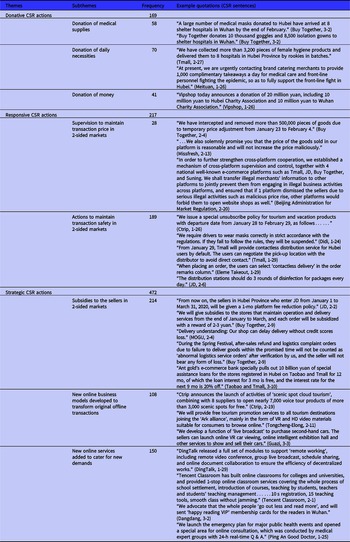
In total, 72 of 100 samples engaged in CSR practices. Three main themes emerged from the qualitative content analysis: donative CSR actions, responsive CSR actions, and strategic CSR actions. Each theme consisted of a set of subthemes that were described as follows (see Table 1).
Themes and subthemes related to the approaches to CSR implemented by e-commerce platforms in China during ESCOVID-19

Theme 1: Donative CSR Actions
During ESCOVID-19, the nationwide lockdown in China led to an emergency shortage of medical supplies and daily necessities. Using strong capabilities of information collection, resource integration, and material distribution, e-commerce platforms donated scarce resources to alleviate the shortage and enhance confidence.
Subtheme 1: Donation of Medical Supplies
Medical supplies were basic materials to fight against COVID-19. However, there was a large gap in medical supplies in affected areas due to the surge of patients. The platforms made great efforts to fill the gap by donating medical supplies directly. For example, at the end of February, Buy Together donated a large volume of medical supplies to Wuhan shelter hospital, including goggles, isolation gowns, and medical mask.
Subtheme 2: Donation of Daily Necessities
Many platforms provided daily necessities (eg, water, rice, vegetables, salt, toilet paper) to guarantee basic living needs. As the largest platform in China, Tmall collected more than 3200 pieces of female hygiene products and delivered them to 8 hospitals in Hubei Province by rookies in batches until late February. Meituan, the largest catering platform in China, provided 1000 complimentary takeaways for medical staff and other frontline staff fighting the epidemic in some Wuhan hospitals every day from January 26 to February 26.
Subtheme 3: Donation of Money
Money, the other kind of donation, is a simple and traditional approach to CSR. A classic example of this practice was Vipshop. Vipshop announced a donation of 20 million yuan, including 10 million yuan to the Hubei Charity Association and 10 million yuan to the Wuhan Charity Association on January 16.
Theme 2: Responsive CSR Actions
The transactions on e-commerce platforms formed various risks to our society during COVID-19. To mitigate the harm stemmed from the risks was another responsive approach to fulfill CSR. The word “responsive” meant that the platforms should respond to the social basic expectations that they cannot operate and earn profit at the cost of social welfare.
Subtheme 1: Supervision to Stabilize the Transaction Price in Two-Sided Markets
The sudden decrease in the supply of daily necessities and the intense increase in the demand for medical supplies drove sellers to sell them at vastly inflated prices and make a quick buck. This behavior was immoral and disrupted the entire market. The platforms strengthened the supervision to maintain reasonable prices through multiple mechanisms. From January 23 to February 4, Buy Together had intercepted and removed more than 500,000 pieces of goods due to temporary price adjustment. In mid-February, Missfresh promised to the public that the price was reasonable and would never rise maliciously. Notably, a mechanism of cross-platform supervision and control was established and integrated by Beijing Administration for Market Regulation on February 20. Tmall, JD, Buy Together, and Suning jointly engaged in the mechanism and ensured that, if 1 platform dismissed the sellers due to serious illegal activities such as malicious price rise, other platforms would forbid them to open website shops as well.
Subtheme 2: Actions to Maintain the Transaction Safety in Two-Sided Markets
It is better to be safe than sorry. The platforms launched strict policies to ensure transaction safety (ie, keeping their users healthy in the transactions), a prime social expectation to the platforms. On January 24, Ctrip issued a free unsubscribe policy to allow tourists to free-of-chage cancel entertainment and tourism plans. Following Ctrip, Fliggy and Qunar enforced the same policy during January and February. Face masks became mandatory on Didi from January 24, otherwise, the transaction would be suspended. A stricter policy of “contactless transaction” was implemented by Tmall and Eleme Takeout in Hubei from January 29. They required distributors to put goods or take-outs in designated positions to avoid direct contact. In addition, meticulous disinfection and sanitization were applied to transaction places and instruments by the platforms. JD ordered its distribution station to do 3 rounds of disinfection for packages every day during ESCOVID-19.
Theme 3: Strategic CSR Actions
Many transactions on the platforms ceased, while huge amounts of new transaction demands were emerging during ESCOVID-19. At this time, several sophisticated platforms not only strived to get the laying-off sellers out of trouble and met the new demands to fulfill social responsibility but also offered a subtle blend of business strategy with their CSR actions to earn potential or immediate profits. This was a strategic approach. The word “strategic” meant that the platforms fulfill CSR as well as achieve their business strategy.
Subtheme 1: Subsidies to the Sellers in Two-Sided Markets
The sellers in 2-sided markets were in crises because of high-cost transactions and rupturing capital chains. Because the platforms and the sellers are symbiotic relationships, it was a business strategy that they assisted the sellers to get through the time of hardship. A wide range of subsidy programs was put forward by the platforms. A common program was sales commission subsidy. On February 2, JD exempted sellers who sold medical supplies and daily necessities from a 2-mo sales commission. The delivery subsidy was another program to ensure unimpeded logistics. From the end of January to March, Buy Together gave delivery subsidies to sellers who insisted on operations and delivery services, and each order could be rewarded with 2 to 3 yuan. Furthermore, JD, Tmall, MOGU, and Buy Together all announced that credit scores would not be docked for the delay in delivery during COVID-19. In addition, the policies of financial support were available on the platforms. Taobao and Tmall drew up a special assistance loan with a total amount of 10 billion yuan for the sellers in Hubei on March 10. The loan interest was free for the first 3 mo.
Subtheme 2: New Online Business Models Developed to Transform Original Offline Transactions
In normal times, the transactions on many platforms can be completed offline. However, they lost ground and had to be ceased during ESCOVID-19. To meet the original transaction demands and keep operations, many platforms developed new online business models to transform original offline transactions. For instance, tourism platforms including Ctrip and Tongcheng-Elong introduced online display programs such as “cloud tourism,” in which consumers could enjoy the scenic spots online, to transform offline tours. Cloud tourism attracted a large number of tourist destinations and consumers to join and meet their travel needs. Guazi developed a function of “live broadcast” to purchase second-hand cars in March, allowing sellers to show and sell their cars through online live broadcast.
Subtheme 3: New Online Services Added to Cater for New Demands
COVID-19 spur some new demands. Sophisticated platforms seized the chance by adding new online services (might free in the beginning). They not only met urgent social needs but also expanded their business to gain more profits. The platforms of online education and online office were typical examples. On January 29, DingTalk released a full set of modules to support “remote working,” including remote video conference, group live broadcast, schedule sharing, and online document collaboration to ensure the efficiency of decentralized works. On February 1, the special “teacher version” was launched by Tencent Classroom in an emergency. It supported teachers to quickly construct an online course within 10 s. Other examples include Dangdang (offered free reading topics to keep people at home) and Ping An Good Doctor (run a Global Medical Consultation Platform to provide 24 h online consultation of COVID-19 for global users).
More Results From Quantitative Frequency Analysis
The quantitative analysis aimed to investigate whether market size and time were associated the frequency of the 3 approaches. The results are presented in Table 2. In total, strategic CSR was the most commonly used CSR approach (n = 472; 55.0%). Cooperative CSR actions (n = 42; 4.9%) among the platforms only represented a tiny fraction of total CSR actions.
Differences in the frequency of the 3 approaches to CSR between 2 groups based on market size

* MS = market size.
First, the 100 samples were divided into 2 equal groups according to their market size (ie, MAU): higher market size group (N = 50) and lower market size group (N = 50). The frequency of donative CSR actions in the former group (n = 118; 69.8%) was much higher than it in the latter group (n = 51; 30.2%), P = 0.009. This comparative conclusion was also true regarding the frequency of strategic CSR actions (n = 327 vs n = 145; P = 0.004). However, no significant differences were observed in the frequency of responsive CSR actions (n = 123 vs n = 94; P = 0.836) between the 2 groups. In summary, the CSR actions were largely implemented by the platforms with higher market size instead of lower market size.
Then, the period of ESCOVID-19 (46 d) was bisected into 2 periods. The first period was from January 22 to February 18, while the second period was from February 19 to March 17. It is apparent that very few donative CSR actions were used in the second period (n = 50; 29.6%) in comparison with the first period (n = 119; 70.4%), P = 0.001 (see Table 3). In addition, a relatively large proportion of strategic CSR actions (n = 298; 63.1%) were implemented in the later period (P = 0.001).
Differences in the frequency of the 3 approaches to CSR between 2 groups based on periods

Discussion
This study explored the approaches that the e-commerce platforms in China adopted to implement CSR during ESCOVID-19 and what factors were associated with these CSR approaches. Three main CSR approaches (ie, donative, responsive, and strategic) were used by the platforms. Market size and time were associated with these approaches.
This study found that the platforms donated relief goods during ESCOVID-19, including money, medical supplies, and daily necessities. As a traditional approach, similar behaviors of companies were popular worldwide during COVID-19. Reference Martino, Brooks and Browne33,Reference Zhang34 Furthermore, the platforms engaged in stabilizing the transaction price and maintaining the transaction safety in 2-sided markets. This responsive approach indicates an ad hoc public philanthropy that CSR actions were regarded as irregular, event-based actions to prevent firms’ activities harming social welfare. It is consistent with a body of literature on the approaches to CSR. Reference Tran35,Reference Ishimaru, Nagata and Hino36 Specifically, this study identified a unique responsive CSR action that the platforms supervised the transactions to stabilize soaring prices due to “COVID-19 capitalism.” Reference Cohen21 This action might stem from their unique roles of trade bridges and dominant power.
Never let a good crisis go to waste. Previous studies Reference Asante Antwi, Zhou and Xu3,Reference Martino, Brooks and Browne33,Reference van Schalkwyk, Maani and McKee37 have revealed the companies promoting their products by CSR actions during COVID-19, which is confirmed in this study. The platforms incorporated business strategy into CSR actions to seize the market opportunities due to COVID-19. Two typical strategic approaches to CSR were presented: adding new online services to cater for the new demands, and developing new online business models to transform original offline transactions. These approaches are not exclusive to e-commerce platforms and align with existing literature on other companies. Reference Asante Antwi, Zhou and Xu3,Reference Martino, Brooks and Browne33,Reference van Schalkwyk, Maani and McKee37 Notably, the platforms used a special strategic approach by subsidizing the sellers selling on them. A company subsidizing other companies was a rare sight during COVID-19, because each company had a lot on its plate. However, the symbiotic relationships between the platforms and the sellers meant the platforms could not sit idly by. This study detailed various subsidy programs, such as sales commission subsidy, delivery subsidy, marketing subsidy, financial support, and referral traffic. These findings expand extant literature on strategic CSR Reference Porter and Kramer22,Reference Bruyaka, Zeitzmann and Chalamon38–Reference Rhee, Park and Petersen40 by a systematic, in-depth focus on e-commerce platforms’ strategic CSR actions during COVID-19.
Frequency analysis suggested that the strategic approach was the most frequently used. This finding was supposed by a body of literature Reference Chen, Liu and Liu13,Reference Yeo41–Reference Yu, Li and Li43 and verified in the context of e-commerce platforms in China. We further observed that few actions were cooperative actions. Little cooperation indicates that there existed serious mistrust, as well as fierce competition, among the platforms. Considering organizations using cooperation were more effective to cope with COVID-19, Reference Crick and Crick44 it could be inferred that enormous potential would be tapped by constructing cooperation mechanisms among the platforms to confront future crises.
This research noted 2 factors associated with the approaches. You have to make some money before you can do some good. The recent work by Chen et al. Reference Chen, Liu and Liu13 suggested that corporate philanthropic donations in China were significantly affected by organizational market size during COVID-19, echoed insights from slack resources theory Reference Gao and Hafsi45,Reference Waddock and Graves46 that the prerequisite for corporate philanthropy is that a firm must have sufficient resources. This study confirmed this finding and further generalized it to other strategic CSR actions. The platforms with higher market size preferred to implement more strategic CSR actions. Apart from slack resources, the reason may also be rooted in better strategic awareness and implementation capacity of the platforms with higher market size.
Furthermore, compared with the first period of ESCOVID-19, the frequency of total CSR actions remained at the same level during the second period of ESCOVID-19. However, significant differences appeared between the 2 periods regarding different approaches. As time went by, a growing number of strategic CSR actions were implemented, whereas donative CSR actions were in decline significantly. It indicates that the platforms put the emphasis on donation at first and gradually diverted their attention to strategic CSR actions. A possible explanation might be that the decision-making process and operation of donations are simple, whereas strategic CSR actions are skillful actions and need much deliberation. The other underlying probable reason is that greater donations resulted in a more favorable short-term market reaction but weaker in the long term. Reference Zhou, Qiu and Zhang47 Thus, the platforms needed strategic CSR actions following early donations to keep a long-term reaction. These findings enrich the studies on the factors associated with CSR actions during crisis. Reference Chen, Liu and Liu13,Reference Zhang34,Reference Zhang, Rezaee and Zhu48–Reference Muller and Whiteman50
In summary, our findings have implications for policy and practice during a public health emergency. The design of prevention and control policies should incorporate e-commerce platforms, as they played an important role in our society through various CSR approaches. Especially, some shortcomings of current policies (eg, the supply and transportation of emergency materials, maintenance of transaction justice and safety, reduction of the burdens of small and medium enterprises, remote working, and telemedicine) could be overcome by making full use of them. Thus, tax incentives and wide publicity for their CSR actions should be launched. The government could establish information windows sharing the material demands and unsolved problems in affected areas to assist them in targeted CSR actions. These suggestions could extend to other countries because similar CSR actions of e-commerce platforms were popular worldwide. Furthermore, the policies should consider the associated factors. The government should focus on the platforms with higher market size and launch support policies to induce their donations as soon as possible. Previous studies Reference Chen, Liu and Liu13,Reference Porter and Kramer22 have suggested business environment significantly influenced the intention to strategic CSR (the main approach implemented by the platforms in China); thus, the government should optimize the local business environment. For the platforms, promoting closer cooperation with other platforms is advised to improve the efficiency of CSR actions.
Two limitations must be considered. First, the samples may not be representative of small platforms in China, because we only chose the biggest 100 platforms as samples. A reason to support extending our findings is that scarce CSR actions implemented by small platforms were found when we browsed the websites. Second, this study only calculated the frequency of CSR actions, and ignored the strength of CSR actions. This may distort the information of actions, which is expected to be solved in further studies.
Conclusions
E-commerce platforms in China implemented various CSR actions during ESCOVID-19. Through a mixed-methods content analysis of the CSR data collected from the Internet, this study extracted 3 main approaches and 8 sub-approaches to CSR implemented by the platforms. Market size and time were found associated with the platforms’ choice of the 3 main approaches. The design of prevention and control policies should incorporate e-commerce platforms and consider the associated factors.
Supplementary material
To view supplementary material for this article, please visit https://doi.org/10.1017/dmp.2021.346
Acknowledgments
We hank Chengqi Wang, a professor of strategy and international business at Nottingham University, for editing and revising this study.
Funding
This work was supported by the National Social Science Foundation of China under Grant number 20CGL057; and Jiangxi Normal University under Grant Number 2020.