Introduction
Polar lakes act as ‘early warning systems’ because they respond quickly to climate-induced environmental changes (Hodgson & Smol Reference Hodgson and Smol2008). In the Arctic and maritime Antarctica, where global warming is particularly amplified, the recent temperature rise has resulted in enhanced primary productivity in lakes (Quayle et al. Reference Quayle, Peck, Peat, Ellis-Evans and Harrigan2002), a negative precipitation-evaporation balance (Smol & Douglas Reference Smol and Douglas2007a), and marked changes in their community structure (Smol et al. Reference Smol, Wolfe, Birks, Douglas, Jones, Korhola, Pienitz, Ruhland, Sorvari, Antoniades, Brooks, Fallu, Hughes, Keatley, Laing, Michelutti, Nazarova, Nyman, Paterson, Perren, Quinlan, Rautio, Saulnier-Talbot, Siitoneni, Solovieva and Weckstrom2005). In particular, lakes with a high surface area to volume ratio were shown to respond quickly to changes in the precipitation-evaporation balance and are prone to salinization and desiccation (Smol & Douglas Reference Smol and Douglas2007a).
In comparison to these regions, recent climate changes are relatively modest in East Antarctica (EA; Turner et al. Reference Turner, Arthern, Bromwich, Marshall, Worby, Bockheim, di Prisco, Verde, Convey, Roscoe, Jones, Vaughan, Woodworth, Scambos, Cook, Lenton, Comiso, Gugliemin, Summerhayes, Meredith, Naveira-Garabato, Chown, Stevens, Adams, Worland, Hennion, Huiskes, Bergstrom, Hodgson, Bindschadler, Bargagli, Metzl, van der Veen, Monaghan, Speer, Rintoul, Hellmer, Jacobs, Heywood, Holland, Yamanouchi, Barbante, Bertler, Boutron, Hong, Mayewski, Fastook, Newsham, Robinson, Forcarda, Trathan, Smetacek, Gutt, Pörtner, Peck, Gili, Wiencke, Fahrbach, Atkinson, Webb, Isla, Orejas, Rossi and Shanklin2009) and there are distinct regional differences in, for example, snow accumulation rates (Monaghan et al. Reference Monaghan, Bromwich, Fogt, Wang, Mayewski, Dixon, Ekaykin, Frezzotti, Goodwin, Isaksson, Kaspari, Morgan, Oerter, van Ommen, van der Veen and Wen2006). Measurements on the Law Dome ice core show that snow accumulation rates have increased since 1970 and are now outside the natural variability of the past 750 years (Van Ommen & Morgan Reference Van Ommen and Morgan2010). In contrast, in other EA regions, such as the inner part of the continent and in Dronning Maud Land, the volume of snow has decreased between 1995 and 2004 (Monaghan et al. Reference Monaghan, Bromwich, Fogt, Wang, Mayewski, Dixon, Ekaykin, Frezzotti, Goodwin, Isaksson, Kaspari, Morgan, Oerter, van Ommen, van der Veen and Wen2006). The relatively modest warming in EA is likely to be related to the buffering effect of the ‘ozone hole’, which has led to a stronger circumpolar flow around Antarctica (Turner et al. Reference Turner, Arthern, Bromwich, Marshall, Worby, Bockheim, di Prisco, Verde, Convey, Roscoe, Jones, Vaughan, Woodworth, Scambos, Cook, Lenton, Comiso, Gugliemin, Summerhayes, Meredith, Naveira-Garabato, Chown, Stevens, Adams, Worland, Hennion, Huiskes, Bergstrom, Hodgson, Bindschadler, Bargagli, Metzl, van der Veen, Monaghan, Speer, Rintoul, Hellmer, Jacobs, Heywood, Holland, Yamanouchi, Barbante, Bertler, Boutron, Hong, Mayewski, Fastook, Newsham, Robinson, Forcarda, Trathan, Smetacek, Gutt, Pörtner, Peck, Gili, Wiencke, Fahrbach, Atkinson, Webb, Isla, Orejas, Rossi and Shanklin2009). However, it is predicted that when the ‘ozone hole’ closes, warming will accelerate in EA as well (Turner et al. Reference Turner, Arthern, Bromwich, Marshall, Worby, Bockheim, di Prisco, Verde, Convey, Roscoe, Jones, Vaughan, Woodworth, Scambos, Cook, Lenton, Comiso, Gugliemin, Summerhayes, Meredith, Naveira-Garabato, Chown, Stevens, Adams, Worland, Hennion, Huiskes, Bergstrom, Hodgson, Bindschadler, Bargagli, Metzl, van der Veen, Monaghan, Speer, Rintoul, Hellmer, Jacobs, Heywood, Holland, Yamanouchi, Barbante, Bertler, Boutron, Hong, Mayewski, Fastook, Newsham, Robinson, Forcarda, Trathan, Smetacek, Gutt, Pörtner, Peck, Gili, Wiencke, Fahrbach, Atkinson, Webb, Isla, Orejas, Rossi and Shanklin2009).
The effect of changes in air surface temperatures, wind speeds and changes in snow accumulation rates on EA lake ecosystems is expected to be complex and will depend, in part, on the geomorphology of the individual lake basins and their catchment areas, and limnological properties. By analogy to well-studied lakes in the Arctic and maritime Antarctica (Douglas & Smol Reference Douglas and Smol1994, Quayle et al. Reference Quayle, Peck, Peat, Ellis-Evans and Harrigan2002, Smol & Douglas Reference Smol and Douglas2007b, Hodgson & Smol Reference Hodgson and Smol2008) the potential ecosystem changes in EA lakes in response to changing climate variables and weather patterns can be summarized as follows: increased air surface temperatures generally result in higher water temperatures and an increase in the number of ice-free days, which in turn will lead to increased lake primary productivity (Quayle et al. Reference Quayle, Peck, Peat, Ellis-Evans and Harrigan2002). In closed basin lakes (see Supplemental Fig. S1) with no multi-year snow banks or glaciers in their catchments, increased air surface temperatures can also lead to enhanced evaporation of the lakewater and sublimation of the lake ice resulting in a negative water balance, falling lake levels and increased specific conductance. Conversely, catchments with multi-year snow banks and glaciers may deliver an increased meltwater input into lakes. In closed lakes, this will affect the water level, lakewater specific conductance and the lakes may become open and develop an outflow stream. In open lakes, increased meltwater input leads to increased flushing rates, which also results in a decrease in lakewater specific conductance (Verleyen et al. Reference Verleyen, Hodgson, Vyverman, Roberts, McMinn, Vanhoutte and Sabbe2003). In addition, soil development in newly exposed ice-free ground in their catchments, results in increased nutrient and organic matter export providing an additional feedback mechanism leading to a further increase of the lake primary productivity (Quayle et al. Reference Quayle, Peck, Peat, Ellis-Evans and Harrigan2002, Quesada et al. Reference Quesada, Vincent, Kaup, Hobbie, Laurion, Pienitz, Lopez-Martinez and Duran2006). Decreased wind speeds lead to lower evaporation rates, positively affecting the hydrological balance (e.g. Hodgson et al. Reference Hodgson, Roberts, McMinn, Verleyen, Terry, Corbett and Vyverman2006). However, this relationship is complicated by the negative effect of both increased temperatures on the evaporation rate, and wind speed on snow accumulation, as slower (katabatic) winds transport less snow from the interior to the coastal regions. The hydrological balance of Antarctic lakes is thus a complex function of melting glaciers and multi-year snow banks in the catchment area, in combination with snowfall (including on the Central Plateau), temperature, and the presence of strong winds to transport it to the lake basin.
Changes in the physical and chemical characteristics of EA lakes are expected to have profound effects on the structure of their communities and the biological and biogeochemical processes occurring in these lakes and their catchments. This is important as EA lakes and ponds are hotspots of biodiversity and microbial production in an otherwise cold desert (Laybourn-Parry & Pearce Reference Laybourn-Parry and Pearce2007). Moreover, EA lakes provide habitats for endemic organisms including rotifers, cladocerans, tardigrades, and several classes and divisions of microorganisms (Convey & Stevens Reference Convey and Stevens2007, Vyverman et al. Reference Vyverman, Verleyen, Wilmotte, Hodgson, Willems, Peeters, van de Vijver, De Wever and Sabbe2010) and may have served as refugia in which organisms have escaped extinction during Pleistocene and Neogene glacial maxima (e.g. Convey & Stevens Reference Convey and Stevens2007).
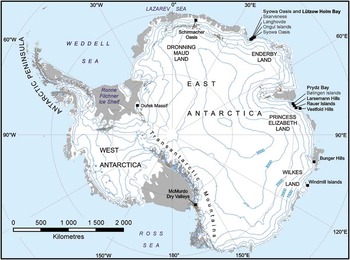
In order to understand better the possible trajectory of climate related ecosystem changes in EA, we compiled limnological baseline data on 127 water bodies from eight ice-free regions along the EA coastline (Fig. 1).
Map of Antarctica showing the locations mentioned in the text.

We combined existing datasets for the Prydz Bay region (Supplemental Table S1) with new data from Prydz Bay and Dronning Maud Land, and compared repeat surveys of specific conductance data for selected lakes from the Larsemann Hills and Skarvsnes. The dataset presented here can i) be used to select regions and lakes which are of particular interest for studies of microbial biodiversity, ii) serve as baseline data against which future limnological changes can be compared, and iii) be used to identify lakes which are expected to respond particularly quickly to climate variability and should thus be considered as priority sites for palaeolimnological research and long-term biological and limnological monitoring programmes.
Study area
Dronning Maud Land
Schirmacher Oasis (70°46′S–11°44′E) in Dronning Maud Land (Fig. 1) is a 17 km long and 2–3 km wide ice-free area, with a maximum elevation of 238 m. The region has over 50 ponds and lakes which range in size from 0.02–2.2 km2 (Vincent & Laybourn-Parry Reference Vincent and Laybourn-Parry2008). There is a wide variety of lake types, including epishelf lakes, supraglacial water bodies, ice-dammed lakes, lakes situated on moraines and lakes that have formed in deglaciated basins. Our dataset only contains lakes of the last type, which were formed in ice-free depressions following the retreat of the glaciers that flowed across the Schirmacher Oasis. The presence of former lake terraces show that many of the present day lakes are remnants of larger proglacial lakes (Phartiyal et al. Reference Phartiyal, Sharma and Bera2011). Sediments in the lakes are generally Holocene in age but some of the deeper lakes contain glacial sediments dating back to >30 ka (Schwab Reference Schwab1998).
In Lützow-Holm Bay (Dronning Maud Land; Fig. 1) a series of islands and peninsulas form a c. 200 km2 ice-free region, known as Syowa Oasis. Numerous lakes and ponds occur in the region, some of which have been the subject to detailed limnological and biological research programmes (e.g. Tominaga & Fukui Reference Tominaga and Fukui1981, Imura et al. Reference Imura, Bando, Saito, Seto and Kanda1999, Kimura et al. Reference Kimura, Ban, Imura, Kudoh and Matsuzaki2009 and references therein). East and West Ongul Island are the largest islands and are separated by a narrow seaway. East Ongul Island contains mostly small ephemeral ponds and relatively shallow water bodies. West Ongul Island is the larger of the two islands and contains larger and deeper lakes (up to 0.05 km2 and 11 m depth). Most regions in Lützow-Holm Bay deglaciated during the Holocene, but 14C dates of in situ fossils of the marine bivalve Laternula elliptica (King & Broderip) and other marine macrofossils in raised beaches on West Ongul Island suggest that parts of the coastline were ice-free during the Last Glacial Maximum (LGM) and Marine Isotope Stage 3 (Nakada et al. Reference Nakada, Kimura, Okuno, Moriwaki, Miura and Maemoku2000). However, this contradicts a recent 14C dating programme of lake sediment cores which revealed that the bottom sediments in none of the five lakes studied are of pre-Holocene age (Verleyen et al. unpublished results).
Skarvsnes is one of the two largest peninsulas in Lützow-Holm Bay. The water bodies range from small ponds to large lakes (up to 0.5 km2) and their water chemistry from freshwater to hypersaline (Kimura et al. Reference Kimura, Ban, Imura, Kudoh and Matsuzaki2009). The saline lakes are situated on fossil marine beaches and sometimes have water levels below present sea level (e.g. Suribati Ike). The freshwater lakes are known for their luxuriant moss communities, which in some lakes, form pillars up to 60 cm high (Imura et al. Reference Imura, Bando, Saito, Seto and Kanda1999). Some of the lakes that were formerly connected to the sea are meromictic, but the majority are holomictic, being mixed throughout the summer ice-free period (Vincent & Laybourn-Parry Reference Vincent and Laybourn-Parry2008, Kimura et al. Reference Kimura, Ban, Imura, Kudoh and Matsuzaki2009).
Langhovde is the other of the two largest peninsulas in Lützow-Holm Bay. The northern part of Langhovde contains lakes and (ephemeral) ponds with varying ionic concentrations, ranging from freshwater to hypersaline. This wide gradient is probably related to differences in wind exposure, sea spray, and altitude, with the most saline lake being isolation lakes.
Princess Elizabeth Land, Prydz Bay
In Prydz Bay near the Lambert Glacier a number of ice-free regions occur, some of which have been the subject of intensive limnological research programmes and microbiological studies (e.g. Roberts & McMinn Reference Roberts and McMinn1996, Verleyen et al. Reference Verleyen, Sabbe, Hodgson, Grubisic, Taton, Cousin, Wilmotte, De Wever, van der Gucht and Vyverman2010). The Vestfold Hills (68°30′S, 78°00′E) form a 400 km2 ice-free area (Fig. 1), consisting of three main peninsulas (Mule, Broad and Long) and a number of offshore islands. The lakes here also range from freshwater to hypersaline (Roberts & McMinn Reference Roberts and McMinn1996) and include a number of large permanently stratified meromictic lakes (e.g. Laybourn-Parry et al. (Reference Laybourn-Parry, Quayle and Henshaw2002), Gibson (Reference Gibson1999)). Most of the lakes are of Holocene age but at least one (Abraxas Lake) existed during the LGM (Verleyen et al. Reference Verleyen, Hodgson, Sabbe, Cremer, Emslie, Gibson, Hall, Imura, Kudoh, Marshall, McMinn, Melles, Newman, Roberts, Roberts, Singh, Sterken, Tavernier, Verkulich, van de Vyver, van Nieuwenhuyze, Wagner and Vyverman2011).
The Larsemann Hills (69°23′S, 76°53′E), comprise a 50 km2 large ice-free area located approximately midway between the eastern extremity of the Amery Ice Shelf and the southern boundary of the Vestfold Hills (Fig. 1). The region consists of two main peninsulas (Stornes and Broknes), together with a number of scattered offshore islands. An inventory of 74 of the 150 freshwater bodies present in the region ranging from small ephemeral ponds to large water bodies is given in Gillieson et al. (Reference Gillieson, Burgess, Spate and Cochrane1990). Further details on the limnology and microbial communities of 51 of these lakes are described in Sabbe et al. (Reference Sabbe, Hodgson, Verleyen, Taton, Wilmotte, Vanhoutte and Vyverman2004). Parts of the region remained ice-free during the LGM whereas others were deglaciated during the Holocene (Verleyen et al. Reference Verleyen, Hodgson, Sabbe, Cremer, Emslie, Gibson, Hall, Imura, Kudoh, Marshall, McMinn, Melles, Newman, Roberts, Roberts, Singh, Sterken, Tavernier, Verkulich, van de Vyver, van Nieuwenhuyze, Wagner and Vyverman2011).
The Rauer Islands (68°45′S–68°55′S and 77°30′E–78°00′E) are an ice-free coastal archipelago situated c. 30 km south of the Vestfold Hills (Fig. 1). The region includes ten major islands and promontories together with numerous minor islands covering a total area of some 300 km2. A detailed description of the region and of the microbial communities inhabiting 10 out of more than 50 shallow lakes and ponds is given in Hodgson et al. (Reference Hodgson, Vyverman and Sabbe2001). The minimum age of deglaciation of the islands is at some time in the late Pleistocene/early Holocene, but the presence of in situ, open-marine sediments with radiocarbon ages ranging from 40–30 ka bp to the east of Filla Island suggest that deglaciation of some areas could have commenced much earlier (Verleyen et al. Reference Verleyen, Hodgson, Sabbe, Cremer, Emslie, Gibson, Hall, Imura, Kudoh, Marshall, McMinn, Melles, Newman, Roberts, Roberts, Singh, Sterken, Tavernier, Verkulich, van de Vyver, van Nieuwenhuyze, Wagner and Vyverman2011).
The Bølingen Islands (69°30′S–75°50′E) are a coastal archipelago, situated north of the Publications Ice Shelf c. 10 km from the Larsemann Hills (Fig. 1). The limnology and microbial biology of five out of the eight shallow lakes and ephemeral ponds in the islands have been studied (e.g. Hodgson et al. Reference Hodgson, Vyverman, Verleyen, Sabbe, Leavitt, Taton, Squier and Keely2004, Sabbe et al. Reference Sabbe, Hodgson, Verleyen, Taton, Wilmotte, Vanhoutte and Vyverman2004, Verleyen et al. Reference Verleyen, Sabbe, Hodgson, Grubisic, Taton, Cousin, Wilmotte, De Wever, van der Gucht and Vyverman2010).
Materials and methods
Sampling procedures and limnological measurements
Details of the lake sampling procedures and limnological measurements applied in the Vestfold Hills in the 1994 field season can be found in Roberts & McMinn (Reference Roberts and McMinn1996). Specific conductance was measured using a submersible data logger (Platypus Engineers, Hobart). All samples, except those from Watts Lake and “Pointed” Lake, which were surface samples, were collected from a depth of 2 m. For the methods used in the Larsemann Hills, the Rauer Islands, and Bølingen Islands in the 1997 field season, we refer to Sabbe et al. (Reference Sabbe, Hodgson, Verleyen, Taton, Wilmotte, Vanhoutte and Vyverman2004) and Hodgson et al. (Reference Hodgson, Vyverman and Sabbe2001). Specific conductance was measured using a YSI 6000 meter and the samples were taken in the top 1–2 m of the water column when the lake was ice-free, or in the top 1 m under ice cover. During 2007, the specific conductance and pH of the lakes in Dronning Maud Land were analysed using a YSI 600 meter and the samples were taken in the top 1 m of the water column in deep lakes. In shallow lakes, surface waters were analysed and sampled. During the 2009 field season, specific conductance and pH in the lakes in the Larsemann Hills and Schirmacher Oasis were measured using an IQ170 Scientific Instruments field pH-conductivity meter in the top 1 m of the water column, except for Progress Lake and Lake Smirnov which were ice-covered. In Progress Lake the measurements were taken at 3 m and in Lake Smirnov at 4 m. The concentration of the main ions and nutrients in lakes in Dronning Maud Land sampled during the 2007 field season were sampled in the surface waters and analysed in certified laboratories using standard techniques. Measurements were done by atomic absorption spectroscopy (Varian SpectraAA-600) following ISO norms (ISO 7980, 1986; ISO 9964, 1993) and ion chromatography (Dionex ICS-2000) following ISO 10304-1(2007). The major ions in the samples from the Larsemann Hills and Schirmacher Oasis taken in 2009 were analysed using high performance liquid chromatography following the procedures described in Buck et al. (Reference Buck, Mayewski, Spencera, Whitlow, Twicklera and Barrett1992).
Repeat measurements of specific conductance from the lakes in the Larsemann Hills, used here to assess long-term changes in the precipitation-evaporation balance were collected first in January and February 1987 by Gillieson et al. (Reference Gillieson, Burgess, Spate and Cochrane1990). These data were compared with more recent data collected in November–December 1997 and January 2009 using the procedures described above, and during February 1998 as described in Gasparon et al. (Reference Gasparon, Lanyon, Burgess and Sigurdsson2002). The pH measurements from 1997 (Sabbe et al. Reference Sabbe, Hodgson, Verleyen, Taton, Wilmotte, Vanhoutte and Vyverman2004) were compared with the data extracted from Gillieson et al. (Reference Gillieson, Burgess, Spate and Cochrane1990). The repeat specific conductance measurements for the Lützow-Holm Bay region were collected in 1997, 2000, 2003, 2004 and 2008 using a Toa Multi Water Quality Meter (MWQ-22A), and compared with measurements taken in January 2007 using the procedures described above (Table S1).
Data treatment and statistical analyses
Limnological datasets in EA typically differ in the number and type of variables measured and often show missing values resulting from logistical and/or technical problems associated with working in these harsh environments (Table S1), and the lack of a longer-term co-ordinated strategy for data collection. In the multivariate analysis we thus only retained lakes for which at least the following minimal set of environmental variables was available: pH, specific conductance, and the concentration of the major ions (Na+, K+, Mg+, Ca2+, SO42- and Cl-), because these factors are known to change in response to climate warming and changes in the hydrological balance (precipitation vs evaporation and sublimation), brought about by changes in temperature, wind patterns and precipitation (e.g. Verleyen et al. Reference Verleyen, Hodgson, Vyverman, Roberts, McMinn, Vanhoutte and Sabbe2003). All limnological variables were standardized prior to statistical analyses in order to reduce skewness, to minimize the effect of outlier values, and to enable a comparison of variables measured in different units (ter Braak & Šmilauer Reference ter Braak and Šmilauer2002). Principal Component Analysis (PCA) in Canoco 4.5 (ter Braak & Šmilauer Reference ter Braak and Šmilauer2002) was used to visualize variations in the limnological properties between and within the regions. Two subsets of data were analysed. Subset A contained the lakes for which measurements of pH, specific conductance and major ions were available. For subset B, the above-mentioned variables together with PO4-P and NO3-N were available. For the statistical analysis, nutrient concentrations were divided into classes or threshold values because the data were obtained using different instruments and methods with differing precision (see Table S1). For PO4-P, measurements below or equal to 5 μg l-1 were assigned 0. For NO3-N, concentrations between 0 and 100 were assigned to class 0, between 100 and 200 to class 1, etc.
Redundancy Analysis (RDA) was applied to explore the relationship between differences in limnology and differences in bedrock geology and/or glacial history of the ice-free regions. To this end, we created a dummy variable for each geographical region (1 when the lake is situated in the region and 0 if not; Table S1) which represents contrasts in the deglaciation history and a dummy variable denoting bedrock type. Four lakes in the Bølingen Islands (Table S1) were excluded from the RDA and variation partitioning analysis, because no detailed geological information was available for this region. We are aware that inter-regional differences in limnology may also be due to the time of sampling and to different field instruments and laboratory protocols used. We therefore created dummy variables representing the different sampling campaigns (see Table S1) and subsequently applied variation partitioning analysis (Borcard et al. Reference Borcard, Legendre and Drapeau1992) to test whether the regional differences hold after accounting for the variation caused by sampling bias. First, the forward selection procedure in Canoco 4.5 was used to select those dummy variables which significantly explain the variation in the limnological conditions. The dummy variables representing the different regions and the sampling campaigns were tested separately. We then treated the significant dummy variables denoting the sampling campaigns as covariables in a RDA with the significant geographical dummy factors as constrained variables. This procedure resulted in four fractions, namely 1) the unique effect of geology, geomorphology and glaciation history, 2) the unique effect of the time of sampling and the methods and instruments used, 3) the overlap between (1) & (2), and 4) the unexplained variation.
A scatterplot of the specific conductance and the lake depth to area ratio was used to identify those lakes which are expected to be particularly vulnerable to climate changes, because specific conductance changes are more easily detected in non-dilute lakes. Moreover, the lake depth to lake area ratio is a rough measure for basin morphology; shallow lakes with a large surface area are particularly vulnerable to changes in the precipitation evaporation balance as a result of wind and temperature induced changes in the evaporation rate (e.g. Smol & Douglas Reference Smol and Douglas2007a).
Results
Limnological variables
Lakewater specific conductance ranges from extremely dilute (0.002 mS cm-1) in one of the Schirmacher Oasis lakes to hypersaline (131.5 mS cm-1) in one of the lakes in the Rauer Islands (Table S1). With the exception of a few lakes, the nutrient concentrations and the dissolved organic carbon (DOC) and total organic carbon (TOC) concentrations are low. The latter data are, however, only available for the lakes in the Larsemann Hills, Bølingen Islands, Rauer Islands, and the ice-free regions in Lützow-Holm Bay (Table S1).
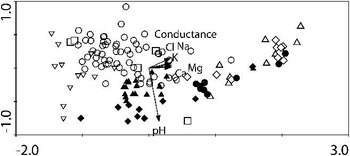
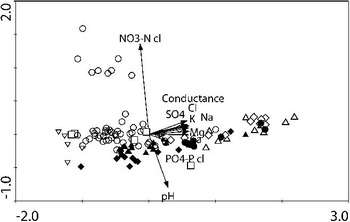
PCA of all lakes (subset A), and all except some lakes from Schirmacher Oasis due to the lack of high precision nutrient data (subset B), revealed that specific conductance and the concentration of major ions are correlated with the first PCA axis and thus govern the main limnological variability within and between the different regions (Figs 2 & 3).
PCA biplot of pH and the environmental properties related to lakewater specific conductance and the major ions in Prydz Bay: the Vestfold Hills (up-triangle), Rauer Islands (diamonds), Bølingen Islands (squares), Larsemann Hills (circles); Lützow-Holm Bay (symbols filled with black): Ongul islands (up-triangles), Langhovde (circles), Skarvsnes (diamonds); and Schirmacher Oasis (down-triangle).

pH is correlated with the second axis in subset A as well as with NO3 in subset B, while PO4 governs the third axis (EV = 0.08) in subset B (figure not shown). The lakes in the Rauer Islands, Vestfold Hills, and Langhovde have on average a higher specific conductance than the lakes in the other regions. The lakes in Schirmacher Oasis rank among the most dilute freshwater bodies. There is no clear geographic difference in measured limnological properties between the saline lakes, yet the high PO4-P concentration in Organic Lake (Table S1) differentiates it from the other saline water bodies in the Vestfold Hills, the Rauer Islands, and Langhovde (Fig. 3). In Firelight Lake in the Bølingen Islands the PO4-P concentration is higher than in the other freshwater lakes. The NO3-N concentration is relatively high in some shallow freshwater lakes in the Larsemann Hills (Fig. 3). There is some geographical overlap between the freshwater systems, yet the lakes in the Lützow-Holm Bay region (Ongul Islands and Skarvsnes) are situated on the negative side of the second PCA axis, due to their relatively high pH levels (Fig. 3). In addition, there are inter-and intra-regional differences in the ionic ratios (Table S1). Lakes close to the ice sheet and/or situated relatively further away from the ocean, such as the lakes in Schirmacher Oasis, and lakes near the continental ice plateau in the other regions (e.g. L49 in the Larsemann Hills and Lichen Lake in the Vestfold Hills) are characterized by a higher Ca2+ to Na2+ ratio, which is the result of a decreasing marine influence when moving further away from the ocean.
PCA biplot of the lakes for which the following environmental variables were available: pH, specific conductance, Mg2+, Ca2+, Cl-, Na+, K+, SO42-, NO3-N cl (classes), and PO4-P cl (classes). Symbols as in Fig. 2.

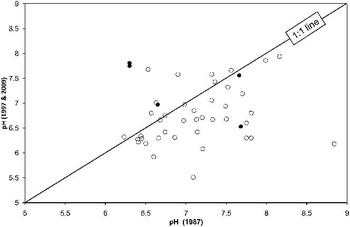
The variation partitioning analysis of subsets A and B revealed that the dummy regional variables explained respectively 51.7% and 42.8% of the variation in limnological conditions, whereas the dummy variables representing sampling bias explained only 20.2% and 19.1% in subsets A and B respectively. The geographical dummy variables independently and significantly (P ≤ 0.005) explained 34.1% and 30.9% of the limnological variation in subsets A and B respectively, suggesting that a significant part of the difference in limnological properties between the various regions is related to differences in geology, geomorphology and the deglaciation history, and/or with differences in sub regional climate patterns. However, it is unclear whether the inter-regional difference in pH is real or related to the month in which sampling took place and related variability in lake-ice cover dynamics. For example, 80% of the pH values taken in 1997 that were measured under lake ice cover in the Larsemann Hills are lower compared with the values from 1987 that were measured during (partly) ice-free conditions (Fig. 4). However, three out of the five pH values taken in 1997 were higher than those from 2009, also measured during (partly) ice-free conditions.
Historical variations in pH in the Larsemann Hills (n = 34) showing that the measurements from 1987 are generally higher than those of 1997 (open circles) and 2009 (filled circles), which is likely related to differences in lake ice cover. If a point falls on the 1:1 line, no change in pH has occurred. If the site points are below the 1:1 line, pH has decreased.

Long-term changes in lakewater specific conductance
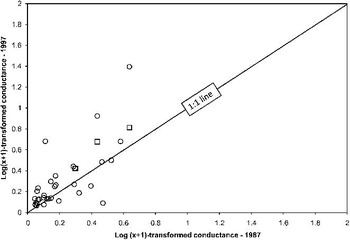
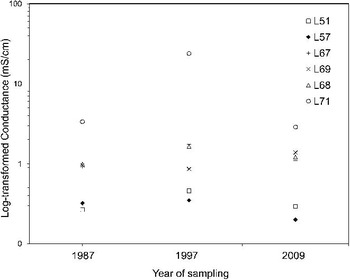
Changes in specific conductance are generally higher in the more saline lakes as evidenced by their larger deviation from the 1:1 line (Figs 5–7). In the Larsemann Hills (Fig. 5), over 70% of the specific conductance data obtained both during late spring and early summer under respectively ice covered and (partly) ice-free conditions in 1997–98, are higher compared with measurements taken during the summer of 1987 when the majority of the lakes were ice-free (Gillieson et al. Reference Gillieson, Burgess, Spate and Cochrane1990). However, during the summer of 2009, specific conductance was more or less similar in the six lakes studied when compared with the data obtained in 1987 (Fig. 6).
Historical variations in lakewater specific conductance in the Larsemann Hills, comparing measurements from the summer of 1987 with those obtained during the spring of 1997 (circles) and the summer (squares).

Historical variations in lakewater specific conductance in the six lakes in the Larsemann Hills sampled during three field campaigns (1987, 1997 and 2009) showing a large inter-annual variability.

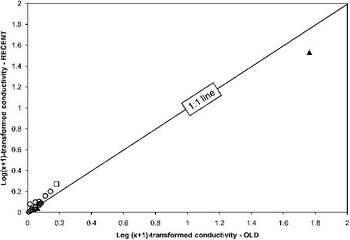
Historical variations in lakewater specific conductance in Skarvsnes. All measurements were taken in January under ice-free conditions. Circles denote a comparison between 2000 and 2007–08, triangles between 1997 and 2007, and squares between 2004 and 2007.

In Syowa Oasis, the pattern is less consistent although the lakes were all measured in the Antarctic summer under ice-free conditions (Fig. 7). Specific conductance increased or remained nearly constant in the majority of the lakes in Skarvsnes between 2000 and 2007–08. The variability in specific conductance was again highest in the most saline lake (Suribati Ike), but decreased from 58.7 mS cm-1 in January 1997 to 32.9 mS cm-1 in January 2007, while the Cl concentration in the surface water (29.1 g l-1) remained more or less constant over the period between January 1977 and 2007 (Tominaga & Fukui Reference Tominaga and Fukui1981).
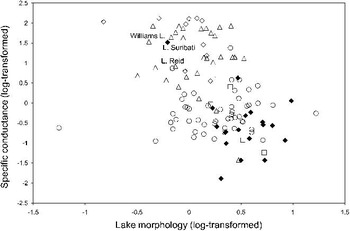
The biplot with specific conductance and the surface to lake depth ratio revealed that saline or brackish lakes with a high surface to lake depth ratio are present in nearly all regions studied (Fig. 8). These lakes are therefore identified as priority sites to study changes in the hydrological balance.
Biplot of the log-transformed lake depth to lake surface area and log-transformed lakewater specific conductance. Lakes which are particularly sensitive to changes in the precipitation evaporation balance and should therefore be priority sites for environmental monitoring programmes are labelled. Symbols as in Fig. 2.

Discussion
We assessed the limnological variability in eight ice-free regions in a sector between 10° and 80°E along the EA coastline. Our dataset contains a representative set of lakes, although epishelf lakes in Schirmacher Oasis and Amery Oasis were not included neither were the large and well studied glacial lakes in the McMurdo Dry Valleys and a number of other ice-free regions where complementary datasets were not available (e.g. the Bunger Hills, Windmill Islands, Thala Hills; Vincent & Laybourn-Parry Reference Vincent and Laybourn-Parry2008). In Schirmacher Oasis, lakes in contact with the East Antarctic Ice Sheet were not included in our survey. In the Vestfold Hills our dataset was collected to create a diatom-salinity transfer function (Verleyen et al. Reference Verleyen, Hodgson, Vyverman, Roberts, McMinn, Vanhoutte and Sabbe2003) and is therefore somewhat biased towards the more saline lakes although freshwater lakes also occur in that region (Roberts & McMinn Reference Roberts and McMinn1996). Moreover, the nutrient concentration in lakes from the Lützow-Holm Bay region and Schirmacher Oasis were measured using less sensitive techniques, and hence we used categorized data, which might underestimate interregional differences in trophic status. Despite this sampling and analytical bias we were able to observe some general trends. EA lakes are in general oligotrophic and span a wide specific conductance gradient, ranging from oligosaline to hypersaline. In the Prydz Bay and the Lützow-Holm Bay regions, both freshwater and hypersaline lakes occur, whereas in Schirmacher Oasis only dilute lakes were found. The variation partitioning analysis revealed that the observed differences in chemical limnology are, in part, related to the time of sampling and hence processes related to lake ice dynamics. For example, the lakes in the Larsemann Hills were still ice covered during the field campaign in 1997 and sampled in the upper 1 m under ice-cover, which potentially affected the ionic concentration and the pH. In particular, the vast majority of the pH measurements taken in 1997 are lower than the values from 1987 and 2009 when the lakes were ice-free or when lake ice cover was less extensive. It is well known that lake ice cover simultaneously limits the photosynthetic drawdown of limnetic CO2 and traps respired CO2 within lakes (e.g. Axford et al. Reference Axford, Briner, Cooke, Francis, Michelutti, Miller, Smol, Thomas, Wilson and Wolfe2009). Moreover, ice cover and thawing also affect the concentration of ions in the water column. Ions are expelled out of the lake ice which results in more concentrated lakewater. The thawing of the ice can in turn result in an increase or a decrease in ionic concentration and specific conductance, depending on lake-ice and snow cover characteristics. Lake-ice thawing can either result in more diluted lakewater due to the addition of meltwater with a low ionic concentration or, on the contrary, it can lead to more concentrated lakewater if marine aerosols got accumulated in the snow and ice. However, after accounting for differences in the time of sampling, the geographical and geological dummy variables remain important, hence regional differences in chemical limnology are likely to be real and related to differences in the time of deglaciation, geology, bedrock type and geomorphology of the lake basins and their catchment areas, lake origin and evolution, sub-regional climate patterns, and the distance of the lakes and the lake districts to the ice sheet and the Southern Ocean. For example, these factors underlie the absence of brackish and (hyper)saline lakes in Schirmacher Oasis. First, all lakes there are situated at elevations above the Holocene relative sea level limit, which is typically below 25 m a.s.l. in EA (Verleyen et al. Reference Verleyen, Hodgson, Milne, Sabbe and Vyverman2005; unpublished results). Hence, they are of glacial origin, in contrast to the saline lakes and ponds in EA which are isolation basins and situated at low altitudes. These isolation lakes originated from the sea after isostatic uplift and the ions trapped in the basins led to brackish conditions (if the flushing rate was relatively low) or hypersaline conditions (if the evaporation-precipitation balance was negative). Second, many of the lakes in Schirmacher Oasis are likely to be of Holocene age and thus relatively young (Phartiyal et al. Reference Phartiyal, Sharma and Bera2011). Lakes situated at higher altitudes (above c. 25 m) can only be saline in Antarctica if i) they have a long history of evaporation and addition of salts by sea spray, such as Lake Reid which is over 100 000 years old (Hodgson et al. Reference Hodgson, Verleyen, Sabbe, Squier, Keely, Leng, Saunders and Vyverman2005), ii) if the lakes are remnants of very large glacial and old (pre-LGM) lakes, such as Lake Bonney and Lake Fryxell in the McMurdo Dry Valleys in which the ions derived from the large glacial Lake Washburn were concentrated in the bottom waters (Vincent & Laybourn-Parry Reference Vincent and Laybourn-Parry2008), or iii) if they are remnants of larger glacial lakes in ablation dominated areas such as Forlidas Pond in the Dufek Massif (Hodgson et al. Reference Hodgson, Convey, Verleyen, Vyverman, McIntosh, Sands, Fernández-Carazo, Wilmotte, de Wever, Peeters, Tavernier and Willems2010). Third, the lakes sampled in Schirmacher Oasis are flushed by meltwater, which flows continuously during summer through small streams originating from the East Antarctic Ice Sheet or from permanent snow banks upstream. Also the relatively high Ca2+ to Na+ ratio in the lakes from Schirmacher Oasis are the result from the continuous flushing with glacial meltwater (Table S1).
The effect of the proximity of the lakes in Schirmacher Oasis to the ice sheet on their chemical limnology is also apparent within other regions. For example, the freshwater lakes such as Lichen Lake in the Vestfold Hills and L49 in the Larsemann Hills, are situated close to the ice sheet and show a higher Ca2+ to Na+ ratio (Table S1), compared with other freshwater lakes which are more influenced by sea spray. Inter- and intra-regional differences in specific conductance and the concentration of the major ions are also related to exposure to winds, in combination with the distance to the sea. The lakes in Langhovde receive salts from the ocean through sea spray and are exposed to the dry katabatic winds which blow over Lützow-Holm Bay on the north-eastern part of Langhovde. The lakes there are hypersaline and some were almost completely dried out during the visit in January 2007. In contrast, lakes in the south and south-western part of Langhovde are not exposed to sea spray and hence freshwater lakes and ponds occur there.
Differences in chemical limnology between lakes might also be related to the presence of specific biological communities or the biogeochemistry of the sediments. For example, in some shallow freshwater lakes on Broknes in the Larsemann Hills, the nitrate concentration is higher than in similar systems in the region and other EA oases, which may be partly underlain by the presence of nitrogen fixing cyanobacteria that are abundantly present there (Sabbe et al. Reference Sabbe, Hodgson, Verleyen, Taton, Wilmotte, Vanhoutte and Vyverman2004). The PO4-P concentration is highest in Organic Lake in the Vestfold Hills and in Firelight Lake in the Bølingen Islands. In the latter this is likely related to high density of breeding bird colonies in the catchment area (Sabbe et al. Reference Sabbe, Hodgson, Verleyen, Taton, Wilmotte, Vanhoutte and Vyverman2004). Organic Lake and the isolation lakes in the Vestfold Hills in general are more nutrient rich, because they contain relict seawater (Vincent & Laybourn-Parry Reference Vincent and Laybourn-Parry2008). Alternatively, the age and history of the landscape, along with the gradient and geomorphology of the inflow streams may play an important role in regulating the nutrient input, as observed in the lakes in the McMurdo Dry Valleys (Lyons & Finlay Reference Lyons and Finlay2008). The fact that the highest nitrate concentrations are found in lakes on Broknes might be related to the relative long period of ice-free conditions over this part of the oasis (Verleyen et al. Reference Verleyen, Hodgson, Sabbe, Cremer, Emslie, Gibson, Hall, Imura, Kudoh, Marshall, McMinn, Melles, Newman, Roberts, Roberts, Singh, Sterken, Tavernier, Verkulich, van de Vyver, van Nieuwenhuyze, Wagner and Vyverman2011). Interestingly, in the lakes of the McMurdo Dry Valleys, particularly phosphate concentrations were higher on relatively older surfaces and not nitrate (Barrett et al. Reference Barrett, Virginia, Lyons, McKnight, Priscu, Doran, Fountain, Wall and Moorhead2007). It is clear that more detailed studies are required to understand fully the differences in nutrient concentrations between the different water bodies.
Our analyses of repeat survey data revealed relatively large seasonal and inter-annual variability in specific conductance. In most lakes in the Larsemann Hills specific conductance increased between 1987 (Gillieson et al. Reference Gillieson, Burgess, Spate and Cochrane1990) and 1997 (Sabbe et al. Reference Sabbe, Hodgson, Verleyen, Taton, Wilmotte, Vanhoutte and Vyverman2004) and decreased again in 2009 (Figs 5 & 6), which was probably related to both inter-annual climate variability and weather patterns (Rochera et al. Reference Rochera, Justel, Fernandez-Valiente, Banon, Rico, Toro, Camacho and Quesada2010), and the different seasons during which sampling took place. We consider the effect of different field instruments being used as minor, as they were calibrated to fixed standards and the differences in readings in some lakes are more than would be anticipated due to normal instrument error. In 1987 and 2009, samples were taken during the summer, whereas in 1997 the lakes were visited during spring when they were still ice covered. It is well known that seasonal differences in specific conductance occur due to changes in lake ice cover and the amount of meltwater input (Douglas & Smol Reference Douglas and Smol1994). During autumn, ions are frozen out during lake ice formation, which leads to the concentration of the solutes in the remaining lakewater and higher specific conductance values compared with summer conditions. During summer, the lakewater can be additionally diluted as a result of snowmelt draining into the lake from the catchment area. However, seasonal differences in ice cover and snowmelt alone fail to explain the increase in specific conductance in three lakes that were consistently sampled under partly ice-free conditions in 1997 (Gasparon et al. Reference Gasparon, Lanyon, Burgess and Sigurdsson2002). A consistent increase in specific conductance was observed during both spring and late summer 1997, when compared with data obtained in the summers of 1987 (Gillieson et al. Reference Gillieson, Burgess, Spate and Cochrane1990), 1992 (Ellis-Evans et al. Reference Ellis-Evans, Laybourn-Parry, Bayliss and Perriss1998) and 2009. This increase in specific conductance is consistent with lower snow accumulation rates recorded in ice cores from this part of EA between 1985 and 1994 (Monaghan et al. Reference Monaghan, Bromwich, Fogt, Wang, Mayewski, Dixon, Ekaykin, Frezzotti, Goodwin, Isaksson, Kaspari, Morgan, Oerter, van Ommen, van der Veen and Wen2006). The lower specific conductance values after 1997 are in agreement with increased snow accumulation rates between 1995 and 2004 (Monaghan et al. Reference Monaghan, Bromwich, Fogt, Wang, Mayewski, Dixon, Ekaykin, Frezzotti, Goodwin, Isaksson, Kaspari, Morgan, Oerter, van Ommen, van der Veen and Wen2006), indicating that part of the long-term variation might be related to regional climate variability. The increase in lakewater specific conductance in the majority of the lakes is also consistent with long-term monitoring data from Deep Lake in the nearby Vestfold Hills, where lakewater dropped between 1987 and 1997 (Gibson Reference Gibson2010). Interestingly, the subsequent decrease in specific conductance in six lakes during the 2009 field season is not consistent with the lake level trend in Deep Lake, implying that regional differences in snow fall and snow accumulation are relatively large.
In Syowa Oasis lakes, repeat surveys were carried out in January 1997, 2000, 2007 and 2008, hence inter-lake variations in specific conductance are not biased by seasonal differences in snowmelt and lake ice dynamics. The majority of the lakes showed an increase in specific conductance or relatively stable conditions if measurements from 2000 and 2007–08 are compared. In contrast, if measurements from 1997 in Suribati Ike are compared with data obtained in 2007, specific conductance decreases. Interestingly, the Cl- concentration analysed ten years before is similar to the 2007 measurements (Tominaga & Fukui Reference Tominaga and Fukui1981). This large inter-annual and inter-decadal variability is difficult to compare with existing snow thickness data as no direct measurements are available for this region (Monaghan et al. Reference Monaghan, Bromwich, Fogt, Wang, Mayewski, Dixon, Ekaykin, Frezzotti, Goodwin, Isaksson, Kaspari, Morgan, Oerter, van Ommen, van der Veen and Wen2006). Yearly snowfall variability of 20 mm yr-1 is, however, common in Antarctica and might underlie this long-term variability (Monaghan et al. Reference Monaghan, Bromwich, Fogt, Wang, Mayewski, Dixon, Ekaykin, Frezzotti, Goodwin, Isaksson, Kaspari, Morgan, Oerter, van Ommen, van der Veen and Wen2006), possibly in combination with changes in wind strength.
Our analysis revealed that in terms of the sensitivity of the lakes to climate changes, those lakes with medium to high specific conductance levels and with a high surface area to lake depth ratio in which meteoric water is the only moisture source will respond quickly to changes in the evaporation-precipitation balance and snow accumulation. In EA, such lakes can be found in nearly all regions studied (Fig. 8) and these water bodies should be targeted for long-term limnological and biological monitoring programmes. Ideally, however, lakes selected for long-term monitoring should not be too shallow so that they are susceptible to complete desiccation, and their sediments should remain undisturbed by ice working so they can be used in palaeolimnological studies. Typically, lake depth should exceed 2 m for these purposes; however, sites with shallower water have also accumulated important sedimentary profiles in the Arctic (e.g. Douglas et al. Reference Douglas, Smol and Blake1994). Based on these criteria, Lake Reid and Williams Lake are the priority sites for long-term monitoring programmes in respectively the Larsemann Hills and Vestfold Hills (Fig. 8), together with Deep Lake, which is already part of such a programme (see Gibson Reference Gibson2010). Lake RI4 is probably too shallow and prone to complete desiccation under future climate warming. In Lützow-Holm Bay, Suribati Ike appears to be ideally suited for long-term monitoring programmes. Additional selection criteria are easy logistic access to the study lakes and the proximity of a weather station. Hence, lakes close to research stations or field huts are preferred. This is the case for Lake Reid in the Larsemann Hills, Williams Lake in the Vestfold Hills and Lake Suribati in Syowa Oasis. Standardized long-term monitoring of these ecosystems in combination with local meteorological data (including precipitation) is thus of primary importance to understand the ecological implications of future climate anomalies. Our data have also shown that it is of utmost importance that in future surveys, the date of sampling and the thickness of the lake ice cover are recorded. Similarly, to monitor the effect of future climate changes on lakes, the specific conductance in these water bodies should be measured, if possible, during the short ice-free period (cf. Smol & Douglas Reference Smol and Douglas2007a). In addition, the measurements should be taken at a fixed lake depth, which is particularly important in stratified saline lakes, but also in low-salinity lakes which can be stratified after ice melt during early summer. For some lakes there are basic specific conductance data from at least the late 1980s and, although the data collection has been intermittent, this combined instrumental data is of great value. Such standardized long-term specific conductance measurements are complementary to snow accumulation data from ice cores and should thus be part of long-term monitoring, palaeolimnological and microbiological research programmes. Moreover, in combination with palaeolimnological analysis using diatom based transfer functions (e.g. Verleyen et al. Reference Verleyen, Hodgson, Vyverman, Roberts, McMinn, Vanhoutte and Sabbe2003, Hodgson et al. Reference Hodgson, Verleyen, Sabbe, Squier, Keely, Leng, Saunders and Vyverman2005, Reference Hodgson, Roberts, McMinn, Verleyen, Terry, Corbett and Vyverman2006; Supplemental Table S1) these programmes will allow us to place the recent instrumental data on lacustrine and climate changes in the context of long-term natural variability.
The limnological data presented here can also be used to select regions and lakes for future biodiversity studies, linking the presence of particular taxa to climate-related environmental conditions (cf. Verleyen et al. Reference Verleyen, Sabbe, Hodgson, Grubisic, Taton, Cousin, Wilmotte, De Wever, van der Gucht and Vyverman2010). These studies can be used to reveal the ecological conditions under which particular species (including endemics) occur, which is important for the conservation of these unique habitats and their communities. The understudied freshwater lakes in Dronning Maud Land, which appear to differ from the other EA water bodies should be considered as priority sites to study their microbial communities as they might contain other, potentially endemic taxa than those already observed in our analyses of a subset of lakes from the Prydz Bay region and the McMurdo Dry Valleys (Verleyen et al. Reference Verleyen, Sabbe, Hodgson, Grubisic, Taton, Cousin, Wilmotte, De Wever, van der Gucht and Vyverman2010).
Acknowledgements
This work benefited from the HOLANT and AMBIO projects funded by the Belgian Federal Science Policy Office (BelSPO), the Fund for Scientific Research in Flanders (FWO) project 3G/0533/07, the Natural Environment Research Council (UK), and the MERLIN and REGAL projects funded by the National Institute of Polar Research (Japan). The work was only possible with the logistic support of the Australian Antarctic Division, the British Antarctic Survey, the Japanese National Institute for Polar Research (JARE 48) and the Indian Antarctic Expedition. EV and CS are funded by FWO. IT is financed by the institute for the promotion of Science and Technology in Flanders (Belgium). EK was partly funded by the target grant SF0320080s07 of the Estonian Ministry of Education and Science. Geological maps were provided by the Australian Antarctic Division Data Centre (Henk Brolsma), the National Institute of Polar Research Japan, and the National Centre for Antarctic and Ocean Research India. Professor John P. Smol and two anonymous reviewers are thanked for their constructive comments on a previous version of the manuscript. We thank M. Jamie Oliver (BAS) for his help in preparing the figures.
Supplementary Materials
For supplementary material for this article, please visit http://dx.doi.org/10.1017/S0954102011000642.