Introduction
Aggressive or violent behaviour is one of the commonest reasons patients are admitted to secure care (Dolan, Reference Dolan2001; Davies & Oldfield, Reference Davies and Oldfield2009). The short-term management of such behaviour focuses on non-pharmacological interventions, such as de-escalation, while the use of restraint, seclusion and sedation are considered treatments of last resort. Rapid tranquillisation (RT), or emergency sedation, has been defined as ‘the use of psychotropic medication to control agitated, threatening or destructive psychotic behaviour’ (Pereira et al. Reference Pereira, Paton, Walkert, Shaw, Gray and Wildgust2005). The National Institute for Clinical Excellence (2005) adopted a somewhat broader definition of RT, namely ‘the use of medication to calm/ lightly sedate the patient, reduce the risk to self and/ or others and achieve an optimal reduction in agitation and aggression’. The NICE Guideline also states that the use of as required (‘prn’) and one-off (‘stat’) additional doses of oral psychotropic medicines should be considered as part of RT. The two most common classes of drugs used in RT are benzodiazepines and antipsychotics. Although RT can be a reasonably safe procedure, there are concerns about unwanted side effects of medication, principally dystonia with first generation antipsychotics and respiratory depression with benzodiazepines. Other dangers of RT include neuroleptic malignant syndrome (NMS), needle stick injuries and injuries to patient and staff during restraint. There is also a small but potentially serious risk with antipsychotics of cardiac dysrhythmias leading to sudden death (Ray et al. Reference Ray, Meredith, Thapa, Meador, Hall and Murray2001).
Relatively little research has been conducted to establish the preferred drugs and doses for use in RT, although there have been four pragmatic randomised controlled trials (RCTs) of intra-muscular medication in ‘real-life’ violent or agitated patients, known as the TREC studies (see for example TREC Collaborative Group, 2003; Alexander et al. Reference Alexander, Tharyan, Adams, John, Mol and Philip2004). A systematic review of guidelines and phase III RCTs of medication used for rapid tranquillisation, identified only 20 RCTs and concluded there was a lack of high quality clinical trials available and that no particular medication regime for RT could definitively be recommended over others (Pratt et al. Reference Pratt, Chandler-Oatts, Nelstrop, Branford and Pereira2008). Similarly, the NICE Guideline (National Institute for Clinical Excellence, 2005) states that ‘there are no conclusive benefits in terms of effectiveness of one antipsychotic over another, of antipsychotics over benzodiazepines or of combination medications over single medication regimes’. The RT policy of our own hospital that was current at the time of this study recommended the use of lorazepam 2 mg IM and/or haloperidol 5–10 mg IM or alternatively olanzapine IM. No mention was made of the use of sedative antihistamines. Prescribers were also advised to refer to the algorithm for RT in the current edition of the Maudsley Prescribing Guidelines. The Hospital's RT policy recommended the IM over the IV route on the grounds of safety but did not preclude the use of IV sedation.
Surveys of the use of psychotropic medication for RT have focused upon general acute psychiatric wards and psychiatric intensive care units (PICUs; see for example Pilowsky et al. Reference Pilowsky, Ring, Shine, Battersby and Lader1992; Brown et al. Reference Brown, Chhina and Dye2010). We could find only a small literature on emergency parental sedation for patients in low and medium secure care and decided to carry out a cross-sectional audit at our own hospital in order to review local clinical and risk management protocols around RT. A further rationale for the survey was that RT is, at present, a topical issue.
The primary aims of the study were to survey the nature, timing and frequency with which intramuscular (IM) or intra-venous (IV) sedation was given to male and female patients at a large secure (mixture of medium and low secure provision) psychiatric hospital. Secondary aims were to establish the main reasons for administering such sedation, whether or not the local policy was being adhered to and whether or not there was evidence that patients were being monitored after being given sedation.
Method
Setting
St Andrew's Healthcare, Northampton, is a large secure psychiatric hospital caring for patients of a wide variety of ages, many of whom have complex mental health needs and exhibit challenging behaviour. Although the hospital is a charity, almost all patients are funded by the NHS. The study was conducted among the male and female forensic and rehabilitation services which comprise a total of 414 beds (275, 66% male; 139, 34% female) in 26 wards (11 medium secure, 10 low secure, 3 locked and 2 open units). At the time of conducting this survey there was no psychiatric intensive care unit (PICU). The majority of male patients suffer from schizophrenia and related psychoses while the most common diagnoses for female patients are emotionally unstable personality disorder followed by schizophrenia. Co-morbidity of psychiatric disorders is common. Four units cater for older adults; the rest are for patients of working age and five units are for patients with mild learning disabilities and co-morbid mental disorders and/or challenging behaviour. One 23-bed unit is dedicated to the treatment of female patients with emotionally unstable personality disorder using dialectical behaviour therapy. All medium secure units have seclusion rooms, as do four of the low secure units, but none of the locked or open units have them.
Hospital RT policy
The hospital policy current at the time of the study defined RT as ‘the emergency administration of IM or IV tranquillising/ sedative medication in order to calm a patient and prevent them from being violent towards self, other people or property’. Thus, oral medication was not included in the definition (the policy has since been changed and now includes oral drugs). Medication may be ‘as required’ or written as a one-off (stat) dose and must be prescribed by a doctor. Following the administration of RT the nurse must sign the administration box on the paper medication chart, complete an electronic RT form (this describes the reason for giving the RT, its timing, the drug(s) given and by whom), make an entry in the patient's progress notes and carry out monitoring of vital signs and level of consciousness at intervals as agreed with the doctor but usually every 15 minutes following RT. If the patient is uncooperative with monitoring this should be recorded in the patient's notes.
Data collection
Approval for the study was granted by the hospital audit committee. The wards were visited in November and December 2011. All current medication charts (a chart can contain a maximum of three months of prescriptions) were scrutinised and details of any antipsychotic, anxiolytic or other sedative medication such as promethazine and administered IM or IV (excluding depot antipsychotics) were recorded on a paper data entry form (one form was completed for each injection of sedation administered). Consent to treatment forms T2, T3 and Section 62 were checked to see that the sedation had been authorised. (Under the Mental Health Act 1983 (amended in 2007) of England and Wales, detained patients beyond the first three months of treatment have to have their psychotropic medication authorised on a form T2 or T3. If a patient gives informed consent to treatment a form T2 is completed by their responsible clinician. If they either refuse the treatment or are not capable of consenting then a second opinion appointed doctor authorises the treatment on a form T3. Urgent medical treatment can be authorised on a Section 62.) The auditors also checked to see if there were any physical observation charts recording patients’ pulse, blood pressure, respiratory rate, level of consciousness and blood oxygen saturation on the ward. Patients’ electronic notes were examined to check that the administration of sedation had been documented as per hospital policy, whether or not the patient was documented as having been restrained or secluded and whether or not there was evidence of physical monitoring of the patient, including level of consciousness or a statement that the patient was refusing physical monitoring. Basic demographic and clinical details were collected from the case notes on all patients who received IM or IV sedation. Anonymised data were entered into SPSS (2009) and subjected to descriptive analyses.
Results
A total of 316 medication charts were examined belonging to 195 male and 121 female patients. There were 203 IM but no IV sedative injections recorded as being administered to a total of 35 patients. These 35 patients received a median of four injections (range 1–23). Ten IM injections (IMIs) were given on the four male admission wards and 145 on the three female admission wards. A further 35 IMIs were administered on a low secure ward for older female patients. The remaining 13 IMIs were spread across a number of rehabilitation wards. No IMIs were given on the two wards for older male patients and none on the ward dedicated to the treatment of female patients with emotionally unstable personality disorder.
Patient characteristics
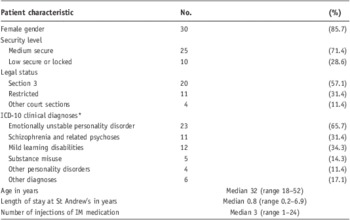
The characteristics of the 35 patients who received IM sedation are presented in Table 1. Patients were predominantly female, had a primary diagnosis of emotionally unstable personality disorder and tended to be given IM sedation relatively early on in their hospital stay (median duration of stay at St Andrew's is currently just over two years).
Characteristics of patients given parenteral sedation (N = 35)

*Some patients had more than one diagnosis
Timing of IM sedation
Between Monday and Friday the mean daily number of IMIs was 30.8, whereas at the weekend it was lower at 24.5. As would be expected, almost all IMIs were given during the daytime, the peak time being between 12 noon and 8pm. There was no increase at patient meal times or at nursing handover times. For those patients who received a large number of IMIs there appeared to be some clustering of injections over the course of a number of days.
Nature and dosages of drugs administered
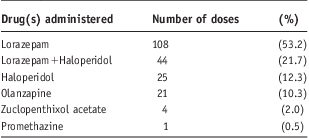
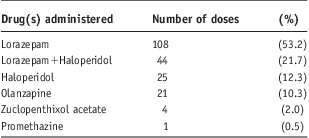
A single drug was administered in 159 (78.3%) cases. In the remaining 44 (21.7%) instances haloperidol and lorazepam had been administered as separate injections at the same point in time. No drug dosages exceeded the British National Formulary (Joint Formulary Committee, 2011) recommended limits but we did not take into account patients’ usual regular doses of medication. By far the most frequently administered drug was lorazepam (152 cases), followed by haloperidol (69), olanzapine (21), zuclopenthixol acetate (4) and promethazine (1). Details of the drugs administered are given in Table 2. Only 3 (1.5%) patients had a second injection of sedative medication administered within two hours of the first dose. In 197 (97.0%) of cases the drug(s) administered were already prescribed in the prn section of the medication chart. In five (2.5%) cases the doctor came to the ward to prescribe the medication and in one case a doctor gave a verbal message for a drug to be given.
Details of parenteral sedation administered (N = 203)
Indications for IM sedation
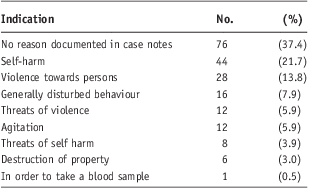
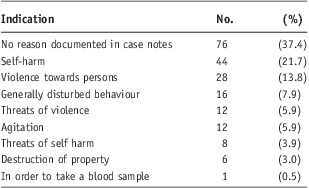
In 37.4% of cases there was no documented reason for the IMI (see Table 3). In some of these cases the patient was described as calm or settled prior to the injection of RT medicine. In other cases there was no description of the patient's behaviour. The most common reason given was self-harm, followed by violence towards persons and generally disturbed behaviour.
Documented indications for parenteral sedation (N = 203)
Case note documentation
For 53 (26.1%) cases there was no case note documentation that an IM dose of medication had been given. In 139 (68.5%) cases there was documentation in the progress notes giving the timing, name, route and dose of the IMI but in only 58 (28.6%) cases was the required rapid tranquillisation event form completed.
Consent to treatment status
All 35 patients were detained under the Mental Health Act 1983 (amended in 2007) of England and Wales and all but one were beyond the first three months of treatment on their section. This one patient had received 16 IMIs, which have been excluded from the following analysis as forms T2 and T3 were not yet applicable. Most (94/187; 50.3%) doses of IM sedation were authorised by a form T3; 26 (13.9%) doses were authorised by a form T2; and 34 (18.2%) doses were not authorised by the current consent to treatment certificate. A total of 23 (11.3%) doses were given under the provision of Section 62. For ten IMIs no consent to treatment forms were found with the medication charts for the two patients concerned. Interestingly, there were 24 (11.8%) instances (all involving detained female patients) where the patient was recorded as requesting IM sedation.
Use of other treatments for therapeutic containment
In 83 (40.9%) cases it was documented that the patient was restrained and in 20 (9.9%) cases it was documented that the patient was also secluded.
Post-RT monitoring
In only 5 (2.5%) cases were readings of pulse, blood pressure and respiratory rate recorded. There was only one instance where a pulse oximeter had been used. In only 2 (1.0%) cases was it documented that the patient refused to be monitored.
Discussion
In this study of male and female patients at a secure hospital, the administration of IM sedation appeared common among female patients with a diagnosis of emotionally unstable personality disorder, especially those on female medium secure admission wards. A small number of patients received a large number of IMIs. The most common indication for IM sedation was self-harm and a minority of patients even requested an injection. In another study of aggressive incidents conducted in a special hospital, a small number of female patients were responsible for the majority of incidents requiring emergency sedation (Tuddenham & Logan, Reference Tuddenham and Logan2005). This is in contrast to emergency prescribing in general psychiatric hospitals and PICUs where the majority of patients receiving IM sedation are male, have psychosis and are aggressive (Pilowsky et al. Reference Pilowsky, Ring, Shine, Battersby and Lader1992; Brown et al. Reference Brown, Chhina and Dye2010). Another finding of our study was that the majority of patients given IM sedation were detained on civil as opposed to court sections. This was also the case in a study conducted in a regional secure unit (McLaren et al. Reference McLaren, Browne and Taylor1990).
No doses of sedation were given by the IV route (the hospital's RT policy states the IM route is preferred to IV on safety grounds), again in contrast to an older study of emergency prescribing in a general psychiatric hospital where IV sedation was favoured over the IM route (Pilowsky et al. Reference Pilowsky, Ring, Shine, Battersby and Lader1992). In a recent study of RT in seven PICUs no sedation was given by the IV route (Brown et al. Reference Brown, Chhina and Dye2010). This was also a finding in a study of medication given for aggressive incidents in a special hospital (Tuddenham & Logan, Reference Tuddenham and Logan2005), suggesting that clinicians have now abandoned the IV route. There are a number of possible reasons for the move to IM sedation including ease of administration, that nursing staff can administer the drug and on the grounds of safety.
In this study, lorazepam 2 mg was the most common sedative administered, sometimes given concurrently with haloperidol 5 mg. Clinicians are known to favour benzodiazepines over antipsychotics for neuroleptic naïve patients, though preferring the combination of an antipsychotic with a benzodiazepine or just an antipsychotic for non-naïve patients (Pereira et al. Reference Pereira, Paton, Walkert, Shaw, Gray and Wildgust2005). Expert opinion favours benzodiazepines as the mainstay of RT (McAllister-Williams & Ferrier, Reference McAllister-Williams and Ferrier2002). The most commonly used antipsychotic was haloperidol, despite the fact that this drug has been found to be poorly tolerated when used for RT (Huf et al. Reference Huf, Coutinho and Adams2007), the summary of product characteristics (SPC) recommends a pre-treatment ECG and the Maudsley Prescribing Guidelines state that IM haloperidol should be the last drug considered for IM RT (Taylor et al. Reference Taylor, Paton and Kapur2012). The use of IM haloperidol is not favoured by other expert opinion (McAllister-Williams & Ferrier, Reference McAllister-Williams and Ferrier2002), though the TREC studies found some positive evidence of efficacy (Alexander et al. Reference Alexander, Tharyan, Adams, John, Mol and Philip2004). The NICE Clinical Guideline on schizophrenia (National Institute for Health and Clinical Excellence, 2009) states that all psychiatric inpatients should have an ECG prior to any antipsychotic. Only occasional use was made of the second generation antipsychotic, olanzapine, despite its low rate of extra-pyramidal side effects and lack of significant QTc prolongation (McAllister-Williams & Ferrier, Reference McAllister-Williams and Ferrier2002) and no use was made of IM aripiprazole, the other second generation antipsychotic available as a short-acting IM preparation. The limited use of IM olanzapine may relate to its interaction with parenteral benzodiazepines which may result in excessive sedation, cardiorespiratory depression and death. Only one patient received promethazine even though this drug is considered a useful option in patients who are tolerant of benzodiazepines (Taylor et al. Reference Taylor, Paton and Kapur2012), and the fact that this sedative antihistamine is licensed for sedation (see the SPC) for parenteral promethazine, www.medicines.org.uk). Very few patients received more than one injection of sedation, unlike in previous studies of RT (Pilowsky et al. Reference Pilowsky, Ring, Shine, Battersby and Lader1992; Brown et al. Reference Brown, Chhina and Dye2010). This may be the result of different patient populations in these studies. In our study many patients were female and had a primary diagnosis of borderline personality disorder, in contrast to other studies where male patients with psychosis predominated. In our study, four patients received zuclopenthixol acetate. This preparation is not suitable for RT because its action is not rapid (sedation usually begins to be seen two hours post injection (Taylor et al. Reference Taylor, Paton and Kapur2012)). Very few patients received a second IMI within two hours of the first. Clearly, it is necessary to allow sufficient time for medication to take effect. The Maudsley Prescribing Guidelines recommend only repeating the IMI after 30–60 minutes have elapsed if there is insufficient effect (Taylor et al. Reference Taylor, Paton and Kapur2012).
In the current study, case note documentation was minimal and there was negligible documented physical monitoring of patients post-IMI, despite the NICE RT guidance. In only a quarter of cases had hospital policy had been followed and an RT event form been completed. Although we did not systematically study the comments of nursing staff about patients’ behaviour post-injection, in only a small proportion of cases was the patient's level of consciousness described. Previous studies of RT have not examined the associated case note documentation. However, in a survey of UK consultant psychiatrists concerning the treatment of acute behavioural disturbance, only 9% said they did not routinely perform routine physical observations post RT (Pereira et al. Reference Pereira, Paton, Walkert, Shaw, Gray and Wildgust2005). There are, of course, difficulties in attempting to physically monitor patients with aggressive and challenging behaviour. Where patients have been secluded but are still ambulant, nursing staff are placing themselves at risk of assault by entering the seclusion room in order to perform physical observations. However, the assessment of sedation, respiratory rate and general physical status can be done from a distance and does not require nursing staff to enter the seclusion room.
We noted in our survey that consent to treatment forms did not always authorise the IMI and sometimes IM sedation was administered under restraint to patients being treated on a form T2. It would seem unlikely that a patient requiring restraint for an IMI could be giving informed consent for a sedative injection. We searched the case notes, including care plans, of these patients to see if they had made an advance statement that they wished to receive IM sedation should they become acutely unwell. However, no such statements could be found. A further problem was that a copy of the consent to treatment form was not always with the medication chart. The above are significant shortcomings that need to be rectified and re-audited.
We found a minority of patients who requested IM sedation rather than receive an oral dose of sedation. In a previous study, conducted in male and female forensic patients at our hospital, some patients commented that the IM route was preferred because of its more rapid onset and greater efficacy and duration of effect (Haw et al. Reference Haw, Stubbs, Bickle and Stewart2011). But is it ethical to administer IM sedation on request? The oral route is to be preferred on the grounds of safety and when a patient suffering from an emotionally unstable personality disorder requests an IMI, administering one could be viewed as feeding their wish to punish themselves.
Our study has a number of limitations including its retrospective and cross-sectional design which prevented us from carrying out a detailed study of the timing of IM sedation to individual patients over days and weeks. We did not examine concurrent (regular) medicines and doses and so it was not possible to assess if these IM doses pushed the patients’ total antipsychotic doses beyond a total percentage dose of 100%. A further limitation is that we did not have psychiatric diagnoses for all the inpatients current at the time of the survey and so were unable to make statistical comparisons between those patients who did and those who did not receive IM sedation. We have used the term ‘sedation’ rather than RT in describing our study. This is because we cannot be sure that all doses met the definition of RT given in the hospital's policy. Some doses might be better described as the giving of prn sedation. We were unable to discriminate between these two scenarios because of the retrospective nature of the study design. In practice RT is not a clear-cut phenomenon, there are differing opinions as to its definition and there is overlap with prn doses. However, it can be argued that all patients receiving parenteral sedation should be physically monitored post-injection regardless of the circumstances leading to the administration of an IMI. We only studied parenteral medication. RT does, of course, include the administration of oral sedation and hospital policy now reflects this fact.
In conclusion, emergency parenteral medication was administered to a relatively small number of predominantly female patients many of whom were on medium secure wards. Intra-muscular lorazepam was the drug given in the majority of cases and first generation antipsychotics were favoured over second generation ones. Case note documentation of the rationale for administration of sedation and physical health observations after IMI showed room for significant improvement and not all medication was authorised by consent to treatment forms. Hospital policy was rarely being followed and a worryingly small percentage of patients underwent any physical monitoring after IM sedation. These results have implications for staff training and policy awareness in order to optimise patient safety and compliance with legal requirements. Our hospital is now running Safe Medicines Administration courses for nursing staff, there is a regular audit of compliance with consent to treatment documentation and there are plans for pharmacists to hold training sessions on RT for all clinical staff, particularly on those wards where IM sedation is used frequently. We plan to repeat the audit at a later date to see if documentation has improved.