

1 Introduction
When a ‘rough’ hydrophobic solid is immersed in water, bubbles can get trapped within the vacancies of the roughness in a stable Cassie state. The resulting surface is known as superhydrophobic (Quéré Reference Quéré2008). As these surfaces tend to exhibit reduced resistance to liquid motion about them, they have been of interest to the fluid mechanics community (Bocquet & Lauga Reference Bocquet and Lauga2011). The analysis of flows about superhydrophobic surfaces is typically concerned with two classes of canonical problems: the first, rather idealized problem, concerns an externally imposed shear flow over a single superhydrophobic surface; the second, more representative of realistic configurations (Rothstein Reference Rothstein2010), has to do with pressure-driven flow within ‘superhydrophobic channels’. In both classes, interest lies not in the details of the flow, but rather in an appropriate lumped quantity that represents, in some averaged sense, the reduced friction due to superhydrophobicity. In the first class this quantity is provided by the intrinsic slip length (Davis & Lauga Reference Davis and Lauga2009; Crowdy Reference Crowdy2010) – a pure geometric function of the surface morphology; in the second class it is provided by the effective slip length (Lauga & Stone Reference Lauga and Stone2003), which represents the excess volumetric flux in the channel.
Following recent experiments (Muralidhar et al. Reference Muralidhar, Ferrer, Daniello and Rothstein2011; Castagna, Mazellier & Kourta Reference Castagna, Mazellier and Kourta2018; Jetly, Vakarelski & Thoroddsen Reference Jetly, Vakarelski and Thoroddsen2018) one can envision a third class of canonical problems, associated with rigid-body motion of a superhydrophobic ‘particle’. To highlight that third class it is convenient to consider a small particle, where inertial effects are negligible. Given the linearity of the governing problem, the general properties of classical zero-Reynolds-number resistance problems (Happel & Brenner Reference Happel and Brenner1965; Hinch Reference Hinch1972) are expected to remain valid. These naturally suggest the particle mobility as the quantity of interest, which constitutes the pertinent counterpart of the slip-length concept in the first two problems.
We here consider a prototypic resistance problem, involving the rotation of a circular cylinder about its axis within a viscous liquid, where superhydrophobicity is brought about by the presence of a periodic array of infinite grooves, parallel to the cylinder axis, on its boundary. The same type of boundary was employed by Lauga & Stone (Reference Lauga and Stone2003), who considered pressure-driven flow. With the resulting flow being two-dimensional, this may be the simplest resistance problem. Indeed, in the case of a homogeneous solid boundary, the flow is given by a two-dimensional rotlet. Following Lauga & Stone (Reference Lauga and Stone2003), we assume that the curvature of the bubbles that are trapped in the grooves is the same as that of the circular groove boundaries. The compound boundary is accordingly circular.
Lauga & Stone (Reference Lauga and Stone2003) solved an internal flow problem, driven by an imposed pressure gradient. We here solve an external flow problem, driven by the angular rotation of the cylinder relative to the otherwise quiescent liquid. Our goal is the angular mobility of the cylinder.
2 Problem formulation
An infinite solid cylinder of radius
 $a$
is decorated with a finite number
 $N({\geqslant}1)$
of equally spaced grooves, infinitely extending parallel to the cylinder axis. Upon immersing the cylinder in a liquid (viscosity
 $\unicode[STIX]{x1D707}$
), an infinite bubble is trapped in each groove. The boundary of the cylinder accordingly consists of
 $N$
liquid–gas interfaces, corresponding to the bubbles, and
 $N$
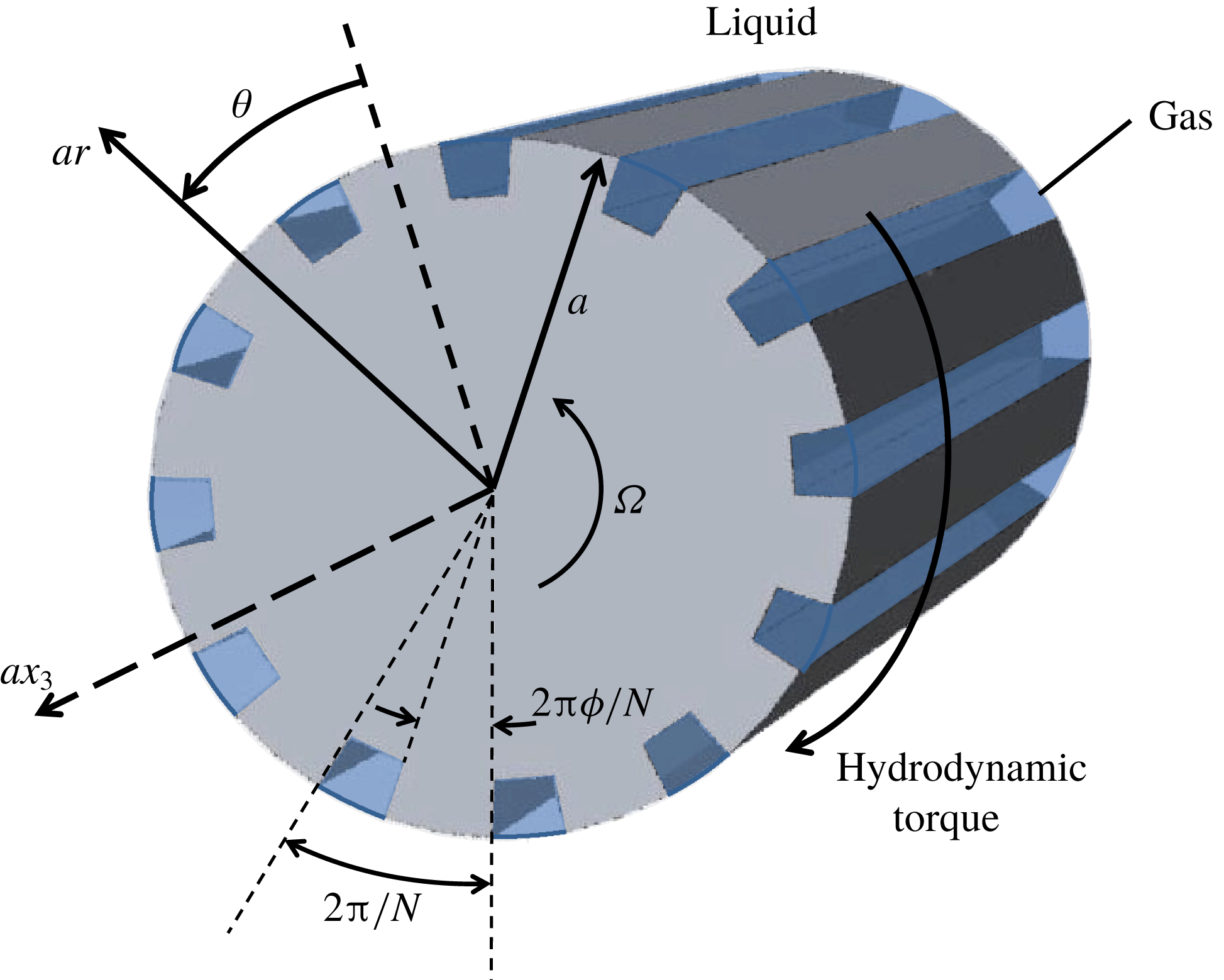
solid–air interfaces, corresponding to the ridges which separate the bubbles. It is assumed that the curvature of the liquid–gas interfaces coincides with that of the solid ridges. The boundary of the cylinder cross-section is accordingly a circle. The geometry is portrayed in figure 1.
Our interest lies in the two-dimensional flow which is driven by the imposed rigid-body rotation of the cylinder about its axis, say with an angular velocity
 $\unicode[STIX]{x1D6FA}$
. In particular, we seek to calculate the hydrodynamic torque (per unit length) about that axis. It is convenient to employ the ratio
 $T$
of that torque to the corresponding torque about a groove-free cylinder, which is given by
 $4\unicode[STIX]{x03C0}\unicode[STIX]{x1D707}a^{2}\unicode[STIX]{x1D6FA}$
. Alternatively, we may employ its inverse
 $M=1/T$
, which represents the ratio of the angular mobility of the cylinder to the corresponding mobility of a groove-free cylinder.
We employ a dimensionless notation throughout, using
 $a$
,
 $a\unicode[STIX]{x1D6FA}$
and
 $\unicode[STIX]{x1D707}\unicode[STIX]{x1D6FA}$
as the respective units of length, velocity and stress. We employ a non-rotating reference frame using the
 $(x_{1},x_{2},x_{3})$
Cartesian coordinates, with the
 $x_{3}$
-axis coinciding with the cylinder axis. Writing
 $x=x_{1}$
and
 $y=x_{2}$
, we also employ the
 $(r,\unicode[STIX]{x1D703})$
polar coordinates in the
 $xy$
-plane. With no loss of generality, the polar angle
 $\unicode[STIX]{x1D703}$
is defined such that, at the instantaneous moment considered, the angle of the centre of the
 $n$
th ridge (
 $n=0,1,\ldots ,N-1$
) is
 $\unicode[STIX]{x1D703}_{n}=2\unicode[STIX]{x03C0}n/N$
. In particular,
 $\unicode[STIX]{x1D703}_{0}=0$
: the
 $x$
-axis bisects the zeroth ridge.
Schematic of the dimensional problem.

Denoting the angle spanned by each bubble as
 $2\unicode[STIX]{x03C0}\unicode[STIX]{x1D719}/N$
, the parameter
 $\unicode[STIX]{x1D719}$
(which satisfies
 $0<\unicode[STIX]{x1D719}<1$
) represents the solid fraction of the compound boundary. Because of periodicity, it is sufficient to consider a ‘unit sector’ of angle
 $2\unicode[STIX]{x03C0}/N$
centred about
 $\unicode[STIX]{x1D703}=0$
, where the solid and free boundaries occupy the intervals
 $|\unicode[STIX]{x1D703}|<\unicode[STIX]{x1D719}\unicode[STIX]{x03C0}/N$
and
 $\unicode[STIX]{x1D719}\unicode[STIX]{x03C0}/N<|\unicode[STIX]{x1D703}|<\unicode[STIX]{x03C0}/N$
, respectively.
The velocity field
 $\boldsymbol{u}=\hat{\boldsymbol{e}}_{r}u+\hat{\boldsymbol{e}}_{\unicode[STIX]{x1D703}}v$
satisfies the continuity and Stokes equations,
 $$\begin{eqnarray}\displaystyle \hspace{-24.0pt}{\displaystyle \frac{\unicode[STIX]{x2202}(ru)}{\unicode[STIX]{x2202}r}}+{\displaystyle \frac{\unicode[STIX]{x2202}v}{\unicode[STIX]{x2202}\unicode[STIX]{x1D703}}}=0,\quad {\displaystyle \frac{\unicode[STIX]{x2202}p}{\unicode[STIX]{x2202}r}}=\unicode[STIX]{x1D6FB}^{2}u-{\displaystyle \frac{u}{r^{2}}}-{\displaystyle \frac{2}{r^{2}}}{\displaystyle \frac{\unicode[STIX]{x2202}v}{\unicode[STIX]{x2202}\unicode[STIX]{x1D703}}},\quad {\displaystyle \frac{1}{r}}{\displaystyle \frac{\unicode[STIX]{x2202}p}{\unicode[STIX]{x2202}\unicode[STIX]{x1D703}}}=\unicode[STIX]{x1D6FB}^{2}v+{\displaystyle \frac{2}{r^{2}}}{\displaystyle \frac{\unicode[STIX]{x2202}u}{\unicode[STIX]{x2202}\unicode[STIX]{x1D703}}}-{\displaystyle \frac{v}{r^{2}}},\quad & & \displaystyle\end{eqnarray}$$
wherein
 $p$
is the dynamic pressure associated with the flow. In addition, it satisfies (i) kinematic impermeability,
 $$\begin{eqnarray}\displaystyle u=0\quad \text{at }r=1; & & \displaystyle\end{eqnarray}$$
(ii) the periodicity conditions,
 $$\begin{eqnarray}\displaystyle u=0\quad \text{at }\unicode[STIX]{x1D703}=\pm {\displaystyle \frac{\unicode[STIX]{x03C0}}{N}}; & & \displaystyle\end{eqnarray}$$
(iii) the decay requirement,
 $$\begin{eqnarray}\displaystyle u,v\rightarrow 0\quad \text{as }r\rightarrow \infty ; & & \displaystyle\end{eqnarray}$$
and (iv) the no-slip and shear-free conditions at
 $r=1$
,
 $$\begin{eqnarray}\displaystyle v=1\quad \text{for }|\unicode[STIX]{x1D703}|<{\displaystyle \frac{\unicode[STIX]{x1D719}\unicode[STIX]{x03C0}}{N}},\quad {\displaystyle \frac{\unicode[STIX]{x2202}v}{\unicode[STIX]{x2202}r}}-v=0\quad \text{for }{\displaystyle \frac{\unicode[STIX]{x1D719}\unicode[STIX]{x03C0}}{N}}<|\unicode[STIX]{x1D703}|<{\displaystyle \frac{\unicode[STIX]{x03C0}}{N}}. & & \displaystyle\end{eqnarray}$$
Two points are worth noticing. First, it is evident from the above formulation that
 $p$
and
 $v$
are even functions of
 $\unicode[STIX]{x1D703}$
, while
 $u$
is an odd function of
 $\unicode[STIX]{x1D703}$
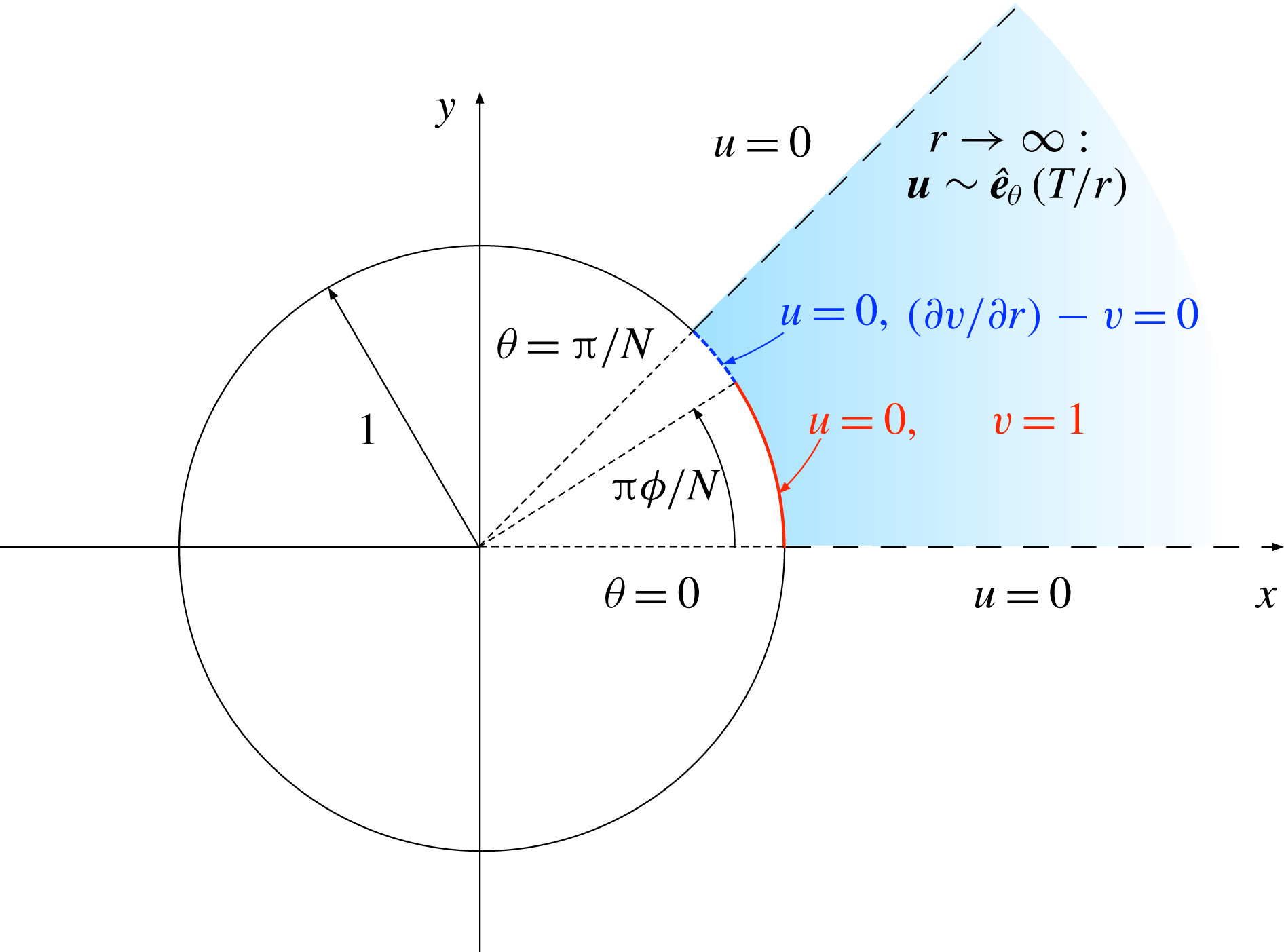
. It follows that one may actually solve the preceding problem in the ‘semi-sector’
 $0<\unicode[STIX]{x1D703}<\unicode[STIX]{x03C0}/N$
, with condition (2.3) becoming
 $$\begin{eqnarray}\displaystyle u=0\quad \text{at }\unicode[STIX]{x1D703}=0,{\displaystyle \frac{\unicode[STIX]{x03C0}}{N}}; & & \displaystyle\end{eqnarray}$$
the associated problem is depicted in figure 2. Second, we note that in the absence of grooves the flow field is simply that of a two-dimensional rotlet (Pozrikidis Reference Pozrikidis2011),
 $$\begin{eqnarray}\displaystyle v={\displaystyle \frac{1}{r}},\quad u\equiv 0,\quad p\equiv 0. & & \displaystyle\end{eqnarray}$$
The hydrodynamic problem in the semi-sector
 $0<\unicode[STIX]{x1D703}<\unicode[STIX]{x03C0}/N$
(with
 $N=4$
).

Our interest is in the hydrodynamic torque (per unit length in the
 $x_{3}$
-direction) in the negative
 $x_{3}$
-direction. Normalized by
 $4\unicode[STIX]{x03C0}\unicode[STIX]{x1D707}a^{2}\unicode[STIX]{x1D6FA}$
, it is given by
 $$\begin{eqnarray}\displaystyle T=-{\displaystyle \frac{1}{4\unicode[STIX]{x03C0}}}\int _{-\unicode[STIX]{x03C0}}^{\unicode[STIX]{x03C0}}\left({\displaystyle \frac{\unicode[STIX]{x2202}v}{\unicode[STIX]{x2202}r}}-v\right)_{r=1}\,\text{d}\unicode[STIX]{x1D703}, & & \displaystyle\end{eqnarray}$$
or, upon use of periodicity,
 $$\begin{eqnarray}\displaystyle T=-{\displaystyle \frac{N}{4\unicode[STIX]{x03C0}}}\int _{-\unicode[STIX]{x03C0}\unicode[STIX]{x1D719}/N}^{\unicode[STIX]{x03C0}\unicode[STIX]{x1D719}/N}\left({\displaystyle \frac{\unicode[STIX]{x2202}v}{\unicode[STIX]{x2202}r}}-v\right)_{r=1}\,\text{d}\unicode[STIX]{x1D703}. & & \displaystyle\end{eqnarray}$$
Note that in the Stokes regime, where the stress is divergence-free, the torque may be evaluated over any closed curve which encloses the circle
 $r=1$
. In particular, choosing a circle of large radius we obtain the following alternative to (2.8):
 $$\begin{eqnarray}\displaystyle T=-{\displaystyle \frac{1}{4\unicode[STIX]{x03C0}}}\int _{-\unicode[STIX]{x03C0}}^{\unicode[STIX]{x03C0}}\lim _{r\rightarrow \infty }\left[r^{2}\left({\displaystyle \frac{\unicode[STIX]{x2202}v}{\unicode[STIX]{x2202}r}}-{\displaystyle \frac{v}{r}}\right)\right]\,\text{d}\unicode[STIX]{x1D703}. & & \displaystyle\end{eqnarray}$$
The large-
 $r$
velocity behaviour implied by (2.10) is
 $$\begin{eqnarray}\displaystyle \boldsymbol{u}\sim \hat{\boldsymbol{e}}_{\unicode[STIX]{x1D703}}{\displaystyle \frac{T}{r}}+O(r^{-2})\quad \text{for }r\rightarrow \infty . & & \displaystyle\end{eqnarray}$$
In particular, the torque corresponding to (2.7) is
 $T=1$
.
A more convenient formulation is obtained by subtracting off the far-field rotlet (2.11)
 $$\begin{eqnarray}\displaystyle \boldsymbol{u}^{\prime }=\boldsymbol{u}-\hat{\boldsymbol{e}}_{\unicode[STIX]{x1D703}}{\displaystyle \frac{T}{r}}. & & \displaystyle\end{eqnarray}$$
The excess velocity
 $\boldsymbol{u}^{\prime }=\hat{\boldsymbol{e}}_{r}u^{\prime }+\hat{\boldsymbol{e}}_{\unicode[STIX]{x1D703}}v^{\prime }$
, which vanishes in the case of a homogeneous surface (see (2.7)), satisfies (together with the original pressure field
 $p$
) equations (2.1)–(2.3). In addition, it satisfies the dynamic conditions at
 $r=1$
(cf. (2.5))
 $$\begin{eqnarray}\displaystyle v^{\prime }=1-T\quad \text{for }|\unicode[STIX]{x1D703}|<{\displaystyle \frac{\unicode[STIX]{x1D719}\unicode[STIX]{x03C0}}{N}},\quad {\displaystyle \frac{\unicode[STIX]{x2202}v^{\prime }}{\unicode[STIX]{x2202}r}}-v^{\prime }=2T\quad \text{for }{\displaystyle \frac{\unicode[STIX]{x1D719}\unicode[STIX]{x03C0}}{N}}<|\unicode[STIX]{x1D703}|<{\displaystyle \frac{\unicode[STIX]{x03C0}}{N}}. & & \displaystyle\end{eqnarray}$$
The conceptual difference between the two formulations has to do with the calculation of the torque. In the original formulation, it is obtained by directly evaluating (2.9); in the excess-velocity formulation, it is obtained by imposing the refined condition on the far-field decay rate (cf. (2.4)),
 $$\begin{eqnarray}\displaystyle \boldsymbol{u}^{\prime }=O(r^{-2})\quad \text{for }r\gg 1. & & \displaystyle\end{eqnarray}$$
Note that this condition allows for the possibility of a faster decay rate than
 $r^{-2}$
.
We have therefore obtained a well-posed linear problem which depends upon two parameters – namely,
 $N$
and the solid fraction
 $\unicode[STIX]{x1D719}$
. It is not difficult to solve the preceding problem, for any numerical values of
 $N$
and
 $\unicode[STIX]{x1D719}$
, using a Fourier-series expansion in the spirit of Lauga & Stone (Reference Lauga and Stone2003). It turns out, however, that such a Fourier-series solution is inessential. To understand why, we consider now the asymptotic limit of large
 $N$
.
3 Large-
 $N$
limit

The large-
 $N$
limit is addressed using matched asymptotic expansions. The inner region, of
 $O(1/N)$
extent, is described by the stretched coordinates
 $$\begin{eqnarray}\displaystyle X={\displaystyle \frac{N(r-1)}{\unicode[STIX]{x03C0}}},\quad Y={\displaystyle \frac{N\unicode[STIX]{x1D703}}{\unicode[STIX]{x03C0}}}. & & \displaystyle\end{eqnarray}$$
In terms of these coordinates, the unit sector is bounded by
 $Y=\pm 1$
. While
 $X$
merely satisfies
 $X>0$
, we define the inner region by the requirement that
 $X$
is
 $O(1)$
there.
The outer region corresponds to the limit
 $N\rightarrow \infty$
with
 $r$
fixed. In that region, the fine details of the compound surface are not discerned. Since the excess velocity vanishes in the case of a homogeneous surface, we postulate that
 $\boldsymbol{u}^{\prime }$
is exponentially small there (i.e. it vanishes at all asymptotic orders when expanded in inverse powers of
 $N$
). This null solution trivially satisfies equations (2.1), conditions (2.3) and the strong version (2.14) of the decay condition.
Since the curvature is negligible in the inner region, it is evident that the Stokes equations (2.13) adopt there the approximate form (which resembles that in Cartesian coordinates),
 $$\begin{eqnarray}\displaystyle {\displaystyle \frac{\unicode[STIX]{x2202}u^{\prime }}{\unicode[STIX]{x2202}X}}+{\displaystyle \frac{\unicode[STIX]{x2202}v^{\prime }}{\unicode[STIX]{x2202}Y}}\approx 0,\quad {\displaystyle \frac{\unicode[STIX]{x03C0}}{N}}{\displaystyle \frac{\unicode[STIX]{x2202}p}{\unicode[STIX]{x2202}X}}\approx \unicode[STIX]{x0394}u^{\prime },\quad {\displaystyle \frac{\unicode[STIX]{x03C0}}{N}}{\displaystyle \frac{\unicode[STIX]{x2202}p}{\unicode[STIX]{x2202}Y}}\approx \unicode[STIX]{x0394}v^{\prime }, & & \displaystyle\end{eqnarray}$$
wherein
 $\unicode[STIX]{x1D6E5}=\unicode[STIX]{x2202}^{2}/\unicode[STIX]{x2202}X^{2}+\unicode[STIX]{x2202}^{2}/\unicode[STIX]{x2202}Y^{2}$
denotes the inner-region Laplacian. At the same level of approximation, conditions (2.13) become
 $$\begin{eqnarray}\displaystyle v^{\prime }\approx 1-T\quad \text{for }|Y|<\unicode[STIX]{x1D719},\qquad {\displaystyle \frac{\unicode[STIX]{x2202}v^{\prime }}{\unicode[STIX]{x2202}X}}\approx 0\quad \text{for }\unicode[STIX]{x1D719}<|Y|<1, & & \displaystyle\end{eqnarray}$$
at
 $X=0$
. In addition, matching with the quiescent outer region requires large-
 $X$
decay. By setting
 $T\approx 1$
, we find that the solution is trivial. The nil inner solution at
 $O(1)$
, which trivially satisfies (2.2)–(2.3), is consistent with our anticipation that the leading-order problem is identical to that about a homogeneous cylinder.
The problem structure suggests that the leading-order superhydrophobic effect is
 $O(1/N)$
. We accordingly write
 $$\begin{eqnarray}\displaystyle u^{\prime }={\displaystyle \frac{\unicode[STIX]{x03C0}U}{N}}+\cdots \,,\quad v^{\prime }={\displaystyle \frac{\unicode[STIX]{x03C0}V}{N}}+\cdots \,,\quad p=P+\cdots \,, & & \displaystyle\end{eqnarray}$$
where the fields
 $U$
,
 $V$
and
 $P$
are presumably
 $O(1)$
functions of
 $X$
and
 $Y$
. Consistently, we write
 $$\begin{eqnarray}\displaystyle T(N,\unicode[STIX]{x1D719})=1+{\displaystyle \frac{\unicode[STIX]{x03C0}\unicode[STIX]{x1D70F}(\unicode[STIX]{x1D719})}{N}}+\cdots \,, & & \displaystyle\end{eqnarray}$$
and seek to evaluate the leading-order correction
 $\unicode[STIX]{x1D70F}(\unicode[STIX]{x1D719})$
.
The leading-order flow variables
 $U$
,
 $V$
and
 $P$
are governed by (i) the continuity and Stokes equations (cf. (2.1)),
 $$\begin{eqnarray}\displaystyle {\displaystyle \frac{\unicode[STIX]{x2202}U}{\unicode[STIX]{x2202}X}}+{\displaystyle \frac{\unicode[STIX]{x2202}V}{\unicode[STIX]{x2202}Y}}=0,\quad {\displaystyle \frac{\unicode[STIX]{x2202}P}{\unicode[STIX]{x2202}X}}=\unicode[STIX]{x0394}U,\quad {\displaystyle \frac{\unicode[STIX]{x2202}P}{\unicode[STIX]{x2202}Y}}=\unicode[STIX]{x0394}V; & & \displaystyle\end{eqnarray}$$
(ii) the kinematic condition at
 $X=0$
,
 $$\begin{eqnarray}\displaystyle U=0; & & \displaystyle\end{eqnarray}$$
and (iii) the periodicity conditions (cf. (2.3)),
 $$\begin{eqnarray}\displaystyle U={\displaystyle \frac{\unicode[STIX]{x2202}V}{\unicode[STIX]{x2202}Y}}=0\quad \text{at }Y=\pm 1. & & \displaystyle\end{eqnarray}$$
In addition, they also satisfy the dynamic conditions at
 $X=0$
(cf. (2.5)),
 $$\begin{eqnarray}\displaystyle V=-\unicode[STIX]{x1D70F}\quad \text{for }|Y|<\unicode[STIX]{x1D719},\quad {\displaystyle \frac{\unicode[STIX]{x2202}V}{\unicode[STIX]{x2202}X}}=2\quad \text{for }\unicode[STIX]{x1D719}<|Y|<1, & & \displaystyle\end{eqnarray}$$
and the decay condition
 $$\begin{eqnarray}\displaystyle \lim _{X\rightarrow \infty }V=0. & & \displaystyle\end{eqnarray}$$
Note that the latter does not follow from the original decay condition (2.4), which does not apply in the inner region. Rather, it follows from the need to match the quiescent outer solution.
Defining
 $\tilde{V}=V+\unicode[STIX]{x1D70F}-2X$
we find that the fictitious flow field
 $\hat{\boldsymbol{e}}_{r}U+\hat{\boldsymbol{e}}_{\unicode[STIX]{x1D703}}\tilde{V}$
, with the same pressure
 $P$
, satisfies (3.6)–(3.8). In terms of that field, conditions (3.9) at
 $X=0$
transform to the homogeneous conditions,
 $$\begin{eqnarray}\displaystyle \tilde{V}=0\quad \text{for }|Y|<\unicode[STIX]{x1D719},\quad {\displaystyle \frac{\unicode[STIX]{x2202}\tilde{V}}{\unicode[STIX]{x2202}X}}=0\quad \text{for }\unicode[STIX]{x1D719}<|Y|<1, & & \displaystyle\end{eqnarray}$$
while the far-field decay (3.10) is replaced by
 $$\begin{eqnarray}\displaystyle \tilde{V}\sim -2X+\unicode[STIX]{x1D70F}+o(1)\quad \text{for }X\gg 1. & & \displaystyle\end{eqnarray}$$
The problem governing
 $(U,\tilde{V})$
is analogous to the problem of transverse shear over a periodic array of flat bubbles, which was solved by Philip (Reference Philip1972). Making use of the asymptotic behaviour of his solution at large distances (Lauga & Stone Reference Lauga and Stone2003), we find that
 $$\begin{eqnarray}\displaystyle \tilde{V}\sim -2X+{\displaystyle \frac{2}{\unicode[STIX]{x03C0}}}\ln \sin {\displaystyle \frac{\unicode[STIX]{x03C0}\unicode[STIX]{x1D719}}{2}}+o(1)\quad \text{for }X\gg 1. & & \displaystyle\end{eqnarray}$$
Comparing with (3.12) thus gives
 $$\begin{eqnarray}\displaystyle \unicode[STIX]{x1D70F}={\displaystyle \frac{2}{\unicode[STIX]{x03C0}}}\ln \sin {\displaystyle \frac{\unicode[STIX]{x03C0}\unicode[STIX]{x1D719}}{2}}. & & \displaystyle\end{eqnarray}$$
We conclude that the torque is
 $$\begin{eqnarray}\displaystyle T=1+{\displaystyle \frac{2}{N}}\ln \sin {\displaystyle \frac{\unicode[STIX]{x03C0}\unicode[STIX]{x1D719}}{2}}+\cdots \quad \text{for }N\gg 1. & & \displaystyle\end{eqnarray}$$
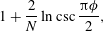
Inversion thus provides the requisite approximation for the enhanced mobility
 $$\begin{eqnarray}\displaystyle M\sim 1+{\displaystyle \frac{2}{N}}\ln \csc {\displaystyle \frac{\unicode[STIX]{x03C0}\unicode[STIX]{x1D719}}{2}}+\cdots \quad \text{for }N\gg 1. & & \displaystyle\end{eqnarray}$$
4 Functional dependence upon
$N$

We now consider the general case, where
 $N$
is not necessarily large. Without trying to actually solve that formidable problem, we try to extract the structure by which the torque depends upon the number of grooves
 $N$
. To that end we hereafter employ the subscript ‘
 $N$
’ to denote quantities associated with
 $N$
grooves. Thus, the excess liquid velocity is denoted by
 $\boldsymbol{u}_{N}^{\prime }$
, while the associated torque is denoted by
 $T_{N}$
.
We define the streamfunction
 $\unicode[STIX]{x1D713}_{N}$
associated with the excess velocity
 $\boldsymbol{u}_{N}^{\prime }$
via the relation
 $$\begin{eqnarray}\displaystyle \boldsymbol{u}_{N}^{\prime }=\unicode[STIX]{x1D735}\unicode[STIX]{x1D713}_{N}\times \hat{\boldsymbol{e}}_{z}, & & \displaystyle\end{eqnarray}$$
or, equivalently,
 $$\begin{eqnarray}\displaystyle u_{N}^{\prime }={\displaystyle \frac{1}{r}}{\displaystyle \frac{\unicode[STIX]{x2202}\unicode[STIX]{x1D713}_{N}}{\unicode[STIX]{x2202}\unicode[STIX]{x1D703}}},\quad v_{N}^{\prime }=-{\displaystyle \frac{\unicode[STIX]{x2202}\unicode[STIX]{x1D713}_{N}}{\unicode[STIX]{x2202}r}}. & & \displaystyle\end{eqnarray}$$
The streamfunction
 $\unicode[STIX]{x1D713}_{N}$
satisfies the biharmonic equation in the semi-sector
 $0<\unicode[STIX]{x1D703}<\unicode[STIX]{x03C0}/N$
. Since it is defined up to within an additive constant, the kinematic condition (2.2) may be simply written
 $$\begin{eqnarray}\displaystyle \unicode[STIX]{x1D713}_{N}=0\quad \text{for }r=1. & & \displaystyle\end{eqnarray}$$
In addition to (4.3),
 $\unicode[STIX]{x1D713}_{N}$
satisfies the periodicity conditions (cf. (2.6))
 $$\begin{eqnarray}\displaystyle {\displaystyle \frac{\unicode[STIX]{x2202}\unicode[STIX]{x1D713}_{N}}{\unicode[STIX]{x2202}\unicode[STIX]{x1D703}}}=0\quad \text{at }\unicode[STIX]{x1D703}=0,{\displaystyle \frac{\unicode[STIX]{x03C0}}{N}}; & & \displaystyle\end{eqnarray}$$
the decay requirement (cf. (2.14))
 $$\begin{eqnarray}\displaystyle \unicode[STIX]{x1D713}_{N}=O(1/r)\quad \text{for }r\rightarrow \infty ; & & \displaystyle\end{eqnarray}$$
and the dynamic conditions at
 $r=1$
(cf. (2.13))
 $$\begin{eqnarray}\displaystyle & \displaystyle {\displaystyle \frac{\unicode[STIX]{x2202}\unicode[STIX]{x1D713}_{N}}{\unicode[STIX]{x2202}r}}=T_{N}-1\quad \text{for }0<\unicode[STIX]{x1D703}<{\displaystyle \frac{\unicode[STIX]{x1D719}\unicode[STIX]{x03C0}}{N}}, & \displaystyle\end{eqnarray}$$
 $$\begin{eqnarray}\displaystyle & \displaystyle {\displaystyle \frac{\unicode[STIX]{x2202}^{2}\unicode[STIX]{x1D713}_{N}}{\unicode[STIX]{x2202}r^{2}}}-{\displaystyle \frac{\unicode[STIX]{x2202}\unicode[STIX]{x1D713}_{N}}{\unicode[STIX]{x2202}r}}=-2T_{N}\quad \text{for }{\displaystyle \frac{\unicode[STIX]{x1D719}\unicode[STIX]{x03C0}}{N}}<\unicode[STIX]{x1D703}<{\displaystyle \frac{\unicode[STIX]{x03C0}}{N}}. & \displaystyle\end{eqnarray}$$
We now employ the Goursat representation for biharmonic functions (Langlois & Deville Reference Langlois and Deville1964), writing
 $z=x+\text{i}y$
and
 $$\begin{eqnarray}\displaystyle \unicode[STIX]{x1D713}_{N}=\text{Re}\{\bar{z}f(z)+g(z)\}, & & \displaystyle\end{eqnarray}$$
where
 $f(z)$
and
 $g(z)$
are analytic functions in the semi-sector
 $0<\arg z<\unicode[STIX]{x03C0}/N$
(with
 $|z|>1$
) and
 $\bar{z}=x-\text{i}y$
. Given (4.5), both
 $f$
and
 $\text{d}g/\text{d}z$
are
 $O(z^{-2})$
at large
 $|z|$
. Condition (4.3) suggests the following representation
 $$\begin{eqnarray}\displaystyle \unicode[STIX]{x1D713}_{N}=\text{Re}\left\{\left(\bar{z}-{\displaystyle \frac{1}{z}}\right)G(z)\right\}, & & \displaystyle\end{eqnarray}$$
where
 $G(z)$
is analytic in the semi-sector. It corresponds to
 $f=G$
and
 $g=-G/z$
in (4.8). The function
 $G$
is
 $O(z^{-2})$
at large
 $|z|$
.
Since
 $G(z)/z$
is analytic in the semi-sector, its real part
 $$\begin{eqnarray}\displaystyle \unicode[STIX]{x1D712}(r,\unicode[STIX]{x1D703})=\text{Re}\left\{{\displaystyle \frac{G(z)}{z}}\right\} & & \displaystyle\end{eqnarray}$$
is harmonic there. In terms of
 $\unicode[STIX]{x1D712}$
, representation (4.9) reads
 $$\begin{eqnarray}\displaystyle \unicode[STIX]{x1D713}_{N}=(r^{2}-1)\unicode[STIX]{x1D712}(r,\unicode[STIX]{x1D703}). & & \displaystyle\end{eqnarray}$$
With that form, the impermeability condition (4.3) is indeed trivially satisfied. Upon differentiation with respect to
 $r$
we find that conditions (4.6)–(4.7) become
 $$\begin{eqnarray}\displaystyle 2\unicode[STIX]{x1D712}(1,\unicode[STIX]{x1D703})=T_{N}-1\quad \text{for }0<\unicode[STIX]{x1D703}<{\displaystyle \frac{\unicode[STIX]{x1D719}\unicode[STIX]{x03C0}}{N}}, & & \displaystyle\end{eqnarray}$$
 $$\begin{eqnarray}\displaystyle 2{\displaystyle \frac{\unicode[STIX]{x2202}\unicode[STIX]{x1D712}}{\unicode[STIX]{x2202}r}}(1,\unicode[STIX]{x1D703})=T_{N}\quad \text{for }{\displaystyle \frac{\unicode[STIX]{x1D719}\unicode[STIX]{x03C0}}{N}}<\unicode[STIX]{x1D703}<{\displaystyle \frac{\unicode[STIX]{x03C0}}{N}}. & & \displaystyle\end{eqnarray}$$
Also, upon differentiation with respect to
 $\unicode[STIX]{x1D703}$
we find that condition (4.4) becomes
 $$\begin{eqnarray}\displaystyle {\displaystyle \frac{\unicode[STIX]{x2202}\unicode[STIX]{x1D712}}{\unicode[STIX]{x2202}\unicode[STIX]{x1D703}}}=0\quad \text{at }\unicode[STIX]{x1D703}=0,{\displaystyle \frac{\unicode[STIX]{x03C0}}{N}}\quad \text{for }r>1. & & \displaystyle\end{eqnarray}$$
Last, the decay condition (4.5) now reads
 $$\begin{eqnarray}\displaystyle \unicode[STIX]{x1D712}=O(1/r^{3})\quad \text{for }r\rightarrow \infty . & & \displaystyle\end{eqnarray}$$
We have therefore transformed the flow problem into a boundary-value problem governing a harmonic function. Rather than trying to solve the above problem, we choose a different approach: we employ the structure (4.12)–(4.15) to relate the streamfunction appropriate for
 $2N$
grooves,
 $\unicode[STIX]{x1D713}_{2N}$
, to that appropriate for
 $N$
grooves,
 $\unicode[STIX]{x1D713}_{N}$
. In doing so, it is convenient to denote the polar coordinates associated with the problem governing
 $\unicode[STIX]{x1D713}_{2N}$
by, say,
 $\unicode[STIX]{x1D70C}$
and
 $\unicode[STIX]{x1D6FC}$
, so as to distinguish them from the
 $(r,\unicode[STIX]{x1D703})$
polar coordinates associated with the problem governing
 $\unicode[STIX]{x1D713}_{N}$
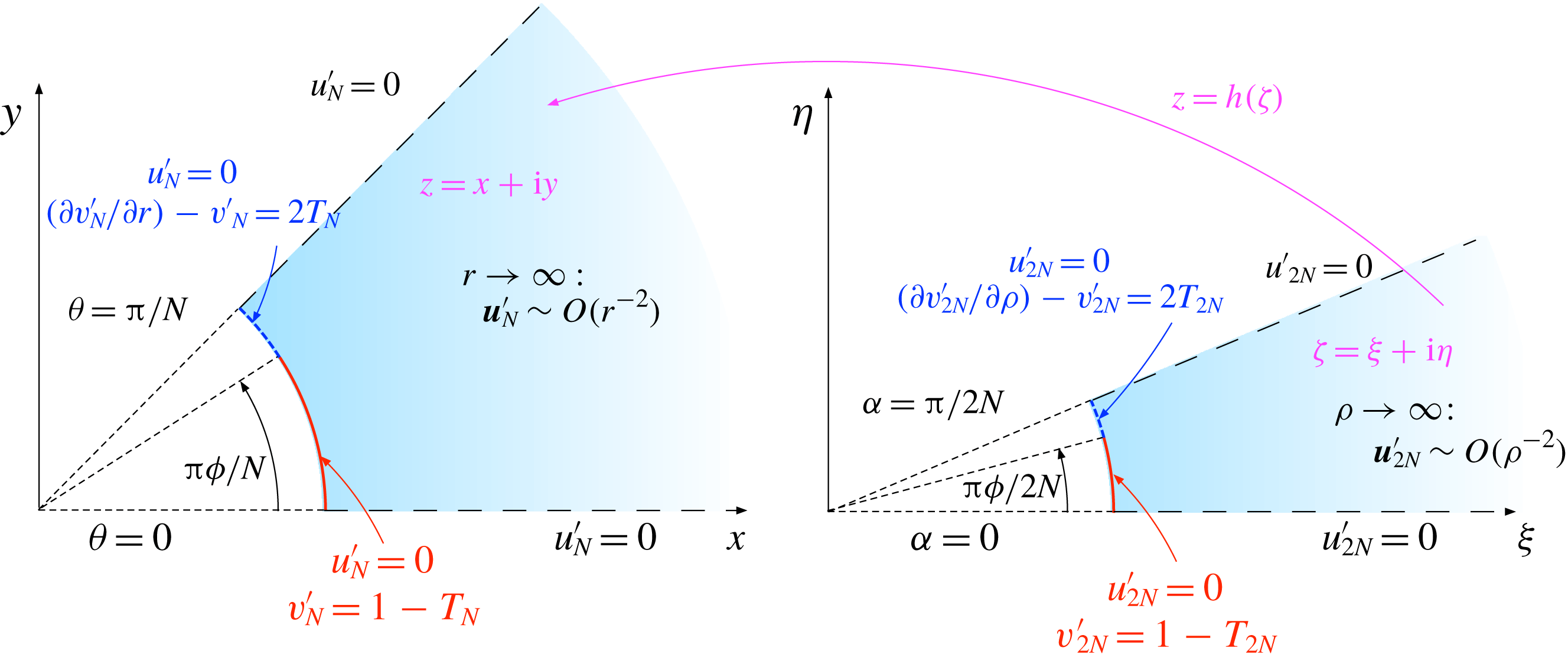
. Adopting (4.3)–(4.7) to the excess-velocity problem for
 $2N$
grooves, as detailed in figure 3, the biharmonic function
 $\unicode[STIX]{x1D713}_{2N}(\unicode[STIX]{x1D70C},\unicode[STIX]{x1D6FC})$
must satisfy: (i) kinematic impermeability,
 $$\begin{eqnarray}\displaystyle \unicode[STIX]{x1D713}_{2N}=0\quad \text{for }\unicode[STIX]{x1D70C}=1; & & \displaystyle\end{eqnarray}$$
(ii) the periodicity conditions,
 $$\begin{eqnarray}\displaystyle {\displaystyle \frac{\unicode[STIX]{x2202}\unicode[STIX]{x1D713}_{2N}}{\unicode[STIX]{x2202}\unicode[STIX]{x1D6FC}}}=0\quad \text{at }\unicode[STIX]{x1D6FC}=0,{\displaystyle \frac{\unicode[STIX]{x03C0}}{2N}}; & & \displaystyle\end{eqnarray}$$
(iii) the decay requirement,
 $$\begin{eqnarray}\displaystyle \unicode[STIX]{x1D713}_{2N}=O(1/\unicode[STIX]{x1D70C})\quad \text{for }\unicode[STIX]{x1D70C}\rightarrow \infty ; & & \displaystyle\end{eqnarray}$$
and (iv) the dynamic conditions at
 $\unicode[STIX]{x1D70C}=1$
,
 $$\begin{eqnarray}\displaystyle & \displaystyle {\displaystyle \frac{\unicode[STIX]{x2202}\unicode[STIX]{x1D713}_{2N}}{\unicode[STIX]{x2202}r}}=T_{2N}-1\quad \text{for }0<\unicode[STIX]{x1D6FC}<{\displaystyle \frac{\unicode[STIX]{x1D719}\unicode[STIX]{x03C0}}{2N}}, & \displaystyle\end{eqnarray}$$
 $$\begin{eqnarray}\displaystyle & \displaystyle {\displaystyle \frac{\unicode[STIX]{x2202}^{2}\unicode[STIX]{x1D713}_{2N}}{\unicode[STIX]{x2202}\unicode[STIX]{x1D70C}^{2}}}-{\displaystyle \frac{\unicode[STIX]{x2202}\unicode[STIX]{x1D713}_{2N}}{\unicode[STIX]{x2202}\unicode[STIX]{x1D70C}}}=-2T_{2N}\quad \text{for }{\displaystyle \frac{\unicode[STIX]{x1D719}\unicode[STIX]{x03C0}}{2N}}<\unicode[STIX]{x1D6FC}<{\displaystyle \frac{\unicode[STIX]{x03C0}}{2N}}. & \displaystyle\end{eqnarray}$$
The excess-velocity boundary conditions for
 $N$
and
 $2N$
grooves in the appropriate semi-sectors
 $0<\unicode[STIX]{x1D703}<\unicode[STIX]{x03C0}/N$
and
 $0<\unicode[STIX]{x1D6FC}<\unicode[STIX]{x03C0}/2N$
.

Consider a conformal mapping
 $z=h(\unicode[STIX]{x1D701})$
from the complex
 $\unicode[STIX]{x1D701}$
-plane, with
 $\unicode[STIX]{x1D701}=\unicode[STIX]{x1D709}+\text{i}\unicode[STIX]{x1D702}=\unicode[STIX]{x1D70C}\text{e}^{\text{i}\unicode[STIX]{x1D6FC}}$
, to the
 $z$
-plane. By choosing
 $$\begin{eqnarray}\displaystyle h(\unicode[STIX]{x1D701})=\unicode[STIX]{x1D701}^{2}, & & \displaystyle\end{eqnarray}$$
the pre-image of the semi-sector in the
 $z$
-plane is the semi-sector for the
 $2N$
-grooves problem, where
 $0<\unicode[STIX]{x1D6FC}<\unicode[STIX]{x03C0}/2N$
: see figure 3. We claim that the relevant streamfunction is
 $$\begin{eqnarray}\displaystyle \unicode[STIX]{x1D713}_{2N}=C_{N}\text{Re}\left\{\left(\bar{\unicode[STIX]{x1D701}}-{\displaystyle \frac{1}{\unicode[STIX]{x1D701}}}\right){\displaystyle \frac{G(h(\unicode[STIX]{x1D701}))}{\unicode[STIX]{x1D701}}}\right\}, & & \displaystyle\end{eqnarray}$$
wherein
 $C_{N}$
is a constant. Since representation (4.22) is of the Goursat form (4.8), it clearly satisfies the biharmonic equation. To prove our assertion, we accordingly need to show that conditions (i)–(iv) above are also satisfied.
To that end we make use of (4.10) and (4.21), which transform (4.22) to
 $$\begin{eqnarray}\displaystyle \unicode[STIX]{x1D713}_{2N}=C_{N}(\unicode[STIX]{x1D70C}^{2}-1)\unicode[STIX]{x1D712}(\unicode[STIX]{x1D70C}^{2},2\unicode[STIX]{x1D6FC}). & & \displaystyle\end{eqnarray}$$
We now note that (i) representation (4.23) trivially satisfies the impermeability condition (4.16); (ii) differentiating it with respect to
 $\unicode[STIX]{x1D6FC}$
and making use of (4.4) shows that the periodicity conditions (4.17) are satisfied; and (iii) substitution of (4.15) into (4.23) gives
 $\unicode[STIX]{x1D713}_{2N}=O(\unicode[STIX]{x1D70C}^{-4})$
at large
 $\unicode[STIX]{x1D70C}$
, which accordingly satisfies the far-field requirement (4.18).
It remains to show that the dynamic conditions (4.19)–(4.20) are also satisfied. Differentiating (4.23) with respect to
 $\unicode[STIX]{x1D70C}$
shows that these conditions are equivalent to
 $$\begin{eqnarray}\displaystyle 2C_{N}\unicode[STIX]{x1D712}(1,2\unicode[STIX]{x1D6FC})=T_{2N}-1\quad \text{for }0<\unicode[STIX]{x1D6FC}<{\displaystyle \frac{\unicode[STIX]{x1D719}\unicode[STIX]{x03C0}}{2N}}, & & \displaystyle\end{eqnarray}$$
 $$\begin{eqnarray}\displaystyle 4C_{N}{\displaystyle \frac{\unicode[STIX]{x2202}\unicode[STIX]{x1D712}}{\unicode[STIX]{x2202}r}}(1,2\unicode[STIX]{x1D6FC})=T_{2N}\quad \text{for }{\displaystyle \frac{\unicode[STIX]{x1D719}\unicode[STIX]{x03C0}}{2N}}<\unicode[STIX]{x1D6FC}<{\displaystyle \frac{\unicode[STIX]{x03C0}}{2N}}. & & \displaystyle\end{eqnarray}$$
Comparing with (4.12)–(4.13) reveals that conditions (4.24)–(4.25) are satisfied if and only if
 $$\begin{eqnarray}\displaystyle C_{N}(T_{N}-1)=T_{2N}-1,\quad 2C_{N}T_{N}=T_{2N}. & & \displaystyle\end{eqnarray}$$
Elimination of
 $C_{N}$
provides the recursive equation
 $$\begin{eqnarray}\displaystyle T_{2N}={\displaystyle \frac{2T_{N}}{1+T_{N}}}, & & \displaystyle\end{eqnarray}$$
whose general solution is
 $$\begin{eqnarray}\displaystyle T_{N}={\displaystyle \frac{N}{N+{\mathcal{C}}}}. & & \displaystyle\end{eqnarray}$$
The ‘integration constant’
 ${\mathcal{C}}$
is independent of
 $N$
and can only depend upon
 $\unicode[STIX]{x1D719}$
. We conclude that the mobility
 $M_{N}=1/T_{N}$
is
 $$\begin{eqnarray}\displaystyle M_{N}={\displaystyle \frac{N+{\mathcal{C}}(\unicode[STIX]{x1D719})}{N}}. & & \displaystyle\end{eqnarray}$$
We have therefore obtained the general structure for the dependence of the cylinder mobility upon
 $N$
. Since we did not solve the flow problem, we cannot obtain the explicit form of
 ${\mathcal{C}}(\unicode[STIX]{x1D719})$
using that method. Nonetheless, that form may be obtained indirectly: making use of the large-
 $N$
asymptotic sequence
 $1,1/N,1/N^{2},\ldots$
we find that the exact expression (4.29) constitutes a large-
 $N$
asymptotic expansion in this sequence which consists of only two terms,
 $1+{\mathcal{C}}/N$
. Comparing with (3.16) and making use of the uniqueness of the coefficients of any asymptotic expansion (Bender & Orszag Reference Bender and Orszag1978) we conclude that
 $$\begin{eqnarray}\displaystyle {\mathcal{C}}(\unicode[STIX]{x1D719})=2\ln \csc {\displaystyle \frac{\unicode[STIX]{x03C0}\unicode[STIX]{x1D719}}{2}}, & & \displaystyle\end{eqnarray}$$
and that the asymptotic expansion (3.16) actually terminates after the
 $O(1/N)$
term. We have therefore obtained an exact expression for the mobility for the case where
 $N$
is an integer power of two.
Incidentally, it is evident from our construction that for each such
 $N$
the excess velocity
 $\boldsymbol{u}_{2N}^{\prime }$
decays faster than
 $\boldsymbol{u}_{N}^{\prime }$
. To elucidate this mechanism, we write
 $N=2^{k}$
with
 $k=0,1,2,\ldots$
and postulate that
 $\unicode[STIX]{x1D713}_{N}=O(r^{-\unicode[STIX]{x1D706}_{k}})$
for
 $r\rightarrow \infty$
, with
 $\unicode[STIX]{x1D706}_{k}\geqslant 1$
. (This asymptotic relation is clearly more restrictive than (4.5).) From (4.11) and (4.23) it readily follows that
 $\unicode[STIX]{x1D706}_{k+1}=2\unicode[STIX]{x1D706}_{k}+2$
. The solution of this recursive equation subject to
 $\unicode[STIX]{x1D706}_{0}=1$
(which follows from (4.5)) is
 $\unicode[STIX]{x1D706}_{k}=3\times 2^{k}-2$
. We conclude that the excess velocity
 $\boldsymbol{u}_{N}^{\prime }$
is
 $O(r^{1-3N})$
at large
 $r$
. This rapid increase in the decay rate is consistent with our postulate of exponentially small outer velocity in the large-
 $N$
limit.
5 Concluding remarks
Motivated by the desire to understand rigid-body motion of a superhydrophobic particle in a viscous liquid, we have considered what may be the simplest problem in that class – namely, the rotation of an infinite cylinder which is decorated by longitudinal grooves. The dimensionless Stokes-flow problem involves two geometric parameters: the solid fraction
 $\unicode[STIX]{x1D719}$
and the number
 $N$
of grooves. We have obtained a two-term asymptotic approximation in the limit where
 $N$
is large. Making use of conformal-mapping techniques, we proved that this approximation is actually exact whenever
 $N$
is an integer power of two. Comparison of the mobility expression (4.29)–(4.30) with that obtained from the Fourier-series solution of the Stokes-flow problem shows perfect agreement. We accordingly conjecture that (4.29)–(4.30) holds for all
 $N$
.
The complex-variable approach has been used in this paper so as to extract the functional dependence of the rotational mobility upon the number of grooves. This approach can actually be used in order to transform the flow problem into a Hilbert problem, which results a semi-analytic expression for all the pertinent fluid dynamic quantities. While the semi-analytic Hilbert-transform solutions cannot provide the explicit mobility expression (4.29)–(4.30), they may be utilized for the construction of convenient numerical solutions in the more general case of a non-uniform (i.e. aperiodic) distribution of grooves. (Techniques introduced by Crowdy Reference Crowdy2013b , which avoid the difficulties associated with end point singularities at the points where the boundary conditions change type, may also be useful here.) The Hilbert-transform approach can be used, moreover, to recover analytical solutions in other two-dimensional Stokes-flow problems, such as the slip–stick Janus swimmers considered by Crowdy (Reference Crowdy2013a ). Details will be given in a future paper.
Given the Stokes paradox, the rotational mobility obtained in the present contribution is the only existing component in the mobility tensor – no other mobility problem can be sensibly formulated in the present context of two-dimensional unbounded flow. On the other hand, there is no obstruction to finding the full resistance tensor for a two-dimensional particle near a plane wall (Crowdy Reference Crowdy2013c ) – a situation of interest in applications. The mobility of a cylinder near a superhydrophobic wall has been addressed recently by Schnitzer & Yariv (Reference Schnitzer and Yariv2019); a natural follow-up of both that work and the present analysis would involve the calculation of the mobility tensor of a superhydrophobic cylinder near a no-slip wall (Kaynan & Yariv Reference Kaynan and Yariv2017).
Acknowledgements
E.Y. acknowledges support from the Israel Science Foundation (grant no. 1081/16). M.S. acknowledges support from the National Science Foundation (grant no. DMS-1909407). We thank M. Hodes and D. Kane for useful discussions and for their help in preparing figure 1.