Introduction
As health declines with increasing age, older people often experience difficulty performing everyday activities because environmental demands exceed their diminished personal capabilities (Verbrugge and Jette Reference Verbrugge and Jette1994). Many daily activities involve interactions between people and the designed artefacts with which they are surrounded or within which they are situated (i.e. products, systems, services or spaces). For example, shopping requires travelling through a store, lifting objects, and reading labels; cooking requires retrieving supplies from shelves, preparing food items, and operating kitchen appliances. The quality and success of those interactions is determined by the relationship between the functional capabilities of the person and the functional demands of the artefact. Evidence suggests that around half of the difficulties older people experience with daily activities can be overcome by better design (Rogers et al. Reference Rogers, Meyer, Walker and Fisk1998). For example, an older woman with arthritis in her hands may have difficulty opening jars or doors through weak grip and restricted finger flexion, but kitchen devices and special door-handles that take account of such capability loss can reduce the task demand and help overcome the difficulty (Verbrugge and Jette Reference Verbrugge and Jette1994). To design artefacts that are well suited to the tasks for which they are to be employed and the people who will use them, designers require an understanding of what functions certain tasks demand and what functional capabilities people have. Thus, the study of human functioning serves as a link between the health sciences and other disciplines such as engineering, design and human factors (Satariano Reference Satariano2006: 131).
‘Functioning' is a useful concept in studying health and wellbeing in later life because it relates to the underlying abilities that enable people to perform daily activities. An older person's functional level is closely related to the use of long-term care services and may be a better indicator of quality of life than the presence of certain diseases (Berkman and Gurland Reference Berkman and Gurland1998). Day-to-day activities in later life are frequently referred to by clinicians and researchers as the instrumental activities of daily living (IADLs) which include, but are not restricted to, preparing meals, doing housework and laundry, shopping for groceries, handling finances, managing medications and using the telephone (Lawton and Brody Reference Lawton and Brody1969). The ability to perform IADLs has been recognised as an important focus by which to promote independent living (Wiener et al. Reference Wiener, Hanley, Clark and Van Nostrand1990). Some authors (Ng et al. Reference Ng, Niti, Chiam and Kua2006; Stump et al. Reference Stump, Clark, Johnson and Wolinsky1997) have proposed that IADLs can be distinguished into physical and cognitive domains: difficulty with cooking, housework, laundering and shopping more obviously points to limitations in physical functioning, whereas difficulty with finances, medications and telephone to limitations in cognitive functioning (though all require some degree of both). The items in the cognitive domain were primarily designed for assessment of stroke patients, who may have cognitive impairment, and are less applicable to the wider older population (Ward, Jagger and Harper Reference Ward, Jagger and Harper1998). On the other hand, the items in the physical domain have been shown to correlate significantly with functional health status, suggesting that as health declines, older people may require more assistance with these to remain independent in the community (Whittle and Goldenberg Reference Whittle and Goldenberg1996). Thus, in developing strategies to maintain older people in their own homes, advances must be made in understanding the demands associated with physical IADLs.
When older people become limited in their activities, the home environment needs to be more supportive to compensate for such limitations (Lawton Reference Lawton1980). ‘Inclusive design’ is an approach to the design of products, services and environments that aims to consider the diverse needs of the wider population, including older people, and to minimise the exclusion of those who are less capable. The rationale behind this is to systematically identify the capability demands placed upon a person and to re-design features exceeding their capabilities (Keates and Clarkson Reference Keates and Clarkson2003). To develop designs that include older people who are excluded by disability, information is needed on how activities match to capabilities. Task analysis, or the study of what a person is required to do in order to achieve an objective (Kirwan and Ainsworth Reference Kirwan and Ainsworth1992), is useful for the description of an existing set of activities, such as IADLs. It provides a way to understand how people perform activities and what difficulties they face.
We conducted a systematic review of the literature on IADL task analyses. In January 2009, two electronic databases (ISI Web of Knowledge and PubMed) were systematically searched using a combination of the keywords ‘task analysis’ and ‘activities of daily living’ or ‘instrumental activities of daily living’ or ‘day-to-day activities’ or ‘daily living’, with no restriction on year or language of publication. Relevant studies were retrieved based on inspection of their title and abstract. For those that appeared promising, a full copy was examined. References of identified studies were scanned (‘cross-referencing’) to ensure that none were missed. Only peer-reviewed studies were considered with adult participants living in the community but not in institutions. From the 20 initial studies identified, only a single study (Clark, Czaja and Weber Reference Clark, Czaja and Weber1990) was judged to be of relevance and retrieved for examination. The authors were contacted and asked to provide details of the data that specified the demands associated with IADLs.
Task analysis
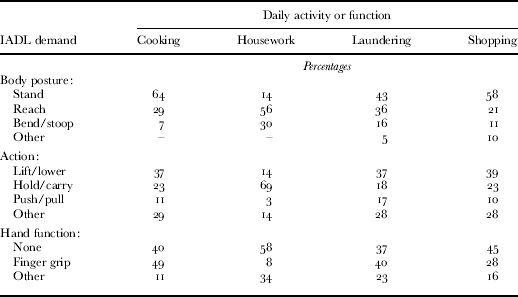
During 1984–87, Clark and colleagues analysed a number of tasks carried out by 60 older adults (11 single males, 30 single females and 19 couple members) living in the community. Their mean age was 72 years (range 55–93). The participants were videotaped in their own homes, at a laundromat (a self-service laundry) and in a grocery store. Definitions of task breakdowns were standardised based on specifically written software (Weber, Czaja and Redmond Reference Weber, Czaja and Redmond1988). Each task was decomposed into sub-tasks and, in turn, body postures, actions and hand functions. In this way, task demand profiles were generated for each activity considered. Overall, more than 20 activities were analysed, including the four IADLs of cooking, housework (‘vacuum-cleaning floors’), laundering and shopping. The frequencies of body postures (‘sit’, ‘stand’, ‘reach’ and ‘bend/stoop’), actions (‘lift/lower’, ‘push/pull’, ‘hold/carry’, ‘rotate/twist’, ‘side/side’, ‘hand to hand’, ‘shake’ and ‘drop/throw’), and hand functions (‘full’, ‘finger grip’, ‘palm’ and ‘cradle’) were recorded for each activity. The data were compiled so that body postures, actions and hand functions were mutually exclusive and summed to 100 per cent. For example, the body postures involved in cooking are made up by 64 per cent standing, 29 per cent reaching, and 7 per cent bending/stooping (Table 1). The most frequent body postures involved in cooking, housework, laundering and shopping were standing, reaching and bending/stooping. Lifting/lowering, holding/carrying and pushing/pulling were the most frequent actions across all activities, and finger grip the most frequent hand function.
IADL demands by body postures, actions and hand functions
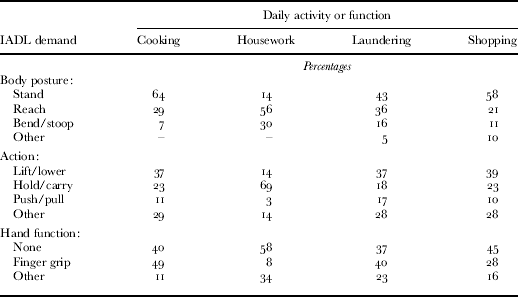
Note: Sample size 60. The sample was a convenience sample of healthy residents from two counties in the state of Florida in 1984–87. IADL: instrumental activity of daily living.
Source: Derived from unpublished data from the task analysis conducted by Clark, Czaja and Weber (Reference Clark, Czaja and Weber1990) .
Our objectives were to investigate how the activity demands relate to the capabilities of a sample of older people in Great Britain, and to discuss the population-level implications of the findings for interventions to redesign the task environment.
Materials and methods
Study design
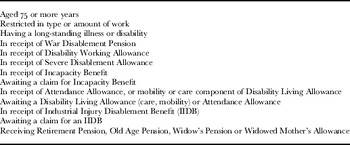
The Disability Follow-up Survey (DFS) was conducted in 1996–97 by the United Kingdom Office for National Statistics (ONS). A detailed description of the survey's rationale and the methods used can be found elsewhere (Devore Reference Devore1998). The Family Resource Survey (FRS) of 1996/97 determined the primary sample of the DFS, which covered the private household population of Great Britain aged 16 or more years. Computer-assisted face-to-face interviews were conducted with the participants (or their proxies). Respondents to the FRS with a disability, as indicated by 13 criteria (Table 2), were eligible for inclusion in the DFS. The DFS was treated as a separate survey with its own instructions and administration. Interviews were either conducted immediately after the FRS (75%) or at a later date (25%). More than 7,000 interviews were completed over nine months (July 1996 to March 1997).
Criteria used to assess eligibility for the Disability Follow-up Survey

Note: Respondents meeting any of the criteria were eligible, n.b. they did not have to be aged 75 or more years. The computer-assisted personal interview program checked the answers to certain questions of the Family Resources Survey which indicated that the respondent might have a disability.
Source: Devore (Reference Devore1998) .
Variables
The DFS data were scanned to identify the most frequent body postures, actions and hand functions. Standing was assessed by ‘difficulty standing’ and bend/stoop by ‘difficulty bending down and straightening up again’. A binary variable (difficulty/no difficulty) was generated based on difficulty reaching an arm ‘out in front’, ‘out to the side’, ‘up to the head’, ‘behind the back’ and ‘above the head’. The action lift/lower was assessed by the ability to ‘pick up a pint of milk’ (yes/no), hold/carry by ‘holding a mug of coffee or tea’, and push/pull by ‘squeezing water from a sponge’. ‘Turning a tap or control knobs of a cooker’ was selected for finger grip. All variables involving arms and hands were assessed for both the right and left side. If a person was right-handed the variable asking about their right hand was used, and if they were left-handed that hand's variable was used. The respondents were finally asked whether they had difficulty with cooking (‘preparing a hot meal’), housework (‘using a vacuum cleaner to clean the floor’), laundering (‘washing clothes or bed linens’), and shopping (‘doing the household shopping on one's own’). Scores of ‘1’ indicated difficulty and of ‘0’ indicated no difficulty. Responses to a sequence of ‘yes/no’ questions were used to grade the severity of disability, e.g. participants who said they had ‘no difficulty holding, gripping or turning things’ were asked no further questions about actions, including the abilities lift/lower, hold/carry and push/pull, but instead were assumed capable of conducting actions at these lower levels of functioning.
The sample
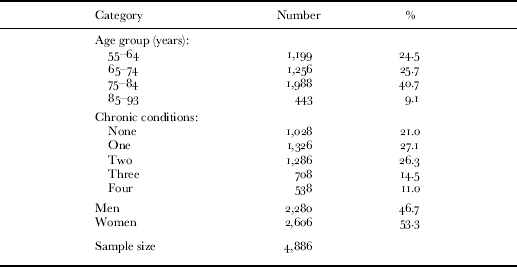
The analysis sample initially had 4,898 participants aged 55–93 years (mean 72). Twelve participants with missing values for any variable were excluded, leaving 4,886. Based on the data provided by Clark et al., people with full body posture, action and hand function should be able to perform most IADLs without difficulty. A sub-analysis was performed where the DFS sample was restricted to participants with no difficulty standing, reaching and bending/stooping, able to lift/lower, hold/carry and push/pull, as well as with full finger grip. There were 2,147 highly capable such participants in the final sample.
Statistical analyses
Logistic regression was employed to predict the influence of limitations in body postures, actions and hand functions on difficulty with cooking, housework, laundering and shopping. Odds ratios (ORs) and 95 per cent confidence intervals (CIs) are reported. The regression models were adjusted for all variables as well as age, gender and the number of chronic conditions (up to four were recorded). Assuming causal associations, attributable fractions (AFs) were also calculated from the multivariable logistic regression models to determine the proportion of difficulty attributable to each limitation in the population. Individual risks do not provide information on the relevance of a certain limitation in a population that also contains people without that limitation. AFs help to assess the potential impact of interventions to redesign the task environment on the ability of older people to function well by considering both the individual association and the frequency of limitation. A risk factor strongly associated with IADL difficulty but uncommon in the sample is less relevant than a risk factor of similar effect size which is more common. In an attempt to prioritise the body postures, actions and hand functions, a matrix was developed with four categories (‘low’, ‘medium’, ‘high’ and ‘critical’) based on the AFs (determined by taking quartiles of the observed range). All analyses were undertaken using STATA version 9.1 and the AFs were estimated using the aflogit package (Brady Reference Brady1998).
Results
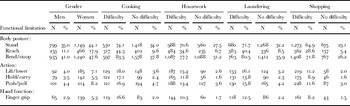
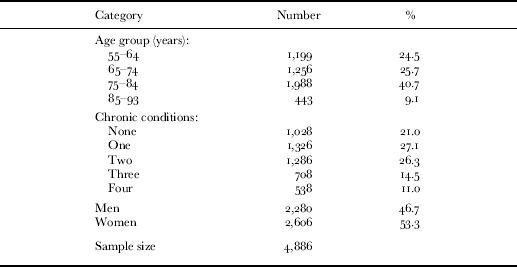
Table 3 presents the sample's characteristics. There were comparable numbers of men and women, and 41 per cent were aged 75–84 years. Around one-half reported one or two chronic conditions. The prevalence of difficulty in the IADLs was highest for shopping (40%), then housework (29%), laundering (19%) and cooking (15%). Both genders had similar levels of difficulties with cooking and laundering, but many more women than men had difficulty with housework (35% versus 21%) and shopping (50% versus 29%). Most participants reported difficulty with bending/stooping, followed by standing and reaching (Table 4). Few were unable to push/pull, lift/lower and hold/carry or had limited finger grip. Consistently higher levels of limitations were observed among women than men. When the prevalence of limitations in body postures, actions and hand functions was tabulated by IADL difficulty, markedly elevated levels were observed in those with IADL difficulties, particularly among the body postures.
The characteristics of the sample
Prevalence of functional limitations according to gender and IADL difficulty

Note: Sample size 4,886. IADL: instrumental activity of daily living.
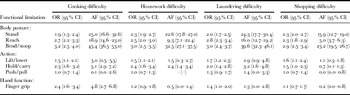
The results of the multivariable logistic regressions are given in Table 5. Standing was moderately associated with difficulty in cooking, housework, laundering and shopping (ORs 1.9–2.3). Stronger associations were observed for bending/stooping (ORs 2.9–3.2) and reaching (ORs 2.3–2.8). The action lift/lower was moderately associated across all activities (ORs 1.5–1.7). Hold/carry was more strongly related to difficulty with cooking, housework and laundering (ORs 2.0–2.4) than shopping (OR 1.5), and push/pull was not significantly associated with difficulty in any IADL. There was a moderate association between finger grip and difficulty in cooking (OR 2.4), and weak associations were found with housework, laundering and shopping (ORs 1.1–1.4).
Odds ratios, attributable fractions and 95 per cent confidence intervals for IADL difficulty

Note: Sample size 4,886. The analyses were adjusted for all variables in the table as well as age, sex and the number of chronic conditions. AF: attributable fraction. CI: confidence interval. IADL: instrumental activity of daily living. OR: odds ratio.
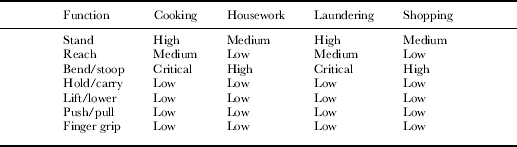
Most of the difficulties were attributable to limitations in body postures, primarily bending/stooping, then standing and reaching. Bending/stooping, for example, accounted for 45 per cent of the difficulty with cooking, 40 per cent of that with laundering, 32 per cent of that with housework, and 23 per cent of that with shopping. This is in line with the individual risk of bending/stooping, which yielded the highest adjusted OR. More difficulty was attributable to standing than reaching in connection with housework (23% versus 9%) and shopping (16% versus 5%), but less so for cooking (25% versus 19%). On the other hand, actions and hand functions accounted for little difficulty with the activities, contrasting with the individual risks. For example, hold/carry and finger grip each accounted for 5 per cent of the difficulty with cooking, lift/carry for 3 per cent and, as expected, almost no difficulty was attributable to limited pushing/pulling ability. Consequently, actions and hand functions were categorised as low priority, while bending/stooping was critical priority, standing was high priority, and reaching medium priority (Table 6). The 2,147 highly-capable respondents had a similar mean age (74 years versus 72 years) and sex distribution (women: 49% versus 53%) to the entire sample, but a higher prevalence of chronic conditions (at least one: 59% versus 79%). In the capable sample, 4 per cent had difficulty with cooking, 7 per cent with housework, 5 per cent with laundering, and 16 per cent with shopping.
Matrix indicating low, medium, high and critical priority levels
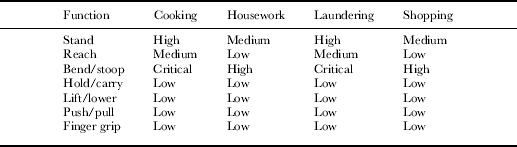
Note: Categories are based on the attributable fractions (Table 5); levels of risk were determined by taking quartiles of the observed range.
Discussion
This study has examined the associations between the IADL demands identified through a task analysis by Cherie Clark, Sara Czaja and Ruth Weber in a United States study published in 1990, using data on physical limitations extracted from the Great Britain Disability Follow-up Survey of 1996–97. Of course, differences may exist between the United States of America and Britain – for example in the size of dwellings, the layout of kitchens and grocery stores, and the nature of day-to-day activities – but it might be assumed that cooking, housework, laundering and shopping have made broadly similar demands in these two countries over the last two decades. If this assumption is correct, then using the task analysis by Clark et al. to guide selection of functional limitation items in the DFS should be acceptable. The variables were positively related to IADL difficulty, the strength of associations being generally comparable across activities (as indicated by the ORs). That is, persons with functional limitations in body postures, actions or hand functions were similarly likely to have difficulty with cooking, housework, laundering and shopping. This finding supports the American finding that activity demands are common across specific IADLs. However, not all limitations had the same relevance in the sample. Most participants reported difficulty with body postures, but few were unable to perform actions or had limited finger grip. As a result, the difficulties with cooking, housework, laundering and shopping were mainly attributable to limitations in body postures, with actions and hand functions accounting for much less of the overall risk (as indicated by the AFs).
Our analyses suggest that a range of interventions can potentially reduce difficulty with IADLs. A matrix has been presented that can be used to help decide which interventions should take priority at a population level. Design solutions to reduce the demands identified as either ‘medium’, ‘high’ or ‘critical’ include providing seating while preparing meals to address difficulty standing, lowering shelves and reducing their depth (or mounting them on rails for electronic operation) to address difficulty reaching, and having laundry pedestals with drawers to address difficulty bending/stooping (Seidel et al. Reference Seidel, Crilly, Matthews, Jagger, Brayne and Clarkson2009). Some results need further investigation; for example, hold/carry was categorised as low priority in terms of shopping. While this might suggest that most respondents had found ways to hold and carry groceries without great difficulty, it may turn out not to be true. For example, qualitative research by Sidenvall, Nydahl and Fjellström (Reference Sidenvall, Nydahl and Fjellström2001) found that many single older women buy few articles at a time, but go to the shops every day. More work is needed to verify our results and investigate how these relate to real-life experiences.
The DFS data have certain limitations. Its sample was drawn from the respondents to the parent Family Resource Survey, with the result that some age groups were under-represented. The compensatory over-sampling of 75–84-year-olds could have introduced bias, but this was at least partially accounted for by adjusting for age in the statistical analyses. It is possible that the DFS respondents differed from the non-respondents with regard to the outcomes of interest. To evaluate the potential for selection bias, the response rates to both surveys must be considered. The ratio of full interviews to eligible participants was 69 per cent in the FRS and 83 per cent in the DFS. Devore (Reference Devore1998) investigated the factors that may have influenced participation, including age, sex, region and the inclusion criteria. The response rate was virtually no different for men and women, while it was slightly lower for people aged less than 60 years (81% versus 85%) and varied somewhat by region (80–88%) as well as the inclusion criteria (80–88%). A further limitation of the DFS is that not all participants in the specified age range were asked the complete set of questions on body postures, actions and hand functions. We deemed the hierarchical order of questions to be valid, yet it may be that the results would be different if the entire sample had responded to all of the questions.
The validity of the results may be compromised by the DFS information being self-reports by the participants or (in 5 per cent of the cases) their proxies. Such information, however, has been found to be reliable (Smith et al. Reference Smith, Branch, Scherr, Wetle, Evans, Hebert and Taylor1990), concordant (Magaziner et al. Reference Magaziner, Bassett, Hebel and Gruber-Baldini1996), and comparable with objective performance measures (Reuben, Siu and Kimpau Reference Reuben, Siu and Kimpau1992). Yet, some discordance between self-reports and objective measures must be expected as a result, for example, of cognitive impairment, gender, age or level of education (Fors, Thorslund and Parker Reference Fors, Thorslund and Parker2006) – as measures collected in the two ways provide different types of information (Kivinen et al. Reference Kivinen, Sulkava, Halonen and Nissinen1998). Objective measures assess the functional capacity to perform activities, whereas self-reports assess the experienced difficulty. The latter might raise our understanding of the level of environmental challenge perceived by the individual due to the subjective factors they encompass. In addition, the questions on IADLs and body postures referred to performance (‘do you’), whereas those on actions and finger grip referred to capacity (‘can you’), which might elicit a different response. The former are perhaps less applicable if people choose not to perform an activity (despite having the capacity); the latter may be prone to reporting bias.
Our study defined reporting difficulty with IADLs as the outcome, although ‘needing help’ is an accepted and widely-used definition (Kovar and Lawton Reference Kovar and Lawton1994). Older people might report that they perform an activity without help but experience quite different degrees of difficulty (Haley et al. Reference Haley, Jette, Coster, Kooyoomjian, Levenson, Heeren and Ashba2002), and the definition could itself be dependent on external factors, such as living arrangements (Jagger et al. Reference Jagger, Arthur, Spiers and Clarke2001). IADLs require interaction with the home environment and its close surroundings, which might either exacerbate or narrow the gap between individual function and activity demand (Clarke and George Reference Clarke and George2005). Difficulty has therefore been introduced as an alternative to inability, because it is less affected by the presence of social support and possibly a better indicator of disability (Verbrugge Reference Verbrugge and Stahl1990). For example, an older couple might do the shopping together and be voluntarily dependent on each other (Ward, Jagger and Harper Reference Ward, Jagger and Harper1998). Finally, the intention of the DFS was to estimate the severity of disability among adults in Great Britain, not to provide optimal measures of body postures, actions and hand functions. Our results should be viewed as suggestive rather than definitive.
We found that risk factors with similar ORs yielded quite different attributable fractions. Body postures had the greatest impact on the ability to perform IADLs, which is consistent with evidence of an association between reduced lower extremity function and disability in the basic activities of daily living, such as bathing or dressing (Guralnik et al. Reference Guralnik, Ferrucci, Simonsick, Salive and Wallace1995; Ostir et al. Reference Ostir, Markides, Black and Goodwin1998). A hierarchy of disability has been identified whereby older people initially experience IADL deficits and later acquire basic ADL deficits in a sequential, overlapping order (Spector et al. Reference Spector, Katz, Murphy and Fulton1987). Consequently, the IADLs require a much higher level of competence than the basic ADLs.
Difficulty with IADLs increases steadily with age (Nikula et al. Reference Nikula, Jylhä, Bardage, Deeg, Gindin, Minicuci, Pluijm and Rodriguez-Laso2003), and medical conditions differentially affect development (Furner, Rudberg and Cassel Reference Furner, Rudberg and Cassel1995). Men and women differ with respect to what they actually do and what they are able to do (Avlund and Schultz-Larsen Reference Avlund and Schultz-Larsen1991). Particularly among today's older cohorts, cooking and housework are traditionally done by women and many men would have difficulty with these tasks as they have rarely, if ever, done them (‘gender bias’). We found that men were comparable to women in terms of cooking and laundering difficulty and reported less difficulty with housework and shopping. This is in line with findings that older women have a greater burden of disability than older men (Parker, Morgan and Dewey Reference Parker, Morgan and Dewey1997). Allen et al. (Reference Allen, Mor, Raveis and Houts1993) suggested that men's difficulties with tasks that have customarily been women's could be reduced by more than half. Ameliorative interventions for the two genders might well differ therefore: for example, interventions to help women do the shopping may be with lifting and carrying, while men might need training. To investigate this, the regression models would actually have to be run separately for men and women (adjusting for gender does not illuminate the issue). Age, sex and the number of chronic conditions were adjusted for in the logistic regression analyses. Other factors have been associated with functional status decline among older people in the community, such as cognitive impairment and poor self-rated health (Stuck et al. Reference Stuck, Walthert, Nikolaus, Büla, Hohmann and Beck1999). No adjustment was made for these factors, which could have attenuated the observed effects.
As was expected from the data provided by Clark and colleagues, most individuals in the highly functioning sample with full body posture, action and hand function were able to perform the IADLs without difficulty, although shopping in particular (the only activity related to the outdoors) seemed to be dependent on factors other than functional ability. While younger people may enjoy buying new products and going to different shops, evidence suggests that older people value the security of their local shop, familiar food items that are easy to find and pick up, as well as personally knowing and being known to the shop assistants (Sidenvall et al. Reference Sidenvall, Nydahl and Fjellström2001). Lastly, it is important to keep in mind that people make efforts to reduce the demands that tasks place upon them. According to the task analysis data, standing makes up 64 per cent of all body postures associated with cooking, but we only found a moderate association between difficulty standing and difficulty cooking (OR 1.9). People limited in their ability to stand may still be able to prepare a hot meal for themselves because of activity accommodations, environmental modifications, psychological coping or external supports (Verbrugge and Jette Reference Verbrugge and Jette1994).
The task analysis data give an insight into the demands associated with IADLs, but provide no information as to which sub-tasks are most critical. Future research should identify which sub-tasks require what body postures, actions and hand functions, so that specific interventions may be developed and tested. For example, cooking may be decomposed into preparing to cook, retrieving supplies, preparing, cooking and serving food, returning items, and cleaning up; and laundering may be decomposed into retrieving and transporting laundry, placing laundry in and removing it from the machine, hanging, folding and putting laundry away. Field studies are needed to help develop design guidelines for products, services and environments with better sensitivity to older people's needs.
Conclusions
Redesigning the task environment to reduce the gap between capability and demand has the potential to provide greater independence in later life. To perform such redesign successfully, designers require an understanding of which tasks demand what functions and which functions people have. This article has presented findings from an analysis of the demands involved in performing the IADLs, and offered provisional guidance as to which demands should be met and in which order of priority. Most Disability Follow-Up Survey respondents with full body posture, action and hand function had no difficulty with cooking, housework, laundering and shopping, suggesting that the activities could be greatly improved by interventions to reduce motor limitations in the older population. However, people also use sensory and cognitive capabilities when they interact with artefacts (e.g. to read labels or remember instructions). This study has only looked at motor capability and there is still a need to identify sensory and cognitive factors that impact on older people's capacity to perform IADLs. Addressing such factors could provide engineers, product designers and architects with a more complete picture of how tasks must be matched to capabilities in order to support continued independent living.
Acknowledgements
We thank M. Cherie Clark (Department of Psychology, Queens University of Charlotte), Sara J. Czaja (Department of Psychiatry and Behavioral Sciences, University of Miami), and Sankaran N. Nair (Center on Aging, University of Miami) for providing us with the IADL component maps. We would also like to thank the editor and two anonymous reviewers for their helpful comments on a previous draft.