

Introduction
Clinical psychology training programmes are required to foster trainees’ professional development in psychotherapy knowledge and skills to help them work effectively with clients (Bruce, Manber, Shapiro, & Constantino, Reference Bruce, Manber, Shapiro and Constantino2010) and to create a culture of self-care as trainees are vulnerable to stress and stress-related problems during training (Pakenham & Stafford-Brown, Reference Pakenham and Stafford-Brown2012). Research has suggested a lack of a structured approach within programmes to develop trainees’ intrapersonal skills and foster trainees’ self-care, resulting in a lack of adequately meeting these needs (Lambert & Simon, Reference Lambert, Simon, Hick and Bien2008; Myers et al., Reference Myers, Sweeney, Popick, Wesley, Bordfeld and Fingerhut2012). This review explores these gaps between research and training in the professional development of intrapersonal and self-care skills, and discusses the use of mindfulness to bridge these gaps. Due to the small amount of research that is specific to clinical psychology training and the application of mindfulness to this population, the reviewed literature includes that of trainees in other mental health fields which involve psychotherapy training, such as counselling psychology, counselling, and social work.
Literature Search Strategy
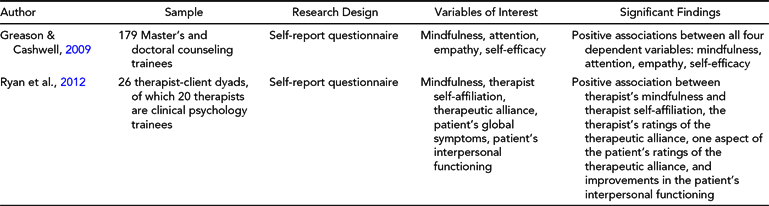
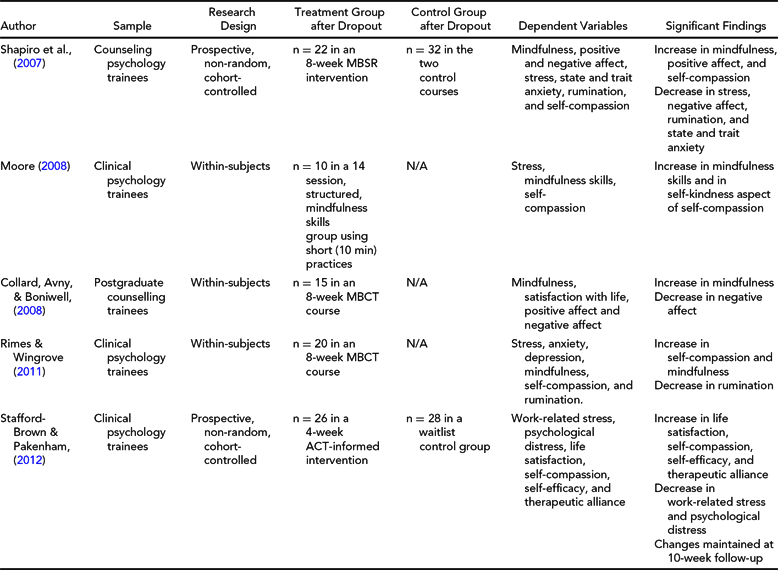
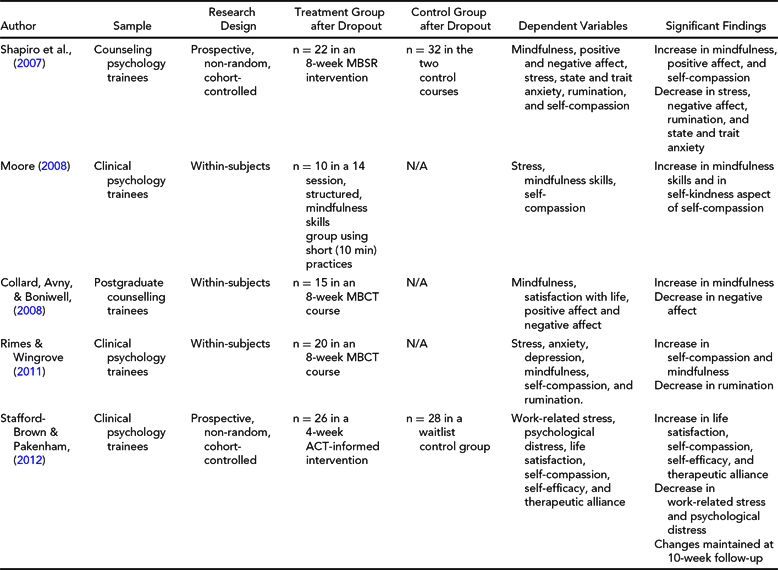
The PsycARTICLES database was searched using the ProQuest interface on 31 December 2011 for the period 1990 to 2012. The Web of Science database was searched on 20 October 2012 for the period 1990 to 2012. The search terms were: clinical, clinical psychology, psychologist, counselling, counsellor, psychotherapy, psychotherapist, therapist, health care, mindfulness AND training, skills, stress, self-care. Other relevant articles were also found individually by looking through reference lists of the relevant journal articles. The articles provided information about the current gaps in the professional development and self-care among trainees in postgraduate psychotherapy training programmes, and the use of mindfulness to fill this gap. In particular, given this review's focus on the use of mindfulness practices for postgraduate psychotherapy trainees, the findings from a number of quantitative and qualitative articles that researched the use of mindfulness with this population were summarised and can be found in Tables 1 and 2.
Quantitative studies regarding dispositional mindfulness for trainees

Quantitative and mixed-method studies regarding mindfulness practices for trainees
Professional Development in Clinical Psychology Programmes
Research suggests that clinical psychology training involves the professional development of psychotherapy knowledge and skills (Lambert & Simon, Reference Lambert, Simon, Hick and Bien2008). Psychotherapy knowledge, which refers to knowledge regarding theories, models, concepts, and techniques of therapy (Kramer, Meleo-Meyer & Turner, Reference Kramer, Meleo-Meyer, Turner, Hick and Bien2008), is commonly learnt through didactic teaching methods, manual-guided techniques, and application of theory to supervised clinical work (Vakoch & Strupp, Reference Vakoch and Strupp2000). Clinical psychology training also involves learning skills such as active listening, questioning, empathy, re-framing, and confrontation (Ivey, Ivey, & Zalaquett, Reference Ivey, Ivey and Zalaquett2010). Some of these skills are more complex and dynamic in nature; in addition to interpersonal components, they also have intrapersonal dimensions pertaining to internal qualities and attitudes of the trainees (Gockel, Reference Gockel2010). Research suggests that it is important for therapists to use their intrapersonal skills to create therapeutic presence, which Gellar and Greenberg (Reference Geller and Greenberg2002) described as having three components: an openness to the client's experiences, openness to one's own experiences when working with the client, and the ability to interact with the client based on this experience. Some examples of important intrapersonal skills that make up therapeutic presence are in-session self-awareness, an internal attitude of empathy, affect tolerance, and managing focused attention (Williams & Fauth, Reference Williams and Fauth2005; Fulton, Reference Fulton, Germer, Siegel and Fulton2005; Greason & Cashwell, Reference Greason and Cashwell2009). Thorne (Reference Thorne1992) reported that therapeutic presence helps to cultivate Rogers’ (Reference Rogers1957) six core conditions, which are agreed upon by theorists from almost all orientations to be important to strengthen the therapeutic alliance and promote positive changes for clients during therapy (Norcross, Reference Norcross and Norcross2002).
Despite the importance of intrapersonal skills to the therapy process, research suggests that there is a lack of focus on inculcating the intrapersonal psychotherapy skills in trainees (Greason & Cashwell, Reference Greason and Cashwell2009; Fulton, Reference Fulton, Germer, Siegel and Fulton2005; Lambert & Simon, Reference Lambert, Simon, Hick and Bien2008). The following reasons have been proposed for this shortcoming in training programmes: over-emphasis on teaching therapy models (Fulton, Reference Fulton, Germer, Siegel and Fulton2005), assumptions about the fact that developing the intrapersonal skills would naturally follow the learning of discernible interpersonal skills (Greason & Cashwell, Reference Greason and Cashwell2009), and the presence of the widely-held belief that intrapersonal attitudes, such as warmth and non-judgement, are difficult to teach (Lambert & Simon, Reference Lambert, Simon, Hick and Bien2008). As a result, training programmes have either failed to pay attention to developing these intrapersonal skills or have depended on other means, such as the therapist's personal psychotherapy and sensitivity training, for the development of these skills (Lambert & Simon, Reference Lambert, Simon, Hick and Bien2008).
Self-Care in Clinical Psychology Training Programmes
Clinical psychology training has been associated with significant challenges to trainees’ subjective well-being (Pakenham & Stafford-Brown, Reference Pakenham and Stafford-Brown2012). Trainee psychologists report many stressors, including personal stressors (e.g., finances), academic and evaluative aspects of training (e.g., being evaluated by supervisors), work-practice stressors (e.g., time constraints, caseload), and challenges in clinical work (e.g., ambiguity, ethical dilemmas; Nelson, Dell’Oliver, Koch, & Buckler, Reference Nelson, Dell’Oliver, Koch and Buckler2001; Pakenham & Stafford-Brown, Reference Pakenham and Stafford-Brown2012). Existing studies show significant levels of stress among clinical psychology trainees (Cushway, Reference Cushway1992; Myers et al., Reference Myers, Sweeney, Popick, Wesley, Bordfeld and Fingerhut2012). Trainees are also vulnerable to difficulties such as burnout and vicarious traumatisation, particularly when they are new to practicing (Gockel, Reference Gockel2010; Adams & Riggs, Reference Adams and Riggs2008). There is no known published empirical research to show that stress and other stress-related outcomes hinder or impair professional functioning among trainee psychologists. However, research on populations such as trainee teachers and trainee engineers suggest that if these problems are not appropriately addressed, there is a risk of trainees experiencing hindered or impaired professional competence as a consequence of impediments to skills such as attention, concentration, and decision-making (El-Ghoroury, Galper, Sawaqdeh, & Bufka, Reference El-Ghoroury, Galper, Sawaqdeh and Bufka2012).
Self-care refers to actions (e.g., seeking social support and exercise) which the individual initiates to promote his or her own health and well-being (Bickley, Reference Bickley1998). Some studies have found that self-care practices are associated with lower perceived stress levels among trainees (McKinzie, Altamura, Burgoon, & Bishop, Reference McKinzie, Altamura, Burgoon and Bishop2006; Myers et al., Reference Myers, Sweeney, Popick, Wesley, Bordfeld and Fingerhut2012; Chrisman, Christopher, & Lichtenstein, Reference Chrisman, Christopher and Lichtenstein2009). Despite these positive findings, training programmes usually do not have a structured component for self-care in the core curriculum (Christopher, Christopher, Dunnagan, & Schure, Reference Christopher, Christopher, Dunnagan and Schure2006). Furthermore, there is a lack of communication regarding the need for self-care, and it is usually conveyed to trainees as their individual responsibility (Munsey, Reference Munsey2006; Christopher et al., Reference Christopher, Christopher, Dunnagan and Schure2006). This approach is considered ineffective as trainees may underestimate their susceptibility to mental and emotional difficulties due to the mental health training they have undergone (Barnett, Reference Barnett, Herson and Gross2008).
Mindfulness as a Tool for Professional Development and Self-Care
Given all of the above challenges, recent research has considered mindfulness as a means to addressing the challenges of professional development and self-care for trainees in clinical psychology and related disciplines, such as counselling, counselling psychology, and social work (Rimes & Wingrove, Reference Rimes and Wingrove2011). Researchers have noticed compatibility between the challenges in professional development and self-care, and the aims and outcomes of practicing mindfulness (Gockel, Reference Gockel2010; Bruce et al., Reference Bruce, Manber, Shapiro and Constantino2010). In order to understand this compatibility, it is useful to first understand the nature of mindfulness and how it has been applied to clinical practice and training.
The Historical Roots of Mindfulness
Mindfulness, a practice that stretches over 2500 years ago, is known for being rooted in Buddhist religion and philosophy. Thomas William Rhys Davids, a Pali-language scholar, has been cited as the person who translated the word Sati to the English word mindfulness. Thich Nhat Hanh was one of the first teachers of mindfulness to the West and his work paved the way for many others to bring mindfulness into the Western clinical context. This included practices such as focusing on bodily felt sensations and body scans (Gendlin, Reference Gendlin1998; Cornell, Reference Cornell2013).
The Definition of Mindfulness
Gunarantana (Reference Gunuratana2002) stated that it was difficult to define mindfulness because of its subtle and non-verbal nature. Researchers have yet to come to a consensus for the operational definition of mindfulness (Bishop et al., Reference Bishop, Lau, Shapiro, Carlson, Anderson and Carmody2004). Kabat-Zinn's (Reference Kabat-Zinn1994) widely-cited definition is ‘paying attention in a particular way: on purpose, in the present moment, and non-judgementally’ (p. 4). Shapiro, Carlson, Astin, and Freedman (Reference Shapiro, Carlson, Astin and Freedman2006) built on Kabat-Zinn's (Reference Kabat-Zinn1994) definition by suggesting that mindfulness comprises three components: intention, attention, and attitude. Kabat Zinn's (Reference Kabat-Zinn1994) ‘on purpose’ refers to intention, ‘paying attention’ refers to attention, and ‘in a particular way’ refers to attitude (Kabat-Zinn, Reference Kabat-Zinn1994; Shapiro et al., Reference Shapiro, Carlson, Astin and Freedman2006). Shapiro et al. (Reference Shapiro, Carlson, Astin and Freedman2006) proposed that these three components lead to ‘reperceiving’ (p. 2), which means a significant shift in an individual's outlook. Bishop et al. (Reference Bishop, Lau, Shapiro, Carlson, Anderson and Carmody2004) view mindfulness as comprising two components, self-regulation of attention to present moment experience and the individual's attitude to the present moment experience, an attitude typified by an attitude of curiosity, openness, and acceptance (Bishop et al., Reference Bishop, Lau, Shapiro, Carlson, Anderson and Carmody2004). Although different operational definitions exist, the definitions include similar fundamental components; the intention to focus one's attention, controlling attention to the present moment, and adopting a particular attitude to one's experiences.
Mindfulness practices can be classified as formal and informal. Formal mindfulness practices often include seated meditation, mindful yoga stretches and the body scan, which involves systematically paying attention to sensations in each part of the body (Cigolla & Brown, Reference Cigolla and Brown2011). Informal mindfulness practices involve the application of mindfulness skills in daily life, such as walking or eating (Cigolla & Brown, Reference Cigolla and Brown2011). Through the cultivation of mindfulness skills, one becomes more aware of thought patterns, detaches from these patterns, and gains a new perspective of seeing the world (Baer, Reference Baer2003). In this new perspective, thoughts and feelings are no longer labelled ‘good’ or ‘bad’ and individuals are empowered to accept what is happening in their present moment, instead of focusing on what they feel should be happening instead (Germer, Reference Germer, Germer, Siegel and Fulton2005).
Mindfulness in Clinical Practice
Mindfulness is also currently of interest to therapists of almost all theoretical orientations, including psychoanalytic and humanistic approaches (Christopher & Maris, Reference Christopher and Maris2010). It is central to many contemporary intervention approaches such as Acceptance and Commitment Therapy (ACT; Hayes, Strosahl, & Wilson, Reference Hayes, Strosdahl and Wilson1999), Dialectical Behaviour Therapy (DBT; Linehan, Reference Linehan1993), Mindfulness-Based Cognitive Therapy (MBCT; Segal, Williams, & Teasdale, (Reference Segal, Williams and Teasdale2001), and Mindfulness-Based Stressed Reduction (MBSR; Kabat-Zinn, Reference Kabat-Zinn2003). Therapists can implement mindfulness interventions into sessions to help their clients and clients can also be encouraged to practice mindfulness in their daily lives outside therapy (Ryan, Saran, Doran, & Muran, Reference Ryan, Safran, Doran and Muran2012).
Mindfulness has also been increasingly promoted in therapeutic interventions to help clients and patients with psychological, physiological and interpersonal difficulties. It has been used in interventions for chronic pain, stress, depressive relapse, binge eating disorder, and cancer (Kabat-Zinn, Reference Kabat-Zinn1984; Shapiro, Schwartz, & Bonner, Reference Shapiro, Schwartz and Bonner1998; Segal et al., (Reference Segal, Williams and Teasdale2001); Kristeller & Hallett, Reference Kristeller and Hallett1999; Speca, Carlson, Goodey, & Angen, Reference Speca, Carlson, Goodey and Angen2000). It has also been used in clinical populations with mixed diagnoses and non-clinical populations (Kabat-Zinn, Reference Kabat-Zinn2003). It is associated with many positive psychological outcomes, such as higher positive affect, life satisfaction, adaptive emotional regulation, and self-compassion (see Keng, Smoski, & Robins, Reference Keng, Smoski and Robins2011 for a review). Mindfulness is also associated with various positive physical outcomes, such as positive changes in immune system functioning and increased physiological levels of melatonin (Davidson et al., Reference Davidson, Kabat-Zinn, Schumacher, Rosenkranz, Muller and Santorelli2003; Massion, Teas, Herbert, Wertheimer, & Kabat-Zinn, Reference Massion, Teas, Hebert, Wertheimer and Kabat-Zinn1995).
Mindfulness for Professionals
Interventions such as ACT, DBT, MBSR, and MBCT include mindfulness practice for the therapist as an important aspect of implementing the intervention (e.g., Linehan, Reference Linehan1993). Many who are experienced in using mindfulness-based interventions have proposed that therapists should have experiential exposure to mindfulness techniques, thereby increasing their own knowledge and experience before using the interventions with their clients (e.g., Segal et al., Reference Segal, Williams and Teasdale2001). Mindfulness has also been suggested to be useful for mental health professionals because it offers professionals a means of self-care (e.g., May & O’Donovan, Reference May and O’Donovan2007; Shapiro, Astin, Bishop, & Cordova, Reference Shapiro, Astin, Bishop and Cordova2005; Christopher et al., Reference Christopher, Chrisman, Trotter-Mathison, Schure, Dahlen and Christopher2011) and they can use mindfulness in their personal and professional lives (Rothaupt & Morgan, Reference Rothaupt and Morgan2007; Cigolla & Brown, Reference Cigolla and Brown2011).
May and O’Donovan (Reference May and O’Donovan2007) found that among 55 mental health professionals, self-reported mindfulness was associated with higher life satisfaction, the experience of more frequent positive emotions and less frequent negative emotions, lower levels of burnout, and higher job satisfaction. Shapiro et al. (Reference Shapiro, Astin, Bishop and Cordova2005) found that an 8-week MBSR intervention led to a significant decrease in perceived stress and increase in self-compassion among 18 health care professionals, including psychologists and social workers, in comparison to a wait-list control group of 20 participants. Aggs and Bambling (Reference Aggs and Bambling2010) found that, for their sample of 47 mental health professionals, an eight-week mindfulness therapy training programme positively impacted on their knowledge about mindfulness, attitudes regarding using mindfulness in their clinical work, ability to practice mindfulness, and reduced stress and tension.
One long-term follow-up qualitative study was conducted on 16 practicing counsellors who had undertaken a mindfulness training course during their graduate training in counselling (Christopher et al., Reference Christopher, Chrisman, Trotter-Mathison, Schure, Dahlen and Christopher2011). The participants had taken the course an average of four years prior to the follow-up study (Christopher et al., Reference Christopher, Chrisman, Trotter-Mathison, Schure, Dahlen and Christopher2011). The study sought to understand the role of mindfulness in their personal and professional lives. The participants’ accounts suggested that they found the course useful. Two themes emerged pertaining to their personal lives: a) personal development/self-care and b) interpersonal relationships. Three themes emerged pertaining to their professional lives: a) counsellors’ experience of self while counselling, b) the therapeutic relationship, and c) clinical practice.
Two qualitative studies have been conducted on populations of registered mental health professionals who had identified themselves as using mindfulness practices. Rothaupt and Morgan (Reference Rothaupt and Morgan2007) interviewed six counsellors, four of whom were also counsellor educators, to understand their application of mindfulness in their personal and professional lives. Their analysis was conducted by constant comparative method and found one overarching theme of the need and effort to live in the present moment. They also found two other broad themes: a) using a variety of tools or methods to incorporate mindfulness into their lives and b) the outcomes or results of their mindfulness. Cigolla and Brown (Reference Cigolla and Brown2011) interviewed six therapists to find out how they understand the concept of mindfulness and its role in their personal and professional lives. Using an interpretive phenomenological analysis, they developed one major theme of mindfulness as a way of being, and three subthemes: a) a way of being in personal life, b) a way of being in therapy, and c) encouraging a way of being in others.
The relative paucity of research in this area suggests that mindfulness for health care professionals is still an area which requires further study so as to establish its usefulness. The existing research, although lacking in quantity, suggests that it offers many useful benefits for self-care, and personal and professional development. While mindfulness can be taught to mental health professionals while they are practicing, it is also useful to explore how this teaching can be fostered before they qualify, so as to reap these benefits as professionals later on in their careers.
Mindfulness for Mental Health Trainees
Research has investigated the use of mindfulness to address the gaps in clinical psychology training. In line with the focus of the literature search strategy, empirical research regarding the use of mindfulness for mental health trainees will be reviewed so as to understand the current knowledge and therefore inform on future research directions.
Quantitative and Mixed-Method Studies Regarding Mindfulness for Trainees
Dispositional mindfulness
Dispositional mindfulness refers to an innate trait that reflects an individual's propensity to cultivate intentional awareness (Brown & Ryan, Reference Brown and Ryan2003). Table 1 lists two quantitative studies that have been conducted to study the association between dispositional mindfulness and variables of interest among mental health trainees. The research shows that dispositional mindfulness is positively associated with qualities within the therapist, therapeutic alliance, and client's interpersonal functioning (Greason & Cashwell, Reference Greason and Cashwell2009; Ryan et al., Reference Ryan, Safran, Doran and Muran2012). Dispositional mindfulness was not associated with improvement in clients’ broader psychological problems and symptoms of psychopathology; one reason that was put forth to explain this was that mindfulness may be more related to interpersonal rather than broader psychological functioning (Ryan et al., Reference Ryan, Safran, Doran and Muran2012).
Mindfulness practices
Table 2 lists the quantitative studies that have been conducted to study the impact of mindfulness practices for mental health trainees. Some of the studies were also mixed method in nature, where qualitative responses were collected from the participants (Stafford-Brown & Pakenham, Reference Stafford-Brown and Pakenham2012; Rimes & Wingrove, Reference Rimes and Wingrove2011, Moore, Reference Moore2008). The studies show that trainees who participate in mindfulness training experience many increases in positive outcomes related to self-care (Shapiro, Brown, & Biegel, Reference Shapiro, Brown and Biegel2007; Stafford-Brown & Pakenham, Reference Stafford-Brown and Pakenham2012; Rimes & Wingrove, Reference Rimes and Wingrove2011, Moore, Reference Moore2008; Collard, Avny, & Boniwell, Reference Collard, Avny and Boniwell2008) and stronger therapeutic alliance (Stafford-Brown & Pakenham, Reference Stafford-Brown and Pakenham2012). Some studies did not find significantly improved outcomes in domains such as stress, anxiety, depression, satisfaction in life, and positive affect (Rimes & Wingrove, Reference Rimes and Wingrove2011; Moore, Reference Moore2008; Collard et al., Reference Collard, Avny and Boniwell2008). Researchers proposed that the possible reasons for this were sampling and measurement issues (Rimes & Wingrove, Reference Rimes and Wingrove2011; Moore, Reference Moore2008; Collard et al., Reference Collard, Avny and Boniwell2008). This suggested that it has been difficult for research to accurately ascertain the effectiveness of mindfulness for this population. Some of these studies also obtained open-ended written feedback from the participants, and their feedback suggested that the practices were helpful in various aspects of their personal and professional lives (Rimes & Wingrove, Reference Rimes and Wingrove2011; Moore; Reference Moore2008; Stafford-Brown & Pakenham, Reference Stafford-Brown and Pakenham2012).
Qualitative Studies Regarding Mindfulness for Trainees
Christopher and Maris (Reference Christopher and Maris2010) summarised five qualitative research studies regarding the impact of mindfulness interventions on trainees’ personal and professional lives. Four of the studies were conducted on postgraduate counselling trainees (Christopher et al., Reference Christopher, Christopher, Dunnagan and Schure2006; Schure, Christopher, & Christopher, Reference Schure, Christopher and Christopher2008; Crisman et al., Reference Chrisman, Christopher and Lichtenstein2009; Maris, Reference Maris2009). These studies revealed many themes that suggested mindfulness to be useful for trainees’ self-care and personal and professional development. Apart from the studies summarised in the article by Christopher and Maris (Reference Christopher and Maris2010), one other qualitative study regarding mindfulness for trainees was found. McCollum and Gehart (Reference McCollum and Gehart2010) conducted a study on 13 marital and family therapy trainees to understand their experience of learning mindfulness meditation to aid them in developing therapeutic presence. The analysis, conducted through thematic analysis, was based on journal entries. The following themes were found: being present, effects of meditation, shift in mode, and compassion and acceptance. Within the theme of being present, the sub-themes were (a) attending to inner experience, (b) aware of what happens with client, and (c) acting from awareness. Within the theme of effects of meditation, the sub-themes were (a) calmer, (b) managing inner chatter, (c) slowing down and (d) boundaries between sessions. Within the theme of shift in mode, one subtheme of doing mode balanced by being mode was found. While the doing mode refers to the idea that therapy is focused on doing activity, the being mode refers to finding times to simply be with the client (McCollum & Gehart, Reference McCollum and Gehart2010). Within the theme of compassion and acceptance, the sub-themes were (a) toward self, (b) toward client, and (c) sense of shared humanity.
Mindfulness for Trainees’ Professional Development
Having listed the broad findings of mindfulness for trainees, this review will now consider, in depth, how mindfulness training can cultivate the intrapersonal skills mentioned earlier in this review.
Firstly, mindfulness can be a way for trainees to manage in-session self-awareness because mindfulness involves non-judgemental and flexible attention and awareness, and might help trainees manage distracting self-focus (Nutt-Williams, Reference Nutt-Williams2008). Qualitative research found that trainees find mindfulness helpful to manage awareness of their experiences during sessions (Christopher & Maris, Reference Christopher and Maris2010). For example, trainees reported feeling more confident in their ability to manage their distracting self-focused anxiety about being a therapist and reported increased ability to react constructively when experiencing countertransference reactions (Chrisman et al., Reference Chrisman, Christopher and Lichtenstein2009; Christopher & Maris, Reference Christopher and Maris2010; Schure et al., Reference Schure, Christopher and Christopher2008).
Secondly, mindfulness has been proposed to help with empathy through decreasing stress, increasing self-compassion, and learning to put aside one's own subjective perspective (Gehart & McCollum, Reference Gehart, McCollum, Hick and Bien2008). Greason and Cashwell (Reference Greason and Cashwell2009) found a positive association between mindfulness and empathy. While there have not been any other quantitative studies directly studying the association between mindfulness and empathy among mental health trainees, it has been found that mindfulness increases self-compassion and reduces stress (e.g., Shapiro et al., Reference Shapiro, Brown and Biegel2007), which is in line with Gehart and McCollum's (Reference Gehart, McCollum, Hick and Bien2008) proposal of the link between mindfulness and empathy. Qualitative research also found that trainees found mindfulness training helpful in increasing their compassion towards clients (Christopher & Maris, Reference Christopher and Maris2010).
Thirdly, mindfulness can also help trainees develop their affect tolerance skills as the trainee would be able to tolerate his or her own affect through mindfulness by accepting the emotions as they arise and letting them pass (Safran & Reading, Reference Safran, Reading, Hick and Bien2008; Luoma & Villatte, Reference Luoma and Villatte2012). This, in turn, can increase the trainee's confidence in his or her ability to hold a client's affect in session (Safran & Reading, Reference Safran, Reading, Hick and Bien2008). This would allow clients a safe environment to fully express their feelings, and this can in itself be a positive experience in therapy (Fulton, Reference Fulton, Germer, Siegel and Fulton2005; Safran & Reading, Reference Safran, Reading, Hick and Bien2008). This also enhances the client's ability to build affect tolerance; this has been found to be important to improve difficulties such as anxiety and addiction (Gockel, Reference Gockel2010). Qualitative research has shown that mindfulness helps trainees tolerate their clients’ and their own affect, thus creating a ‘holding environment’ for the client's feelings (Christopher & Maris, Reference Christopher and Maris2010).
Fourth, mindfulness practices have also been suggested as a way to learn how to focus attention as they give students mastery experiences in attention skills (Greason & Cashwell, Reference Greason and Cashwell2009). Greason and Cashwell (Reference Greason and Cashwell2009) found that self-reported mindfulness was positively associated with attention. Qualitative studies have also revealed that trainees use mindfulness to be more attentive with clients (Christopher & Maris, Reference Christopher and Maris2010).
Mindfulness for Trainees’ Self-Care
Research also suggests the use of mindfulness practices as a self-care tool for trainees. It has been suggested that mindfulness training can help with reducing stress and stress-related psychological problems (Gockel, Reference Gockel2010). Empirical research which has used mindfulness training with trainee samples found that the interventions led to improvements in their self-care and psychological well-being. This included significant increases in self-compassion (Rimes & Wingrove, Reference Rimes and Wingrove2011), positive affect (Shapiro et al., Reference Shapiro, Brown and Biegel2007), self-kindness (Moore, Reference Moore2008), life satisfaction (Stafford-Brown & Pakenham), increased relaxation (Crisman et al., Reference Chrisman, Christopher and Lichtenstein2009), and increased calmness (Crisman et al., Reference Chrisman, Christopher and Lichtenstein2009). The interventions were also associated with decreases in perceived stress (Rimes & Wingrove, Reference Rimes and Wingrove2011), work-related stress (Stafford-Brown & Pakenham), negative affect (Shapiro et al., Reference Shapiro, Brown and Biegel2007), and rumination (Rimes & Wingrove, Reference Rimes and Wingrove2011). Furthermore, Shapiro et al. (Reference Shapiro, Brown and Biegel2007) found that increases in mindfulness mediated these benefits to self-care. Qualitative research has also shown that mindfulness practices offer numerous benefits to trainees for self-care (Christopher & Maris, Reference Christopher and Maris2010). Given all of this literature, there is strong evidence to suggest that mindfulness practices offer a useful approach to self-care for trainees.
Mindfulness for Trainees’ Implementing Mindfulness-Based Interventions
As mentioned above, mindfulness is integral to therapeutic approaches such as MBCT (Segal et al., Reference Segal, Williams and Teasdale2001) and MBSR (Kabat-Zinn, Reference Kabat-Zinn2003), and research suggests that it is an effective intervention for many presenting difficulties (Keng et al., Reference Keng, Smoski and Robins2011). However, the lack of exposure and knowledge about mindfulness interventions can prevent trainees from using mindfulness as an intervention within therapy (McKenzie, Hassed, & Gear, Reference McKenzie, Hassed and Gear2012). Research has found that receiving training in mindfulness helps increase trainees’ willingness and confidence to use mindfulness practices with clients (Moore, Reference Moore2008; McKenzie et al., Reference McKenzie, Hassed and Gear2012).
Impact of Trainees’ Mindfulness Practices on Client Outcomes
In addition to trainees’ outcomes for their own self-care and professional development in intrapersonal skills and using mindfulness-based interventions, research has also studied the relationship between trainees’ mindfulness and client outcomes. Grepmair et al. (Reference Grepmair, Mitterlehner, Loew, Bachler, Rother and Nickel2007) found that the clients of trainees who participated in mindfulness training experienced improved outcomes such as decrease in symptom severity and increase in self-attunement, global functioning, subjective experience and interpersonal functioning (Grepmair et al., Reference Grepmair, Mitterlehner, Loew, Bachler, Rother and Nickel2007). These clients also had a better comprehension of the goals of therapy, their own development, and optimism about their progress (Grepmair et al., Reference Grepmair, Mitterlehner, Loew, Bachler, Rother and Nickel2007). These were in comparison to clients of trainees who did not participate in mindfulness training.
How to Develop Mindfulness in Trainees
Given the potential benefits of mindfulness, attention has been paid to different ways of teaching mindfulness to trainees. Research suggests that mindfulness can be taught to trainees through the use of mindfulness groups as a variety of designs have resulted in increased mindfulness and other positive outcomes (Moore, Reference Moore2008; Collard et al., Reference Collard, Avny and Boniwell2008). It has been noted that time constraints, such as for groups such as clinical psychology trainees where there is a rigorous curriculum, may impede trainees’ ability to participate in mindfulness programmes (Moore, Reference Moore2008). This may be a reason for them to decline participation or drop-out from participating (Carmody & Baer, Reference Carmody and Baer2009). It would be useful to explore possibilities of administering mindfulness programmes which have less strict time demands and which can be conducted without the guidance of an instructor who has been formally trained (Carmody & Baer, Reference Carmody and Baer2009). To support the rationale of using shorter formats, Carmody and Baer (Reference Carmody and Baer2009) found that shortened versions of MBSR were no less effective than the standard format in decreasing psychological distress. In line with recommendations for shorter interventions, suggested intervention designs have included shorter versions of MBSR or MBCT (Carmody & Baer, Reference Carmody and Baer2009) and brief experiential exercises as a group during clinical training (Moore, Reference Moore2008), and a student-led mindfulness group (Myers et al., Reference Myers, Sweeney, Popick, Wesley, Bordfeld and Fingerhut2012). The content in these intervention designs can be typical of those used in mindfulness-based programmes such as MBSR or MBCT, but with a shorter duration (Moore, Reference Moore2008). This would allow for the implementation of these designs within programmes with rigorous curriculum and time constraints.
Critique of Mindfulness Literature
There are some limitations within the available literature regarding mindfulness for mental health trainees. These limitations pertain to measurement and other methodological issues.
Limitations of Quantitative Studies Regarding Mindfulness for Trainees
In quantitative research, researchers determine the variables that will be studied according to their interest (Christopher & Maris, Reference Christopher and Maris2010). Christopher and Marks (Reference Christopher and Maris2010) stated that within quantitative mindfulness studies, the variables of interest are usually measured by questionnaires comprising a number of self-report items. This can result in ‘an imposition by the researcher of his or her own framework of meaning that may miss or distort the structures of meaning that the study participants would spontaneously generate and employ on their own’ (Christopher & Maris, Reference Christopher and Maris2010, p. 116). This is especially pertinent for an experiential concept like mindfulness, for which researchers have yet to attain consensus regarding its definition, operationalization and measurement (Cigolla & Brown, Reference Cigolla and Brown2011).
Different tools tend to differ in the aspects of mindfulness that they measure as well as the way in which the aspects are measured (Hick, Reference Hick, Hick and Bien2008). For example, the Mindfulness Attention Awareness Scale (MAAS; Brown & Ryan, Reference Brown and Ryan2003), as used in the study by Shapiro et al., Reference Shapiro, Brown and Biegel2007, measures attention and awareness but does not measure other important aspects of mindfulness, such as openness to novel experiences and non-judgemental attitude (Hick, Reference Hick, Hick and Bien2008). One implication is that self-report questionnaires may not be sensitive to the magnitude of change that participants experience (Moore, Reference Moore2008). For example, Myers et al. (Reference Myers, Sweeney, Popick, Wesley, Bordfeld and Fingerhut2012) proposed that only those who engage in frequent formal mindfulness practice obtain significant increase in trait mindfulness as measured by self-report questionnaires.
The nature of mindfulness is also such that participants who are more mindful might actually be more aware of the degree to which they are not mindful, and rate themselves lower when completing self-reported questionnaires (Davis & Hayes, Reference Davis and Hayes2011). Similarly, participants who are less mindful may not be fully aware of the degree to which they are not mindful, thus overestimating their mindfulness (Davis & Hayes, Reference Davis and Hayes2011). They may gain more insight during the post-course measures and the questionnaires may not be a reliable indicator of change in mindfulness (Moore, Reference Moore2008; Davis & Hayes, Reference Davis and Hayes2011).
Myers et al. (Reference Myers, Sweeney, Popick, Wesley, Bordfeld and Fingerhut2012) suggested that an alternative to measuring mindfulness in self-report questionnaires is to measure the frequency of mindfulness practice and find out how this is associated with outcome measures. It is important to note that measuring the frequency of mindfulness practice also has its limitations. Firstly, the meaning of engaging in mindfulness practice may differ among individuals (May & O’Donovan, Reference May and O’Donovan2007). For example, individuals may differ as to whether they view informal practices such as labelling one's feelings to be mindfulness practice. Secondly, the intention behind the practice is also of concern (May & O’Donovan, Reference May and O’Donovan2007). For example, some individuals might practice yoga with the intention to exercise rather than to cultivate mindfulness (May & O’Donovan, Reference May and O’Donovan2007). This makes it difficult to quantify how much time an individual spends engaging in mindfulness practice.
The available research also has many other methodological limitations. Firstly, there are no randomised control groups in all studies. This means that the relationship between the mindfulness interventions or courses and the changes in dependent variables cannot be established as causal. The changes may be due to other factors such as trainees adjusting to their professional roles over time. In all studies, the samples are self-selected. This means that motivational differences such as being more open to learning about mindfulness or perceiving the need for help may affect their choice to participate and affect how they experience the interventions. These limitations of self-selection, participant attrition during the intervention and evaluation, and demand effects as the participants may be aware of the rationale of the intervention, can lead to bias with regards to confirming the researcher's hypotheses. Furthermore, the studies contain small sample sizes which may affect statistical analysis and results. The nature of the student populations, that being from specific courses in universities with different features (e.g., public or private programmes), also limits the generalisability of the results to the wider population.
Adopting a Qualitative Approach
Irving, Dobkin, and Park (Reference Irving, Dobkin and Park2009) highlighted the lack of published qualitative studies of mindfulness interventions with clinicians or trainees. Although research has highlighted some emerging consistency in the definition of mindfulness (Bishop et al., Reference Bishop, Lau, Shapiro, Carlson, Anderson and Carmody2004; Shapiro et al., Reference Shapiro, Carlson, Astin and Freedman2006), it was proposed that qualitative research in this area would help explore experiences in an open-ended way and investigate aspects of change that have not yet been captured in previous research (Christopher & Maris, Reference Christopher and Maris2010). This is done without the use of operational definitions of mindfulness to guide the study, and Rubin and Babbie (Reference Rubin and Babbie2009) offer three reasons to explain this. Firstly, the researcher does not want to predict what the most salient variables will be (Rubin & Babbie, Reference Rubin and Babbie2009). Secondly, the researcher recognises that his or her way of operationalising a construct may not be the best way of measuring the phenomenon (Rubin & Babbie, Reference Rubin and Babbie2009). Thirdly, the researcher recognises that operational definitions may be limited because variables are measured by specific observable indicators (Rubin & Babbie, Reference Rubin and Babbie2009). A deeper understanding of mindfulness could help inform operationalisation in future quantitative or mixed-method studies (Cigolla & Brown, Reference Cigolla and Brown2009). Qualitative research can explore how trainees define, learn, and experience mindfulness and mindfulness practices and the application of mindfulness in their personal and professional lives as they train to become psychologists.
Conclusion
The available research on mindfulness for mental health trainees shows many benefits for self-care and professional development, but the research designs comprise many interventions which require substantial time requirements. This might not be feasible for clinical psychology training programmes to implement, given the rigorous curriculum and time constraints. Future research should focus on designs which require shorter time commitments so as to facilitate trainees’ participation.
The research pertaining to the outcomes of these interventions includes quantitative studies which have many methodological limitations, especially the research which concerns the operationalisation and measurement of mindfulness using self-report questionnaires. Qualitative research could offer a complimentary way to understand how trainees experience mindfulness and its impacts on their personal and professional lives. Currently, there is an overall dearth of qualitative studies and none focusing on the views of clinical psychology trainees, who face unique challenges compared to other trainee populations. Future research needs to focus on exploring clinical psychology trainees’ experiences of mindfulness practices and the meanings attached to these experiences. This can contribute to the clarity of understanding as to whether mindfulness practices foster the professional development and self-care that training programmes require for trainees. Understanding their experiences will also help move towards forming guidelines that inform the development of mindfulness training programmes for clinical psychology trainees.
Acknowledgements
This research received no specific grant from any funding agency, commercial or not-for-profit sectors.
Declaration of Interest
None.