1 Introduction
Throughout this paper, let k be an algebraically closed field of characteristic
 $0$
.
In algebraic geometry, (the coordinate ring of) an affine (regular) pencil of conics is defined to be
 $k[x,y]/(f,g)$
, where
 $(f,g)$
is a regular sequence of degree
 $2$
in
 $k[x,y]$
. Such algebras form a natural and basic class of objects in commutative algebra and algebraic geometry.
In noncommutative algebraic geometry, a two-dimensional quantum polynomial algebra (Definition 2.3) is a noncommutative analog of
 $k[x,y]$
. It is known that every two-dimensional quantum polynomial algebra is isomorphic to one of the following famous algebras:
-
•
 $k_J[x,y]: = k{\langle } x,y {\rangle } /(xy-yx+y^2)$
(the Jordan plane);
-
•
$k_\lambda [x,y]: = k{\langle } x,y {\rangle } /(xy - \lambda yx)$
,
$0 \neq \lambda \in k$
(a quantum plane).


The above algebras play important roles in noncommutative algebraic geometry and many other theories related to noncommutative algebras (for example, Lie theory, Poisson geometry, and deformation theory).
Motivated by the above discussion and the study of noncommutative (projective) conics (see Section 6), we generalize in this paper the concept of affine pencils of conics to the noncommutative world.
If
 $f, g\in k[x, y]$
is a regular sequence of degree 2, then it is natural to call
 $k[x, y]/(f, g)$
an affine pencil of conics, however, for the purpose of this paper, we introduce a notion of strongly regular normal sequence by adding one more simple condition to a regular sequence to define a (noncommutative) affine pencil of conics.
Definition 1.1. Let
 $F=(f_1, \ldots , f_m)$
be a (not necessarily homogeneous) sequence of elements in a graded algebra S, where
 $\deg f_i = d_i$
. We say that F is a strongly regular normal sequence if both F and
 $F^\vee := ((f_1)_{d_1}, \ldots, (f_m)_{d_m})$
are regular normal sequences.
In this paper, we introduce a noncommutative version of an affine pencil of conics as follows.
Definition 1.2. We say that an ungraded algebra
 $E = S/(f,g)$
is (the coordinate ring of) a noncommutative affine pencil of conics if S is a two-dimensional quantum polynomial algebra and
 $(f,g)$
is a strongly regular normal sequence of degree
 $2$
in S.
To classify noncommutative affine pencils of conics, we need to find all strongly regular normal sequences
 $(f,g)$
of degree
 $2$
in each two-dimensional quantum polynomial algebra S. It is rather a difficult task. In Section 3, we introduce the notion of
 $st$
-equivalence and provide some useful lemmas to reduce the calculations for finding regular normal elements of degree
 $2$
in graded algebras. Then, we classify noncommutative affine pencils of conics up to
 $st$
-equivalence (Theorem 3.24).
The study of Frobenius algebras is always an important subject. In Section 4, we fully classify four-dimensional Frobenius algebras. Using these classifications and the (de)homogenization theory, we obtain our main result in Section 5.
Theorem 1.3 (Theorem 5.10).
The set of isomorphism classes of noncommutative affine pencils of conics is equal to the set of isomorphism classes of four-dimensional Frobenius algebras.
This paper is one of a series of papers that are dedicated to the complete classification of noncommutative (projective) conics. We briefly discuss future applications to noncommutative (projective) conics in Section 6.
2 Preliminaries
All algebras and vector spaces are over k. A graded algebra is a
 $\mathbb {Z}$
-graded algebra.
For an algebra R, we denote by
 $\operatorname {Mod} R$
the category of right R-modules and by
 $\operatorname {mod} R$
the full subcategory consisting of finitely generated modules.
Let A be a graded algebra. We denote by
 $\operatorname {GrMod} A$
the category of graded right A-modules with degree-preserving right A-module homomorphisms and by
 $\operatorname {grmod} A$
the full subcategory of
 $\operatorname {GrMod} A$
consisting of finitely generated graded right A-modules. For
 $M\in \operatorname {GrMod} A$
and
 $j \in {\mathbb Z}$
, we define the shift
 $M(j) \in \operatorname {GrMod} A$
by
 $M(j)_i := M_{j+i}$
. For
 $M,N\in \operatorname {GrMod} A$
, we define
 $$ \begin{align*} \underline{\operatorname {Ext}}_A^i(M,N) := \bigoplus_{j\in {\mathbb Z}}{\operatorname {Ext}}^i_{\operatorname{GrMod} A}(M,N(j)). \end{align*} $$
For a graded algebra
 $A = \bigoplus _{i \in \mathbb {Z}} A_i$
, we say that A is connected graded if
 $A_0 = k$
and
 $A_i = 0$
for all
 $i < 0$
, and A is locally finite if
 $\operatorname {dim}_k A_i < \infty $
for all
 $i \in \mathbb {Z}$
. If A is a locally finite graded algebra, then we define the Hilbert series of A by
 $ H_A(t) : = \sum _{i \in \mathbb {Z}} (\operatorname {dim}_{k} A_i) t^i \in \mathbb {Z}[[t,t^{-1}]]. $
Let V be a finite-dimensional vector space and
 $T(V)$
the tensor algebra. Let
 ${A = T(V)/(W)}$
be a quadratic algebra, that is,
 $W \subset V \otimes V$
. The quadratic dual is defined by
 $A^! := T(V^*)/(W^\perp )$
, where
 $V^*$
is the dual space of V and
 $W^\perp $
is the orthogonal complement of W.
Definition 2.1. A locally finite connected graded algebra A is called a Koszul algebra if the trivial module
 $k_A:=A/A_{\geq 1}$
has a free resolution

where
 $P^i$
is a graded free right A-module generated in degree i for each
 $i \geq 0$
.
Every Koszul algebra is quadratic.
Theorem 2.2 [Reference Smith19, Theorem 5.9].
If A is a Koszul algebra, then
 $H_{A^!}(t)=1/H_A(-t)$
.
In noncommutative algebraic geometry, an n-dimensional quantum polynomial algebra S defined as follows is a noncommutative analog of the commutative polynomial algebra
 $k[x_1, \ldots , x_n]$
.
Definition 2.3 [Reference Artin and Schelter1].
A noetherian connected graded algebra S is called an n-dimensional quantum polynomial algebra if:
-
(1)
$\operatorname {gldim} S=n<\infty $
; -
(2)
$H_S(t)=(1-t)^{-n}$
; and -
(3) it satisfies the Gorenstein condition,
$$ \begin{align*}\operatorname{\underline{Ext}}^i_S(k, S)\cong \begin{cases} 0 & \text{ if } i\neq n, \\ k(n) & \text { if } i=n. \end{cases} \end{align*} $$


Theorem 2.4 [Reference Smith19, Theorem 5.11].
Every n-dimensional quantum polynomial algebra S is Koszul so that
 $H_{S^!}(t)=(1+t)^n$
.
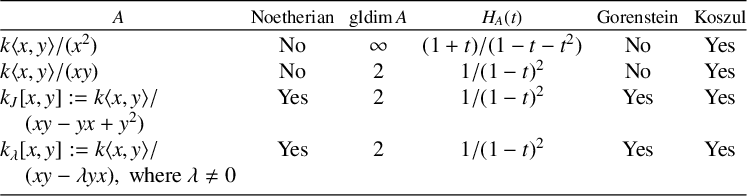
Example 2.5. It is one of the basic facts in noncommutative algebraic geometry that every graded algebra
 $A=k{\langle }x, y{\rangle }/(h)$
, where
 $0\neq h\in k{\langle }x, y{\rangle }_2$
is isomorphic as a graded algebra to exactly one of the following graded algebras in Table 1, where
 $k_{\lambda }[x, y]\cong k_{\lambda '}[x, y]$
as graded algebras if and only if
 $\lambda '=\lambda ^{\pm 1}$
. It follows that a graded algebra S is a two-dimensional quantum polynomial algebra if and only if
 $S\cong k_J[x, y]$
or
 $S\cong k_\lambda [x, y]$
as graded algebras for some
 $\lambda \neq 0$
.
Quadratic algebras
 $A=k{\langle }x, y{\rangle }/(h)$
.

Definition 2.6. For a sequence
 $M = (M_1, \ldots , M_n)$
of linearly independent symmetric matrices of size n, the graded Clifford algebra associated to M is a graded algebra defined by
 $$ \begin{align*} & A : = k{\langle}x_1, \ldots, x_n, y_1, \ldots, y_n{\rangle}/ \bigg(x_ix_j+x_jx_i-\sum_{m=1}^n(M_m)_{ij}y_m, x_iy_j-y_jx_i, y_iy_j-y_j y_i\bigg)_{1\leq i, j\leq n}, \end{align*} $$
where
 $\deg x_i=1$
,
 $\deg y_j=2$
, and
 $(M_m)_{ij}$
is the
 $ij$
-entry of the matrix
 $M_m$
for
 $1\leq m \leq n$
.
Definition 2.7. Let R be an algebra and
 $f\in R$
.
-
(1) We say that f is right (left) regular if, for every
$g\in R$
,
$gf=0$
(
$fg=0$
) implies
$g=0$
. We say that f is regular if it is both right and left regular. -
(2) We say that f is normal if
$Rf=fR$
.


We often implicitly assume that
 $f\in R$
is not a unit when we say that f is a regular normal element. In particular, for a connected graded algebra A, we often implicitly assume that
 $f\in A_{\geq 1}$
when we say that f is a homogeneous regular normal element.
Definition 2.8. Let R be an algebra and
 $F = (f_1, \ldots , f_m)$
a sequence of elements in R. Then:
-
(1) we say that F is regular if
$\bar f_i\in R/(f_1, \ldots , f_{i-1})$
is regular for every
$i=1, \ldots , m$
; -
(2) we say that F is normal (respectively central) if
$\bar f_i\in R/(f_1, \ldots , f_{i-1})$
is normal (respectively central) for every
$i=1, \ldots , m$
.


In the case where R is a graded algebra:
-
(3) we say that F is of degree d if
$\deg f_i = d$
for every
$i=1, \ldots , m$
; -
(4) we say that F is homogeneous if
$f_i$
is homogeneous for every
$i=1, \ldots , m$
.


For
 $f_1, \ldots , f_m\in R$
, the notation
 $(f_1, \ldots , f_m)$
has two possible meanings. If we write
 $R/(f_1, \ldots , f_m)$
, then it is a two-sided ideal of R generated by
 $f_1, \ldots , f_m$
. If we write
 $F=(f_1, \ldots , f_m)$
, then it is a sequence of elements. To avoid such a confusion, we often denote by
 $I_F$
the two-sided ideal of R generated by
 $f_1, \ldots , f_m$
when
 $F=(f_1, \ldots , f_m)$
.
Definition 2.9. We define
 $$ \begin{align*} {\mathcal A}_{n, m} & : = \{S/(h_1, \ldots, h_m) \mid\! S \text{ is an } n\text{-dimensional quantum polynomial algebra and } \\ & \qquad \text H=(h_1, \ldots, h_m) \text{ is a homogeneous regular normal sequence of}\\ & \qquad\qquad \text{degree 2 in } S\}/\cong, \\ {\mathcal B}_{n, m} & :=\{S/(h_1, \ldots, h_m)\in {\mathcal A}_{n, m}\mid\! S=k[x_1, \ldots, x_n]\}/\cong, \\ {\mathcal C}_{n, m} & :=\{S/(h_1, \ldots, h_m)\in {\mathcal A}_{n, m}\mid\! S \text { is a graded Clifford algebra and }\\ &\qquad\quad h_1, \ldots, h_m\in Z(S)_2\}/\cong. \end{align*} $$
A graded algebra A is called a noncommutative quadratic complete intersection if
 $A\in {\mathcal A}_{n, m}$
. In particular, A is called a noncommutative conic, a noncommutative pencil of conics, if
 $A\in {\mathcal A}_{3, 1}, A\in {\mathcal A}_{3,2}$
, respectively. A commutative graded algebra B is called a conic, a pencil of conics, if
 $B\in {\mathcal B}_{3, 1}, B\in {\mathcal B}_{3,2}$
, respectively.
We remark that
 ${\mathcal A}_{n,0}$
is the set of isomorphism classes of n-dimensional quantum polynomial algebras and
 ${\mathcal B}_{n,0} = \{k[x_1, \ldots , x_n] \}$
.
Lemma 2.10 [Reference Shelton and Tingey17, Corollary 1.4], [Reference He and Ye8, Section 5].
For every
 $A=S/(f)\in {\mathcal A}_{n, 1}$
, there exists a regular normal element
 $f^!\in A^!_2$
unique up to a scalar such that
 $S^!=A^!/(f^!)$
. Moreover, if
 $f \in Z(S)_2$
, then
 $f^!\in Z(A^!)_2$
.
Definition 2.11. For
 $A\in {\mathcal A}_{n, 1}$
, we define
 $C(A):=A^![{f^!}^{-1}]_0$
.
It is not obvious from the definition, but
 $C(A)$
is independent of the choice of the pair
 $(S, f)$
such that
 $A=S/(f)\in {\mathcal A}_{n, 1}$
up to isomorphism (see [Reference Hu, Matsuno and Mori10, Lemma 5.3 (2)]).
We denote by
 ${\mathcal F}_2$
the set of isomorphism classes of four-dimensional Frobenius algebras and by
 ${\mathcal G}_2$
the set of isomorphism classes of four-dimensional commutative Frobenius algebras. In our earlier papers, we proved the following two important bijections.
Theorem 2.12 [Reference Hu and Mori11, Theorem 3.28].
The map
 ${\mathcal C}_{n, m}\to {\mathcal B}_{n, n-m}; \; A\mapsto A^!$
is a bijection for every
 $n\in {\mathbb N}$
and
 $m=0, \ldots , n$
.
Theorem 2.13 [Reference Hu9, Corollary 4.10], [Reference Hu and Mori11, Remark 3.29].
The map
 ${\mathcal C}_{3, 1}\to {\mathcal G}_2; A \mapsto C(A)$
is a bijection.
3 Noncommutative affine pencils of conics
In this section, we define and classify noncommutative affine pencils of conics.
Definition 3.1. Let S be a graded algebra. For
 $f\in S$
such that
 $\deg f=d$
, we write
 $f^\vee :=f_d$
. We say that a sequence
 $F=(f_1, \ldots , f_m)$
in S is a strongly regular normal sequence if F is a regular normal sequence in S and
 $F^\vee := (f_1^\vee , \ldots , f_m^\vee )$
is also a (homogeneous) regular normal sequence in S.
Remark 3.2. Let
 $f, g\in k[x_1, \ldots , x_n]\setminus k$
.
-
(1) It is known that
$\operatorname {gcd}(f, g)=1$
if and only if
$(f, g)$
is a regular sequence, so
$(f, g)$
is a regular sequence if and only if
$(g, f)$
is a regular sequence. -
(2) If
$(f^\vee , g^\vee )$
is a regular (normal) sequence, then
$\operatorname {gcd} (f^\vee , g^\vee )=1$
, so
$\operatorname {gcd}(f, g)=1$
; hence,
$(f, g)$
is automatically a strongly regular (normal) sequence. This is not the case in the noncommutative setting (see Example 3.23(1)).


Definition 3.3. We define
 $$ \begin{align*} {\mathcal A}_{n, m}^\vee & : = \{S/(f_1, \ldots, f_m) \mid \!S \text{ is an}\ n\text{-dimensional quantum polynomial algebra and } \\& \quad\ \ F=(f_1, \ldots, f_m)\ \text {is a strongly regular normal sequence of degree 2 in}\ S\}/\cong, \\{\mathcal B}_{n, m}^\vee & :=\{S/(f_1, \ldots, f_m)\in {\mathcal A}_{n, m}^\vee\mid\! S=k[x_1, \ldots, x_n]\}/\cong. \end{align*} $$
An algebra E is called a noncommutative affine pencil of conics if
 $E\in {\mathcal A}_{2,2}^\vee $
and is called an affine pencil of conics if
 $E\in {\mathcal B}_{2,2}^\vee $
.
Example 3.4. Since
 $k[x,y]/(x^2-y)\cong k[x]$
is a domain, it is easy to see that the sequence
 $(x^2-y, yx)$
in
 $k[x,y]$
is a regular (normal) sequence, but not a strongly regular (normal) sequence, so
 $k[x, y]/(x^2-y, yx)$
is not an affine pencil of conics in our definition.
3.1
$st$
-equivalences

We classify noncommutative affine pencils of conics up to
 $st$
-equivalence, which is defined as follows.
Definition 3.5. Let S be a graded algebra and
 $F = (f_1, \ldots , f_m), F' = (f_1', \ldots , f_m') $
sequences in S.
-
(1) We write
$F \sim _s F'$
if there exists
$(\alpha _{ij})\in \operatorname {GL}_m(k)$
such that
$f^{\prime }_j=\sum _{i=1}^m\alpha _{ij}f_i$
for every
${i=1, \ldots , m}$
. In matrix notation,
$(f_1', \ldots , f_m')=(f_1, \ldots , f_m)(\alpha _{ij})$
. -
(2) We write
$F \sim _t F'$
if there exists
$\phi \in \operatorname {Aut}^{{\mathbb Z}}S$
such that
$f^{\prime }_i=\phi (f_i)$
for every
${i=1, \ldots , m}$
. -
(3) We write
$F \sim _{st} F'$
if there exists a sequence
$F"$
in S such that
$F \sim _t F" \sim _s F'.$


Remark 3.6. It is clear that
 $F\sim _{st} F'$
implies
 $S/I_F\cong S/I_{F'}$
, but the converse does not hold in general (see Example 5.12).
Remark 3.7. Let
 $S=k[x_1, \ldots , x_n]$
and
 $H = (h_1, \ldots , h_m), H' = (h_1', \ldots , h_m') $
be homogeneous sequences of degree 2 in S. Since
 $\operatorname {Aut}^{{\mathbb Z}}S=\operatorname {GL}_n(k)$
, the above definition of
 $st$
-equivalence is essentially the same as that given in [Reference Hu and Mori11, Definition 2.17]. In this case,
 $H\sim _{st}H'$
if and only if
 $S/I_H\cong S/I_{H'}$
as graded algebras.
Lemma 3.8. For every fixed
 $m\in \mathbb {N}$
,
 $\sim _s$
,
 $\sim _t$
, and
 $\sim _{st}$
are equivalence relations on the set of sequences
 $F=(f_1,\ldots , f_m)$
in S.
Proof. The relations
 $\sim _s$
and
 $\sim _t$
are obviously equivalence relations, and clearly
 ${F\sim _{st}F}$
.
If
 $F = (f_1,\ldots , f_m), F' = (f^{\prime }_1,\ldots , f^{\prime }_m)$
are sequences in S such that
 $F\sim _{st}F'$
, then there exist
 $(\alpha _{ij})\in \operatorname {GL}_m(k)$
and
 $\phi \in \operatorname {Aut}^{{\mathbb Z}}S$
such that
 $$ \begin{align*} F'= \bigg(\sum_{i=1}^m\alpha_{i1}\phi(f_i),\ldots, \sum_{i=1}^m\alpha_{im}\phi(f_i)\bigg) = \bigg(\phi\bigg(\sum_{i=1}^m\alpha_{i1}f_i\bigg),\ldots ,\phi\bigg (\sum_{i=1}^m\alpha_{im}f_i\bigg)\bigg) , \end{align*} $$
so
 $F \sim _{s} F" \sim _t F'$
, where
 $F"=(\sum _{i=1}^m\alpha _{i1}f_i,\ldots , \sum _{i=1}^m\alpha _{im}f_i)$
, and hence
 $F'\sim _{st}F$
.
If
 $F_1\sim _{st}F_2\sim _{st}F_3$
, then there exist
 $F_4, F_5$
such that
 $F_1\sim _{t}F_4\sim _sF_2\sim _tF_5\sim _sF_3$
. Since
 $F_5\sim _{st}F_4$
, then
 $F_4\sim _{st}F_5$
by the above argument, so there exists
 $F_6$
such that
 $F_1\sim _{t}F_4\sim _tF_6\sim _sF_5\sim _sF_3$
and, hence,
 $F_1\sim _{st}F_3$
.
Definition 3.9. Let S be a graded algebra and
 $H=(h_1, \ldots , h_l)$
a homogeneous sequence of degree d in S. For a sequence
 $G=(g_1, \ldots , g_m)$
in S, we write a sequence
 $\bar G:=(\bar g_1, \ldots , \bar g_m)$
in
 $S/I_H$
. For sequences
 $F=(f_1, \ldots , f_m), F'=(f_1', \ldots , f_m')$
of degree d in
 $S/I_H$
, we define
 $(F, H)\sim _{st}(F', H)$
in S if there exist sequences
 $G, G'$
of degree d in S such that
 $\bar G=F, \bar {G'}=F'$
and that
 $(G, H)\sim _{st}(G', H)$
in S.
Lemma 3.10. Let
 $H=(h_1, \ldots , h_l)$
be a homogeneous sequence of degree d in
 $k{\langle }x_1, \ldots , x_n{\rangle }$
and
 $F=(f_1, \ldots , f_m), F'=(f_1', \ldots , f_m')$
sequences of degree d in
 ${S:=k{\langle }x_1, \ldots , x_n{\rangle }/I_H}$
. If
 $F\sim _{st}F'$
in S, then
 $(F, H)\sim _{st}(F', H)$
in
 $k{\langle }x_1, \ldots , x_n{\rangle }$
.
Proof. Let
 $G, G'$
be sequences of degree d in
 $k{\langle }x_1, \ldots , x_n{\rangle }$
such that
 $\bar G=F, \bar {G'}=F'$
.
If
 $F\sim _{s}F'$
in S, then there exists
 $(\alpha _{ij})\in \operatorname {GL}_m(k)$
such that
 $\overline {g^{\prime }_j}=f^{\prime }_j=\sum _i\alpha _{ij}f_i=\sum _i\alpha _{ij}\overline {g_i}$
for
 $j=1, \ldots , m$
. Hence,
 $g^{\prime }_j=\sum _i\alpha _{ij}g_i+\sum _{i}\gamma _{ij}h_i$
for some
 $\gamma _{ij}\in k$
. Since
 $\Big (\!\begin {smallmatrix} (\alpha _{ij}) & 0 \\ (\gamma _{ij}) & E_l \end {smallmatrix}\!\Big )\in \operatorname {GL}_{m+l}(k)$
, we have
 $(G, H)\sim _{s}(G', H)$
in
 $k{\langle }x_1, \ldots , x_n{\rangle }$
. In matrix notation,
 $$ \begin{align*} (g_1', \ldots, g_m', h_1, \ldots, h_l)=(g_1, \ldots, g_m, h_1, \ldots, h_l)\begin{pmatrix} (\alpha_{ij}) & 0 \\ (\gamma_{ij}) & E_l \end{pmatrix}. \end{align*} $$
If
 $F\sim _{t}F'$
in S, then there exists
 $\bar \phi \in \operatorname {Aut}^{{\mathbb Z}} S$
, where
 $\phi \in \operatorname {Aut}^{{\mathbb Z}}k{\langle }x_1, \ldots , x_n{\rangle }=\operatorname {GL}_n(k)$
such that
 $f^{\prime }_j=\bar \phi (f_j)$
for
 $j=1, \ldots , m$
. Hence,
 $\overline {g^{\prime }_j}=f^{\prime }_j=\bar \phi (f_j)=\bar \phi (\bar {g_j})=\overline {\phi (g_j)}$
and
 ${g_j'=\phi (g_j)+\sum _{r}\gamma _{rj}h_r}$
for some
 $\gamma _{rj}\in k$
. Since
 $h_r=\sum _{i}\beta _{ir}\phi (h_i)$
for some
 $(\beta _{ij})\in \operatorname {GL}_l(k)$
, we have
 $$ \begin{align*} g_j'=\phi(g_j)+\sum_{r}\gamma_{rj}\bigg(\sum_{i}\beta_{ir}\phi(h_i)\bigg)=\phi(g_j)+\sum_{i}\sum_{r}\beta_{ir}\gamma_{rj}\phi(h_i). \end{align*} $$
Since
 $\Big (\!\begin {smallmatrix} E_m & 0 \\ (\beta _{ij})(\gamma _{ij}) & (\beta _{ij}) \end {smallmatrix}\!\Big )\in \operatorname {GL}_{m+l}(k)$
, we have
 $(G, H)\sim _{st}(G', H)$
in
 $k{\langle }x_1, \ldots , x_n{\rangle }$
. In matrix notation,
 $$ \begin{align*} \begin{aligned} (g_1', \ldots, g_m', h_1, \ldots, h_l)=(\phi(g_1), \ldots, \phi(g_m), \phi(h_1), \ldots, \phi(h_l))\begin{pmatrix} E_m & 0 \\ (\beta_{ij})(\gamma_{ij}) & (\beta_{ij}) \end{pmatrix}. \end{aligned}\\[-43pt] \end{align*} $$
Definition 3.11. We define
 $$ \begin{align*} {\mathcal A}_{n, m}^{\vee, st} & : = \{(F, H) \text{ is a linearly independent sequence of degree 2 in } k{\langle}x_1, \ldots, x_n{\rangle} \mid \\ & \qquad S=k{\langle}x_1, \ldots, x_n{\rangle}/I_H\in {\mathcal A}_{n, 0} \text{ and } S/I_{\bar F}\in {\mathcal A}_{n,m}^\vee\}/\sim_{st} \\ {\mathcal B}_{n, m}^{\vee, st} & : = \{(F, H)\in {\mathcal A}_{n, m}^{\vee, st} \mid\! S=k{\langle}x_1, \ldots, x_n{\rangle}/I_H\cong k[x_1, \ldots, x_n]\}/\sim_{st}. \end{align*} $$
Clearly, we have natural surjections
 ${\mathcal A}_{n, m}^{\vee , st}\to {\mathcal A}_{n, m}^\vee , {\mathcal B}_{n, m}^{\vee , st}\to {\mathcal B}_{n, m}^\vee , ({\mathcal A}_{2, 2}^{\vee , st}\setminus {\mathcal B}_{2, 2}^{\vee , st})\to ({\mathcal A}_{2, 2}^{\vee }\setminus {\mathcal B}_{2, 2}^{\vee })$
.
3.2 Normalizing automorphisms
To classify all noncommutative affine pencils of conics, we need to find all strongly regular normal sequences
 $(f,g)$
of degree 2 for each two-dimensional quantum polynomial algebra
 $S \in {\mathcal A}_{2,0}$
as classified in Example 2.5. It is not easy to determine if a given element is regular and/or normal in general, however, it is relatively easier to determine if a given ‘homogeneous’ element is regular and/or normal. For example, the following lemma applies to only homogeneous sequences.
Lemma 3.12. Let A be a locally finite
 ${\mathbb N}$
-graded algebra and
 $F = (f_1, \ldots , f_m)$
a homogeneous normal sequence. Then, F is regular if and only if
 $$ \begin{align*} H_{A/I_F}(t)=(1-t^{d_1})\cdots (1-t^{d_m})H_A(t), \end{align*} $$
where
 $d_i = \deg f_i$
for
 $i = 1, \ldots , m$
.
Proof. This was proved under the assumption that
 $f_1, \ldots , f_m\in A$
are normal in [Reference Hu and Mori11, Lemma 2.28], but the same proof works without the assumption.
Remark 3.13. Unlike [Reference Hu and Mori11, Lemma 2.28], a homogeneous regular normal sequence is not preserved by permutations (see Example 3.23 (2)).
Let R be an algebra. Then,
 $f\in R$
is a regular normal element if and only if there exists a unique algebra automorphism
 $\nu \in \operatorname {Aut} R$
such that
 $gf=f\nu (g)$
for
 $g\in R$
. We call
 $\nu $
the normalizing automorphism of f. A regular normal element
 $f\in R$
is central if and only if
 $\nu =\operatorname {id}$
. If A is a graded algebra and
 $f\in A$
is a homogeneous regular normal element, then
 $\nu \in \operatorname {Aut}^{{\mathbb Z}}A$
is a graded algebra automorphism. The normalizing automorphism is very useful for finding regular normal elements. We prepare some lemmas as follows.
Lemma 3.14. Let R be an algebra.
-
(1) If there exists a surjective map
$\nu : R \to R$
such that
$gf=f\nu (g)$
for
$g\in R$
, then
$f\in R$
is a normal element. In particular, if
$R = k{\langle }x_1, \ldots , x_n{\rangle }/I$
and if there exists
$(a_{ij})\in \operatorname {GL}_n(k)$
such that
$x_if=f(\sum _{j=1}^na_{ij}x_j)$
, then f is normal. -
(2) If
$f, g\in R$
are regular normal elements with the same normalizing automorphism, then
$\alpha f+\beta g\in R$
is a normal element for every
$\alpha , \beta \in k$
.


Remark 3.15. The converse of Lemma 3.14(2) does not hold in general. In fact, it is possible that
 $f, g, f+g\in R$
are regular normal elements such that their normalizing automorphisms are all distinct (see Example 3.23(3)).
Lemma 3.16. Let S be a graded algebra and
 $f=\sum f_i\in S$
a normal element where
 $f_i\in S_i$
. If there exists
 $\nu \in \operatorname {Aut}^{{\mathbb Z}}S$
such that
 $gf=f\nu (g)$
for every
 $g\in S$
, then
 $gf_i=f_i\nu (g)$
for every
 $g\in S$
. Therefore,
 $f_i$
is a normal element for every
 $i\in {\mathbb Z}$
.
Proof. Since
 $\nu \in \operatorname {Aut}^{{\mathbb Z}}S$
, we have
 $\nu (g_j)\in S_j$
for every
 $g_j\in S_j$
, so
 $g_jf_{i}=(g_jf)_{i+j}=(f\nu (g_j))_{i+j}=f_i\nu (g_j)$
. It follows that
 $gf_i=f_i\nu (g)$
for every
 $g\in S$
, so
 $f_i$
is a normal element by Lemma 3.14(1).
The following lemma is useful for finding a (regular) normal element f of degree 2 in
 $S\in {\mathcal A}_{2, 0}$
.
Lemma 3.17. Let
 $S=k{\langle }x_1, \ldots , x_n{\rangle }/I$
be a graded algebra and
 $f=\sum f_j\in S$
a regular normal element with the normalizing automorphism
 $\nu \in \operatorname {Aut} S$
, where
 $f_j\in S_j$
. If
 $f^\vee $
is regular, then the following results hold.
-
(1)
$\nu \in \operatorname {Aut}^{{\mathbb Z}}S$
. -
(2)
$f_j$
is a normal element for every j. -
(3) If
$f_j$
is regular, then the normalizing automorphism of
$f_j$
is also
$\nu $
. -
(4)
$f\in Z(S)$
if and only if
$f_j\in Z(S)$
for every j such that
$f_j$
is regular if and only if
$f_j\in Z(S)$
for some j such that
$f_j$
is regular.


Proof. (1) Since
 $x_if=f\nu (x_i)$
and
 $f^\vee $
is regular, we have
 $\deg \nu (x_i)=1$
. Let
 $e\in {\mathbb N}$
be the smallest integer such that
 $f_e\neq 0$
. Since
 $0=(x_if)_e=(f\nu (x_i))_e=f_e\nu (x_i)_0$
and
 $\nu (x_i)_0 \in k$
, we have
 $\nu (x_i)_0=0$
, so
 $\nu \in \operatorname {Aut}^{{\mathbb Z}}S$
.
(2), (3) Since
 $gf_j=f_j\nu (g)$
for every
 $g\in S$
by Lemma 3.16,
 $f_j \in S_j$
is a normal element for every j and the normalizing automorphism of
 $f_j$
is
 $\nu $
whenever
 $f_j$
is regular.
(4) Clear from item (3).
By the above lemma, if
 $(f_1, \ldots , f_m)$
is a strongly regular normal sequence, then the normalizing automorphism of
 $f_i$
is a graded algebra automorphism as long as
 $f_1, \ldots , f_{i-1}$
are homogeneous. The following lemma is useful in finding a regular normal element g of degree 2 in
 $S/(f)$
.
Lemma 3.18. Let S be a graded algebra and
 $f, g\in S$
. If f is a homogeneous normal element and
 $\overline {g^\vee }$
is regular in
 $S/(f)$
, then
 $\bar g$
is regular in
 $S/(f)$
.
Proof. Suppose that
 $\bar g$
is not right regular in
 $S/(f)$
. Then, there exists
 $a\in S$
such that
 $\bar a\neq 0$
, but
 $\bar a\bar g=\overline {ag}=0$
in
 $S/(f)$
. We may assume that
 $\overline {a^\vee }\neq 0$
in
 $S/(f)$
. Since f is normal in S, there exists
 $b=\sum b_i\in S$
, where
 $b_i\in S_i$
such that
 $ag=bf$
in S. Since f is homogeneous,
 $(ag)^\vee =(bf)^\vee =(\sum b_if)^\vee = b_jf$
in S for some
 $j\in {\mathbb Z}$
, so
 $\overline {(ag)^\vee }=0$
in
 $S/(f)$
. If
 $a^\vee g^\vee \neq 0$
, then
 $a^\vee g^\vee =(ag)^\vee $
, so
 $\overline {a^\vee }\cdot \overline { g^\vee } = \overline {a^\vee g^\vee }=\overline {(ag)^\vee } = 0$
in
 $S/(f)$
. If
 $a^\vee g^\vee =0$
, then
 $\overline {a^\vee }\cdot \overline { g^\vee } = \overline {a^\vee g^\vee }=0$
. In either case,
 $\overline {g^\vee }$
is not right regular in
 $S/(f)$
, which leads to a contradiction. A similar argument applies to the left regularity by symmetry.
3.3 Classification
We now classify noncommutative affine pencils of conics. Note that since every
 $S\in {\mathcal A}_{2, 0}$
is a domain, every nonzero element in S is regular.
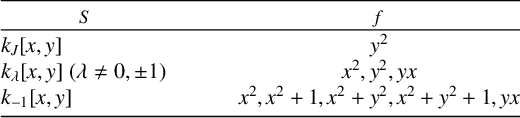
Proposition 3.19. A list of all (regular) normal elements
 $f\in S$
of degree
 $2$
up to t-equivalence for each
 $S\in {\mathcal A}_{2, 0}\setminus {\mathcal B}_{2, 0}$
is given in Table 2.
List of (regular) normal elements in S up to t-equivalence.

Proof (Sketch). Let
 $S\in {\mathcal A}_{2, 0}\setminus {\mathcal B}_{2, 0}$
and
 $f\in S$
be a (regular) normal element of degree 2 in S. Since
 $f_0\in Z(S)$
, if
 $f_0\neq 0$
, then
 $f\in Z(S)$
by Lemma 3.17(4). Moreover, if
 $f_1\neq 0$
, then
 $f_1$
is a (regular) normal element having the same normalizing automorphism as that of
 $f_2$
by Lemma 3.17(3). If S is not commutative, then it is not difficult to find all homogeneous (regular) normal elements of degrees 1 and 2 in S, and to compute their normalizing automorphisms, to conclude
 $f_1=0$
.
For a concrete demonstration, see the following example.
Example 3.20. Let
 $S=k_{\lambda }[x, y]\in {\mathcal A}_{2, 0}\setminus {\mathcal B}_{2, 0}$
, where
 $\lambda \neq 0, 1$
. We can check that the only homogeneous (regular) normal elements of degree 1 are
 $x, y$
up to scalars. If
 ${\lambda \neq -1}$
, then we can check that the only homogeneous (regular) normal elements of degree 2 are
 $x^2, y^2, yx$
up to scalars. We can also check that the normalizing automorphisms of
 $x, y, x^2, y^2, yx$
are all distinct and not the identity, so we can conclude that the only (regular) normal elements of degree 2 are
 $x^2, y^2, yx$
up to scalars by Lemma 3.17(3).
If
 $\lambda =-1$
, then we can check that the only homogeneous (regular) normal elements of degree 2 are
 $\alpha x^2+\beta y^2, yx$
up to scalars, where
 $\alpha , \beta \in k$
. We can also check that the normalizing automorphisms of
 $x, y, \alpha x^2+\beta y^2, yx$
are all distinct and
 $\alpha x^2+\beta y^2$
are the only central elements among them, so we can conclude that the only (regular) normal elements of degree 2 are
 $\alpha x^2+\beta y^2+\gamma , yx$
up to scalars, where
 $\alpha , \beta , \gamma \in k$
by Lemma 3.17(3), (4). Since
 $$ \begin{align*}\operatorname{Aut}^{{\mathbb Z}}(S)= \bigg\{\begin{pmatrix} a & 0 \\ 0 & d \end{pmatrix}, \begin{pmatrix} 0 & b \\ c & 0 \end{pmatrix}\mid\! a, b, c, d\in k, ad\neq 0, bc\neq 0\bigg\},\end{align*} $$
we can show that f is
 $x^2, x^2+1, x^2+y^2, x^2+y^2+1, yx$
up to t-equivalence.
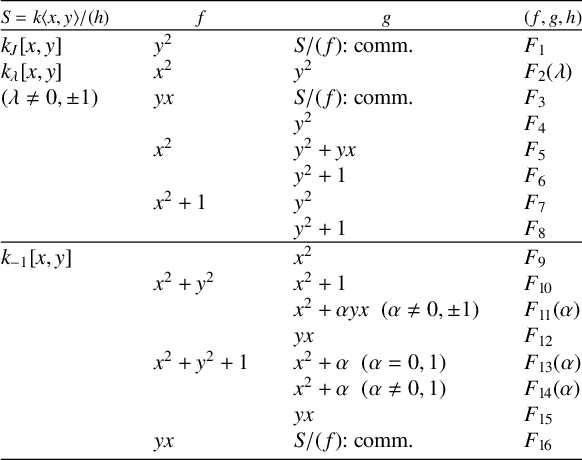
Theorem 3.21. Table 3 consists of the following information:
-
(1) a list of two-dimensional quantum polynomial algebras
$S=k{\langle }x, y{\rangle }/(h) \in {\mathcal A}_{2, 0}\setminus {\mathcal B}_{2, 0}$
; -
(2) a list of (regular) normal elements
$f\in S$
of degree 2 up to t-equivalence for each S; -
(3) a list of elements
$g\in S/(f)$
such that
$(f, g)$
is a strongly regular normal sequence of degree 2 in S up to
$st$
-equivalence of
$(f, g)$
in S for each pair
$(S, f)$
such that
$S/(f)$
is not commutative; -
(4) the name of the sequence
$(f, g, h)$
in
$k{\langle }x, y{\rangle }$
.


(Since
 $(y^2, x^2, xy-\lambda yx)\sim _{s}(x^2, y^2, xy-\lambda yx)$
in
 $k{\langle }x, y{\rangle }$
, we delete the pair
 $(k_{\lambda }[x, y], y^2)$
from Table 3.)
List of regular normal elements in
 $S/(f)$
.

Proof (Sketch). We prove this result using the following steps.
Step 1. Show that every
 $\{f, h\}$
in Table 3 is a noncommutative Gröbner basis for the two-sided ideal
 $(f, h)$
of
 $k{\langle }x, y{\rangle }$
using Bergman’s diamond lemma [Reference Bergman4, Theorem 1.2] (see also [Reference Dräxler, Michler and Ringel6]).
Step 2. Fix a k-basis for each
 $S/(f)=k{\langle }x, y{\rangle }/(f, h)$
using the noncommutative Gröbner basis obtained in Step 1.
Step 3. For an element
 $g\in S/(f)$
of degree 2, write
 $xg, yg, gu, gv$
, where
 $u, v\in S/(f)$
are elements of degree 1 as linear combinations of the k-basis for
 $S/(f)$
obtained in Step 2, and compare the coefficients of the k-basis for the pairs
 $(xg, gu)$
and
 $(yg, gv)$
to find all normal elements of degree 2 in
 $S/(f)$
using Lemma 3.14(1).
Step 4. For g obtained in Step 3, check that
 $(f, g)$
is a strongly regular normal sequence.
We illustrate the above steps in the following example.
Example 3.22. Let
 $S/(f)=k_{-1}[x, y]/(x^2)$
. Using the order
 $y<x$
, we can check that
 $\{x^2, xy+yx\}$
is a noncommutative Gröbner basis for the two-sided ideal
 $(x^2, xy+yx)$
of
 $k{\langle }x, y{\rangle }$
, so we can compute that
 $k{\langle }x, y{\rangle }/(x^2, xy+yx)=S/(f)$
has a k-vector space basis
 $\{1, x, y, yx, y^2, y^2x, y^3, \cdots \}$
. Suppose that
 $(f, g)$
is a strongly regular normal sequence of degree 2 in
 $S=k_{-1}[x, y]$
. Since
 $(f^\vee , g^\vee )=(x^2, g_2)$
is a homogeneous regular normal sequence of degree 2 in S,
 $g_2\neq yx$
, so we may write
 $g_2=\gamma yx+y^2$
for some
 $\gamma \in k$
up to a scalar. Since
 $$ \begin{align*} xg_2 & =x(\gamma yx+y^2)=y^2x=(\gamma yx+y^2)x=g_2x, \\ yg_2 & =y(\gamma yx+y^2)=\gamma y^2x+y^3=(\gamma yx+y^2)(\gamma x+y)=g_2(2\gamma x+y), \end{align*} $$
 $g_2$
is a normal element with the normalizing automorphism
 $\nu =\Big (\!\begin {smallmatrix} 1 & 0 \\ 2\gamma & 1 \end {smallmatrix}\!\Big )$
, and
 $g_2$
is central if and only if
 $\gamma =0$
. By Lemma 3.17(3), the normalizing automorphism of g is also
 $\nu \in \operatorname {Aut}^{{\mathbb Z}}S/(f)$
, so
 $ug_1 = g_1 \nu (u)$
for every
 $u\in S$
by Lemma 3.16. If
 $g_1=\alpha x+\beta y$
, where
 $\alpha , \beta \in k$
, then
 $$ \begin{align*} -\beta yx &= x(\alpha x+\beta y) = xg_1 = g_1\nu(x) = (\alpha x+\beta y)x=\beta yx, \\ \alpha yx+\beta y^2 &= y(\alpha x+\beta y)= yg_1 = g_1\nu(y) =(\alpha x+\beta y)(2\gamma x+y)=(2\beta\gamma-\alpha)yx+\beta y^2, \end{align*} $$
so
 $\alpha =\beta =0$
. It follows that
 $g_1=0$
, so
 $g=y^2+\gamma yx$
or
 $g=y^2+\delta $
for some
 $\gamma , \delta \in k$
. It is now easy to see that g is
 $y^2, y^2+1, y^2+yx$
up to t-equivalence in S. Since
 $$ \begin{align*}(k_{-1}[x, y]/(x^2, y^2))^!\cong k[x, y], \quad (k_{-1}[x, y]/(x^2, y^2+yx))^!\cong k_J[x, y]\in {\mathcal A}_{2, 0}\end{align*} $$
and
 $$ \begin{align*}H_{k_{-1}[x, y]/(x^2, y^2)}(t)=H_{k_{-1}[x, y]/(x^2, y^2+yx))}(t)=(1+t)^2=(1-t^2)^2/(1-t)^2\end{align*} $$
by Theorem 2.4,
 $g_2\in S/(f)$
is regular by Lemma 3.12. By Lemma 3.18,
 $g\in S/(f)$
is regular, so
 $(f, g)$
is a strongly regular normal sequence.
Example 3.23. Example 3.22 provides some counter-examples.
-
(1) For a sequence
$(f, g)=(x^2, y^2+y)$
in
$ k_{-1}[x, y]$
,
$(f^\vee , g^\vee )=(x^2, y^2)$
is a regular normal sequence, but
$(f, g)$
is not a (strongly) regular normal sequence (see Remark 3.2(2)). -
(2)
$(x^2, y^2+yx)$
is a regular normal sequence in
$ k_{-1}[x, y]$
, but
$(y^2+yx, x^2)$
is not a regular normal sequence in
$ k_{-1}[x, y]$
(see Remark 3.13). -
(3)
$y^2+yx, y^2-yx\in k_{-1}[x, y]/(x^2)$
are regular normal (noncentral) elements with the distinct normalizing automorphisms, but
$(y^2+yx)+(y^2-yx)=2y^2\in k_{-1}[x, y]/(x^2)$
is a regular central element (see Remark 3.15).


Theorem 3.24. Let
 $(f, g, h)\in {\mathcal A}_{2, 2}^{\vee , st}$
so that
 $S=k{\langle }x, y{\rangle }/(h)\in {\mathcal A}_{2, 0}$
and
 $E=S/(f, g)\in {\mathcal A}_{2, 2}^\vee $
.
-
(1) We have that E is not commutative if and only if
$(f, g, h)$
is
$st$
-equivalent in
$k{\langle }x, y{\rangle }$
to one of the following: where
$$ \begin{align*}(x^2, y^2, xy\kern1.6pt{-}\kern1.6pt\lambda yx), (x^2, y^2\kern1.6pt{+}\kern1.6pt yx, xy\kern1.6pt{+}\kern1.6pt yx), (x^2,y^2\kern1.7pt{+}\kern1.7pt1, xy\kern1.7pt{+}\kern1.7pt yx), (x^2\kern1.7pt{+}\kern1.7pt 1,y^2\kern1.6pt{+}\kern1.6pt 1, xy\kern1.6pt{+}\kern1.6pt yx),\end{align*} $$
$\lambda \neq 0, 1$
.
-
(2) We have that E is commutative if and only if there exists
$(f', g', xy-yx)\in {\mathcal B}_{2, 2}^{\vee , st}$
such that in
$$ \begin{align*}(f, g, h)\sim_{st}(f', g', xy-yx)\end{align*} $$
$k{\langle }x, y{\rangle }$
.


Proof. (1) If E is not commutative, then
 $S/(f)$
is not commutative, so
 $F_1, F_3, F_{12}$
,
 $F_{15}, F_{16}$
in Table 3 are excluded. Evidently
 $F_4\sim _{st}F_9, F_6\sim _{st}F_7\sim _{st}F_{13}(\alpha ), F_8\sim _{st}F_{10}$
in
 $k{\langle }x, y{\rangle }$
in Table 3. Now,
 $F_{14}(\alpha ) \sim _{st} (x^2+\alpha , y^2+ (1-\alpha ), xy+ yx) \sim _{st} F_8$
. If
 $\phi =\Big (\!\begin {smallmatrix} 1 & 1 \\ 1 & -1 \end {smallmatrix}\!\Big )\in \operatorname {GL}_2(k)=\operatorname {Aut}^{{\mathbb Z}}(k{\langle }x, y{\rangle })$
, then
 $$ \begin{align*} \phi(x^2+y^2)&=(x+y)^2+(x-y)^2=2(x^2+y^2), \\ \phi(x^2\!+\alpha yx)&=(x+y)^2\!+\alpha (x-y)(x+y)=(1\!+\alpha )x^2\!+(1\!+\alpha )xy+(1-\alpha )yx\!+(1\!-\alpha )y^2, \\ \phi(xy+yx)&=(x+y)(x-y)+(x-y)(x+y)=2(x^2-y^2), \end{align*} $$
so
 $(x^2+y^2, x^2+\alpha yx, xy+yx)\sim _{st} (x^2, y^2, xy-\lambda yx)$
in
 $k{\langle }x, y{\rangle }$
, where
 $\lambda =(\alpha +1)/ (\alpha -1)$
, that is,
 $F_{11}(\alpha )\sim _{st}F_2( (\alpha -1)/(\alpha +1))$
in
 $k{\langle }x, y{\rangle }$
. It is easy to see that none of these algebras E is commutative.
(2) Suppose that E is commutative. If
 $S=k[x, y]$
, then the result is trivial. If
 $S\neq k[x, y]$
, then it is enough to check it for
 $F_1, F_3, F_{12}, F_{15}, F_{16}$
in Table 3. Since
 $$ \begin{align*} &F_1\sim_s(y^2,g, xy-yx), \, F_3\sim_sF_{16}\sim_s(yx, g, xy-yx), \\ &F_{12} \sim_s (x^2 + y^2 ,yx, xy-yx), \, F_{15} \sim_s (x^2 + y^2 + 1, yx, xy-yx) \end{align*} $$
in
 $k{\langle }x, y{\rangle }$
, the result follows.
We restate Theorem 3.24 in the following form.
Corollary 3.25. Every
 $(f, g, h)\in {\mathcal A}_{2, 2}^{\vee , st}\setminus {\mathcal B}_{2, 2}^{\vee , st}$
is
 $st$
-equivalent in
 $k{\langle }x, y{\rangle }$
to one of the following:
 $$ \begin{align*}(x^2, y^2, xy-\lambda yx), (x^2, y^2 + yx, xy+yx), (x^2,y^2+1, xy+yx), (x^2+1,y^2+1, xy+yx),\end{align*} $$
where
 $\lambda \neq 0, 1$
.
Proof. Take
 $(f,g,h) \in {\mathcal A}_{2, 2}^{\vee , st}\setminus {\mathcal B}_{2, 2}^{\vee , st}$
and consider
 $E = k{\langle }x, y{\rangle }/(f, g, h)$
. If E is commutative, then by Theorem 3.24(2), we have
 $(f,g,h) \in {\mathcal B}_{2, 2}^{\vee , st}$
, which is a contradiction. Hence, E is not commutative and the conclusion follows from Theorem 3.24(1).
The above theorem (corollary) shows that
 $E\in {\mathcal A}_{2, 2}^{\vee }$
is commutative if and only if
 $E\in {\mathcal B}_{2, 2}^{\vee }$
, which is not obvious from the definition.
4 Four-dimensional Frobenius algebras
In this section, we give complete classifications of four-dimensional Frobenius algebras up to isomorphism and up to derived equivalence.
Definition 4.1. A finite-dimensional algebra R is called a Frobenius algebra if there exists a bilinear form
 $ (-,-): R \times R \to k $
satisfying the following conditions.
-
(1) Associative:
$(ab,c) = (a,bc)$
for all
$a,b,c \in R$
. -
(2) Nondegenerate: for any
$a \in R$
, there are
$b, c\in R$
such that
$(a,b) \neq 0$
and
${(c,a) \neq 0}$
.


The following lemmas are useful.
Lemma 4.2 [Reference Skowronski and Yamagata18, Proposition IV 2.4].
If
 $R = R_1\times \cdots \times R_n$
is a direct product of finite-dimensional algebras, then R is Frobenius if and only if
 $R_i$
is Frobenius for every
 $i=1, \ldots , n$
.
We say a quiver Q is path connected if for any two vertices i and j, there are a path from i to j and a path from j to i. The lemma below follows from [Reference Green7, Corollary 3.4] since every Frobenius algebra is (left and right) self-injective by [Reference Skowronski and Yamagata18, Proposition IV 3.8].
Lemma 4.3. If
 $R = kQ/I$
is a Frobenius algebra, where Q is a connected quiver and I is an admissible ideal, then Q is path connected.
Lemma 4.4. Every Frobenius algebra up to dimension
 $3$
is commutative.
Proof. Let E be an algebra up to dimension 3. If E is not commutative, then it is known that  , which is not Frobenius by Lemma 4.3.
There is a close relationship between quantum polynomial algebras and Frobenius algebras.
Theorem 4.5 [Reference Smith19, Proposition 5.10].
Let S be a Koszul algebra of finite global dimension. Then, S satisfies the Gorenstein condition if and only if
 $S^!$
is a Frobenius algebra. In particular, if S is a quantum polynomial algebra, then
 $S^!$
is a Frobenius algebra.
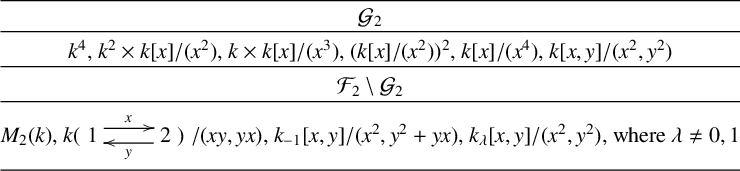
Theorem 4.6. Every four-dimensional Frobenius algebra is isomorphic to exactly one of the algebras listed in Table 4, where
 $k_\lambda [x,y]/(x^2,y^2)\cong k_{\lambda '}[x, y]/(x^2, y^2)$
if and only if
 $\lambda '=\lambda ^{\pm 1}$
.
Four-dimensional Frobenius algebras.

Proof. The classification of
 ${\mathcal G}_2$
is given in [Reference Hu9, Corollary 4.10], so we classify
 ${\mathcal F}_2\setminus {\mathcal G}_2$
. If
 $E\in {\mathcal F}_2$
is a direct product of two algebras, then E is commutative by Lemma 4.2 and Lemma 4.4, so we exclude this case. In particular, we exclude the case where E is a basic algebra and the quiver of E is not connected.
We divide the proof into four cases in terms of the dimension of
 $E / {\operatorname {rad}}\ E$
.
(a)
 $\operatorname {dim}_k E / {\operatorname {rad}}\ E = 4$
: since
 ${\operatorname {rad}}\ E = 0$
, E is semisimple (so that E is a Frobenius algebra by [Reference Skowronski and Yamagata18, Proposition IV 6.7]), so either
 $E\cong k^4$
(commutative) or
 $E\cong M_2(k)$
.
(b)
 $\operatorname {dim}_k E / {\operatorname {rad}}\ E = 3$
: since
 $E / {\operatorname {rad}} \; E \cong k^3$
, E is a basic algebra. The quiver Q of E has
 $3$
vertices with one arrow, so Q is not connected.
(c)
 $\operatorname {dim}_k E / {\operatorname {rad}}\ E = 2$
: since
 $E / {\operatorname {rad}} \; E \cong k^2$
, E is a basic algebra. Since the quiver Q of E is connected, it has two vertices with two arrows, so Q is one of the following.
-
(i)
-
(ii)
-
(iii)
-
(iv)


By Lemma 4.3, option (iv) is the only possible quiver for a Frobenius algebra. Since
 $\operatorname {dim}_k E = 4$
,

which is known to be a Frobenius algebra ([Reference Skowronski and Yamagata18, Example IV 7.5]).
(d)
 $\operatorname {dim}_k E / {\operatorname {rad}}\ E = 1$
: Since
 $E / {\operatorname {rad}}\ E \cong k$
, E is a basic algebra. The quiver Q of E has one vertex with i arrows, where
 $i = 1, 2, 3$
. If
 $i = 1$
, then
 $E \cong k[x]/I$
is commutative. If
 $i = 3$
, then
 $$ \begin{align*} E \cong k\langle x,y,z\rangle/(x^2,y^2,z^2, xy, yx, xz, zx, yz, zy) = k [x,y,z]/(x^2,y^2,z^2, xy, xz, yz) \end{align*} $$
is commutative. If
 $i = 2$
, then
 $E \cong T/I$
for some admissible ideal
 $I\lhd T=k{\langle }x, y{\rangle }$
. Since
 $I\subset T_{\geq 2}$
,
 $$ \begin{align*}T_0\oplus T_1\oplus (T_2/(T_2\cap I))\subset T/I\end{align*} $$
as vector spaces. Since
 $\operatorname {dim} _k(T_0\oplus T_1)=3$
,
 $\operatorname {dim} _k(T_2/(T_2\cap I))\leq 1$
, so
 ${\operatorname {dim} _k(T_2\cap I)\geq 3}$
. It follows that there are linearly independent elements
 $h_1, h_2, h_3\in T_2\cap I$
and a surjective algebra homomorphism
 $\phi :R=T/(h_1, h_2, h_3)\to E$
. Recall that for quadratic algebras
 $A, A'$
,
 $A\cong A'$
as graded algebras if and only if
 $A^!\cong {A'}^!$
as graded algebras (see [Reference Mori and Ueyama14, Lemma 4.1]). Since
 $(T/(h_1, h_2, h_3))^!\cong T/(h)$
, where
 $0\neq h\in T_2$
is isomorphic as graded algebras to one of the graded algebras in Example 2.5,
 $T/(h_1, h_2, h_3)$
is isomorphic to one of the following graded algebras:
-
(i)
$R_1=(k{\langle }x, y{\rangle }/(x^2))^!\cong k[x, y]/(xy, y^2)$
; -
(ii)
$R_2=(k{\langle }x, y{\rangle }/(xy))^!\cong k{\langle }x, y{\rangle }/(x^2, yx, y^2)$
; -
(iii)
$R_3=k_J[x, y]^!\cong k_{-1}[x, y]/(x^2, y^2+yx)$
; -
(vi)
$R_4(\lambda )=k_{-\lambda ^{-1}}[x, y]^!\cong k_{\lambda }[x, y]/(x^2, y^2), \, \lambda \neq 0$
.


We exclude
 $R_1$
since it is commutative. By Example 2.5,
 $k{\langle }x, y{\rangle }/(xy), k_J[x, y]$
,
 $k_{\lambda }[x, y]\; (\lambda \neq 0)$
are Koszul algebras of global dimension 2 with Hilbert series
 $1/(1-t)^2$
, so
 $R_2, R_3, R_4(\lambda )$
are four-dimensional algebras by Theorem 2.2, and hence,
 $\phi $
is an isomorphism. Moreover, by Example 2.5,
 $k{\langle }x, y{\rangle }/(xy)$
does not satisfy the Gorenstein condition, while
 $k_J[x, y], k_{\lambda }[x, y]\; (\lambda \neq 0)$
satisfy the Gorenstein condition, so we can conclude that
 $R_2$
is not Frobenius, while
 $R_3, R_4(\lambda )$
are Frobenius by Theorem 4.5.
By Example 2.5, any two algebras in Table 4 are not isomorphic (even as ungraded algebras by [Reference Bell and Zhang3]) to each other except that
 $k_\lambda [x,y]/(x^2,y^2)\cong k_{\lambda '}[x, y]/(x^2, y^2)$
if and only if
 $\lambda '=\lambda ^{\pm 1}$
.
We now classify four-dimensional Frobenius algebras up to derived equivalence.
Lemma 4.7 [Reference Rickard16, Proposition 9.2].
Let R,
 $R'$
be rings. If
 ${\mathcal D}^b(\operatorname {mod} R)\cong {\mathcal D}^b(\operatorname {mod} R')$
, then
 $Z(R)\cong Z(R')$
.
Lemma 4.8 [Reference Xi and Zhang21, Corollary 5.8].
Let R,
 $R'$
be finite-dimensional algebras such that R is self-injective and its Nakayama permutation is transitive. Then,
 ${\mathcal D}^b(\operatorname {mod} R) \cong {\mathcal D}^b(\operatorname {mod} R')$
if and only if
 $\operatorname {mod} R\cong \operatorname {mod} R'$
.
Lemma 4.9 [Reference Skowronski and Yamagata18, Proposition II 6.20].
Let R,
 $R'$
be basic finite-dimensional algebras. Then,
 $\operatorname {mod} R\cong \operatorname {mod} R'$
if and only if
 $R\cong R'$
.
Remark 4.10. The Nakayama permutation of  is transitive by [Reference Skowronski and Yamagata18, Example IV 7.5].
Theorem 4.11. For four-dimensional Frobenius algebras E,
 $E'$
, the following are equivalent:
-
(1)
$E \cong E'$
; -
(2)
$\operatorname {mod} E\cong \operatorname {mod} E'$
; -
(3)
$ {\mathcal D}^b(\operatorname {mod} E)\cong {\mathcal D}^b(\operatorname {mod} E')$
.


Proof. It is enough to show (3)
 $\Rightarrow $
(1).
Suppose that E is commutative. If
 ${\mathcal D}^b(\operatorname {mod} E){\kern-1pt}\cong{\kern-1pt} {\mathcal D}^b(\operatorname {mod} E')$
, then
 ${Z(E'){\kern-1pt}\cong{\kern-1pt} Z(E){\kern-1pt}={\kern-1pt}E}$
by Lemma 4.7. Since
 $\operatorname {dim} _kZ(E')=\operatorname {dim} _kE=4=\operatorname {dim}_kE'$
,
 $Z(E')=E'$
.
If E is not commutative, then either E is basic or else
 $E\cong M_2(k)$
by Theorem 4.6. If E is basic, then it is a basic self-injective algebra with transitive Nakayama permutation ([Reference Skowronski and Yamagata18, Proposition IV 3.8], Theorem 4.6, Remark 4.10), so
 ${\mathcal D}^b(\operatorname {mod} E)\cong {\mathcal D}^b(\operatorname {mod} E')$
if and only if
 $E \cong E'$
by Lemma 4.8 and Lemma 4.9. Suppose
 $E\cong M_2(k)$
. If
 ${\mathcal D}^b(\operatorname {mod} E')\cong {\mathcal D}^b(\operatorname {mod} E)\cong {\mathcal D}^b(\operatorname {mod} k)$
, then
 $E'\cong M_2(k)\cong E$
; hence, the result.
Remark 4.12. For
 $A, A'\in {\mathcal A}_{3, 1}$
, Theorem 4.11 shows that
 $\underline {\operatorname {CM}}^{{\mathbb Z}}(A)\cong \underline {\operatorname {CM}}^{{\mathbb Z}}(A')$
if and only if
 $C(A)\cong C(A')$
(see [Reference Smith and Van den Bergh20, Proposition 5.2]).
5 Main results
In this last section, we prove our main result, the classification of noncommutative affine pencils of conics is the same as the classification of four-dimensional Frobenius algebras. We prove it in the commutative case and in the noncommutative case separately. In the commutative case, we use the techniques of homogenization and dehomogenization.
Definition 5.1. Let
 $S=k[x_1, \ldots , x_n]$
.
-
(1) (Homogenization) For
$f\in S$
such that
$\deg f=d$
, we define For a sequence
$$ \begin{align*} f^z:=f(x_1z^{-1}, \ldots, x_nz^{-1})z^d\in S[z]_d. \end{align*} $$
$F = (f_1, \ldots , f_m)$
in S, we define and
$$ \begin{align*} F^z:=((f_1)^z, \ldots, (f_m)^z), \end{align*} $$
$\mathscr H^z(F):=S[z]/I_{F^z}$
.
-
(2) (Dehomogenization) For
$f\in S[z]$
, we define For a sequence
$$ \begin{align*} f_z:=f(x_1, \ldots, x_n, 1)\in S. \end{align*} $$
$F = (f_1, \ldots , f_m)$
in
$S[z]$
, we define and
$$ \begin{align*} F_z = ((f_1)_z, \ldots, (f_m)_z), \end{align*} $$
$\mathscr D_z(F):=S/I_{F_z}$
.


If
 $f=\sum _{i=0}^df_i\in S$
such that
 $\deg f=d$
, where
 $f_i\in S_i$
, then
 $f^z=\sum _{i=0}^df_iz^{d-i}\in S[z]_d$
. The following lemma is well known (and easy to check).
Lemma 5.2. Let
 $S=k[x_1, \ldots , x_n]$
.
-
(1) For a sequence
$F $
in S,
$(F^z)_z=F$
. -
(2) Let H be a homogeneous sequence in
$S[z]$
and
$B=S[z]/I_H$
a graded algebra. If
$z\in B_1$
is regular, then
$\mathscr D_z(H)\cong B[z^{-1}]_0$
.


By Lemma 5.2, we make the following definition by abuse of notation.
Definition 5.3. For a commutative graded algebra B finitely generated in degree 1 and a regular element
 $z\in B_1$
, we define
 $\mathscr D_z(B):=B[z^{-1}]_0$
.
Lemma 5.4. For a sequence F in
 $S=k[x_1, \ldots , x_n]$
, if
 $z\in \mathscr H^z(F)$
is regular, then
 $\mathscr D_z(\mathscr H^z(F))\cong S/I_F$
.
Proof. By Lemma 5.2,
 $$ \begin{align*} \begin{aligned} \mathscr D_z(\mathscr H^z(F))\cong \mathscr D_z(F^z)=S/I_{(F^z)_z}=S/I_F. \end{aligned}\\[-37pt] \end{align*} $$
We denote by
 $\operatorname {Kdim} B$
the Krull dimension of a commutative graded algebra B.
Lemma 5.5. For
 $B=k[x_1, \ldots , x_n]/(f_1, \ldots , f_{n-1})\in {\mathcal B}_{n, n-1}$
, there exists a regular element
 $z\in B_1$
.
Proof. Since B is a graded algebra generated in degree 1 such that
 $\operatorname {Kdim} B=1$
, there exists a homogeneous system of parameters consisting of one element
 $z\in B_1$
by [Reference Bruns and Herzog5, Theorem 1.5.17]. Since B is a connected graded Cohen–Macaulay algebra,
 $z\in B_1$
is a regular element by [Reference Matsumura13, Theorem 17.4].
Lemma 5.6. Let B be a commutative graded algebra finitely generated in degree 1 such that
 $\operatorname {Kdim} B=1$
. If
 $f, f'\in B$
are homogeneous regular elements, then
 $B[f^{-1}]_0\cong B[{f'}^{-1}]_0$
. In particular, if
 $z, z'\in B_1$
are regular, then
 $\mathscr D_z(B)\cong \mathscr D_{z'}(B)$
.
Proof. Since
 $\operatorname {Kdim} B/(f)\kern1.2pt{=}\kern1.2pt\operatorname {Kdim} B/(f')\kern1.2pt{=}\kern1.2pt0$
,
 $\operatorname {Spec} B[f^{-1}]_0\kern1.2pt{\cong}\kern1.2pt \operatorname {Proj} B\kern1.2pt{\cong}\kern1.2pt \operatorname {Spec} B[{f'}^{-1}]_0$
, so
 $B[f^{-1}]_0\cong B[{f'}^{-1}]_0$
.
By the above lemma, we may write
 $\mathscr D(B)$
in place of
 $\mathscr D_z(B)$
if
 $\operatorname {Kdim} B=1$
.
Lemma 5.7. If
 $A\in {\mathcal C}_{3, 1}$
, then
 $C(A)\cong \mathscr D(A^!)$
.
Proof. If
 $A\in {\mathcal C}_{3, 1}$
, then
 $A^!\in {\mathcal B}_{3, 2}$
by Theorem 2.12, so there exists a regular element
 $z\in A^!_1$
by Lemma 5.5. Since
 $\operatorname {Kdim} A^!=1$
and
 $f^!\in A^!_2$
is regular by Lemma 2.10,
 $C(A):=A^![f^{-1}]_0\cong A^![z^{-1}]_0=:\mathscr D(A^!)$
by Lemma 5.6.
Theorem 5.8. If
 $E=k[x, y]/(f, g)\in {\mathcal B}_{2, 2}^\vee $
, then
 $\mathscr H^z(f, g)=k[x, y, z]/(f^z, g^z)\in {\mathcal B}_{3, 2}$
and
 $\mathscr D_z(\mathscr H^z(f, g))\cong E$
.
Proof. Since
 $k[x, y, z]/(f^z, g^z, z)\cong k[x, y]/(f^\vee , g^\vee )$
and
 $(f^\vee , g^\vee )$
is a homogeneous regular sequence of degree 2 in
 $k[x, y]$
,
 $$ \begin{align*}H_{k[x, y, z]/(f^z, g^z, z)}(t)=H_{k[x, y]/(f^\vee, g^\vee)}(t)=(1-t^2)^2/(1-t)^2=(1-t^2)^2(1-t)/(1-t)^3\end{align*} $$
by Lemma 3.12. Since
 $(f^z, g^z, z)$
is a homogeneous sequence of elements of degrees 2, 2, 1 in
 $k[x, y, z]$
,
 $(f^z, g^z, z)$
is a regular sequence in
 $k[x, y, z]$
by Lemma 3.12 again. It follows that
 $(f^z, g^z)$
is a homogeneous regular sequence of degree 2 in
 $k[x, y, z]$
, so
 $\mathscr H^z(f, g) =k[x, y, z]/(f^z, g^z)\in {\mathcal B}_{3, 2}$
.
Since
 $z\in \mathscr H^z(f, g)_1$
is regular by the above argument,
 $\mathscr D_z(\mathscr H^z(f, g))\cong k[x, y]/(f, g)=E$
by Lemma 5.4.
Theorem 5.9. If
 $B=k[x, y, z]/(f, g)\in {\mathcal B}_{3, 2}$
and
 $z\in B_1$
is regular, then
 $\mathscr D_z(B)\cong k[x, y]/(f_z, g_z)\in {\mathcal B}_{2, 2}^\vee $
.
Proof. Since
 $z\in B_1$
is regular,
 $k[x, y, z]/(f, g, z)\cong k[x, y]/((f_z)^\vee , (g_z)^\vee )$
. Since
 $(f, g, z)$
is a regular sequence of elements of degrees 2, 2, 1 in
 $k[x, y, z]$
,
 $$ \begin{align*}H_{k[x, y]/((f_z)^\vee, (g_z)^\vee)}(t)=H_{k[x, y, z]/(f, g, z)}(t)=(1-t^2)^2(1-t)/(1-t)^3=(1-t^2)^2/(1-t)^2,\end{align*} $$
so
 $(f_z^\vee , g_z^\vee )$
is a regular sequence in
 $k[x, y]$
by Lemma 3.12. By Remark 3.2,
 $(f_z, g_z)$
is a strongly regular normal sequence in
 $k[x, y]$
, so
 $\mathscr D_z(B)\cong k[x, y]/(f_z, g_z)\in {\mathcal B}_{2, 2}^\vee $
.
Theorem 5.10. We have
 ${\mathcal A}_{2, 2}^\vee = {\mathcal F}_2$
.
Proof. If
 $E\in {\mathcal G}_2$
, then there exists
 $A\in {\mathcal C}_{3, 1}$
such that
 $E\cong C(A)\cong \mathscr D(A^!)\in {\mathcal B}_{2, 2}^\vee $
by Theorem 2.13, Lemma 5.7, and Theorem 5.9. However, if
 $E=k[x, y]/(f, g)\in {\mathcal B}_{2, 2}^\vee $
, then
 $\mathscr H^z(f, g)\in {\mathcal B}_{3, 2}$
by Theorem 5.8, so
 $\mathscr H^z(f, g)^!\in {\mathcal C}_{3, 1}$
by Theorem 2.12, and hence,
 $E\cong \mathscr D_z(\mathscr H^z(f, g))\cong C(\mathscr H^z(f, g)^!)\in {\mathcal G}_2$
by Theorem 5.8, Lemma 5.7 and Theorem 2.13. So far, we have proved
 ${\mathcal B}_{2, 2}^\vee ={\mathcal G}_2$
.
It is known that
 $M_2(k) \cong k_{-1}[x,y]/(x^2+1,y^2+1)$
and it is easy to check that the algebra homomorphism

defined by
 $$ \begin{align*} e_1 \mapsto \dfrac{1}{2}(1+y), \, e_2 \mapsto \dfrac{1}{2}(1-y), \, x \mapsto x+yx, \, y \mapsto x-yx \end{align*} $$
is an isomorphism. By comparing the list of algebras in
 ${\mathcal F}_2\setminus {\mathcal G}_2$
in Theorem 4.6 with the list of sequences in
 ${\mathcal A}_{2, 2}^{\vee , st}\setminus {\mathcal B}_{2, 2}^{\vee , st}$
in Corollary 3.25, we have a surjection
 $$ \begin{align*}({\mathcal F}_2\setminus {\mathcal G}_2)\to ({\mathcal A}_{2, 2}^{\vee, st}\setminus {\mathcal B}_{2, 2}^{\vee, st}) \to ({\mathcal A}_{2, 2}^{\vee}\setminus {\mathcal B}_{2, 2}^{\vee}),\end{align*} $$
which is obviously injective.
We get the following corollary immediately.
Corollary 5.11. For
 $(f, g, h), (f', g', h')\in {\mathcal A}_{2, 2}^{\vee , st}\setminus {\mathcal B}_{2, 2}^{\vee , st}$
,
 $(f, g, h)\sim _{st}(f', g', h')$
in
 $k{\langle }x, y{\rangle }$
if and only if
 $k{\langle }x, y{\rangle }/(f, g, h)\cong k{\langle }x, y{\rangle }/(f', g', h')$
.
The above corollary is false for
 $(f, g, h), (f', g', h')\in {\mathcal B}_{2, 2}^{\vee , st}$
as the following example shows.
Example 5.12.
 $F = (x^2-1, y^2-1)$
and
 $F' = (x^2-y, y^2-1)$
are strongly regular normal sequences in
 $k[x,y]$
such that
 $k[x,y]/I_F \cong k^4 \cong k[x,y]/I_{F'}\in {\mathcal B}_{2,2}^\vee $
. For every
 $\phi \in \operatorname {Aut}^{{\mathbb Z}}k{\langle }x, y{\rangle }= \operatorname {GL}_2(k)$
,
 $\phi (xy-yx)=(\operatorname {det} \phi )(xy-yx)$
. For every
 $f=\alpha (x^2-1)+\,\beta (y^2-1)$
, where
 $\alpha , \beta \in k$
,
 $f_1=0$
, so
 $\phi (f)_1=0$
. It follows that
 $\phi (f)\neq x^2-y$
, so
 $(x^2-1, y^2-1, xy-yx)\not \sim _{st}(x^2-y, y^2-1, xy-yx)$
in
 $k{\langle }x, y{\rangle }$
(see Remark 3.6).
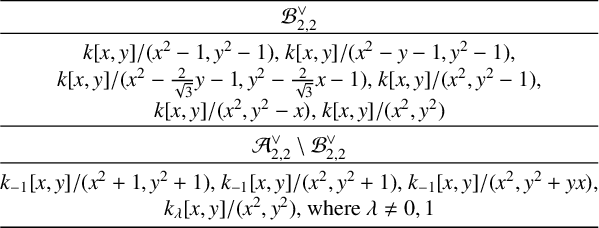
By Theorem 5.10, we can write every algebra in Theorem 4.6 in the form of
 ${\mathcal A}_{2, 2}^\vee $
.
Corollary 5.13. Every four-dimensional Frobenius algebra is isomorphic to exactly one of the algebras listed in Table 5, where
 $k_\lambda [x,y]/(x^2,y^2)\cong k_{\lambda '}[x, y]/(x^2, y^2)$
if and only if
 $\lambda '=\lambda ^{\pm 1}$
.
Algebras in
 ${\mathcal A}^\vee _{2,2}$
.

6 Applications to noncommutative conics
The study of noncommutative quadric hypersurfaces is active in noncommutative algebraic geometry. Recently, there have been found many interesting and important results (see, for example, [Reference Hu9, Reference Hu, Matsuno and Mori10, Reference Hu and Mori11, Reference Mori and Ueyama15, Reference Smith and Van den Bergh20]). In particular, [Reference Hu, Matsuno and Mori10] shows that there are exactly nine isomorphism classes of (homogeneous coordinate rings of) noncommutative central conics (that is,
 $f \in Z(S)_2$
) of the form
 $A=S/(f)$
, where S is a three-dimensional ‘Calabi–Yau’ quantum polynomial algebra (see also [Reference Hu and Mori11]). This is a surprising result since there are infinitely many isomorphism classes of three-dimensional ‘Calabi–Yau’ quantum polynomial algebras and gives some hope to classify all noncommutative central conics, dropping the condition ‘Calabi–Yau’.
For a noncommutative conic A, the four-dimensional Frobenius algebra
 $C(A)$
(Definition 2.11) plays an important role in the classification of noncommutative central conics [Reference Hu, Matsuno and Mori10, Reference Hu and Mori11]. With the help of the classification result in this paper and results in other papers (see, for example, [Reference Hu9–Reference Hu and Mori11, Reference Mori and Ueyama15]), we give a complete classification of noncommutative central conics in our subsequent paper [Reference Hu, Mori and Wu12].
Acknowledgement
We would like to thank Ryoma Suzuki for his assistance in checking some of the computations.