Despite improvements in outcomes in recent decades, infants with hypoplastic left heart syndrome have high rates of morbidity and mortality following stage 1 palliation.Reference Ohye, Sleeper and Mahony1,Reference Tabbutt, Ghanayem and Ravishankar2 Patients with hypoplastic left heart syndrome also have high rates of feeding complications in the post-operative period, including poor oral feeding, feeding intolerance, and necrotizing enterocolitis.Reference McElhinney, Hedrick and Bush3–Reference Indramohan, Pedigo, Rostoker, Cambare, Grogan and Federman7 Infants with hypoplastic left heart syndrome tend to take longer to reach full feeds post-operatively and have poor growth during the interstage period.Reference Kogon, Ramaswamy and Todd8–Reference Hong, Moffett, Payne, Rich, Ocampo and Petit10 Prolonged intubation and vocal cord paralysisReference Kogon, Ramaswamy and Todd8,Reference Burch, Gerstenberger and Ravishankar9,Reference Hill, Rhodes and Aiyagari11 have been identified as risk factors for feeding problems.
Recoarctation after stage 1 palliation occurs in 9–40% of patients with hypoplastic left heart syndrome, with many requiring repeat intervention on the arch obstruction within the first 6 months of stage 1 palliation.Reference Hill, Rhodes and Aiyagari11–Reference Fundora, Sasaki and Muniz16 Recoarctation was associated with ventricular dysfunction and tricuspid regurgitation in some studies,Reference Januszewska, Kozlik-Feldmann and Kordon14,Reference Larrazabal, Tierney and Brown17 but not in all.Reference Hill, Rhodes and Aiyagari11,Reference Fundora, Sasaki and Muniz16 Less is known about other potential consequences of arch obstruction in this patient group.
The feeding problems in patients with hypoplastic left heart syndrome are complex and the aetiology is multi-factorial. In the post-operative period, hemodynamic factors likely influence the ability to tolerate feeds. Diastolic runoff (from a patent ductus arteriosus or aortopulmonary shunt) has been theorized as one reason for the increased risk of necrotizing enterocolitis in infants with hypoplastic left heart syndrome,Reference McElhinney, Hedrick and Bush3 although the risk does not appear to be lower in patients who underwent Sano modification or hybrid palliation.Reference Weiss, Gossett, Kaushal, Wang, Backer and Wald18–Reference ElHassan, Tang and Gossett20 Rates of necrotizing enterocolitis are higher in hypoplastic left heart syndrome and in single ventricle patients with arch obstruction compared to other forms of congenital heart disease.Reference McElhinney, Hedrick and Bush3,Reference Jeffries, Wells, Starnes, Wetzel and Moromisato5 Infants with hypoplastic left heart syndrome have been shown to have differences in intestinal blood flow,Reference Harrison, Davis and Reid21–Reference Miller, Minich, Lambert, Joss-Moore and Puchalski23 and it is possible that residual arch obstruction may further alter intestinal blood flow patterns. The association of arch obstruction with necrotizing enterocolitis or feeding outcomes has not been examined.
Most studies examining the feeding difficulties in this patient population have been performed on single-centre, small populations.Reference Jeffries, Wells, Starnes, Wetzel and Moromisato5–Reference Kogon, Ramaswamy and Todd8,Reference Weiss, Gossett, Kaushal, Wang, Backer and Wald18 Since the aetiologies of feeding difficulties are likely multi-factorial, larger populations are needed to determine the risk factors that influence post-operative feeding in infants with hypoplastic left heart syndrome. Large multicentre databases are likely to be the best source of such information; however, few have sufficient levels of detail about post-operative feeding to allow for such analysis.
The National Pediatric Cardiology Quality Improvement Collaborative is a multicenter group focused on improving the quality of care for patients with hypoplastic left heart syndrome. This involves quality improvement work as well as collection of data on patients enrolled in a data registry. As the initial goal was focused on improving interstage care, the enrolled patients in Phase I were infants with hypoplastic left heart syndrome who were discharged home following stage 1 palliation. The data collected included information about the stage 1 palliation admission and details about feeding in the post-operative period. We hypothesized that residual or recurrent arch obstruction following stage 1 palliation would be associated with feeding difficulties in the post-operative period.
Materials and methods
A retrospective analysis of data from the National Pediatric Cardiology Quality Improvement Collaborative data registry was performed. This data registry includes data collected from patients with hypoplastic left heart syndrome, and in Phase I, included those patients who were discharged home following stage 1 palliation from 60 centres. Institutional review board approval is obtained from individual centres, parental informed consent is obtained at the individual centres, and deidentified data are submitted to a central registry. The data include demographic information, pre-operative, surgical, and post-operative details, and post-discharge interstage course through stage 2 (Glenn) palliation, death, or study exit. University of Maryland School of Medicine institutional review board approval for this analysis was also obtained.
Gender and pre-operative information, including gestational age, birth weight and length, birth weight for age z-score, cardiac diagnosis, major syndromes and other anomalies (including gastrointestinal anomalies), age and weight at surgery, were collected from the registry. Data for all post-operative reinterventions were collected. For the purposes of this analysis, residual and/or recurrent arch obstruction was defined as requiring arch reintervention prior to stage 1 palliation discharge. Post-operative reinterventions were grouped in two different ways: no arch intervention versus arch intervention; and no intervention versus non-arch intervention versus arch intervention. If patients underwent more than one intervention, they were included in the arch intervention group if this was one of the interventions. Arch intervention included surgical arch revision and balloon and stent angioplasty of the aorta. Post-operative feeding data in the database included age at initial and full post-operative feeds (as defined by individual centres). Post-operative days to initial and full feeds were calculated. Age, weight, weight for age z-score, length, and feeding route at discharge were recorded.
Patients enrolled between June 2008 and June 2016 were included in this study. Patients were excluded if there were incomplete data regarding post-operative days to full feeds or post-operative arch reintervention.
Analysis
Categorical data are presented as counts with percentages. Continuous data are presented as medians with interquartile ranges. Post-operative days to full feeds were the primary dependent variable.
The Mann–Whitney U-test was used to compare medians between two groups. Stepwise linear regression was used to determine variable associations with post-operative days to full feeds. For variables with a significant association with post-operative days to full feeds, for example gestational age, major syndrome, gastrointestinal anomaly, and repeat intervention type (arch versus no arch reintervention), analysis of variance was performed along with their interaction factors in a predictive model for days to post-operative full feeds. These variables were also analysed using chi-square, analysis of variance, and linear regression to determine if they were confounders or effect modifiers. All statistical analyses were performed using IBM SPSS Statistics Version 25 (IBM Corp., Armonk, New York, United States of America). Results were considered significant if the p value was less than 0.05.
Results
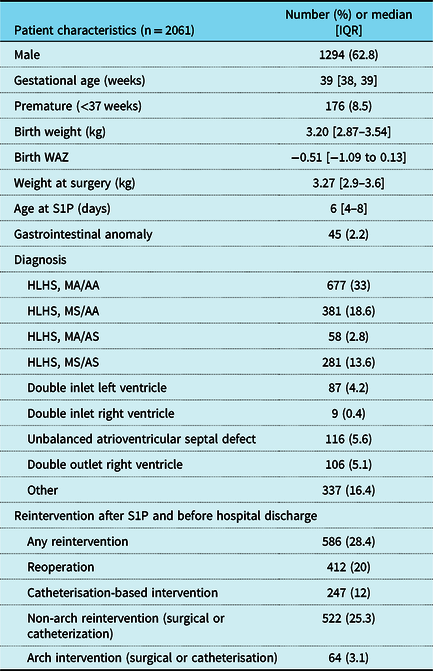
Data for 2201 patients were available in the National Pediatric Cardiology Quality Improvement Collaborative registry. The exclusion criteria removed 140 patients for analysis, leaving a cohort of 2061 patients. Patient characteristics and repeat intervention following stage 1 palliation data are shown in Table 1. None of these patient characteristics were significantly associated with repeat intervention. Patients who underwent a repeat arch intervention were more likely to undergo multiple interventions than those who underwent non-arch interventions (67 versus 26%, p < 0.001), undergoing a median of two repeat interventions versus one repeat intervention (p < 0.001).
Patient characteristics

AA = aortic atresia; AS = aortic stenosis; MA = mitral atresia; MS = mitral stenosis; HLHS = hypoplastic left heart syndrome; S1P = stage 1 palliation; WAZ = weight for age z-score.
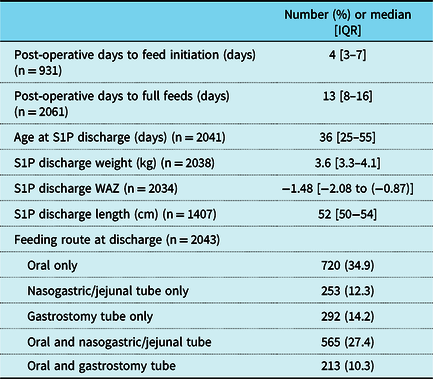
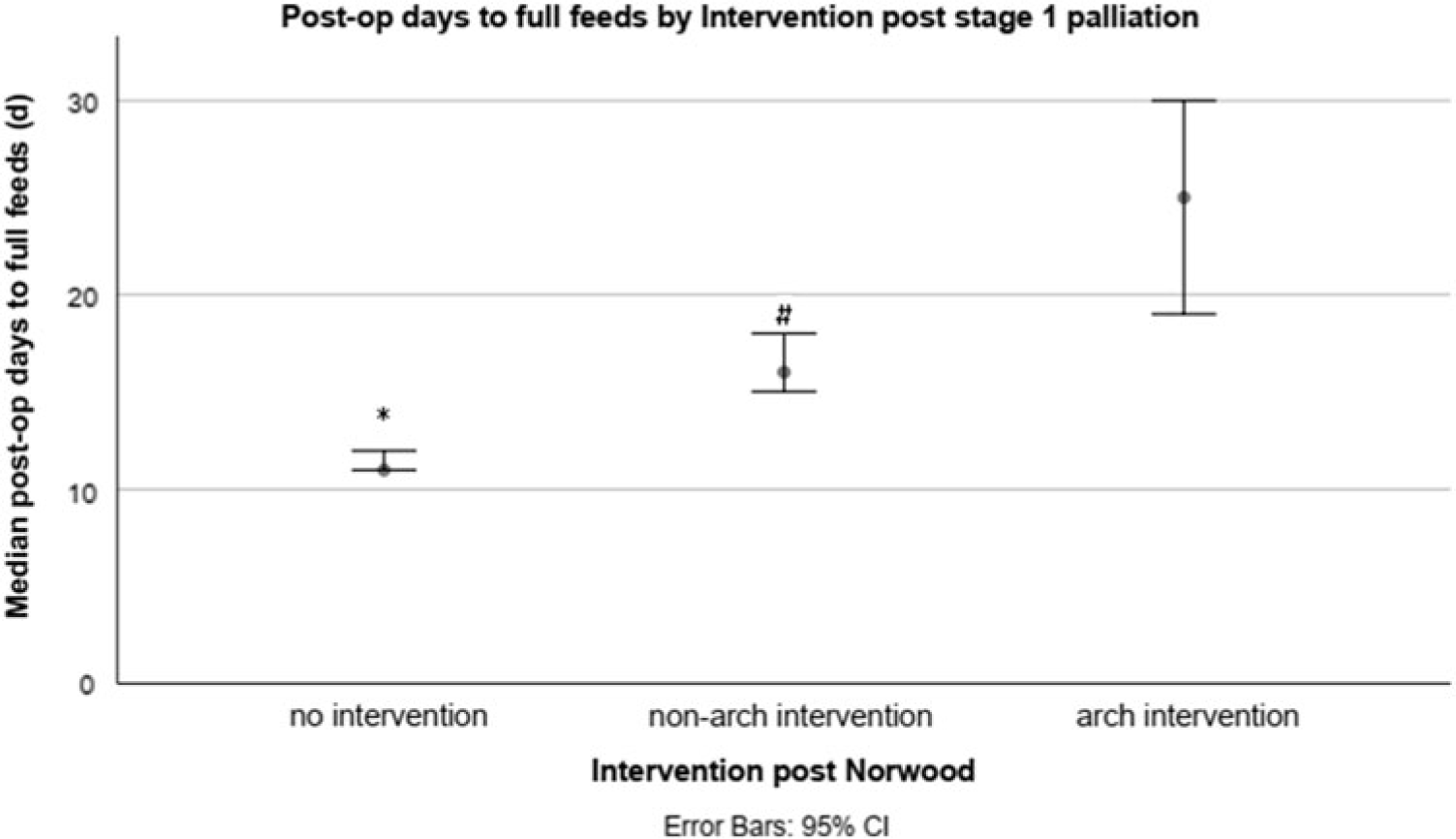
Post-operative outcome data for the entire cohort are presented in Table 2. Median post-operative days to full feeds was significantly longer in patients who underwent arch reintervention compared to patients who did not undergo any reintervention (25 versus 12 days, p < 0.001) and to patients who underwent a non-arch reintervention (25 versus 16 days, p = 0.003) (Fig 1). Patients who underwent one repeat intervention (of any type) versus multiple repeat interventions (>1) had a longer time to full feeds (14 versus 24 days, p < 0.001); there was a similar trend in patients who underwent repeat arch intervention (19 versus 28 days), but it was not statistically significant (p = 0.125).
Post-operative outcomes

S1P = stage one palliation; WAZ = weight for age z-score.
Post-operative days to full feeds by post-stage 1 palliation intervention type. Annotation indicates significant difference compared to arch intervention, *p < 0.001, #p = 0.003.

Gestational age was inversely related to post-operative days to full feeds. Presence of a gastrointestinal anomaly or major syndrome was associated with longer median post-operative days to full feeds (12 versus 17 days, p < 0.001; 12 versus 14 days, p = 0.007). Gender and weight at birth or surgery were not associated with post-operative days to full feeds.
There were no confounding or effect modifier variables identified. There were no differences in the pre-operative factors among intervention groups. Gestational age (p < 0.001), arch reintervention (p = 0.023), multiple repeat interventions (p < 0.001), and gastrointestinal anomaly (p = 0.006) were significantly associated with days to post-operative full feeds. When included in this model, major syndrome was no longer significantly associated with days to post-operative full feeds. Based on the predictive model, each additional week of gestational age decreased the days to full feeds by approximately 1 day. Undergoing arch reintervention increased the days to full feeds by 4.5 days, undergoing multiple interventions increased it by 13 days, and the presence of a gastrointestinal anomaly by almost 6 days.
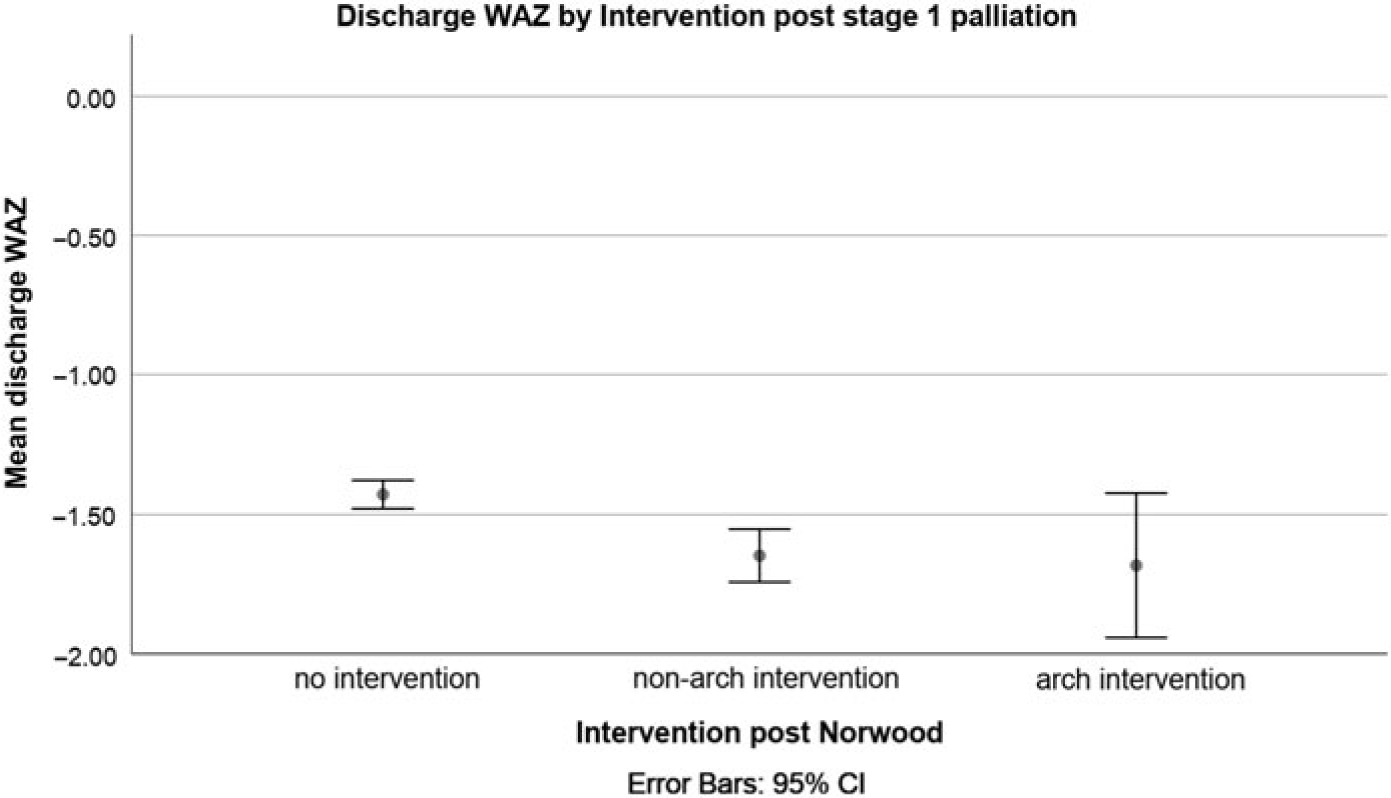
Weight for age z-score at discharge was significantly lower in patients who underwent any type of repeat intervention after stage 1 palliation compared to those who did not (−1.69 versus −1.43, p < 0.001), but was not significantly different between non-arch and arch reintervention (−1.65 versus −1.64, p = 0.97) (Fig 2).
Discharge WAZ by post-stage 1 palliation intervention type. WAZ = weight for age z-scores.

Patients who underwent repeat arch intervention were more likely to be discharged home receiving only tube feeds than patients who underwent no repeat intervention or a repeat non-arch intervention (p < 0.001), although patients undergoing a repeat non-arch intervention were also more likely to be discharged home on only tube feeds than patients undergoing no repeat intervention. These data are presented in Table 3. Post-operative days to full feeds were significantly different by discharge feeding route (Table 3).
Discharge feeding route and post-operative intervention

Discussion
Feeding intolerance in infants with hypoplastic left heart syndrome remains a significant problem following stage 1 palliation. The association of arch obstruction with feeding outcomes in this population has not been described. Our study showed an association between more post-operative days to reach full enteral feeds in the stage 1 palliation post-operative period and arch intervention prior to discharge. In addition, younger gestational age, multiple interventions, and the presence of a gastrointestinal anomaly were also associated with a longer time to full enteral feeds.
Evaluation of feeding in infants with hypoplastic left heart syndrome after stage 1 palliation has focused on four main outcomes: necrotizing enterocolitis, feeding mode, feeding intolerance (variably defined), and growth. Prolonged intubation has been identified as a risk factor for a longer time to full feeds following congenital heart disease surgery.Reference Kogon, Ramaswamy and Todd8 It has also been identified as a risk factor for non-oral feeding at discharge.Reference Einarson and Arthur4,Reference Kogon, Ramaswamy and Todd8 The use of feeding protocols has variable effects on time to full feeds, perhaps based on the centre’s pre-protocol practices and some studies suggest a decreased risk of necrotizing enterocolitis.Reference del Castillo, McCulley and Khemani24–Reference Carpenito, Prusinski and Kirchner26 Our study suggests that arch obstruction or intervention is an additional risk factor for feeding intolerance. Residual arch obstruction after surgery had not previously been studied as a risk factor for feeding outcomes, but arch intervention at the time of surgery was shown to be a risk factor for non-oral feeds in patients undergoing a variety of neonatal congenital heart disease surgeries.Reference Einarson and Arthur4
There are many potential reasons why our study showed that undergoing arch reintervention was associated with prolonged post-operative feeding advancement. This could in part be explained by the fact that sicker infants may require additional procedures in the post-operative period or that undergoing an additional procedure may cause interruptions in feeding advancement. In our cohort, patients who underwent any type of additional intervention took longer to reach full feeds than those who did not, but we also found that the time to full feeds was significantly longer in those requiring an arch reintervention compared to other types of interventions, suggesting that arch obstruction or reintervention has a unique effect. Patients who underwent multiple repeat interventions also took longer to reach full feeds. The patients who underwent repeat arch intervention were more likely to undergo multiple interventions; however, repeat arch intervention remained a significant independent predictor of days to full feeds even when multiple interventions were included in the multivariate model.
One potential reason for the association of arch obstruction with feeding intolerance is alteration in intestinal blood flow. This has already been noted in patients with hypoplastic left heart syndrome. Resistive indices in the mesenteric vessels are higher than normal,Reference Harrison, Davis and Reid21,Reference Johnson, Ansong and Li22 in part due to retrograde flow in patients with aortopulmonary shunts. Miller et alReference Miller, Minich, Lambert, Joss-Moore and Puchalski23 showed that patients with hypoplastic left heart syndrome and necrotizing enterocolitis had lower abdominal aorta pulsatility indices than those who did not develop necrotizing enterocolitis. Infants with residual arch obstruction are likely to have lower pulsatility indices.
In our study, we do not know when the arch intervention occurred in relationship to the feeding advancement, so we do not know if it was the arch obstruction or the intervention that influenced the number of post-operative days to full feeds. If significant arch obstruction were present and then relieved, it is possible that reperfusion injury to the intestines would influence feeding tolerance. It is also possible that feed advancement was purposely slower in patients with known arch obstruction and does not reflect true feeding intolerance. Infants who underwent arch reintervention were able to grow similarly to those undergoing other interventions, suggesting that feeding intolerance may improve by the time of discharge.
Our study also examined the association of arch reintervention with growth parameters at the time of stage I palliation discharge. Arch reintervention was not a predictor of lower weight for age z-score, but patients who underwent any intervention after stage 1 palliation had lower weight for age z-scores than those who underwent no repeat interventions. Hong et alReference Hong, Moffett, Payne, Rich, Ocampo and Petit10 showed that infants who were in the intensive care unit (ICU) longer had less improvement in weight for age z-scores by the time of discharge than those with shorter ICU stays. Similarly, the patients in our study who underwent repeat intervention had a longer length of stay overall. Hong et alReference Hong, Moffett, Payne, Rich, Ocampo and Petit10 also found that growth was directly related to caloric intake and that patients with moderate to severe tricuspid regurgitation did not grow as well as those with lesser degrees of tricuspid regurgitation. Slower growth in infants undergoing additional interventions may be due to similar reasons, such as interruptions in feeds in the peri-procedural time or the increased need for calories related to residual hemodynamic problems or recovery from procedures.
We found an association between type of repeat intervention and need for tube feeds at the time of discharge after stage 1 palliation. Patients were more likely to be discharged on only tube feeds if they underwent a non-arch repeat intervention, and still more likely if they underwent an arch repeat intervention. Patients who were discharged home on tube feeds only or some tube feeds had a longer time to full feeds in the post-operative period. We did not evaluate for other predictors of feeding mode at discharge or confounders of this association in this study, so there are limitations to the conclusions that can be drawn from these findings.
There are other limitations to our study. The patients enrolled in the National Pediatric Cardiology Quality Improvement Collaborative registry during this phase of data collection only included those who were discharged home following stage 1 palliation; thus, we do not know how these findings would differ if patients who died or remained inpatient during the interstage were included. These patients are included in the second phase of data collection in the National Pediatric Cardiology Quality Improvement Collaborative registry, which is ongoing, and further evaluation with this patient population included should be performed. We are using post-operative days to full feeds as a marker for feeding intolerance; however, there are other factors that may affect this variable for which we were not able to account. There are incomplete data in the registry, including missing information about when feeds were initiated post-operatively. Since these data were not available in over half the patients, we used the post-operative days to full feeds, which were more consistently collected, as our feeding outcome. The number of days that it took from feed initiation to full feeds may be a better marker of feeding tolerance; an analysis of the subgroup with these data available showed more days for feed advancement in the non-arch reintervention group and longer still in the arch reintervention group, but the arch reintervention group did not reach significance. We used arch intervention as a marker of arch obstruction in the post-operative period. There may be additional patients who had arch obstruction but who did not undergo intervention. The timing of the arch intervention in relationship to feeding is not known and, as previously discussed, limits our ability to theorize as to why this association was found. These data may be available in the second phase of data collection for the National Pediatric Cardiology Quality Improvement Collaborative registry and future analysis would be helpful in better understanding the association that we have identified.
These limitations affect our ability to draw causal conclusions from the association of arch obstruction and feeding intolerance, but our study does suggest that further evaluation is needed. Feeding intolerance and complications are common occurrences in patients with hypoplastic left heart syndrome. If arch obstruction itself is a risk factor, it is potentially modifiable with post-operative intervention or improvements in operative techniques. Further evaluation is needed to determine if infants with feeding intolerance with no clear aetiology should undergo more extensive evaluation for arch obstruction and to determine what degree of arch obstruction might be associated with feeding intolerance. Additionally, further research is needed to see if arch obstruction is associated with other feeding complications and feeding outcomes after discharge from stage 1 palliation.
In conclusion, our study demonstrates an association between arch reintervention and post-operative feeding advancement in infants with hypoplastic left heart syndrome following stage 1 palliation. Future studies should better define this association and how it affects care of this population of patients.
Acknowledgements
None.
Financial Support
This research received no specific grant from any funding agency, commercial or not-for-profit sectors.
Conflicts of Interest
None.
Ethical Standards
The authors assert that all procedures contributing to this work comply with the ethical standards of the Office for Human Research Protections of the Department of Health and Human Services and with the Helsinki Declaration of 1975, as revised in 2008, and has been approved by the University of Maryland Institutional Review Board.