





Introduction
The rise of China has led to an abundance of literature about the People’s Republic of China (PRC). Much of this literature has tended to approach China through binary frameworks: a threat or an opportunity, a game changer or merely an emerging power, a challenger to the international order, or a benign actor.Footnote 1 Scholars challenge these binaries increasingly by underscoring the importance of plurality and a non-essentialist approach to political thought.Footnote 2 Such dichotomies often compress the diversity of Chinese international practice into evaluative templates that travel well in policy debates but leave less room for analysing how Chinese actors themselves narrate world politics. More recently, the rise of China has broadened discussions, including those on its contributions to international relations (IR) theories. While recognising the significance of these studies in enhancing our understanding of China and, consequently, developing more effective foreign policies, we aim to move beyond these discussions and analyse which schools are promoted in its political communication – an essential element in shaping the state’s discourse power.Footnote 3
As Nadège Rolland argued, China invests heavily in its political communication by narrating the norms and concepts relevant to its vision of a new order.Footnote 4 The Chinese political eliteFootnote 5 explicitly recognised the political value of discourse in international relations in 2013. By “political elites,” we mean a deliberately narrow category: senior office-holders within the party-state and its central propaganda apparatus, whose words are produced or officially attributed as authoritative state communication. This article connects these discussions to the study of elite political narratives. Narratives are not merely rhetorical ornamentation: they organise temporal experience, attribute causality, define identities and relationships, and thereby structure what policies can plausibly be justified. Narrative production is also inseparable from the pursuit of discursive influence.
In China, the elevation of huayuquan (discourse power) to a foreign-policy priority has sharpened attention to the international legibility of Chinese concepts and to the strategic value of “telling China’s story well” (讲好中国故事, jiang hao zhongguo gushi).Footnote 6 Within this context, we ask an under-examined question of which “Chinese schools” of IR are mobilised in Chinese elite narratives and why they are more visible than other political concepts.
To answer the question, we adopt a two-stage process. First, we follow an analytical approach grounded in narrative studies. We map how the most prominent “Chinese schools” of IR – relational theory, moral realism, tianxia, and gongsheng (symbiosis) – are reflected in Chinese political and media communication. In brief, relational theory (associated with Qin Yaqing) treats relations and processes, rather than discrete actors, as the basic unit of international politics; moral realism (associated with Yan Xuetong) reworks realism by making political leadership and morality central to power transition; tianxia (associated with Zhao Tingyang) advances an all-inclusive, “all-under-heaven” vision of world order; and gongsheng (symbiosis) foregrounds coexistence, diversity, and equality among actors.Footnote 7 We deliberately concentrate on China’s narratives of the United States between 2013 and 2024, which provide an analytically dense, high-salience arena rather than a representative sample of Chinese communication as a whole. Our aim is therefore to test the relative narrative viability of these repertoires under conditions of salience and contestation, not to generalise across all external audiences.
Our findings show that political elites do not coherently embed their communiqués within any particular school, as the references to all leading schools can be traced to varying degrees. There is, however, a clear tendency to refer to gongsheng as the only school covered comprehensively in the narratives. Consequently, we further examine why gongsheng has informed the political speeches of Chinese elites, whereas other schools surface more selectively and often in truncated form. We further argue that the prominence of gongsheng in political communication is attributable to its political soundness – that is, its discursive utility for elite communication given the simultaneous demands of domestic legitimacy, ideological discipline, external signalling, and audience management. Building on earlier discussions of “soundness” as a requirement that ideas be ideologically aligned and practically instructive, we operationalise the framework of political soundness through six criteria: alignment with domestic objectives, cultural resonance, applicability, capacity to address global challenges, management of criticism, and adaptability.
Our contribution is threefold. Scholarly, we build on the concept of political soundness by offering a new operationalisation through six indicators, thereby providing a transferable framework for assessing why certain theoretical repertoires become narratively viable in elite discourse. Empirically, we provide a systematic analysis of how leading “Chinese schools” emerge in elite Chinese narratives. Politically, we show how political soundness functions as a set of selection pressures on discursive production, helping to explain the comparative visibility and portability of gongsheng, whereas alternative theoretical languages remain more episodic.
The article proceeds in seven parts. Following this introduction, we briefly discuss the state of the literature on narratives and Chinese political concepts to situate our article. The third section concisely summarises the key elements of the “Chinese schools” of IR to explain what we are looking for in the narratives. This section also addresses the close relationship between Chinese scholars and policymakers. In the fourth section, we describe our methodological approach to substantiate our arguments. We proceed to discuss the political soundness of the schools and close the paper with a brief discussion of its relevance.
Chinese political concepts: bridging IR scholarship and elite narratives
A discursive approach to analysing China’s foreign policy has become more common in recent years, particularly in examining its efforts to shape its institutional and international engagement. There is ample literature discussing discourse as a political tool in general and providing detailed analyses of the discursive underpinnings of China’s political behaviour. In parallel, we have noticed a rise in research on Chinese contributions to IR theory. Scholars discuss and analyse how China conceives of the world and international affairs and how Chinese thought can be translated to enrich (or transform) the mainstream of IR theorising. These works primarily address the ontological and epistemological foundations of China’s political thought, which we will explore in the next section.
Nevertheless, some studies link “Chinese schools” to political narratives and to the pursuit of discourse power. Stephen N. Smith, for example, relates the development of the “Chinese schools” of IR to China’s broader efforts to project ideas and concepts internationally.Footnote 8 Other analyses discuss China’s contribution to international relations theories in a similar manner.Footnote 9 Chinese scholars, such as Su Changhe and Cai Liang, also link the “Chinese schools” of IR to political speech by treating communication as an element in their formation.Footnote 10 These works are valuable; however, they do not systematically trace how other leading “Chinese schools” of IR are reflected in elite political communication, nor do they specify under what conditions particular theoretical repertoires are more narratively employed than others. This raises an associated issue of circularity, in which scholarship and political discourse co-evolve.
Ample studies showcase the interrelations between academic research and politics, often referencing the Eighteenth National Congress of the Communist Party of China (CPC) in November 2012 and subsequent calls to strengthen China’s discursive power. Qin Xuan draws on Xi Jinping’s speeches and high-level meetings to argue that enhancing discourse power requires developing a Chinese academic discourse system.Footnote 11 In a similar vein, Qin Xuan stresses the creation of social sciences with Chinese characteristics, strongly advocated by Xi during the social science symposium in May 2016. In the same spirit, Huang Zhong argues for activating academic communication channels to disseminate the Chinese political discourse.Footnote 12 Among others, Liu Wei describes the increasingly important role of academia in shaping China’s political discourse, which reinforces and explains the CPC’s interests.Footnote 13
These debates explore how political ideas are simultaneously interpretive and performative – they offer accounts of world politics but also shape the terms through which political claims are advanced and justified. The concepts of the “harmonious world” or “peaceful rise” were adopted by politically inspired academics. For example, the “peaceful rise” was developed mainly by Zheng Bijian, affiliated with the Central Party School, and gained momentum when Wen Jiabao mentioned it in 2003.Footnote 14 For some time, Chinese scholars were perceived as academics working primarily for policymakers and the current political agenda.Footnote 15 Their primary role was to produce politically relevant knowledge and to provide ideologically sound theories.Footnote 16 Importantly, the existence of close scholar–policy linkages does not, by itself, resolve whether elites adopt academic theorisation, whether scholars codify official narratives, or whether both processes occur simultaneously. Recent studies show that IR scholars have more room for manoeuvre than previously suggested.Footnote 17
Huiyun Feng and Kai He developed four models that describe the relationship between IR scholars and policymakers.Footnote 18 These are epistemic community (denoting an influence on foreign policy through shared policy ideas), free market model (indicating production of knowledge and policymakers choosing some ideas over others), policy signalling (signifying that scholars can signal and test ideas and concepts), and policy mirroring (denoting development of knowledge based on the governmental behaviour). The authors argue that the “free market” is the most popular one. Their work clearly shows that the relationship between IR scholars and policymakers is not just “a one-way street.” The two groups’ relations are complex, and their work is interrelated.Footnote 19
If so, is there a point in analysing the theoretical content of elite narratives? We argue there is, for four reasons. First, as already mentioned, some scholars operate on a “free market.” There is no clear evidence or mechanism explaining which will be embraced by the political elites. It is justified to conclude that, on the macro level, scholars generally follow the rule of embedding their work within the political agenda; on the micro level, there is some freedom, allowing researchers to develop their work more freely. Second, scholars are also responsible for educating policymakers;Footnote 20 therefore, they are more than just simple providers of knowledge and scholarly services on demand. Third, academics are also influenced by domestic political structures and other determinants, such as Western political philosophy. Some of them work outside China, but they are also expected to offer something new and unique to counterbalance the dominance of Western theories. The schools and political concepts are contested internally by other Chinese scholars promoting their ideas and externally by other academicians. Fourth, Chinese scholars are driven by their ambitions to contribute to debates in an original way.Footnote 21
Drawing upon works analysing the link between academia and political elites, we suggest not treating “Chinese schools” as doctrines that are straightforwardly transmitted into official discourse. We treat them as discursive repertoires whose motifs may be selectively mobilised in elite narratives. This perspective allows us to acknowledge the proximity between policy and scholarship while avoiding assumptions that direct intellectual exchange is a precondition for analysis.Footnote 22
In this paper, we focus on China’s narratives of the United States and examine how they reflect elements of the four “Chinese schools” of IR (relational theory, moral realism, tianxia, and gongsheng) and their key concepts. Hence, we address a gap in the literature by systematically tracing the presence of these repertoires in elite narratives and explaining why certain repertoires become more narratively viable than others.
The “Chinese schools” of international relations
A debate about whether there is, and what is, a “Chinese school” of IR has been present in academic discussions for years. Since Barry Buzan’s and Amitav Acharya’s push to discuss non-Western approaches to international relations theories and the lack thereof,Footnote 23 alongside the broader agenda of global IR, Chinese political thought has been a focal point in many works inspired by their research.Footnote 24
Moreover, the rise and development of the “Chinese schools” of IR also demonstrate the growth of self-confidence among Chinese scholars in international studies and highlight their aspirations to “become producers of knowledge” rather than just “consumers.”Footnote 25 Consequently, we also do not treat Chinese IR in an essentialist and static manner as solely bound to a national tradition; instead, we are inclined to view “Chinese schools” as transnational and transcultural phenomena (Yang Reference Yang2024), which also emerge in exchanges with Euro-American IR.Footnote 26
This positioning follows recent scholarship that reconceives Chinese IR as a globally embedded process of knowledge production rather than a bounded national tradition. Yang traces how the “Chinese schools” emerge, circulate, and mutate across intellectual contexts and argues that they are best understood as a transnational and transcultural field rather than as the unfolding of an indigenous essence.Footnote 27 In a complementary vein, Huo, Parmar, and Pérez Mena show how external actors, notably the Ford Foundation, helped shape the institutional and disciplinary infrastructure of IR in China, underscoring that even self-consciously “Chinese” theorising has been co-constituted through cross-border funding, training, and exchange.Footnote 28 We take two implications from this literature for our own argument. First, it cautions against reading the schools as authentic national doctrines whose narrative uptake would simply express a fixed cultural identity. Their motifs are already hybrid, and elites mobilise them selectively rather than inheriting them whole. Second, and more pointedly for our puzzle, it sharpens rather than dissolves the question we ask: if these repertoires are all transnationally entangled, their differential visibility in elite narration cannot be explained by cultural authenticity and must instead be traced to their differential usability under domestic and diplomatic constraints, which is precisely what our concept of political soundness is designed to capture.
The “Chinese schools” of IR are diverse and evolving works in progress, engaging in transnational exchangesFootnote 29 to position themselves within global debates. Here, we briefly summarise the literature and outline the main concepts to provide an analytical framework for our subsequent narrative analysis. Scholars investigating the content and development of the “Chinese schools” focus mainly on tianxia, relationality, and moral realism as the main concepts of China’s contribution to IR theory.Footnote 30 These approaches are closely tied to their principal authors, their intellectual communities, and, often, the institutions with which they are affiliated. The first school is associated with Zhao Tingyang, the second with Qin Yaqing and his work on relationality, and the third with Yan Xuetong, a leader of the Qinghua school.
Hun Joon Kim argues that three approaches are worth discussing: tianxia, Yan Xuetong’s moral realism, and Qin Yaqing’s relational theory; however, Ren Xiao offers a comprehensive discussion of the Chinese contributions to IR.Footnote 31 His work enumerates the main approaches and sources of output in political thinking on world affairs, including the relational theory, moral realism, tianxia, and gongsheng (also known as the symbiotic theory).Footnote 32
The relational theory (also guanxi) draws heavily on Chinese history and philosophy. Qin Yaqing initiated the discussion on relationality as a response to Western rationality.Footnote 33 Politics is embedded in interwoven and dynamic relations and processes, in which the character of relationships shapes the form of interaction and change emerges from ongoing processes.Footnote 34 The relationships between actors determine the form of their interactions. Changes occur as an outcome of processes. Qin evokes the Zhongyong (the dialectic of the mean) as an essential concept of the theory.Footnote 35 Relationality is further developed in scholarship advancing the idea of the “balance of relationship.”Footnote 36 The primary assumption of this approach is that different ideas, cultures, and material capabilities matter, but less than suggested, as relational configurations shape how such differences are interpreted. In this perspective, fear-driven political decisions are not treated as inherently conflict-generating; rather, relational theory foregrounds harmony and reciprocity as stabilising aims of political practice. Chiung-Chiu Huang and Chih-yu Shih argue that “the obsession with harmony justifies a policy that seeks to stabilise relationships rather than spread specific values.”Footnote 37 Harmony is possible when security is perceived as a relational concept, and the notion of power is positive.Footnote 38 The relevance of differences is downplayed by the idea of “relational security,”Footnote 39 and as suggested, the actor matters more than the system itself.Footnote 40
Moral realism is associated with the Qinghua school and Yan Xuetong. He argues there is no such thing as Chinese theories, as theories should be universal to accommodate international and global changes. According to Yan, political leadership and national strength are the core factors influencing the country’s strategic foreign orientation.Footnote 41 The scholar refines and enriches the theory of realism by explaining the meaning of leadership. He argues that leadership is a central category and explains how major states determine their relationship and how power shifts occur, that is, when the leadership of a rising power overcomes that of a leading actor.Footnote 42 Moral realism complements interests and power with morality, and “the role of morality is to influence policymakers’ concerns about how national interests should be achieved rather than what national interests ought to be.”Footnote 43 Morality thus implies a different set of political behaviours during a power shift, as well as strategic reputation, both of which determine foreign policy decisions. A rising power sets a pattern of behaviour that is attractive for others to follow; thus, a rising actor can change or reshape international norms and systems without coercion.Footnote 44 More broadly, as argued, this approach emphasises leadership “by example,” in which the leader promotes “fairness, justice, and civility.”Footnote 45
Tianxia is most often associated with Zhao Tingyang, whose 2005 book sparked extensive discussion.Footnote 46 Tianxia is deeply rooted in Chinese philosophy and offers a conceptual framework for understanding the international system and its constituent elements.Footnote 47 It incorporates tianxia yijia (one family under the sun) and wuwai (all-inclusiveness) ideas.Footnote 48 The tianxia order implies no boundaries between one another but a continuum.Footnote 49 To solve global problems, there is a need to establish “genuine world institutions as embodied in the Confucian worldview.”Footnote 50 According to Zhao Tingyang, tianxia is an all-embracing system of “one system, many institutions” (yige tixi, duo zhong zhidu).Footnote 51 Tianxia relations centre on the “maximisation of love” by prioritising collectivism.Footnote 52 The ideas and principles are promoted through ongoing processes. The concept suggests that an environment of harmony, friendship, and coexistence guarantees peace. It promotes the idea that political stability emerges through the sustained reproduction and cultivation of relationships over time; thus, attention should be paid to better constructing future relationships.Footnote 53 Tianxia has also been recognised as an influential concept, providing a broad framework for understanding international politics and driving Chinese leaders’ political mindsets.Footnote 54
Gongsheng centres on difference and diversity. As a reflection of reality, pluralism is the key concept shaping the relations between people of different civilisations, cultures, or traditions. At the same time, collaboration and interaction are constitutive of social relations. Differences do not imply a change in one’s values in the interaction process; on the contrary, differences do not clash as long as actors base their relations on coexistence and equality.Footnote 55 Equality creates an environment conducive to cooperation, development, and mutual learning. Respect for pluralism and diversity promotes cooperative behaviour.Footnote 56 The gongsheng approach includes symbiosis as an essential part, framed primarily as cooperative coexistence, with limited attention to harmful or unequal interdependence. The relations are described in conjunction with dependence.Footnote 57 All actors, regardless of their status or power, are a part of the same world. Thus, interrelatedness pushes towards equality and peaceful cooperation.Footnote 58 As argued, the gongsheng concept may be a remedy for current international problems and crises, as it excludes the politics of maximising power or putting one’s interests above others. The symbiotic order assumes a place and space for everyone as long as equality is assured.Footnote 59 Another essential feature of gongsheng is its focus on equality, rather than hierarchy, at least not explicitly.Footnote 60 While hierarchical structures of political relations are based on moral realism and tianxia, gongsheng moves towards explanations of interrelatedness and symbiosis.Footnote 61
As argued, moral realism, relational, and tianxia concepts have multiple similarities and overlapping elements.Footnote 62 We suggest that, in some respects, the gongsheng approach might also become part of this group, as notions such as peaceful cooperation appear in other schools. Each approach offers a distinct narrative explaining its conception of politics and the norms regulating relationships among actors. Relational theory emphasises the meaning of a relationship as a starting point for any political goal, including the ultimate one – harmony, defined as stability. Moral realism theorises leadership through the enactment and projection of virtuous conduct. Tianxia explains that an all-inclusive world can be created through trust and hierarchy, while gongsheng portrays embracing diversity as a means to provide stability and development. The approaches, therefore, differ substantially in their normative orientation and explanatory power.
Scholars working on the development of the “Chinese schools” focus on the core elements that give them substance. Given that these schools remain contested and are still being consolidated, it is understandable that the debates focus on fundamental issues. We agree with the statement that “the important issue is not whether or not there is or is not a Chinese School(s) but what kinds of Chinese School(s) will emerge, and in which direction current Chinese efforts will be aimed.”Footnote 63 However, while we acknowledge the importance of these debates, we believe that it is equally essential to examine how China communicates its contribution and worldview in practice. We move beyond conceptual discussions to assess whether and why concepts associated with the schools discussed are reflected in Chinese political communication.
Methodological approach and research design
We proceed through a two-stage research design. In the first stage, we trace how elements associated with the “Chinese schools” of IR are reflected in elite narratives. In the second stage, we use an operationalised concept of political soundness to explain why some school-linked repertoires are more narratively visible than others.
Our work is embedded within narrative studies. A narrative interprets an event and its development by linking actors, temporality, and causality to particular political meanings and interests.Footnote 64 We focus on one actor – China’s political elites – and examine how their political communication constructs specific interpretations. The analysis is based on a collection of political and media speeches and statements (N = 82) that refer to the United States (the full list of analysed documents with coding samples is available in the appendix). The corpus comprises Chinese statements from the database of the Ministry of Foreign Affairs, the National People’s Congress, the State Council Information Office of the People’s Republic of China, the China International Development Cooperation Agency, and Chinese media outlets, including Xinhua, the Beijing News, the Paper, China News Service, and People’s Daily. From a larger pool of texts that referenced the United States, we drew a random sample for qualitative coding and analysis to ensure variation across time and communicative settings. The pool was constructed using keyword-based retrieval from the selected official and media sources, after which ineligible items (duplicates, non-substantive mentions, and texts without discursive content relevant to China–US relations) were removed. The resulting sample was then coded according to the school-specific indicators and overlap rules described below. Our dataset includes speeches and statements by high-ranking officials, as well as media texts that report on, reproduce, or frame elite positions. Each text was coded as reflecting one, several, or none of the theoretical repertoires discussed in the previous section. On this basis, we provide a qualitative analysis of “Chinese schools” and their reflection in political narratives.
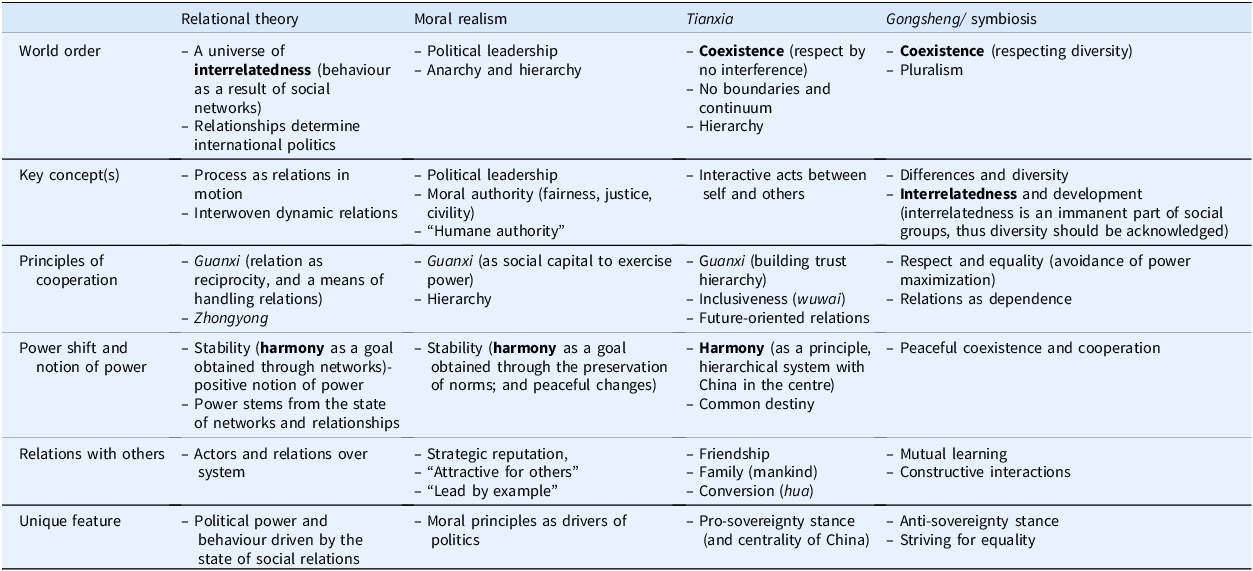
First, to trace the reflection of the “Chinese schools” of IR, we select their key features. Some scholars argue that Chinese schools are in the making; others argue that Chinese leaders politically instrumentalise them, so there is a need to deconstruct their meanings and contents to discover what they are and how they can contribute to international affairs. Second, the “Chinese schools,” as already stated, are complex, and some of their concepts overlap, particularly in the meanings of relationship, harmony, coexistence, and interdependence. We classify a speech into one of the possible categories if at least one element of the school is provided in the speech or if we can clearly distinguish between overlapping concepts. Suppose a concept is discussed using such a general approach that we cannot find any reference suggesting a school. In that case, we classify it as all schools operating with overlapping concepts. Table 1 summarises the key features of the discussed schools. On that basis, we trace references to the schools in political and media statements. Third, we focus on narratives about the United States to examine the comparative visibility of these repertoires in a high-salience communicative context.Footnote 65
Key features of the ‘Chinese schools’ of international relations*

Table 1. Long description
The table compares key features of four Chinese schools of international relations: Relational theory, Moral realism, Tianxia, and Gongsheng/symbiosis. It has six rows and five columns, including the headers. The columns are labeled Relational theory, Moral realism, Tianxia, and Gongsheng/symbiosis. The rows are labeled World order, Key concept(s), Principles of cooperation, Power shift and notion of power, Relations with others, and Unique feature. Each cell contains specific features or principles associated with each school. For example, under World order, Relational theory mentions interrelatedness and relationships determining international politics, while Tianxia emphasizes coexistence and no boundaries. The table provides a detailed comparison of the principles and concepts that define each school.
Source: Based on the literature cited in the third section of the article.
*Harmony is differently conceived in the respective schools. Seen as a goal, it denotes a state to be achieved by constructing relations and cooperation. However, some scholars argue that “harmony” is a value (Bell Reference Bell2017, p. 140). Harmony is strongly associated with coexistence. Within different approaches, there are labels such as “harmonious co-existence” (Zhao Reference Zhao2005) and “harmonious existence” (Chu Reference Chu2022, 69), and here we follow the understanding that harmony is inextricably linked to coexistence.
Our arguments are substantiated by an analysis of narratives of the United States between 2013 and 2024. We focus on 2013, when Xi Jinping took power and initiated a new, assertive, and active foreign policy. China declared the importance of “telling China’s story well” also in 2013.Footnote 66 Sino–US relations constitute a structurally central arena in which questions of hierarchy, leadership, plurality, and power transition are explicitly articulated.Footnote 67 These themes are central to debates about China’s global role and power transition.Footnote 68 From the perspective of narrative scholarship, it offers an analytically dense relationship for observing how actors shape discursive resources under pressure. Our analytical objective is not to generalise substantively across all external audiences but to test the relative narrative viability of distinct theoretical repertoires under conditions of high salience and contestation.Footnote 69 Nevertheless, our framework evaluates bounded discursive usability rather than policy content. In this sense, it is compatible with calls within Global IR to examine how non-Western theoretical vocabularies travel, mutate, or encounter resistance across audiences (Acharya Reference Acharya2014; Acharya and Buzan Reference Acharya and Buzan2019).Footnote 70 Future research could apply the same indicators to Chinese communication towards Europe, Southeast Asia, or the Global South to test whether narrative selection and its employment vary across differently structured relational contexts.
We use political soundness as an explanatory lens to account for variations in how political discourse refers to the schools. Following Gustaaf Geeraerts and Men Jing, we understand “soundness” as the requirement that ideas be ideologically aligned and guide practice in an acceptable manner. As they write, sound theory is “strongly ideologically oriented and must be able to instruct practice in the ‘right’ way.”Footnote 71 Thus, soundness is understood as discursive political utility: the extent to which a repertoire provides elites with language that is both domestically legitimate and usable for strategic communication. Political soundness is operationalised as bounded discursive usability: the extent to which a vocabulary can be mobilised by elites under ideological, legitimacy, and diplomatic constraints, consistent with work on strategic narratives and discourse power.Footnote 72
Our approach is sequential. The concept of political soundness is established in the literature. However, we add six indicators developed after engagement with the corpus. Our narrative mapping revealed systemic variation in the coverage of the Chinese school of IR.Footnote 73 Once established, we have consistently applied indicators as an explanatory assessment to compare the schools. The six indicators are alignment with domestic objectives, cultural resonance, applicability, capacity to address global challenges, criticism management, and adaptability.
Alignment with political objectives contributes to the regime’s domestic legitimation, mobilisation, and overall performance.Footnote 74 Cultural resonance allows us to justify narratives and embed them more convincingly, particularly in external communication and nation branding.Footnote 75 Applicability serves as a roadmap for using narratives for policy narration and uptake.Footnote 76 The capacity to address global challenges helps portray a country as a “solution provider” in global governance domains (climate, health, connectivity, human rights, and digital governance), rather than merely as a bilateral rival.Footnote 77 Criticism management helps to capture the extent to which a repertoire enables elites to anticipate, deflect, absorb, or reframe external criticism, particularly in moments of reputational contestation.Footnote 78 Finally, adaptability shows that narrative usability depends on its usage between cooperation and contestation without losing its coherence.Footnote 79
Use this to justify that elite narration must anticipate, deflect, absorb, or reframe external criticism (reputation repair, counter-accusation, justification, and corrective action), especially in crisis and reputational contestation. Together, they aim to capture what makes a theoretical language usable in elite narrative practice. Thus, they must resonate domestically, travel across contexts, offer actionable and interpretable scripts for policy communication, and reduce rhetorical risks under contestation.
The following two sections provide an overview of narratives and discuss each school’s perspective on China’s political communication towards the United States.
The “Chinese schools” of international relations in political narratives
Approximately 97% of the collected material can be attributed to one or more “Chinese schools” of IR. The majority of speeches are anchored in concrete political events, such as anniversaries of US-China relations, or are a direct response to US measures (for example, trade restrictions or trade negotiations) or reactions to US policy documents (including periodic human rights reporting or legislative acts).Footnote 80 Within the corpus, two broad communicative settings can be distinguished. The first, approximately 73%, is predominantly positive or neutral and follows a recurring structure composed of an emphasis that differences should not obstruct peaceful coexistence; an offer of cooperation, for example, by building a new type of major-country relations;Footnote 81 and a need for high-level exchanges and dialogue. The second set of collected texts (approximately 27%) is more directly reactive, framed as responses to particular US decisions and communiqués.
The “Chinese schools” in political elites’ narratives
Relational theory argues that the world of international relations is a universe of interrelatedness. The school is the least prevalent among the political narratives researched (approximately 17%) and appears mainly in the first type of text. References most often take the form of repeated calls to expand exchanges at multiple levels, intensify contacts, and “integrate interests” as a means of stabilising the relationship and producing a condition that can be read as harmony or relational stability. The US and China are framed as interrelated actors, whose interactions should be managed through processual cultivation of ties (guanxi) rather than through antagonistic categories such as rivalry (Wang Reference Wang2015a).
The key concepts associated with moral realism can be tracked down in a substantial portion of the corpus (approximately 27%). Elite statements position China as capable of responsible leadership, for example, by undertaking significant measures to support the United Nations in maintaining peace.Footnote 82 Wang Yi, for example, highlights that “wrong ideas about China stem from wrong ideas” and that the US misjudged China’s ambitions to become a strong hegemonic power, akin to traditional ones.Footnote 83 In more critical speeches, moral realism becomes evident through contrasts between China’s claimed responsibility and the US withdrawals from major international arrangements, which are framed as evidence of a leadership deficit.Footnote 84 At the same time, statements retain a moderating tone, thereby softening criticism of US policy.
Material reflecting tianxia encompasses ideas such as family (humankind), friendship, cooperation, and peace (approximately 33%). These references are most often conveyed through an all-inclusive framing of the world (for example, “mankind” as a referent) and through claims that the principle of conflict-free relations and win-win cooperation serve broader global interests. Elite narratives present China as committed to peaceful development and as seeking to “promote the cause of peace and development of mankind,” with US-China cooperation framed as a potential contribution to world peace, development, and cooperation.Footnote 85
Gongsheng is the most frequent theory in the analysed material of the corpus (approximately 61%). The ideas associated with the school are expressed through repeated emphasis on equality, proper handling of differences, and the possibility of peaceful coexistence.Footnote 86 The difference is not treated as inherently conflictual. Diversity and plurality are narrated as conditions that can be accommodated through respect. Wang Yi explicitly frames “harmony” as requiring the recognition and respect of “difference,”Footnote 87 a formulation that closely aligns with the gongsheng emphasis on diversity under conditions of equality. Moreover, calls for a “new type of relationship in major country relations” are linked to the idea of mutual dependence and the rejection of power maximisation. On a practical level, politicians refer to economic ties to show that the common interests prevail over the differences.
Patterns of referring to the “Chinese schools”
There is no consistent pattern of evoking the elements or concepts of the “Chinese schools” of IR. Overlaps are common, and references are often partial. Nonetheless, a few clear tendencies can be identified. First, politicians most often refer to the elements of gongsheng, moral realism, and tianxia. The relational theory has been evoked only partially. Second, where relationality appears, it is predominantly in formulae emphasising exchanges and relationship-building, with particular salience in speeches by Zhang Dejiang and Li Zhanshu, both of whom repeatedly stress high-level dialogue and stable ties as conditions for managing difference. Third, speeches referencing moral realism tend to surface most visibly in negative or defensive texts, particularly from 2018 onwards, when elite statements increasingly pair assurances that China does not seek hegemony with assertions of justice, fairness, and “humane authority” as markers of legitimate leadership. Fourth, as with moral realism, references to tianxia are only partially covered. The hierarchy element and the category of interactive acts between the self and the other are largely neglected. The speeches referring to tianxia mostly evoke the idea of common destiny, harmony, and humanity and focus on the future. The references to gongsheng appear most cohesively. Politicians and the media covered all essential aspects of the theory, including equality, pluralism, coexistence, and interdependence. They are most consistently narrated together, rather than appearing as isolated rhetorical fragments.
Temporal variation is also observable. First of all, the references to the relational theory were most popular in 2017, during the first year of Donald Trump’s presidency. Chinese politicians often emphasised the importance of reciprocity and promoted bilateral exchanges. In the case of moral realism, references were made more often in negative speeches. Gongsheng motifs are especially prominent in 2013–2016, during Barack Obama’s presidency, when the language of symbiosis and “new-type major-country relations” is most intensively promoted; however, core gongsheng claims – especially the primacy of common interests over differences and the legitimacy of plurality – continue to recur beyond that period. The turn towards reactively evoking moral realism was made approximately in 2018. Chinese politicians emphasised that Beijing does not intend to become a hegemon but strives for justice and fairness. The replies included traces of “humane authority,” as China presented itself as an example of civility. Overall, while the corpus does not reveal stable “school–consistent” narratives in a doctrinal sense, it does reveal patterned selectivity. Some repertoires are invoked episodically and in truncated form, whereas gongsheng-consistent motifs are comparatively frequent and more comprehensively assembled within elite narratives.
Political soundness of the “Chinese schools” of IR
In this section, we explain the uneven visibility of the narrative. Building on findings that narratives associated with different “Chinese Schools” of IR are not equally prevalent, we redefine the concept of political soundness by introducing criteria for assessing political communication. As discussed, and in line with Gustaaf Geeraerts and Men Jing’s understanding of “soundness” as ideologically oriented and practice-guiding,Footnote 88 we use political soundness to denote political utility as perceived and enacted in elite discourse; that is, whether a language can be mobilised credibly, repeatedly, and with low rhetorical cost in official narratives. It allows for accounting for why some schools’ elements (especially gongsheng-consistent ones) are more often exposed than others.
Examining “Chinese schools” of IR: a comparative discussion
Comparative debates on the “Chinese schools” have faced extensive scrutiny from Chinese and non-Chinese researchers. Relational theory, often treated in the comparative literature as a major candidate for “Chinese IR theory”, faces a different set of constraints. Lu Peng argued that relational theory is based on “Chinese logic” rather than on distinctly Chinese thought, such as that underlying gongsheng or moral realism.Footnote 89 This limits its capacity to provide alternative ontological explanations for international politics.Footnote 90 Like tianxia, relational theory has been criticised for replicating elements of Western paradigms, including realism, liberalism, and constructivism.Footnote 91 This complicates claims to distinctiveness and can dilute the rhetorical payoffs of explicit theorisation in official communication.
William A. Callahan’s discussion of tianxia highlights how ostensibly inclusive civilisational framings can be read as masking hierarchical or hegemonic projects, thereby generating interpretive vulnerability in global debates.Footnote 92 In a similar vein, Klaas Dykmann and Ole Bruun show how tianxia-centred civilisational discourse can attract scepticism precisely because it is easily interpreted through the lens of imperial or hierarchical ordering.Footnote 93 Additionally, tianxia mimics key aspects of realism, liberalism, and constructivism, which some scholars argue disrupts the mainstream Western conceptualisation of IR.Footnote 94 Moreover, tianxia has been criticised for neglecting the diversity of global actors and oversimplifying the relationship between the “Self” and “Others.” Its portrayal of global unity as “one family” often contradicts China’s foreign policy decisions, and attempts to counterbalance the “China threat” narrative by promoting peacefulness have been deemed ideologically insufficient.Footnote 95
Moral realism, primarily developed by Yan Xuetong, faces two primary criticisms. First, it is fundamentally a realist or neo-realist approach with added Chinese characteristics, as noted by Yan, Bell, and Sun.Footnote 96 While its contributions refine realism, they do not offer a fundamentally new theoretical paradigm.Footnote 97 Second, its reliance on historical precedents has been critiqued as overly interpretative and lacking necessary rigour.Footnote 98 Thus, the theory can be read as an important intervention, but one that remains recognisably realist in its theoretical architecture and, as such, is vulnerable to dismissal as strategic rebranding rather than a genuinely alternative normative vocabulary.
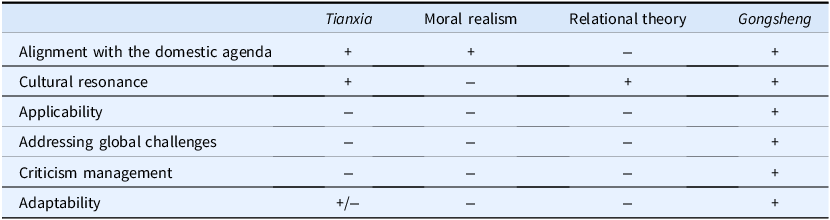
Gongsheng can be treated as comparatively narratively viable not because it is beyond criticism, but because its core elements of sovereignty, diversity, and non-interference can be articulated as non-threatening, broadly compatible with sovereignty discourse, and adaptable across issue areas. Scholars such as Ren highlight its ability to minimise zero-sum dynamics, making it compatible with China’s foreign policy objectives while addressing critiques about China’s real intentions.Footnote 99 Despite its merits, gongsheng is not without criticism. Some scholars argue that it incorporates implicit hierarchies, as evidenced by Ren Xiao’s observation that “small respects big, and big tolerates small.”Footnote 100 Gongsheng’s value for elite narratives lies in its ability to project legitimacy and reassure audiences while minimising exposure to common lines of critique levelled at more explicitly hierarchical or civilisational ordering projects (Table 2 presents a summary of the schools).
Assessment of the political soundness of the “Chinese schools” of IR*

Table 2. Long description
A table comparing the political soundness of different IR schools across six criteria. The table has four rows and five columns. The columns are labeled Tianxia, Moral realism, Relational theory, and Gongsheng. The rows are labeled Alignment with the domestic agenda, Cultural resonance, Applicability, Addressing global challenges, Criticism management, and Adaptability. Each cell contains a plus sign, minus sign, or plus/minus sign indicating alignment or lack thereof. For example, Tianxia has a plus sign for Alignment with the domestic agenda and Cultural resonance, a minus sign for Applicability, Addressing global challenges, and Criticism management, and a plus/minus sign for Adaptability.
* “+” indicates that a repertoire consistently provides usable narrative resources on a given dimension across the corpus and in the comparative literature; “−” indicates recurrent limitations or vulnerabilities on that dimension; and “+/−” indicates mixed performance or context-dependent usability. The scoring is interpretive and comparative rather than metric, and is intended to summarise the structured assessment presented in the text.
Assessing political soundness: a comparative discussion
Building upon the above discussion, the criticisms articulated towards the schools, and the characteristics observed in our narrative mapping, we propose a framework to assess political soundness. The question is not whether one school is normatively preferable, but what each repertoire offers (and what costs it carries) when deployed as elite narrative language. This is also why the framework is comparative: it clarifies which features make a repertoire easier to sustain and recombine in political communication and why others remain more episodic, truncated, or exposed to counter-framing.
Although gongsheng is often presented as rooted in Confucian notions of harmony and relational embeddedness, it is not unique in its mobilisation of classical resources. Relational theory explicitly draws on Zhongyong and processual balance,Footnote 101 whereas tianxia is grounded in the cosmological idea of “all under heaven” as a normative ordering principle.Footnote 102 The difference lies less in the presence of Confucian references than in their narrative presence. Tianxia translates civilisational heritage into a universalist vision that invites critiques of hierarchy,Footnote 103 and relational theory remains comparatively abstract in communicative practice.Footnote 104 Gongsheng finally reframes classical discussions in a sovereignty-compatible, pluralist idiom centred on equality and coexistence.Footnote 105 Thus, its narrative viability derives not from distinctive ancestry but from the flexible operationalisation of that heritage in contemporary elite discourse.
Relational theory is frequently treated as a key candidate for a “Chinese school” because it places relationships and process at the centre of political explanation and offers a vocabulary well suited to emphasising dialogue, reciprocity, and managed difference.Footnote 106 This gives relationality considerable potential cultural resonance and makes it compatible with diplomatic communication that prioritises stability and ongoing interaction. At the same time, while conceptually robust, the theory also faces significant limitations in its practical and political applicability. Its abstract nature and limited flexibility further limit its relevance across diverse geopolitical settings. Moreover, relational theory is frequently discussed as overlapping with or resembling elements of mainstream paradigms, which can diminish its perceived novelty and complicate its role as a unique discursive resource. Critics argue that it replicates aspects of Western frameworks without introducing sufficient distinctiveness. We should be careful here not to conflate two different judgements: a limited theoretical innovation does not in itself make a vocabulary politically unsound, since a familiar idiom can be highly serviceable for elite communication. What constrains relational theory’s political soundness is not its modest novelty as such, but its abstraction and its lack of a distinctively “Chinese” signature: when its motifs are translated into generic calls for dialogue and reciprocity, they become difficult to recognise as a specific school and so yield little of the discursive payoff that explicit theorisation might otherwise provide.Footnote 107 These features do not reduce its scholarly value, but they do limit its political soundness, understood here as routine, school-specific narrative usability.
Moral realism reflects China’s aspiration for ethical leadership and introduces a moral dimension to traditional realist paradigms. This provides a potentially deployable narrative resource in settings where China seeks to portray itself as a responsible actor while differentiating its conduct from that of other actors. Yet, its reliance on historical precedents and philosophical interpretations has led to critiques of over-interpretation and a lack of originality.Footnote 108 In elite narratives, these issues can translate into a repertoire that is useful for particular argumentative moves (leadership, responsibility, moral contrast) but less consistently portable as a broadly acceptable vocabulary across heterogeneous communicative settings. Moral realism is often seen as an extension of Western realism rather than a distinctively Chinese framework, thereby diminishing its cultural resonance.Footnote 109 Moreover, its theoretical nature and limited adaptability hinder its ability to address contemporary global challenges, further limiting its political utility.
Tianxia offers significant philosophical richness. Its vision of global unity aligns with China’s leadership aspirations in a specific sense: by depicting the world as a single, all-inclusive order oriented towards harmony, tianxia supplies a normative vocabulary in which a central, civilising actor can be cast as the custodian of common order rather than as a self-interested great power. This allows leadership to be framed as moral stewardship of the whole rather than as domination, which is rhetorically attractive for a rising state seeking to legitimise an enlarged international roleFootnote 110 and whose cultural resonance is deeply rooted in traditional Chinese values.Footnote 111 However, its perceived hierarchical structure often clashes with modern principles of equality and inclusivity, exposing it to counter-framing as hegemonic or hierarchical. Furthermore, tianxia’s rigidity limits its ability to adapt to diverse global contexts, making it less viable as a practical framework for international relations. Related critiques suggest that tianxia can underplay the diversity and agency of weaker actors and can oversimplify the relationship between the “Self” and “Others” by subsuming difference within a universalist idiom. In narrative practice, these vulnerabilities matter because they increase the interpretive costs of sustained reliance on explicit tianxia language in contexts where sovereign equality and pluralism are salient expectations.
Gongsheng is often presented as a Chinese alternative to understanding international relations, aiming to offer a universal path for global governance. For example, Su Changhe demonstrated that China has historically applied the principles of gongsheng through its economic and political relations with Asian states, emphasising flexibility and mutual benefit.Footnote 112 Ren further argues that gongsheng better reflects East Asian political ties than the tributary system.Footnote 113 Jin Yingzhong advocates an international gongsheng society characterised by peaceful, harmonious collaboration among great powers.Footnote 114 Cai Liang builds on this vision, proposing a staged development of international gongsheng: peaceful coexistence (heping gongchu), peaceful symbiosis (heping gongsheng), and harmonious symbiosis (hexie gongsheng).Footnote 115 Yuan Shengyu positions gongsheng as a counter-narrative to the dichotomous US-China rivalry, emphasising the concept as a cooperative model beneficial to all parties.Footnote 116 Similarly, Su Changhe and Cai Liang link gongsheng to the “community of common destiny,” presenting it as an antidote to the zero-sum frameworks advocated by Western theories.Footnote 117
Gongsheng builds on the Five Principles of Peaceful Coexistence, transitioning from peaceful coexistence to harmonious symbiosis, integrating respect for sovereignty with the cultivation of cooperative relationships.Footnote 118 In this reading, its flexibility and mellowness allow it to align with China’s strategic needs while projecting an inclusive and harmonious image. At the same time, scholarship also notes that such claims require scrutiny. The coherence of gongsheng depends on whether it remains consistent across diverse issue areas and in the face of contestation.Footnote 119 Gongsheng’s promise of inclusiveness and mutual accommodation does not eliminate the need to examine how it manages predictable criticisms about China’s intentions and how it performs when narratives shift from agenda-setting to more reactive contexts.
Two further considerations help explain why gongsheng is comparatively visible in elite narration despite being, in scholarly terms, less developed and less transnationally established than tianxia, relational theory, or moral realism. The first is semantic; gongsheng translates directly as “coexistence,” and coexistence is already a deeply sedimented term in Chinese foreign-policy discourse, from the Five Principles of Peaceful Coexistence onwards. A repertoire whose core term is pre-aligned with existing diplomatic vocabulary requires little translation to become narratively usable, which is itself a form of political soundness independent of theoretical maturity. The second is conceptual and warrants candour about a limitation the school tends to elide. Gongsheng borrows the language of symbiosis from biology, yet biological symbiosis is not uniformly benign: alongside mutualism, it encompasses commensalism and parasitism, that is, relations that are one-sided, exploitative, or mutually harmful.Footnote 120 In its current articulation, gongsheng largely abstracts away from these darker forms and treats symbiosis as synonymous with cooperative, mutually beneficial coexistence. This selective reading is part of what makes the concept rhetorically attractive: it lets difference and interdependence be narrated as inherently harmonious, but it also leaves the theory analytically underspecified about asymmetric or coercive interdependence, and arguably more serviceable as a political narrative than as an explanatory theory.
Building on the above discussion and criticism of the schools and the characteristics observed in our narrative mapping, we take an evaluative step.
Gongsheng emerges as comparatively more politically sound among the Chinese IR theories. Its alignment with China’s internal priorities, such as stability and diversity, highlights its coherence with the nation’s domestic agenda.Footnote 121 The theory’s emphasis on minimising zero-sum dynamics resonates with the broader goals of China’s foreign policy, primarily through initiatives such as the Belt and Road Initiative.Footnote 122 Its selective mobilisation of Confucian elements, particularly the reframing of harmony as coexistence rather than hierarchy, enhances its contemporary legitimacy. It offers Chinese political elites a reassuringly mellower discourse that appeals to external audiences. Moreover, its adaptability across bilateral and multilateral platforms showcases its relevance in addressing diverse geopolitical contexts. Gongsheng mitigates critiques like the “China threat” narrative and offers a flexible, pragmatic model that aligns with China’s aspirations to present itself as a cooperative global actor.Footnote 123 These strengths underscore its potential as a comprehensive and politically sound approach. It aligns well with China’s preference for policy-specific issues, sidelining conflict-focused research and debates.Footnote 124
Tianxia scores highly on cultural resonance and philosophical ambition, but its perceived hierarchical implications increase vulnerability to counter-framing and raise the rhetorical costs of repetition, particularly where sovereign equality and non-imposition are salient. Moral realism applies to leadership – and responsibility-centred narratives, yet it is often perceived as a refinement of realism rather than a distinct grammar, and leadership claims are comparatively exposed to reframing as status-seeking; this can constrain portability and the management of criticism. Relational theory offers a processual vocabulary of reciprocity and relationship cultivation, but its abstraction and frequent translation into generic diplomatic tropes can weaken school-specific distinctiveness and limit routinised usability.
Taken together, the political soundness framework does not claim that gongsheng (or any other school) is analytically superior for explaining China’s foreign policy. Rather, it specifies why gongsheng may be comparatively easier to sustain as an elite narrative repertoire. It is adaptable, broadly legible, and relatively robust in the face of contestation, while also aligning with sovereignty-centred messaging and enabling persuasive management of difference. The framework is developed to assess China’s political narratives. However, political soundness could also be applied to analyse and evaluate other ideas in IR scholarship, particularly non-Western IR theories and political concepts. This is especially relevant in regions and states lacking democratic contexts, where academia is often subject to state control.
Conclusion
Chinese narratives of the United States provide valuable insights into how Chinese political elites incorporate Chinese political thought into their discourse. To summarise, the Chinese political worldview presents China as a responsible, peacefully developing (rising) actor, contributing to the development of all nations based on non-interference, equality, respect for differences, and the promotion of mutually beneficial cooperation. Tensions and conflict are often narratively located in misunderstanding, misperception, or external provocation, whereas China’s preferred self-presentation stresses pluralism, reciprocity, and restraint.
Recognising the importance of narratives in politics, we set out to analyse how and to what extent the “Chinese schools” of IR are reflected in the narratives of political elites. Our findings show considerable inconsistency in the theoretical embeddedness of Chinese political elites. Chinese narratives are grounded in theory, and while all the schools discussed are traceable in the speeches, gongsheng is the most comprehensively covered and promoted. To explain this uneven visibility, we introduce political soundness as a framework for assessing the viability of narratives in elite communication. Building on existing understandings of “soundness” as ideologically oriented and practice-guiding, we operationalise political soundness through six indicators: alignment with domestic objectives, cultural resonance, applicability, capacity to address global challenges, criticism management, and adaptability. The last of these captures the extent to which a repertoire enables elites to anticipate, deflect, absorb, or reframe external criticism, particularly in moments of reputational contestation. The comparative assessment suggests that gongsheng functions as a comparatively “safe” and portable repertoire: it can be used across settings, supports sovereignty-centred messaging, and helps manage predictable criticisms more effectively than vocabularies that foreground hierarchy or civilisational ordering.
The analysis of Chinese narratives of the United States substantiates the arguments made. While we cannot, or would only do so cautiously, extrapolate the findings on Chinese international communication in general, we posit that this is an illustrative case that offers an initial but compelling discussion of how China promotes its political thought. It was not our aim here to determine whether selectivity and inconsistencies in framing political communication within the “Chinese schools” are driven by political pragmatism, gaps in knowledge, political bureaucracy, or other possible factors. However, by shedding more light on the discursive embrace of the schools, we suggest that a further in-depth investigation of Chinese concepts may prove worthwhile for unpacking changes in Chinese politics.
Finally, our research brings up two broader implications. For IR scholarship, we invite greater attention to gongsheng debates, which are often treated as peripheral relative to tianxia, relationality, and moral realism in mainstream discussions of “Chinese IR.” For policy-making analysis, they highlight that narrative effectiveness depends not only on message content but also on the comparative viability of the underlying repertoire across contexts, audiences, and moments of contestation. Lastly, we contribute theoretically to IR scholarship by borrowing the concept of political soundness and developing it by incorporating measurable indicators.
Supplementary material
The supplementary material for this article can be found at https://doi.org/10.1017/S1479591426100916.
Acknowledgements
We would like to thank Professor Zhang Biwu for his comments on an earlier draft of this article. We also sincerely thank the anonymous reviewers for their detailed and constructive feedback on the earlier versions of the manuscript.
Competing interests
The authors declare that they have no conflict of interest.
Anna Grzywacz holds a PhD in Political Science (International Relations). She is an assistant professor at the Institute of Political Studies of the Polish Academy of Sciences. She is interested in Asian politics, authoritarianism, civil society, and middle powers.
Patrycja Pendrakowska holds a PhD in Philosophy earned at the Department of Philosophy at Humboldt University. She is interested in Chinese foreign policy, Asian political ideas, and contemporary Chinese philosophy.


 Open access

