





Introduction
The Orbán government controlled Hungary from 2010 to 2026. It both gained and lost power after landslide elections. This paper studies two civil disobedience campaigns and the responses of the public authorities under the Orbán reign in the period 2016 to 2023. While the campaigns in hindsight may have contributed positively to the electoral defeat of Orbán in April 2026, where he achieved only 38 per cent of the vote, their immediate and short-term goal attainment was poor and prompts the question of how to conceive of the effectiveness of civil disobedience in electoral autocracies.
After a sweeping victory of Fidesz in 2010, gaining almost 53 per cent of the vote, a constitutional majority enabled the new government of Viktor Orbán to carry out wide-ranging institutional changes that led to the establishment of a new political system referred to as an ‘electoral autocracy’ or as a ‘competitive authoritarian regime’, that is, a system with an uneven playing field between the government and the opposition in favour of the former (Levitsky and Way Reference Levitsky and Way2020). This transformation of the political framework resulted in the emergence of new, more radical forms of expression of political resistance. In addition to boycotts by the opposition in the national parliament and foreign initiatives against the government, acts of civil disobedience became frequent forms of anti-government protest (Bourne Reference Bourne2024; Tyszka Reference Tyszka and Angela2024), although they had taken place, albeit rarely (Fekete Reference Fekete2020; Egresi Reference Egresi2022), in the previous two decades of democratic transformation in Hungary (eg the taxi blockade 1990, and the protest against a NATO-radar in Zengö in 2005).
Not all such acts shared the same characteristics, but common features were that they were public, non-violent, and illegal (cf. Rawls Reference Rawls1999). They included blocking the execution of eviction warrants, occupying the building of the Theater and Film Academy, refusal by NGOs to comply with the new anti-immigration legislation, and other numerous acts, from chaining oneself to public property to sit-ins and bridge occupations. They took the form of both individual and collective disobedience (Tyszka Reference Tyszka and Angela2024).
How effective was civil disobedience as a way of resisting democratic backsliding under Viktor Orbán’s populist rule? The article studies this question by looking at two civil disobedience campaigns, where different parts of the Hungarian civil society mobilised against the Hungarian government. The first campaign was directed against the violation of the principle of state neutrality and encroachments on the freedom of expression. ‘Poster destroyers’ vandalised government posters that they claimed were political propaganda for Fidesz and not government information, and wanted the courts to confirm that their actions were consistent with the right to freedom of expression. The second campaign was led by teachers who wanted to persuade the government to modify its education policy and reacted against a circumscription of their civic and political rights, not least their right to strike.
As a political means, civil disobedience contested both normatively regarding its legitimacy and empirically regarding its effectiveness or transformative capacity. Arguably, the value of civil disobedience primarily comes from being an effective means of changing things for the better. However, it may also hold an intrinsic value for people whose rights and status as equal members of society are being disrespected (Rawls Reference Rawls1999; Scheuerman Reference Scheuerman2018). This article analyses and compares the nature and effect of the two mentioned civil disobedience campaigns directed against the Fidesz government. Studies of civil disobedience under democratic governments and non-violent forms of resistance (including civil disobedience) under undemocratic governments indicate, perhaps unsurprisingly, that civil disobedience has less likelihood of success against a government that is internally tightly coordinated and centralised, controls the media, the legislature, the courts, and civil society, and is independent of other internal and external actors (Schock Reference Schock1999, Reference Schock2005, Reference Schock and William2021). Even though government repression can also work as a motivational factor, this suggests that the further institutions are from the ideal of liberal democracy, and the less the government is dependent on other actors, the worse the conditions are for successful civil disobedience campaigns.
Moreover, the more civil disobedience is conceived in instrumental terms (as a means to an end), the more dependent the civilly disobedient become on the reactions of the very government that is typically the target of civil society campaigns. Governments with fewer constraints in terms of public accountability will be in a better position to render civil disobedience campaigns futile.
The conclusion of the article is that neither campaign was effective in terms of realising its immediate goals of securing and restoring concrete rights. They did not undermine the government’s ability and willingness to pursue a populist political agenda. With the aid of the EU Commission, the teachers’ campaign did lead to a pay raise, and another effect was a widespread protest against the government and its policy. However, judged on the short term and on the immediate goals of the campaigns, the latter left protesters worse off than they were before.
That said, viewed within a longer timeframe and allowing for more indirect connections between cause and effect, it is possible that both campaigns, and the teachers’ campaign in particular, reinforced the self-respect of the opposition and provided yet other oppositional forces with experience and inspiration for how (not) to confront the government. In other words, the campaigns may have contributed to a sequence of events that cumulatively led to the opposition’s victory over Orbán’s Fidesz in the election on 12 April 2026.
The article will proceed as follows. First, it defines and discusses the central features of civil disobedience as a political means. Second, it elaborates on what it implies for civil disobedience to be an effective political means and relates the question of effectiveness to the question of legitimacy. Third, it explains the method applied in the study, before turning to the analysis of the two civil disobedience campaigns and their effects. The analyses aim to depict the structural conditions under which they took place and to describe the government’s strategic responses to the campaigns, as both factors contributed to their results. Taken together, the analyses demonstrate that under unfavourable socio-political conditions, two factors make effective action possible: involving influential external actors and organised cooperation between domestic oppositional groups. Subsequently, we show that even moderate achievements, such as a pay raise in the teachers’ case, were eventually undermined by the long-term policy of the Fidesz government, which was dominated by retaliatory reactions to the teachers. Moreover, through a mapping of the changing positions of the Hungarian Supreme Court (Curia) towards the constitutional principles of state neutrality, freedom of speech, and property rights, the key issues of the poster campaign are shown. The article ends with a brief reflection on how to conceive of the effectiveness of civil disobedience campaigns in light of both their short-term failure and their possible long-term contribution to the fall of the Fidesz government in April 2026.
The controversy of civil disobedience as a political means
Civil disobedience is a contested means of improving the justice and democratic quality of political institutions. It is contested because it involves breaking the law. Not only does it disobey political authority, but it also unsettles the security of the rights of other citizens. In democracies, civil disobedience implies dismissing laws passed by the majority and, thereby, disrespecting their democratic rights. In non-democracies, civil disobedience is less controversial, normatively speaking, because of the lack of clear political obligations. Still, the security of rights is an issue under non-democratic regimes (Szűcs Reference Szűcs2020). According to the liberal tradition, civil disobedience should remedy clear violations of society’s common conception of justice, such as fundamental rights, motivated by the duty of justice that all citizens have to create and support just institutions (Rawls Reference Rawls1999: 326–7). Civil disobedience should be public, non-violent, and non-evasive of legal consequences. Its aims should be communicated publicly, preferably in advance, and appeal to all other citizens as free and equal. The non-violence requirement is strict in relation to persons but does not exclude all kinds of damage to public and private property. The purpose of civil disobedience is to initiate a political process towards a revision of unjust or undemocratic policies. The aim of breaking the law is to improve it (Scheuerman Reference Scheuerman2018), so civil disobedience is a tolerant means of intervention. Still, civil disobedience is seen as a necessary last resort. Citizens should exercise it with a sense of responsibility, avoiding the creation of chaos or the provocation of foreseeable harsh responses from the government that render citizens’ actions futile (Rawls Reference Rawls1999: 373–6; Scheuerman Reference Scheuerman2018: 47). As a necessary last resort, initiating civil disobedience relies on a belief that civil disobedience can achieve its goals. We therefore need some idea of how civil disobedience can be an effective means.
Conceptualisation of the effectiveness of civil disobedience
Tolerant and intolerant opponents of populists pursue different goals. Intolerant opponents seek to reduce the impact of populist parties to an absolute minimum, questioning their right to exist as a legitimate political party and group. Tolerant opponents do not have such a desire but still see populists as political opponents with mistaken agendas and policies (Olsen Reference Olsen2023). However, both types of opponents share the idea of effectiveness as the ability to reduce the potential power and influence of populist parties over policies and institutional reforms (Bourne Reference Bourne2023). Effectiveness means that the threat to (liberal) democratic institutions is reduced. In Hungary, where right-wing populists turned authoritarian (cf. Arato and Cohen Reference Arato and Cohen2021) controlled policies and institutional reforms, effective responses would imply that the deviation of the governments’ policies and of institutions from the principles of (liberal) democracy were reduced or minimised. This can result from a reduced legitimacy of the governing party in the eyes of their voters, and the public more generally, and its ideological moderation and/or weakened party structure (Bourne Reference Bourne2023).
As Bourne (Reference Bourne2026) explains, the actions of civil society actors can have effects on the ability of populist party governments to implement illiberal or antidemocratic policies and institutional reforms, diminish their support, and reduce their organisational resources and capability through the following three mechanisms: (a) disruption and social leverage, (b) alliances and access, and (c) persuasion and frame diffusion.
Civil disobedience works through the mobilisation of the public to produce pressure to change the discourse and policies. The mobilisation may in part come from acts of civil disobedience that force government and society to relate to the civilly disobedient group because it disrupts the daily lives and practices of citizens, workers, employers, and public authorities. If the disruption becomes widespread, governments might concede the issues raised by the civilly disobedient in exchange for restoring order (Bourne Reference Bourne2026). Moreover, the appeal to commonly shared values and principles, the non-violent nature and the readiness to expose oneself to the reactions from opponents and public authorities, and the legal repercussions of one’s actions, signal how important the matter is for the civilly disobedient citizens. It communicates that the issue is important and requires government and society attention and commitment (Bourne Reference Bourne2026). Here, structural conditions make a difference. Under opportune conditions, this leads to mobilisation of a number of relevant groups and the general public, which place pressure on the government. The notion of mobilisation makes the cause and effect of civil disobedience campaigns complex and raises issues about the timeframe within which one can expect to observe the effects of civil disobedience campaigns. As mentioned, some campaigns may fail to achieve their immediate goals but may have an indirect impact on other oppositional initiatives, protests, and civil disobedience.
Studies of the mechanisms through which civil disobedience (in the 1950s to 1980s US) became successful emphasise the centrality of influencing public opinion through the media, of being able to persuade legislators independently of the executive to change the conditions for government action, independent courts, and judicial review, as well as the ability of civil society to form organisations that can emulate and initiate further protest and civil disobedience (Schock Reference Schock and William2021: 412–6; for the importance of media, see also Sutton, Butcher, and Svensson Reference Sutton, Butcher and Svensson2014). While this does not exclude that civil disobedience might yet work through other mechanisms, it does suggest that civil disobedience has worse conditions under authoritarian regimes where the government controls the media, legislature, courts, and tries to limit the activities of critical civil society organisations, all of which was the case in Hungary under the Fidesz reign.
Indeed, studies comparing the political opportunity structures available to social movements in non-democratic regimes suggest that movements are more likely to become successful if they are facing a governing elite with internal divisions, have access to free mass media or free flow of information, can exercise pressure on the government through dependencies that the government has with external actors (states or international organisations), and have internal actors controlling key societal sectors (eg different kinds of industries) and/or can create an alliance with transnational movements engaged with the process (Schock Reference Schock1999, Reference Schock2005). These opportunity structures suggest that it is by no means impossible for nonviolent resistance campaigns, which include elements of civil disobedience, to create change. However, they do emphasise, again, that conditions are worse where the government that civil society actors are facing has strong internal coordination and controls the media. As we will see, one of the Hungarian campaigns, the teachers’ campaign, was able to benefit from the intervention by the EU Commission, and this led to some preliminary positive results, while the activists behind the poster campaign did not manage to generate external support for their cause either through an appeal to the European Court of Human Rights (Council of Europe) or through referral of the cases to the European Court of Justice (European Union).
How structural conditions affect the effect of civil disobedience also depends on the type of civil disobedience. Especially for civil disobedience campaigns that do not have tangible consequences for the daily lives of the citizens or for the generation of government resources (for example, revenue), the media component is crucial. Acts of civil disobedience that are not ‘merely’ symbolic but do have tangible consequences, such as the non-provision of public services to citizens or the non-production of critical goods, are more likely to generate more public attention in and of their own. They are simply harder to ignore.
Moreover, the success or failure of civil disobedience does not only depend on structural conditions, but also on the concrete strategic actions undertaken by protesters and their targets, typically the government. The reactions by the government may render civil disobedience ineffective.
The two campaigns discussed in the next section emphasise both the unfavourable structural conditions under which civil disobedience in Hungary took place and how the Hungarian government used the means at its disposal to respond in a way that rendered the acts of civil disobedience futile, at least in the short term. Their possible long-term positive effects on the eventual defeat of Fidesz in April 2026 are a matter for further research and discussion.
Methods
As with the other empirical analyses in this special issue, the analysis is based on a bottom-up approach whereby the responses to populist parties are identified empirically and then evaluated in terms of whether they achieved their goals. The two campaigns are identified based on a pre-existing database compiling a non-representative sample of initiatives opposing the Fidesz government between 2010 and 2020 (n = 909). The timeframe encompasses the period between 2010 and 2020, but we also include events that take place after this period (until 2023). Data on initiatives opposing the Fidesz government were collected by coding press articles from the Wednesday editions of the two leading Hungarian newspapers, Népszava and Magyar Nemzet. Népszava was the only government-critical, left-liberal daily that published during the entire period under study. The second newspaper, the conservative Magyar Nemzet, represented the government’s point of view for almost the entire period. With the two complementary political outlooks, chances are good that most relevant events have been included in the data collection.
The two specific cases of civil disobedience – defacing government posters and refusing to teach school classes – were chosen as the subject of analysis because they were significantly different in practical implementation and, yet, produced similar effects. The actions of the disobedient in both cases were, respectively, individual (lone activists) and collective (numerous teachers with diverse supporters), aimed at property damage and at peaceful street gatherings, and of frequent and occasional occurrence. Both cases also varied in the public inconveniences they caused. While mocking government posters is not perceived as a threat to public life and can merely generate a passing interest among passersby, the suspension of school lessons by teachers, followed by mass demonstrations in their defence, can seriously disorganise people’s daily activities and pose a challenge to those in power. Indeed, the different levels of threat to public order may well explain that the two types of protests triggered responses from different branches of power. The poster campaign led to new regulations at the judicial level, whereas the teachers’ campaign triggered a swift response from the executive.
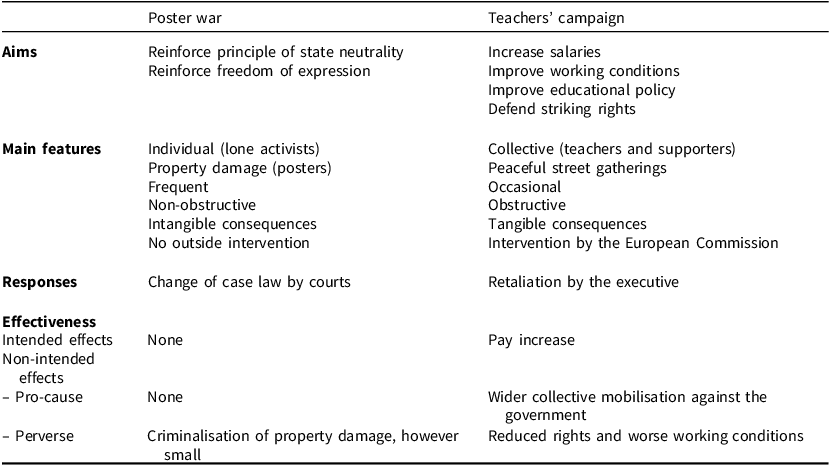
However, what interests us the most is that the two forms of civil disobedience provoked the Hungarian authorities to radicalise illiberal policy-making in the two relevant policy areas. Not only were both cases of civil disobedience ineffective at least in the short term, but they also led to perverse effects in terms of more restrictive policies (see Table 1 for an overview of the two cases).
Two civil disobedience campaigns: aims, features, responses, and effectiveness

Table 1. Long description
A table comparing two civil disobedience campaigns, their aims, features, responses, and effectiveness. The table has two columns: Poster war and Teachers’ campaign, and four rows: Aims, Main features, Responses, and Effectiveness. Row 1: Aims. Poster war: Reinforce principle of state neutrality, Reinforce freedom of expression. Teachers’ campaign: Increase salaries, Improve working conditions, Improve educational policy, Defend striking rights. Row 2: Main features. Poster war: Individual (lone activists), Property damage (posters), Frequent, Non-obstructive, Intangible consequences, No outside intervention. Teachers’ campaign: Collective (teachers and supporters), Peaceful street gatherings, Occasional, Obstructive, Tangible consequences, Intervention by the European Commission. Row 3: Responses. Poster war: Change of case law by courts. Teachers’ campaign: Retaliation by the executive. Row 4: Effectiveness. Intended effects. Poster war: None. Teachers’ campaign: Pay increase. Non-intended effects. Poster war: None. Teachers’ campaign: Wider collective mobilisation against the government. Perverse. Poster war: Criminalisation of property damage, however small. Teachers’ campaign: Reduced rights and worse working conditions.
To show this, we have reconstructed the timeline for the campaigns and compared it with whether they have reached their desired results. To solidify our findings, we contacted campaign participants to interview them about the nature and effects of the campaigns.
We interviewed seven teachers who taught at three different high schools in Budapest during the period of civil disobedience. Three of them actively participated in the organisation of the civil disobedience protest (Int. #1-3), and four participated in the protest; that is, they temporarily refused to hold classes (Int. #4-7). Two out of seven resigned from teaching and left school in protest against the government’s policies (Int. #1 and #2), and two of them were dismissed for participating in civil disobedience (Int. #5 and #7). The other three remained employed at their respective schools. We interviewed two prominent unionists from the very top of, respectively, the Teachers’ Democratic Union (PDSZ) (Int. #8) and the Teachers’ Trade Union (PSZ) (Int. #9).
Poster campaign participants generally declined to give interviews. However, we obtained an interview with Péter Heindl, a lawyer and social activist from Pécs in southern Hungary who has modified public government announcements over many years to protest against their anti-constitutional nature. In contrast to the interviewees related to the teachers’ campaign, we have, with his expressed approval, decided not to keep him anonymous.
Together with the media reports, the interviews give us a balanced view of the effects of the campaigns. Triangulation based on these different data gives us a reasonably solid foundation for judging whether campaigns were effective or ineffective in reaching their targets or produced perverse effects. The conclusions naturally depend on the timeframe of the study (until 2023). As suggested, we cannot categorically exclude the possibility that the two campaigns indirectly contributed to the electoral defeat of the Fidesz government in April 2026 and that this would not have happened without the two campaigns.
The first acts of civil disobedience against government posters and the protests against the government’s education policy were carried out already in the first years following Viktor Orbán’s Fidesz landslide victory in 2010. However, it was not until the turn of 2021/2022 that these two forms of anti-government civic activism reached their peak and caused an immediate and severe backlash from the Hungarian authorities.
Teachers’ protest – forced to civil disobedience
In 2022, the teachers’ civil disobedience and ensuing protests were a response to the government’s long-standing education policy characterised by centralisation of the administration, nationalisation of the curriculum, work overload, wage freeze, and restrictions on constitutional rights (Weiler and Előd Reference Weiler and Előd2022).
It is difficult to conceive of the teachers’ campaign on its own as a success, even if some of the intended results were achieved. First, the result, a pay raise, was predominantly an outcome of an intervention by the European Commission. Second, subsequent retaliatory responses from the Fidesz government by and large undermined achieved benefits, leaving teachers in a worse situation than before. In fact, it is reasonable to claim that the campaign had perverse effects. To understand why this is so, we first take a look at the general structural conditions for the teachers’ practice of civil disobedience. Then, we turn to the EU Commission’s intervention and, finally, to the government’s retaliation against the teachers.
Structural conditions
To begin with, the political conditions in Hungary after 2010 were not conducive either to active citizenship or civic solidarity. The Fidesz government repeatedly used the ‘divide et impera’ principle to resolve social and political conflicts, setting various domestic actors against each other, that is, opposition parties (Dunai Reference Dunai2020), trade unions, and professional groups such as teachers (Tarnay Reference Tarnay2023). A factor that significantly facilitated the implementation of this tactic was full control over the state media (press, radio, television, internet). Controlling the media was one of the most urgent tasks of the Fidesz government in 2010, and in the following years, they continued to expand the media empire in the private and public sectors, reducing the opposition parties’ visibility in the public sphere (Euronews 2024). The disobedients themselves felt that their protests were either silenced or manipulated in the public and private media (bought by Fidesz-linked businessmen) (Int. #1 and #2) and considered these unequal conditions of competition a sufficient reason to engage in civil disobedience.
According to our interviewees, another related reason for the poor effect of the teachers’ civil disobedience campaign was that what they perceived to be a fight for a just cause did not resonate with a large part of the general public, including parts of the teacher community itself. Their feeling was that a large part of society only paid lip service to the teachers’ fight and that, in reality, people felt a kind of Schadenfreude looking at the teachers’ fate – perhaps guided by unpleasant school memories or by loyalty to Fidesz (Int. #6). Within the teacher community, political and cultural factors were seen as barriers to support for the cause. Politically, many teachers did not see any point in opposing Orbán’s government because it was seen as no different from its predecessors, for example, regarding corruption. Culturally, the teacher community is dominated by women who, living in a patriarchal Hungarian culture, are not accustomed to criticising authorities (Int. #4). The most commonly cited reason for the teachers’ rejection of joining the ranks of their disobedient colleagues was fear of losing their jobs – an attitude that some interviewees approach with sympathy and others with contempt (calling them ‘cowards’ and claiming that ‘they deserved their fate’).
Outside intervention – the European Commission to the rescue
The teachers’ campaign led to a pay raise through the intervention of the European Commission. Despite the poor structural conditions and the half-hearted support from the general public as well as from within the teacher community, the teachers’ protests attracted the attention of the European Union to the problems with the educational sector in Hungary (Int. #9), thereby triggering a series of events involving the European Commission, which eventually persuaded the government to raise salaries (Joób and Halász Reference Joób and Halász2022). Following the outbreak of protests, the European Commission initiated contact with the two most important Hungarian trade unions representing teachers’ interests, which quickly took the form of regular online and in-person meetings (Szakszervezetek.hu 2022; Int. #8 and # 9). It also pressured the government to include trade unions and non-government organisations (NGOs) in the meetings of the Monitoring Committee, consisting of representatives from the government and the Commission tasked with monitoring the process of implementing changes in the education system (Czinkóczi Reference Czinkóczi2023; Int. #8 and # 9). Originally, in autumn 2021 (before the protests), the government submitted an education reform plan to the Commission without any pay increase. However, in negotiations with Hungary on EU funds in 2022, the Commission pressured Fidesz on this point and even demanded that the increase in teachers’ salaries be accelerated and the scale of the pay increases enhanced (Flash report 2022; Joób and Halász Reference Joób and Halász2022; Teczár Reference Teczár2024). Furthermore, during the negotiations on the European Social Fund Plus (ESF+), the Commission underlined the need to create legislation that makes a teaching career attractive and does not violate vested rights and school autonomy.
As a result, the government decided to increase teachers’ salaries (mainly from EU funds) to 80 per cent of the average salary of other graduates from 1 January 2025. The heads of the two most important teachers’ unions independently claim that the government would not have increased teachers’ salaries only under the pressure of protests and that the influence of the Commission was crucial (Int. #8 and # 9).
The case demonstrates that the decisive factor in reaching the agreement on a faster and higher pay raise was the cooperation between the ‘national coalition’ (teachers, trade unions, NGOs, students) and the European Commission. In this manner, the civil disobedience of the teachers can be said to be partly successful in that it led to a temporary victory for improved working conditions, and many of the activists also perceive it as a success in terms of reaching one of the most important goals, namely the increase in salaries (Int. #2, #5, #6, #7).
Perverse effects – the government strikes back
However, the argument can be made that this was a Pyrrhic victory and one that was only secured through the intervention of the EU Commission. The net result of the campaign was poor because of the government’s retaliatory steps towards the teachers after the protests. They consisted of collective punishment. After firing some of the teachers to intimidate others, the government adopted a law that deteriorated teachers’ working conditions and made it more difficult to express disagreement with the government policy (the ‘Strike Law’ of 2022 and the ‘Status Law’ of 2023 on new career paths of teachers). The government continued its policy of restricting teacher autonomy into 2024.
Thus, in January 2022, after the first-instance Budapest court supported the strike demand, teachers staged a warning strike to express disapproval of the government’s delaying of the new wage agreement (Csengel Reference Csengel2022). In response, the government – fearing a nationwide teachers’ strike announced for late March – introduced a law severely restricting their ability to strike (Kuli Reference Kuli2022) so that courts cannot rule in favour of teachers’ strikes again (Hungarian Helsinki Committee 2023). The law, which entered into force the following day, pushed teachers towards civil disobedience since the restrictions actually made striking de facto illegal (Int. #1). The teachers reacted spontaneously with anger, violated dignity, helplessness, and desperation (Int. #1-7). They staged walkouts during the school day and formed human chains around or outside schools, mainly in Budapest (Kertész Reference Kertész2022). As a response, government-controlled school districts randomly selected 14 teachers from the pool of approximately 2,000 disobedient teachers and fired them with immediate effect. This resulted in a wave of protests in defence of the dismissed teachers that took place in Budapest and continued into 2023.
By mid-2023, and in response to the prolonged protests, the government adopted a law on the new career of teachers, which provoked even greater anger among protesters, who immediately dubbed it a ‘vengeance law’. The new law evinced the anti-democratic motivation of the Hungarian authorities. Teachers lost a number of privileges, such as exerting meaningful influence in shaping the curriculum. More importantly, the law contained several points that were clearly aimed at preventing teachers’ protests: prohibiting negative statements about public education during and after working hours, possibilities of transferring a teacher to another school and of assigning more substitute teachers to classes, an increase in working time from 40 hours per week to 48, and an extension of the school year in case of lost hours during work stoppages (Székács Reference Székács2024).
In summer 2024, the government decided to get rid of the principals in some of the Budapest high schools where teachers had engaged in civil disobedience by preventing them from running for another term – the Kölcsey Ferenc and Károlyi Mihaly High Schools (Fődi Reference Fődi2024; Windisch Reference Windisch2024) – or by dismissing them – the Imre Madach High School (Pataki Reference Pataki2024). In addition, teachers and trade unions criticised additional burdens imposed by the government on teachers, such as a mandatory knowledge-checking course and exam and a new evaluation system of teachers’ performance, which they characterised as ‘absolutely subjective’ and ‘absolutely pointless’ (Int. #9). In their view, these actions are part of the government’s retaliation for the protests and serve to humiliate the teaching community (PDSZ official website 2024; Int. #8 and # 9). Although this was one of the goals that the government committed to in its agreement with the Commission, these new measures hardly increase the attractiveness of a teaching career. Moreover, the government most likely wanted to compensate for its partial loss of control of educational policy – especially the pay policy – to the European Commission by centralising the educational system.
In sum, with the intervention by the government, the teachers’ campaign had the opposite effects of those intended, at least in the short term. Longer term, the government reactions may have provoked increased civil society protest, and protesters may have learned from the predominantly negative experience incurred by the teachers and their supporters. As such, the campaigns may have added cumulatively to the electoral defeat of the Fidesz government in April 2026.
Poster wars without victory
Undoubtedly, it was Péter Heindl who played a key role in the ‘poster wars’ with the Fidesz government. Since 2021, Heindl has persistently and regularly ‘corrected’ government posters, claiming that they violate state neutrality, freedom of vote, and equal treatment. In most cases, he carried out his actions alone and posted his actions on the internet. Another part of his activities was to send complaints against the government to the main state offices – the General Prosecutor’s Office, the Ombudsman, the National Electoral Commission, the Curia, and the Constitutional Court – and to institutions abroad, such as the European Court of Human Rights in Strasbourg (Kormos Reference Kormos2023). Furthermore, Heindl asked national courts to refer to the European Court of Justice a request for a preliminary ruling to determine whether the government posters were unlawful (Int. w. Heindl Reference Heindl2024). All these requests have so far been rejected. In his legal defence, Heindl cites various documents issued by domestic and international institutions (Hungarian Constitutional Court from before 2010, Venice Commission, European Court of Human Rights), which claim that the competition between parties to obtain votes must be based on equal opportunities and that the state must remain neutral in that struggle (Kertész Reference Kertész2023).
Heindl’s acts of civil disobedience took place under the same structurally unfavourable conditions as the teachers’ campaign. However, along with other poster activists, Heindl did initially obtain some success for his campaign in local courts that passed verdicts in his favour. In 2016, courts convicted some poster destroyers and acquitted other perpetrators on at least two occasions (the cases of Kinga Kalocsai/Andras Szeles and Péter Heindl). They stated that the destruction of posters fell within the scope of the constitutional right to express political opinion and to shape the opinions of others (Pest Központi Kerületi. 2015).
As we describe below, that did not last, and compared to the teachers, Heindl did not have a strong external ally such as the EU Commission. He also did not manage to gain one in the European Court of Human Rights, which decided not to hear the case (Kormos Reference Kormos2023), perhaps because of case overload.
The sober conclusion is not only that the poster campaign did not reach its intended result in reducing the illiberal practices of the Fidesz government, but also that it actually fuelled an illiberal interpretation of the right to free speech and state neutrality by the higher courts. As a consequence, this must be seen as a perverse or counterproductive effect of the campaign (cf. Bourne Reference Bourne2023).
Perverse effects of the poster war – the government’s courts strike back
The poster campaign contributed to the radicalisation of the government’s anti-liberal policy, contrary to the protesters’ initial intentions to moderate it. As a response to the poster campaign, the highest bodies of the judiciary (Curia, Constitutional Court), controlled by the ruling party, played a key role in the consolidation of a model of adjudication that put the state’s rights to inform citizens and protect property integrity above the citizen’s rights. In the end, higher courts did not see the actions as a principled exercise and defence of the freedom of expression.
Thus, in 2019 and 2022, the Curia issued key rulings on the crime of defacing government posters, restricting the constitutional rights of citizens. Earlier, in 2016, it invalidated the requirement of state neutrality in the election campaign by supporting the rejection by the National Electoral Commission of a citizen’s complaint regarding the violation of state neutrality by the government responsible for the anti-refugee referendum posters (Origo.hu 2016a). The Curia stated that the government’s campaign activity ‘aimed at informing the public’ (Kúria végzése 2016), and in 2019, it once again criticised the requirement of state neutrality, additionally citing the judgements of the Hungarian Constitutional Court (Kúria végzése 2019). By preventing the state from being sued for unconstitutional actions such as displaying political posters, both rulings de facto opened the way for civil disobedience in this area.
The Curia’s first seminal ruling of 2019, addressing the issue of the legal qualification of poster defacing, concerned the government’s campaign of June 2015 entitled ‘National consultations on immigration and terrorism’. The ruling concerned the painting over of government billboards by two activists from Szeged and – as they considered the billboards xenophobic – placing on them their own message critical of the government policy. The Curia declared that the defendants were guilty of the crime of vandalism because they intentionally destroyed someone else’s property, causing damage exceeding the misdemeanour threshold of 50,000 HUF. The Curia stated that ‘freedom of speech cannot be exercised by committing a crime’ and qualified their act as ‘unlawful and dangerous to society’ (Kúria végzése 2019). As mentioned, three years earlier, a court in Budapest, when acquitting two activists who had defaced anti-refugee posters of the same kind, not only found that the act was not socially harmful but stated that limiting freedom of expression would be contrary to the principle of social justice (Pest Központi Kerületi. 2015). Activists from Szeged appealed the Curia’s ruling to the Constitutional Court, which in 2020 justified its rejection by arguing that ‘the necessary limitation of freedom is the institutional aspect of protecting property rights, and the government has a legitimate interest in the integrity of its announcement’ (Alkotmánybíróság 2020).
What was most conspicuous about the justification of the judgements of the Curia and the Constitutional Court is the objectification of the right of citizens to freedom of expression by subordinating it to the principle of the inviolability of state property. A uniformity decision of the Curia in late autumn 2022 was unique in making that an official interpretation of the law, binding on all courts in the country. Basically, by this ruling, the Curia pointed to the ‘inviolability of others’ property’ as the most important criterion when issuing judgements regarding graffiti. Furthermore, once the integrity of an object has been violated by making graffiti, the content and purpose of the inscription placed on the surface become ‘indifferent’ (Jogegységi határozat [71] 2022). The Curia expanded the qualification of a criminal act related to the violation of property to include two categories of acts: those for which the compensation is less than 50,000 HUF (Jogegységi határozat [62] 2022) (until then, it was classified as a misdemeanour) and those involving the infringement of others’ property, with the concept of property broadened to include all objects ‘that can be converted into money’ (Jogegységi határozat [69] 2022). This means that the category of criminal acts would include doing damage (graffiti) to all kinds of surfaces – public or private, of negligible or great financial value and easy or impossible to repair.
Péter Heindl, having many years of experience in dealing with the Hungarian justice system, suggests that the government – fearing that the mass poster remaking would disrupt its advertising campaigns – ‘instructed’ the courts to criminalise it (Int. w. Heindl Reference Heindl2024). He explains the lack of direct references to the protection of government posters in the content of the uniformity decision by the nature of the functioning of the Hungarian ‘electoral autocracy’: ‘The state never justifies its repressive actions with the intention of consciously restricting democracy and basic freedoms. After all, the differentia specifica of systems such as ‘electoral autocracy’ consists precisely in the fact that they pretend to be democracies while at the same time preventing the exercise of democratic rights’ (Int. w. Heindl Reference Heindl2024).
The evolution of the Curia’s rulings in an increasingly illiberal direction resulted from the desire to ‘protect’ the Fidesz government posters from the ever-more frequent cases of their destruction. It is not without reason that the Curia did not refer to the need to protect state property (here, billboards). Instead, it cited the right to protect the property of others as a pretext to eliminate the courts’ discretion in decisions regarding acts of altering government posters. The Curia included poster defacing in a very broad legal framework by extending the category of crime of vandalism to scribbling/painting/blurring on the surface of any physical object owned by someone else and then called poster defacing an unjustified and disproportionate violation of property rights (Jogegységi határozata 2022: 50–55). This provided them with a safe excuse against accusations of being subject to political influence.
The price for ensuring the safety of the government’s political announcements was the potentially absurd nature of Hungarian court rulings, provided the new Curia decisions are consistently applied. According to the uniformity decision, graffiti is a crime regardless of the value, size, or purpose of the damage. However, presumably, the intention behind such a law was not to have it enforced in every case of wall scribbling. Rather, as in the case of the selective teachers’ dismissals, the purpose was to intimidate those who intend to disobey the law by resorting to civil disobedience.
Conclusion
It is a striking feature of the Fidesz government’s reactions to civil disobedience that they not only did not yield to protesters but also reacted with what seemed to be disproportionate measures. The Fidesz government employed radical solutions that sought to undermine the confidence among protesters that their protests would make a positive difference. By convicting the poster destroyers for vandalism, the judicial bodies apparently violated the principle of proportionality and sided with the government. The prioritisation of the state’s fundamental rights by the courts in this context is questionable since it is unclear that the state even possesses fundamental rights (Origo.hu 2016b).
The teachers’ campaign had some noticeable effects. One was the Commission’s intervention to secure a pay raise. Another was the spurring of diverse, prolonged, and sometimes violent protests that mobilised a significant part of society as a reaction to the government’s disproportional responses to the teachers’ strike. Thus, the teachers’ campaign indicates that the way to increase pressure on an illiberal government is to engage actors both in the country and abroad for a common cause. However, compared to the poster campaign, it also suggests that chances of gaining allies are greater when the protests carry more weight.
To return to the article’s main question of whether civil disobedience is an effective way of resisting and reversing democratic backsliding under Hungarian populist rule, the answer is that within the timeframe of the studies and thus judged on the short term, the results were negative and the campaigns on first impressions counterproductive. The case studies suggest that this is in part due to structural conditions, not least the absence of free media. Without free media, protesters have difficulties reaching the general public with their political message and, thereby, creating public pressure against the government. However, the government’s strategic reactions to protesters also played an important part. Through its control of the judiciary, it managed to change the basic interpretation of what actions were protected under the freedom of expression and what actions were to be considered common crimes. It also moved swiftly to limit the rights of teachers even further, emphasising its dominance and willingness to go far, even within an area with tangible impact on the daily lives of Hungarian families.
These results are a warning for people undertaking civil disobedience campaigns under conditions similar to those of the Orbán regime. Citizens should be prepared for autocrats striking back and leaving them with even less than before. That said, the Hungarian case (at least in the early days after the 12 April 2026 election) arguably shows that short-term losses may be replaced by long-term gains. Studies of civil disobedience and other forms of non-violent resistance suggest that public criticism and protest may reinforce the self-respect of the opposition, provide them with learning opportunities and inspiration for how (not) to confront the government and thus increase the long-term chances of the opposition to prevail against an autocratic regime. It is also likely that the number of protest events has been an important factor in Peter Maygars’ decision to break with Fidesz and create the Tisza party and challenge Orbán at the polls.
Data availability statement
The article uses publicly available judicial documents, press and journal articles, and published books, all of which are cited in the text. The article also draws on interviews with one civil activist, teachers, and leaders of teachers’ trade unions. The interview data are not publicly available because participants were assured confidentiality.
Acknowledgements
We are very grateful for detailed comments on earlier versions of this paper from our colleagues Bénédicte Laumond, Anthoula Malkopoulou, Patrick Nitzschner, Angela Bourne, Aleksandra Moroska-Bonkiewicz, Juha Tuovinen, Rasmus Møller Hvid, and two anonymous reviewers for European Political Science. All errors are ours only.
Funding statement
The research for this article was funded by the Carlsberg Foundation, Grant no CF20-0008.
Competing interests
The authors report no conflict of interest.
Ethical standards
The research was conducted in accordance with established ethical standards for research involving human participants. Interviews with teachers, civil activists, and trade union leaders were conducted with informed consent. Participants were informed about the purpose of the research and the intended use of the interview material. Given the politically sensitive nature of the research, participants were assured privacy and confidentiality. The article also draws on publicly available judicial documents, press and journal documents, and books. The distinction is clearly made between publicly documented sources and statements presented by the authors.
Franciszek Tyszka, PhD, Post Doc at University of Warsaw (2021–2024).
Tore Vincents Olsen, PhD, is associate professor in political theory at Department of Political Science, Aarhus University.

 Open access

