Introduction
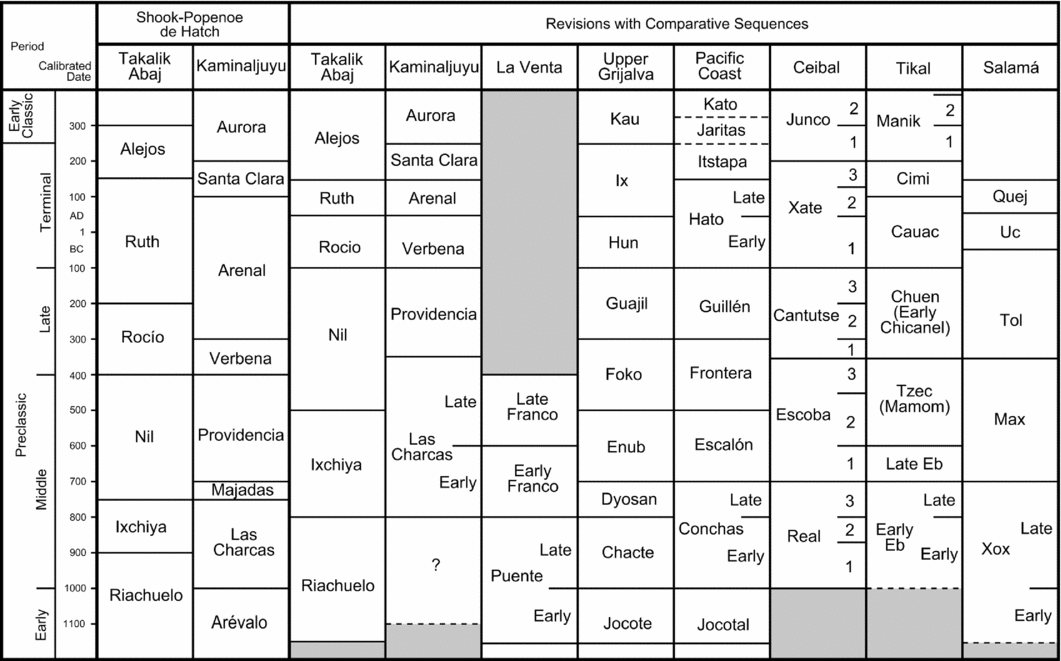
In a recent study, Inomata et al. (Reference Inomata, Ortiz, Arroyo and Robinson2014) proposed a substantial revision in the chronology of Kaminaljuyu, a major centre in the Maya highlands, shifting its Preclassic portion approximately 300 years later than was previously supposed (Figures 1 & 2; Robinson et al. Reference Robinson, Garnica, Armitage, Rowe, Laporte, Arroyo, Escobedo and Mejía2006; Arroyo Reference Arroyo2010; Ortíz Vallejos Reference Ortíz2014). Despite some ongoing debate (e.g. Demarest Reference Demarest, Arroyo, Méndez Salinas and Paiz2015; Popenoe de Hatch Reference Popenoe de Hatch, Arroyo, Méndez Salinas and Paiz2015), widespread support for the revision has been expressed at sessions held at professional meetings over the past two years, including the 2014 Simposio de Investigaciones Arqueológicas en Guatemala, the 2015 meeting of the Society for American Archaeology, and a 2015 workshop at the Casa Herrera, Antigua, Guatemala. A chronological change of this magnitude compels scholars to rethink currently accepted interpretations of social processes, not only at the highland centre of Kaminaljuyu, but across the entire Southern Maya Region, a geographic label we use to describe the area comprising the Maya highlands and the southern Pacific Coast, without implying specific ethnic or linguistic affiliations (Love & Kaplan Reference Love and Kaplan2011). In this article, the revised chronology serves as both a foundation and catalyst for a re-evaluation of inter-regional interaction and sculptural traditions in the Southern Maya Region during the Middle, Late and Terminal Preclassic periods (1000 BC–AD 250). Given the archaeological complexity of the area under discussion, this article is intended as a starting point for further research, rather than as a comprehensive review of the literature and data.
Map of southern Mesoamerica showing the locations of sites and the distributions of the Middle Formative Chiapas (MFC) pattern and Olmec-style monuments.

Shook-Popenoe de Hatch chronology (1999) and the revised sequences. Modified from Inomata et al. (Reference Inomata, Ortiz, Arroyo and Robinson2014: fig. 2), incorporating information provided by John Clark (pers. comm. 2015) and Mendelsohn (Reference Mendelsohn2015).

Background
By the 1950s and 1960s, discoveries of sophisticated sculptures inscribed with early dates, royal tombs and monumental architecture at sites in the Southern Maya Region had prompted scholars to argue that these features arose roughly 300 years earlier here than in the Maya lowlands (Shook & Kidder Reference Shook and Kidder1952; Lowe & Mason Reference Lowe, Mason and Willey1965; Miles Reference Miles and Willey1965). Local chronologies and sculptural seriations placed some Maya-style bas-relief sculptures as early as 300 BC, and other monuments even earlier. Kaminaljuyu Stela 9 was dated to c. 700 BC (Parsons Reference Parsons1986). Coe's (Reference Coe1962) theory that the ‘Izapan style’ formed a bridge between earlier Olmec and later lowland Maya-style art gained significant traction during this time (Lowe et al. Reference Lowe, Lee and Martinez1982; Parsons Reference Parsons1986). Over the ensuing decades, various ceramic sequences for Kaminaljuyu were published, with the Shook and Popenoe de Hatch (Reference Shook, Popenoe de Hatch and Popenoe de Hatch1999) version eventually becoming the most widely accepted.
In recent years, the ‘Izapan-style’ origin theory has been brought into question. Meanwhile, support has grown for the simultaneous development of Maya-style sculpture in the lowlands and highlands c. 400–300 BC (Clarke et al. Reference Clark, Hansen, Pérez Suárez, Manzanilla and López Luján2000; Hansen Reference Hansen and Powis2005; Estrada-Belli Reference Estrada-Belli2011). Although some have called for chronological adjustments (Love Reference Love, Love, Popenoe de Hatch and Escobedo2002; Kaplan Reference Kaplan, Love and Kaplan2011), the Shook-Popenoe de Hatch chronology continues to be the most widely cited highland sequence. With the site's Verbena and Arenal phase peak dated to c. 400 BC–AD 100 (Figure 2), Kaminaljuyu bas-relief sculptures continue to be described as some of the earliest-known examples of Maya-style iconography in the Mesoamerican world.
The revised chronology (Inomata et al. Reference Inomata, Ortiz, Arroyo and Robinson2014) also indicates that the Preclassic sequence of Takalik Abaj needs to be modified in accordance with that of Kaminaljuyu (Figure 2). The chronologies of other parts of the Southern Maya Region, including the Chixoy River Valley, the Salama Valley and the Chalchuapa/Santa Leticia region, correlate well with the revised chronology. The correlation with sequences from the Pacific Coast of western Guatemala and Chiapas, including the sites of El Ujuxte and Izapa, remains problematic though, as Preclassic ceramics from this area diverge substantially from those of Kaminaljuyu. Establishing a more reliable chronology for this region will require full publication of ceramics, their archaeological contexts and additional radiocarbon dates.
According to the revised sequence, the emergence of Maya-style sculpture and royal tombs in the Southern Maya Region occurred c. 100 BC or later, not c. 300 BC as was traditionally thought. This suggests that the growth of Kaminaljuyu was substantially faster than previously believed and that the expression of kingship through tombs and ruler portraits occurred roughly contemporaneously in the Southern Maya Region and in the Maya lowlands. This shift not only leaves a large gap in our understanding of the Late Preclassic period (c. 400–100 BC) at Kaminaljuyu, but demands a change in terminology as well. The new chronology moves the Providencia phase, the period of Kaminaljuyu's initial growth, from the Middle Preclassic period (c. 700–400 BC) to the Late Preclassic period (c. 400–100 BC). The Verbena and Arenal phases—widely considered Kaminaljuyu's heyday in population, construction and artistic production—shift accordingly, from c. 400–100 BC to c. 100 BC–AD 150. Although scholars following the Shook-Popenoe de Hatch chronology generally equate the Verbena–Arenal phases with the Late Preclassic period, we prefer to call this time of rapid growth and cultural florescence the ‘Terminal Preclassic’ in order to differentiate it more readily from what is now the Late Preclassic Providencia phase.
Before continuing, it is important to note the issues inherent in dating Preclassic stone monuments without inscribed calendrical dates. Radiocarbon samples and ceramics can only be used to date sculptures’ final depositions. In the Southern Maya Region, many stone sculptures lack archaeological context entirely, while others underwent several iterations of use before their final depositions. Carving dates are thus most often determined through educated guesswork, aided by stylistic seriations and cross-dating (e.g. Miles Reference Miles and Willey1965; Parsons Reference Parsons1986).
The revised chronology moves the final deposition dates later in time for many stone monuments from the Southern Maya Region. Unless evidence suggests otherwise, it follows that the presumed carving dates of these sculptures should move forward accordingly. This maintains the widely accepted assignment of Maya-style sculptures to the Verbena–Arenal phases (Parsons Reference Parsons1986; Kaplan 2011; Henderson Reference Henderson2013) but changes their absolute dates from 400 BC–AD 100 to 100 BC–AD 150. Stylistic comparisons with securely dated murals from the Preclassic Maya lowlands (Saturno et al. Reference Saturno, Taube, Stuart and Hurst2005) lend further support to this argument, suggesting that many bas-relief sculptures from the Southern Maya Region are much later in date than previously thought.
Middle Preclassic interaction (1000–350 BC)
The Middle Preclassic period was characterised by broad inter-regional interactions across southern Mesoamerica, reflected in shared sculptural styles, site layouts and ritual practices. La Venta, various centres along the Grijalva River, and the lowland Maya community of Ceibal shared a highly standardised site layout, which John Clark (Clark & Hansen Reference Clark, Hansen, Inomata and Houston2001) calls the Middle Formative Chiapas (MFC) pattern (Inomata et al. Reference Inomata, Triadan, Aoyama, Castillo and Yonenobu2013). This configuration consisted of the so-called ‘E-Group’ assemblage (defined by a square structure to the west and an elongated platform to the east) in the centre, and large platforms placed along the north–south axis of the E-Group (Figure 3). This site layout appears to have been associated with shared ritual practices involving the deposition of greenstone axe caches. The north–south directionality exhibited by many sites in the Maya highlands and on the Pacific Coast, including La Blanca, Takalik Abaj and Kaminaljuyu, indicates affinity with the MFC pattern, although the specific details of site layouts vary. Many of these sites were aligned with major geological or geographic landmarks, such as volcanoes, suggesting the importance of the local landscape in the cosmological view of each community (Blake Reference Blake2013).
Map of Ceibal Group A with 1m contour lines. The buildings dating to the Real 1 phase represent the core elements of the Middle Formative Chiapas pattern, with structures Ajaw and Xa'an forming an E-Group assemblage. The layout of the Escoba phase shows a fully developed MFC format.

The ceramics of southern Mesoamerica from the early Middle Preclassic period (c. 1000–700 BC) were characterised by regional diversity, but they began to exhibit greater similarity during the latter half of the period (700–350 BC). The Grijalva River valley of Chiapas and the Maya lowlands, in particular, developed close ceramic affinities, reflected in the sharing of orange-resist decorations. Late Las Charcas (600–350 BC) ceramics of the Kaminaljuyu region also began to share features with lowland materials, including orange-resist decorations, waxy slips and pre-slip grooves.
The Middle Preclassic also witnessed the spread of ‘Olmec-style’ monuments beyond the Gulf Coast and the surrounding region. Full round sculptures and rock art appeared at sites along the isthmus, the Pacific Coast of Chiapas and Guatemala, and El Salvador (Clark & Pye Reference Clark, Pye, Clark and Pye2000; Clark et al. Reference Clark, Guernsey, Arroyo, Guernsey, Clark and Arroyo2010). Zoomorphic altars probably emerged during this time (Figure 4a), as did boulder-style niche monuments, which appear to be localised interpretations of earlier Olmec niche altars (Figure 4b) (Lowe et al. Reference Lowe, Lee and Martinez1982; Parsons Reference Parsons1986; Clark et al. Reference Clark, Guernsey, Arroyo, Guernsey, Clark and Arroyo2010; Schieber de Lavarreda & Orrego Corzo Reference Schieber de Lavarreda, Orrego Corzo, Guernsey, Clark and Arroyo2010). Plain monuments were also produced in the region (Bove Reference Bove, Love and Kaplan2011; Shook Reference Shook1952). At the Highland Guatemalan site of Naranjo, for instance, 35 plain monuments were erected, including the earliest examples of stela-altar pairs encountered in the Maya area (Figure 4c) (Arroyo Reference Arroyo2010).
a) Zoomorphic altar (Takalik Abaj Monument 47; drawing courtesy of the Parque Arquelógico Nacional Takalik Abaj); b) niche monument (Takalik Abaj Monument 67; drawing courtesy of the Parque Arquelógico Nacional Takalik Abaj); c) plain stela-altar pair (Naranjo Monument 4 & Altar 1; photograph courtesy of Bárbara Arroyo, Proyecto de Rescate Naranjo).

It is probable that the Middle Preclassic Gulf Coast centre of La Venta and its predecessor, San Lorenzo, had centralised political systems and divine kingship, expressed most visibly by ruler portraits carved in stone (Clark Reference Clark, Scarborough and Clark2007). ‘Olmec-style’ monuments depicting possible rulers at sites such as Takalik Abaj suggest that some Middle Preclassic centres in the Southern Maya Region may have shared certain elements of this centralised political system (Schieber de Lavarreda & Orrego Corzo Reference Schieber de Lavarreda, Orrego Corzo, Guernsey, Clark and Arroyo2010). Other Southern centres did not consistently display stone monuments during the Middle Preclassic, suggesting that conceptions of elite power were not always tied to sculptural production and display during this time (Love Reference Love, Love, Popenoe de Hatch and Escobedo2002, Reference Love, Guernsey, Clark and Arroyo2010; Guernsey & Love Reference Guernsey, Love, Fields and Reents-Budet2005; Bove Reference Bove, Love and Kaplan2011; Guernsey Reference Guernsey2012). Middle Preclassic stone carvings are less common in the Grijalva River valley of Chiapas and nearly absent in the Maya lowlands. In the latter part of the Middle Preclassic, Nakbe, in northern Petén, grew into a large centre with pyramids and monumental platforms (Hansen Reference Hansen and Powis2005). These impressive constructions possibly required some form of political centralisation, but debate continues over whether or not political organisation was based on hereditary rulership at this time.
Late Preclassic reorganisation (350–100 BC)
Many communities in the Maya lowlands continued to develop without interruption during the Late Preclassic period. El Mirador grew to an impressive size, boasting some of the largest pyramids in the world (Hansen Reference Hansen, Boxt and Dillon2012). Ritual behaviours associated with La Venta and centres in the Grijalva region, including the caching of greenstone axes, lost popularity, although the E-Group assemblage represents a notable exception. These standardised ceremonial complexes continued to be built as foci of communal gatherings at many lowland settlements. Overall, the Maya lowlands became a well-defined cultural sphere during the Late Preclassic period, sharing relatively homogeneous ceramic and architectural styles.
Around 350 BC, the significant highland centre of Naranjo was mostly abandoned, and its population appears to have moved to Kaminaljuyu, a few kilometres to the south (Arroyo Reference Arroyo, Arroyo, Méndez Salinas and Paiz2015). At this time, during the Providencia ceramic phase, Kaminaljuyu began to rise as a major highland centre, with increased construction activities, major hydraulic projects and an increasingly large population (Popenoe de Hatch Reference Popenoe de Hatch1997; Love & Kaplan Reference Love and Kaplan2011). This transition may be associated with significant changes at other major centres in southern Mesoamerica and the collapse of La Venta around 400 or 350 BC (Clark et al. Reference Clark, Hansen, Pérez Suárez, Manzanilla and López Luján2000; Rust Reference Rust2008). In Chiapas, La Libertad, its satellite sites and Tzutzuculi were abandoned around this time as well (Finca Acapulco was deserted somewhat earlier). Chiapa de Corzo and other settlements in the western Grijalva Basin continued, but their shared ceramic styles and spatial configurations broke down, and some sites decreased in size (Lowe Reference Lowe and Adams1977; Clark & Hansen Reference Clark, Hansen, Inomata and Houston2001). A notable exception to this pattern of disruption may be the site of Takalik Abaj, which appears to have functioned as a major regional centre throughout this time (Schieber de Lavarreda & Orrego Corzo Reference Schieber de Lavarreda, Orrego Corzo, Guernsey, Clark and Arroyo2010).Overall, the beginning of the Late Preclassic is characterised by major reorganisations of inter-regional trade networks in southern Mesoamerica. Although the Chiapas Grijalva region maintains strong ceramic ties with the Maya lowlands, Providencia ceramics of Kaminaljuyu diverge from the materials of these areas, exhibiting closer affinities with western El Salvador (Demarest Reference Demarest1986, Reference Demarest, Sharer and Grove1989).The new chronology shifts many Late Preclassic Southern Maya sculptures into the Terminal Preclassic period. This particularly affects the Maya-style bas-relief sculptures of Kaminaljuyu, Takalik Abaj and highland centres such as El Portón and La Lagunita, although the chronological placement of Izapa's bas-relief sculptures remains under debate (Lowe et al. Reference Lowe, Lee and Martinez1982; Sharer & Sedat Reference Sharer and Sedat1987; Schieber de Lavarreda & Orrego Corzo Reference Schieber de Lavarreda, Orrego Corzo, Guernsey, Clark and Arroyo2010). This shift alters the Late Preclassic sculptural landscape, bringing locally developed forms into the foreground and highlighting the importance of this region's indigenous sculptural traditions.
Although some sculptures exhibit close connections to Middle Preclassic ‘Olmec-style’ precedents, the innovation of localised formats predominated in the Southern Maya Region during the Late Preclassic. Zoomorphic toad altars became more refined (Figure 5a; Schieber de Lavarreda & Orrego Corzo Reference Schieber de Lavarreda, Orrego Corzo, Guernsey, Clark and Arroyo2010); mushroom stones became common (Ohi & Torres Reference Ohi and Torres1994); and the potbelly tradition gained great popularity (Figure 5b; Guernsey 2012). The tradition of displaying plain monuments continued, and stela-altar pairs increased in frequency (Shook Reference Shook1952; Parsons Reference Parsons1986; Bove Reference Bove, Love and Kaplan2011).
a) Toad altar from Kaminaljuyu (photograph: Lucia Henderson); b) potbelly sculpture (Monte Alto Monument 4; photograph: Lucia Henderson).

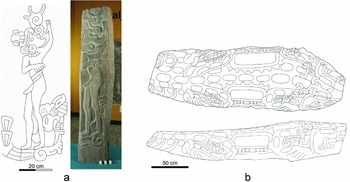
Overall, Late Preclassic sculptures from Kaminaljuyu and neighbouring sites emphasise the inherent properties of stone and its natural contours. This is true for the earliest bas-relief carvings found at Kaminaljuyu, Sculpture 9 and Sculpture 2 (Figure 6), which drape carved iconography over the natural facets of basalt columns. These sculptures both depict early versions of the earth crocodile—on Sculpture 9 a singing figure stands on the crocodile earth, while on Sculpture 2 it is rendered in three dimensions. In both cases, this cosmic earth model is combined with water iconography (Henderson Reference Henderson2013). This follows the general trend of Preclassic sculptures, particularly zoomorphic altars, niche sculptures and potbellies, in exhibiting themes closely tied to the local environment, including its mountains and volcanoes, lakes and rivers, and tremendous thunderstorms (Henderson Reference Henderson2013, Reference Henderson, Arroyo, Méndez Salinas and Paiz2015). Such representations echo the strong emphasis on local landscape features exhibited by the spatial layouts and architectural alignments of Southern centres during this and the preceding period (Blake Reference Blake2013).
a) Kaminaljuyu Sculpture 9 (photograph and illustration: Lucia Henderson), exhibited at the Museo Nacional de Arqueología e Etnología, Guatemala; b) Kaminaljuyu Sculpture 2, top and side (illustration: Lucia Henderson).

Three associated formats—pedestal sculptures (Figure 7a), ‘bench figures’ (Figure 7b) and four-legged thrones (Figure 7c)—all gained sudden popularity during this time (Parsons Reference Parsons1986; Kaplan Reference Kaplan1995; Clark et al. Reference Clark, Guernsey, Arroyo, Guernsey, Clark and Arroyo2010; Henderson Reference Henderson2013). The representation of seated individuals (both anthropomorphic and zoomorphic) and the presence of stone thrones themselves suggest not only a rising emphasis on the ‘seating’ of authority figures in the Southern Maya Region, but on the recording of this practice in public, permanent media.
a) Pedestal sculpture (El Portón Monument 10; image courtesy of the New World Archaeological Foundation); b) bench figure (private collection; photograph: Lucia Henderson); c) Izapa Throne 2 (image courtesy of the New World Archaeological Foundation).

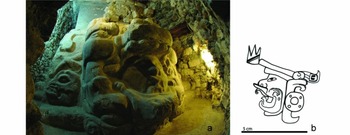
Art production in the Late Preclassic lowlands was markedly different from that encountered to the south. Late Preclassic lowland monumental art generally took the form of great stucco masks (Figure 8a; Estrada-Belli Reference Estrada-Belli2011: 92–102). Mural paintings appeared at Cival (Figure 8b), and Maya hieroglyphic texts were painted at San Bartolo (Saturno et al. Reference Saturno, Stuart and Beltrán2006; Estrada-Belli Reference Estrada-Belli2011: 106–108, 114–16). Late Preclassic lowland iconography directly cites Olmec symbols and deities, especially those related to rulership, maize and rain (Fields Reference Fields1989; Freidel Reference Freidel, Clancy and Harrison1990; Taube Reference Taube and Coe1995, Reference Taube1996; Fields & Reents-Budet Reference Fields and Reents-Budet2005; Guernsey Reference Guernsey, Love and Kaplan2011). These, however, take the form of a new and widespread iconographic system, generally referred to as ‘Maya-style’ iconography.
Lowland Late Preclassic art: a) Holmul Building B-1st Mask (photograph by Francisco Estrada-Belli, courtesy of the Holmul Archaeological Project); b) detail from Cival Structure 1-4th, painted Maize God (illustration by Heather Hurst, 2007, courtesy of the Holmul Archaeological Project).

Terminal Preclassic development (100 BC–AD 150)
During the Verbena phase (100 BC–AD 50), the first royal tombs and Maya-style bas-relief ruler monuments appeared at Kaminaljuyu (Parsons Reference Parsons1986; Kaplan 2011; Henderson Reference Henderson2013). The same is probably true for Takalik Abaj and related sites in the Southern Maya Region. Although scholars are debating whether rulership existed in the Maya area during the Late Preclassic period following the collapse of La Venta (Clark Reference Clark, Scarborough and Clark2007; Bove Reference Bove, Love and Kaplan2011), these tombs and portraits represent the first unequivocal evidence for kingship in the area. At the very least, they indicate that the Terminal Preclassic period witnessed a dramatic change in the way in which the office of kingship was reflected in the material record (Fields & Reents-Budet Reference Fields and Reents-Budet2005).
In the Maya lowlands, the Terminal Preclassic marked a similar florescence in artistic expression. Maya-style iconography continued to be represented in elaborate stucco façade masks (Figure 9a), exquisitely painted narrative mural scenes (Figure 9b) and painted hieroglyphic texts (Saturno et al. Reference Saturno, Taube, Stuart and Hurst2005; Taube et al. Reference Taube, Saturno, Stuart and Hurst2010). The earliest lowland bas-relief sculptures depicting rulers probably date to this period as well, as is the case for their Southern counterparts. Consequently, the most important implication of the chronological revision is that the rapid growth of centralised polities and transitions in the material expression of kingship occurred nearly simultaneously across the lowlands and the Southern Maya Region, beginning c. 100 BC. Although some scholars have suggested the coeval and largely independent development of lowland and Southern polities around 300 BC (Estrada-Belli Reference Estrada-Belli2011; Hansen 2012), some of these arguments appear to be based on the problematic dating of lowland monuments, which places them several centuries too early (Hammond Reference Hammond1991).
a) Southern mask, Cival Structure 1-4th (illustration by Heather Hurst, 2008, courtesy of the Holmul Archaeological Project); b) detail of the north wall of the San Bartolo murals, Las Pinturas, Sub-1A (illustration by Heather Hurst, 2004).

In the Southern Maya Region, indigenous formats such as mushroom stones, toad altars, plain monuments, potbellies, and four-legged thrones appear to have continued throughout the Terminal Preclassic period. Pedestal sculptures and bench figures, however, seem to have fallen out of fashion. The most dramatic change in sculptural production is a sudden explosion in the production of bas-relief sculpture with Maya-style iconography. At Kaminaljuyu, Maya iconography was first expressed in two distinct carving styles: one associated with the precedents set by earlier bas-relief carvings such as Sculpture 2 (Figures 6b & 10a), and the other more closely resembling the baroque, calligraphic style encountered in lowland mural paintings (Figures 9b & 10b). Over time, these blended into Kaminaljuyu's singular bas-relief carving style, including its spectacular and unique silhouette sculptures (Figure 10c). Several pieces of evidence, including its sudden appearance in the Southern Region, suggest that Maya-style iconography was a lowland innovation (Stuart n.d.).
a) Kaminaljuyu Sculpture 19 (c. 100 BC, Verbena phase), exhibiting a traditional, locally developed approach to stone; b) Kaminaljuyu Sculpture 10 (c. 100 BC, Verbena phase), exhibiting distinct influence from Maya-style lowland painting traditions; c) Kaminaljuyu Sculpture 24 (c. AD 50–150), a silhouette sculpture that blends these earlier approaches (illustrations: Lucia Henderson).

Sculpture played a powerful role in the structuring and expression of early kingship (Guernsey & Love Reference Guernsey, Love, Fields and Reents-Budet2005; Guernsey Reference Guernsey2006, Reference Guernsey2012; Henderson Reference Henderson2013). The simultaneous advent of Maya-style iconography and royal tombs in the Southern Region suggests that the two were closely related. Notably, Maya-style sculpture in the Southern Maya Region is expressed in highly localised ways, and often includes site-specific deities (Henderson Reference Henderson2013). Localised adaptation, however, existed hand in hand with widely shared symbols, particularly those related to kingship, such as the headband of rulership and the Principal Bird Deity (Guernsey & Love Reference Guernsey, Love, Fields and Reents-Budet2005; Guernsey 2011). Maya-style iconography thus served a two-fold purpose, allowing elite groups to embrace a new symbolism of authority publicly and signal participation in the broader Maya world, while preserving and referencing locally relevant ideologies and iconographies. Such adaptations seem to indicate that agency and strategy were involved in the adoption of Maya-style iconography in the Southern Region, highlighting local choice over conquest or coercion.
The rapid political centralisation seen during the Terminal Preclassic period ended with upheaval across wide areas (Popenoe de Hatch Reference Popenoe de Hatch1997; Estrada-Belli Reference Estrada-Belli2011). Highland and lowland sites, including major centres such as Kaminaljuyu and El Mirador, experienced dramatic declines in population and construction around AD 150, and stone sculptural production ceased across the entire Maya area. Tikal and other lowland centres appear to have quickly stepped into the power vacuum left by El Mirador, building vast temples and constructing rich tombs for rulers. In the Southern Maya Region, however, sites appear to have been more dramatically affected. Although sites like Kaminaljuyu, Takalik Abaj and Izapa show continuous occupation throughout this time, they suffered precipitous declines, reflected most visibly in population loss and diminished construction activities.
Concluding remarks
Inter-regional interaction in southern Mesoamerica has provided fodder for decades of academic debate (Demarest 1989; Estrada-Belli Reference Estrada-Belli2011). Until now, however, an important geographic region has been ‘misplaced’ in time. If Maya-style sculptural sequences are adjusted according to the revised chronology, several hypotheses can be put forth that significantly change our understanding of political developments in the early Maya world.
First, the revised chronology suggests that several major centres in the Southern Maya Region experienced a political disruption around 350 BC, roughly contemporaneous with the collapse of La Venta and the collapse and reorganisation of several Chiapan centres. These concurrent events suggest that the political fortunes of these centres were closely intertwined. During the following Late Preclassic, artists of the Southern Maya Region began a period of sculptural innovation, moving away from ‘Olmec-style’ precedents to carve local styles and imagery related to the surrounding environment, a change that hints at a reformation of Middle Preclassic precepts associated with authority. Meanwhile, lowland Maya communities adhered closely to longstanding Middle Preclassic symbols of political authority. Slow to adopt the tradition of stone carving, Late Preclassic lowland artists nevertheless developed a highly complex ‘Maya-style’ iconography, expressed in elaborate mask façades and mural paintings replete with direct citations to Olmec symbolic precedents.
Second, the revised chronology suggests that a profound transformation in political organisation occurred throughout the Maya area at the onset of the Terminal Preclassic. Rich royal burials first appeared, and portraits of kings became widespread for the first time since the Middle Preclassic. This political change was accompanied by a resurgence in lowland–highland interaction, reflected in closely shared ceramic and stone-carving styles. Regional differences in the employment of Maya-style iconography suggest that Terminal Preclassic kings drew on varied, locally relevant themes, while sharing a widespread symbolic language of authority.
Finally, the revised chronology suggests that social changes in the Southern Maya Region were faster and more closely intertwined with social processes in other regions than previously thought. Although inter-regional interaction has always been an important theme in the archaeological study of southern Mesoamerica, this possible concurrency in political dynamics encourages us to explore further how interactions across wide areas shaped the trajectories of various groups in the region. These observations also highlight the ever-increasing importance of reliable chronologies when seeking to understand the past.
Acknowledgements
We are grateful to our many colleagues who provided feedback on this article, particularly Stephen Houston, John Clark, Rebecca Mendelsohn and an anonymous reviewer. We would also like to thank Marion Popenoe de Hatch for her work and generosity. This paper would not have been possible without her remarkable contributions to the archaeology of this important site.