Introduction
Natural wild boar populations are distributed throughout Europe. These animals eat different kinds of diets including fruits, amphibians, reptiles, mushrooms, birds and their eggs, small rodents, carrion and insect larvae (Solaymani-Mohammadi et al., Reference Solaymani-Mohammadi, Mobedi, Rezaian, Massoud, Mohebali, Hooshyar, Ashrafi and Rokni2003; Mowlavi et al., Reference Mowlavi, Massoud, Mobedi, Solaymani-Mohammadi, Gharagozlou and Mas-Coma2006). Because of their feeding habits, wild boars can play a significant role in the circulation and maintenance of certain parasites, especially Trichinella, in the environment (Antolová et al., Reference Antolová, Reiterová and Dubinský2006; Mowlavi et al., Reference Mowlavi, Massoud, Mobedi, Solaymani-Mohammadi, Gharagozlou and Mas-Coma2006). Studies on parasitic diseases in wildlife are important to evaluate the extent to which wild animals serve the sources of infectious agents transmitted to livestock and humans, because some wild animals inhabit areas near the suburbs. Wild boars (Sus scrofa) can be found in almost all of the ecosystems of Turkey; however, no accurate estimation of the wild boar population is currently available. In Turkey, wild boars are hunted by hobby hunters and are shot by farmers to protect agricultural crops. In addition, wild boars are also hunted for their meat by different ethnic groups. Even though wild boars are common and widely distributed in Turkey, the parasites of these animals have received little attention, and only minimal data are available on them (reviewed by Merdivenci, Reference Merdivenci, Unat, Yaşarol and Merdivenci1965, Reference Merdivenci1983). Furthermore, no systematic studies on the prevalence and intensity of helminth infections in wild boars from Turkey have been conducted to date.
The present study was designed to determine: (1) visceral helminth species and Trichinella spp. larvae present in wild boars in Turkey; (2) the prevalence, intensity and abundance of helminth species; and (3) the effect of sex and age on the parasitic infections.
Materials and methods
Study area
Between 2007 and 2008, the helminths infecting wild boars were investigated in the Bursa province of Turkey. This area is located in the south-eastern part of the Marmara Region and is characterized by hot and dry summers with some rainfall. The altitude of the area is approximately 100 m above sea level. The mean annual temperature is 14–16°C with average minimum and maximum temperatures of 5°C and 25°C, respectively. The warmest months are July through September, and the coldest months are January and February. Total precipitation averages 686 mm/year, most of which is recorded in December; August has the least rainfall. The mean relative humidity is roughly 66% (Anonymous, 2010). The forest land is dominated by common oak, hornbeam, pine, beech, oak, linden and chestnut trees.
Collection and examination of wild boars for helminths
A total of 27 wild boars (17 females and 10 males; 11 juveniles and 16 adults) were collected from hunters during two consecutive hunting periods from 2007 to 2008. Data for each wild boar with respect to shooting site, sampling time, sex and age were recorded. According to tooth development, tooth eruption patterns and physical appearance, the wild boars were categorized into two age groups, juveniles ( ≤ 1 year) and adults (>1 year). During necropsy, each organ was examined macroscopically by the naked eye. The oesophagus was separated from the rest of the digestive tract, sliced longitudinally and inspected to detect any worms present. Livers were inspected for the presence of milk spots, infarcts or cysts on the surface. Larger bile ducts and the gall bladder were cut open to search for liver flukes. Subsequently, the livers were sliced into small pieces and squeezed in warm water. After discarding large tissue pieces, helminths in the sediment were collected and counted. Lungs were inspected for abscesses and cysts. The larger bronchi and bronchioles were opened with a pair of scissors, and lungworms, if any, were collected. To recover non-visible worms, the lungs were sliced into small pieces and soaked in warm water and examined in a manner similar to that for the liver. The gastrointestinal tract was separated into the following three regions: the stomach, small intestine and large intestine. The stomach was cut open along the major curvature; the small and large intestines were opened along their entire lengths. Their contents were repeatedly washed with tap water and sieved through a 50-μm aperture sieve. The mucosa of the stomach and intestinal tracts was examined to collect helminths attached to or buried in the mucosal layer. Subsequently, the mucosa was scraped and washed directly into a 50-μm aperture sieve. The heart, kidney, urinary bladder and spleen were also examined for the presence of helminths or larvae. All collected parasites were placed in 70% alcohol for preservation and later identification. All helminths were cleared with lactophenol solution and identified under a light microscope based on figures and descriptions given in Soulsby (Reference Soulsby1986), Joachim (Reference Joachim and Schnieder2006), Morita et al. (Reference Morita, Haruta, Shibata-Haruta, Kanda, Imai and Ike2007) and Taylor et al. (Reference Taylor, Coop and Wall2007).
Examination of tongue and diaphragm for Trichinella spp. larvae
Individual samples of tongue and diaphragm from 27 necropsied wild boars and an additional 22 tongue and diaphragm samples provided by hunters were examined by trichinoscopy and artificial digestion. Trichinoscopy was performed according to Nöckler et al. (Reference Nöckler, Pozio, Voigt and Heidrich2000), as follows: 28 small pieces of muscle tissue of about 2 mm × 10 mm, with a total weight of about 0.5 g, were removed from each sample. The muscle pieces were compressed between two glass plates until they become translucent, and then they were examined using a stereomicroscope. Artificial digestion for the detection of muscle larvae was performed on 5 g samples using the magnetic stirring method, as recommended by the International Commission on Trichinellosis (Gamble et al., Reference Gamble, Bessonov, Cuperlovic, Gajadhar, van Knapen, Noeckler, Schenone and Zhu2000).
Data analysis
The terminology for describing the infection parameters (prevalence, mean intensity and abundance) followed that of Bush et al. (Reference Bush, Lafferty, Lotz and Shostak1997). The effects of sex and age on the prevalence (Fisher's Exact Test) and intensity (non-parametric Mann–Whitney U test) of most encountered helminths were investigated. Differences were considered significant when the P value was < 0.05. All statistical calculations were performed using the GraphPad InStat Software V2.02 (GraphPad Software Inc., San Diego, California).
Results
Helminth species, prevalence, intensity and abundance
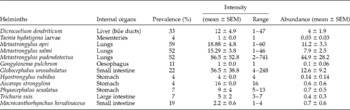
Out of 27 animals, 20 (74%) were positive for helminth infection. Twelve helminth species were identified, including one trematode, nine nematodes, one acanthocephalan and one cestode larva. The locations found, prevalence, mean intensity and mean abundance of the helminth species are shown in table 1. Most of the infected animals (85%) were found to be infected with multiple distinct helminth species, and the distribution was as follows: 15% hosted two species, 5% hosted three, 25% hosted four, 20% hosted five, 15% hosted six and 5% hosted seven species. The most commonly encountered parasites in the animals were Dicrocoelium dendriticum and Metastrongylus species. The total helminth burden varied from 1 to 741 parasites in individual hosts, with a mean of 112.3 ± 42.7. The mean intensity varied greatly between helminth species, and the parasite with the highest intensity in a single animal was Metastrongylus pudendotectus. The highest abundance was observed for M. pudendotectus, whereas the lowest was recorded for Taenia hydatigena larvae. Adult cestodes and milk spots due to the migration of Ascaris suum larvae in the liver were not detected. Trichinella spp. larvae were not detected in the muscle samples of the 49 wild boars by either of the two different methods.
Prevalence, mean intensity, range and mean abundance of helminth species in 27 wild boars hunted in the province of Bursa (South Marmara) in Turkey.

SEM, Standard error of the mean
Helminth infections relative to host age and sex
The prevalences of D. dendriticum and Metastrongylus species with respect to age and sex are shown in table 2. Only the prevalence of D. dendriticum was significantly (P < 0.05) correlated with the age of the animals (adults, 50%; juveniles, 9%). The mean intensities of D. dendriticum and M. pudendotectus were significantly higher (P < 0.05) in males than in females (table 3). Furthermore, juvenile wild boars were more heavily infected with M. pudendotectus (P < 0.05) than the adult boars. Neither the overall prevalence nor the mean intensity was correlated with the animals' age and sex (data not shown).
The prevalence of Dicrocoelium dendriticum and Metastrongylus species in wild boars relative to host sex and age.

N, Number of animals examined.
Intensity of Dicrocoelium dendriticum and Metastrongylus species in wild boars relative to host sex and age.

N, Number of animals examined; NA, not applicable.
Discussion
There are limited data on helminth infections in wild boars in Turkey (reviewed by Merdivenci, Reference Merdivenci, Unat, Yaşarol and Merdivenci1965, Reference Merdivenci1983) and, to our knowledge, there are no detailed systematic studies on the prevalence, intensity or abundance of natural helminth infections in this animal species. The helminths reported in wild boars from Turkey by Merdivenci (Reference Merdivenci, Unat, Yaşarol and Merdivenci1965, Reference Merdivenci1983) are as follows: Metastrongylus apri, T. hydatigena larvae, Gongylonema pulchrum, Trichuris suis, Fasciola hepatica, A. suum, Oesophagostomum dentatum and Haemonchus contortus. The present study revealed the presence of 12 helminth species parasitizing the visceral organs, with an overall infection rate of 74%. Among the identified helminths, Metastrongylus salmi, M. pudendotectus, D. dendriticum, Globocephalus urosubulatus, Macracanthorhynchus hirudinaceus, Physocephalus sexalatus, Ascarops strongylina and Hyostrongylus rubidus are reported for the first time in Turkey. The overall prevalence of helminth infections in wild boars in this study was similar to that recorded in Iran (Eslami & Farsad-Hamdi, Reference Eslami and Farsad-Hamdi1992), but was lower than those found in Estonia (Järvis et al., Reference Järvis, Kapel, Moks, Talvik and Mägi2007) and Spain (De-la Muela et al., Reference De-la Muela, Hernandez-de-Luján and Ferre2001). Such differences in infection rates may be due to the different climatic, geographical and environmental conditions of each study area. Furthermore, the species composition of the parasite community of wild boars in our study was generally similar to that of parasite communities of wild boars investigated in other countries (Humbert & Henry, Reference Humbert and Henry1989; Fernandez de Mera et al., Reference Fernandez de Mera, Gortazar, Vicente, Höfle and Fierro2003; Solaymani-Mohammadi et al., Reference Solaymani-Mohammadi, Mobedi, Rezaian, Massoud, Mohebali, Hooshyar, Ashrafi and Rokni2003; Järvis et al., Reference Järvis, Kapel, Moks, Talvik and Mägi2007; Sato et al., Reference Sato, Suzuki and Yokoyama2008). Adult cestodes were not encountered in any of the wild boars that we examined. This finding may suggest a minor role for cestode infections in this region.
Lungworms are often encountered as highly prevalent helminths in wild boars (De-la Muela et al., Reference De-la Muela, Hernandez-de-Luján and Ferre2001; Morita et al., Reference Morita, Haruta, Shibata-Haruta, Kanda, Imai and Ike2007). Similarly, a high prevalence rate (overall: 74%) of metastrongylids was also recorded in the present study. This result might be explained by the wide geographical distribution of different earthworm species, which form part of the diet of wild boars and act as intermediate hosts for these parasites. Moreover, the intensity and abundance of M. pudendotectus were considerably greater than those of any other helminth species. This finding is in agreement with that of Järvis et al. (Reference Järvis, Kapel, Moks, Talvik and Mägi2007), who reported that infection intensity of M. pudendotectus was higher than that of other helminths in wild boars on the island Saaremaa in western Estonia.
It is well known that host factors such as age and sex can influence the presence of helminths (Martin et al., Reference Martin, Meek and Willeberg1987). In the current study, due to the small number of infected animals, the effects of age and sex were only analysed for infections with D. dendriticum and lungworm species. Consequently, host age was shown to be significantly correlated with the prevalence and intensity of D. dendriticum. In addition, the prevalence and the mean intensity were found to be high in adults and in males, respectively. Furthermore, there was evidence of sex-biased parasitism, with male wild boars tending to be more heavily infected with M. pudendotectus than females. Differences between the two sexes were also detected with respect to the prevalence of M. hirudinaceus and A. strongylina (De-la Muela et al., Reference De-la Muela, Hernandez-de-Luján and Ferre2001; Rajković-Janje et al., Reference Rajković-Janje, Bosnić, Rimac, Dragičević and Vinković2002). Our finding that juvenile animals are more susceptible to M. pudendotectus is in agreement with the earlier observation of Humbert & Henry (Reference Humbert and Henry1989). However, no significant correlation has been found between wild boar age and the prevalence or intensity of helminth infections (De-la Muela et al., Reference De-la Muela, Hernandez-de-Luján and Ferre2001; Magi et al., Reference Magi, Bertani, Dell'Omodarme and Prati2002). Differences in the intensity of infection between juveniles and older animals may be related to changes in the diet of wild boars with age, including the number of earthworms eaten, with juvenile boars eating more earthworms than adults (Foata et al., Reference Foata, Mouillot, Culioli and Marchand2006); these differences may also be explained by acquired immunity in older animals as a result of repeated exposure to infections (Humbert & Henry, Reference Humbert and Henry1989; Humbert, Reference Humbert1992).
Trichinella is one of the most widespread zoonotic parasites infecting people and other mammals all over the world in most climates, except for deserts (Dupouy-Camet, Reference Dupouy-Camet2000). In Turkey, which is largely a Muslim country, although eating the meat of pigs and wild boars is strictly prohibited by Islamic instructions, and trichinellosis is believed to be extremely rare, sporadic outbreaks occur due to the ingestion of raw or inadequately cooked meat-products containing parasite larvae (Akkoc et al., Reference Akkoc, Kuruuzum, Akar, Yuce, Onen, Yapar, Ozgenc, Turk, Ozdemir, Avci, Guruz, Oral and Pozio2009). The presence of people with different religious faiths and religious attitudes, along with increasing tourism, has stimulated an increase in wild boar meat consumption; however, these animals are not subject to veterinary control in this country. This situation poses a risk of Trichinella transmission to humans. However, to date, limited studies have been conducted on the presence of Trichinella spp. in wild boars in Turkey. In one of these studies, meat samples of 535 pigs and 1165 wild boars were examined by trichinoscopy and the digestion method in Istanbul between 1973 and 1984. Trichinella spiralis was detected in the diaphragm muscle of two wild boars, but all domesticated pigs were negative (Nazli & Inal, Reference Nazli and Inal1987). In another study in the Aydın province, 43 wild boar muscle samples were examined, and no Trichinella spp. larvae were detected (Aypak et al., Reference Aypak, Bakırcı, Aysul and Karagenç2009). Although Trichinella spp. larvae were not found in the muscle samples that we examined, the number of animals in this study may have been too small to enable the evaluation of the importance of wild boar trichinellosis in this region.
In conclusion, the present study showed that wild boars are infected with a broad spectrum of helminths. This is one of the first studies to investigate the helminth parasites of wild boars from Turkey. Therefore, further comparative studies that determine the population dynamics, prevalence, intensity and abundance of helminths would help to assess the relationship between these parasite communities and their host populations. Finally, although Trichinella spp. larvae were not found in the current study, the risk of human infection should not be dismissed in the case of people eating wild boar meat without any veterinary control measures.