Introduction
Scales to measure symptoms of anxiety and depression (SxAnxDep) are widely used in psychiatry to monitor response to treatments. This approach assumes that SxAnxDep are largely state-like in nature, reflecting the patient's current clinical status. Indeed, many studies have shown that scales assessing SxAnxDep decline with successful treatment (e.g. Burke et al. Reference Burke, Gergel and Bose2002; Judd et al. Reference Judd, Rapaport, Yonkers, Rush, Frank, Thase, Kupfer, Plewes, Schettler and Tollefson2004; Fava et al. Reference Fava, Alpert, Nierenberg, Mischoulon, Otto, Zajecka, Murck and Rosenbaum2005) and can do so quickly (Taylor, Reference Taylor2007).
However, three sets of findings suggest that SxAnxDep do not solely reflect state effects. First, in general population samples, SxAnxDep are relatively stable over time (Duncan-Jones et al. Reference Duncan-Jones, Fergusson, Ormel and Horwood1990; Ormel & Schaufeli, Reference Ormel and Schaufeli1991; Ormel & Wohlfarth, Reference Ormel and Wohlfarth1991), suggesting ‘trait-like’ features. Second, neuroticism, a personality dimension originally conceptualized by Eysenck (Eysenck & Eysenck, Reference Eysenck and Eysenck1964) and included in all major personality typologies (e.g. John & Srivastava, Reference John, Srivastava, Pervin and John1999), strongly predicts SxAnxDep (Jardine et al. Reference Jardine, Martin and Henderson1984; Fergusson et al. Reference Fergusson, Horwood and Lawton1989; Duncan-Jones et al. Reference Duncan-Jones, Fergusson, Ormel and Horwood1990; Kendler et al. Reference Kendler, Neale, Kessler, Heath and Eaves1993, Reference Kendler, Gatz, Gardner and Pedersen2006; Clark et al. Reference Clark, Watson and Mineka1994). SxAnxDep seem to reflect, to some degree, personality. Third, consistent with a ‘trait-like’ conceptualization, twin studies find that genetic factors are responsible for a substantial proportion of individual differences in SxAnxDep, both cross-sectionally (Kendler et al. Reference Kendler, Heath, Martin and Eaves1986, Reference Kendler, Gardner and Lichtenstein2008; Silberg et al. Reference Silberg, Heath, Kessler, Neale, Meyer, Eaves and Kendler1990; McGue & Christensen, Reference McGue and Christensen1997; Boomsma et al. Reference Boomsma, van Beijsterveldt and Hudziak2005) and longitudinally (O'Connor et al. Reference O'Connor, Neiderhiser, Reiss, Hetherington and Plomin1998; Gillespie et al. Reference Gillespie, Kirk, Evans, Heath, Hickie and Martin2004).
Several prior studies have proposed etiologic models for SxAnxDep (e.g. Headey & Wearing, Reference Headey and Wearing1989; Duncan-Jones et al. Reference Duncan-Jones, Fergusson, Ormel and Horwood1990; Ormel & Schaufeli, Reference Ormel and Schaufeli1991; Ormel & Wohlfarth, Reference Ormel and Wohlfarth1991) that have supported the division of causes of SxAnxDep into a stable trait-like component strongly related to personality and an occasion-specific component. Despite providing important insights, these models have several limitations. First, they typically lacked measures of key causal influences on SxAnxDep, including genetic and distal and proximal environmental risk factors. Second, these studies typically used questionnaire data and did not include information on whether subjects were, when assessed, in episodes of major depression (MD) or generalized anxiety disorder (GAD). Third, many of these models (e.g. Duncan-Jones et al. Reference Duncan-Jones, Fergusson, Ormel and Horwood1990), although statistically elegant, unrealistically assumed that the factors influencing the stable and occasion-specific components of SxAnxDep were uncorrelated.
Understanding the etiology of SxAnxDep is important because of their widespread use in clinical and epidemiological research. Therefore, we have developed a more comprehensive etiologic model for SxAnxDep that addresses many of these prior limitations. Using three waves of interviews in female–female twin pairs from the Virginia Adult Twin Study of Psychiatric and Substance Use Disorders (VATSPSUD), we examined causal pathways to SxAnxDep from eight sources: two sets of genetic risk factors reflecting vulnerability to chronic dysphoria and episodic internalizing disorders, retrospective assessments of childhood family dysfunction, sexual abuse, and personality, two groups of past-year stressful life events experienced, and the presence/absence of a concurrent episode of MD or GAD. Furthermore, our statistical model permits the temporally stable and occasion-specific pathways to be influenced by common risk factors.
Method
Sample
Participants were Caucasian female–female same-sex twins from VATSPSUD (Kendler & Prescott, Reference Kendler and Prescott2006), ascertained from the birth certificate-based Virginia Twin Registry. Twin pairs, born 1934–1974, were eligible if both members responded to a mailed questionnaire. This report uses data from that mailed questionnaire and three of the four waves of personal interviews (FF1, FF3 and FF4), which included 85–92% of eligible twins (Kendler & Prescott, Reference Kendler and Prescott2006). SxAnxDep were not assessed in the second wave. Mean inter-wave intervals were 61.2 (s.d.=5.1) months between FF1 and FF3 and 31.1 (s.d.=6.7) months between FF3 and FF4 (Kendler & Prescott, Reference Kendler and Prescott2006). For simplicity, we refer to these three interviews as waves 1, 2 and 3. Zygosity was determined by discriminant function analyses using ‘twin questions’ validated against DNA genotyping (Kendler & Prescott, Reference Kendler and Prescott1999). The mean age of the twins was 36.3 (s.d.=8.2) years and the mean duration of education was 14.3 (s.d.=2.2) years at the FF4 interview. Interviews were conducted by clinically trained individuals. No interviewer assessed both members of a twin pair. This project was approved by the human subject committees at Virginia Commonwealth University. Written informed consent was obtained prior to face-to-face interviews and verbal consent prior to telephone interviews. These analyses included a total of 2395 individual twins, including both members of 1155 pairs, 82 twins without their co-twin and one set of triplets.
Outcome variable
SxAnxDep was a common factor indexed by the items from four subscales of the Symptom Checklist (SCL; Derogatis et al. Reference Derogatis, Lipman and Covi1973), a frequently used, non-diagnostic, self-report questionnaire. Twins were asked to report, on a five-point scale, for a range of symptoms: ‘How much discomfort that problem has caused you during the last 30 days including today?’ These scales, their number of items, and their correlations between waves 1 and 2, and 2 and 3, were: (i) Depression (10 items) (+0.47, +0.51), (ii) Somatization (five items) (+0.42, +0.46), (iii) Anxiety (seven items) (+0.42, +0.46), and (iv) Phobic-Anxiety (five items) (+0.37, +0.46). The parallel inter-wave correlations for the latent construct of SxAnxDep were +0.59 and +0.60 respectively.
Model variables
Our model contained nine predictor variables. All quantitative variables were normalized prior to analysis (Blom, Reference Blom1958).
Genetic risk for chronic dysphoria
This was assessed by a composite measure of SxAnxDep and neuroticism in the co-twin, with monozygotic (MZ) co-twins weighted twice as strongly as dizygotic (DZ) co-twins. These scores were collected at the questionnaire and FF1, FF3 and FF4 interviews.
Genetic risk for episodes of internalizing disorder
This was assessed by a composite measure of a lifetime history of co-twins for MD and GAD from the FF1, FF3 and FF4 interviews. MZ co-twins were weighted twice as strongly as DZ co-twins.
Childhood family dysfunction
This was a retrospectively assessed latent variable indexed by two measures. The first was low parental warmth assessed at FF2 using the Parental Bonding Instrument (Parker et al. Reference Parker, Tupling and Brown1979). We took the mean of up to eight reports from a twin pair, with each twin reporting on the relationship between themselves and their co-twin and their mother and father. The second measure was disturbed family environment assessed by 14 items chosen from the Family Environment Scale (Moos & Moos, Reference Moos and Moos1986), reflecting the emotional tone of the home when the twins ‘were growing up’. We took the mean of the standardized scores of the twin and co-twin assessed at FF2, and the separately standardized score of mother and father assessed in 1990–1991. These four reports were then averaged and restandardized to create a single Family Environmental Scale score.
Childhood sexual abuse (CSA)
CSA was assessed retrospectively based on twin self-report at FF4. Because the increased risks for MD and GAD were associated largely with the more severe forms of abuse (Kendler et al. Reference Kendler, Bulik, Silberg, Hettema, Myers and Prescott2000), twins were assigned a score of 1 if they reported, before the age of 16 years, an unwanted sexual contact with an older individual that included attempting or completed sexual intercourse.
Neuroticism
Neuroticism was assessed by the Short-Scale (12-item) version of the Eysenck Personality Questionnaire – Revised (EPQ-R; Eysenck et al. Reference Eysenck, Eysenck and Barrett1985) obtained at each of the three waves. We used the latent level of neuroticism operationalized as the common factor from multiple assessments, thereby correcting for any possible contamination of neuroticism scores by the levels of current SxAnxDep (Coppen & Metcalfe, Reference Coppen and Metcalfe1965; Hirschfeld et al. Reference Hirschfeld, Klerman, Clayton, Keller, McDonald-Scott and Larkin1983; Horwood & Fergusson, Reference Horwood and Fergusson1986; Duncan-Jones et al. Reference Duncan-Jones, Fergusson, Ormel and Horwood1990; Ormel & Schaufeli, Reference Ormel and Schaufeli1991).
Stressful life events
At every wave, twins were asked about the occurrence, at any time in the current and preceding 12 months, of 11 ‘personal’ events (assault, divorce/separation, major financial problem, serious housing problems, serious illness or injury, job loss, legal problems, loss of confidant, serious marital problems, robbery, and serious difficulties at work) and four classes of ‘network’ events (serious trouble getting along with an individual in the network or a serious personal crisis, death or serious illness of someone in the network). Each event was dated to the nearest month with high reliability (Kendler et al. Reference Kendler, Karkowski and Prescott1998). Events that occurred in the month of interview and in the two preceding months were called ‘proximal life events’ because such events can impact directly on risk for depressive episodes (Kendler et al. Reference Kendler, Karkowski and Prescott1998). Stressful events occurring earlier in the year before interview were termed ‘distal life events’, reflecting backgrounds level of stress/difficulties.
Episodes of MD or GAD
We assessed at both waves, using a modified SCID (Spitzer & Williams, Reference Spitzer and Williams1985), the presence of MD and GAD in the past year using DSM-III-R criteria (APA, 1987), dating the onset and offset of episodes. Consistent with several prior studies (Breslau & Davis, Reference Breslau and Davis1985; Kendler et al. Reference Kendler, Neale, Kessler, Heath and Eaves1992; Lee et al. Reference Lee, Tsang, Ruscio, Haro, Stein, Alonso, Angermeyer, Bromet, Demyttenaere, de Girolamo, de Graaf, Gureje, Iwata, Karam, Lepine, Levinson, Medina-Mora, Browne, Posada-Villa and Kessler2009), we used the 1-month minimum duration requirement for GAD from DSM-III (APA, 1980). Our model fitting contained a dichotomous variable reflecting whether the subject, at the time of the assessment of SxAnxDep, was in an episode of DSM-III-R MD and/or GAD.
Stable component of SxAnxDep
This variable, operationalized as the common factor obtained from the individual SxAnxDep scores from waves 1, 2 and 3, reflects an individual's basal level of SxAnxDep, which might deviate upward or downward as a result of environmental exposures or the onset or offset of episodes of MD and/or GAD.
Statistical methods
Structural equation models were fit using robust weighted least squares (WLS) estimates and standard errors in Mplus version 5.1 (Muthen & Muthen, Reference Muthen and Muthen2007). We began by ordering out the variables in logical temporal relationships. To reflect cross-waves stability beyond that predicted by the model, the residuals of variables were allowed to correlate across time. Model fit was monitored using the Tucker–Lewis Index (TLI; Tucker & Lewis, Reference Tucker and Lewis1973), the Comparative Fit Index (CFI; Bentler, Reference Bentler1990) and the root mean square error of approximation (RMSEA; Steiger, Reference Steiger1990). For the TLI and CFI, values between 0.90 and 0.95 are considered acceptable, and ⩾0.95 as good. For the RMSEA, good models have values ⩽0.05.
The approach to exploratory fitting was to initially constrain to equality paths that occurred at all three waves. Additionally, because bivariate relationships between variables were known, the scoring was set up to provide positive regression coefficients, so that higher scores represent increased risk for SxAnxDep. A few small negative paths emerged that reflected corrections to non-additivity. We first removed these paths without degrading the model fit. Next, we eliminated, one at a time, non-significant positive path coefficients (at p⩾0.05), starting with those with the smallest z statistic. After this trimming was complete, we examined the potential across wave paths. The only significant new relationships that appeared were paths from SxAnxDep at an earlier time to an episode of MD or GAD at the next wave. These paths replaced the residual correlations for episodes of MD/GAD across waves without an adverse affect on model fit and were retained as being more meaningful. As there was no cross-wave path to the first time-point, we relaxed the requirement that paths leading to an episode of MD or GAD at the first time be equal to those at later times. The only change that resulted from this was that the path from genetic risk for chronic dysphoria had a significant path to current episodes of MD or GAD at time 1, but no significant path existed to times 2 and 3.
Results
Model fitting results
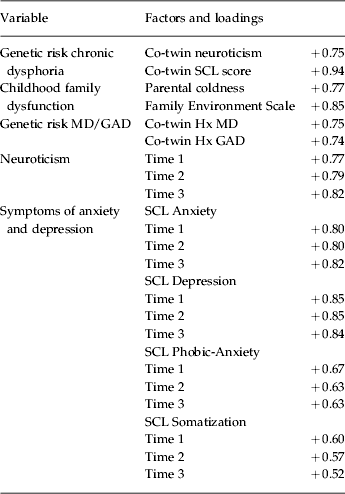
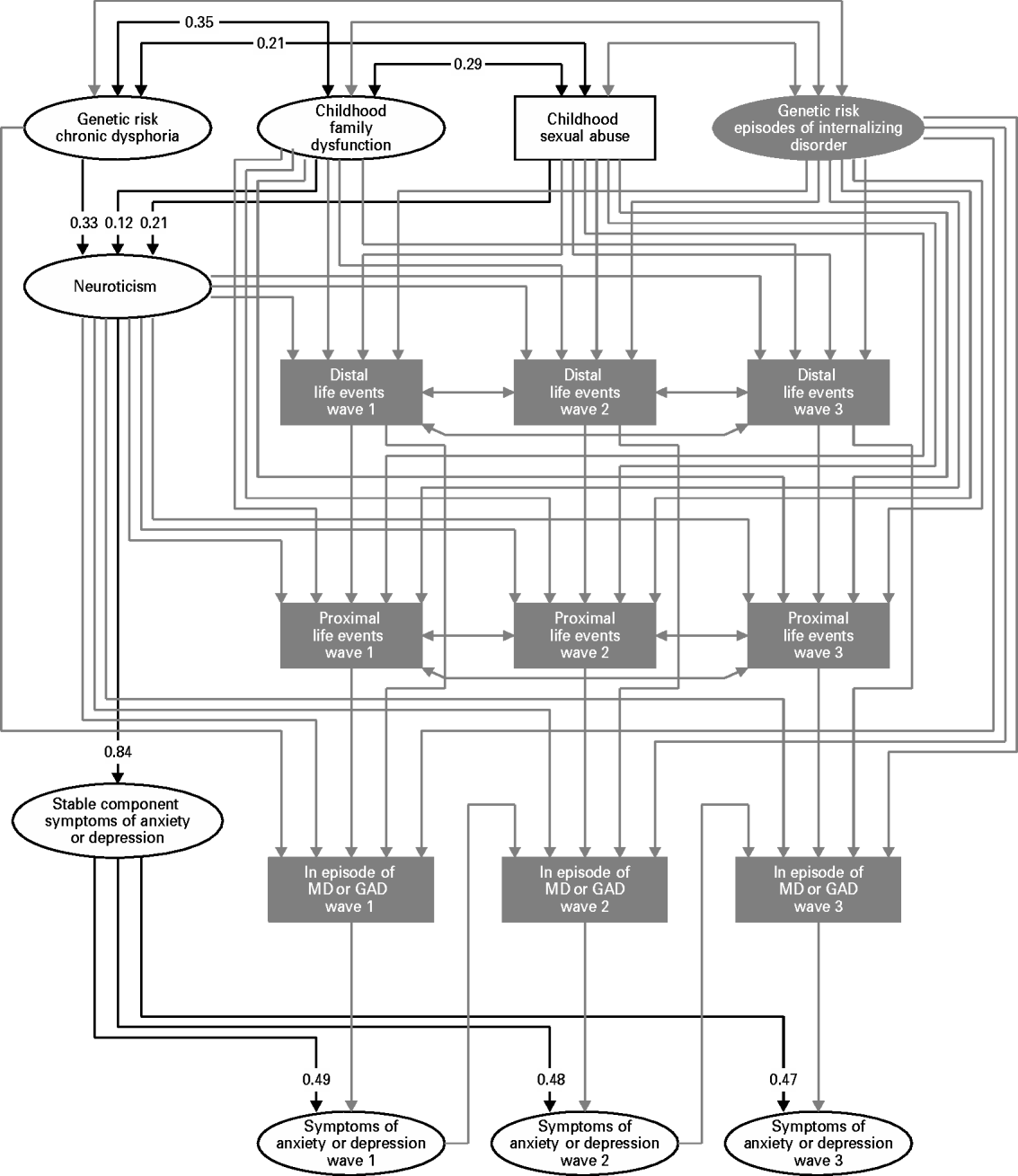
Our final model (for parameters, see Fig. 1) contained 125 free parameters including 21 independent path coefficients, six correlations between exogenous variables, three factor loadings and six residual correlations between model variables across time. (The model also contained 14 factor loadings, 12 residual correlations among factor components across time, 27 means/intercepts, four thresholds and 32 residual variances, not shown.) The model provided an excellent fit to the data: CFI=0.98, TFI=0.97, RMSEA=0.03. The proportion of variance accounted for in SxAnxDep (r 2) was 0.68, 0.74 and 0.72 for waves 1, 2 and 3 respectively. For one of the latent variables (Stable component; SxAnxDep), loadings on the observed variables are depicted in Fig. 1. To make Fig. 1 more comprehensible, the estimated loadings for the remaining latent variables (i.e. that comprised the latent factors for childhood adversities, genetic risk for chronic dysphoria, genetic risk for episodic MD or GAD, neuroticism, and symptoms of anxiety and depression at waves 1, 2 and 3) are given in Table 1.
Parameter estimates for our best-fit model for symptoms of anxiety and depression (SxAnxDep) measured over three waves in female twins from the Virginia Adult Twin Study of Psychiatric and Substance Use Disorders (VATSPSUD). Rectangles reflect observed variables and ovals represent latent variables. Loadings on the latent variables (except for ‘Stable Component – Symptoms of Anxiety and Depression’) are given in Table 1. Single-headed arrow path coefficients represent standardized partial regression coefficients. Two-headed arrows represent correlation coefficients.

Factor loadings on the latent variables in the best-fit model

SCL, Symptom Checklist; MD, major depression; GAD, generalized anxiety disorder; Hx, history.
Eight of the many findings depicted in Fig. 1 are noteworthy. First, this model depicts two pathways correlated to SxAnxDep, one of which is shared across all three waves of assessment and is expressed through the variable ‘Stable component – Symptoms of Anxiety and Depression’ depicted in Fig. 1 (and highlighted in Fig. 2); and the other of which is occasion specific and is expressed through the variable ‘In episode of MD or GAD’.
Parameter estimates for our best-fit model for symptoms of anxiety and depression (SxAnxDep) measured over three waves in female twins from the Virginia Adult Twin Study of Psychiatric and Substance Use Disorders (VATSPSUD) with the temporally stable pathway estimates highlighted.

Working from the top of the model down, the second noteworthy result is that the model contains two different and moderately correlated sets of genetic risk factors. Genetic risk for chronic dysphoria has two downstream paths, strongly influencing levels of neuroticism and specifically impacting on risk for a wave 1 episode of MD/GAD. Genetic risk for episodes of internalizing disorder has a much more pervasive influence, impacting on the probability of exposure to distal and proximal life events, and on risk for being in an episode of MD or GAD at all waves.
Third, the two distal environmental risk factors, childhood family dysfunction and CSA, were only modestly correlated but performed similarly. Both contributed to neuroticism and impacted on the probability of experiencing both distal and proximal life events at all three waves.
Fourth, our latent variable for neuroticism was the central variable within the model and had three major influences: (i) a direct and fairly strong effect on the stable component of SxAnxDep; (ii) direct effects on distal and proximal life events; and (iii) a direct and moderately strong effect at all three waves on the risk for being in an episode of MD or GAD.
Fifth, at all three waves, distal life events impacted on the risk for proximal events and directly influenced the risk for being in an episode at interview. Furthermore, despite the presence in the model of the genetic, early childhood and personality influences on distal life events, a substantial residual cross-time correlation was observed between the distal life events reported at the three waves.
Sixth, proximal life events have only one down-stream path to risk for being in an MD or a GAD episode at the time of assessment. Small residual correlations were also observed between our measures of proximal life events.
Seventh, second to neuroticism, the other key variable within the model is being in an episode of MD or GAD at interview. In addition to the stable liability to SxAnxDep, the only other direct influence on levels of SxAnxDep in the model is being in an episode. Although the risk factors for being in an episode are varied and include genetic, personality and environmental factors, these variables have no direct effect on SxAnxDep. For example, the only way in which stressful events in the past year impact SxAnxDep is by causing a depressive or GAD episode.
At all three waves, being in an episode was the strongest single influence on SxAnxDep, even though the proportion of subjects in episode ranged from only 4.1% to 5.0% across the three waves. However, the magnitudes of the two direct paths to SxAnxDep are similar across all three waves. The occasion-specific pathways mediated through being in episode are only slightly greater, at each wave, than the stable influences on SxAnxDep mediated through neuroticism.
Eighth, and finally, despite all the diverse variables in our model, we were able to detect a direct causal effect between SxAnxDep at times 1 and 2, and the risk for being in an episode of MD/GAD at times 2 and 3 respectively.
Decomposition of pathways
Structural models can provide further insight into causal pathways through the decomposition of associations. Using wave 1 data, our four distal risk factors (two genetic and two childhood adversities) have a total path to SxAnxDep of +0.59, of which 46% is mediated through the temporally stable pathway and 54% through the occasion-specific pathway. The total association between neuroticism and wave 1 SxAnxDep equals +0.56, of which 73% is mediated through the temporally stable pathway and 27% through the occasion-specific pathway.
Inter-relationship of the temporally stable and occasion-specific pathways in the prediction of SxAnxDep
To clarify the relationship between the causal effects of the temporally stable and occasion-specific pathways, we first examined (for wave 1 data) the distribution of the standardized mean of the scales making up our SxAnxDep measure in subjects with, and without, a current MD/GAD episode. The distributions overlap substantially, differing by approximately one standard deviation (Fig. 3). Would these two pathways add together or interact in their impact on SxAnxDep? We predicted by linear regression the mean SCL score from proxies for the temporally stable and occasion-specific pathways (mean neuroticism score and absence/presence of an MD/GAD episode respectively) and their interaction. For wave 1, episodes and neuroticism scores both had very strong main effects (t=8.72, df=2092, p<0.0001 and t=27.1, df=2092, p<0.0001 respectively). However, the interaction was not significant (t=0.34, df=2092, p=0.34). Similar results were obtained for the subsequent two waves.
Distribution of the average standardized score across the four Symptom Checklist (SCL) scales making up our symptoms of anxiety and depression (SxAnxDep) measure in subjects reporting (lower section) and not reporting (upper section) being in a current episode of major depression (MD) or generalized anxiety disorder (GAD).

Discussion
We sought to clarify, in a community sample of women, the etiological pathways to current SxAnxDep. In accordance with prior reports (Headey & Wearing, Reference Headey and Wearing1989; Duncan-Jones et al. Reference Duncan-Jones, Fergusson, Ormel and Horwood1990; Ormel & Schaufeli, Reference Ormel and Schaufeli1991; Ormel & Wohlfarth, Reference Ormel and Wohlfarth1991), we found evidence for two causal pathways. The first temporally stable pathway begins with genetic and childhood environmental risk factors, and flows through the personality trait of neuroticism, to stable levels of SxAnxDep, which in turn impact strongly on current symptom levels. The second occasion-specific pathway also begins with genetic risk factors and childhood adversities, and flows through distal and proximal life events in the past year, to risk for being in an episode of MD or GAD. Being in an MD or a GAD episode in turn strongly influences current SxAnxDep.
Importantly, these two pathways are etiologically interwoven, sharing common risk factors. Genetic risk for chronic dysphoria, childhood family dysfunction and CSA impacts on both pathways. The paths from these genetic and childhood environmental risk factors for SxAnxDep run approximately equally via the temporally stable and occasion-specific pathways. High levels of the personality trait of neuroticism directly influence the temporally stable component of SxAnxDep and, consistent with a range of research in this and other samples (Bolger & Schilling, Reference Bolger and Schilling1991; Magnus et al. Reference Magnus, Diener, Fujita and Pavot1993; van Os et al. Reference van Os, Park and Jones2001; Kendler & Baker, Reference Kendler and Baker2007), impact on the occasion-specific aspects of SxAnxDep by increasing exposure to stressful life events and chances of developing episodes of MD or GAD. For neuroticism, about three-quarters of its effect on SxAnxDep is mediated through the temporally stable pathway.
The temporally stable and occasion-specific pathways are additive in their influences on SxAnxDep. Neuroticism is a strong predictor of SxAnxDep for individuals both in and not in MD/GAD episodes.
Our results demonstrate that occasion-specific influences on SxAnxDep reflect a mixture of random factors, such as fateful life events and systematic genetic, early environmental and temperamental factors, which influences selection into high-risk environments. Finally, despite including a wide array of risk factors, we consistently saw ‘forward transmission’ of SxAnxDep from one time period to another.
Viewing the results in the context of prior studies
Our findings should be viewed in the context of the prior relevant literature that has examined constructs similar to SxAnxDep, including ‘minor psychiatric symptoms’ and ‘psychological distress’. First, Ormel & Schaufeli (Reference Ormel and Schaufeli1991) review 13 two-wave studies of psychological distress with an average inter-wave interval of 1 year. They note that the cross-time correlations range from +0.30 to +0.70 with an average of around +0.50. Our results for the SCL subscales of +0.37 to +0.51, over a longer time interval, are well within that range.
Second, congruent with our results, several studies found that the stable component of SxAnxDep correlates strongly with measures of personality. Duncan-Jones et al. (Reference Duncan-Jones, Fergusson, Ormel and Horwood1990) reported correlations between neuroticism and the stable component of their symptom measure in three samples ranging from +0.79 to +0.94. Ormel & Schaufeli (Reference Ormel and Schaufeli1991) report similar results in two other samples.
Third, studies have examined the proportion of variance in SxAnxDep-like constructs that reflect temporally stable versus occasion-specific effects. Using statistical models that (because they assume uncorrelated influences) permit a clean separation of these influences, Duncan-Jones et al. (Reference Duncan-Jones, Fergusson, Ormel and Horwood1990) found that the proportion reflecting stable individual differences varied widely across three samples, from 40% to 76%. Using a similar statistical approach, Ormel & Schaufeli (Reference Ormel and Schaufeli1991, p. 288) report that, in their two samples, ‘two-thirds of the variance in distress could be attributed to differences in stable symptom levels’. Looking at the two direct paths to SxAnxDep (from stable symptoms and episodes of MD/GAD) in our model, the proportion of variance due to the temporally stable influences varies from 45% to 48% across waves. However, in our more realistic model, stable and occasion-specific paths are correlated with stable influences impacting on the key occasion-specific risk factors, preventing a neat division into stable versus occasion-specific influences on SxAnxDep. However, the proportion of stable influences on SxAnxDep must be greater than the 45–48% calculated from our model because of the substantial impact of stable risk factors on the occasion-specific pathway.
Fourth, our study most closely resembles a two-wave analysis of psychological distress by Ormel & Wohlfarth (Reference Ormel and Wohlfarth1991) in a small general population sample. Their model included prior neuroticism levels, long-term difficulties and life-situation change (as a measure of adversities arising between the two waves). Similar to our results, they found that, at both waves, neuroticism and distress were connected through a strong direct pathway and through moderate and relatively weak indirect paths mediated respectively by long-term difficulties and life-situation change. They conclude that, although direct environmental effects on psychological distress certainly occur, a ‘substantial proportion’ of the correlation between difficulties, change and distress ‘can be attributed to the confounding effects of earlier neuroticism’ (Ormel & Wohlfarth, Reference Ormel and Wohlfarth1991, p. 753).
Fifth, the forward transmission of risk for MD or GAD influences from prior levels of SxAnxDep could reflect a scarring effect, whereby high levels of SxAnxDep, above and beyond the impact of the risk factors included in the model, directly increase the risk for future episodes of illness. This process might reflect the mechanism underlying kindling (Post, Reference Post1992), whereby the brain/mind ‘learns’ to be depressed. Prior longitudinal studies have shown evidence for potential changes in the affective or ‘well-being’ set-point of individuals (Lucas et al. Reference Lucas, Clark, Georgellis and Diener2004; Headey, Reference Headey2010). Our results reflect one possible pathway for this phenomenon, a positive feedback loop, whereby basal high levels of SxAnxDep impact on the risk for depressive episodes, which contribute to further elevations in SxAnxDep.
Sixth, we are unaware of any prior study that has examined the impact of episodes of MD or GAD on SxAnxDep in the context of a longitudinal model. We were surprised that, in our best-fit model, all the effects of stressful live events on SxAnxDep were mediated by episode occurrence. In our initial model, positive direct paths were seen between proximal stressful live events and SxAnxDep, but their value (about +0.02) was too low to be retained in the final model. These results are consistent with a threshold effect. That is, within the power of our sample, stressors insufficient to produce an episode of illness had a fairly small additional impact on SxAnxDep. Across the three waves, 32–40% of the sample reported exposures to one or more stressful proximal life events whereas only 4.1–5.0% reported episodes of MD and/or GAD.
Finally, our study was able to divide genetic risk into two factors reflecting vulnerability to chronic dysphoria versus vulnerability to episodes of the internalizing disorders. Consistent with prior studies (Kendler et al. Reference Kendler, Neale, Kessler, Heath and Eaves1993, Reference Kendler, Gatz, Gardner and Pedersen2006; Hettema et al. Reference Hettema, Prescott and Kendler2004), these risk factors were substantially correlated. However, their patterns of association were surprisingly different. Genetic risk factors for the episodic disorders had a direct and substantially stronger impact on stressful life event exposure than the indirect pathway (mediated through neuroticism) from genetic risk for chronic dysphoria.
Limitations
These results should be interpreted in the context of the methodological strengths and limitations of our sample. The strengths include a large, representative, genetically informative sample followed prospectively and evaluated through both personal interview and questionnaires. Many key measures were assessed concurrently (SxAnxDep, neuroticism, current episodes of MD/GAD) or with short-term recall (past-year life events).
Six potential limitations are also noteworthy. First, this sample consisted of adult, white, female twins born in Virginia. Although we know that these twins are broadly representative of the general white US population (Kendler & Prescott, Reference Kendler and Prescott2006), our results might differ in males or females from other ethnic groups.
Second, some of the variables (e.g. CSA) were assessed by long-term retrospective recall and may be subject to recall bias.
Third, the interval between waves 1 and 2 was nearly twice as long as between waves 2 and 3. Surprisingly, we saw little evidence of this time difference in our modeling as no strong trend emerged for correlations or regression paths to be much lower between waves 1 and 2, versus 2 and 3.
Fourth, our model assumes a causal relationship between predictor and dependent variables. The a priori validity of this assumption varies across our model. For many pairs of variables, we have good justification for this assumption (that the inter-variable relationships really is of the form A↔B). However, for some variables (e.g. proximal life events and episodes of MD/GAD), the true form of the inter-variable relationship could be A↔B (e.g. events increase the risk for episodes but being in an episode can increase the risk of events). In considering the nature of the relationship between SxAnxDep and MD/GAD episodes, SxAnxDep reflects 27 items scored on a 0–4 scale whereas MD/GAD episodes are coded as a single binary variable. Furthermore, SxAnxDep assesses symptoms only in the past 30 days whereas the MD/GAD variable refers to a disorder being present in the month of interview, but may have begun months or, in a few cases, years prior to the interview. Thus, the MD/GAD episodes function in the model as an explanation for a temporal shift in SxAnxDep from its steady state. As shown in Fig. 3, the MD/GAD variable soaks up little of the ‘steady state’ variance of SxAnxDep.
Fifth, our model assumes that multiple independent variables act additively and linearly in their impact on SxAnxDep. We tested this assumption for the crucial relationship between the temporally stable and occasion-specific pathways and found it to be justified. We recognize that the assumption of additivity is unlikely to be true for all of the effects of our predictor variables. Models in science must always seek a balance between parsimony and explanatory power and completeness. It would have been impractical for us to have systematically evaluated and then depicted all possible interactions between the 15 predictor variables present in our model.
Finally, consistent with the previous literature that has addressed this question (Jardine et al. Reference Jardine, Martin and Henderson1984; Fergusson et al. Reference Fergusson, Horwood and Lawton1989; Headey & Wearing, Reference Headey and Wearing1989; Duncan-Jones et al. Reference Duncan-Jones, Fergusson, Ormel and Horwood1990; Ormel & Schaufeli, Reference Ormel and Schaufeli1991; Ormel & Wohlfarth, Reference Ormel and Wohlfarth1991; Kendler et al. Reference Kendler, Neale, Kessler, Heath and Eaves1993, Reference Kendler, Gatz, Gardner and Pedersen2006; Clark et al. Reference Clark, Watson and Mineka1994), we have assumed that personality can causally influence SxAnxDep. That is, personality is viewed in these analyses as a more fundamental, stable construct that can impact causally on the experience of symptoms. However, it can be argued that some personality traits, especially neuroticism, have an identity and not a causal relationship with SxAnxDep. From this perspective, the strong pathway we observed from neuroticism to the stable component of SxAnxDep reflects two closely related versions of the same construct rather than, as we have interpreted it, a causal path between two related, but conceptually distinct, measures.
Implications
SxAnxDep are used widely in clinical and epidemiological psychiatric research to evaluate treatment response and general level of symptomatology respectively. However, SxAnxDep are etiologically complex and arise through a dynamic, developmental process. Our findings broadly validated an approach advocated over 20 years ago (Headey & Wearing, Reference Headey and Wearing1989) for the crucial role of two etiologic pathways: stable and occasion specific. However, although it may be statistically elegant to cleanly separate these two pathways, our results show that such a separation cannot be empirically defended. Instead, the two paths are actively intertwined, sharing several genetic and early environmental risk factors. Furthermore, while playing a predominant role in the temporally stable pathway, the personality trait of neuroticism also influences key elements in the occasion-specific path. Both pathways potently influence current levels of SxAnxDep and the impact of the stable pathway remains robust both in those free of, and in those suffering from, a current episode of MD or GAD.
Further attempts to study SxAnxDep should take into account its complex etiology. For example, for studies identifying molecular genetic variants impacting on SxAnxDep, it would be important to maximize its trait-like features, either by sampling multiple times and taking a common factor or by covarying for the effects of stressful events and/or MD/GAD episodes. For studies examining the response of SxAnxDep to short-acting environmental risk factors, it would be important to emphasize its state-like features, for example, by sampling multiple times and covarying for prior SxAnxDep levels.
Acknowledgments
This study was supported in part by grants MH-068643 and MH-49492 from the National Institute of Health (NIH). L. Corey provided assistance with the ascertainment of twins from the Virginia Twin Registry, now part of the Mid-Atlantic Twin Registry (MATR). The MATR, now directed by J. Silberg, has received support from the NIH, the Carman Trust, and the W.M. Keck, John Templeton, and Robert Wood Johnson Foundations. C. Prescott contributed to the design and implementation of this study.
Declaration of Interest
None.