As of December, 2019, the pandemic of COVID-19 has consisted a leading cause of significant morbidity and mortality. It has imparted substantial economic, social, and medical burdens on the global community. Reference Younis, Zareef, Mohammad Ali and Mahfouz1,2 Unfortunately, based on the latest evidence deriving from epidemiological data and pre-clinical and clinical studies, the resolution of the pandemic cannot be warranted in the near future. Reference Scudellari3 Hence, physicians and healthcare professionals should remain abreast of the latest state of the pandemic and adjust their medical guidelines and policies as per the most recent updates. Meanwhile, novel strategies are needed for delivering medical care while protecting patients and medical personnel from COVID-19 infection. Reference Iacobazzi, Baquedano, Madeddu and Caputo4-Reference Ing, Barrett, Chatterjee, Twite and Whitney7
Interestingly, the management of all patients in clinics and hospitals has been noticeably affected by the abrupt emergence and immense propagation of the current pandemic of COVID-19. Initially, during the first half of 2020, elective and non-emergency medical evaluations and interventions were suspended in almost all countries. At that time, surgical interventions were particularly affected due to the ambiguity of COVID-19 transmission and the need for general anesthesia and intubation in variant surgeries. These limitations have implied substantial delays in scheduling and performing surgeries. The Children’s Heart Center at the American University of Beirut Medical Center is a tertiary cardiac referral centre that provides care not only for Lebanese children but also for non-Lebanese patients referred from all over the Middle East and North Africa region. The centre is one of the chief specialised centres in Middle East and North Africa that is dedicated to performing congenital heart surgeries on daily basis. Up to 250 surgeries were performed annually at our centre prior to COVID-19 emergence. Shortly after the early cases of COVID-19 were declared in the country, and the total number of CHD surgeries dropped significantly between March and June, 2020. Similar delay has been likely witnessed in up to 190 countries including American, Asian, European, and Middle Eastern ones. 8
The impact of COVID-19 on the pre-operative assessment of surgical candidates has been tackled by a few studies. Various policies have been applied in distinct medical centres. These policies are largely determined and swayed by the demographic, epidemiologic, and financial states of the corresponding countries. Herein, we aspire to assess the prevalence of SARS-CoV-2 infection among children with cardiac disease admitted for surgical interventions at our tertiary care centre. We also aim to discuss the efficacy of the COVID-19-related policy implemented at our centre.
Methods and material
Study design and population
Our retrospective single-centre observational study involves a review of the charts of cardiac patients admitted to the Children’s Heart Center–American University of Beirut Medical Center for open-heart surgery between March and November, 2020, after the first cases of COVID-19 were declared in the country. The study population is limited to children aged 18 years and below. No older patients are included. Patients admitted for non-surgical interventions are excluded. Similarly, patients admitted for surgery before or after the aforementioned period are excluded as well.
Data collection and analysis
Following securing Institutional Review Board Approval, we reviewed the charts of eligible patients and inspected the following parameters: age, gender, surgery type, past medical history, past surgical history, presence of COVID-19-suggestive symptoms before admission, results of SARS-CoV-2 reverse transcription-polymerase chain reaction test, and cancellation/postponement of surgery. Similarly, we examined the results of the radiological images (i.e., chest X-ray, chest CT scan, and echocardiography) and the laboratory tests of the studied patients.
We identified the total number of cardiac patients admitted to our centre for open-heart surgery during this period. The total numbers of both completed surgeries and postponed surgeries due to SARS-CoV-2 infection were determined as well. Our study focuses on the positive SARS-CoV-2 cases and aspires to provide a thorough discussion of their clinical presentation and COVID-19 status (asymptomatic/symptomatic and mild/moderate/severe disease).
Study aim
In this descriptive study, we aim to assess the prevalence of COVID-19 among children with cardiac disease requiring surgical interventions at our tertiary care centre. Moreover, we aim to evaluate the efficacy of the newly adopted COVID-19-related policies in maintaining the quality of the delivered medical care and reducing the risk of SARS-CoV-2 transmission to patients and healthcare workers.
Results
A total of 68 open-heart procedures were planned at our centre between 1 March, 2020 and 1 November, 2020. Only three (4.4%) procedures were postponed due to COVID-19. The remaining operations (65/68) were performed at the scheduled time after performing proper screening for COVID-19 symptoms over the phone or through telehealth and SARS-CoV-2 reverse transcription-polymerase chain reaction testing for asymptomatic patients. Surgeries were delayed in all patients with COVID-19-suggestive symptoms such as cough, fever, rhinorrhea, dyspnea, headache, myalgia, anosmia, or ageusia. In infants and neonates, we delayed surgery in lethargic or febrile patients having reduced activity or PO (by mouth, orally) intake.
Moreover, SARS-CoV-2 polymerase chain reaction testing was performed to asymptomatic patients who passed symptoms screening. Surgeries were postponed in all SARS-CoV-2-positive patients. Asymptomatic patients who tested negative for SARS-CoV-2 were re-evaluated in clinic prior to the procedure, and clearance for surgery was warranted after thorough history taking and physical examination. Most of the performed surgeries were deemed essential and urgent operations that could not be delayed until the COVID-19 situation is more stable. Interestingly, COVID-19 was not diagnosed post-operatively in cases with negative symptoms and SARS-CoV-2 polymerase chain reaction testing.
Herein, we discuss the three SARS-CoV-2-positive cases witnessed over the aforementioned period. We describe their clinical presentation as well as their laboratory, molecular, and radiological findings. We also discuss the impact of the adopted strategy on the propagation of the infection among our healthcare workers, and the delivery of necessary surgical care to our at-risk patients.
Case 1
The first patient is a male infant brought for ventricular septal defect repair. He presented to our tertiary care centre before the COVID-19 peri-operative evaluation protocol was implemented. Upon clinical and physical evaluation, history taken from the mother was negative for any signs or symptoms of infection. The patient was assessed initially by our nurses and was then examined by the pediatric cardiology fellow. Physical examination was significant for a harsh holosystolic murmur heard at the lower sternal border. Chest X-ray was only remarkable for mild enlargement in the cardiac silhouette and an increase in the pulmonary vascular markings that go with his known cardiac disease. COVID-19 polymerase chain reaction taken as part of the pre-operative workup was positive.
Subsequently, we consulted our infectious disease specialists who cleared the patient for discharge on strict isolation. The surgery was postponed, and the patient was monitored remotely for signs and symptoms of clinical or physical deterioration. Similarly, the team, consisting of the cardiology fellow and the two nurses who were in direct contact with the patient, was quarantined for 14 days and SARS-CoV-2 polymerase chain reaction tests were performed. To note, throughout the patient’s initial assessment and physical examination, our personnel were wearing the proper personal protective equipment consisting of face mask, isolation gown, and non-sterile gloves.
The patient continued to have positive SARS-CoV-2 polymerase chain reactions for 1 month. The surgery was scheduled following one negative polymerase chain reaction; however, it was not performed due to abnormal liver function tests during pre-operative evaluation. Following this first case of asymptomatic COVID-19 who was detected incidentally on laboratory evaluation, we adjusted our adopted preliminary COVID-19-related policies, and we implemented the aforementioned peri-operative assessment protocol to reduce the risk of SARS-CoV-2 transmission to healthcare workers and admitted patients who receive direct care from these workers.
Case 2
The second patient is a 3-year-old girl planned for Fontan surgery.
Before she presented to the hospital for Fontan surgery, her parents were contacted by phone and asked whether she had any COVID-19-suggestive symptoms. As per the mother, the patient had negative pre-operative assessment questionnaire. Blood tests (i.e., complete blood count and chemistry) and SARS-CoV-2 reverse transcription-polymerase chain reaction testing were then ordered prior to in clinic evaluation as per our newly implemented pre-operative assessment protocol. Complete blood count came back significant for a white blood cell count of 11,000/cu.mm, and the SARS-CoV-2 polymerase chain reaction test was positive. The patient was asymptomatic, afebrile, and hemodynamically stable. The surgery was postponed, and she was isolated and monitored at home. The Fontan surgery was scheduled 6 weeks later after two negative SARS-CoV-2 polymerase chain reactions 4 weeks apart. The surgery was smooth; however, it was difficult to wean her off the invasive ventilation postoperatively.
Case 3
The third patient is a 5-month-old female known to have tricuspid atresia, non-restrictive patent foramen ovale, and non-restrictive ventricular septal defect. She was scheduled for bidirectional Glenn. Her parents were contacted via phone. Pre-operative assessment questionnaire was negative. Pre-operative laboratory evaluation revealed a positive SARS-CoV-2 polymerase chain reaction test. Owing to her positive polymerase chain reaction, the surgery was postponed, and the patient was cleared by the infectious disease team for strict home isolation with the appropriate supportive measures. The surgery was performed around 4 weeks later. Post-operative course was complicated by multiple episodes of desaturation and prolonged requirement of mechanical ventilation.
As for urgent cases, patients are managed medically to the maximum possible extent, while awaiting pre-operative clearance. If medical management fails, the patient is taken to surgery with full personal protective equipment for droplet and contact precautions. These patients are treated as COVID-19-positive cases. They undergo surgeries in COVID-19-specialised isolated operating rooms. These special operating rooms were designed following the pandemic and are used to perform urgent surgeries on patients who are COVID-19 positive or who have unknown COVID-19 infection status. Following the operation, patients are placed under contact and droplet isolation until two negative COVID-19 polymerase chain reaction tests are obtained. As for neonates, they are placed in a separate isolation room in the neonatal intensive care unit, until two negative polymerase chain reaction tests are obtained.
Discussion
As per the COVIDSurg Collaborative Group, more than 28 million operations were cancelled or delayed globally within the first 12 weeks of the pandemic declaration, on 11 March, 2020. 8
In addition, pediatric CHD surgeries were equally affected. In two separate studies evaluating the effect of COVID-19 on CHD surgeries, the number of surgeries performed during 2020 was almost equal to half the number performed during the pre-COVID-19 years. Reference Korun, Yurdakök and Arslan9,Reference Polo López, Centella Hernández and González Calle10
Moreover, owing to the increased quest for healthcare services, the suspension of non-emergent and essential surgeries is perceived as a necessity that should be employed at any point during the course of the pandemic. Nevertheless, the need for healthcare services should not thwart the provision of essential and life-saving procedures to non-COVID-19 patients, particularly cardiac and cancer patients. These patients are already at risk of acquiring severe and complicated COVID-19; thus, delaying the delivery of the required medical care may weaken their immune response resulting in worsened clinical and hemodynamic conditions.
In light of the above, several CHD centres recommended adopting a patient triage that is based on surgical urgency and necessity. This triage can decrease the risk of COVID-19 transmission and ensure the delivery of emergent medical care to all patients, especially in the current era of limited medical resources. Reference Korun, Yurdakök and Arslan9,Reference Protopapas, Rito and Vida11-Reference Atalay, Türkcan and Taşoğluİ13 It can provide an effective and just distribution of the available resources among COVID-19 and non-COVID-19 patients. Stephen et al also recommended delaying elective CHD surgeries until obtaining two negative polymerase chain reaction testing at least 24 hours apart. Reference Dilli and Taşoğlu14 They endorsed prioritising surgeries into emergent surgeries that need to be performed in 48 hours from diagnosis when adequate resources are available, urgent surgeries that can be performed within 2 weeks of diagnosis when resources are available, and high-priority elective surgery that can be performed after 2 weeks. Reference Stephens, Dearani and Guleserian12 Others like Dilli and Taşoğlu also suggest obtaining a SARS-CoV-2 polymerase chain reaction for all patients and parents. Reference Dilli and Taşoğlu14
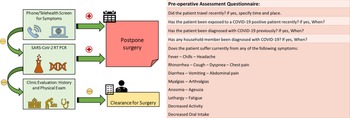
Herein, between 1 March and 1 November, 2020, we were able to perform 65 open-heart surgeries. The performed surgeries were not restricted to urgent or emergent ones, but to the essential and life-changing surgeries that could improve the life quality of our patients. These surgeries occurred after we implemented the COVID-19 pre-operative assessment protocol consisting of telehealth or over the phone symptoms screening with immediate postponement of scheduled surgeries in symptomatic patients, providing SARS-CoV-2 polymerase chain reaction testing to all asymptomatic patients and rescheduling surgeries in SARS-CoV-2 positive patients, re-evaluating asymptomatic SARS-CoV-2 negative patients in clinic, and (4) clearing afebrile and hemodynamically stable asymptomatic SARS-CoV-2-negative patients for surgeries (see Fig 1). To control and reduce further the in-hospital transmission of SARS-CoV-2, we limited the number of patients’ companions to one and enforced all companions to perform a SARS-CoV-2 polymerase chain reaction testing. Only SARS-CoV-2-negative companions were allowed to accompany the patients.
Pre-operative assessment protocol during COVID-19 pandemic. The first step of the pre-operative assessment begins within a week of the surgery. The patient is screened for current active symptoms suggestive of COVID-19 infection via phone interview or through Telehealth*. If the patient has positive initial survey, the surgery is directly postponed. If this was not the case, the patient then performs reverse transcription-polymerase chain reaction test, 24 48 hours prior to surgery. If the swab result is negative, the patient is asked to come in person for pre-operative clinical assessment. In the clinic, the physician performs the required pre-operative physical examination and takes relevant history. If the patient passes all the aforementioned assessment steps, he is cleared for surgery. The pre-operative assessment questionnaire represents the set of questions used in the phone assessment.

Before adjusting our original COVID-19-related policies and following the discussed pre-operative assessment protocol, one of our patients tested positive without having symptoms (case 1). The medical team members who were exposed with proper personal protective equipment to this patient were identified and quarantined for 14 days. Similarly, we provided polymerase chain reaction testing to all suspected in-contact personnel. However, after following the aforementioned multistep pre-operative protocol, we were able to identify preemptively two additional SARS-CoV-2-positive patients thus to prevent SARS-CoV-2 transmission to our healthcare workers and hospitalised patients who are in contact with our workers. Collectively, this protocol along with the appropriate use of necessary personal protective equipment has enabled avoiding unnecessary quarantine of medical team members and preventing unexpected delays in medical care delivery to both surgical and non-surgical patients.
Interestingly, COVID-19 presentation among the three discussed CHD patients was asymptomatic. Our findings are consistent with the data available in the literature concerning disease severity and manifestations in CHD children. Reference Lewis, Anderson and Fremed15,Reference Zareef, Younis, Bitar, Eid and Arabi16 These patients, particularly those with complex lesions, are at risk for acquiring severe and complicated COVID-19. However, many of them may display an asymptomatic to mild presentation. Hence, we argue that a thorough clinical evaluation should be offered to these patients, even the symptoms-free patients, to detect asymptomatic cases of COVID-19 who may silently transmit the disease not only to healthcare workers but also to in-contact hospitalised patients. Besides, in our institution, COVID-19-positive CHD patients, who are undergoing elective surgery, have to wait at least four weeks following the infection before undergoing the surgery.
Finally, protocols for international CHD patients were also derived. They should follow the country’s regulations, as well as those adopted by our centre. In most of the cases, the country’s regulations require one negative COVID-19 polymerase chain reaction test before traveling to Lebanon and another negative one post-arrival. As for our hospital regulations, in addition to adhering to the above, they should obtain a negative COVID-19 swab at least 48 hours post-arrival to Lebanon, and within 48 hours of surgery. After negative test, they should be assessed and cleared according to our pre-operative protocol.
This stepwise pre-operative evaluation protocol is cost-effective in decreasing operation cancellation and healthcare professionals’ quarantine. This newly implemented protocol is designed based on the assumption that sufficient medical equipment, staffs, and resources are available. Moreover, following such a protocol is mandatory particularly in developing countries, like Lebanon, that are tremendously affected by the economic, social, and medical drawbacks of the pandemic. In these countries, the pre-COVID-19 medical resources are already limited by the weakened economies and medical infrastructures. This protocol allows an equitable and rationalised employment of these limited resources. For instance, our children cardiac centre is a leading referral centre that accepts critical cases from all over the country. Reference El Rassi, Assy and Arabi17,Reference Bitar, Baltaji, Dbaibo, Abed el-Jawad, Yunis and Obeid18 Prior to March, 2020, around 200–250 surgeries were performed annually at our centre. This number was reduced to around 40% during 2020. This significant reduction is attributed to the drastic consequences and demands of the COVID-19 pandemic. In fact, even at our centre that is considered one of the most equipped cardiac centres in the country, the number of available mechanical ventilators was reduced to a few owing to the increasing number of hospitalised COVID-19 patients. Nonetheless, essential highly-needed surgeries were still performed at our centre owing to the adopted guidelines and policies that include the above-discussed pre-operative assessment protocol among others.
Ultimately, even with the recent promissory COVID-19 vaccine results, the path towards the end of the pandemic is still vague and might take several years. Global vaccination will prompt a decline in COVID-19 transmission. However, children, such as our patients, are not yet included in the ongoing vaccination trials. This pre-operative assessment protocol is necessary even after reaching mass vaccination to secure a COVID-19-free environment to our patients and healthcare workers.
Our study is one of a few studies discussing the impact of COVID-19 on the pre-operative evaluation of cardiac patients. It suggests an effective and easy-to-apply protocol that attains to improving the wellbeing of the patients and reducing the risk of COVID-19 transmission among both medical workers and patients. The study is limited by the small number of enrolled patients and the inherent biases of descriptive retrospective observational studies. Similarly, our findings are certainly affected by the false negative rate of SARS-CoV-2 polymerase chain reaction testing that may mask the presence of additional asymptomatic COVID-19 cases. Hence, we postulate that at least two negative polymerase chain reactions are needed to minimise the incidence of undetected asymptomatic COVID-19 that may remain unnoticed. Moreover, we encourage healthcare workers to adopt a step-wise patient-centered pre-operative assessment protocol, like the one discussed in our study, while dealing with at-risk populations.
Conclusion
The healthcare system worldwide has been significantly strained by the current ongoing pandemic of COVID-19. Nonetheless, the social and medical impacts of this pandemic should not impede the delivery of emergent and essential care to non-COVID-19 patients who are markedly affected by the current situation. As a result, amenable and easy-to-apply guidelines and policies should be implemented in all healthcare centres to secure a just distribution of medical services among COVID-19 and non-COVID-19 patients. Concerning children with CHD, our aforementioned protocol is deemed a safe and effective approach that identifies asymptomatic COVID-19 patients. It ensures proper performing of both emergent and non-emergent surgeries. It optimises patient’s care during the COVID-19 era while ensuring healthcare workers’ safety.
Acknowledgements
Not applicable.
Financial support
This research received no specific grant from any funding agency, commercial, or not-for-profit sectors.
Conflicts of interest
None.
Ethical standards
The study was conducted after receiving approval from the Institutional Review Board (IRB) of the American University of Beirut Medical Center.
Author contributions statement
M.A. fostered the idea of the research. M.A., F.B., O.E.S., and I.M.E. provided direct care to the patients in the Children’s Heart Center at The American University of Beirut Medical Center. N.K.Y., R.O.Z., and M.A.D. collected and analysed data, and wrote the first draft of the manuscript. All authors contributed to corrections and adjustment of subsequent iterations of the manuscript. All authors approve and agree with the content.