The novel coronavirus (COVID-19) outbreak illustrates the impact of globalization on the transmission of communicable diseases.Reference Morens, Folkers and Fauci1 The “Identify–Isolate–Inform” algorithm developed by the Centers for Disease Control and Prevention (CDC) to assist emergency department (ED) providers with timely identification of patients at risk for Ebola Virus Disease has been adapted to guide clinicians in the rapid identification and isolation of patients who meet case definitions for a variety of communicable illnesses, including COVID-19.Reference Koenig, Beÿ and McDonald2 Prior studies have evaluated the frequency with which clinicians perform general travel screening in the ED.Reference Burkholder, Dziadkowiec, Bookman and King3 However, the “Identify–Isolate–Inform” framework highlights that effective screening for global health threats also depends on obtaining accurate details about epidemiological risk factors, including the region and country of travel, as well as specific symptoms. This information can be used to trigger electronic medical record (EMR) system alerts that prompt clinicians to suspect diseases from active outbreaks.
In August 2018, a Best Practice Advisory (BPA, Epic 2018) was implemented in our electronic health record to build upon the “Identify–Isolate–Inform” framework and to assist in the rapid identification of patients at risk for Middle East Respiratory Syndrome (MERS). The primary objective of this study was to evaluate adherence to travel screening among patient encounters in the ED. Our secondary objective was to determine rates of documentation of region and country of travel among patients with documented foreign travel. In the subgroup of encounters with reported travel to the Middle East, we aimed to measure the frequency of symptom screening and identify the number of encounters that prompted clinicians via the MERS BPA.
Methods
Massachusetts General Hospital (MGH) is a tertiary-care, academic teaching center in Boston, Massachusetts, with 1,035 licensed beds and >100,000 emergency room visits per year. Travel screening is performed by MGH ED triage providers who use a travel-screening tool in the EMR that queries with regard to travel within the past month. Providers can choose from the following options: “foreign,” “domestic,” “no travel,” or “unknown.” When a provider selects “foreign,” regional choices appear. If a region is chosen, the corresponding country choices appear. Users can also record information using free-text comments. If providers select “Middle East” as a region of travel, they are also prompted to answer symptom-screening questions. The region and country of travel and symptom-screening answers recorded via the travel-screening tool menu can be programmed to prompt travel-associated BPAs; however, comments written in free text cannot be leveraged for this purpose.
The MERS BPA alerts clinicians to the possibility of a MERS diagnosis when both of the following criteria are met: (1) Middle East is chosen as a region through the travel-screening tool; AND (2) temperature ≥ 38°C (100.4°F) is documented in the electronic medical record flowsheet; OR “subjective fever/feeling feverish” is documented in the symptoms screen; OR “cough/shortness of breath” is documented in the symptoms screen. When the MERS BPA appears, users are prompted to notify providers to consider utilizing order sets for isolation precautions and to contact a designated biothreats doctor (Biothreats MD) who is an infectious disease physician with specialized knowledge of high-consequence infectious diseases.
We performed a retrospective automated record abstraction using Epic software (Epic, Verona, WI) of all adult and pediatric patient encounters in the MGH ED from August 2018 through December 2019. If a patient encounter had multiple travel screens documented, we only analyzed the first one performed following arrival at the ED. We categorized an encounter as adherent if providers had answered “foreign,” “domestic,” or “no travel” to the screen, and if the care department at the time of initial travel screening was within the ED. Encounters were defined as nonadherent if the travel screen was left blank or if providers had recorded “unknown.” Among encounters with documented foreign travel, we analyzed rates of documentation for region and country of travel. We also evaluated the frequency of the MERS BPA activation and analyzed rates of isolation and diagnostic testing orders. Finally, we examined the frequency of free-text comments and we characterized the type of information present in these fields.
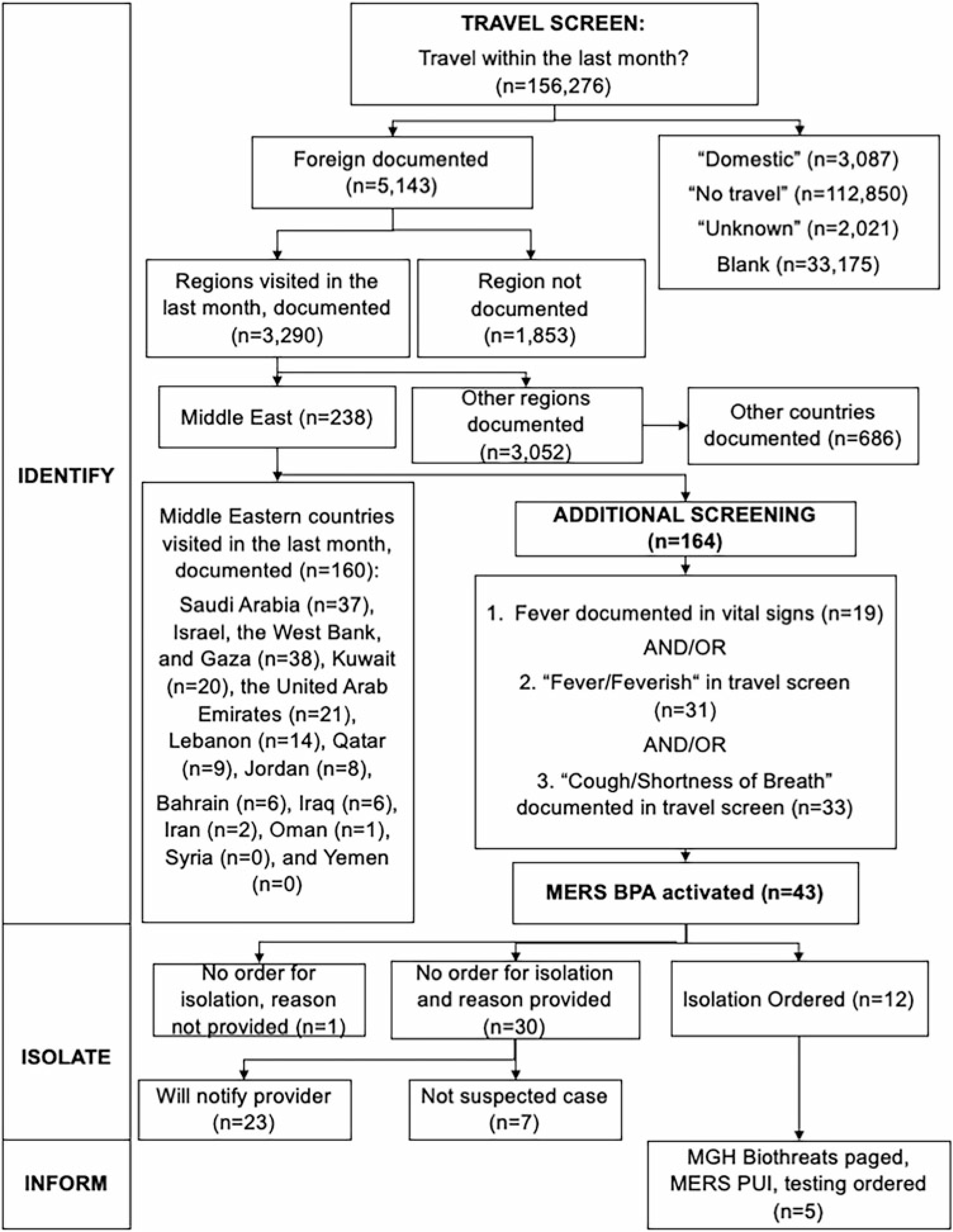
Cascade of travel-screening adherence and Middle East Respiratory Syndrome (MERS) Best Practice Advisory (BPA) response. The cascade of travel screening demonstrates the total number of patient encounters during the study period and subsequent adherence to general travel screening (including foreign travel, domestic travel, or no travel), and capture of region and country level data. For the subgroup of encounters with documented travel to the Middle East as a region, symptom screening rates were also documented. The final portion of the cascade demonstrates the number of MERS Best Practice Advisory (Epic 2018) alerts and the breakdown of user actions regarding notification of providers, as well as patient isolation and testing of persons under investigation (PUIs) and contact with the MGH Biothreats MD pager.

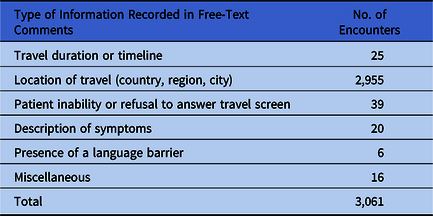
Characterization and Frequency of Free-Text Comments in Our Travel-Screening Tool

Results
In total, 156,276 MGH ED patient encounters were included in this analysis, of which 121,080 (77%) were adherent to general travel screening (Fig. 1). Among encounters with documented foreign travel during the study period (n = 5,143); 3,290 encounters (64%) specified the region of travel and 846 (16%) selected a country of travel with use of the travel screening tool. In total, 3,061 encounters included free-text comments (Table 1). Most of these encounters (n = 2,955) included information on location of travel.
Travel to the Middle East was documented in 238 patient encounters with use of the travel-screening tool. Symptom screening was performed in 164 encounters (69%). Of these, 113 encounters documented absence of fever and cough, 20 documented fever and cough, 13 documented a cough alone, and 18 documented a fever alone through report or vital signs. The MERS BPA was prompted in 43 encounters. Using BPA guidance, clinicians ordered isolation precautions for 12 patients. Following review of the 12 patients by the clinical team, Biothreats MD, and the state epidemiologist, 5 patients met the CDC criteria for a MERS person under investigation and were tested; all were negative. On chart review of free-text comments, an additional 62 encounters had reported travel to the Middle East that had not been documented through the travel-screening tool (data not shown).
Discussion
Although general travel screening was completed for 77% of all MGH ED patient encounters, only 16% of encounters with reported foreign travel had a documented country of travel. In the subset of patients who had travelled to the Middle East, symptom screening was not documented in 31% of encounters. Free-text comments were used in a minority of encounters (2%); however, documentation of travel to the Middle East through this mechanism was common.
The effective implementation of the “Identify–Isolate–Inform” framework requires healthcare facilities to conduct universal travel screening. A recent evaluation of mystery patient drills performed throughout New York City, during which actors presented to local EDs with symptoms and histories consistent with either measles or MERS, found that adherence to infection control practices occurred in 88% of encounters with a completed travel history, compared with only 21% of encounters that lacked travel screening.Reference Foote, Styles and Quinn4
This study adds to the available literature by demonstrating a substantial decrease in the documentation of country and region within the cascade of travel screening, as well as room for improvement in symptom screening. To our knowledge, there were no missed cases of MERS in this cohort. However, the existence of 62 encounters of travel to the Middle East that were not documented through the travel screening tool menu suggests potentially missed opportunities for use of the MERS BPA. Indeed, our analysis shed light on gaps in documentation through the travel screening tool with the use of free-text comments to record travel information. This practice needs to be further understood and addressed to successfully use BPAs for decision support, particularly amid an early outbreak. These findings will inform the optimization of our travel-screening tool to support the timely identification and isolation of patients with emerging infectious diseases.
Acknowledgments
Financial support
No financial support was provided relevant to this article.
Conflicts of interest
All authors report no conflicts of interest relevant to this article.