Introduction
The study of poverty has a long history across several branches of the social sciences. But it is only in relatively recent times that people in poverty themselves have been asked by researchers for their own perspectives on poverty and the services that aim to support them (Williams et al., Reference Williams, Popay, Oakley, Williams, Popay and Oakley1999; Narayan-Parker and Patel, Reference Narayan-Parker and Patel2000; Lister, Reference Lister2004). Just as poor people have recently been increasingly recognised as persons with rights, dignity and agency, it is only in recent times, too, that children's right to be heard (United Nations, 1989) has become widely accepted. In tandem with these two developments, a growing body of academic literature has sought to document and understand children's perspectives on economic adversity. The development of this literature can be seen as a positive indicator of concern for children's rights and well-being. The studies reviewed in this paper show that while economic disadvantage constrains physical well-being, social engagement and aspirations, children actively adapt to, and endeavour to manage, these constraints.
There are now a number of literature reviews on children's perspectives on poverty already published (Attree, Reference Attree2006; Ridge, Reference Ridge2007a). This review seeks to make an original contribution by examining the issue of children's agency: the agency that children living in poverty exercise, the agency associated with self-exclusion and children's agency in excluding other children. This is not a detailed analysis of the literature, but a broad-brush review, where I highlight a few specific themes that appear to me to capture how children exercise agency in the context of poverty. The next section summarises some of the main themes in the literature. The following two sections define agency, and explore agency associated with exclusion and agency inherent in children's responses to poverty and economic disadvantage. The final section concludes with a review of some gaps in the literature.
Overview of the literature
For this review, I looked at 25 papers published between 1998 and 2008. These were found through a literature search on children's perspectives on poverty conducted using both academic search tools (Web of Science; JSTOR) and ‘grey’ sources (for example, websites for UNICEF, Save the Children, CHIP – the Childhood Poverty Research and Policy Centre, the Joseph Rowntree Foundation and the British Library for Development Studies). Relevant texts were searched for sources that they cited and the citations they generated as flagged by internet tools such as Google Scholar. The review is not comprehensive, in that I do not report on all papers I found. But the papers discussed here do, I believe, capture the literature's various approaches to children's agency in the context of poverty.
Of the 25 papers, 21 pertain to children in rich countries (14 of these to the UK) and four (Witter, Reference Witter2002; Boyden et al., Reference Boyden, Eyber, Feeny and Scott2003; Ablezova et al., Reference Ablezova, Botoeva, Jukusheva, Marcus and Satybaldieva2004; Harpham et al., Reference Harpham, Huong, Long and Tuan2005) pertain to middle-income and poor countries. The studies deal with the perspectives of children who are defined by the researchers as experiencing poverty. Therefore, the large literature on street children or migrant children in middle-income and poor countries (Gallina and Masina, Reference Gallina and Masina2002; Iversen, Reference Iversen2002; Plummer et al., Reference Plummer, Kudrati and Dafalla El Hag Yousif2007) is excluded, as is literature from all over the world on children's perspectives on their work (Frederiksen, Reference Frederiksen1999; Leonard, Reference Leonard2002; Biggeri et al., Reference Biggeri, Libanora, Mariani and Menchini2006), and literature on children's perspectives on their parents’ employment (Galinsky, Reference Galinsky1999; Pocock, Reference Pocock2006).
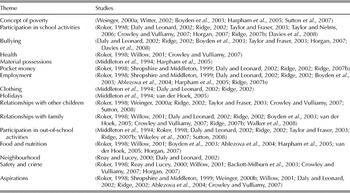
Most of the studies are qualitative with small sample sizes. A few studies use mixed qualitative/quantitative methods, or exclusively quantitative methods (Shropshire and Middleton, Reference Shropshire and Middleton1999; Ridge, Reference Ridge2002). Ages of respondents range from five to 18 years. In general, both boys and girls are interviewed. Several studies also seek the views of both children and their parents. The major themes that these studies investigate are summarised in Table 1. Overall, the 25 studies can be placed into three broad overlapping groups. In the first group are studies that have a general and exploratory character, and examine a wide range of issues relating to children's own experiences of and perspectives on living in low-income families (Roker, Reference Roker1998; Willow, Reference Willow2001; Daly and Leonard, Reference Daly and Leonard2002; Ridge, Reference Ridge2002; Boyden et al., Reference Boyden, Eyber, Feeny and Scott2003; Taylor and Fraser, Reference Taylor and Fraser2003; Ablezova et al., Reference Ablezova, Botoeva, Jukusheva, Marcus and Satybaldieva2004; van der Hoek, Reference Van Der Hoek2005; Taylor and Nelms, Reference Taylor and Nelms2006; Crowley and Vulliamy, Reference Crowley and Vulliamy2007). The second group includes studies which explore differences between poorer and middle-class children (Middleton et al., Reference Middleton, Ashworth and Walker1994; Shropshire and Middleton, Reference Shropshire and Middleton1999; Reay and Lucey, Reference Reay and Lucey2000; Weinger, Reference Weinger2000a, Reference Weinger2000b; Backett-Milburn et al., Reference Backett-Milburn, Cunningham-Burley and Davis2003; Taylor and Fraser, Reference Taylor and Fraser2003; Taylor and Nelms, Reference Taylor and Nelms2006; Sutton et al., Reference Sutton, Smith, Dearden and Middleton2007; Wikeley et al., Reference Wikeley, Bullock, Muschamp and Ridge2007; Sutton, Reference Sutton2008). In the third group are studies that focus on quite specific questions. Horgan (Reference Horgan2007) looks at the relationship between poverty and children's perspectives on school. Wikeley et al. (Reference Wikeley, Bullock, Muschamp and Ridge2007) consider how children develop educational relationships with adults outside of the school setting. Ridge (Reference Ridge2007b) examines what children in low-income lone parent families think and do when their mothers take up employment – perceived attitudes of other children, changes in family income, household work and childcare, and changes in their relationships with their mothers. Weinger (Reference Weinger2000b) compares poor and middle-class children's perspectives on career opportunities available to them. And Witter (Reference Witter2002) considers children's perceptions of child poverty itself, and how they define the concept.
Main themes in the literature, and studies that discuss them

Across all 25 studies covering richer and poorer countries, the following three themes emerge. First, children are active agents and use a variety of strategies to cope with living on low income; second, it is often not poverty per se that hurts, but the social exclusion or the ‘symbolism of poverty’ (Boyden et al., Reference Boyden, Eyber, Feeny and Scott2003) that accompanies it; and third, families are central to children's lives – children both contribute to and draw on family strength as a source of resilience. It is also worth noting that lack of quality food and hunger, while highlighted in all of the poor and middle-income country studies, is also mentioned as an issue in a number of the rich country studies (Roker, Reference Roker1998; Willow, Reference Willow2001; van der Hoek, Reference Van Der Hoek2005). Schooling is also discussed in nearly all the studies, but children in the richer countries show a greater preoccupation with exclusion at school, while children in the poorer countries are more concerned with access to school. Finally, three of the four poorer country studies examine children's views on the definition of poverty (Witter, Reference Witter2002; Boyden et al., Reference Boyden, Eyber, Feeny and Scott2003; Harpham et al., Reference Harpham, Huong, Long and Tuan2005), but few of the rich country studies cover this issue (Weinger, Reference Weinger2000a; see for example Sutton et al., Reference Sutton, Smith, Dearden and Middleton2007). This may be due to differing interests of researchers in poorer and richer countries, and I return to this point in the final section.
Defining agency
My aim in this review is to focus in particular on agency – how children exercise it, how it impacts on their situation and how the literature interprets it. Agency can be broadly defined as the capacity to act. Giddens (Reference Giddens1984) identifies two characteristics associated with agency: first, that the individual has choice – he or she could have acted differently; and, second, that the individual engages in ‘reflexive monitoring’ (Giddens, Reference Giddens1984:9), which might be interpreted as the actor showing some awareness of his or her actions. Giddens closely links agency to structure, in that the latter cannot exist without the former. Agency is constrained by structure, but structure is at the same time a resource that people can draw on in their interactions with others (Finch, Reference Finch1989). People seek to (implicitly or explicitly) explain their own and others' actions through their interpretation of the structural environment in which they live; this is what Giddens means by reflexive monitoring.
The concept of agency-within-structural constraint has been taken up by a number of social policy analysts in their interpretation of the ‘new paradigm of welfare’ (Williams et al., Reference Williams, Popay, Oakley, Williams, Popay and Oakley1999), in part as a means of differentiating them from neo-classical economists who assume that the individual is a free and rational actor (van Krieken, Reference van Krieken1997; Lister, Reference Lister2004). Children's agency needs to be understood in the context of social and economic constraint, but also in the context of dependence on, and submission to, the authority of adults. Within the confines of this relationship, some agency is sanctioned or positively encouraged, while some agency can also be understood in terms of rebellion against adult and parental authority. Two implicit ideas run through the literature reviewed here. The first is that poverty both facilitates and constrains children's agency: economic constraints compel children to make decisions that they might otherwise be able to avoid making, or not be allowed to make; the same constraints however limit children's room for manoeuvre in other directions. The second idea is that children's agency is a major force for their own and other children's exclusion. These types of agency are examined in more detail below.
Children as actors
One of the key assumptions that underpin the concept of social exclusion, and one of the factors that sets it apart from the concepts of poverty or deprivation, is that (active or passive) actions by people and institutions can have the impact of excluding adults and children from participating in what is considered normal in a community or society (Atkinson, Reference Atkinson, Atkinson and Hills1998). Micklewright (Reference Micklewright2002) proposes a list of the key potential actors who exclude children: government and its agents, the labour market, schools, parents, other children and the children themselves. Of this list, I wish to focus on just the last two – children as excluders, and children as agents of self-exclusion.
Children as excluders: The exclusion of poor children by non-poor children, and how it is ingrained from an early age, is the main theme running through Weinger (Reference Weinger2000a). Sutton et al. (Reference Sutton, Smith, Dearden and Middleton2007) emphasise the antagonism that children often feel for children in other socio-economic groups. Several studies report on children being excluded by other children, or bullied by them because they do not have the right clothes (Roker, Reference Roker1998; Daly and Leonard, Reference Daly and Leonard2002; Boyden et al., Reference Boyden, Eyber, Feeny and Scott2003; van der Hoek, Reference Van Der Hoek2005). On the other hand, where Taylor and Fraser (Reference Taylor and Fraser2003), report bullying of children, poverty is not listed as one of the causes. Moreover, Backett-Milburn et al. (Reference Backett-Milburn, Cunningham-Burley and Davis2003) report that children tend to downplay the importance of clothing and other material goods as markers of social differentiation or factors in social exclusion. Following Weinger (Reference Weinger2000a) and Sutton et al. (Reference Sutton, Smith, Dearden and Middleton2007), it is possible that much of the exclusion that children practice occurs between groups, rather than at a personal level. Following Ridge (Reference Ridge2002), however, it is also possible that exclusion practiced by children may be reinforced by other barriers, such as transport costs, excursion costs and admission prices, that result in some children being unable to participate in certain events, even though they are not explicitly excluded by their peers.
Children's self-exclusion: Children can also exclude themselves (for example, from school or from interaction with their peers). Micklewright (Reference Micklewright2002) notes a number of forms of self-exclusion, including truancy and drug addiction, which also arise in the literature here (Roker, Reference Roker1998; Willow, Reference Willow2001). One of the more common forms of self-exclusion reported by children in the literature appears to be not asking parents or the school for support to participate in an event, or to access regular services such as free school meals (Daly and Leonard, Reference Daly and Leonard2002; Ridge, Reference Ridge2002; Horgan, Reference Horgan2007; Davies et al., Reference Davies, Davis, Cook and Waters2008). This suggests that the children may be protecting both themselves and their parents from the stigma of having to ask for support from the school, as well as protecting their parents from financial demands that they cannot easily accommodate. Also important is reassessment, where the young person states they were not interested in the event anyway (Wikeley et al., Reference Wikeley, Bullock, Muschamp and Ridge2007). In her review of the literature, Attree (Reference Attree2006) highlights another form of self-exclusion: children often have few aspirations to engage more actively in life in the present, or to improve their situations in the future, a point echoed in Weinger's (Reference Weinger2000b) study of poor and middle-class children's career expectations. In the Roker (Reference Roker1998) sample, parents’ aspirations for their children are modest (for example, they want them to get any job) while children's own aspirations often appear unrealistic, especially when their engagement in school is considered.
If exclusion by other children and self-exclusion represent some of the more worrisome aspects of economic disadvantage as experienced by children, children's own responses to these challenges (and to the challenge of poverty more generally) can sometimes present a more positive picture. Lister (Reference Lister2004) identifies four types of agency that are relevant to the analysis of poverty, ‘getting by’, ‘getting (back) at’, ‘getting out’ and ‘getting organised’.
Getting by represents an everyday and personal response to poverty, and includes the many little things that people do in order to cope with everyday situations, for example, prioritising daily expenditure and juggling resources. Lister (Reference Lister2004) indeed argues that this form of agency is so commonplace that it is often only noticed when it breaks down. Ridge (Reference Ridge2002) and van der Hoek (Reference Van Der Hoek2005) provide examples of what some children do to get by in the face of economic adversity: for example, saving pocket money and birthday money, taking advantage of informal and ad-hoc opportunities to earn money, helping parents with housework and childcare, reappraising their daily situations in a more positive light, and not complaining to parents about lack of money. Although Roker (Reference Roker1998) states that a third of the sample in her study said that lack of money did not affect their social lives, the literature generally suggests reliance on, and support for the family (coupled with a wish not to overburden parents), but a reluctance to show weakness and dependency to peers – thus avoiding engagement in a range of wider social activities (‘getting by’ through self-exclusion). Thus, children in low-income families are significantly less likely than other children to spend time with their peers outside of school (Taylor and Fraser, Reference Taylor and Fraser2003). Sutton (Reference Sutton2008) shows how children living in a poor estate in their study participate widely in spontaneous street play, in contrast to middle-class children, who tend to engage in more formalised activities, or visit each other's houses. Street play can be seen as a positive and creative response to economic disadvantage, since it is enjoyable for children and costs little. However, its visibility means that children are exposed to a number of risks, including being victims of crimes and facing accusations of anti-social behaviour because they may be seen to ‘hang around’ in groups (Backett-Milburn et al., Reference Backett-Milburn, Cunningham-Burley and Davis2003; Wikeley et al., Reference Wikeley, Bullock, Muschamp and Ridge2007).
Getting (back) at is an everyday and political response to poverty, and signals resistance to bureaucratic and social norms. This includes, as far as children are concerned, petty crime, engaging in confrontational behaviour, vandalism, graffiti writing or taking excessive amounts of drugs (which Micklewright (Reference Micklewright2002) also characterises as self-exclusion). These ‘isolated acts of resistance’ (Lister, Reference Lister2004) usually take place in a context where such behaviour is to some extent tolerated. Indeed what may be seen by some as ‘confrontational behaviour’ may be seen by others as innocuous, as Sutton (Reference Sutton2008) shows in describing how poor children's street play is often perceived by outsiders and adults. On the other hand, Reay and Lucey (Reference Reay and Lucey2000) discuss poor children's longing to see the (often vandalised and crime ridden) estates that they live in as ‘good’ places: these children are actively responding against the idea of ‘getting (back) at’.
Lister highlights ‘getting back at’ as a form of adaptation to circumstances that challenges the view of poor people as passive and lacking agency. However, it also suggests to my mind a response to powerlessness in relation to society and the formalised world. Most children are placed in positions of powerlessness – subjection to adult authority is one widely understood characteristic of childhood. When they do respond with ‘getting back at’ agency, it is not always clear whether it is the powerlessness of childhood and testing the limits of adult authority, or the powerlessness of poverty that provokes the response, and this ambiguity is indeed notable in some of the literature reviewed here.
Getting out represents both a personal and strategic agency type. It is the ‘officially sanctioned’ response to poverty, particularly if it involves taking up employment, or improving one's employment prospects through education or training (although it could also conceivably involve re-partnering). Lister (Reference Lister2004: 145) notes that ‘individuals exercise their strategic agency in negotiating these routes, but the routes themselves are forged by structural and cultural factors, which can assist or obstruct the exercise of that agency’. Children express a will to ‘get out’ in a number of ways – through their desire for more income and material possessions, and particularly better clothing (Shropshire and Middleton, Reference Shropshire and Middleton1999; Ridge, Reference Ridge2002; Boyden et al., Reference Boyden, Eyber, Feeny and Scott2003; Ablezova et al., Reference Ablezova, Botoeva, Jukusheva, Marcus and Satybaldieva2004; Harpham et al., Reference Harpham, Huong, Long and Tuan2005); and through career aspirations for themselves, or their parents (Ridge, Reference Ridge2007b). Ridge (Reference Ridge2007b) suggests that children's support for working parents can make a real difference – through engaging in greater self care, care of siblings and home production, and through giving parents emotional space to recuperate after the working day. However, children's will to ‘get out’ may also be compromised by aspirations that are adapted to economically straitened circumstances (Willow, Reference Willow2001; van der Hoek, Reference Van Der Hoek2005).
Getting organised is described by Lister (Reference Lister2004) as a strategic-political/citizenship response to poverty. She argues that this is often a particularly difficult type of agency for poor people, not least because of the ‘othering’ process that objectifies them as passive, because poverty is not a status that people aspire to, and because membership of this group is associated with lack of political power, and sometimes self-blame (see also Narayan-Parker and Patel, Reference Narayan-Parker and Patel2000). Like poor adults, all children experience ‘othering’ to a greater or lesser extent simply because of their status as children. Moreover, they are for the most part explicitly excluded from political processes and community activism. ‘Getting organised’ does not feature at all in the literature reviewed here. One of a few areas where children have proved to be politically active is in child labour issues (Biggeri et al., Reference Biggeri, Libanora, Mariani and Menchini2006), which effectively transcends the ‘othering’ that may be associated with both poverty and childhood.
Conclusion: What is missing?
Perhaps the most significant contribution of the literature as it stands is first, to remind us that children are active agents; and, second, to highlight the creativity of children who experience economic adversity, in coping with their situation, and in improving their own lives, and those of their families. Here, the literature has already achieved much in terms of exposing some of the shortcomings of conventional approaches to the analysis of child poverty. But there is much that we still need to know.
Children excluding children: Exclusion by other children is clearly central to children's lives from their own perspectives, whether or not this is associated with economic adversity. While children in some studies state that economic resources are not a key determinant of inclusion or exclusion, children in other studies report being bullied, teased and excluded in other ways because they do not have the ‘right’ clothes, for example. The studies of Weinger (Reference Weinger2000a; Weinger, Reference Weinger2000b), Backett-Milburn et al. (Reference Backett-Milburn, Cunningham-Burley and Davis2003) and Sutton et al. (Reference Sutton, Smith, Dearden and Middleton2007) suggest that differentiation on the basis of social class is ingrained in children from an early age and subtly reinforced by parents who may at the same time profess to want their children to make friends with other children from a broad range of backgrounds. Yet the literature does not give a clear picture of how exclusion changes with context. For example, is stigma associated with poverty felt more strongly by children in socially mixed schools than in schools where almost every child is economically disadvantaged, or do other stigmatising hierarchies emerge in these latter schools? Do active policies to encourage children to integrate make a difference in terms of children's perceptions of stigma? On this point, Horgan's (Reference Horgan2007) research appears to suggest that school cultures that stigmatise children may be somewhat resistant to change. More detail on children's perceptions of exclusion and stigma across a range of social contexts could provide information on which more inclusive education policies could be based.
Agency and constraint in the context of poverty: Agency is a two edged sword. It can be associated with generally ‘positive’ actions, such as ‘getting out’ or ‘getting organised’, but it can also be associated with what might be described as ‘negative’ actions – ‘getting (back) at’, and different forms of self-exclusion. Self-exclusion arguably represents one of the most pressing policy problems associated with child poverty, particularly where it is associated with withdrawal from participation in school, or reduced career or lifetime aspirations. Again, more research is needed on how adapted preference and self-exclusion can be overcome (for example through a broadening of children's experiences), even where material poverty itself continues.
Children becoming involved in the redefinition of poverty: There is now a growing literature where adults are asked to provide their own indicators of deprivation (Saunders et al., Reference Saunders, Naidoo and Griffiths2007). In their groundbreaking study of adults’ perception of poverty in developing countries, Narayan-Parker and Patel (Reference Narayan-Parker and Patel2000) showed that for poor people in developing countries, what often affected them most about poverty was shame, lack of freedom and lack of power over their own lives and the communities they lived in. Witter (Reference Witter2002) offers an example of the complexity of some Ugandan children's definitions, spanning the spiritual, the relational, and the material, which she contrasts with the more materially focused definitions of adult key informants. That both Narayan-Parker and Patel's, and Witter's studies were based in poorer countries is perhaps not surprising, given the overt human rights orientation towards poverty, including a meaningful participative element, by the UN and other development agencies (Office of the High Commissioner of Human Rights, 2004). Both policymakers and researchers in rich countries, while often engaging in the rhetoric of human rights, have tended to shy away from explicitly linking poverty and human rights. More systematic studies of what children themselves perceive to be necessities for their own lives could help plug this gap between rhetoric and action.
Children in and out of family contexts: As noted above, the literature reviewed here examines the perspectives of children who live with, support and are supported by their families. The importance of family for these children is an almost universal theme. This begs two questions. First, how is poverty perceived by children who live outside of their family contexts? This is a difficult issue, but it appears to me that studies of children who live outside of a family context have tended to focus on other dynamics in their lives, for example homelessness, migration, employment, etc. There may now be space for a re-interpretation of this literature through poverty and social exclusion frameworks. Second, among children who live in family contexts, there may be space to develop further the concept of ‘family’. In the literature reviewed, Walker et al. (Reference Walker, Crawford and Taylor2008) and Sutton et al. (Reference Sutton, Smith, Dearden and Middleton2007) point to the complex family arrangements of many children living in poverty, while Backett-Milburn et al. (Reference Backett-Milburn, Cunningham-Burley and Davis2003) state that transfers and gifts from wider kin networks were important in supporting children's living standards. This suggests that children living in poverty need to be engaged more systematically about the appropriate unit of analysis for them as they consider their own situations.
Acknowledgement
This article was written as a contribution to projects funded by the Australian Research Alliance on Children and Youth, and by the Australian Research Council (Project No. LP0882352). The author is grateful for comments and advice on earlier drafts from Bettina Cass, Megan Griffiths, Eva Jespersen, David Parker, Tess Ridge, Peter Saunders, Jen Skattebol, and two anonymous referees.