One gets a glimpse of the germ of attachment theory in John Bowlby's Reference Bowlby1944 article, “Forty-Four Juvenile Thieves: Their Character and Home-Life,” published in the International Journal of Psychoanalysis. Using a combination of case studies and statistical methods (novel at the time for psychoanalysts) to examine the precursors of delinquency, Bowlby arrived at his initial empirical insight: The precursors of emotional disorders and delinquency could be found in early attachment-related experiences, specifically separations from, or inconsistent or harsh treatment by, mothers (and often fathers or other men who were involved with the mothers). Over the subsequent decades, as readers of this journal know, he built a complex and highly generative theory of attachment.
Unlike other psychoanalytic writers of his generation, Bowlby formed a working relationship with a very talented empirically oriented researcher, Mary Ainsworth. Her careful observations, first in Uganda (Ainsworth, Reference Ainsworth1967) and later in Baltimore, led to a detailed specification of aspects of maternal behavior that preceded individual differences in infant attachment. Her creation of the Strange Situation (Ainsworth, Blehar, Waters, & Wall, Reference Ainsworth, Blehar, Waters and Wall1978) provided a gold standard for identifying and classifying individual differences in infant attachment security (and insecurity) and ushered in decades of research examining the precursors and outcomes of individual differences in infant attachment. (A PsycInfo literature search using the keyword “attachment” yields more than 15,000 titles.)
By the beginning of the 21st century, the National Research Council and the Institute of Medicine's Committee on Integrating the Science of Early Childhood Development based its policy and practice conclusions and recommendations on four themes, one of which was that “early environments matter and nurturing relationships are essential” (Shonkoff & Phillips, Reference Shonkoff and Phillips2000, p. 4). “Children grow and thrive in the context of close and dependable relationships that provide love and nurturance, security, responsive interaction, and encouragement for exploration. Without at least one such relationship, development is disrupted, and the consequences can be severe and long-lasting” (p. 7). These clear and strong statements could be made, in large part, because of the research inspired by Bowlby's theory and Ainsworth's creative research methods.
Years after Ainsworth's Strange Situation was proposed, Mary Main and colleagues (e.g., George, Kaplan, & Main, Reference George, Kaplan and Main1984; Main, Kaplan, & Cassidy, Reference Main, Kaplan and Cassidy1985) provided a way to study the intergenerational transmission of attachment patterns. They and other researchers found that a parent's “state of mind with respect to attachment” predicted his or her infant's pattern of attachment. Moreover, since the 1980s there has been an explosion of research examining attachment processes beyond the parent–child dyad (e.g., in adult romantic relationships) that has supported Bowlby's (Reference Bowlby1979) belief that attachment is a process that characterizes humans “from the cradle to the grave” (p. 129). In the present article, space limitations lead us to focus principally on attachment processes early in life and consider the adult attachment literature largely in relation to parental predictors of infant attachment.
A Simple Model of Infant–Mother Attachment
During the 70 years since Bowlby's initial consideration of the developmental precursors of adolescent delinquency and psychopathology, researchers have provided a complex picture of the parental and experiential precursors of infant attachment, the links between early attachment-related experiences and later child functioning, the mechanisms involved in explaining these links, and moderators of these linking mechanisms. Much has been learned at each of several analytic levels, including behavior, cognition, emotion, physiology, and genetics. Figure 1 summarizes this literature in a simple model. We have selected several of the components in Figure 1 for further discussion. For each component, following a brief background and review of the current state of knowledge, we offer suggestions for future research, based largely on identification of gaps in theory or methodological innovations that make new lines of discovery possible. We begin by considering one of the central concepts of attachment theory, the internal working model (IWM), followed by a consideration of physiological mechanisms that also help to explain the influence of early attachments. Next, we consider the caregiving behavior that predicts infant attachment and the perplexing issue of the transmission gap between parental Adult Attachment Interview (AAI) classifications and infant Strange Situation classifications. We then examine connections between attachment and (a) child psychopathology; (b) neurobiology; (c) health and immune function; (d) empathy, compassion, and altruism; (e) school readiness; and (f) culture. Finally, we discuss the translational application of attachment research to reducing the risk of developing or maintaining insecure attachments and the policy implications of attachment research.
A simple model of attachment-related processes. A complete depiction of attachment processes would require several pages. For instance, we note the parent's attachment representations as a contributor to parental attachment-related behavior. There are many other important contributors to parental behavior, including culture, socioeconomic status, parental age, parental personality, child temperament, and the presence or absence of a partner, to name a few. Each of the constructs and arrows could be surrounded by numerous others.

IWMs
One of the key concepts in attachment theory is the attachment behavioral system, which refers to an organized system of behaviors that has a predictable outcome (i.e., proximity) and serves an identifiable biological function (i.e., protection). According to Bowlby (Reference Bowlby1969/1982), such a system is organized by experience-based IWMs of self and environment, including especially the caregiving environment.
It is by postulating the existence of these cognitive components and their utilization by the attachment system that the theory is enabled to provide explanations of how a child's experiences with attachment figures come to influence in particular ways the pattern of attachment he develops. (pp. 373–374)
Much of the research on these models is based on the notion that, beginning in the first year of life, mentally healthy individuals develop a “secure base script” that provides a causal–temporal prototype of the ways in which attachment-related events typically unfold (e.g., “When I am hurt, I go to my mother and receive comfort”). According to Bretherton (Reference Bretherton, Gunnar and Sroufe1991; Bretherton & Munholland, Reference Bretherton, Munholland, Cassidy and Shaver2008), secure base scripts are the “building blocks” of IWMs. Theoretically, secure children's and adults' scripts should allow them to create attachment-related “stories” in which one person successfully uses another as a secure base from which to explore and as a safe haven in times of need or distress. Insecure individuals should exhibit gaps in, or distortion or even absence of, such a script. H. S. Waters and colleagues (Waters & Rodrigues-Doolabh, Reference Waters and Rodrigues-Doolabh2001; Waters & Waters, Reference Waters and Waters2006) tested this hypothesis by having children complete story stems that began with a character's attachment behavioral system presumably being activated (e.g., a child rock-climbing with parents hurts his knee). Secure attachment at 2 years of age was positively correlated with the creation of stories involving knowledge of and access to the secure base script at ages 3 and 4. (A similar methodology has been used in studies of young adults; see Mikulincer, Shaver, Sapir-Lavid, & Avihou-Kanza, Reference Mikulincer, Shaver, Sapir-Lavid and Avihou-Kanza2009.)
New directions in the examination of IWM formation during infancy
Despite Bowlby's hypothesis that infants develop IWMs during the first year of life (see also Main et al., Reference Main, Kaplan and Cassidy1985), almost no empirical work has focused on attachment representations during infancy (instead, most research on IWMs has involved children, adolescents, and adults). We believe, as do others (Johnson et al., Reference Johnson, Dweck, Chen, Stern, Ok and Barth2010; Sherman & Cassidy, Reference Sherman and Cassidy2013; Thompson, Reference Thompson, Cassidy and Shaver2008), that IWMs can be studied in infancy. Such work is made possible by recent efforts to bridge social–emotional and cognitive developmental research (e.g., Calkins & Bell, Reference Calkins and Bell2010; Olson & Dweck, Reference Olson and Dweck2008), along with methodological advances and accumulating research on an array of previously unexplored infant mental capacities.
Attachment researchers have assumed that infants recall the emotional nature of their attachment-related social experiences with specific individuals (e.g., experiences of comfort with vs. rejection by mother), and that they use these memories to create IWMs that guide their attachment behavior in subsequent interactions with these individuals. This claim has been supported with correlational research findings; for example, observations indicate that infants' daily interactions with attachment figures are linked to their IWMs reflected in behavior in the Strange Situation (Ainsworth et al., Reference Ainsworth, Blehar, Waters and Wall1978). These findings can now be supplemented with results from experimental studies.
There is a compelling body of experimental work showing that infants extract complex social–emotional information from the social interactions they observe. For example, they notice helpful and hindering behaviors of one “person” (usually represented by a puppet or a geometric figure) toward another, they personally prefer individuals who have helped others, they form expectations about how two characters should behave toward each other in subsequent interactions, and they behave positively or negatively toward individuals based on what they have observed (e.g., Hamlin & Wynn, Reference Hamlin and Wynn2011; Hamlin, Wynn, Bloom, & Mahajan, Reference Hamlin, Wynn, Bloom and Mahajan2011). This work could and should be extended to include attachment relationships, revealing in detail how infants form “models” of particular adults and then modify their emotional reactions and social behaviors toward those adults accordingly (Johnson et al., Reference Johnson, Dweck, Chen, Stern, Ok and Barth2010). At present, there is no experimental research showing that infants form expectations about the later social behavior of another person toward them based on the infants' own past interactions with that person, a capacity that is assumed to underlie infants' development of working models of their caregivers.
As explained in detail in another paper (Sherman & Cassidy, Reference Sherman and Cassidy2013), we urge infancy researchers to consider the specific cognitive and emotional capacities required to form IWMs and then to examine these capacities experimentally. Methods used by researchers who study infant cognition, but rarely used by attachment researchers (e.g., eye-tracking, habituation paradigms), will prove useful. For example, habituation paradigms could allow attachment researchers to study infant IWMs of likely mother and infant responses to infant distress (see Johnson et al., Reference Johnson, Dweck, Chen, Stern, Ok and Barth2010).
Another research area relevant to attachment researchers' conception of IWMs concerns infants' understanding of statistical probabilities. When considering individual differences in how mothering contributes to attachment quality, Bowlby (Reference Bowlby1969/1982) adopted Winnicott's (Reference Winnicott1953) conception of “good enough” mothering; that is, mothering that assures a child that probabilistically, and often enough, the mother will prove responsive to the child's signals. Implicit in such a perspective is the assumption that an infant can make probabilistic inferences. Only recently has there been a surge in interest in the methods available to evaluate this assumption of attachment theory (e.g., Krogh, Vlach, & Johnson, Reference Krogh, Vlach and Johnson2013; Pelucchi, Hay, & Saffran, Reference Pelucchi, Hay and Saffran2009; Romberg & Saffran, Reference Romberg and Saffran2013; Xu & Kushnir, Reference Xu and Kushnir2013).
One useful conceptual perspective, called rational constructivism, is based on the idea that infants use probabilistic reasoning when integrating existing knowledge with new data to test hypotheses about the world. Xu and Kushnir (Reference Xu and Kushnir2013) reviewed evidence that, by 18 months of age, infants use probabilistic reasoning to evaluate alternative hypotheses (Gerken, Reference Gerken2006; Gweon, Tenenbaum, & Schulz, Reference Gweon, Tenenbaum and Schulz2010), revise hypotheses in light of new data (Gerken, Reference Gerken2010), make predictions (Denison & Xu, Reference Denison and Xu2010), and guide their actions (Denison & Xu, Reference Denison and Xu2010). Moreover, infants are capable of integrating prior knowledge and multiple contextual factors into their statistical computations (Denison & Xu, Reference Denison and Xu2010; Teglas, Girotto, Gonzales, & Bonatti, Reference Teglas, Girotto, Gonzales and Bonatti2007; Xu & Denison, Reference Xu and Denison2009). Xu and Kushnir (Reference Xu and Kushnir2013) have further proposed that these capacities appear to be domain-general, being evident in a variety of areas: language, physical reasoning, psychological reasoning, object understanding, and understanding of individual preferences. Notably absent from this list is the domain of social relationships, including attachment relationships.
Several questions about probabilistic inferences can be raised. Do infants make such inferences about the likely behavior of particular attachment figures, and could this ability account for qualitatively different attachments to different individuals (e.g., mother as distinct from father)? Do infants use probabilistic reasoning when drawing inferences related to the outcomes of their own attachment behaviors? (This is related to if–then contingencies: “If I cry, what is the probability that x will occur?”) How complex can this infant reasoning become and across what developmental trajectory? “If I do x, the likelihood of outcome y is 80%, but if I do w, the likelihood of y is only 30%.” Do infants consider context? “If I do x, the likelihood of y is 90% in context q, but only 20% in context r.” How do infants calculate variability in these probabilities across attachment figures?
In sum, it seems likely that infants use statistical inference to understand their social worlds. This ability would seem to be evolutionarily adaptive in relation to attachment figures because infants could incorporate probabilistic inferences into their IWMs and use them to guide their attachment behavior. Important advances in our understanding of attachment behavior might occur with respect to how and when this incorporation happens and also with respect to the role of statistical inference in infants' openness to change in response to changing environmental input (e.g., in response to interventions designed to change parental behavior).
Child–Parent Attachment, Response to Threat, and Physiological Mechanisms of Influence
Bowlby's emphasis on cognitive IWMs as the mechanism through which early experiences influence later functioning is understandable given the emerging cognitive emphasis in psychology when he was writing. However, scientists are becoming increasingly aware that the effects of attachment-related experiences are carried in the body and brain in ways not easily reducible to cognition. As a way to touch briefly on the physiological processes involved in attachment, we focus here on a central issue in attachment theory, infants' responses to threat, as these are shaped by attachment relationships. One of the core propositions of attachment theory is that proximity to an attachment figure reduces fear in the presence of a possible or actual threat. As explained in the previous section, Bowlby thought the mechanism that explained this link is children's experience-based cognitive representation of the availability of an attachment figure. Specifically, it is because securely attached infants are more likely than insecurely attached infants to have mental representations of caregiver availability and responsiveness that they are able to interpret a threat as manageable and respond to it with less fear and anxiety. In species that do not possess human representational capacities, the link between attachment and response to threat clearly exists, suggesting that in humans there is likely to be more to attachment orientations than cognitive IWMs. (For the initial and more extensive discussion of ideas presented in this section, see Cassidy, Ehrlich, & Sherman, Reference Cassidy, Ehrlich, Sherman, Mikulincer and Shaver2013.)
Another level of “representation” or internal structure: Physiology
Since the time of Bowlby's original writings, one important advance that has extended our understanding of the link between attachment and response to threat has roots in Myron Hofer's laboratory in the 1970s. Hofer, a developmental psychobiologist, noticed defensive vocal protest responses to maternal separation in infant rat pups and asked what nonrepresentational process could account for them. He and his colleagues conducted a series of tightly controlled experiments to identify what physiological subsystems, which he called hidden regulators, are disrupted when mothers are removed from their pups (for reviews, see Hofer, Reference Hofer2006; Polan & Hofer, Reference Polan, Hofer, Cassidy and Shaver2008). The pups exhibit changes in multiple physiological and behavioral systems, such as those controlling heart rate, body temperature, food intake, and exploration. Hofer concluded that mother–infant interactions have embedded within them a number of vital physiological regulatory functions that are disrupted by separation from mother and do not require cognitive mediators. These regulators can be disentangled by experimentally manipulating parts of a “mother”: the food she provides, her warmth, her licking and grooming, and so forth. Later, Meaney and colleagues (e.g., Liu et al., Reference Liu, Diorio, Tannenbaum, Caldji, Francis and Freedman1997; reviewed in Meaney, Reference Meaney2001) found that rat pups that received high levels of maternal licking and grooming and arched-back nursing positions had milder responses to threat and increased exploratory behavior, effects that lasted into adulthood. (The effects lasted into subsequent generations as a function of maternal affection in each successive generation.) This research group further found that individual differences in maternal behavior were mediated by differences in offsprings' gene expression (Weaver et al., Reference Weaver, Cervoni, Champagne, D'Alessio, Sharma and Seckl2004), a finding that has opened up a new research domain for researchers studying both animals and humans (Sharp et al., Reference Sharp, Pickles, Meaney, Marshall, Tibu and Hill2012; Suomi, Reference Suomi2011).
Early attachment-related experiences and human infant biological response to stress
In humans, a fully developed stress response system, the hypothalamic–pituitary–adrenal (HPA) axis, is present at birth (Adam, Klimes-Dougan, & Gunnar, Reference Adam, Klimes-Dougan, Gunnar, Coch, Dawson and Fischer2007). A growing body of research indicates that differences in the quality of early care contribute to variations in the initial calibration and continued regulation of this system. This regulation in turn plays an important role in shaping behavioral responses to threat (Jessop & Turner-Cobb, Reference Jessop and Turner-Cobb2008).
Researchers have examined connections between caregiving experiences and infant stress physiology by comparing infants' cortisol levels before and after a stressful task (e.g., the Strange Situation). For example, Nachmias, Gunnar, Mangelsdorf, Parritz, and Buss (Reference Nachmias, Gunnar, Mangelsdorf, Parritz and Buss1996) found that inhibited toddlers who were insecurely attached to their caregivers exhibited elevated cortisol levels following exposure to novel stimuli. There is also experimental evidence that mothers' touch buffers infants' cortisol stress response (in this case, during the Still Face laboratory procedure, in which mothers are asked to cease interacting emotionally with their infants; Feldman, Singer, & Zagoory, Reference Feldman, Singer and Zagoory2010). Children living in violent families endure particularly stressful caregiving environments, which are extremely dysregulating for them (Taylor, Repetti, & Seeman, Reference Taylor, Repetti and Seeman1997). A number of studies have documented the disrupted stress response of maltreated children (e.g., De Bellis et al., Reference De Bellis, Baum, Birmaher, Keshavan, Eccard and Boring1999; Hart, Gunnar, & Cicchetti, Reference Hart, Gunnar and Cicchetti1995). Even living in a family in which the violence does not involve them directly has negative consequences for children, and studies suggest that the quality of caregiving in these harsh environments plays an important role in modifying the stress response (e.g., Hibel, Granger, Blair, Cox, & the FLP Investigators, Reference Hibel, Granger, Blair and Cox2011).
Attachment as a regulator of infant stress reactivity: Further questions
Just as infants are thought to have evolved a capacity to use experience-based information about the availability of a protective caregiver to calibrate their attachment behavioral system (Main, Reference Main1990), and given the close intertwining of the attachment and fear systems, it is likely that infants also evolved a capacity to use information about the availability of an attachment figure to calibrate their threat response system at both the behavioral and physiological levels (Cassidy, Reference Cassidy2009). This capacity is probably not solely cognitive, which raises important questions for research: How are representational and physiological processes linked and how do they influence each other and affect child functioning? Does the nature of their interaction vary across particular aspects of child functioning and across developmental periods? How can we understand these interactions in relation to both normative development and individual differences?
In humans, representations and physiological (e.g., stress) reactions are thought to affect each other in ways unlikely to occur in other species. Sapolsky (Reference Sapolsky2004) noted that, in humans, representational processes (the anticipation of threat when none currently exists) can launch a stress response. Relatedly, Bowlby (Reference Bowlby1973), focusing on the link between attachment and fear, specified representational “forecasts of availability or unavailability” of an attachment figure as “a major variable that determines whether a person is or is not alarmed by any potentially alarming situation” (p. 204). Thus, the representations that others will be unavailable or rejecting when needed (i.e., representations that characterize insecure attachment) could contribute to chronic activation of physiological stress response systems, as could the associated representations of others as having hostile intentions (Dykas & Cassidy, Reference Dykas and Cassidy2011). Conversely, in times of both anticipated and actual threat, the capacity to represent a responsive attachment figure can diminish physiological responses associated with threatening or painful experiences (see Eisenberger et al., Reference Eisenberger, Master, Inagaki, Taylor, Shirinyan and Lieberman2011; Coan, Schaefer, & Davidson, Reference Coan, Schaefer and Davidson2006). Moreover, consideration of linkages between representational and nonrepresentational processes must include the possibility that causality flows in both directions: physiological stress responses can presumably prompt a person to engage in higher level cognitive processes to understand, justify, or eliminate the stressor.
When and how do young children use attachment-related representations as regulators of stress? Neither normative trajectories nor individual differences in the use of representations to influence stress reactivity have been examined extensively. Evidence that stress dysregulation can lead to the conscious engagement of representational processes comes from children as young as 4 who are able to describe strategies for alleviating distress (e.g., changing thoughts, reappraising the situation, mental distraction; Sayfan & Lagattuta, Reference Sayfan and Lagattuta2009). Less studied but of great interest are possible “automatic emotion regulation” processes (Mauss, Bunge, & Gross, Reference Mauss, Bunge and Gross2007) that do not involve conscious or deliberate self-regulation. Recent studies of adults show that there are such processes, that there are individual differences in them that might relate to attachment orientations, that they are associated with particular brain regions that are not the same as those associated with conscious, deliberate emotion regulation, and that they can be influenced experimentally with priming procedures.
Many researchable questions remain: given the extent to which many forms of psychopathology reflect problems of self-regulation in the face of stress (e.g., Kring & Sloan, Reference Kring and Sloan2010), can “hidden regulators” stemming from infant–mother interactions tell us about the precursors of psychopathology? What about hidden regulators embedded within a relationship with a therapist (who, according to Bowlby, Reference Bowlby1988, serves as an attachment figure in the context of long-term psychotherapy)? When change occurs following long-term therapy, does this change emerge through cognitive representations, changes at the physiological level, or both? See Cassidy et al. (Reference Cassidy, Ehrlich, Sherman, Mikulincer and Shaver2013) for additional suggestions for future research.
Maternal Caregiving and Infant Attachment: Intergenerational Transmission of Attachment and the “Transmission Gap”
In 1985, Main and colleagues published the first evidence of the intergenerational transmission of attachment: a link between a mother's attachment representations (coded from responses to the AAI; George et al., Reference George, Kaplan and Main1984) and her infant's attachment to her (Figure 1, Path c). Based on findings from Ainsworth's initial study of the precursors of individual differences in infant attachment (Ainsworth et al., Reference Ainsworth, Blehar, Waters and Wall1978), researchers expected this link to be explained by maternal sensitivity: they believed that a mother's state of mind with respect to attachment guides her sensitive behavior toward her infant (Figure 1, Path a), which in turn influences infant attachment quality (Figure 1, Path b). However, at the end of a decade of research, van IJzendoorn (Reference van IJzendoorn1995) published a meta-analysis indicating that the strong and well-replicated link between maternal and infant attachment was not fully mediated by maternal sensitivity (see also Madigan et al., Reference Madigan, Bakermans-Kranenburg, van IJzendoorn, Moran, Pederson and Benoit2006). van IJzendoorn labeled what he had found as the transmission gap. Moreover, meta-analytic findings revealed that the link between maternal sensitivity and infant attachment, although nearly universally present across scores of studies, was typically considerably weaker than that reported in Ainsworth's original study (De Wolff & van IJzendoorn, Reference De Wolff and van IJzendoorn1997).
The transmission gap has been one of the most perplexing issues facing attachment researchers during the past 15–20 years. Immediate attempts to understand it focused largely on measurement of maternal behavior. Many studies have been aimed at understanding why the strength of the association between maternal sensitivity and infant attachment, while not negligible, is lower than the particularly strong effect found in Ainsworth's original study and lower than attachment researchers expected. These studies have provided important insights, but no consensus has emerged about how to understand maternal behavior as a predictor of infant attachment. Continued efforts in this area are essential, and they will inform both researchers' understanding of the workings of the attachment behavioral system and clinicians' attempts to reduce the risk of infant insecure attachments.
Further consideration of Bowlby's concept of the secure base may help researchers better understand maternal contributors to infant attachment. First, we should note that any consideration of caregiving influences necessitates consideration of differential child susceptibility to rearing influence. According to the differential susceptibility hypothesis (Belsky, Reference Belsky, Ellis and Bjorklund2005; see also Boyce & Ellis, Reference Boyce and Ellis2005, on the theory of biological sensitivity to context, and Ellis, Boyce, Belsky, Bakermans-Kranenberg, & van IJzendoorn, Reference Ellis, Boyce, Belsky, Bakermans-Kranenburg and van IJzendoorn2011, for an integration of the differential susceptibility hypothesis and the theory of biological sensitivity to context), children vary genetically in the extent to which they are influenced by environmental factors, and for some children the influence of caregiving behavior on attachment may be minimal. Moreover, we underscore that the thinking presented in the present paper relates to the initial development of infant attachment during the first year of life; contributors to security are likely to differ at different developmental periods.
A focus on secure base provision
For Bowlby (Reference Bowlby1988), the secure base concept was the heart of attachment theory: ‘‘No concept within the attachment framework is more central to developmental psychiatry than that of the secure base’' (pp. 163–164). When parents provide a secure base, their children's confidence in the parents' availability and sensitive responsiveness when needed allows the children to explore the environment freely. The secure base phenomenon contains two intertwined components: a secure base from which a child can explore and a haven of safety to which the child can return in times of distress. As noted earlier, the central cognitive components of secure attachment are thought to reside in a secure base script (i.e., a script according to which, following a distressing event, the child seeks and receives care from an available attachment figure, experiences comfort, and returns to exploration).
If the goal of research is to understand what components of a parent's behavior allow a child to use the parent as a secure base, researchers should focus as precisely as possible on the parent's secure base provision rather than on his or her parental behavior more broadly. Through experience-based understanding of parental intentions and behavior, an infant gathers information to answer a central secure base question: what is my attachment figure likely to do when activation of my attachment system leads me to seek contact? If experiences lead the infant to believe that the parent will be responsive (most of the time) to behaviors related to activation of his/her attachment system, then the infant will use the parent as a secure base, and behavioral manifestations of the secure base script will appear (i.e., the secure base script will be evident in the Strange Situation attachment assessment, and the infant will be classified as secure). In Reference Waters and Cummings2000, Waters and Cummings, when proposing an agenda for the field in the millennium of the 2000s, urged that the secure-base concept be kept “at center stage in attachment theory and research” (p. 164). We share this opinion and believe that additional consideration of the secure base notion will provide a useful framework within which to consider parental behavior as a predictor of infant attachment.
Bowlby (Reference Bowlby1988) emphasized that an infant's sense of having a secure base resides in the infant's confidence that parental sensitive responsiveness will be provided when needed (e.g., specifying “especially should [the infant] become tired or frightened,” p. 132). As such, it may be useful for attachment researchers to frame their question as the following: which contexts provide the infant with information about the parent's likely behavior when needed, not in all contexts, but specifically in response to activation of the infant's attachment system? Bowlby (Reference Bowlby1969/1982) described the relevant contexts as “fall[ing] into two classes: those that indicate the presence of potential danger or stress (internal or external) and those concerning the whereabouts and accessibility of the attachment figure” (p. 373).
Especially during the early years of life, both of these circumstances are likely to be associated with infant distress. This association has led some writers to wonder whether maternal response to infant distress is particularly predictive of infant attachment quality (e.g., Thompson, Reference Thompson1997), and there is compelling evidence that this is the case (e.g., Del Carmen, Pedersen, Huffman, & Bryan, Reference Del Carmen, Pedersen, Huffman and Bryan1993; Leerkes, Reference Leerkes2011; Leerkes, Parade, & Gudmundson, Reference Leerkes, Parade and Gudmundson2011; McElwain & Booth-LaForce, Reference McElwain and Booth-LaForce2006). When infants experience comfort from parental sensitive responses to their distress, they develop mental representations that contribute to security (“When I am distressed, I seek care, and I am comforted”). These representations are then thought to guide secure attachment behavior, and the physiological regulation that comes from regaining calmness in contact with the parent is thought to calibrate the child's stress reactivity systems and feed back into further secure mental representations (e.g., Cassidy et al., Reference Cassidy, Ehrlich, Sherman, Mikulincer and Shaver2013; Suomi, Reference Suomi, Cassidy and Shaver2008). The greater predictive power of the maternal response to distress, compared to maternal response to nondistress, may emerge from the considerable intertwining of infant distress and the infant's attachment system during the first year of life.
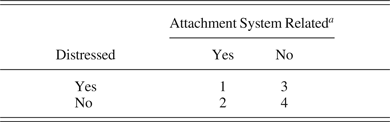
Future studies attempting to predict infant attachment might benefit from a framework that considers two components of parental behavior: (a) parental behavior related specifically to the secure base function of the infant's attachment system as Bowlby described it (see above), and (b) parental response to infant distress. Table 1 presents a 2 (attachment-related or not) × 2 (infant distressed or not) matrix that gives rise to a number of research questions. One key question is the following: is parental behavior in response to an infant's attachment behavioral system most predictive of infant attachment, regardless of whether the infant is distressed (i.e., parental behavior in both Cells 1 and 2)? Another set of questions relates to distress: is parental response to any form of infant distress the most central predictor of infant attachment (i.e., parental behavior in both Cells 1 and 3)? Does the termination of the physiological and emotional dysregulation of distress, no matter what the cause, that occurs through parental care solidify a tendency to use the parent as a secure base, or do the cognitive models that derive from experiences of distress in different contexts (e.g., distress during play vs. distress when seeking comfort) contribute differentially to secure base use? Most previous research has not drawn distinctions concerning the context of infant distress; future work that considers this distinction is needed.
Role of distress and context in parenting
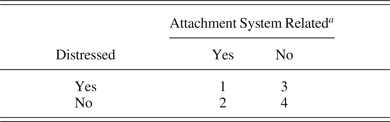
Note: The following examples describe 5- to 12-month-old infants participating in studies with their mothers in Cassidy's lab. Cell 1: The context is attachment related, and the infant is distressed: after having been left alone in an unfamiliar laboratory playroom, a crying 12-month-old crossed the room to her returning mother and reached to be picked up. Cell 2: The context is attachment related, and the infant is not distressed: an 8-month-old infant had been playing contentedly for 20 min near her mother at home. The mother had been sitting on the floor holding a toddler whose hair she was braiding. When the mother finished and the toddler moved away, the infant crawled to the mother, clambered up on her lap, and snuggled in for a hug; after exchanging tender pats with her mother, the infant returned to play on the floor. The lack of accessibility to the mother may have led to the infant's seeking contact in a manner that did not involve other activities (e.g., play or feeding). Cell 3: The context is not attachment related, and the infant is distressed: a 12-month-old infant became distressed when a toy was removed. Cell 4: The context is not attachment related, and the infant is not distressed: an infant, with her mother nearby, played happily with toys.
aIt is important to keep in mind that Bowlby (Reference Bowlby1969/1982) believed that the attachment system is best viewed as being “never idle” (p. 373), with a continuum of infant behavioral manifestations ranging from the simple monitoring of levels of threat and attachment figure availability to the high distress and intense attachment behavior evident when a crying infant rushes to be picked up. Attachment system related indicates that the context in question is related centrally to the infant's attachment behavioral system rather than to another behavioral system.
Additional questions raised by Table 1 include, is it the combination of maternal behavior when the infant's attachment system is central, along with any behavioral response to infant distress, that best predicts infant attachment (i.e., maternal behavior in Cells 1, 2, and 3)? Finally, is it the case (as some have suggested; e.g., Pederson & Moran, Reference Pederson and Moran1999) that maternal behavior in all four cells is predictive of infant attachment? Attempts to increase understanding of the precursors of infant attachment will require the development of detailed coding systems.
Finally, it will be crucial for future research conducted within a secure base framework to identify the specific maternal behaviors in response to activation of the infant's attachment system that predict infant security (for one approach, see Cassidy et al., Reference Cassidy, Woodhouse, Cooper, Hoffman, Powell, Rodenberg, Berlin, Ziv, Amaya-Jackson and Greenberg2005; and Woodhouse & Cassidy, Reference Woodhouse and Cassidy2009, who note that providing physical contact until the infant is fully calmed may be a more powerful predictor of later security than the general sensitivity of the parent's response). Basic research examining the extent to which infant distress occurs in relation to the attachment behavioral system will provide an important foundation for further work.
Additional mediational pathways: Genetics, cognitions, and emotions
Following the discovery of the transmission gap, several studies examined the possibility of a genetic mediating mechanism. However, neither behavior–genetic nor molecular–genetic research so far indicates a genetic component to individual differences in secure vs. insecure attachment, although mixed findings have emerged concerning a genetic vulnerability for infant disorganized attachment (Bakermans-Kranenburg & van IJzendoorn, Reference Bakermans-Kranenburg and van IJzendoorn2004, Reference Bakermans-Kranenburg and van IJzendoorn2007; Bokhorst et al., Reference Bokhorst, Bakermans-Kranenburg, Fearon, van IJzendoorn, Fonagy and Schuengel2003; Fearon et al., Reference Fearon, van IJzendoorn, Fonagy, Bakermans-Kranenburg, Schengel and Bokhorst2006; Roisman & Fraley, Reference Roisman and Fraley2008). (For evidence that variability in infants' serotonin transporter linked polymorphic region predicts not whether infants are secure or insecure but their subtype of security or subtype of insecurity, see Raby et al., Reference Raby, Cicchetti, Carlson, Cutuli, Englund and Egeland2012.) Future research should examine other genes and Gene × Environment interactions (for examples from primate research, see Suomi, Reference Suomi2011).
Despite a conceptual model of intergenerational transmission in which maternal behavior is central, examination of additional linking mechanisms purported to underlie maternal behavior, such as maternal cognitions and emotions, will continue to be important. Perhaps such factors may be more reliably measured than maternal behavior, and if they are, mediating relations may emerge to shed light on mechanisms of transmission (e.g., Bernier & Dozier, Reference Bernier and Dozier2003). Moreover, from a clinical standpoint, factors thought to underlie maternal behavior may be more amenable targets of intervention than maternal behavior itself. For example, continued examination of maternal cognition through the study of constructs such as reflective functioning and maternal insightfulness may shed light on the link between mother and child attachment (Oppenheim & Koren-Karie, Reference Oppenheim, Koren-Karie and Zeanah2009; Slade, Sadler, & Mayes, Reference Slade, Sadler, Mayes, Berlin, Ziv, Amaya-Jackson and Greenberg2005). These constructs refer to the extent to which a mother can see the world from her infant's point of view while also considering her own mental state. There is evidence that these and other components of maternal cognition (e.g., perceptions of the baby, attributions about infant behavior and emotions, maternal mind-mindedness) are linked to maternal and/or child attachment, and additional research is needed to clarify the extent to which these components mediate the link between the two (e.g., Leerkes & Siepak, Reference Leerkes and Siepak2006; Zeanah, Benoit, Hirshberg, Barton, & Regan, Reference Zeanah, Benoit, Hirshberg, Barton and Regan1994).
Another aspect of maternal functioning that should prove fruitful for researchers examining the transmission gap is maternal emotion regulation. As Cassidy (Reference Cassidy2006) has proposed, much maternal insensitivity can be recast as a failure of maternal emotion regulation. That is, when mothers themselves become dysregulated in the face of child behavior or child emotions that they find distressing (particularly child distress), their maternal behavior is more likely to be driven by their own dysregulation rather than by the needs of the child (see also Slade, in press). Evidence that maternal emotion-regulation capacities contribute to problematic parenting and insecure attachment has been reported (Leerkes et al., Reference Leerkes, Parade and Gudmundson2011; Lorber & O'Leary, Reference Lorber and O'Leary2005), as have data indicating that maternal state of mind with respect to attachment (i.e., maternal secure base script knowledge) is uniquely related to maternal physiological regulation in response to infant cries (but not in response to infant laughter; Groh & Roisman, Reference Groh and Roisman2009). Unfortunately, although there is a sound conceptual and empirical basis for maternal emotion regulation as a mediator of the link between maternal and child attachment, there has been no empirical examination of this possibility.
In sum, the direction of future work depends on researchers' goals. If the goal is to understand the maternal behavior that mediates the link between maternal state of mind and child attachment, then the focus must be on maternal behavior. However, if the goal is to understand what factors may guide maternal behavior, and as such may themselves be successful targets of intervention, then examination of factors such as maternal cognitions and emotions should prove useful as well.
Caregiving as a function of adult attachment style
Although most researchers using self-report measures of adult attachment have not focused on links with parenting, there is a substantial and growing body of literature (more than 50 published studies) that addresses this link (for a review, see Jones, Cassidy, & Shaver, Reference Jones, Cassidy and Shaver2013). Whereas researchers using the AAI have focused mainly on links between adults' AAI classifications and their observed parenting behaviors, attachment style researchers have focused mainly on links between adult attachment style and self-reported parenting cognitions and emotions (reviewed by Mikulincer & Shaver, Reference Mikulincer and Shaver2007). However, the few studies in which self-report attachment measures were used to predict parenting behavior have found support for predicted associations (e.g., Edelstein et al., Reference Edelstein, Alexander, Shaver, Schaaf, Quas and Lovas2004; Mills-Koonce et al., Reference Mills-Koonce, Appleyard, Barnett, Deng, Putallaz and Cox2011; Rholes, Simpson, & Blakely, Reference Rholes, Simpson and Blakely1995, Study 1; Selcuk et al., Reference Selcuk, Günaydin, Sumer, Harma, Salman and Hazan2010). This is especially the case for maternal self-reported attachment-related avoidance. (Note that each of these studies was conducted with mothers only [Edelstein et al., included four fathers], so caution is warranted in generalizing these findings to fathers.)
It would be useful to have more studies of adult attachment styles and observed parenting behavior. It would also be important to conduct longitudinal and intergenerational research using self-report measures. Prospective research is needed examining the extent to which adult attachment styles predict both parenting behaviors and infant attachment (see Mayseless, Sharabany, & Sagi, Reference Mayseless, Sharabany and Sagi1997; and Volling, Notaro, & Larsen, Reference Volling, Notaro and Larsen1998, for mixed evidence concerning parents' adult attachment style as a predictor of infant attachment). Of related interest to researchers examining attachment styles and parenting will be longitudinal research examining the developmental precursors of adult attachment as measured with self-report measures. (See Fraley, Roisman, Booth-LaForce, Tresch Owen, & Holland, Reference Fraley, Roisman, Booth-LaForce, Tresch Owen and Holland2013; and Zayas, Mischel, Shoda, & Aber, Reference Zayas, Mischel, Shoda and Aber2011, for evidence that self-reported attachment style in adolescence and early adulthood is predictable from participants' mothers' behavior during the participants' infancy and early childhood.)
In general, we need more merging of social and developmental research traditions. It would be useful to include both the AAI and self-report attachment style measures in studies of parenting behaviors and cognitions. It would also be useful to know how the two kinds of measures relate similarly and differently to parenting variables. Scharf and Mayseless (Reference Scharf and Mayseless2011) included both kinds of measures and found that both of them prospectively predicted parenting cognitions (e.g., perceived ability to take care of children), and in some cases, the self-report measure yielded significant predictions when the AAI did not (e.g., desire to have children). From the viewpoint of making predictions for practical or applied purposes, it is beneficial that both interview and self-report measures predict important outcomes but sometimes do so in nonredundant ways, thus increasing the amount of explained variance.
Mothers and fathers
It is unclear whether it is best to think of a single kind of parental caregiving system in humans or of separate maternal and paternal caregiving systems. Harlow proposed separate maternal and paternal systems in primates (e.g., Harlow, Harlow, & Hansen, Reference Harlow, Harlow, Hansen and Rheingold1963). Within a modern evolutionary perspective, the existence of separate maternal and paternal caregiving systems is readily understood. Because mothers and fathers may differ substantially in the extent to which the survival of any one child enhances their overall fitness, their parenting behavior may differ. The inclusion of fathers in future attachment research is crucial. We contend that the field's continued focus on mothers is more likely to reflect the difficulty of recruiting fathers as research participants than a lack of interest in fathers. Bowlby, after all, was careful to use the term attachment figure rather than mother, because of his belief that, although biological mothers typically serve as principal attachment figures, other figures such as fathers, adoptive mothers, grandparents, and childcare providers can also serve as attachment figures. Researchers presume it is the nature of the interaction rather than the category of the individual that is important to the child. In addition, the inclusion of fathers will permit examination of attachment within a family-systems perspective (Byng-Hall, Reference Byng-Hall, Cassidy and Shaver1999; Johnson, Reference Johnson, Cassidy and Shaver2008). Future research should examine (a) whether the precursors of infant–father attachment are similar to or different from the precursors of infant–mother attachment, (b) whether the Strange Situation best captures the quality of infant–father attachments (some have suggested that it does not; Grossmann Grossman, Kindler, & Zimmermann, Reference Grossmann, Grossmann, Kindler, Zimmermann, Cassidy and Shaver2008), (c) the influence of infants’ relationships with fathers and father figures on their subsequent security and mental health, (d) possible differences in the working models children have of mothers and fathers, and (e) possible influences of parents' relationship with each other on the child's sense of having, or not having, a secure base (Bretherton, Reference Bretherton2010; Davies & Cummings, Reference Davies and Cummings1994).
Attachment and Psychopathology
As mentioned at the outset of this article, Bowlby was a clinician interested in the influence of early experiences with caregivers on children's later mental health and delinquency (Bowlby, Reference Bowlby1944, Reference Bowlby1951). Following a line of thinking that later came to characterize the developmental psychopathology approach (e.g., Cicchetti, Reference Cicchetti1984), Bowlby developed attachment theory as a framework for investigating and understanding both normal and abnormal development (Sroufe, Carlson, Levy, & Egeland, Reference Sroufe, Carlson, Levy and Egeland1999). Given space limitations and the focus of this journal, we will concentrate on relations between attachment and child psychopathology (Figure 1, Path d; see Cassidy & Shaver, Reference Cassidy and Shaver2008; and Sroufe, Egeland, Carlson, & Collins, Reference Sroufe, Egeland, Carlson and Collins2005a, for reviews of attachment and psychosocial functioning more broadly). The vast majority of existing studies have, however, not focused on clinically diagnosed psychopathology but have been concerned with relations between attachment and continuous measures of internalizing and externalizing symptoms (e.g., assessed with the Child Behavior Checklist [CBCL]; Achenbach, Reference Achenbach1991).
Bowlby's theory of attachment and psychopathology
Bowlby used Waddington's (Reference Waddington1957) developmental pathways model to explain how early attachment relates to later developmental outcomes, including psychopathology. According to this model, developmental outcomes are a product of the interaction of early childhood experiences and current context (at any later age). Early attachment is not expected to be perfectly predictive of later outcomes. Moreover, attachment insecurity per se is not psychopathology nor does it guarantee pathological outcomes. Instead, insecurity in infancy and early childhood is thought to be a risk factor for later psychopathology if subsequent development occurs in the context of other risk factors (e.g., poverty, parental psychopathology, abuse). Security is a protective factor that may buffer against emotional problems when later risks are present (for a review, see Sroufe et al., Reference Sroufe, Carlson, Levy and Egeland1999).
Attachment and internalizing/externalizing behavior problems: State of the field
Over the past few decades, there have been many studies of early attachment and child mental health. The findings are complicated and difficult to summarize, as explained by Fearon, Bakermans-Kranenburg, van IJzendoorn, Lapsley, and Roisman (Reference Fearon, Bakermans-Kranenburg, van IJzendoorn, Lapsley and Roisman2010, p. 437): “With the sheer volume, range, and diversity of studies . . . it has become virtually impossible to provide a clear narrative account of the status of the evidence concerning this critical issue in developmental science” (italics added). Studies contributing to this body of work have used diverse samples and different methods and measures and have yielded inconsistent and, at times, contradictory results. Fortunately, two recent meta-analyses (Fearon et al., Reference Fearon, Bakermans-Kranenburg, van IJzendoorn, Lapsley and Roisman2010; Groh, Roisman, van IJzendoorn, Bakermans-Kranenburg, & Fearon, Reference Groh, Roisman, van IJzendoorn, Bakermans-Kranenburg and Fearon2012) provide quantitative estimates of the degree of association between child attachment and internalizing/externalizing symptoms.
The meta-analyses revealed that insecurity (avoidant, ambivalent, and disorganized combined) was related to higher rates of internalizing and externalizing symptoms (though the link appears to be stronger for externalizing symptoms). When the subtypes of insecurity were examined individually, avoidance and disorganization were each significantly related to higher rates of externalizing problems, but only avoidance was significantly related to internalizing problems. Ambivalence was not significantly related to internalizing or externalizing. Contrary to expectations, neither meta-analysis yielded much support for an interaction of child attachment and contextual risk in predicting behavior problems. For example, neither meta-analysis found support for the predicted child attachment by socioeconomic status (SES) interaction. However, given that high versus low SES is a rather imprecise measure of the numerous psychosocial risk factors that could contribute (individually and additively) to behavior problems, along with evidence from large sample studies supporting an attachment by risk interaction (e.g., Fearon & Belsky, Reference Fearon and Belsky2011), these results should be interpreted cautiously. In sum, the answer to the question “Is early attachment status related to later mental health difficulties?” is a resounding yes, but the precise nature of the connections remains unclear.
Attachment and psychopathology: Gaps in the research and future directions
More research is needed on mechanisms, or mediators, that help to explain how insecurity, or a particular form of insecure attachment, leads in some cases to psychopathology. These mechanisms should be considered at different levels of analysis: neurological, hormonal, cognitive, behavioral, and social–interactional. Mediators may include difficulties in emotion regulation and deficits in social skills, for example. Given the documented links between early attachment and emotion regulation and physiological stress responses (Cassidy, Reference Cassidy1994; Spangler & Grossmann, Reference Spangler and Grossmann1993), as well as the role of emotion dysregulation and HPA axis irregularities in psychopathology (Gunnar & Vazquez, Reference Gunnar, Vazquez, Cicchetti and Cohen2006; Kring & Sloan, Reference Kring and Sloan2010), emotion regulation seems to be a promising target for mechanism research. More research is also needed on potential moderators and risk factors, such as age, gender, personality, traumas and losses, SES, exposure to family and neighborhood violence. Researchers should consider the cumulative effects of multiple risk factors as well as interactions among risk factors (Belsky & Fearon, Reference Belsky and Fearon2002; Fearon & Belsky, Reference Fearon and Belsky2011; Kazdin & Kagan, Reference Kazdin and Kagan1994).
Given that most research on the mental health sequelae of early attachment has focused on internalizing and externalizing symptoms in nonclinical samples, future research should focus more on clinically significant problems and consider specific clinical disorders. The CBCL is not a measure of psychopathology, although it does indicate risk for eventual psychopathology (Koot & Verhulst, Reference Koot and Verhulst1992; Verhulst, Koot, & Van der Ende, Reference Verhulst, Koot and Van der Ende1994). Future research should address why the link between attachment and problematic behaviors is stronger for externalizing than for internalizing problems and whether this difference holds for diagnosable pathology (e.g., conduct disorder or major depression). This may be partially a measurement issue. The CBCL is often completed, with reference to a child, by a parent, a teacher, or both. It may be easier to see and remember externalizing behaviors than it is to notice whether a child is experiencing anxiety, sadness, or internal conflicts. Another important diagnostic issue is comorbidity. It is very common for clinicians to assign a person to multiple diagnostic categories. Perhaps attachment theory and related measures could help to identify common processes underlying comorbid conditions and suggest where their roots lie (Mineka, Watson, & Clark, Reference Mineka, Watson and Clark1998). One likely possibility is emotion regulation and dysregulation influenced by early experiences with parents.
Moreover, additional research is needed on the precise nature of the early childhood predictive factors and issues of causation. Is the issue really attachment status at age 1, for example, or is it continual insecure attachment across years of development? We also need to know whether attachment status per se is the issue or whether, for example, poor parenting predicts both attachment classification and psychopathology. Answering these questions will require studies using repeated assessments of attachment, parenting, context, and psychopathology. Further, there is increasing recognition of the importance of genetics and Gene × Environment interactions in understanding the development of psychopathology (e.g., Moffitt, Reference Moffitt2005). Given preliminary evidence for genetic influences on disorganized attachment (Lakatos et al., Reference Lakatos, Toth, Nemoda, Ney, Sasvari-Szekely and Gervai2000), as well as evidence for a Gene × Early Maternal Sensitivity interaction in predicting mental health outcomes (Bakermans-Kranenburg & van IJzendoorn, Reference Bakermans-Kranenburg and van IJzendoorn2006), this area of inquiry is a very promising avenue for further research. There is also growing evidence concerning environmental effects on gene expression (i.e., epigenetics; Meaney, Reference Meaney2010). Especially interesting is the possibility that secure attachment may protect a child from the expression of risky genotypes (see Kochanska, Philibert, & Barry, Reference Kochanska, Philibert and Barry2009, for preliminary evidence).
The Neuroscience of Attachment
Recent methodological advances (e.g., functional magnetic resonance imaging) have enabled researchers to investigate the neural correlates of attachment in humans. Initial theoretical formulations and empirical findings from the nascent subfield of “attachment neuroscience” (Coan, Reference Coan, Cassidy and Shaver2008) have begun to provide answers to important questions about the neurobiology of attachment. Recent advances in this area include (a) identifying key brain structures, neural circuits, neurotransmitter systems, and neuropeptides involved in attachment system functioning (see Coan, Reference Coan, Cassidy and Shaver2008, Reference Coan2010; and Vrtička & Vuilleumier, Reference Vrtička and Vuilleumier2012, for reviews), (b) providing preliminary evidence that individual differences in attachment can be seen at the neural level in the form of differential brain responses to social and emotional stimuli (Vrtička & Vuilleumier, Reference Vrtička and Vuilleumier2012), (c) demonstrating the ability of attachment figures to regulate their spouses' neural threat response (i.e., hidden regulators; Coan et al., Reference Coan, Schaefer and Davidson2006), and (d) advancing our understanding of the neurobiology of parenting (for a review, see Parsons, Young, Murray, Stein, & Kringelbach, Reference Parsons, Young, Murray, Stein and Kringelbach2010).
These early findings suggest important directions for attachment research. First, the vast majority of research on the neurobiology of attachment has been conducted with adults (yet see Dawson et al., Reference Dawson, Ashman, Hessl, Spieker, Frey and Panagiotides2001; White et al., Reference White, Wu, Borelli, Rutherford, David and Kim-Cohen2012). Researchers have the tools, however, to examine the neural bases of attachment in younger participants. It is feasible to have children as young as 4 or 5 years old perform tasks in a functional magnetic resonance imaging scanner (Byars et al., Reference Byars, Holland, Strawsburg, Bommer, Dunn, Schmithorst and Plante2002; Yerys et al., Reference Yerys, Jankowski, Shook, Rosenberger, Barnes and Berl2009), and less invasive measures such as EEG are commonly used with infants and even newborns. Additional investigations with younger participants could move the field of attachment neuroscience forward in important ways. For example, researchers could find ethically acceptable ways to extend the work of Coan and colleagues (Reference Coan, Schaefer and Davidson2006) to parents and children: just as holding the hand of a spouse attenuates the neural threat response in members of adult couples, holding the hand of a caregiver may have a similar effect on children. Researchers should also extend the sparse literature on how individual differences in attachment in children relate to differential neural responses to social and emotional stimuli.
Second, there is a need for longitudinal investigations that address several important unanswered questions. (a) What does child–parent attachment formation look like at the neural level in terms of the circuits involved and changes in neurobiology over time? (b) What is the role of developmental timing (i.e., sensitive and critical periods in brain development) in the formation of neural circuits associated with attachment? (c) Is the neural circuitry associated with attachment the same for children, adolescents, and adults? Some researchers have suggested that the neural circuitry associated with attachment may be different at different ages (Coan, Reference Coan, Cassidy and Shaver2008).
Third, future research should examine the ability of experience to change neural activity in brain regions related to attachment and should explore potential clinical implications of these findings. For example, Johnson et al. (Reference Johnson, Coan, Moser, Beckes, Smith and Dalgleish2013) compared the ability of spousal hand-holding to buffer neural responses to threat before and after couples underwent emotion-focused therapy. They found that emotion-focused therapy increased the ability of hand-holding to attenuate threat responses; similar examination of both parent and child neural activity in response to attachment-related interventions would be informative.
Fourth, it is important for future research to identify which, if any, brain regions are specific to attachment and which are shared with other related social constructs, such as caregiving or affiliation more broadly. There is initial evidence that caregiving and attachment involve both unique and overlapping brain regions (Bartels & Zeki, Reference Bartels and Zeki2004).
Fifth, given the inherent interpersonal nature of attachment, future research should attempt to study attachment-related neural processes in situations that approximate as closely as possible “real” social interactions (Vrtička & Vuilleumier, Reference Vrtička and Vuilleumier2012). To date, all studies of the neuroscience of attachment have focused on the neural activity of only one partner in a relationship. By capitalizing on further methodological advances in neuroimaging (e.g., hyperscanning; Montague et al., Reference Montague, Berns, Cohen, McClure, Pagnoni and Dhamala2002) researchers may be able to examine simultaneously the neural activity of a parent and child while they are interacting.
Attachment, Inflammation, and Health
Evidence is accumulating that attachment insecurity in adulthood is concurrently associated with negative health behaviors (e.g., poor diet, tobacco use; Ahrens, Ciechanowski, & Katon, Reference Ahrens, Ciechanowski and Katon2012; Huntsinger & Luecken, Reference Huntsinger and Luecken2004; Scharfe & Eldredge, Reference Scharfe and Eldredge2001) and problematic health conditions (e.g., chronic pain, hypertension, stroke, heart attack; McWilliams & Bailey, Reference McWilliams and Bailey2010). Despite these intriguing cross-sectional findings in adult samples, much less is known about how early attachment relates to long-term health outcomes. One longitudinal study (Puig, Englund, Collins, & Simpson, Reference Puig, Englund, Simpson and Collins2012) reported that individuals classified as insecurely attached to mother at 18 months were more likely to report physical illnesses 30 years later. Two other studies found that early insecure attachment was associated with higher rates of obesity at age 4.5 (Anderson & Whitaker, Reference Anderson and Whitaker2011) and 15 (Anderson, Gooze, Lemeshow, & Whitaker, Reference Anderson, Gooze, Lemeshow and Whitaker2012). Additional longitudinal investigations of the links between early attachment and health outcomes are needed to replicate these findings in different samples using a wider variety of health measures (e.g., medical records, biomarkers, onset and course of specific health problems).
Another goal for future research is to advance our understanding of the processes or mechanisms by which early attachment is related to later health outcomes. Recent proposals that early psychosocial experiences become “biologically embedded” at the molecular level and influence later immune system functioning (e.g., inflammation) provide a promising model with which to pursue this kind of research (for a review of the conceptual model and its empirical support, see Miller, Chen, & Parker, Reference Miller, Chen and Parker2011). In brief, the model proposes that early adverse experiences result in immune system cells with a “proinflammatory phenotype” and neuroendocrine dysregulation leading to chronic inflammation. Inflammation in turn is involved in a variety of aging-related illnesses, including cardiovascular disease, autoimmune diseases, and certain types of cancer (Chung et al., Reference Chung, Cesari, Anton, Marzetti, Giovannini and Seo2009).
As mentioned earlier, there is mounting evidence that early experiences with caregivers (including their influence on attachment) contribute to the calibration and ongoing regulation of the HPA axis (e.g., cortisol reactivity, diurnal cortisol rhythms), a system that is central to the body's stress response (Adam et al., Reference Adam, Klimes-Dougan, Gunnar, Coch, Dawson and Fischer2007; Gunnar & Quevedo, Reference Gunnar and Quevedo2007; Luijk et al., Reference Luijk, Saridjan, Tharner, van IJzendoorn and Bakermans-Kranenburg2010; Spangler & Grossmann, Reference Spangler and Grossmann1993). The HPA axis also plays an integral role in inflammatory responses and immune system functioning. In addition, there is evidence that early maternal warmth (retrospectively reported) can buffer the deleterious effects of early adversity on proinflammatory signaling in adulthood (Chen, Miller, Kobor, & Cole, Reference Chen, Miller, Kobor and Cole2011; for a review of the links between adult attachment and HPA axis functioning, see also Pietromonaco, DeBuse, & Powers, Reference Pietromonaco, DeBuse and Powers2013). Finally, studies show that attachment in adulthood is concurrently related to biomarkers of immunity: attachment-related avoidance is related to heightened levels of the proinflammatory cytokine interleukin-6 in response to an interpersonal stressor (Gouin et al., Reference Gouin, Glaser, Loving, Malarkey, Stowell and Houts2009) and to lower levels of natural killer cell cytotoxicity (natural killer cells are involved in immune defense; Picardi et al., Reference Picardi, Battisti, Tarsitani, Baldassari, Copertaro and Mocchegiani2007); attachment-related anxiety is related to elevated cortisol production and lower numbers of T cells (Jaremka et al., Reference Jaremka, Glaser, Loving, Malarkey, Stowell and Kiecolt-Glaser2013).
These initial findings provide an empirical basis for researchers to pursue further the connections between attachment and health. Future research should prospectively examine the relation between early attachment security and biomarkers of inflammation in adulthood. Further, researchers should attempt to elucidate the relations among attachment, HPA axis functioning, inflammation, and the immune system to better understand the biological processes underlying the link between early experience and later health outcomes.
Attachment and Empathy, Compassion, and Altruism
Shortly after the development of the Strange Situation, which allowed researchers to validly assess infants' attachment orientations, there was strong interest in the potential links between attachment security and prosocial motives and behaviors (e.g., empathy, compassion). From a theoretical standpoint, there are reasons to expect that secure children (whose own needs have been responded to in a sensitive and responsive way) will develop the capacity to respond to the needs of others empathically. Several early investigations confirmed the association between child attachment security and empathic responding (Kestenbaum, Farber, & Sroufe, Reference Kestenbaum, Farber and Sroufe1989; Sroufe, Reference Sroufe and Perlmutter1983; Teti & Ablard, Reference Teti and Ablard1989). Over the past 24 years, however, the link between child attachment status and prosocial processes (e.g., empathy, helping, altruism) has received surprisingly little research attention (though see Panfile & Laible, Reference Panfile and Laible2012; Radke-Yarrow, Zahn-Waxler, Richardson, Susman, & Martinez, Reference Radke-Yarrow, Zahn-Waxler, Richardson and Susman1994; van der Mark, van IJzendoorn, & Bakermans-Kranenburg, Reference van der Mark, van IJzendoorn and Bakermans-Kranenburg2002). In contrast, social/personality psychologists have generated substantial and compelling empirical support for a connection between adult attachment and prosocial motives and behaviors.
Mikulincer, Shaver, and colleagues (Mikulincer & Shaver, Reference Mikulincer and Shaver2001; Mikulincer, Shaver, Gillath, & Nitzberg, Reference Mikulincer, Shaver, Gillath and Nitzberg2005; Mikulincer, Shaver, Sahdra, & Bar-On, in press) have demonstrated that both dispositional and experimentally augmented attachment security (accomplished through various forms of “security priming”) are associated with several prosocial constructs, including reduced outgroup prejudice, increased compassion for a suffering stranger and willingness to suffer in her place, and the ability and willingness of one partner in a couple to listen sensitively and respond helpfully to the other partner's description of a personal problem. In addition, surveys completed in three different countries (United States, Israel, Netherlands) revealed that more secure adults (measured by self-reports) were more likely to volunteer in their communities (e.g., by donating blood or helping the elderly). Avoidant respondents were much less likely to volunteer, and although anxious respondents volunteered, their reasons for doing so (e.g., to receive thanks, to feel included) were less generous than those of their more secure peers (Gillath et al., Reference Gillath, Shaver, Mikulincer, Nitzberg, Erez and van IJzendoorn2005).
Further study of how early attachment relates to various forms of prosocial behavior is needed. Developmental attachment researchers would benefit from using the experimental techniques that Mikulincer, Shaver, and colleagues used (Mikulincer & Shaver, Reference Mikulincer and Shaver2001; Mikulincer et al., 2005, in press). Are young children who were classified as secure in the Strange Situation (especially in comparison to children classified as avoidant) more willing to help a suffering individual or more willing to interact with a child from a different ethnic group? Can experimental security “boosts” increase tolerance, empathy, compassion, and altruism in children? There is already robust experimental evidence that infants as young as 14 to 18 months readily engage in altruistic behavior (e.g., retrieving an out-of-reach object for a stranger; for a review, see Warneken & Tomasello, Reference Warneken and Tomasello2009). To the best of our knowledge, however, no study has examined whether variations in infant attachment predict individual differences in this kind of instrumental helping behavior (although the potential for attachment-related differences has been proposed by Dweck; see Tomasello, Dweck, Silk, Skyrms, & Spelke, Reference Tomasello, Dweck, Silk, Skyrms and Spelke2009). Warneken and Tomasello (Reference Warneken and Tomasello2009) have proposed that these early helping behaviors reflect a biological predisposition for altruism in infants that begins to be influenced by social and cultural experiences only “a year or two after [the infants] have started behaving altruistically” (p. 400). However, given the innumerable social experiences that infants encounter in the first year of life and the pioneering work by Johnson and colleagues (Johnson, Dweck, & Chen, Reference Johnson, Dweck and Chen2007; Johnson et al., Reference Johnson, Dweck, Chen, Stern, Ok and Barth2010) showing that 12- to 16-month-old infants with different attachment patterns have different expectations about others' helpfulness, it may be possible to observe attachment-related individual differences in early helping behaviors earlier than Warneken and Tomasello suggest.
Attachment and School Readiness
In recent years researchers, educators, and policy makers have been increasingly interested in understanding factors that predict children's school readiness and in developing and testing programs that may better prepare children (particularly at-risk children) for school entry. In his 2013 State of the Union Address at the beginning of his second term, President Obama proposed implementing universal, high-quality preschool for all American children with the idea that these early preparatory experiences will enhance school readiness and future academic performance. The focus of much of the initial research on school readiness has been on children's basic cognitive skills, such as early literacy and numeracy abilities (e.g., Duncan et al., Reference Duncan, Dowsett, Claessens, Magnuson, Huston and Klebanov2007). More recently, researchers have recognized the importance of other competencies, such as emotion regulation and social skills (e.g., High, Committee on Early Childhood, Adoption, and Dependent Care, & Council on School Health, Reference High2008). Further, High et al. listed “strong nurturing relationships” as one of the universal needs of children that must be met to promote school readiness and positive educational outcomes (p. e1009).
The conclusions reached by High et al. (Reference High2008) suggest that child attachment security is an important factor to consider when studying school readiness and developing programs designed to improve school readiness (for empirical evidence, see Belsky & Fearon, Reference Belsky and Fearon2002; and Stacks & Oshio, Reference Stacks and Oshio2009). Decades of research have provided substantial evidence that early attachment security is associated with better emotion-regulation capacities and greater social competence (e.g., Cassidy, Reference Cassidy1994; Sroufe et al., Reference Sroufe, Egeland, Carlson and Collins2005a; Thompson, Reference Thompson, Cassidy and Shaver2008). In addition, research has demonstrated that secure attachment is associated with better academic performance (Granot & Mayseless, Reference Granot and Mayseless2001) as well as enhanced cognitive skills and executive functions (Bernier, Carlson, Deschênes, & Matte-Gagné, Reference Bernier, Carlson, Deschênes and Matte-Gagné2012; Jacobsen, Edelstein, & Hofmann, Reference Jacobsen, Edelstein and Hofmann1994). Thus, as research on school readiness continues to advance, greater consideration of the direct and indirect influences of early attachment security on school readiness is warranted. For example, researchers should test mediational models in which attachment security predicts greater emotion regulation or social competence, which in turn predicts greater school readiness. In addition, both parenting and school readiness interventions could consider whether increasing parental secure base provision fosters a child's school readiness. Moreover, consideration of the extent to which preschool teachers perform secure base and safe haven functions for their young students, and whether these components of the student–teacher relationship relate to young children's classroom functioning will be important (see Commodari, Reference Commodari2013).
Attachment and Culture
Bowlby (Reference Bowlby1969/1982) viewed the attachment behavioral system as a product of human evolutionary history, making it cross-culturally universal. Ainsworth's (Reference Ainsworth1967; Ainsworth et al., Reference Ainsworth, Blehar, Waters and Wall1978) early studies in Uganda and the United States provided empirical support for similar attachment processes in very different cultures. Although some researchers have disputed the cross-cultural validity of core tenets of attachment theory (e.g., Rothbaum, Weisz, Pott, Miyake, & Morelli, Reference Rothbaum, Weisz, Pott, Miyake and Morelli2000), decades of research strongly suggest that the basic phenomenon and the major kinds of individual differences are universal (see van IJzendoorn & Sagi-Schwartz, Reference van IJzendoorn, Sagi-Schwartz, Cassidy and Shaver2008, for a review). Three hypotheses rooted in attachment theory have been examined and supported in cross-cultural research: (a) that secure attachment is the most prevalent pattern in all cultures and is viewed as the most desirable pattern, (b) that maternal sensitivity influences infant attachment patterns, and (c) that secure infant attachment predicts later social and cognitive competence.
However, much more research is needed. As psychological knowledge, research, and applications become increasingly global, it will become more feasible to map the detailed effects of cross-cultural and contextual differences in parenting, coparenting, community care, environmental harshness and instability, and conflicts and war on attachment patterns and attachment-related mental health problems. It will be increasingly important to define “culture” and “context” more specifically. Within any large and diverse society, and in every large urban area (in a world increasingly urbanized), there are many cultures and subcultures. Moreover, within any modern society there are large differences in ethnicity, religion, diet, education, income, economic security, and threats to health and the availability of medical care. It is therefore important not to think of differences only between nation states but also within different groups and contexts within each nation.
Translating Attachment Research to Clinical Practice
Interventions with infants and young children at risk for insecure attachment
Just as the study of individual differences in attachment began with the study of infants, so the systematic study of how to create attachment-related change focused initially on attempts to alter the developmental trajectory of infants who are at risk of developing or maintaining insecure attachments. Given the substantial and converging longitudinal research underscoring the risks associated with insecure attachment (e.g., poorer mental and physical health and lower social competence), the need to intervene to reduce the risk of insecure attachment is clear. In the past 20 years, researchers and clinicians have developed numerous therapeutic programs to prevent or reduce insecure attachment (Bakermans-Kranenburg, van IJzendoorn, & Juffer, Reference Bakermans-Kranenburg, van IJzendoorn and Juffer2003; Egeland, Weinfield, Bosquet, & Cheng, Reference Egeland, Weinfield, Bosquet, Cheng, Osofsky and Fitzgerald2000; see Berlin, Zeanah, & Lieberman, Reference Berlin, Zeanah, Lieberman, Cassidy and Shaver2008, for a review). Even though a handful of attachment interventions have shown initial success (e.g., Bernard et al., Reference Bernard, Dozier, Bick, Lewis-Morrarty, Lindhiem and Carlson2012; Cassidy et al., Reference Cassidy, Woodhouse, Sherman, Stupica and Lejuez2011; Cicchetti, Rogosch, & Toth, Reference Cicchetti, Rogosch and Toth2006; Hoffman, Marvin, Cooper, & Powell, Reference Hoffman, Marvin, Cooper and Powell2006; Klein Velderman, Bakermans-Kranenburg, Juffer, & van IJzendoorn, Reference Klein Velderman, Bakermans-Kranenburg, Juffer and van IJzendoorn2006; Lieberman, Weston, & Pawl, Reference Lieberman, Weston and Pawl1991; Lyons-Ruth & Easterbrooks, Reference Lyons-Ruth and Easterbrooks2006; Sadler et al., Reference Sadler, Slade, Close, Webb, Simpson and Fennie2013; Toth, Rogosch, Manly, & Cicchetti, Reference Toth, Rogosch, Manly and Cicchetti2006; van den Boom, Reference van den Boom1994, Reference van den Boom1995), we have as yet a collection of individual initiatives with little replication. More research is needed to identify the critical targets of attachment interventions and to understand the process of change.
Targets of early intervention
What should an intervention target? Until recently, this question was framed largely as “Should interventions target parental behavior, parental representations, or both?” Greater specificity is required. When an intervention targets parental behavior, what specific components of behavior should be targeted? (We discussed potential aspects of parental behavior earlier.) When an intervention targets parental representations, what specific components should be targeted? Should interventions target representations of the parent her- or himself, of the infant, of the relationship; of the baby as an entity with a mind (e.g., mentalizing approaches; Slade et al., Reference Slade, Sadler, Mayes, Berlin, Ziv, Amaya-Jackson and Greenberg2005); or maternal attributions about the infant's behavior (Bugental et al., Reference Bugental, Ellerson, Lin, Rainey, Kokotovic and O'Hara2002)?
Several studies (described earlier) suggest additional intervention targets. For example, the evidence that maternal emotion-regulation capacities influence parenting (Dix, Reference Dix1991; Leerkes, Crockenberg, & Burrous, Reference Leerkes, Crockenberg and Burrous2004; Lorber & Slep, Reference Lorber and Slep2005; Smith & O'Leary, Reference Smith and O'Leary1995) suggests that targeting maternal emotion regulation capacities might be useful in bringing about change (e.g., the Circle of Security intervention; Hoffman et al., Reference Hoffman, Marvin, Cooper and Powell2006). Another target of intervention is suggested by research with nonhuman primates and other mammals that demonstrates the soothing and regulatory functions that physical contact with an attachment figure can provide (Hofer, Reference Hofer1994, Reference Hofer2006; Meaney, Reference Meaney2001; Suomi, Reference Suomi, Cassidy and Shaver2008; see Feldman, Singer, & Zagoory, Reference Feldman, Singer and Zagoory2010, for such evidence in humans; see also Field, Reference Field, Hertenstein and Weiss2011). Interventions focused on infant–mother contact may prove useful. (See Anisfeld, Casper, Nozyce, & Cunningham, Reference Anisfeld, Casper, Nozyce and Cunningham1990, for a randomized trial in which mothers assigned to carry their infants in soft baby carriers were more likely to have infants who were securely attached at age 1.) Consideration of intervention targets necessarily requires considering moderators of intervention effectiveness. Targeting certain components may be more effective for some mothers than others.
The desire to intervene to reduce the risk of insecure attachment rests on the assumption that doing so in turn reduces the risk of poor child functioning, including a reduction in behavior problems and psychopathology. Although there are a number of studies (described above) that show a link between insecure attachment and behavior problems and psychopathology, much less research has focused on whether intervening to reduce the risk of insecure attachment actually leads to a reduction in later problems (however see Dozier et al., Reference Dozier, Peloso, Lindhiem, Gordon, Manni and Sepulveda2006; Moss et al., Reference Moss, Dubois-Comtois, Cyr, Tarabulsy, St-Laurent and Bernier2011; Klein Velderman et al., Reference Klein Velderman, Bakermans-Kranenburg, Juffer and van IJzendoorn2006; van den Boom, Reference van den Boom1995; Van Zeijl et al., Reference Van Zeijl, Mesman, van IJzendoorn, Bakermans-Kranenburg, Juffer and Stolk2006). Future intervention research should test the change model according to which improving parenting reduces the risk of insecure attachment, which in turn reduces child behavior problems and psychopathology. Given that behavior problems associated with early insecure attachment may not emerge until later in development, and the evidence that the link between insecure attachment and behavior problems grows stronger over time (Fearon & Belsky, Reference Fearon and Belsky2011), longitudinal studies with long-term outcome assessments will be an important component of future intervention research.
Intervention development and issues of implementation
No attachment intervention has yet achieved widespread implementation. When following the typical efficacy-to-effectiveness clinical model, researchers initially design an intervention with a highly specified protocol, and only once it has proven to be efficacious in a tightly controlled setting do they begin to consider the adaptations needed for effectiveness in real-world settings. With attachment-based infant interventions, the problem has been that initial interventions are typically very expensive, and real-world social agencies attempting to meet the needs of at-risk infants cannot afford them. This is an unfortunate situation, especially because, over the past decade, there has been a call for researchers to attend to issues of implementation during the early stages of intervention planning. For instance, an argument that “the focus on feasibility in the prevention research cycle should not be restricted to the effectiveness stage” has been put forward by Ialongo and colleagues (Reference Ialongo, Rogosch, Cicchetti, Toth, Buckley, Petras, Cicchetti and Cohen2006).
Several components of early attachment-based interventions make implementation at a broad public health level impractical. Many such interventions involve videotaping individual parent–infant interactions and providing individualized parental feedback (e.g., Dozier et al., Reference Dozier, Peloso, Lindhiem, Gordon, Manni and Sepulveda2006; Klein Velderman et al., Reference Klein Velderman, Bakermans-Kranenburg, Juffer and van IJzendoorn2006). This requires considerable resources, including extensive training and supervision of staff; expertise and time to create individual diagnostic and treatment plans; and time, space, equipment, skills, and parental assent for individual videotaping. From an attachment perspective, the problem is how to provide an individualized approach that does not require expensive, highly skilled staff. This problem has not been easy to solve (e.g., Berlin, Ziv, Amaya-Jackson, & Greenberg, Reference Berlin, Ziv, Amaya-Jackson and Greenberg2005). Continued attempts to develop interventions that are widely and affordably implementable are important.
We urgently need evaluations of comprehensive theory- and research-based intervention protocols that can be widely implemented among families whose infants and children are at elevated risk for developing or maintaining insecure attachments. Addressing this need is in keeping with the National Institute of Mental Health (NIMH; 2008) strategic plan's objective of moving interventions to “common practice” more quickly and of examining interventions in “the care setting in which they are delivered” (p. 35). Continued testing of attachment-based interventions should occur further down the efficacy-to-effectiveness stream, with affordable protocols that can be provided through existing service delivery mechanisms. Expensive interventions are not implementable on a broad scale within the current American health care and educational structures.
Intervention development and testing are enormously expensive, yet replication of existing interventions is crucial. We propose that the dedication of resources to development of new interventions occur only when theory, clinical perspectives, or research indicate that existing interventions lack an important component that could reasonably contribute to change.
Interventions during adolescence
Adolescence is a period of increased risk-taking behavior and mental health disorders (Centers for Disease Control and Prevention, 2012; Roberts, Attkisson, & Rosenblatt, Reference Roberts, Attkisson and Rosenblatt1998), and attempts to reduce these problematic symptoms and behaviors are important. The dramatic biological and cognitive changes that occur during adolescence have led some researchers to consider this period as a second sensitive period (e.g., Andersen & Teicher, Reference Andersen and Teicher2008; Guttmannova et al., Reference Guttmannova, Bailey, Hill, Lee, Hawkins and Woods2011), and as such, adolescents may be particularly open to environmental interventions that can lead to improved functioning.
Interventions designed to help adolescents are typically targeted at the reduction of specific problems (e.g., depression or delinquency), and there are many effective interventions for helping troubled adolescents (e.g., Dishion & Kavanagh, Reference Dishion and Kavanagh2003; Stein, Zitner, & Jensen, Reference Stein, Zitner and Jensen2006). Given evidence that the link between attachment security and healthy functioning continues to exist in adolescence (Dykas, Ziv, & Cassidy, Reference Dykas, Ziv and Cassidy2008; Kobak & Sceery, Reference Kobak and Sceery1988; see Allen, Reference Allen, Cassidy and Shaver2008, for a review), increasing adolescent attachment security may also be an effective means of reducing adolescent problems. In other words, does an intervention focused on the adolescent–parent attachment relationship increase the likelihood of reduced problematic adolescent behavior? There has been remarkably little research on this important question. Moreover, the associations among intervention, attachment, and psychopathology may be more complex in adolescence than they are in infancy and early childhood. Another important way to examine the connections among these factors is to design studies to determine whether reducing adolescent psychopathology contributes to secure adolescent attachment.
In an intervention designed to enhance adolescent–parent attachment security, with the idea being that increased security will reduce the prevalence of adolescent problems, questions about intervention approaches arise. For instance, should an intervention include the parent, the adolescent, or both? Bretherton (Reference Bretherton1992) described Bowlby as the first family therapist because of his proposition that change in a child's attachment to a parent is possible only when there is change within the interaction between the child and the parent (see also Byng-Hall, Reference Byng-Hall, Cassidy and Shaver1999). There has been almost no examination of this proposition in adolescence. One randomized controlled trial (Diamond et al., Reference Diamond, Wintersteen, Brown, Diamond, Gallop and Shelef2010) showed that attachment-based family therapy was more efficacious than enhanced usual care in reducing adolescents' depressive symptoms and suicidal ideation.
Policy Implications
Throughout this article we have suggested topics for future research. At least as important are the needs for application of the findings already obtained and increased collaborations among researchers, policy makers, educators, and child service workers. Here we list a few important areas for such efforts.
Attachment research has clearly established the importance of early experiences with parents for child development, yet far too many parents enter parenthood with insufficient knowledge about child development and the importance of the early parent–child relationship and without the knowledge and skills needed to parent in a sensitive, responsive manner. Unfortunately, there is almost no future-parent education at any grade level in public schools. In American schools, there seems to be a greater focus on education about sex than about successful parenting. (Most sex education classes do not deal with other aspects of couple relationships, even though there is a considerable body of attachment-related research relevant to establishing and maintaining healthy couple relationships, which is a foundation for healthy parent–child relationships.) Even at the college level, there are few courses aimed at preparing young adults for healthy marriages and parenting. Researchers and educators should work together to develop future-parent curricula that could be implemented as part of high school and university education. There are several empirically supported parent training programs based on attachment research (described earlier; see Berlin et al., Reference Berlin, Zeanah, Lieberman, Cassidy and Shaver2008, for a review), but these have yet to be made a part of general education.
In the context of dramatic social and economic changes, many parents are struggling to strike a balance between work and family responsibilities and to find quality care for their children while the parents are at work or school. There is a need for more flexible work arrangements that recognize child care as a prime societal concern. This includes reexamination of parental leave policies that require parents to return to work too soon after childbirth, either because of company policy or because of financial necessity. In addition, greater attention to the training and screening of childcare workers and prospective foster parents is warranted. In a review of attachment theory and its implications for society, Sweeney (Reference Sweeney, Loveless and Homan2007) suggested, among several policy implications, “legislative initiatives reflecting higher standards for credentialing and licensing childcare workers, requiring education in child development and attachment theory, and at least a 2-year associate's degree course as well as salary increases and increased stature for childcare positions” (p. 342). The massive NICHD childcare study showed that high-quality daycare is compatible with secure attachment of young children to their parents and also that, when home conditions make secure attachment unlikely, high-quality daycare can increase children's chances of achieving attachment-related security (NICHD Early Child Care Research Network, 1997).
Policies directed at helping families in which one or both parents serve in the military could also be informed by attachment theory and research. Military service often entails frequent moves within the United States and separation of at least one parent from the family during periods of service overseas. In thousands of cases, the separation ends with a soldier's death, and his or her family is left to cope with the tragedy. Attention to helping spouses and children cope effectively with attachment-related stresses that have the potential to damage their lives for years to come has increased in recent years (e.g., Maholmes, Reference Maholmes2012; see also Riggs & Riggs, Reference Riggs and Riggs2011, for consideration of military families within an attachment theory framework), but there continues to be a need for research-informed interventions that consider the particular challenges faced by military families (for discussion, see Miller, Miller, & Bjorklund, Reference Miller, Miller and Bjorklund2010; Paris, DeVoe, Ross, & Acker, Reference Paris, DeVoe, Ross and Acker2010).
We end with a brief mention of policy implications related to parental incarceration. Elsewhere (Cassidy, Poehlmann, & Shaver, Reference Cassidy, Poehlmann and Shaver2010) we have provided reviews and studies related to this issue. Often, incarcerated parents are unable to see their children, and pressures are placed on the rest of extended families and, in many cases, on the foster care system. For each adult placed in prison, there are likely to be, on average, more than one or two people outside of prison who suffer from the incarceration. Policymakers could consider the separations and losses that accompany parental incarceration within an attachment framework. Research is needed to assess the value of greater contact between incarcerated individuals and their children and of parenting interventions that can take place as part of rehabilitation.
Conclusions
Our goal in this article has been to provide a current state-of-the-art description of what is known in many important areas of attachment research, discuss gaps in current knowledge, and suggest important avenues for future research and for creating and evaluating practical interventions. Although we have, by design, focused on issues within attachment research specifically, an important enterprise for the future is to consider how attachment is differentiated from, and integrated with, other features of development. As our colleague Alan Sroufe responded when asked his views on the future of attachment research, “There is a lot more to personal development than attachment, and there is a lot more even to parenting than attachment. The task is to describe how all of this fits and works together” (personal communication, 2012; see also Sroufe, Egeland, Carlson, & Collins, Reference Sroufe, Egeland, Carlson, Collins, Grossmann, Grossmann and Waters2005b). That task arises with respect to every phase of development (infancy, childhood, adolescence, adulthood) and the range of issues and factors to be considered is somewhat different at every stage or phase of development.
Certain large goals of any worthy society, including the mental and physical health of its members, the optimal development of each individual's interests and capacities, and a safe environment free of violence and hatred, are likely to be achieved only to the extent that infants and children receive the benefits of what Bowlby and Ainsworth called a safe haven and a secure base, which as far as we can see imaginatively into the future are likely to depend on responsive attachment figures. Partly through the efforts of Bowlby, Ainsworth, and their intellectual offspring, it has been possible to improve hospital procedures, reduce child abuse, contribute to better parenting, increase understanding of the development of psychopathology, and provide a much better understanding of our social nature as mammals, primates, and human beings. With the goal of a mentally and physically healthy human race in mind, we can simultaneously be proud of the accomplishments of attachment researchers and look forward to participating in addressing the many intellectual, clinical, and educational challenges remaining.