INTRODUCTION
Inadequate attention has been paid to fathers whose wives have died of cancer and who are now shepherding themselves and their dependent children through bereavement and recovery (Yopp & Rosenstein, Reference Yopp and Rosenstein2012). There is also insufficient research on the effects of paternal parenting styles on preadolescent and adolescent daughters after a mother's/wife's death (Wellisch et al., Reference Wellisch, Ormseth and Hartoonian2012).
A lack of effective parenting by widowed fathers of their daughters can compound the tragedy of maternal loss. We observed this in our research population of women attending the UCLA Revlon High Risk Clinic, half of whose mothers had died from breast cancer. The combination of maternal loss with subsequent maladaptive paternal parenting resulted in dysfunction in a substantial subset of women who are considered at high risk for breast cancer because of family history and/or genetic mutations. The types and severity of dysfunction were related to their fathers' coping and parenting strategies. Intervening with these father–daughter dyads prior to the mother's death might reduce their impairment (Wellisch & Lindberg, Reference Wellisch, Lindberg and Baider2000). Studies have shown that breast cancer affects all family members while the mother is undergoing treatment and permanently affects family dynamics after her death (Lewis et al., Reference Lewis, Hammond and Woods1993; Osborn, Reference Osborn2007; Visser et al., Reference Visser, Huizinga and van der Graaf2004). While both male and female children reported feeling stressed while their mothers were ill, and while all children fared worse in homes in which mothers had poorer prognoses, it appears that adolescent daughters of mothers with cancer suffered more problems, assumed more family responsibilities, and were more prone to ruminative coping than were sons (Compas et al., Reference Compas, Worsham and Epping-Jordan1994; Grant & Compas, Reference Grant and Compas1995; Birenbaum et al., Reference Birenbaum, Yancey and Phillips1999; Visser et al., Reference Visser, Huizinga and van der Graaf2004). Adult daughters and fathers who shared caregiving responsibilities were grieved equally, but the daughters experienced more symptoms of anxiety, depression, and extent of family strain than did their widowed fathers (Bernard & Guarnaccia, Reference Bernard and Guarnaccia2003).
LITERATURE REVIEW
Paternal Adjustment during Maternal Illness
When the mother in a two-parent family develops breast cancer, fathers' responses vary. In addition to outside work responsibilities, fathers are called upon to shoulder additional duties at home and to talk to their children about their mother's diagnosis (Wellisch & Lindberg, Reference Wellisch, Lindberg and Baider2000). Fathers were less comfortable and successful than their own wives in answering their children's questions about their mother's outcome. Fathers were less aware than were their wives of their children's anxiety.
The fathers did not wish to be seen as psychologically needy. Their resulting efforts to control their emotions may have contributed to additional communication difficulties with their adolescent children (Forrest et al., Reference Forrest, Plumb and Ziebland2009). In turn, children were sensitive to their fathers and sought to protect them from stress by seeking reassurance from other family members, friends, and peers. In homes where fathers were already actively engaged with their children and with the household, the fathers found it easier to assume more caretaking responsibilities, but they acknowledged feeling overextended by their additional roles (Northouse, Reference Northouse1988; Zahlis & Shands, Reference Zahlis and Shands1993; Hilton et al., Reference Hilton, Crawford and Tarko2000).
Parenting after Maternal Death
Children's responses to their mother's death depend on their developmental stage, language, and cognitive abilities; their relationship with their father; and his ability to provide a stable home while managing his own grief (Nickman et al., Reference Nickman, Silverman and Normand1998; Tennant, Reference Tennant1998). An open style of communication, already important during their mother's illness, becomes more critical after the mother's death, when fathers can help their bereaved children talk freely about their mother and share memories of her (Nickman et al., Reference Nickman, Silverman and Normand1998). Children of fathers who supply emotional warmth and consistent discipline have fewer problems after the first year of loss, are more psychologically resilient, and cope better than children whose fathers neglected these tasks (Kwok et al., Reference Kwok, Haine and Saudler2005). Fathers who removed reminders of the dead parent, soon began dating, or remarried without consulting with their children left children feeling that something was “missing” (Nickman et al., Reference Nickman, Silverman and Normand1998). These children were at risk for complicated grief because they had no internalized maternal image to comfort them (Black & Urbanowicz, Reference Black and Urbanowicz1987; Kissane & Bloch, Reference Kissane and Bloch1994; Nickman et al., Reference Nickman, Silverman and Normand1998).
Children from families that are supportive, cohesive, adept at conflict resolution, and who communicate well fare better than children who come from “hostile” families where family members reject help, communicate poorly, and are not united (Kissane et al., Reference Kissane, McKenzie and Bloch2006). In the hostile families, and in families where the strain of bereavement overwhelms previous cohesiveness, mourning is difficult. Anxiety, depression, and complicated grief occur more frequently in these children and their fathers (Kissane et al., Reference Kissane, McKenzie and Bloch2006). These troubled families frequently decline offers of therapeutic interventions, leaving them more at risk (Kissane & Bloch, Reference Kissane and Bloch1994; Kissane et al., Reference Kissane, Bloch and Onghena1996; Reference Kissane, McKenzie and McKenzie2003; Haine et al., Reference Haine, Wolchik and Sandler2006).
Given the limited data on the father–daughter relationship and outcomes after maternal death from breast cancer, we posed two research questions:
1. Is paternal psychological stability related to daughters' symptomatology after mother's death?
2. Is paternal parenting style related to daughters' subsequent capacity to form committed relationships after mother's death?
METHODS
Participants and Procedures
Data for the present study were obtained during patients' initial visits to the UCLA Revlon Breast Cancer High Risk Clinic, a multidisciplinary center that serves patients at familial risk for breast cancer. Patients are referred to this clinic to evaluate and manage their high-risk status for breast cancer as defined by the referring physician. During that initial visit, patients are individually screened by an oncologist, a genetics counselor, a nurse practitioner, a nutritionist, and a psychologist; some patients also receive a mammogram. During follow-up visits, patients are seen by specific team members according to the patient's needs.
Approval from the institutional review board was granted prior to data collection. Following informed consent, participants completed baseline questionnaires assessing depression and anxiety symptoms, plus a semistructured clinical interview to obtain psychosocial background information. The information presented here was obtained during patients' initial consultation with the team psychologist. Women were eligible for participation if their biological mother had been diagnosed with breast cancer and if they were at least 18 years of age, English-speaking, and had never themselves been diagnosed with breast cancer. Only 2 of the 198 eligible patients declined participation. Only participants who lost their mothers to breast cancer before age 22 were retained, leaving 68 participants for the final analysis. The cutoff age of 22 was selected daughters over the age of 22 would likely be less affected by paternal symptomatology because they are less likely to live at home.
Underlying Psychological Model
Our model is derived from the Parental Bonding Instrument (PBI), which measures an individual's perception of being parented up to age 16 (Parker et al., Reference Parker, Templing and Brown1979; Wilhelm et al., Reference Wilhelm, Niven and Parker2005). The PBI contains two dimensions—“parental care” and “parental overprotection”—by which parenting styles are assigned to one of four quadrants: 1 = affectionate constraint (high care/high protection), 2 = optimal parenting (high care/low protection), 3 = affectionless control (high protection/low care), and 4 = neglectful parenting (low care/low protection). We did not actually administer the PBI but rather utilized its constructs to formulate our underlying model and the methodology of this study. We sought to relate quality of functional paternal parenting to the degree of severity of symptomatology in the daughters.
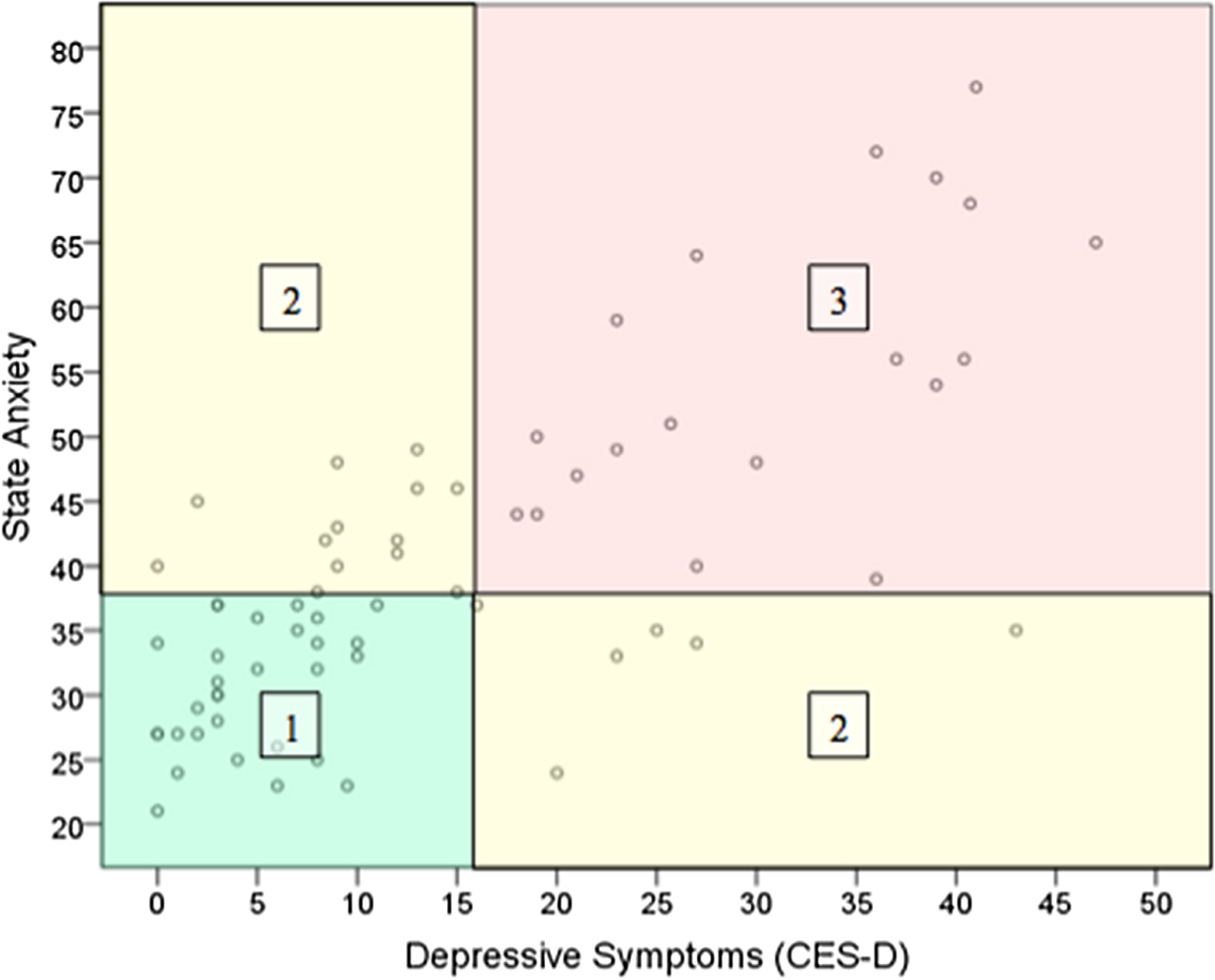
Our data reflected three categories of the PBI model. For the daughters, quadrant 1 became our group 1 with low endorsed symptomatology, and quadrants 2 and 3 became our group 2, with medium endorsed symptomatology. We kept quadrant 4 as our group 3, with high endorsed symptomatology. The daughter participants were grouped according to the severity of their symptomatology (anxiety and depression) (see Figure 1).
Scatterplot of CES–D and State Anxiety with corresponding categories. Each point gives the value of depressive symptoms and of state anxiety for one daughter participant. The four quadrants define our three participant groups; two quadrants are combined in group 2. Categories of risk are shown in different colors with respect to the level of daughter psychiatric risk. Category 1 reflects least symptomatology, whereas category 3 shows clinically significant anxiety and depressive symptoms.

The PBI served as a model for the continuum of the quality of parenting. By this, we mean the following. (1) Our group 1 reflects daughters who had parenting that was high in empathy, age-appropriate expectations, and effective limitation behavior. (2) Our group 2 daughters had parenting that was somewhat less empathic but still maintained appropriate expectations for behavior. (3) Our group 3 daughters had parenting that reflected low empathy, low expectations, and an inability to provide for the child's welfare (characterized by paternal substance abuse and fathers' unwillingness to recognize their compromised state and to seek appropriate help).
The adult daughters' symptomatology was defined by their scores on the State–Trait Anxiety Inventory (STAI) and the Center for Epidemiological Studies Depression Scale (CES–D). Each test measures the intensity of feelings of depression and anxiety. The lowest level of daughters' symptomatology was defined by little to no endorsement of anxiety or depressive symptoms. The middle level was defined by endorsement of moderate feelings of anxiety and depression, and the highest level was defined by endorsement of constant feelings of anxiety and depression (Schroevers et al., Reference Schroevers, Sanderman and van Sonderen2000). On the STAI, the cutoff score is 39–40, which indicates a clinically significant state of anxiety (feeling worried, frightened, confused). On the CES–D, a cutoff score of 16 is indicative of “significant” or “mild” depressive symptomatology (feelings of hopelessness, depressed mood, and loss of interest).
The lowest level of fathers' psychopathology was defined by no substance abuse, no severe psychiatric events or diagnoses, and no prescribed psychotropic medications. The middle level was defined by fathers' documented psychiatric diagnosis and prescribed psychotropic medications. The highest level was defined by fathers' substance abuse and severe psychiatric events (i.e., suicide attempts, psychiatric hospitalizations).
Measures
We assessed the current depressive symptomatology of the daughters by the CES–D. It includes 20 items, scored from 0 to 60, with higher scores signifying more symptomatology. The test has good reliability: α = 0.95 in the current study (α = 0.85 for the general population, α = 0.90 for the clinical population). Although they do not constitute a clinical diagnosis of depression, scores at or above 16 on the CES–D are considered to indicate significant depression (Radloff, Reference Radloff1991).
We used the STAI to evaluate the current anxiety level (“state anxiety”) of the daughters. It contains 20 items scored on a 4-point Likert-type scale, with higher scores signifying higher anxiety. The STAI manual reports high internal consistency for the scale (α = 0.92), replicated in this study (α = 0.90). A cutoff point of the 39th to 40th percentile has been proposed to detect clinically significant anxiety (Knight et al., Reference Knight, Waal-Manning and Spears1983; Addolorato et al., Reference Addolorato, Ancona and Capristo1999).
Paternal psychopathology was assessed from daughters' statements (during their clinical interviews) about whether their father had a diagnosed psychiatric condition, used psychotropic medication, abused alcohol, used illicit drugs, or experienced a serious psychiatric event (i.e., psychiatric hospitalization, attempted or completed suicide). This interview also yielded the daughter's age, ethnicity (Caucasian or non-Caucasian), marital status (married/partnered or never married/partnered), educational attainment, employment status, number of years since mother's diagnosis, number of relatives diagnosed with breast cancer, and objective breast cancer risk based on the Gail model (Gail et al., Reference Gail, Brinton and Dyar1989). Daughters were also asked about their lifetime history of diagnosed psychiatric conditions and about whether they felt able to talk openly about their mother's breast cancer with their families (open or closed communication). Thus, this study used mixed methods (a semistructured interview/qualitative data and psychological inventories that yield quantitative data). The data from the semistructured interviews were collated and categorized by one rater separate from the study authors.
Statistical Analyses
The daughters were classified into categories of psychiatric risk arising from anxiety and depressive symptoms by plotting State Anxiety and CES–D scores against each other (see Figure 1). The resulting scatterplot divided participants into nonoverlapping categories of psychiatric risk, formed by a split of the State Anxiety scores and CES–D scores based on established clinical cutoff points. The result was three participant groups: (1) no symptomatology (low risk); (2) clinically significant anxiety (moderate risk) or else depressive symptomatology; and (3) both clinically significant anxiety and depressive symptoms (high risk).
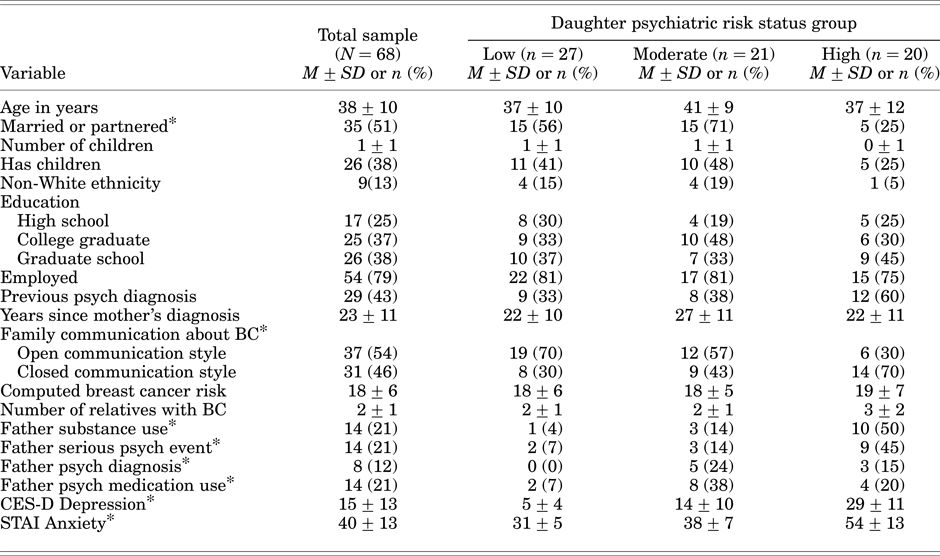
Frequencies and descriptive statistics were used to describe the data. Participants were classified as being at low, moderate, or high psychiatric risk. They were then compared by ANOVA and chi-square tests (see Table 1). Participant characteristics differentiating between the three risk groups were identified by discriminant function analysis (see Table 2).
Characteristics of participants

Left-most column: characteristics of participants. Second column: mean value of that characteristic, or else number of participants with that characteristic, in our whole sample. Columns 3–5: mean value or number in each of our three daughter groups. Numbers in parentheses are the percentage of that daughter group with that characteristic, e.g., out of a total sample of 68 daughters, 35 (i.e., 51% of 68) were married or partnered.
* p < 0.05 for between-group differences.
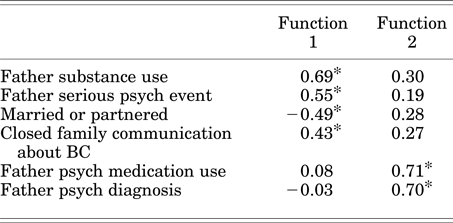
Correlations of predictor values with discriminant functions

* Largest correlation between each variable and either discriminant function.
RESULTS
Table 1 summarizes characteristics of daughters (n = 68) divided into groups of low (n = 27), moderate (n = 21), and high (n = 20) psychiatric risk. Differences between the three psychiatric risk groups were assessed with t tests, with several significant differences found at p < 0.05. These groups are the same categories previously described in the first paragraph of the statistical section (group 1 = no symptoms/low risk, group 2 = clinically significant/moderate risk, group 3 = both clinically significant anxiety and depressive symptoms/high risk).
Figure 1 is a scatterplot depicting the relationship between daughter CES–D and State Anxiety symptoms. Categories 1, 2, and 3 consist of the daughter subgroups with low, medium, and high symptomatology, respectively.
As shown in Table 2, two functions discriminated among the three daughter psychiatric risk groups (Wilk's Λ = 0.52, χ2(12) = 41.35, p < 0.001). Correlations of the discriminant functions with each predictor are shown in Table 2. The first function discriminated most strongly, accounting for 73% of the variance (eigenvalue = 0.59, canonical r = 0.61). It had the highest correlations with father substance use, father serious psychiatric event, daughter marital status (being unmarried/unpartnered), and perceived closed style of family communication about breast cancer. After removal of the first function, there was still an association between group predictors: (Wilk's Λ = 0.82, χ2(5) = 12.43, p = 0.029). The second function accounted for an additional 27% of the variance (eigenvalue = 0.22, canonical r = 0.43). It had the highest absolute correlations with father psychiatric diagnosis and father psychiatric medication use.
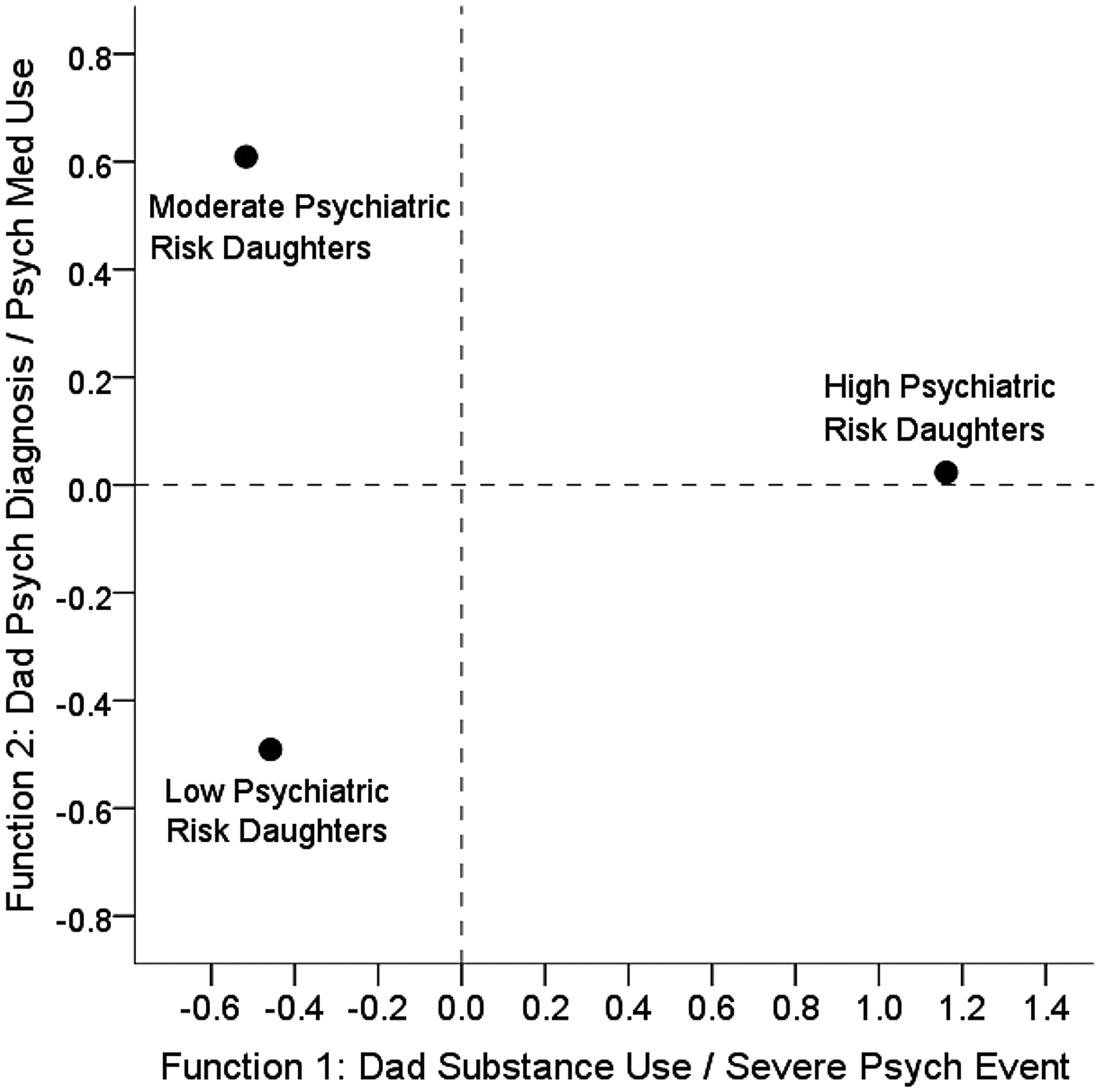
Figure 2 demonstrates the relationship of the three daughter psychiatric risk groups with the two functions by plotting the nonstandardized canonical discriminant functions for each group. The first function (X axis: father substance use and father severe psychiatric event) differentiated daughters in the highest psychiatric group from daughters in the other two groups. The second function (Y axis: father psychiatric diagnosis and father psychiatric medication use) discriminated the moderate psychiatric risk group from the low- and high-risk groups.
Discriminant function plot. Mean values of functions 1 and 2 for each of our three daughter groups. As shown in Table 2, function 1 mainly reflects father substance use and father severe psychiatric event, while function 2 mainly reflects father psychotropic medication use and father psychiatric diagnosis. Note that the three daughter groups are well separated by these two functions.

DISCUSSION
Our data reflect three levels of psychological symptomatology in adult daughters and also in their fathers. In regard to our first research question, we found that paternal psychopathology correlated with similar levels of anxiety and depression in adult daughters. For daughters in the moderate psychiatric risk group, their fathers had a history of a psychiatric diagnosis and had been prescribed psychotropic medication. For daughters in the high psychiatric risk group, their fathers had a history of substance abuse and at least one serious psychiatric event.
A difference between these two groups of fathers was that the fathers of daughters at moderate psychiatric risk were likely to have received psychiatric care for their emotional difficulties. In contrast, fathers of daughters at high psychiatric risk resisted seeking treatment for their emotional difficulties, abused substances, and had histories of DUIs, acute decompensations, and suicide attempts.
In regard to our second research question, daughters at high psychiatric risk came from families characterized by closed communication about the mother's illness, death, and bereavement. Those daughters were less likely to have spouses or committed partners later in life. Some 30% of them scored one or more standard deviations above the cutoff score for clinically significant anxiety, marking them as having “high” anxiety. Some 75% of them scored above the clinically significant cutpoint on the CES–D, as contrasted with only 23 and 3% in the moderate- and low-risk groups, respectively. This result is important because individuals scoring above the cutoff point are more likely to present with a DSM–V diagnosis of depression and to experience impairment in their lives, such as difficulties establishing secure relationships (Miller et al., Reference Miller, Bouzaglo and Clarke2013).
Our data suggest that adult daughters at low psychiatric risk can do well at addressing their high-risk breast cancer status without additional psychological interventions because their families offered them appropriate support.
Hence, our concerns focus upon the adult daughters at moderate and high psychiatric risk. They came from families where fathers were immersed in their own difficulties, unable to attend to their daughters' welfare, tended to pressure their daughters into becoming their caretakers, were prone to self-medication, and blocked their daughters' attempts to separate and move on with their lives. This environment sometimes prevented daughters from seeking a college education or pursuing an independent life outside the family home. These daughters were also prone to excessive guilt and often felt responsible for their father's welfare.
Daughters at highest psychiatric risk had fathers who psychologically “abandoned ship.” These fathers were severely limited in parenting, as part of their broader inability to cope as adults, exemplified by histories of a lack of consistent employment, severe substance abuse and dependency, suicide attempts, and resistance to obtaining psychiatric care. As a result, their daughters presented with the most severe affective states, the most severely disturbed father–daughter bonding, and the least ability to create successful interpersonal relationships as previously reflected in the data.
Our results suggest some interventions. A basic rule is: the earlier the intervention, the better—ideally, at the time of the initial diagnosis of the breast cancer (Hopwood et al., Reference Hopwood, Keeling and Long1998). We suggest including the treating oncologist, child's pediatrician, and relevant school personnel to assist in early intervention (Kissane et al., Reference Kissane, McKenzie and Bloch2006).
We offer three suggestions for working with these low-functioning fathers. These include:
1. An initial assessment with father and daughter(s) together in order to evaluate coping style. The clinician needs to see the realities of the family situation “warts and all.” This allows formulating a plan for interventions.
2. A plan may include parenting skills coaching, in order to maintain continuity for the children and fathers in the wake of illness and death.
3. A plan may also include psychiatric evaluation, substance abuse intervention, and intensive psychotherapy for both fathers and daughters. If this is not possible when the child is young, an intervention would instead begin when the adult daughter presents to the High Risk Breast Program.
We also offer four suggestions for working with the daughters, especially for those with the lowest functioning fathers. These include:
1. Initial evaluation of what they experienced, and how they function now.
2. Assessment of their feelings about their mother's illness and father's parenting, especially after their mother's death.
3. A therapeutic intervention that acknowledges their “right to grieve” and to be angry (Doka, Reference Doka1989; Reference Doka2002).
4. Consideration of the importance of forgiveness (Gentry, Reference Gentry2007). Forgiveness requires relinquishing the belief that life must always be “fair,” that remaining angry will undo injustices that one has suffered, and that forgiveness is a sign of personal weakness.
In summary, this study suggests a relationship between the quality of paternal parenting following the death of the wife/mother and the adult daughter's symptoms of anxiety and depression, which may have long term implications for the adult daughters of these parents. The subsequent nature of the father–daughter relationship has received insufficient attention in the literature. The more compromised the fathers were, the greater was the degree of psychological symptomatology in the adult daughters.
The limitations of our data include the modest number of daughters in each psychiatric risk categories and the fact that our data are only retrospective, thereby posing the usual problems of potential distortion involved in retrospection. We did not use multiple coders for the semistructured interviews, so that we could not calculate interrater reliabilities. Future research using a specific measure of adult adjustment in the daughters would improve the ability to predict the impacts of paternal symptomatology and psychopathology on their daughters' long-term adjustment. In future research, the use of an objective measure of parenting competence combined with an objective measure (e.g., medical chart review) would provide an objective measure of paternal psychopathology. Finally, our study design did not permit a longitudinal analysis, so causality cannot be determined.
DISCLOSURES
The authors hereby declare that they have no conflicts of interest to disclose.