Black youth growing up in the United States face substantial and sustained environmental challenges including neighborhoods disproportionately characterized by concentrated poverty and dangerous environments (Keppel et al., Reference Keppel, Pearcy and Wagener2002; McArdle et al., Reference McArdle, Osypuk and Acevedo-Garcia2007), and increased likelihood of low socioeconomic status (SES), a key indicator of environmental harshness. The long-term consequences of harsh environments and their impact on health may be substantial (Gunnar & Quevedo, Reference Gunnar and Quevedo2007; Lupien et al., Reference Lupien, McEwen, Gunnar and Heim2009), contributing to elevated health difficulties among Black Americans later in life (Williams, Reference Williams2012). For example, Black Americans are substantially more likely than White Americans to develop diabetes Howard et al., Reference Howard, Safford, Moy, Howard, Kleindorder, Unverzagt and Cushman2017), die of sudden cardiac arrest (Carnethon et al., Reference Carnethon, Pu, Howard, Albert, Anderson, Bertoni and Yancy2017), have early onset of blood pressure problems, experience arthritis, or cancer, or experience several chronic conditions simultaneously (Lim et al., Reference Lim, Gandhi, Davis and Chen2016; Thorpe et al., Reference Thorpe, Gesahazion, Parker, Wilder, Rooks, Bowie and LaVeist2016).
Despite the likely early origins of these chronic illnesses, most chronic illnesses do not emerge during childhood or early adulthood, making it difficult to prospectively identify unique contributing pathways. The current study focuses instead on links between childhood harshness and indices of accelerated aging which have been shown to be powerful predictors of chronic illness (Hillary et al., Reference Hillary, Stevenson, McCartney, Campbell, Walker, Howard and Marioni2020; Levine et al., Reference Levine, Lu, Quach, Chen, Assimes, Bandinelli and Horvath2018; Lu et al., Reference Lu, Quach, Wilson, Reiner, Aviv, Raj and Horvath2019). Specifically, we use data from the Family and Community Health Study (FACHS) to examine prospective reports of stressors experienced when participants were 10 years old and examine potential indirect pathways to deoxyribonucleic acid (DNA) methylation-based indices of accelerated aging at age 29. We draw on Life History Theory (LHT; Ellis et al., Reference Ellis, Figueredo, Brumbach and Schlomer2009) and earlier findings from Gibbons et al. (Reference Gibbons, Roberts, Gerrard, Li, Beach, Simons and Philibert2012) and McLaughlin et al. (Reference McLaughlin, Sheridan and Lambert2014) to test a dual pathway model linking environmental harshness in childhood to accelerated aging through a behavioral pathway and through a pathway reflecting increased exposure to threat/danger, as elaborated below.
Environmental harshness among Black youth
In keeping with Ellis et al. (Reference Ellis, Figueredo, Brumbach and Schlomer2009), harshness is defined as the rate at which external factors cause disability and death at each age in a population. Traditional markers of harshness focus on SES (Ellis et al., Reference Ellis, Figueredo, Brumbach and Schlomer2009), which reliably predicts morbidity and mortality across multiple populations (cf Ellis et al., Reference Ellis, Figueredo, Brumbach and Schlomer2009, p. 244; see also Chen et al., Reference Chen, Matthews and Boyce2002). In keeping with our longstanding practice (Gibbons et al., Reference Gibbons, Roberts, Gerrard, Li, Beach, Simons and Philibert2012), elevated experiences with racial discrimination are also hypothesized to be an important environmental source of harshness for Black youth (i.e., “weathering,” Geronimus et al., Reference Geronimus, Hicken, Keene and Bound2006, Reference Geronimus, James, Destin, Graham, Hatzenbuehler, Murphy and Thompson2016). Although not well articulated in the LHT tradition, racial discrimination meets the criteria to be included as a marker of “harshness” due to its association with increased morbidity and mortality. Supporting the expectation that harshness in the form of experiences of racial discrimination is consequential and potentially influences behavior, experiences of racial discrimination have been found to adversely impact well-being of Black youth (Benner et al., Reference Benner, Wang, Shen, Boyle, Polk and Cheng2018; Greene et al., Reference Greene, Way and Pahl2006; Hart et al., Reference Hart, Lavner, Carter and Beach2021; Lavner et al., in press), and to exert toxic effects on Black youth (Geronimus et al., Reference Geronimus, Hicken, Keene and Bound2006; Goosby et al., Reference Goosby, Cheadle and Mitchell2018), leading to downstream consequences for health and health behavior (Carter et al., Reference Carter, Ong, Simons, Gibbons, Lei and Beach2019, in press; Geronimus et al., Reference Geronimus, Hicken, Pearson, Seashols, Brown and Cruz2010; Gibbons et al., Reference Gibbons, Gerrard, Cleveland, Wills and Brody2004; Zapolski et al., Reference Zapolski, Fisher, Hsu and Barnes2016).
Because exposure to discrimination is not highly correlated with SES (English et al., Reference English, Lambert, Tynes, Bowleg, Zea and Howard2020), it cannot easily be used as a second indicator of a higher-order factor of harshness. Indeed, having a college degree is associated with higher rather than lower odds of experiencing overall institutional discrimination for Black adults (Bleich et al., Reference Bleich, Findling, Casey, Blendon, Benson, SteelFisher, Sayde and Miller2019). Racial discrimination is uncorrelated or positively correlated with higher SES because it is difficult for Black Americans to escape discrimination even when they are upwardly mobile in terms of social class (Phelan & Link, Reference Phelan and Link2015). As noted by Phelan and Link (Reference Phelan and Link2015), the association between experiences with discrimination and health remain significant even after controlling for SES, suggesting that discrimination operates as a separate and important contributor to inequalities in health. Accordingly, we treat discrimination as a separate factor reflecting perceived harshness.
A dual pathway model from harshness to health outcomes in adulthood
We suggest the possibility of a dual pathway model leading from harshness to young adult accelerated aging, with one pathway reflecting effects of harshness on faster Life History cognitions and behavior, and the other reflecting effects of exposure to harshness on increased exposure to threat/danger and the biological consequences of that elevated exposure.
The fast Life History (or behavioral) pathway to health outcomes in adulthood
Stressors related to harsh environments are hypothesized to be linked to changes in parental investment and patterns of risky cognition and risky behavior (Ellis et al., Reference Ellis, del Giudice, Dishion, Figueredo, Gray, Griskevicius and Wilson2012; Gibbons et al., Reference Gibbons, Roberts, Gerrard, Li, Beach, Simons and Philibert2012; Schneider et al., Reference Schneider, Hastings and LaBriola2018). High-quality parental investment is hypothesized to be decreased by environmental harshness (Ellis et al., Reference Ellis, Figueredo, Brumbach and Schlomer2009; see also Bachmann et al., Reference Bachmann, Beecham, O’Connor, Briskman and Scott2021). Better quality parenting behavior characterized by greater monitoring, less parental substance use, and more positive affect contributes to the development of slower LH strategies (Ellis et al., Reference Ellis, Figueredo, Brumbach and Schlomer2009; Gibbons et al., Reference Gibbons, Roberts, Gerrard, Li, Beach, Simons and Philibert2012). That is, LH theorists hypothesize that, in human populations, exposure to greater environmental harshness signals the potential value of shifting reproductive efforts forward in time. This association has been documented in the form of links between lower life expectancy, earlier age at childbearing, and greater number of offspring (Ellis et al., Reference Ellis, Figueredo, Brumbach and Schlomer2009; see also Low et al., Reference Low, Hazel, Parker and Welch2008). Gibbons et al. (Reference Gibbons, Roberts, Gerrard, Li, Beach, Simons and Philibert2012) hypothesized that another effect of this shift would be the development of risky cognitions and behavioral tendencies that historically would have supported earlier onset of reproductive activity (cf. Ellis et al., Reference Ellis, del Giudice, Dishion, Figueredo, Gray, Griskevicius and Wilson2012; Kruger et al., Reference Kruger, Reischl and Zimmerman2008). This shift in risky cognition is particularly important in modern contexts because it is linked to substance use and other behavioral processes that lead to poor health over time. The adaptive benefit of this phenotype is presumed to be increased early opportunity to procreate given an uncertain future. In modern social environments, however, this phenotype may also confer risk of increased engagement in other risky behavior with negative health consequences (particularly smoking and substance use).
Gibbons et al. (Reference Gibbons, Roberts, Gerrard, Li, Beach, Simons and Philibert2012) tested these ideas by examining the impact of environmental harshness and parenting on the development of risky cognitions (i.e., faster LHS cognition) and risky behavioral tendencies (i.e., faster LHS behavior) among Black adolescents over an 11-year period (5 waves, from age 10.5 to 21.5) using data from the FACHS. Results indicated that environmental harshness and parenting were associated with faster LHS cognitions (e.g., greater tolerance of deviance, decreased future orientation, decreased planfulness). In turn, LHS cognitions predicted faster LHS behaviors (Belsky et al., Reference Belsky, Steinberg and Draper1991; Figueredo et al., Reference Figueredo, Vásquez, Brumbach, Sefcek, Kirsner and Jacobs2005; Gibbons et al., Reference Gibbons, Roberts, Gerrard, Li, Beach, Simons and Philibert2012), that is, riskier health behavior (e.g., greater substance use), and increased risk of adverse health outcomes.
Extending these findings using the same constructs and time points, we hypothesized that there would be a behavioral pathway to accelerated aging characterized by early experiences of harshness leading to decreased parental investment and ultimately acceleration of young adult DNA methylation indices through effects on LHS-related cognitions and LHS-related substance use behaviors. The hypothesized Life History/behavioral pathway from child adversity to health outcomes explained by LHS is portrayed in Figure 1. As can be seen, it is hypothesized that problematic health behavior should be proximal to accelerated aging outcomes and that LHS cognitions (e.g., greater tolerance of deviance, decreased future orientation, and decreased planfulness) should mediate the impact of parental investment and discrimination on LHS behavior (e.g., substance use) and ultimately accelerated aging. It should be noted that these predictions follow directly from Gibbons et al. (Reference Gibbons, Roberts, Gerrard, Li, Beach, Simons and Philibert2012), but do not directly test LHT predictions.
Pathways from harshness (SES) and decreased parental investments leading to adult health and weathering through the behavioral pathway.

The preparation for danger (FKBP5/inflammation) pathway to health outcomes in adulthood
In addition to effects on risky cognition and risky behavior (i.e., the hypothesized behavioral pathway), childhood exposure to harsh environments in the form of SES might also be expected to influence later adult health through its impact on exposure to danger (McLaughlin et al., Reference McLaughlin, Sheridan and Lambert2014). That is, harsh childhood environments in the form of lower SES also lead to increased childhood exposure to chronic signals of danger, in turn leading to altered immune responses and brain circuitry that may be adaptive in the context of a dangerous environment, increasing vigilance and preparedness for injury. Early exposure to danger is expected to affect multiple facets of developmental biology, leading to a conserved response that includes elevated inflammation (Cohen et al., Reference Cohen, Janicki-Deverts, Doyle, Miller, Frank, Rabin and Turner2012; Cole, Reference Cole2014).
Based on a growing literature in neurodevelopment, McLaughlin et al. (Reference McLaughlin, Sheridan and Lambert2014) proposed that cues signaling the dangerousness of an early environment may have powerful developmental effects, eliciting epigenetic changes, and shaping intermediate phenotypes, particularly phenotypes related to activity of the Hypothalamic/pituitary/adrenal (HPA) axis (cf. Miller et al., Reference Miller, Chen and Parker2011). Factors that affect the HPA axis are of particular interest from the standpoint of potential widespread epigenetic effects because of HPA system effects on glucocorticoids (e.g., cortisol) that influence a range of different tissues throughout the body and the brain, potentially initiating a range of changes in a systematic and coordinated manner. In addition, many glucocorticoid effects are mediated by changes in gene expression, again suggesting the importance of changes in epigenetic regulatory mechanisms. Finally, because of its potential to alter cellular environments in both the peripheral and central nervous system, sustained HPA activation has the potential to produce epigenetic reprogramming that could be detected in both peripheral tissues, like blood, while also affecting the central nervous system and other important organ systems. As with the behavioral pathway, in the modern world, these adaptations might also come at the cost of increased health risks that would accrue later in life. In both cases, the guiding hypothesis is that short-term gains in likelihood of survival or procreation outweigh the costs of long-term health consequences.
It was recently hypothesized that exposure to dangerous environments in childhood could result in methylation changes in FKBP5, initiating a cascade of biological effects (Kremer et al., Reference Kremer, Braun, Chen, Harneit, Zang, Schweiger and Tost2020) with developmental consequences. Changes in methylation involve biochemical mechanisms that influence gene expression – either upregulating or downregulating particular genes and so influencing biological outcomes. Changes in methylation occur when a methyl group attaches to a segment of DNA at a CpG site (i.e., a DNA region where a cytosine nucleotide is followed by a guanine nucleotide and they are linked by a phosphate group), a change that usually causes the inhibition of gene expression. In the case of FKBP5, researchers found that DNA methylation of FKBP5 (cg20813374) changed in response to stress and that stress-induced demethylation resulted in subsequent change in FKBP5 expression. Further, demethylation within FKBP5 was related to brain volume in two key regulatory regions related to human emotion and stress processing circuitry (i.e., gray matter volume in ACC and DLPFC), consistent with animal and human studies indicating that early exposure to high threat leads to changes in amygdala function, greater sensitivity to fear stimuli, and heightened vigilance to potential threats (van Marle et al., Reference van Marle, Hermans, Qin and Fernandez2009).
More generally, the gene expressing FK506-binding protein 51 (FKBP51), has been found to play an important role in responding to early signals of danger, with danger influencing methylation of two key loci. FKBP5 expression is associated with regulation of inflammatory activity (e.g., Erlejman et al., Reference Erlejman, de Leo, Mazaira, Molinari, Camisay, Fontana and Galigniana2014; Maiarù et al., Reference Maiarù, Tochiki, Cox, Annan, Bell, Feng and Géranton2016) and accelerated aging of the brain (Blair et al., Reference Blair, Nordhues, Hill, Scaglione, O’Leary, Fontaine and Dickey2013; Jinwal et al., Reference Jinwal, Koren, Borysov, Schmid, Abisambra, Blair and Dickey2010). The two CpGs of particular interest on FKBP5 (cg20813374 and cg00130530) have shown consistent and robust decreases in methylation with increasing age (Zannas et al., Reference Zannas, Jia, Hafner, Baumert, Wiechmann, J. and Binder2019). These two age-related CpGs are in close physical proximity to each other and to the FKBP5 transcription start site (i.e., less than 500 bp in each case), and their methylation levels are significantly correlated with each other.
As noted for the behavioral pathways related to LHS cognition and behavior, biological changes stimulated by dangerous childhood environments characterized by exposure to violence or awareness of violence in the surrounding environment may be “adaptive” in response to future dangerous environments, but may also come at a longer-term health cost, particularly in modern contexts. Adaptations in the danger/FKBP5 pathway may include elevated amygdala activation to emotional stimuli, heightened attention to threat-related cues, generalization of learned fear to previously neutral stimuli, and elevated emotional responses to a wide range of emotional cues as well as attenuated extinction of fear-related behavior (Ishikawa et al., Reference Ishikawa, Saito, Yanagawa, Otani, Hiraide, Shimamura and Togashi2011; Matsumoto et al., Reference Matsumoto, Togashi, Konno, Koseki, Hirata, Izumi and Yoshioka2008).
Because inflammation is a conserved adaptation to perceived threat and danger (Cole, Reference Cole2014; Liu et al., Reference Liu, Wang and Jiang2017), as threat and danger increase, the immune system may increase expression of this inflammatory program as a way to prepare for increased risk of attack and injury (Powell et al., Reference Powell, Sloan, Bailey, Arevalo, Miller, Chen. and Cole2013; Slavich & Cole, Reference Slavich and Cole2013). Accordingly, early exposure to danger might be expected to upregulate pro-inflammatory tendencies in preparation for increased potential for infection secondary to injury and physical threat (Powell et al., Reference Powell, Sloan, Bailey, Arevalo, Miller, Chen. and Cole2013), thereby promoting chronic illness, such as heart disease, diabetes, arthritis, and cancer Liu et al., Reference Liu, Wang and Jiang2017; Nowakowski & Sumerau, Reference Nowakowski and Sumerau2015; Paalani et al., Reference Paalani, Lee, Haddad and Tonstad2011). There is evidence that Black individuals tend to have higher levels of inflammation than White individuals (Ferrucci & Fabbri, Reference Ferrucci and Fabbri2018; Franceschi & Campisi, Reference Franceschi and Campisi2014; Hayflick, Reference Hayflick2007), suggesting that factors contributing to elevated inflammation may help explain the poorer health of Black Americans. These considerations led to the expectation that there will be a pathway from elevated danger in childhood to health outcomes as portrayed in Figure 2, with a significant indirect pathway from early exposure to danger to changes in methylation of FKBP5, which, in turn, should predict a shift toward more pro-inflammatory propensities and accelerated aging.
Pathway from Harshness (SES) to Childhood exposure to Danger leading to adult health and weathering via the Danger/FkBP5 pathway.

An integrated model incorporating both pathways is portrayed in Figure 3a. Additionally, as noted previously, some prior work suggests the possibility of cross-talk between these two pathways. First, harshness, in the form of SES, is expected to influence both the behavioral pathway to health outcomes and the danger pathway to health effects. Second, it is possible that LHS cognition may be linked to inflammatory phenotypes. It is also possible that greater experience of discrimination may be related to greater felt exposure to danger, beyond the effect of harshness due to lower SES, or that danger and its downstream consequences might feedback to influence LHS cognition and behavior. Accordingly, although we present the two pathways as independent, it will be important to examine the data for cross-pathway effects. Figure 3b includes the potential cross-pathway effects to be explored, indicated as dotted lines.
(a) Two pathways to young adult health from childhood exposure to Harshness via decreased parental investment and increased exposure to danger. (b) Two pathways to young adult health from childhood exposure to Harshness via decreased parental investment and increased exposure to danger – with dotted lines illustrating potential cross-pathway effects.

Measurement considerations
In considering outcomes related to accelerated aging and inflammation based on DNA methylation, several measurement issues warrant consideration. Accordingly, we briefly examine the impact of cell-type variation on inflammation and the differences between various measures used to assess accelerated aging based on DNA methylation.
Assessing pro-inflammatory tendencies through analysis of cell-type variation
Cole (Reference Cole2014) note that the immune system comprises two rather distinct programs: pro-inflammatory cytokine genes that combat tissue damage, bacteria, and other extracellular pathogens; and antiviral genes, which produce antibodies and target intracellular pathogens, such as viruses. They argue that adversity (threat and danger) leads to increased expression of the inflammatory program, coupled with decreased expression of the antiviral program, as the organism prepares for possible attack and injury. Cole (Reference Cole2014) labels this pattern of gene expression the conserved transcriptional response to adversity (CTRA). Support for Cole’s hypothesis comes from studies reporting a link between various types of social adversity (e.g., PTSD) and the CTRA transcription pattern (Cole, Reference Cole2014; Slavich & Cole, Reference Slavich and Cole2013).
The CTRA hypothesis implies that the effect of danger on young adult health should be mediated, at least to some extent, by a physiological pattern characterized by increased activation of the inflammatory program combined with decreased activation of the antiviral program. We test this idea by examining the relative proportion of various types of peripheral leukocytes. Specifically, we examine the ratio of those leukocytes, such as monocytes and natural killer cells, that mediate innate immune responses and express genes that promote the cascade of cytokines involved in the inflammatory process, to those cell types such as B cells, CD4 T-helper cells, and CD8 T-helper cells that are involved in adaptive immune responses and express genes involving antibodies and antiviral activities (Abbas et al., Reference Abbas, Lichtman and Pillai2022).
Measuring DNA methylation-based indices of accelerated aging
The proposed dual pathway model highlights the need for indices related to healthy aging that are comparable and meaningful across the life span. One way to assess the impact of early experiences on adult health is to examine epigenetic indices of speed of biological aging. Several DNA methylation-based aging indices have been shown to be powerful predictors of chronic illness and time-to-death (Hillary et al., Reference Hillary, Stevenson, McCartney, Campbell, Walker, Howard and Marioni2020; Levine et al., Reference Levine, Lu, Quach, Chen, Assimes, Bandinelli and Horvath2018; Lu et al., Reference Lu, Quach, Wilson, Reiner, Aviv, Raj and Horvath2019), and have generally supported the hypothesis that social conditions and relationships may influence an individual’s speed of biological aging (Brody et al., Reference Brody, Miller, Yu, Beach and Chen2016; Lei et al., Reference Lei, Simons, Beach and Philibert2019; Simons et al., Reference Simons, Lei, Beach, Philibert, Cutrona, Gibbons and Barr2016, in press; Zannas et al., Reference Zannas, Arloth, Carrillo-Roa, Lurato, Roh, Ressler and Mehta2015). These findings suggest that epigenetic indices may provide a useful source of information about how early adverse events become biologically embedded and influence morbidity and mortality in middle-age and beyond.
However, it has recently been demonstrated that different DNA methylation-based aging indices have different patterns of association with smoking (Lei et al., Reference Lei, Gibbons, Simons, Philibert and Beach2020), a key element of the behavioral pathway. Therefore, it is important to review each of the DNA methylation-based aging indices we proposed to examine and highlight relevant distinctions. Because Lei et al. (Reference Lei, Gibbons, Simons, Philibert and Beach2020) found different patterns of association between smoking and epi-aging measures depending on whether they were derived using chronological age (CA) as the criterion or a biological criterion variable, it is of particular interest to see whether fast strategies linked to risky behaviors, such as substance use, will have an effect primarily on those accelerated aging indices known to be associated with substance use. Accordingly, we divide the DNA methylation-based aging indices into two groups. In the first group, we examine the two widely used DNA methylation-based measures of accelerated aging that were derived to capture loci associated with chronological age (DNAm-CA). In the second group, we examine three DNA methylation-based measures of aging that use biological processes, illness, or death as the criterion (DNAm-Bio). For each of the DNA methylation-based aging measures reviewed below, the residual, or error, relative to CA, can be used to index “age acceleration” and is commonly used to predicting individual difference in health outcomes.
DNA methylation-based indices keyed to chronological age
Horvath
Early epigenetic indices used CA as the criterion variable to be predicted, focusing on the way that DNA methylation patterns followed a regular pattern of change with CA (see Horvath, Reference Horvath2013; Horvath & Raj, Reference Horvath and Raj2018). The Horvath measure was designed to capture changes occurring across tissues.
Hannum
Using a similar approach as Horvath, but focused on peripheral blood only, Hannum et al. (Reference Hannum, Guinney, Zhao, Zhang, Hughes, Sadda and Zhang2013) devised a DNA methylation-based index predicting CA that used a largely nonoverlapping set of weighted methylation values. This measure was designed to have a relatively constant rate of change across adulthood after age 20 and a high correlation with CA (Bocklandt et al., Reference Bocklandt, Lin, Sehl, Sánchez, Sinsheimer, Horvath and Vilain2011).
A recent meta-analytic examination of available studies using these measures of DNAm-CA (Fransquet et al., Reference Fransquet, Wrigglesworth, Woods, Ernst and Ryan2019) indicated that greater age acceleration on the Hannum or Horvath epigenetic aging (EA) measures (DNAm-CA) was a significant predictor of longevity, but performed inconsistently as a predictor of early onset of diseases of aging.
Indices based on underlying biomarkers
DNA methylation-based phenotypic (morbidity) aging
To increase predictive accuracy regarding onset of diseases of aging, a DNA methylation-based index was developed to predict disease phenotypes. The “PhenoAge” DNA methylation index (DNAm PhenoAge) developed by Levine et al. (Reference Levine, Lu, Quach, Chen, Assimes, Bandinelli and Horvath2018) is currently in widespread use (Levine et al., Reference Levine, Lu, Quach, Chen, Assimes, Bandinelli and Horvath2018) and is associated with cardiovascular disease and early onset of chronic illness Jylhävä et al., Reference Jylhävä, Pedersen and Hägg2017). DNAm PhenoAge provides a useful marker of elevated risk for early-onset morbidity and chronic illness (Horvath & Raj, Reference Horvath and Raj2018).
GRIM age
To address the need for an epigenetic index that could predict increased risk for mortality, Lu et al. (Reference Lu, Quach, Wilson, Reiner, Aviv, Raj and Horvath2019) developed a DNAm-based measure of predicted life span, focusing on the prediction of time-to-death due to all-cause mortality. The index, called “DNAm GrimAge” or “GRIM,” has demonstrated good predictive ability for time-to-death, time-to-coronary heart disease, time-to-cancer, and has also shown an association with computed tomography data for fatty liver/excess visceral fat, and age at menopause Lu et al., Reference Lu, Quach, Wilson, Reiner, Aviv, Raj and Horvath2019).
Telomere length
Lu et al. (Reference Lu, Quach, Wilson, Reiner, Aviv, Raj and Horvath2019) also developed a DNA methylation-based index of telomere length (mTL), that is, the number of repetitive nucleotide sequences at the end of each chromosome that shortens with increasing number of replications. Correlations between telomere length (mTL) and age range between r = −.51 for women and r = −.55 for men Nordfjäll et al, (Reference Nordfjäll, Svenson, Norrback, Adolfsson and Roos2010).
Specific hypotheses
Using data from FACHS, we test the following hypotheses:
-
H1: Elevated environmental harshness in the form of racial discrimination will combine with decreased parental investment to exert an effect on DNAm indices of aging via a “behavioral pathway” comprising faster LHS cognition and faster LHS behavior, including increased risk for substance use.
-
H2: Elevated exposure to threat/danger during childhood will exert an effect on epigenetic aging via effects on dysregulation of a FKBP/inflammation pathway.
-
H3: Harshness in the form of elevated SES risk in childhood will contribute to both the harshness/parenting /LHS behavior and the Danger/FKBP5/inflammation pathways, helping initiate each pathway by forecasting decreased parental investment and increased exposure to threat/danger, but not increased exposure to discrimination.
-
H4: Exploratory Questions – Are there differences between men and women for either pathway? Are there model differences across each of the individual indices of accelerated aging? Are there cross-pathway effects in which discrimination, or LHS cognition influence elements of the danger pathway, or conversely elements of the danger pathway that influence LHS cognition or behavior?
Method
Participants
We tested all hypotheses using data from the FACHS sample (Beach et al., Reference Beach, Lei, Simons, Barr, Simons, Ehrlich and Philibert2017), a longitudinal study initiated in 1997 using a sampling strategy to generate a pool of families representative of a range of SES statuses and neighborhood contexts in Iowa and Georgia. The protocol and all study procedures were approved by the University of Georgia Institutional Review Board. At baseline (1997−1998), the FACHS sample consisted of 889 African American families, each with a fifth-grade child. Their mean age was 10.56 years (SD = .63; range 9–13). At that time, the average family per capita income reported by children’s primary caregivers was $6,956, with 36% of the families below the poverty line and 51% of the respondents self-identified as single parents. Data used in the current study were also collected in 2002–2004, 2005–2007, 2008–2009, 2010–2011, and 2015–2016, when the participants in the current study were, on average, aged 15.66, 18.73, 21.49, 23.51, and 28.67, respectively. In the 2015–2016 data collection, we also included blood draws allowing genetic analyses, as well as objective indicators of health. Of the 889 targets interviewed at baseline, 714 were reinterviewed in 2002–2003, and 687 in 2008–2009. As noted, the 2015–2016 data collection included blood draws, resulting in the inclusion only of those members of the sample residing in Georgia, Iowa, or a contiguous state who could be visited at home by phlebotomists. After also excluding persons who were deceased, incarcerated, or otherwise unreachable, we were left with a potential pool of 556 individuals, 470 of whom (182 men and 288 women) provided blood at age 29. Of these, 449 (96%) were successfully assayed and comprise the sample for the current analyses (172 men and 277 women). Comparisons of this subsample with those who were not included in the analysis did not reveal any significant differences with regard to major study variables or covariates at time 1 baseline assessment (e.g., age, sex, SES (deprivation), discrimination, parenting, danger; see Supplemental Table S1).
Procedure
All study protocols and procedures for age 29 participants were approved by the Institutional Review Board at the University of Georgia (Title: FACHS weathering – Protocol study number 00006152).
African American university students and community members served as field researchers to collect data. Prior to data collection, all field researchers received training in the administration of the interview to increase validity and enhance rapport and cultural understanding. Interviews were administered in respondents’ homes and took on average about 2 to 2 ½ hr. Primary caregivers were interviewed concurrently with youth. Some of the instruments administered in later waves (after 2007) included questions regarding illegal or potentially embarrassing sexual activities, leading us to use audio-enhanced, computer-assisted, self-administered interviews to enhance confidentiality. Using this procedure, the respondent sat in front of a computer and responded to questions as they were presented visually on the screen, and also auditorily, via earphones. In 2015–2016 (W7), data collection included blood draws allowing analysis of cell-type variation as well as DNA-based indices of aging. After blood was drawn it was shipped via courier to a laboratory at the University of Iowa to allow assessment of genome-wide methylation as described below. Mean age at the time of the blood draw was 28.67 years (SD = .79; range: 27–31).
Assessment of methylation
Whole blood samples were received in sodium citrate tubes and were processed into DNA using cold protein precipitation. The resulting DNA was stored at −20 °C until usage. DNA methylation-based assessments were conducted with the Illumina Infinium (Sequenom, Inc., San Diego, CA, USA) HumanMethylationEPIC 850 BeadChip. This array contains 865,918 probes recognizing CpG positions of known transcripts, potential transcripts, or CpG islands. Participant DNA samples were randomly assigned to “slides/chips” that were bisulfite converted in 96 well batches. A replicated sample of DNA was included in each plate to aid in assessment of batch variation and to ensure correct handling of specimens. The replicate samples were examined for average correlation of beta values between plates and were found to be greater than 0.99. Prior to normalization, DNA methylation data were filtered based on these criteria: (a) samples were examined to identify any “poor quality samples” containing 1% or more of CpG sites with detection p < .05 (no samples failed this criterion), (b) sites were removed if a bead count of < 3 was present in 5% of samples, and (c) sites with a detection p < .05 in 1% of samples were removed.
The beta value at each CpG locus was calculated as the ratio of the intensity of the methylated probe to the sum of intensities of the methylated and unmethylated probes. Quantile normalization methods were used, with separate normalization of Type I and Type II assays, as this approach has been found to produce marked improvement for the Illumina array in detection of relations by correcting distributional problems inherent in the manufacturers’ default method for calculating the beta value. Finally, beta values after quantile normalization were used to calculate DNA methylation-based aging indices and DNA methylation-based telomere length for each participant using a public online tool (https://dnamage.genetics.ucla.edu/) as described below. Methylation values were also used to calculate cell types for our measure of inflammation. To control for variability in target age, we regressed the methylomic risk index score on CA and used the residual.
Measures
Predictors and mediational variables were selected to conform to those used by Gibbons et al. (Reference Gibbons, Roberts, Gerrard, Li, Beach, Simons and Philibert2012). In addition, we added indices of FKBP5, inflammation, and accelerated aging using the genome-wide methylation assessment.
Childhood exposures
Danger
Three items were used to capture the child’s view of the dangerousness and potential for physical harm at Wave 1 when they were approximately 10 years old. The three items reflected the child’s perception of dangerous conditions prevalent in the surrounding community: (1) During the past six months, how often was there…a fight in your neighborhood in which a weapon like a gun or knife was used; (2) During the past 6 months, how often was there…a robbery or mugging; and (3) During the past 6 months, how often was there…a sexual assault or rape. All indicators were coded on a scale from 1 = never to 3 = often. A composite measure of exposure to danger was created by taking the mean of the indicators. Scores ranged from 1 to 3 (M = 1.40, SD = .50, Alpha = .614).
Harshness (childhood SES)
To examine the potential effect of objective indicators of early SES risk, we examined SES risk at age 10. Caregiver reports across six indicators were used to create our measure of socioeconomic risk/deprivation. These indicators were (1) family poverty, defined as being below the poverty level, taking into account both family income and number of family members; (2) primary caregiver noncompletion of high school or an equivalent; (3) primary caregiver unemployment; (4) single-parent family structure; (5) family receipt of Temporary Assistance for Needy Families; and (6) income rated by the primary caregiver as not adequate to meet all needs. Each indicator was scored dichotomously (0 if absent, 1 if present). SES risk was defined as the number of SES-related indicators, summing items to form an index with a theoretical range of 0–6 (M = 1.81, SD = 1.52), with larger numbers indicating greater deprivation (i.e., lower SES).
Discrimination
To assess perceived racial discrimination at W1, targets completed a 13-item, modified version of the Schedule of Racist Events (Landrine & Klonoff, Reference Landrine and Klonoff1996), commonly used to assess discrimination (Pascoe & Smart Richman, Reference Pascoe and Smart Richman2009; Williams et al., Reference Williams, Neighbors and Jackson2003). The measure describes various discriminatory events and asks participants how often they have experienced each type of event in the past; for example, “How often has someone said something insulting to you just because you are African American?”; “How often have you been treated unfairly because you are African American instead of White?” rated from 1 = never to 4 = frequently). In order to make the scale more appropriate for nonadult respondents, the revision simplified some language, and items on workplace discrimination were replaced with items about general experiences in the community. Cronbach’s alpha was .859.
The extent to which the three childhood exposure variables were distinguishable was examined using a confirmatory factor analysis. Results are shown in Supplemental Figure S1 and indicate that the three constructs are distinguishable.
Parental investment
Parental investment at W1 was assessed with four scales: parent-reported monitoring, adolescent-reported monitoring, parent substance use, and parent negative affect (NA).
Subscales for Parent- and adolescent-reported monitoring (see Thornberry et al., Reference Thornberry, Huzinga and Loeber2004) included five items from youth (α = .609) and four items from parents (α = .613). An example item is “How often [does your parent/do you] know what [you do/your child does] after school?”). All items were followed by a 4-point scale ranging from 1 (never) to 4 (always).
For parent substance use, the focus was on problematic use more than occasional drug use and/or “social” drinking. The Composite International Diagnostic Interview contained four questions about experiencing problems due to alcohol use within the last 2 years (e.g., fighting, problems at home; yes/no), as well as a list of 21 drugs; parents indicated whether they had used each more than five times within the past 24 months. The 25 items were summed to create an overall score (0–25) (α =.762).
Parent NA (Clark & Watson, Reference Clark and Watson1995) had the stem, “During the past week, how much have you felt..?” followed by five depression and three anxiety items (each ranging from 1 [not at all] to 3 [extremely]) (α = .842).
A composite measure was created by taking the mean of the four standardized indicators. Effective reliability of the composite was .675.
Mediational paths
LHS (cognition)
Four scales assessed adolescent’s LHS cognitions at Wave 3 when they were 15.66 years old. The Tolerance of Deviance scale began with “How wrong do you think it is for someone your age to. . .” followed by 17 deviant behaviors (e.g., cheat on a test, have a baby; ranging from 1 [very wrong] to 4 [not at all wrong]) (alpha = .949). Toughness focused on the extent to which adolescents believed that being tough is necessary to achieve respect and obtain fair treatment (e.g., “It is important to show other people that you cannot be intimidated,” with response options ranging from 1 [strongly disagree] to 4 [strongly agree]; alpha = .754). Two items assessed future orientation (e.g., “I often think about the goals that I have for the future” ranging from 1 [never] to 5 [always]; alpha = .577). The Prototype/willingness scale comprised items from the prototype model of health risk (Gerrard et al., Reference Gerrard, Gibbons, Houlihan, Stock and Pomery2008; Gibbons et al., Reference Gibbons, Gerrard, Lane, Suls and Wallston2003); with 20 questions about risk prototypes or images (e.g., perceptions of “the type of kid your age who uses drugs”; the “type of girl your age who gets pregnant”; Gibbons et al., Reference Gibbons, Gerrard and Boney McCoy1995) and six questions about willingness to engage in risky behavior (e.g., use drugs, have unprotected sex), (alpha = .896). A composite measure was created by calculating a mean of the standardized scale scores. The effective reliability for the composite measure was .855.
LHS substance use behavior
LHS behaviors were operationalized as self-reported substance use at Waves 4, 5, and 6 when participants were, on average, 18.73, 21.49, and 23.51 years old. Participants were asked one question at each wave for heavy alcohol consumption (During the past 12 months, how often have you had a lot to drink, that is 3 or more drinks at one time?), marijuana use (During the past 12 months, how often have you used Marijuana in order to get high), and cigarette use (How many cigarettes have you smoked in the last 3 months?). Items were combined within wave by taking the mean of the standardized scores for each item and then averaged across waves. The alpha for the LHS behavior scale was .825.
FKBP5-2
To provide an index of methylation level for the two methylation sites on FKBP5 previously shown to be related to childhood exposures, we examined level of methylation at cg20813374 and cg00130530 at Wave 7 when participants were, on average, 28.67 years old. The two CpG sites were correlated r = .480, p < .001, supporting previous work indicating that they covary and could be combined into a meaningful index. To create a single index, the quantile-normalized beta values at each CpG site were averaged, resulting in a single methylation index of impact of early exposure to danger on FKBP5 methylation.
Inflammatory to antiviral cell-type ratio (ITACT ratio)
Based on the blood drawn at Wave 7, an index of cell types was developed using the procedure developed by Houseman et al. (Reference Houseman, Accomando, Koestler, Christensen, Marsit, Nelson and Kelsey2012), and following the formula outlined by Simons et al. (Reference Simons, Lei, Beach, Barr, Cutrona, Gibbons and Philibert2017). Specifically, the “EstimateCellCounts” function in the minfi Bioconductor package was performed to assess individual differences in the distribution of cell types. This statistical package is based on the reference-based and regression calibration methods developed by Houseman et al. (Reference Houseman, Accomando, Koestler, Christensen, Marsit, Nelson and Kelsey2012). The peripheral white blood cell contribution was subclassified into five different cell types. Two of these cell types – monocytes and natural killer cells – are associated with the innate immune system and an inflammatory response. The other three cell types – CD4+ T cells, CD8+ T cells, and B cells – are associated with the adaptive immune system and antiviral processes. The following equation was used to calculate the prevalence of inflammatory relative to antiviral cell types:
 $$\rm {{(Monocytes + Natural\ Killer)} \over {({\rm{CD}}{4^ + }{\rm{T}} + {\rm{CD}}{8^ + }{\rm{T}} + {\rm{B}}cells)}}$$
Using this ratio, higher scores indicated increased dominance of the innate/inflammatory response. The correlation between the numerator (innate/inflammatory cells) and denominator (adaptive/antiviral cells) was r = −.330. The mean ratio score was .281 (SD = .284) and the range was 0.00–3.75
Accelerated aging outcomes
Accelerated aging composites
DNAm-CA and DNAm-Bio. We assessed DNA methylation-based aging using established procedures to calculate each of the previously established DNA methylation-based clocks including the Hannum index (Hannum et al., Reference Hannum, Guinney, Zhao, Zhang, Hughes, Sadda and Zhang2013), the Horvath index (Horvath, Reference Horvath2013), the PhenoAge index (Levine et al., Reference Levine, Lu, Quach, Chen, Assimes, Bandinelli and Horvath2018), the GrimAge index (Lu, Quach, et al., Reference Lu, Quach, Wilson, Reiner, Aviv, Raj and Horvath2019), and the mTL index (Lu, Seeboth, et al., Reference Lu, Seeboth, Tsai, Sun, Quach, Reiner and Horvath2019). All indices were analyzed using the online “New Methylation Age Calculator” (https://dnamage.genetics.ucla.edu/) with the Advanced Analysis option and the normalize data option. For all indices, accelerated aging was calculated by using the residual from regressing the index on CA. A positive value indicates greater than expected scores based on CA.
After using the online calculators to create the five indices of interest for the current study and regressing each on CA to create indices of accelerated aging, we averaged the indices to create two sets of measures. For DNAm-CA, we took the mean of the standardized Hannum and Horvath measures, given that both were designed to capture CA. For DNAm-Bio, we took the mean of the standardized PhenoAge, GRIM, and mTL measures.
Results
Plan of analysis
After computing simple correlations and descriptive statistics for each step of the analyses, we used Mplus 8, allowing us to test multiple pathway models and calculate indirect effects (IEs). To assess goodness-of-fit, chi-squared statistics, the comparative fit index (CFI > .90 = acceptable; > .95 = good), and Steiger’s root mean square error of approximation (RMSEA < .10 = acceptable; < .06 = good) were used. To assess the significance of IEs, the 95% confidence interval (CI) was estimated using bias-corrected and accelerated bootstrapping with 1,000 resamples. To examine potential differences in patterns as a function of different measures of EA, gender differences, and cross-pathway effects we used nested comparisons, examining whether constraints produced a significant deterioration in model fit.
Given our use of a cell-type-based measure of inflammatory propensities in the proposed model, we did not control for cell type in our primary analyses. That is, analyses were not conducted on “intrinsic” DNAm accelerated aging indices. However, in follow-up analyses (available on request) we did control for cell type in each of the DNAm accelerated aging indices, using the procedure described by Houseman et al. (Reference Houseman, Accomando, Koestler, Christensen, Marsit, Nelson and Kelsey2012) after dropping the inflammatory stage in the model that specifically relies on cell type, and found consistent patterns of results.
General description of associations
As can be seen in Table 1, there were no significant zero-order correlations between childhood harshness (SES) and the LHS mediators or accelerated aging outcomes, but it was associated with increased exposure to danger (r = .136, p = .004) and decreased parental investment (r = −.155, p = .001). Parenting was significantly associated with LHS mediators, with r’s of −.115, p = .019 and −.154, p = .001, respectively, for LHS cognition and LHS behavior. Discrimination was also significantly associated with LHS mediators, with r’s of .145, p = .004 and .157, p = .001, respectively, for LHS cognition and LHS behavior. Early exposure to danger was not associated with LHS mediators, but was significantly associated with demethylation of FKBP5-2, r = −.112, p = .018. It is also noteworthy that epigenetic aging based on Biomarkers (DNAm-Bio) was significantly correlated with EA based on chronological age (DNAm-CA), r = .494, p < .001. LHS cognition was significantly correlated with DNAm-Bio, with r of .099, p = .043, but it was not significantly correlated with DNAm-CA. LHS behavior was also significantly correlated only with DNAm-Bio, with r = .218, p < .001. FKBP5-2 was significantly associated with both DNAm-Bio and DNAm-CA, with r’s = −.271 and −.321 (both p < .001).
Correlations, means, and standard deviations for main study variables (N = 449)

Note: † p < .10, * p < .05, ** p < .01(two-tailed tests). DNAm-Bio = Epigenetic aging on Biomarkers; DNAm-CA = Epigenetic aging on Chronological Age; LHS Cognition = Life History Strategies: Cognition; LHS Behavior = Life History Strategies: Behavior; ProINF = Pro-Inflammatory Tendencies.
H1: Elevated exposure to discrimination and decreased parental investment will be associated with DNA m indices of Aging via the “behavioral pathway”
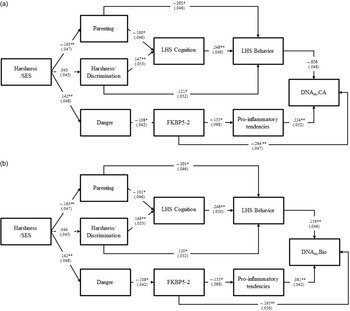
In the model with DNAm-CA (i.e., the mean of standardized scores for the Hannum and Horvath indices as the outcome; see Figure 4a), there were significant associations linking early exposure to increased discrimination and decreased parental investment to LHS cognition (b’s = .147, p = .006; and −.100, p = .030, for discrimination and parental investment respectively). In addition, discrimination and parenting had significant direct effects on LHS behavior (b = .121, p = .020 and b = −.101, p = .029, for discrimination and parenting respectively), beyond their effect via LHS cognition. There were not, however, significant associations of either of the hypothesized LHS mediators with DNAm-CA. Examination of IEs yielded a small, but significant, IE of parenting on DNAm-CA through LHS cognition and LHS behavior (IE = .001) with a 95% CI of [.000, .006]. There was no significant IE from discrimination to DNAm-CA.
(a) The unconditional indirect effects model showing the prediction of Epigenetic aging (Chronological Age) from childhood exposure to harshness, decreased parental investment, discrimination, and danger. Chi-square = 6.948, df = 10, p = .7304; RMSEA = .000; CFI = 1.000. Values are standardized parameter estimates and standard errors are in parentheses. Gender and age are controlled in these analyses. **p ≤ .01, *p ≤ .05 (two-tailed tests), n = 449. DNAm-CA = Epigenetic aging - Chronological Age; LHS Cognition = fast life history strategies reflected in Cognition; and LHS Behavior = fast life history strategies reflected in substance use behavior. (b) The unconditional indirect effects model showing the prediction of Epigenetic aging (Biomarker Age) from childhood exposure to harshness, decreased parental investment, discrimination, and danger. Chi-square = 6.984, df = 10, p = .7270; RMSEA = .000; CFI = 1.000. Values are standardized parameter estimates and standard errors are in parentheses. Gender and age are controlled in these analyses. **p ≤ .01, *p ≤ .05 (two-tailed tests), N = 449. DNAm-Bio = Epigenetic aging - Biomarker Age; LHS Cognition = fast life history strategies reflected in Cognition; and LHS Behavior = fast life history strategies reflected in substance use behavior.

In the model using DNAm-Bio (i.e., the mean of standardized scores for PhenoAge, GRIM, and telomere length) as the outcome (Figure 4b), the patterns of associations between predictors and hypothesized LHS mediators were unchanged, but the association between LHS behavior and DNAm-Bio was significant (b = .159, p = .001). This pattern resulted in numerically stronger and significant IEs from discrimination and parental investment to DNAm-Bio. We found a significant IE = .006, with a 95% CI of [.002, .014] from discrimination to DNAm-Bio through LHS cognition and LHS behavior, and a significant IE = −.004 with a 95% CI of [−.011, −.001] from parental investment to DNAm-Bio through LHS cognition and LHS behavior. In addition, the IEs from discrimination and parental investment to DNAm-Bio via LHS behavior were also significant: IEs = .019 (CI = [.004, .046]) and −.016 (CI = [−.036, −.001]) for discrimination and parental investment, respectively.
Given the numerical differences in the patterns obtained for DNAm-CA and DNAm-Bio for the behavioral pathway, we directly compared the magnitude of the pathway from LHS behavior to DNAm-CA with the magnitude of the pathway from LHS behavior to DNAm-Bio. Constraining the pathway from LHS behavior to DNAm to be equal across Figures 4a and 4b resulted in a significant deterioration in model fit, χ2 (1) = 10.807, p = .001. This indicated that the two composite indices of DNA methylation-based aging (DNAm-CA vs DNAm-Bio) performed significantly differently in response to the LHS behavioral pathways. These differences also suggested the value of more fine-grained examination of the associations with each index of DNA methylation-based accelerated aging separately, which are reported in the supplemental materials (Figures S2a–S2e) and discussed below.
H2: Elevated exposure to danger during childhood will exert an effect on epigenetic aging via effects on dysregulation of a FKBP/inflammation pathway.
Using DNAm-CA as the outcome (see Figure 4a), there were significant associations between early exposure to danger and hypothesized mediators in the FKBP5/inflammation pathway. The association of danger with methylation of FKBP5-2 was b = −.108, p = .010. In turn, there was a significant association of FKBP5-2 with pro-inflammatory cell type (b = −.155, p = .022). In addition, pro-inflammatory cell type had a significant association with DNAm-CA (b = .224, p = .001). Further, FKPB5-2 had a direct association with DNAm-CA that was not mediated by pro-inflammatory cell types (b = −.264, p = .001). There was a significant IE from danger to DNAm-CA through FKBP5-2 and pro-inflammatory cell type, IE = .004, with a 95% CI of [.001, .009].
Using DNAm-Bio (i.e., the mean of the standardized scores for PhenoAge, GRIM, and telomere length) as the outcome (Figure 4b), all associations between danger, FKPB5-2, pro-inflammatory cell types, and DNAm-aging were similar to the findings with DNAm-CA. There were two significant IEs from danger to DNAm-Bio: (1) from danger to FKBP5-2 to DNAm-Bio (IE = .021, [.005, .046]) and (2) from danger to FKBP5-2 to pro-inflammatory cell type to DNAm-Bio (IE = .006, [.001, .020]).
We directly compared the magnitude of the pathway from danger to DNAm-CA with the magnitude of the pathway from danger to DNAm-Bio. Constraining the pathways to be equal across Figures 4a and 4b did not result in a significant deterioration in model fit, χ2 (1) = 3.380, p = .066, indicating no (significant) differences.
H3: Will greater exposure to harshness (lower SES) in childhood contribute to the initiation of the LHS behavior as well as the danger/FKBP5 pathways to DNA m ?
Next we examined the potential role of harshness in the form of lower SES. As can be seen in Figures 4a and 4b, harshness (SES) was associated with parenting and danger, but not discrimination, with b’s = −.163, p = .001 and .142, p = .003 for parenting and danger, respectively, and b = .044, p = .330 for discrimination. We also examined indirect pathways from harshness (SES) to the LHS pathway as well as from harshness (SES) to the FKBP5-2 pathway. For the LHS pathway, we found a significant IE from harshness (SES) → Parental investment → LHS Cognition (IE = .016, 95% CI [.004, .040]). For the FKBP5 pathway, we found a significant IE from harshness (SES) → Danger → FKBP5-2 (IE = −.015, 95% CI [−.035, −.003]).
Exploratory analyses
Because effects of early adverse experience may vary as a function of sex, we also compared model results for males and females by constraining all pathways for both genders to be equal. Constraining pathways to DNAm-CA for males and females did not result in a significant deterioration in model fit χ2 (10) = 16.879, p = .077. Likewise, constraining pathways to DNAm-Bio to be equal for males and females did not result in a significant deterioration in model fit χ2 (10) = 16.516, p = .086. Accordingly, no significant difference in patterns of association for males and females was observed.
Because sometimes association with “intrinsic” accelerated aging, that is, controlling for the potential influence of cell-type heterogeneity may reflect somewhat different patterns than analyses using “extrinsic” accelerated aging as the outcome, we also ran models with outcomes of DNAm-CA and DNAm-Bio after introducing controls for cell-type heterogeneity for each measure of DNA methylation-based accelerated aging. For these models, we dropped the index of inflammation (results available on request). The observed patterns using intrinsic indices of accelerated aging were the same as those previously observed using extrinsic indices.
To explore the possibility of cross-pathway effects of potential interest we examined each of the cross-path connections indicated with a dotted arrow in Figure 3b, and did so separately for DNAm-CA and DNAm-Bio. When freely estimated, none of the cross-path connections was significant (all p’s > .1). Further, when we constrained all cross-path connections to be zero, there was no significant deterioration in model fit for the model with DNAm-CA as the outcome, χ2 -change (4) = 4.388, NS, or for the model with DNAm-Bio as the outcome, χ2 -change (4) = 2.817, NS. These results suggest that the two pathways were independent, other than both being initiated by environmental harshness (SES).
Finally, to explore differences across the five specific DNA methylation-based indices of aging, we ran the model for each index separately. As can be seen in Supplemental Figures S1a–S1e, there was good consistency across indices for the pattern of results obtained. However, several observations are worthy of note and suggest potentially important differences in patterns of association for particular indices. First, LHS substance use behavior had a much stronger association with GRIM (r = .366) than with other DNAm-Bio indices (r’s between −.006 and −.113), or with the DNAm-CA measures (r’s between −.011 and −.038) and it accounts for the significant positive association of the behavioral pathway with DNAm-Bio. Given recent findings by Lei et al. (Reference Lei, Gibbons, Simons, Philibert and Beach2020) that smoking was more strongly linked to GRIM than to other DNA methylation-based indices of aging, this underscores the likely importance of increased exposure to aromatic hydrocarbons (see Philibert et al., Reference Philibert, Long, Mills, Beach, S.R., Gibbons and Dogan2021) as a primary mechanism linking the behavioral pathway to accelerated aging on the GRIM measure. Conversely, the danger/FKBP5 pathway was robust across DNA methylation-based indices of aging, suggesting its effects are not tied to substance use, or at least not to smoking. Further, for all indices except Grim, there was a significant association between FKBP5-2 and indices of accelerated aging beyond its effect through increased inflammation. In addition, for all indices except Horvath, there was a significant association between inflammation and accelerated aging. Beyond these broad observations, there are also interesting differences in the relative impact of the LHS/behavioral pathway and the Danger/FKBP5 pathway on different indices of accelerated aging. As suggested by the preceding observations, in every case other than GRIM, the Danger/FKBP5 pathway exerted a stronger influence on accelerated aging than did the LHS behavior pathway. For Grim this pattern was reversed.
Discussion
The theoretical model presented replicated and extended that presented by Gibbons et al. (Reference Gibbons, Roberts, Gerrard, Li, Beach, Simons and Philibert2012) in three ways. First, in keeping with conventions provided by Ellis et al. (Reference Ellis, Figueredo, Brumbach and Schlomer2009), we used SES as our primary indicator of harshness and renamed other variables in Gibbons’ “behavioral pathway” to make them more readily interpretable within the Ellis framework. Second, we added indices of accelerated aging to directly examine longer-term effects of the behavioral pathway on accelerated aging. Third, reflecting work by McLaughlin et al. (Reference McLaughlin, Sheridan and Lambert2014), we added a second, more biologically focused pathway to capture an alternative way in which harshness might lead to long-term changes in accelerated aging through increased exposure to danger, as well as introducing key potential mediators. Importantly, developments in measurement of DNA-based indices of accelerated aging have provided a set of tools for examining the development of accelerated aging and provide a useful window on developmental precursors of poor health in adulthood by allowing them to be assessed in young adulthood (Horvath & Raj, Reference Horvath and Raj2018).
Distinct pathways
In the current investigation we combined these developments and built upon prior work showing an impact of harshness on both parenting and exposure to danger. In keeping with Gibbons et al. (Reference Gibbons, Roberts, Gerrard, Li, Beach, Simons and Philibert2012), we identified a behavioral pathway that reflected the impact of harshness on the emergence of risky behavior (Gibbons et al., Reference Gibbons, Roberts, Gerrard, Li, Beach, Simons and Philibert2012), and showed that risky behavior has the potential to influence accelerated aging. Following the second pathway, we found that harshness was also associated with elevated exposure to danger in childhood – showing that this also contributed to accelerated aging, but through different mechanisms. Finally, we checked for cross-pathway connections, but found no evidence of significant cross-pathway effects. Accordingly, the results provided broad support for a dual pathway model in which some forms of early adversity (e.g., exposure to racial discrimination and decreased parental investment) led to risky cognitive styles, increased likelihood of substance use, and accelerated aging; whereas other forms of early adversity (e.g., exposure to elevated levels of danger) led to decreased methylation of a key regulator of glucocorticoid response (FKBP5-2), an increased inflammatory profile, and increases in accelerated aging across a range of DNA methylation-based measures of accelerated aging.
LHS effects through smoking
Of particular interest, in supplemental follow-up analyses, the impact of the behavioral pathway on accelerated aging was captured primarily by GRIM, an index previously shown to be strongly influenced by smoking (Lei et al., Reference Lei, Gibbons, Simons, Philibert and Beach2020), whereas the impact of the danger/FKBP5 pathway was reflected by all the indices of accelerated aging. Both the LHS pathway previously conceptualized by Gibbons et al. (Reference Gibbons, Roberts, Gerrard, Li, Beach, Simons and Philibert2012) and the Danger pathways (McLaughlin & Sheridan, Reference McLaughlin and Sheridan2016) received support. Both showed longitudinal patterns of association reflecting the impact of prospectively assessed stressors in childhood affecting accelerated aging in young adulthood. However, consistent with expectations based on theorizing by McLaughlin and Sheridan (Reference McLaughlin and Sheridan2016), the two pathways appeared to be largely independent, even when both were related to the same outcome, as in the case of DNAm-Bio, or in the follow-up analyses using GRIM as the sole index of accelerated aging. This appears to be because the LHS pathway captures the impact of decreased parental investment and discrimination, exerting much of its impact by increasing risky cognition and behavior that puts youth at risk for using substances. Specifically, the behavioral pathway appears to increase risk of smoking and other unhealthy behaviors that increase exposure to aromatic hydrocarbons. Conversely, the danger pathway produces biological changes that may reflect evolutionarily preserved tradeoffs by which preparation for danger today results in broad biological shifts toward a pro-inflammatory profile that increases biological aging.
We also examined the potential role of exposure to harshness in the form of exposure to lower SES and found that lower SES in childhood contributed significantly to decreased parental investment and also to increased exposure to community sources of danger. In addition, in line with prior research we found that harshness in the form of exposure to discrimination was largely independent of SES risk. Accordingly, harshness in the form of lower SES was an important factor in the initiation of both the LHS cognition and LHS behavior pathway as well as the Danger/FKBP5/inflammation pathway. Given continuing racial disparities in SES risk (Lynch, Reference Lynch2003), this suggests that poverty acts as a “fundamental cause of disease” (Link & Phelan, Reference Link and Phelan1995), influencing illness through multiple pathways.
The current research has heuristic value in showing the potential for explicating independent pathways from different childhood challenges and adversities to young adult health. This suggests additional points of intervention to prevent the accumulation of negative impacts due to childhood experiences. In the current research, we highlight the utility of focusing on prevention linked to risky behavior and substance use as well as focusing on regulation of stress and inflammatory responses. Further, the current results suggest that even when adversities share common roots, such as harshness in the form of economic hardship, they may contribute in distinguishable ways to outcomes. In particular, there were no significant associations between risky behavior and elements in the danger/FKBP5 pathway. Likewise, there was no association between pro-inflammatory shifts in cell-type distribution and either the predictability or harshness measures, again suggesting little cross-pathway impact.
The current findings do not support the hypothesis that associations between substance use and methylation of genes associated with regulation of the HPA axis, like FKBP5, are due to the accumulated effects of substance use and that substance use accounts for links to EA indices (Dogan et al., Reference Dogan, Lei, Beach, Brody and Philibert2016; Marzi et al., Reference Marzi, Sugden, Arseneault, Belsky, Burrage, Corcoran and Caspi2018; Philibert & Beach, Reference Philibert and Beach2018). The prior work proposing a connection between HPA axis genes and substance use, and especially cigarette smoking, did not find effects of substance use or smoking at the loci we used to index FKBP5-2. In the current investigation, these two loci are not significantly associated with elevated levels of current or cumulative self-reported cigarette smoking, marijuana smoking, or drinking. In addition, self-reported smoking was associated with DNAm-Bio, and particularly with GRIM, but even in this case effects attributable to FKBP5-2 were consistent and independent of smoking effects. Thus, it does not appear that increased self-reported substance use provides an explanation for the impact of early exposure to danger on indices of accelerated aging in the current study. Nonetheless, continued attention to potential points of contact between substance use and FKBP5-2 is warranted.
It is also noteworthy that, although we observed the predicted IE patterns for each pathway, there were also some direct pathways. For example, we found that discrimination and parenting predicted LHS behavior beyond the mediating effect of LHS cognition, underscoring the potential for early family intervention to interrupt an important pathway to substance use. Likewise, although the predicted IE from FKBP5 methylation to EA through inflammation was observed, there was also an additional direct effect, suggesting additional mechanisms by which the danger/FKBP5 pathway may influence EA.
The adaptiveness of “adaptations” triggered by childhood adversity
It is assumed that some of the behaviors and tendencies that comprise a fast LH strategy may not be adaptive, but at least some would have been adaptive in our evolutionary past (Cosmides & Tooby, Reference Cosmides, Tooby and Dupre1987). In particular, the advantage of a “fast” LH strategy is that it would include early adoption of adult roles, potentially allowing some opportunity to pass on genes to a subsequent generation even in a very harsh and unpredictable context. Risky behaviors, such as early sexual intercourse, fit this profile and have previously been identified as consequences of harshness. The current data suggest that substance use, and particularly smoking, is also a consequence of the LHS pathway and the LHS behavioral pathway exerts its negative effect on accelerated aging because of this effect.
Likewise, enhanced responsiveness to danger and enhanced inflammatory response may have had greater adaptive benefits in our evolutionary past as argued by Cole (Reference Cole2014). These potential benefits notwithstanding, chronic activation of flight or fight responses can undermine health by fostering prolonged activation of the inflammatory program far beyond what would have been typical in our ancestral environment, increasing risk for inflammation-related diseases such as CHD, diabetes, arthritis, neurodegeneration, and cancer, while simultaneously downregulating the antiviral program and resistance to viral infections (Cole, Reference Cole2014).
Implications for prevention
The current findings suggest the possibility that prevention of health consequences of childhood adversity may ultimately require dual, or multiple, foci to counter the impact of different childhood experiences of adversity. For example, the effect of the LHS behavior cascade on health may derive from its association with substance use. Although increased risk for substance use may be just one component of increased risk taking that results from exposure to elevated harshness and unpredictability, in the modern context, substance use is an important predictor of mortality, primarily through the effect of cigarette smoking on a range of specific diseases, and so may be an important target of direct prevention efforts. Conversely, the shared effect of early SES-related hardship on both health-relevant pathways, suggests that a focus on childhood exposure to financial and other SES-related hardship also has potential to reduce exposure to multiple problematic precursors – suggesting it may be a useful focus for broadly based prevention efforts.
Limitations
Although there are many strengths of the current investigation, including its longitudinal nature and its ability to examine separate facets of childhood adversity prospectively, there are also limitations. Specifically, because we do not have an early childhood measure of methylation we are not able to examine whether childhood experiences precede or follow the emergence of individual differences in both FKBP5-2/inflammation, and accelerated aging outcomes. Accordingly, it is possible that the causal order is different than that specified in the models used here. In addition, our examination of childhood experiences did not include prospective measures of trauma. Nor have we ruled out other ways in which danger might contribute to elevated chronic inflammation or other ways that harshness might contribute to health, such as through effects on other aspects of behavioral health. Likewise, we cannot rule out the possibility of other distinct pathways from adverse childhood experiences to later health.
In sum, an important contribution of the current research is its demonstration of a dual pathway from childhood experiences of harshness (SES) to later health consequences and the associated demonstration that it may be possible to move beyond cumulative risk (McLaughlin & Sheridan, Reference McLaughlin and Sheridan2016). The elaboration of a danger/FKBP5/inflammation pathway to accelerated aging, and its independence from the more established harshness/predictability/risky cognition and behavior pathway to accelerated aging, expands the range of potential mechanisms that can be used to explain the persistent effect of childhood adversity on health. Effects of each pathway appear to be similar for males and females, providing internal replication of effects, and effects are similar across different ways of computing the index of early exposure to danger. Interestingly, effects of the LHS behavioral pathway were not similar across indices of accelerated aging, even within the DNAm-Bio set of indices (GRIM, PhenoAge, TLm), with the largest effect (on GRIM), being consistent with the strong association of GRIM and cigarette smoking (Lei et al., Reference Lei, Gibbons, Simons, Philibert and Beach2020). Conversely, the effect of the danger/FKBP5 pathway was consistent across indices of accelerated aging, providing internal replications of the pathway. Future research may expand upon these analyses by examining change in DNAm indices of accelerated aging as well as change in other DNAm-based biomarkers.
Supplementary material
The supplementary material for this article can be found at https://doi.org/10.1017/S0954579421001541
Funding statement
This research was supported by NIH (FXG, grant numbers CA220254, DA018871, DA021898), (SRHB grant numbers CA220254, HD080749, DA051361), (RLS grant numbers HD080749, AG055393). The content is solely the responsibility of the authors and does not necessarily reflect the official views of the National Institutes of Health.
Conflicts of interest
R. A. Philibert is employed at Behavioral Diagnostics. No other authors have potential conflicts.