Introduction
Major depressive disorder (MDD) is a heterogeneous mental disorder with high prevalence. In addition to affective and vegetative symptoms, cognitive functions are often impaired in affected patients with disturbances in concentration being among the formal diagnostic criteria. Cognitive deficits seem to be more severe in patients with recurrent episodes, in late-onset elderly cases (onset after 50–65 years of age) and among patients who have psychotic or melancholic features (Gorwood et al. 1998; Austin et al. Reference Austin, Mitchell, Wilhelm, Parker, Hickie, Brodaty, Chan, Eyers, Milic and Hadzi-Pavlovic1999; Fleming et al. Reference Fleming, Blasey and Schatzberg2004;Herrmann et al. Reference Herrmann, Goodwin and Ebmeier2007; Bora et al. Reference Bora, Yucel and Pantelis2010b). Cognitive impairment might also be a contributing factor that determines levels of social and occupational impairment in differerent phases of MDD (Fennig et al. Reference Fennig, Mottes, Ricter-Levin, Treves and Levkovitz2002; Yen et al. Reference Yen, Rebok, Gallo, Jones and Tennstedt2011).
Despite cognitive dysfunction being conceptualized as a state-related phenomenon of MDD, increasing evidence suggests that at least some of these impairments persist during illness remission (Hasselbalch et al. Reference Hasselbalch, Knorr and Kessing2011). In bipolar disorder, cognitive deficits persist in euthymic patients and these are likely to be related to structural and functional brain abnormalities (Blumberg et al. Reference Blumberg, Leung, Skudlarski, Lacadie, Fredericks, Harris, Charney, Gore, Krystal and Peterson2003; Zimmerman et al. Reference Zimmerman, DelBello, Getz, Shear and Strakowski2006; Bora et al. Reference Bora, Yucel and Pantelis2009; Hartberg et al. Reference Hartberg, Sundet, Rimol, Haukvik, Lange, Nesvåg, Melle, Andreassen and Agartz2011). While MDD is a more heterogeneous condition relative to bipolar disorder as it includes non-melancholic/milder reactive forms, there may be certain cognitive trait features that also reflect underlying pathophysiological changes, primarily implicating frontal brain systems. If true, such cognitive deficits in euthymic patients might help to characterize different subtypes of depression and can give information about prognosis.
A number of studies that examined cognitive functioning in MDD patients following recovery from acute episodes provide inconsistent findings (Clark et al. Reference Clark, Kempton, Scarnà, Grasby and Goodwin2005a; Paelecke-Habermann et al. Reference Paelecke-Habermann, Pohl and Leplow2005; Wang et al. Reference Wang, Halvorsen, Sundet, Steffensen, Holte and Waterloo2006; Delaloye et al. Reference Delaloye, Moy, de Bilbao, Baudois, Weber, Hofer, Ragno Paquier, Donati, Canuto, Giardini, von Gunten, Stancu, Lazeyras, Millet, Scheltens, Giannakopoulos and Gold2010). Thus, not all studies report cognitive impairments and in studies examining cognition, it is not clear what cognitive domains are most impaired in euthymic patients. A meta-analytic review of the existing literature is required to identify the most consistent cognitive features of euthymic MDD patients and the relationship of putative cognitive deficits with relevant clinical factors. Our aim was to conduct a systematic review and meta-analysis of cognitive deficits in studies of euthymic MDD patients compared with healthy controls. We also set out to examine the influence of relevant clinical variables, such as illness relapse (i.e. number of episodes) and age of illness onset (i.e. early versus late onset) on cognitive performance.
Method
Our meta-analysis was conducted according to the Preferred Reporting Items for Systematic Reviews and Meta-Analyses (PRISMA) guidelines (Moher et al. Reference Moher, Liberati, Tetzlaff and Altman2009). Potential articles were identified by a comprehensive literature search in PubMed, Scopus and PsycINFO during the period from January 1980 to December 2011. The following keywords were used: ‘major depression’; ‘major depressive disorder’; ‘cognit*’; ‘neuropsych*’; ‘attention’; ‘memory’; and ‘executive’. The reference lists of identified published studies were also cross-checked for additional studies. Inclusion criteria for studies were that they: (1) included neuropsychological data pertaining to a euthymic adult (age >17 years) MDD patient group and a healthy control group; (2) reported sufficient data to estimate effect sizes (Cohen's d); and (3) used Diagnostic and Statistical Manual of Mental Disorders (DSM) or International Classification of Diseases (ICD) criteria to diagnose MDD.
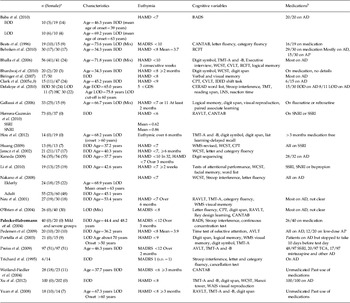
Studies examining MDD patients with co-morbid physical illness were excluded. When results from the same study population were reported in more than one study, only the study with larger samples was included. The flow chart (see online Supplementary Fig. S1) summarizes the study inclusion process. Definitions of euthymia varied between studies, with some of them relying solely on cut-off scores on depression scales while others required a minimum temporal duration (e.g. 2 weeks to 6 months) for clinical remission (Table 1). For the purposes of this study, we also define a ‘strict euthymia’ category (7 <HAMD or 10 <MADRS, and being remitted for at least 2 months).
Characteristics of the studies included in the meta-analysis

HAMD, Hamilton Depression Rating Scale; BADS, Behavioral Assessment of Dysexecutive Syndrome; AD, antidepressant; EOD, early-onset depression; LOD, late-onset depression; Mix, mixed; MADRS, Montgomery-Asberg Depression Rating Scale; CANTAB, Cambridge Neuropsychological Test Automated Battery; AP, antipsychotic; TMT, Trail-Making Test; WCST, Wisconson Card Sorting Test; CVLT, California Verbal Learning Test; RCFT, Rey–Osterrieth Complex Figure Test; CPT, Continuous Performance Test; IDED, intra-dimensional/extra-dimensional; HC, healthy controls; GDS, Geriatric Depression Scale; CERAD, Consortium to Establish a Registry for Alzheimer's Disease; LNS, Letter-Number Sequencing; SNRI, Serotonin-norepinephrine reuptake inhibitors; SSRI, selective serotonin reuptake inhibitors; RAVLT, Rey Auditory Verbal Learning Test; WMS, Wechsler Memory Scale; AVLT, Auditory Verbal Learning Test, TCA, tricyclic antidepressant; s.d., standard deviation; WAIS, Wechsler Adult Intelligence Scale.
a Depressed/control participants unless otherwise specified.
b On medication/depressed participants.
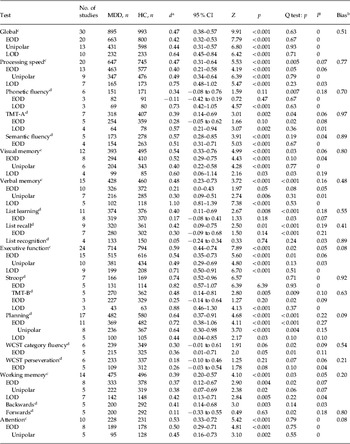
Task-specific meta-analyses were conducted when at least five independent studies reported on a given task (e.g. Stroop task). In addition to task-specific analyses, we grouped individual tasks into broader cognitive domains of ‘executive function’, ‘working memory’, ‘attention’, ‘processing speed’, ‘semantic fluency’, ‘verbal memory’ and ‘visual memory’. This second step was undertaken because there were not sufficient studies to perform meta-analyses for all individual tasks (see online Supplementary Table S1). Cognitive domain scores were calculated by averaging reported effect sizes for the individual tasks listed under each domain. A separate ‘planning’ score was estimated within the ‘executive function’ domain, as planning was examined in a considerable number of studies (Table 2). We also estimated a composite measure of ‘global cognition’ by averaging the effect sizes across each of the cognitive domains.
Mean weighted effect sizes for cognitive differences between euthymic adult MDD patients and HC participants

MDD, Major depressive disorder; HC, healthy control; CI, confidence interval; EOD, early-onset depression; LOD, late-onset depression; TMT, Trail-Making Test; WCST, Wisconson Card Sorting Test.
a d = Effect size of between-group difference.
b Bias=p value of Egger's test.
c Main cognitive domains.
d Individual cognitive tasks.
Statistical analysis
Meta-analyses were performed using MIX software version 1.7 on a Windows platform (Bax et al. Reference Bax, Yu, Ikeda, Tsuruta and Moons2006). For each cognitive task, an effect size and standard error were estimated. For each study, effect sizes were calculated as the mean difference between task performance scores for MDD patients and healthy subjects divided by the pooled standard deviation. Effect sizes were weighted using the inverse variance method. We used a random-effects model (DerSimonian–Laird estimate) because the distributions of effect sizes were heterogeneous for the number of variables. The Q test was used to measure the heterogeneity of the distribution of effect sizes. When the Q test was significant ‘I 2’ – a measure of the degree of inconsistency in the studies' results – was used to quantify heterogeneity (Higgins & Thompson, Reference Higgins and Thompson2002). I 2 estimates the percentage of total variation across studies that is due to heterogeneity rather than chance. I 2 values between 0 and 0.25 suggest small magnitudes of heterogeneity, while I 2 values in the range 0.25 to 0.50 suggest medium magnitudes and those >0.50 indicate large degrees of heterogeneity.
Publication bias was assessed by Egger's test. We also calculated homogeneity statistics using Qbet to test for differences between late-onset (LOD) and earlier-onset adult depression (EOD). The LOD group comprised elderly subjects whose age of illness onse was in later life (onset after 50–65 years, depending on the study) and the EOD group was operationalized to include patients who had their first episode between the ages of 18 years to somewhere between 50 and 65 years. In some studies, samples of both EOD and LOD patients were reported. Where data were provided for both groups, these samples were analysed separately. For studies that reported both EOD and LOD in elderly patients without providing separate data for each group, the study was classified as LOD.
Meta-regression analyses were used to estimate the impact of demographic (age, gender) and clinical (number of episodes, age at illness onset, duration of illness, residual depressive symptoms, based on Hamilton Depression Rating Scale) variables on between-group differences. These meta-analyses were conducted both in the whole sample and in EOD and LOD samples seperately. Meta-regression analyses (weighted generalized least squares regressions) were conducted using SPSS version 11.0 (SPSS Inc., USA). Meta-regression analyses performed with a random-effects model were conducted using the restricted-information maximum likelihood method with significance level set at p < 0.05.
Results
A total of 27 studies (30 samples) comparing 895 (60.7% female) patients with MDD and 993 (60.1% female) healthy controls were included in the final meta-analysis (Table 1). Of these samples, 13 included unipolar patients, while the remaining 17 samples included patients with a mixture of unipolar and single-episode patients. There were no significant differences in age between the groups [d = 0.0, 95% confidence interval (CI) −0.17 to 0.17, Z = 0.02, p = 0.98].
Global cognition
Our composite measure of global cognition was significantly different between euthymic MDD patients compared with healthy controls (d = 0.47), with patients having lower scores in global cognition (Table 2).
There was no evidence for publication bias and the distribution of effect sizes was very homogeneous (I 2 = 0). When repeating analyses on the basis of more stringent criteria for remission (cut-off score and at least 2 months' duration), the magnitude of impairment remained similiar (d = 0.50).
Cognitive domains
Healthy controls significantly outperformed euthymic MDD patients in all cognitive domains (d range 0.39–0.59) (Table 2). Task-specific analyses indicated that healthy controls performed significantly better than MDD patients in Stroop interference (d = 0.74), Trail-Making Test part A (d = 0.39), Trail-Making Test part B (d = 0.48), digit span backwards (d = 0.41), list learning (d = 0.42), list recall (d = 0.39), and animal naming (d = 0.57), but not in phonetic fluency, Wisconson Card Sorting Test (WCST) perseveration, digit span forwards and list recognition.
There was no evidence of publication bias in any of the cognitive domains or individual tasks. The distribution of effect sizes was heterogeneous except the attention domain and three of the individual tasks (Stroop interference, digit backwards, WCST perseveration). However, the magnitudes of this heterogeneoity were quite small (range I 2 = 0 to 0.22) for all measures.
LOD v. controls
Compared with the whole-sample analyses, specific meta-analyses in LOD patients identified more severe cognitive impairment for global cognition (d = 0.64) and for most cognitive domains (range of d = 0.42–1.10), with the largest effect size occuring in the domain of verbal memory (Table 2). It was not possible to conduct meta-analyses for the attention and semantic fluency domains due to a lack of sufficient studies in LOD patients. Unlike the whole-sample analyses, the distribution of effect sizes was homogeneous across all domains in LOD patients, apart from the domain of visual memory. There was no evidence of publication bias. In the LOD samples in which subjects had a mean age of onset after 60 years, cognitive deficits tended to be even more severe for global cognition (d = 0.77, 95% CI = 0.36–1.19, Z = 3.6, p < 0.001) and verbal memory (d = 1.20, 95% CI = 0.77–1.62, Z = 5.5, p < 0.001).
EOD v. controls
For most cognitive domains, the magnitude of cognitive deficits observed in EOD samples was notably smaller (range d = 0.21–0.54). When analyses were limited to unipolar patients, the magnititude of observed effects (d = 0.30–0.49) was very similar to that of the full EOD sample. For specific tasks, EOD patients were most prominently impaired in Stroop interference (d = 0.82). Consistent with the whole-sample analyses, there was significant heterogeneity of the distribution of effect sizes for most cognitive measures, but the magnitude of such heterogeneity was modest (range I 2 = 0–0.29).
EOD v. LOD
Cognitive deficits in LOD patients were significantly more severe than those in EOD patients in terms of processing speed (Qbet = 7.4, p < 0.01) and verbal memory (Qbet = 30.4, p < 0.001) (see online Supplementary Figs S2–S5). There were also trend level differences for global cognition (Qbet = 3.72, p = 0.05) and executive function (Qbet = 3.42, p = 0.06). The between-group differences for executive functions were driven by speed-dependent tasks (Trail-Making Test, part B: Qbet = 5.2, p = 0.03) but not in planning.
Meta-regression analyses
In meta-regression analyses, the number of episodes, duration of illness, current (i.e. residual) depressive symptoms, age and gender variables had no statistically significant influence on the nature of cognitive deficits observed in euthymic MDD patients when conducted in separate EOD and LOD. In the whole sample, older age of onset was associated with more severe verbal memory deficits (B = 0.32, s.e. = 0.09, Z = 3.77,p = 0.0002).
Discussion
Our meta-analytical review has demonstrated overall that cognitive deficits are evident in euthymic MDD patients. A later age of illness onset was associated with a more severe pattern of impairment. Cognitive deficits were evident across all of the domains examined, albeit with small to medium effect sizes (d = 0.39–0.59). The average magnitude (Cohen's d) of cognitive dysfunction in euthymic MDD patients was 0.47, indicating nearly 70% overlap of distributions of cognitive performances of MDD patients and healthy controls.
Cognitive dysfunction in euthymic MDD appears to be severe and common in certain subtypes of patients. Our findings provide strong evidence for pronounced cognitive deficits in remitted patients who had their first episode of illness late in life (d = 0.64, 60% overlap with controls), with the distribution of effect sizes being strikingly homogeneous in this population. This finding extends previous reports of cognitive differences between late-onset and early-onset MDD patients (Herrmann et al. Reference Herrmann, Goodwin and Ebmeier2007). These pronounced deficits might be related to progressive abnormalities in cortico-striatal-pallidal-thalamic circuits that have been identified in MDD (Rogers et al. Reference Rogers, Bradshaw, Pantelis and Phillips1998; Marchand & Yurgelun-Todd, Reference Marchand and Yurgelun-Todd2010; Bora et al. Reference Bora, Harrison, Davey, Yücel and Pantelis2012b) as well as vascular changes in white matter (Herrmann et al. Reference Herrmann, Le Masurier and Ebmeier2008). Verbal memory problems might be related to a risk of future neurodegenerative disorders in some of these patients (Yeh et al. Reference Yeh, Tsang, Lin, Kuo, Yen, Chen, Liu and Chen2011; Vilalta-Franch et al. Reference Vilalta-Franch, López-Pousa, Llinàs-Reglà, Calvó-Perxas, Merino-Aguado and Garre-Olmo2012). The most pronounced deficits in the LOD patients were in verbal memory (d = 1.10, 41% overlap), processing speed (d = 0.75, 55% overlap) and some aspects of executive functions, including the Trail-Making Test part B (d = 0.88, 49% overlap). These deficits statistically distinguished late- from early-onset patients. Positive correlation between verbal memory deficits and age of onset in meta-regression analyses also supported these findings.
By comparision, cognitive deficits were generally modest in euthymic patients who had their first episode of illness in early adulthood. These earlier-onset patients may be considered more representative of patients within the spectrum of ‘functional’ mood disorders, and therefore may be more readily comparable with other disorders, including bipolar disorder. In general, the magnitude of deficits in this subgroup of patients was less pronounced than what has been observed in bipolar disorder (Bora et al. Reference Bora, Yucel and Pantelis2009). One notable exception relates to the Stroop interference task to which both MDD (d = 0.82) and bipolar disorder patients (d = 0.76) appear to be significantly impaired. This finding suggests that deficits of psychomotor inhibitory control may be trait characteristics of mood disorders more generally. Abnormalities of the anterior cingulate cortex, which has been observed in MDD and bipolar disorder, may represent an important component of the anatomical substrate underlying these common deficits (Bora et al. Reference Bora, Fornito, Yucel and Pantelis2010a, Reference Bora, Fornito, Pantelis and Yucel2012a).
Strikingly, verbal memory impairment showed a modest deficit in earlier-onset MDD patients (d = 0.21), suggesting that only a small minority of patients would have such deficits. In fact, a meta-analysis of first-episode MDD also found a very subtle verbal memory deficit (d = 0.13) which was not significant (Lee et al. Reference Lee, Hermens, Porter and Redoblado-Hodge2012). These findings contradict other evidence suggesting that hippocampus alterations are among the most robust findings in MDD (Campbell et al. Reference Campbell, Marriott, Nahmias and MacQueen2004), although it must be said that the vast majority of neuroimaging studies have not compared euthymic versus currently ill patients. It is likely that hippocampus alterations in adult MDD patients are secondary to active stress-related processes and that such alterations might recover in fully remitted patients. Indeed, there is evidence to suggest that verbal memory impairment is related to severity of depression (McDermott & Ebmeier, Reference McDermott and Ebmeier2009). It has been previously suggested that persistent verbal memory deficits might be evident in a subgroup of remitted patients with recurrent episodes (Gorwood et al. Reference Gorwood, Corruble, Falissard and Goodwin2008). Our meta-analysis did not support this hypothesis as meta-regression analyses did not find a relationship between verbal memory and duration of illness/number of episodes. However, these analyses are likely to be underpowered to detect subtle effects as not all studies reported these variables.
There was a significant heterogeneity among findings in adult-onset MDD. It is likely that this heterogeneity is due to variance in the proportion of patients with potentially more severe cognitive deficits, for instance, patients with a history of psychosis or melancholic features during active episodes. In symptomatic MDD samples, these factors are associated with more severe cognitive deficits. There were not sufficient data in remitted patients to appropriately meta-analyse the influence of these factors. Future studies are needed to examine cognitive performance in euthymic MDD patients with a history of melancholic/non-melancholic and psychotic and non-psychotic features.
One important consideration for our results relates to the definition of ‘illness remission’ across studies. Only a minority of the studies used rigorous criteria for defining euthymia that are comparable with the definition employed in studies of bipolar disorder. Many of the included studies reported no criteria for the temporal duration of euthymic mood. Because subthreshold depressive symptoms may negatively influence cognition, this is a relevant limitation. However, there was no significant difference in the magnitude of cognitive impairment between studies that employed more rigorous criteria compared with those that did not, which supports the generalizability of our findings. Also, cognitive deficit might be even more severe than reported here as more substantial deficits were found for LOD samples in which all subjects had age of onset after 60 years. Another limitation relates to the fact that all but two studies included patients receiving antidepressant medication and most studies did not report medication doses, which we were unable to formally examine by meta-analysis. It is clear that further studies of cognition are needed in euthymic and unmedicated MDD patients.
In conclusion, cognitive deficits in MDD are likely to represent trait characteristics of illness in some patient groups. Such deficits are more pronounced in patients who experienced their first episode of illness late in life, particularly in the domain of processing speed and verbal memory. Inhibitory control deficits are the most robust finding in adult-onset MDD. Within the broad and heterogeneous diagnostic spectrum of MDD, persistent cognitive deficits might be important functional markers of some patient groups. Longitudinal studies that are designed to assess cognition in ‘at-risk’ and first-episode populations across the age range will be needed to further clarify the precise nature of cognitive deficits in depression.
Supplementary material
For supplementary material accompanying this paper visit http://dx.doi.org/10.1017/S0033291712002085.
Acknowledgements
B.J.H. was supported by a National Health and Medical Research Council of Australia (NHMRC) Clinical Career Development Award (no. 628509). M.Y. was supported by an NHMRC Senior Research Fellowship (no. 1021973). C.P. was supported by a NHMRC Senior Principal Research Fellowship (no. 628386), a NARSAD Distinguished Investigator Award from the Brain and Behavior Research Foundation and a NHMRC Program Grant (no. 566529).
Declaration of Interest
None.