




No CrossRef data available.
War as a Commitment Problem
Published online by Cambridge University Press: 04 January 2006
Abstract
Although formal work on war generally sees war as a kind of bargaining breakdown resulting from asymmetric information, bargaining indivisibilities, or commitment problems, most analyses have focused on informational issues. But informational explanations and the models underlying them have at least two major limitations: they often provide a poor account of prolonged conflict, and they give an odd reading of the history of some cases. This article describes these limitations and argues that bargaining indivisibilities should really be seen as commitment problems. The present analysis then shows that a common mechanism links three important kinds of commitment problem: (1) preventive war, (2) preemptive attacks arising from first-strike or offensive advantages, and (3) conflicts resulting from bargaining over issues that affect future bargaining power. In each case, large, rapid shifts in the distribution of power can lead to war. Finally, the analysis elaborates a distinctly different mechanism based on a comparison of the cost of deterring an attack on the status quo with the expected cost of trying to eliminate the threat to the status quo.For helpful comments and criticisms, I thank James Fearon, Hein Goemans, Lisa Martin, Sebastian Mazzuca, Branislav Slantchev, and seminar participants at the University of Montreal–McGill Research Group in International Security, the Institute in Mathematical Behavioral Sciences, University of California, Irvine, and University of California, Santa Barbara. I also gratefully acknowledge the support of the National Science Foundation (SES-0315037).
Information
- Type
- Research Article
- Information
- Copyright
- © 2006 The IO Foundation and Cambridge University Press
Formal work on the causes and conduct of war generally sees war as a kind of bargaining process.1
This formal approach can be traced at least as far back as Schelling 1960, 5, who observed that most “conflict situations are essentially bargaining situations.” Wittman 1979 provides a path breaking analysis. Powell 2002 surveys this work.
In an important article, Fearon described three broad rationalist approaches to resolving this puzzle: informational problems, bargaining indivisibilities, and commitment issues.2
Informational problems arise when (1) the bargainers have private information about, for example, their payoffs to prevailing or about their military capabilities, and (2) the bargainers have incentives to misrepresent their private information. Informational problems typically confront states with a risk-return trade-off. The more a state offers, the more likely the other state is to accept and the more likely the states are to avert war. But offering more also means having less if the other accepts. The optimal solution to this trade-off usually entails making an offer that carries some risk of rejection and war.Bargaining indivisibilities occur if the pie to be divided can only be allocated or “cut up” in a few ways. If none of these allocations simultaneously satisfy all of the belligerents, at least one of the states will prefer fighting to settling and there will be war.
The crucial issue in commitment problems is that in the anarchy of international politics, states may be unable to commit themselves to following through on an agreement and may also have incentives to renege on it. If these incentives undermine the outcomes that are Pareto-superior to fighting, the states may find themselves in a situation in which at least one of them prefers war to peace.
Informational problems abound in international politics, and most of the formal work on war done in the past decade has pursued an informational approach to the inefficiency puzzle.3
See, for example, Fearon 1995; Filson and Werner 2002; Kydd 2003; Powell 1996a, 1996b, 1999, and 2004a; Slantchev 2003b; Wagner 2000; Werner 2000.
The present analysis begins by describing these limitations and then outlines a complete-information approach to overcoming them. The basic idea behind this approach is to study war and the inefficiency puzzle in the context of complete-information games where there are no informational problems. This approach, it is important to emphasize, should not be seen as discounting the role of informational accounts in explaining key aspects of war. As just noted, informational arguments have made fundamental contributions. Rather a complete-information approach simply lets one abstract away from informational problems to focus more directly on other possible solutions to the inefficiency puzzle.
Appealing to bargaining indivisibilities to explain war is consistent with this complete-information approach and may seem to offer a way around the limitations of informational accounts. But it does not. The analysis below shows that bargaining indivisibilities do not offer a distinct solution to the inefficiency puzzle and should really be seen as commitment problems.
Commitment problems may help to overcome the limitations of informational accounts, either as a complement to an underlying informational problem or as the primary cause of conflict. But the concept of a commitment problem will be of little analytic value if the inability to commit leads to conflict in a different way in each empirical case. If the only thing different cases have in common is that the states are in an anarchic realm, that is, the states are unable to commit themselves, then the concept of a commitment problem is really not doing any theoretical work and is largely serving as a catch-all label. If, therefore, the notion of a commitment problem is to provide a useful way of organizing research, it will be important to establish that a handful of general commitment problems or mechanisms illuminate a significant number of empirical cases.
To this end, the present analysis shows that the three kinds of commitment problem Fearon describes are quite closely related.4
Fearon 1995, 401–9.
These results build on and extend studies by Fearon and Powell in two major ways.5
See Fearon 1995; and Powell 2004b.
Fearon 1995, 388.
Powell shows that a common mechanism is at work in a wide range of substantively diverse studies, namely, in Acemoglu and Robinson's model of costly coups and democratic transitions, Fearon's account of prolonged civil wars, de Figueiredo's examination of inefficient policy insulation, and Fearon's and Powell's models of interstate bargaining in the shadow of shifting power.7
See Powell 2004b; Acemoglu and Robinson 2000 and 2001; Fearon 2004; de Figueiredo 2002; Fearon 1995; Powell 1999.
Fearon 1996. To the best of my knowledge, there are only two models that focus on this kind of bargaining problem, Fearon's and Schwarz and Sonin's (2003) closely related analysis.
This is a surprising result. The distribution of military power shifts endogenously in Fearon's model because a concession today makes an adversary stronger tomorrow and leads to further demands and concessions. By contrast, the distribution of military power shifts exogenously in Fearon and Powell (possibly because of differential rates of economic growth or sociopolitical development).9
See Fearon 1995; Powell 1999.
In addition to these extensions, the present analysis describes another related mechanism that may operate at the domestic level. Here fighting results from shifts in the distribution of power between domestic factions that cannot commit to distributions of the domestic pie. Interestingly, there would be no fighting in this case if the states were unitary actors.
Finally, the discussion highlights a distinctly different mechanism based on a resource-allocation problem. Many models of war do not include the cost of securing the means of military power. There is no guns-versus-butter trade-off. When these costs are included in the analysis, states may prefer fighting if the long-term cost of continually procuring the forces needed to perpetually deter an attack on the status quo is higher than the expected cost of trying to eliminate the threat.
The next section elaborates two major limitations of informational explanations. The third section describes the complete-information approach. The fourth section shows that bargaining indivisibilities do not solve the inefficiency puzzle and that the real issue is commitment. The fifth section takes up commitment problems. The final section concludes.
The Limitations of Informational Explanations
Most informational explanations of war begin with a bargaining model in which there would be no fighting if there were complete information. The analysis then adds asymmetric information and shows that there is a positive probability of fighting in equilibrium.10
See Fearon 1995; and Powell 1996a, 1996b, and 1999, 86–97, for typical formulations. These informational efforts to explain inefficient fighting parallel earlier efforts in economics to explain inefficient delay in bargaining. Rubinstein's 1982 seminal analysis found that a natural bargaining game had a unique subgame perfect equilibrium when there was complete information. The equilibrium outcome was also efficient: the first offer was accepted and agreement was reached without delay. Economists initially believed that adding asymmetric information would provide a straightforward explanation of delay. But explaining delay in this way proved far from straightforward. See, for example, the discussion in Gul and Sonnenschein 1988.
Consider first prolonged international and intrastate war and the ultimate ability of asymmetric-information bargaining models to provide a compelling explanation of this outcome.11
Protracted interstate conflict turns out to be relatively uncommon, although these wars are among the most destructive. The mean duration of the seventy-eight wars fought during 1816–1985 is about fifteen months with thirteen (17 percent) lasting three or more years and six (7 percent) lasting five or more years (Bennett and Stam 1996). By contrast, civil wars are much more likely to last a long time. Seventy of the 123 civil wars started between 1945 and 1999 lasted at least five years and thirty-nine lasted at least ten years (Fearon 2004).
Fearon 2004, 290.
A second limitation of the information approach follows from an underappreciated implication of the assumption that there would be no fighting if there were complete information: a satisfied state always prefers appeasing a dissatisfied adversary to fighting no matter how large a concession it takes to satisfy the dissatisfied state. To illustrate this implication, consider a simple take-it-or-leave-it offer game in which two states, A and B, are bargaining about revising the territorial status quo, q.13
Fearon 1995; Powell 1999 and 2002, for elaborations of this basic setup.

The bargaining problem
B begins the game by making an offer, x ∈ [0,1], to A, who can accept the offer, reject it, or go to war to change the territorial status quo. If A accepts, the territory is divided as agreed. If A fights, the game ends in a costly lottery in which one state or the other is eliminated. More precisely, A wins all of the territory and eliminates B with probability p, or B eliminates A and thereby obtains all of the territory with probability 1 − p. Fighting also destroys a fraction d > 0 of the value of the territory. If A rejects B's offer, then B can attack or pass. Attacking again ends the game in a lottery. Passing ends with the status quo unchanged.
A's payoff if the status quo is unchanged is q, its payoff to agreeing to x is just x, and its payoff to fighting is p(1 − d) + (1 − p)(0) = p(1 − d). B's payoffs are defined analogously. A state is dissatisfied if it prefers fighting to the status quo. Thus A is dissatisfied if p(1 − d) > q, and B is dissatisfied if (1 − p)(1 − d) > 1 − q.
Suppose then that A is dissatisfied, as depicted in Figure 1, and that there is complete information. In these circumstances, B knows the minimum amount it must offer A to induce A not to fight: it must offer A its certainty equivalent of fighting x* = p(1 − d). This offer makes A indifferent between fighting and accepting, and, consequently, A would strictly prefer to fight if offered less than x*.14
Although A is indifferent between fighting and accepting x*, it can be shown that A is sure to accept x* in equilibrium.
Thus B faces a clear choice when there is complete information. It can appease A by conceding x*, which leaves B with a payoff of 1 − x* = 1 − p(1 − d), or B can fight, which gives it an expected payoff of (1 − p)(1 − d) = 1 − p(1 − d) − d. B clearly prefers the former as long as fighting is costly (that is, as long as d > 0) and regardless of how much it has to concede (that is, regardless of how much larger x* is than q). Hence B always prefers to accommodate A whenever A is dissatisfied, fighting is costly, and there is complete information.
A simple intuition underlies this result. If fighting is costly, the pie to be divided is larger if the states avert war because they save d. But B's offer of A's certainty equivalent x* = p(1 − d) means that A's payoff is the same whether it accepts x* or fights. Thus, whatever is saved by not fighting must be going to B, and this is what leads B to prefer appeasing A.15
To put the point formally, the difference between B's payoff to satisfying A and fighting is just the amount that fighting would have destroyed: (1 − x*) − (1 − p)(1− d) = d.
B's choice is less clear when there is asymmetric information. Suppose A has private information about its military capabilities, for example, about the effectiveness of its military forces. As a result, B is unsure of A's probability of prevailing but believes that it lies in a range from p to p. This uncertainty confronts B with a risk-return trade-off. The more it offers A, the more likely A is to accept but the less well off B will be if A accepts. The optimal offer that resolves this trade-off generally entails some risk of rejection, and this is the way that asymmetric information can lead to war.
The implicit assumption that the states do not fight when there is complete information can produce strange historical accounts. Consider, for example, the run up to World War II in Europe. It is impossible to tell the story of the 1930s without asymmetric information. There was profound uncertainty surrounding Adolf Hitler's ambitions. For example, shortly after Germany annexed Austria, Alexander Cadogan, the permanent undersecretary in the British Foreign Office declared, “I am quite prepared to believe that the incorporation in the Reich of Austrian and Sudetendeutsch may only be the first step in a German expansion eastwards. But I do not submit that this is necessarily so, and that we should not rush to conclusions.”16
Quoted in Parker 1993, 135.
In a screening equilibrium, an actor with incomplete information makes a series of ever more attractive offers that screen the other actor according to the latter's willingness to settle. Suppose 1 is uncertain of 2's degree of dissatisfaction, for example, 2's payoff to fighting. Then, 1 makes a series of increasingly favorable concessions to 2 in the hope of buying 2 off as cheaply as possible. The less dissatisfied 2 is, that is, the lower its payoff to fighting, the earlier it settles. These offers therefore screen 2 according to its willingness to settle. For analyses of these dynamics, see Powell 2004a; and Slantchev 2003b and 2004a.
The war did not come, however, as an informational account would have it, because Britain and France would have been willing to satisfy Hitler's demands if only they had complete information about what those demands were and offered too little because of their uncertainty about those demands. To the contrary, Britain became increasingly confident after Hitler occupied the rump of Czechoslovakia that it was dealing with an adversary it was unwilling to satisfy. Of Hitler's demand for a “free hand in the East,” Lord Halifax, the British Foreign Secretary, wrote to British Prime Minister Neville Chamberlain a few days before the war began, “if he [Hitler] really wants to annex land in the East … I confess that I don't see any way of accommodating him.”18
Quoted in Parker 1993, 268. Also see Aster 1973, 328; Weinberg 1980, 654.
Even if Britain ultimately came to believe that it was facing a type it was unwilling to satisfy, one might still argue that war resulted from Germany's uncertainty about Britain's resolve. Why would Britain stand firm over Poland when it had backed down over Czechoslovakia? Indeed, the events of summer and fall 1939 as well as the “Phony War” can readily be interpreted in terms of asymmetric information. It is, however, much harder to explain Germany's all-out air offensive and invasion plans in summer 1940 in terms of Germany's uncertainty about Britain's willingness to stand firm. The Appendix examines the possibility that war resulted from Germany's uncertainty about Britain's willingness to stand firm in more detail.
In sum, the informational approach has developed in the context of models in which there would be no fighting if states had complete information about each other. These models and the accounts based on them explain important aspects of many cases. But these models also have an analytic blind spot that can lead to odd readings of other equally important aspects of some cases. At times, fighting does not seem to result from some residual uncertainty about an adversary that has yet to be resolved. Fighting ensues when the resolution of uncertainty indicates that a state is facing an adversary it would rather fight than accommodate. Such cases are not well modeled by the standard informational account in which bargaining invariably leads to efficient outcomes when there is complete information.
A Complete-Information Approach to Costly Conflict
Situations in which war breaks out when a state becomes increasingly confident that it is facing an opponent it would rather fight than accommodate combine two problems. The first is an informational problem created by the state's initial uncertainty about its adversary's capabilities or resolve. This uncertainty played a critical role in the 1930s, and, as Fearon observes, it may also play an important part in the early phase of many civil wars. The second problem is the possibility that there are types that would fight each other even if there were no uncertainty. If such types actually are facing each other, then war will come to be seen as more rather than less likely as the states learn more about each other. At some point, one of the states becomes sufficiently confident it is facing a type it is unwilling to accommodate that it attacks.
By focusing almost exclusively on models in which there would be no fighting if the states had complete information, recent formal work on war has treated it as a purely informational problem.20
Three recent exceptions are Fearon 2004; Powell 2004b; Slantchev 2003a.
Although actual cases may combine informational problems with these other potential causes, one can separate the informational problem and set it aside analytically. Models that incorporate asymmetric information, which is needed to study the informational problem, tend to be complex. This complexity typically forces the modeler to simplify other aspects of the states' strategic environment to keep the model tractable. One can, however, abstract away from the information problem by working with complete-information games. These models in effect posit that the states already know or have learned whom they are facing. As a result, this complete-information approach focuses directly on trying to illuminate the key features of a strategic environment that may lead to costly, inefficient fighting even if the states have no private information.
Bargaining Indivisibility as a Commitment Problem
Bargaining indivisibilities appear to provide a simple, straightforward solution to the inefficiency puzzle of explaining why states fight even though there are peaceful agreements all states simultaneously prefer to war. If the disputed issue is indivisible or can only be divided in a limited number of ways, one state or the other may prefer fighting to each of these divisions. There are no Pareto-superior peaceful settlements, and therefore the question of why the states fail to agree to one of them is moot. Moreover, an appeal to bargaining indivisibilities would also seem to be part of a complete-information approach to the inefficiency puzzle because incomplete information plays no role in the argument.
This reasoning is flawed. Bargaining indivisibilities do not solve the inefficiency puzzle by rendering it moot. Even if the disputed issue is indivisible, there are still agreements both sides prefer to resolving the issue through costly fighting. The problem is, rather, that the states cannot commit to these agreements. More generally, the fact that fighting is costly implies that a bargaining range always exists even if the states are risk-acceptant, the issue is indivisible, or there are first-strike or offensive advantages. While Fearon only describes the latter as a commitment problem, all three are fundamentally commitment problems.21
Fearon 1995, 388–90, 402–4.
That bargaining indivisibilities do not offer a distinct rationalist explanation for war runs contrary to a growing literature on bargaining indivisibilities. Although Fearon discounted their empirical significance, he argued that bargaining indivisibilities offered a conceptual solution to the inefficiency puzzle. If the issue were indivisible, there might not be any agreements that all of the states simultaneously preferred to fighting.22
Ibid., 386–90.
Ibid., 390.
Other scholars have begun to assert more recently that bargaining indivisibilities are more common and play a more important role in international disputes. Hassner believes that sacred places are often seen as inherently indivisible and that this perception impedes efforts to resolve disputes over them.24
Goddard and Hassner endogenize indivisibility.25See Goddard 2005; Hassner 2004.
Goddard 2005, 2.
Whether states are more reluctant to make concessions and bargain harder over some types of issues is an interesting theoretical and empirical problem. But bargaining indivisibilities do not explain war. Even if a disputed issue is physically indivisible, one should not think of bargaining indivisibilities as a conceptually distinct solution to the inefficiency puzzle. There are still outcomes (or more accurately mechanisms) that give both states higher expected payoffs than they would obtain by fighting over the issue. The real impediment to agreement is the inability to commit.
To see that this is the case, suppose that the territory over which A and B are bargaining in the example above cannot be divided.29
This analysis draws on Fearon 1995, 389, who briefly discusses the possibility of resolving bargaining indivisibilities through some sort of random allocation and on the insightful discussion in Wagner 2004.
The example above is based on a take-it-or-leave-it bargaining protocol. But the basic point is much more general. Abstractly, one can think of fighting over an indivisible object as a costly way of allocating it: each state gets the object with a certain probability and at some cost. It follows that both states would prefer an agreement that gives the object to them with the same probabilities but does so without their having to pay the cost of fighting. The problem is not that there are no agreements that are Pareto-superior to fighting; the fact that fighting is costly ensures that there are. The problem is that states may not be able to commit themselves to abiding by these agreements.
Somewhat more formally, suppose that the possibly very complicated way of settling a dispute can be represented by a complete-information game, say Γ. In the example above, Γ was a take-it-or-leave-it-offer game. If the states play Γ, then one can characterize an equilibrium outcome in terms of the probability πA that the issue is resolved in A's favor, the probability πB that the issue is resolved in B's favor, and the expected fractions of the value destroyed if A prevails and if B prevails, dA and dB.30
The complete-information assumption comes in here. This assumption implies that the states share the same probability distribution over terminal nodes of the tree. Hence, the probability A attaches to B's prevailing is the same as the probability that B gives it, and similarly for the probability that A prevails. This means that πA, πB, dA, and dB are well defined.
Let A denote the outcomes or terminal nodes of Γ at which A prevails; take A's payoff at j ∈ A to be 1 − dAj; and let the equilibrium probability of reaching outcome j be πAj. A's payoffs at all other outcomes is zero. Thus, A's expected equilibrium payoff is [sum ]j∈A πAj(1 − dAj) = πA(1 − dA), where πA = [sum ]j∈A πAj is the probability that A prevails and dA = [sum ]j∈A (πAj/πA)dAj is the expected cost of fighting conditional on A's prevailing.
As long as this way of settling the dispute is costly (that is, dA > 0 and dB > 0), then there is always a strictly Pareto-superior settlement even if the issue is indivisible. Namely, the issue is costlessly settled in A's favor with probability πA and in B's favor with probability πB. Settling the issue in this way avoids the cost of fighting and gives the states the higher payoffs of πA and πB. Thus there are agreements both states strictly prefer to resolving the dispute through the costly mechanism Γ. The difficulty is not the absence of Pareto improving agreements but the inability of the states to commit to them.
An analogy may help make this more concrete. In order to avoid the high cost of litigation, the parties involved in a contractual dispute will prefer to settle the matter through binding arbitration as long as the chances of prevailing are roughly the same as they would be if the dispute went to court. In these circumstances, arbitration reduces the cost of resolving the dispute and both parties are better off. Of course, this requires that the arbitration be truly binding. If the losing party can go to court or simply refuse to abide by the settlement, arbitration has little to offer. By analogy, the problem with bargaining indivisibilities is not the absence of agreements that states prefer to fighting. The problem is that the states may not be able to commit to following through on them.
The argument above goes beyond bargaining indivisibilities, and the fundamental similarity among bargaining indivisibilities, risk acceptance, and large first-strike or offensive advantages is worth emphasizing. Fearon suggests that the states must be risk-averse or risk-neutral to guarantee that a bargaining range exists. Risk acceptance may eliminate the bargaining range.32
Fearon 1995, 388.
Fearon distinguishes between the bargaining range and what he calls the de facto bargaining range, which is the difference between each state's reservation value for fighting given that it strikes first (Fearon 1995, 403). Large first-strike or offensive advantages eliminate the de facto bargaining range. The commitment problem created by these advantages is discussed in more detail below.
More generally, the equivalent costless lottery induces the same probability distribution over possible outcomes as does the costly lottery. I am grateful to Fearon (private correspondence) for pointing out that the basic argument developed here in the context of bargaining indivisibilities also extends to risk-acceptant states.
In sum, bargaining indivisibilities do not solve the inefficiency puzzle by rendering it moot. The bargaining range is not empty; there are always agreements that all of the states simultaneously prefer to war. Bargaining indivisibilities, risk-acceptant states, and first-strike or offensive advantages should all been seen as commitment issues. Broadly speaking, there are two, not three rationalist approaches to the inefficiency puzzle of war: informational problems and commitment problems.35
Fearon (private correspondence) suggests another approach based on coordination problems. These arise in the context of complete-information games in which there are multiple equilibria some of which entail costly fighting. The stag hunt is a simple example (see Jervis 1978), and Slantchev 2003a provides a richer more recent example. In these models the equilibria in which there is fighting are strictly Pareto-inferior to equilibria in which there is no fighting. Absent a compelling theory of equilibrium selection, inefficient equilibria that are dominated by efficient ones provide at best a weak resolution of the inefficiency puzzle.
Commitment Problems
If the notion of a “commitment problem” is to provide a useful explanation of some aspects of war, this concept must be more than a catch-all label. If a different mechanism seems to be at work in each historical case, then the broader notion of a commitment problem will not be of much analytic value. Formalizing these mechanisms may still be useful, but grouping them together under the label “commitment problems” is not really doing any additional theoretical work. The potential value-added of the broader notion of a commitment problem lies in the possibility that a few basic mechanisms will turn out to illuminate a significant number of cases.
Fearon offered a start in this direction by identifying three kinds of commitment problem that seemed to play an important role in international politics: preventive war triggered by an anticipated shift in the distribution of power, preemptive war caused by first-strike or offensive advantages, and war resulting from a situation in which concessions also shift the military balance and thereby lead to the need to make still more concessions.36
Fearon 1995, 401–9.
A General Inefficiency Condition
To see the connection between Fearon's three commitment problems, one needs to take a step back. Recent work in American, comparative, and, to some extent, international politics has tried to explain inefficient outcomes in a complete-information setting.37
See, for example, Acemoglu and Robinson 2000, 2001, and 2004, on democratic transitions, costly coups, and revolutions; Fearon 1998 and 2004, on ethnic conflict and civil war; Alesina and Tabellini 1990; Persson and Svensson 1989, on inefficient levels of public debt; Besley and Coate 1998, on democratic decision making; Busch and Muthoo 2002, on sequencing; de Figueiredo 2002, on policy insulation; Fearon 1995, 404–8; Powell 1999, 128–32; and Slantchev 2003a, on war.
See Powell 2004b; Acemoglu and Robinson 2000 and 2001; Fearon 2004; de Figueiredo 2002; Fearon 1995; Powell 1999.
Although the substantive contexts differ widely, the bargainers in each of these cases face the same fundamental strategic problem. The bargainers are in effect trying to divide a flow of benefits or “pies” in a setting in which (1) the bargainers cannot commit to future divisions of the benefits (possibly because of anarchy, the absence of the rule of law, or the inability of one Congress to bind another); (2) each actor has the option of using some form of power—mounting a coup, starting a civil war, or launching a preventive attack—to lock in an expected share of the flow; (3) the use of power is inefficient in that it destroys some of the flow; and (4) the distribution of power, that is, the amounts the actors can lock in, shifts over time.
Complete-information bargaining can break down in this setting if the shift in the distribution of power is sufficiently large and rapid. To see why, consider the situation confronting a temporarily weak bargainer who expects to be stronger in the future (that is, the amount that this bargainer can lock in will increase). In order to avoid the inefficient use of power, this bargainer must buy off its temporarily strong adversary. To do this, the weaker party must promise the stronger at least as much of the flow as the latter can lock in. But when the once-weak bargainer becomes stronger, it may want to exploit its better bargaining position and renege on the promised transfer. Indeed, if the shift in the distribution of power is sufficiently large and rapid, the once-weak bargainer is certain to want to renege. Foreseeing this, the temporarily strong adversary uses it power to lock in a higher payoff while it still has the chance.
To sketch the idea more formally, suppose that two actors, 1 and 2, are trying to divide a flow of pies where the size of the pie in each period is one. The present value of this flow is

, where δ is the bargainers' common discount factor. At time t, player j = 1 or 2 can lock in a payoff of Mj(t), but doing so is inefficient because it destroys some of the flow. More concretely, M1(t) might be 1's expected payoff to going to war as in Fearon's and Powell's models, deposing the faction in power as in Acemoglu and Robinson's analysis, fighting a civil war as in Fearon's account, or bureaucratically insulating a policy from one's political adversaries as in de Figueiredo's study. If, for example, 1 locks in its payoff by fighting, then it obtains

where pt is the probability that 1 wins the entire flow less the fraction d destroyed by fighting. More generally, Mj(t) is j's minmax payoff in the continuation game starting at time t. Because j can always ensure itself a payoff of at least Mj(t) starting from time t, j's payoff (starting from t) must be at least as large as Mj(t) in any equilibrium.
Now consider the states' decisions at time t, if they expect the distribution of power to shift in 1's favor. That is, the payoff 1 can lock in increases from M1(t) to M1(t + 1) in the next period. If the temporarily weak 1 is to induce 2 not to exploit its temporary advantage, 1 must promise 2 at least as much as 2 can lock in—that is, 1 must offer at least M2(t).
The most that 1 can give its adversary in the current period is the entire pie. As for the future, 1 can credibly promise to give to 2 no more than the (discounted) difference between all there is to be divided and what 1 can ensure itself by fighting. In symbols, 1 can credibly promise a future transfer to 2 of no more than B − M1(t + 1). Were 1 to offer 2 more than this, then 1 would be promising implicitly to accept less than M1(t + 1) for itself. But such a proposal is inherently incredible, because 1 can always lock in M1(t + 1) and therefore would never accept less than this. Hence, the most that 1 can credibly offer 2 at time t is 1 + δ[B − M1(t + 1)]. If this amount is less than what 2 can lock in, that is, if M2(t) > 1 + δ[B − M1(t + 1)], then 2 prefers fighting. In these circumstances 1's inability to commit to giving 2 a larger share results in the inefficient use of power even though there is complete information.
Rearranging terms and subtracting M1(t) from both sides of the previous inequality gives the inefficiency condition:39
Powell 2004b shows formally that all of the equilibria of a stochastic game are inefficient whenever this condition holds somewhere along every efficient path.

This condition has a natural substantive interpretation. The left side is a measure of the size of the shift in the distribution of power between times t and t + 1 (and, therefore, of the rate at which the distribution of power is shifting). The right side is the bargaining surplus, that is, the difference between what there is to be divided and what each player can ensure itself on its own. Thus the inability to commit leads to inefficient outcomes when the per-period shift in the distribution of power is larger than the bargaining surplus.40
To simplify the exposition, the distribution of power is assumed to shift deterministically in condition (1). This is not the case in Acemoglu and Robinson 2000 and 2001; Fearon 2004; de Figueiredo 2002; and, in the general condition described in Powell 2004b, which allows for stochastic shifts in the distribution of power.
Shifting Power Between States
Shifts in the distribution of power are at the heart of Fearon's three kinds of commitment problems. As Powell shows, condition (1) explains the breakdown in Fearon's model of preventive war.41
See Powell 2004b; Fearon 1995, 404–8.
State 2 prefers fighting in equilibrium to appeasing 1, if the adverse shift in power Δ is sufficiently large. To establish this, observe that 2's payoff to fighting in the first round is (1 − p)(1 − d)/(1 − δ). If, by contrast, 2 does not fight, its payoff in the first round is no more than one, which is what 2 would get if it controlled all of the territory. As for the second round, state 2 must offer 1 its certainty equivalent to fighting x* = (p + Δ)(1 − d) in order to induce 1 not to fight after the distribution of power has shifted in 1's favor. This means that the best that 2 can do, if it decides not to fight at the outset of the game, is 1 + δ(1 − x*)/(1 − δ). State 2, therefore, prefers fighting to accommodating if (1 − p)(1 − d)/(1 − δ) > 1 + δ(1 − x*)/(1 − δ). This relation in turn is sure to hold if 2's gain from fighting now rather than later is larger than the cost of fighting, that is, if Δ(1 − d) > d, and the discount factor is sufficiently large.
Condition (1) yields the same result. At the outset of the game (t = 0), the players' minmax payoffs are M1(0) = p(1 − d)/(1 − δ) and M2(0) = (1 − p)(1 − d)/(1 − δ), which the states get if they fight. State 1's minmax payoff rises to M1(1) = (p + Δ)(1 − d)/(1 − δ) when its probability of prevailing rises to p + Δ. Substituting these into (1) and letting the discount factor go to one give Δ(1 − d) > d. Thus the mechanism formalized in the inefficiency condition explains why bargaining breaks down in fighting in Fearon's (as well as Powell's) model of preventive war.42
See Fearon 1995; Powell 1999, 128–32.
Inefficiency condition (1) also helps explain the commitment problem posed by first-strike or offensive advantages. Fearon shows that what he calls the “de facto” bargaining range disappears if first-strike or offensive advantages are large enough.43
Fearon 1995, 402–4.
Now consider more precisely how first-strike advantages undermine potential agreements. A key way is by creating shifts in the distribution of power. When a state decides to bargain rather than attack, it is also deciding not to exploit the advantages to striking first. This decision effectively shifts the distribution of power in the adversary's favor by giving it the opportunity to exploit the advantage to striking first, and this shift can lead to war through the mechanism formalized in condition (1).
The game in Figure 2 illustrates this possibility. State 1 begins by deciding whether to attack or bargain by proposing a settlement. If 1 does make an offer, 2 can either accept or reject. If 2 accepts the game ends with the agreed division. If 2 rejects, it has to decide whether to fight or continue bargaining with 1, and so on.

First-strike advantages and shifting power
In order for 1 to be willing to make a proposal x that 2 might be willing to accept, 1's payoff to living with the agreement must be at least as large as what it could get by fighting: (1 − x)/(1 − δ) ≥ (p + f)(1 − d)/(1 − δ). State 2 also would only agree to an offer that gave it at least as much as it could get by rejecting it and then fighting x/(1 − δ) ≥ 1 − q + δ(1 − p + f)(1 − d)/(1 − δ), where q is the status quo division. No such offers exist (again in the limit) and the bargaining is sure to break down in war whenever the de facto bargaining range is empty, that is, when 2f (1 − d) > d.
This is just what condition (1) says. The states' minmax payoffs at time t when 2 is choosing between attacking and bargaining are their payoffs to fighting M1(t) = (p − f)(1 − d)/(1 − δ) and M2(t) = (1 − p + f)(1 − d)/(1 − δ). If 2 decides not to attack, the distribution of power shifts in favor of 1 whose minmax payoff rises to M1(t + 1) = (p + f)(1 − d)/(1 − δ). Condition (1) then becomes

or, more simply, [(1 + δ) f − (1 − δ)p](1 − d) > d. This relation is sure to hold if the states are sufficiently patient and if 2f (1 − d) > d. Thus first strike or offensive advantages can lead to war by implicitly creating large shifts in the distribution of power
A third kind of commitment problem can arise when states are bargaining over issues that are themselves sources of military power, for example, Czechoslovakia during the Munich Crisis or the Golan Heights during the 1967 Six Day War.44
Ibid., 408–9.
Fearon shows that this supposition is not completely correct and that the commitment problem is more subtle.
45 Suppose states 1 and 2 are bargaining over territory as in the examples above. In each round t, 1 can propose a territorial division xt ∈ [0,1], which 2 can accept or resist by going to war. If 2 accepts, xt becomes the new territorial status quo, 1 and 2 respectively receive payoffs xt and 1 − xt in that period, and play moves on to the next round with 1's making another proposal.46The states are assumed to be risk-neutral here in order to focus on the inefficiency due to fighting. Fearon's analysis allows the states to be risk-averse as well as risk-neutral. But risk aversion means that any territorial allocation that varies over time will be inefficient even if the states avoid fighting.

. State 2's payoff is defined analogously.
Fearon establishes the striking result that the states never fight in the unique subgame perfect equilibrium as long as p is continuous. Rather 1 makes a series of proposals that always leave 2 just indifferent between fighting and acquiescing to the current proposal. More specifically, 1's offer at time t leaves 2 indifferent between fighting or accepting xt and moving on to the next round where 1's offer will once again leave 2 indifferent between fighting and accepting.
To specify xt more precisely, note that 2's payoff to fighting when 1 proposes xt is (1 − p(xt−1))/(1 − δ) − c2. If 2 accepts xt, it obtains 1 − xt in round t and the states move on to round t + 1, where 1's proposal xt+1 will leave 2 indifferent between fighting and continuing on. Hence, xt satisfies

where the expression in parentheses on the right is 2's payoff to fighting or, equivalently, to accepting xt+1 and moving on. Equation (2) recursively defines a series of equilibrium demands x0*,x1*,x3*,….47
State 2's indifference between fighting now and accepting the current offer is the intuitive basis for the absence of fighting. Clearly, 2 has no positive incentive to fight. State 2's indifference also implies that the bargaining surplus created by not fighting is going to 1 which ensures that 1 has no incentive to fight.
That bargaining does not break down in inefficient fighting turns out to be crucially dependent on the continuity of p, that is, on the fact that small concessions only lead to small changes in the distribution of power. Suppose, instead, that the probability that 1 prevails jumps discontinuously at

as illustrated in Figure 3. Substantively,

might be a strategically important geographic feature, such as a mountain pass, ridge, or river the control of which gives a state a military advantage. Formally,

is strictly less than

, which is the limit of p(x) as x approaches

from the right. Then, bargaining breaks down in war if 1 is dissatisfied at

, the equilibrium sequence of offers includes

, and the discount factor is close enough to one.

A discontinuous shift in power
To see why, suppose that 1 is dissatisfied at time t and that the distribution of territory is

. This distribution implies that 1's probability of prevailing if the states fight in the current round is

. Because 1 is dissatisfied at

, 2 must be willing to make some concession if the states are to avoid fighting. That is, 2 must agree to some

in the current round. But 1 will then exploit its stronger bargaining position in the next period by making a demand that leaves 2 indifferent between accepting that offer and fighting when its probability of prevailing will have dropped from

. Consequently, 2 prefers fighting to agreeing to xt if:

or, equivalently, if

.
The discontinuity of p at

ensures that this inequality holds if the discount factor is close enough to one. That is, the previous inequality goes to

, as δ goes to one. Thus bargaining breaks down in fighting even though there are Pareto-superior efficient divisions of the flow of benefits.
Inefficiency condition (1) once again accounts for this breakdown and in so doing helps provide an intuitive explanation for the effects of this discontinuity. According to this condition, state 2 prefers to fight at time t rather than accept xt if accepting this offer would lead to an increase in 1's power (measured in terms of minmax payoffs) larger than the bargaining surplus. In symbols, there will be fighting if:

This reduces to

which goes to

in the limit. The discontinuity at

, therefore, ensures that the inefficiency condition holds if the states are sufficiently patient. Large, rapid shifts in the distribution of power again lead to costly fighting.
A discontinuous jump of any size can lead to fighting in Fearon's formulation. This result, if robust, would be substantively significant because the prevalence of natural barriers such as rivers and mountain ranges makes discontinuity (in the form of at least small jumps in p) the empirically more plausible assumption. However, this result is not robust. It depends on the fact that fighting in Fearon's setup effectively becomes costless as the discount factor goes to zero. That is, the cost of fighting as a fraction of the total flow of benefits goes to zero as δ goes to one: limδ→1(c1 + c2)/[1/(1 − δ)] = 0. If one makes the perhaps more natural assumption that fighting destroys a fraction d of the benefits as in the examples above, then fighting remains costly even as the discount factor goes to one. The Appendix shows that the inefficiency condition still explains when fighting occurs in this modified model and that a relatively large and substantively less plausible jump of at least d/(1 − d) is needed to ensure fighting.
In sum, the three seemingly different kinds of commitment problems share a fundamental similarity. In each of them, large shifts in the distribution of power can lead to bargaining breakdowns and war. These shifts arise in the case of preventive war from underlying changes in the states' military capabilities because of, for example, differential rates of economic growth or political development. In the case of preemption, these shifts result from a decision to continue bargaining and thereby forego the advantages of striking first or being on the offensive. Finally, small concessions may bring dramatic changes in the distribution of power when the distribution of power depends (discontinuously) on previous agreements.
In order to induce an adversary not to fight in the face of these adverse shifts, a temporarily weak state must offer its adversary at least as much as it could get by fighting. The temporarily weak state also would rather do this than fight because fighting is costly. Buying its adversary off, however, may require the weak state to make a series of concessions that stretch across several periods during which the distribution of power will shift in its favor. If the once-weak state becomes sufficiently strong, it will renege on the remaining concessions. This prospect effectively limits the amount the temporarily-weak state can credibly promise to concede to its adversary. If this amount is less than the adversary can obtain by fighting, the strong state will attack before the distribution of power shifts against it.
Shifting Power between Domestic Factions
An analogous mechanism may operate at the domestic level. Here rapid shifts in the distribution of power between domestic factions may lead to international conflict if these factions are unable to commit themselves to divisions of the “domestic pie.”48
This, of course, turns the anarchy-versus-hierarchy distinction between international and domestic politics on its head. For a discussion of this distinction, see Waltz 1979.
To sketch a simple formal model highlighting this kind of commitment problem, suppose that the status quo is q and that the probability that state 1 prevails is p. As before, fighting destroys a fraction d of the resources, so 1's payoff to fighting is p(1 − d) + (1 − p)0 = p(1 − d) and 2's is (1 − p)(1 − d). Hence both states prefer the territorial division x to war as long as x ≥ p(1 − d) and 1 − x ≥ (1 − p)(1 − d) or, equivalently, as long as x is in the interval p(1 − d) ≤ x ≤ p(1 − d) + d. If q is in this interval, both states, when taken to be unitary actors, prefer the status quo to fighting.
Suppose, however, that state 1 is not a unitary actor. Rather 1 is composed of two factions, α and β. Faction α is currently in power and decides whether to fight and how to divide the state's resources between the two factions. To simplify matters, assume that the faction in power must give the out-of-power faction a share of at least λ < ½ of the state's resources. One can think of this as the minimum necessary to buy off the out-of-power faction and dissuade it from launching a civil war or coup.49
See Acemoglu and Robinson 2000, 2001, and 2004; Fearon 2004, for formulations along these lines.
On the effects of war on the fates of leaders, see Chiozza and Goemans 2004; Goemans 2000, 53–71.
Faction α's payoff to accepting x is (1 − λ)x if α remains in power and λx if it loses power. Agreeing to x, therefore, brings α an expected payoff of r(1 − λ)x + (1 − r)λx. If by contrast α fights, its payoff if state 1 prevails and α remains in power is (1 − λ)(1 − d), and λ(1 − d) if it loses power. Neither faction gets anything if state 2 prevails. This gives α an expected payoff to fighting of p[r′(1 − λ)(1 − d) + (1 − r′)λ(1 − d)].
Thus, both α and state 2 prefer x to war only if p(1 − d)[r′(1 − λ) + (1 − r′)λ]/[r(1 − λ) + (1 − r)λ] ≤ x ≤ p(1 − d) + d. No such allocations exist if this bargaining range is empty, that is, if d [r(1 − λ) + (1 − r)λ] < p(1 − d) (r′ − r)(1 − 2λ). The expression on the left of the inequality is always positive, so this condition can only hold if fighting rather than settling increases α's chances of holding on to power (that is, if r′ − r > 0). When it does, this condition is more likely to hold the more likely state 1 is to prevail (the higher p), the lower the cost of fighting (smaller d), and the more valuable having control of the state is (the smaller λ).
Figure 4 models this situation as a game. State 2 begins by making an offer to state 1, which the faction in power, α, can accept or reject by fighting. If α accepts, it retains power with probability r. Thereafter the faction in power can try to buy off the out-of-power faction who can lock in a share λ of the domestic pie. If α fights, state 1 is eliminated with probability 1 − p, and both factions receive zero. If 1 prevails, α retains power with probability r′, and the faction in power once again has the chance to buy off the out-of-power faction.

Shifts in the domestic distribution of power
Strictly speaking, inefficiency condition (1) does not apply to this game because there is only one period, and there are more than two players. But the condition can be applied roughly by noting that there are only two players in the subgame starting with α's decision to fight or to accept an offer x and by taking the discount factor to be one. If x > p(1 − d), accepting is Pareto-efficient because it increases the size of the domestic pie to be divided between α and β. But accepting also leads to a shift in the distribution of domestic power between α and β as α is less likely to retain power if it accepts. Condition 1 says that the bargaining will breakdown in inefficient fighting if the increase in β's power measured in terms of its minmax payoffs is larger than the bargaining surplus.
Faction β's minmax payoff if α accepts x is the probability that it comes to power times the payoff to being in power, (1 − r)(1 − λ)x, plus the payoff if α remains in power weighted by the probability that α retains control, rλx. Similarly, β's minmax payoff if α fights is p[(1 − r′)(1 − λ)(1 − d) + r′λ(1 − d)]. The bargaining surplus is x − p(1 − d). Substituting these payoffs into condition (1) and assuming δ = 1 give

Simplifying yields p(1 − d)[r′(1 − λ) + (1 − r′)λ]/[r(1 − λ) + (1 − r)λ] > x. But, as shown above, α will only accept x if it is at least as large as the expression on the left of the previous inequality. Hence, α prefers fighting to accepting x whenever the inefficiency condition holds.
Once again, shifts in the distribution of power—this time at the domestic level—lead to bargaining breakdowns. Although the inefficiency condition can only be applied roughly, the fundamental idea underlying it helps explain the inefficient fighting. If x > p(1 − d), the domestic pie to be divided if α accepts is greater than if α fights. However, α's accepting leads to an adverse shift in the distribution of domestic power in that α's chances of remaining in power drop from r′ to r. Because the pie to be divided is greater if α accepts, both factions would be better off if β could credibly promise to let α have as much as it could expect to get by fighting. But absent the ability to commit to divisions of the domestic pie, β cannot make this promise credible and α takes the country to war (or continues fighting).51
To see that both factions are better off, observe that difference between β's payoff to fighting, [r′λ + (1 − r′)(1 − λ)] and β's payoff to giving α its certainty equivalent of fighting, x − [r′(1 − λ) + (1 − r′)λ] p(1 − d), is positive whenever x > p(1 − d).
This domestic commitment problem is closely related to Besley and Coate's analysis of political inefficiency.52
They identify three types of commitment problem that may prevent elected leaders from undertaking efficient investments in a representative democracy in which leaders cannot commit to following through on their election platforms.53Persson and Tabellini 2000, 10–13 draw a useful distinction between models of pre- and postelection politics. In the former, parties or candidates are assumed to be committed to following through on their campaign positions. The median voter theorem is an example of this kind of model. In the latter, candidates cannot commit to their campaign pledges.
See Alesina and Tabellini 1990; Persson and Svensson 1989; Persson and Tabellini 2000, 345–61, for examples of this type of commitment problem.
In the standard hold-up problem, the cost of investing is less than the investor's expected return because there is some chance that someone else will decide how to allocate the gains from the investment. The act of investing, however, has no effect on these chances or on the preferences of those making the allocation decisions. See Bolton and Dewatripont 2005 for an introduction to and further references on the hold-up problem.
Although Besley and Coate focus on democratic states and economic investments, the commitment problems at the center of their analysis extend to other types of inefficient actions, like war in the example above, and to nondemocratic states.56
For example, the authoritarian elites in Robinson 2003 fail to undertake efficient investments because those investments make it easier for the opposition to depose them.
The Cost of Preserving the Status Quo
Finally, I turn to a different type of commitment problem. A striking feature of the all of the examples above, and much formal work on war, is that fighting is costly, but arming and securing the means to deter an attack are not.57
Slantchev 2004b is a recent exception.
Interestingly, models of conflict developed by economists generally do include a resource trade-off but not an explicit decision to fight or attack (for example, Hirshleifer 2001; Rajan and Zingales 2000; and Olsson and Fors 2004) whereas those developed by political scientists typically do include an explicit decision to attack but not a resource trade-off (see Powell 2002 for a review).
In these circumstances a state might face the following dilemma. State 1 can deter state 2 from attacking by devoting a significant share of its resources to the military in every period. Alternatively, 1 can attempt to eliminate 2 by attacking and, if successful, be able to consume the “peace dividend,” that is, the resources it would otherwise be spending on deterring 2. If deterring 2 is expensive relative to the cost of fighting, 1 may prefer attacking.
President Dwight Eisenhower appears to have weighed this option in the context of launching a preventive war against the Soviet Union before it acquired a large nuclear force. Writing to Secretary of State John Foster Dulles in 1953, Eisenhower worried that the United States
would have to be ready on an instantaneous basis, to inflict greater loss on the enemy than he could reasonably hope to inflict on us. This would be a deterrent—but if the cost to maintain this relative position should have to continue indefinitely, the cost would either drive us to war—or into some form of dictatorial government. In such circumstances, we would be forced to consider whether or not our duty to future generations did not require us to initiate war at the most propitious moment that we could designate.59
Quoted in Gaddis 1982, 149.
Note that Eisenhower apparently believed that the United States would be able to deter the Soviet Union. But the cost of doing so over a prolonged period would be so high that going to war might be preferable.
Powell's guns-versus-butter model can be used to illustrate this type of commitment problem.60
Powell 1993 and 1999.
Both states prefer living with the allocation (m1,m2) to optimally arming for war and attacking if (r1 − m1)/(1 − δ) ≥ A1(m1*,m2) and (r2 − m2)/(1 − δ) ≥ A2(m1,m2*), where mj* maximizes Aj.61
Powell 1993 shows that these inequalities bind in a peaceful equilibrium, and this pins down the equilibrium allocations.
This relation formalizes the commitment problem. At least one state will be dissatisfied and prefer attacking if the cost of fighting, d, is less than the cost of preserving the status quo, m1 + m2, plus the cost of being on the defensive rather than offensive.62
The difference p(m1*,m2) − p(m1,m2*) measures the change in 1's probability of prevailing if it optimally rearms for war and attacks or its adversary does. This difference times the resources surviving a war, 1 − d, is the expected loss of giving an adversary the offensive advantage of optimally arming for war.
Conclusion
Broadly speaking, there are two rationalist approaches to the inefficiency puzzle inherent in war. A purely informational problem exists when states fight solely because of asymmetric information. Were there complete information, there would be no fighting. By contrast, a pure commitment problem exists when states have complete information and still fight.
Most formal work has treated war as a purely informational problem, and this approach has yielded important theoretical and empirical results. But the implicit assumption that states would not fight if there were complete information creates an analytic blind spot that leads to odd readings of some cases. Fighting often does not seem to result from some residual uncertainty about an adversary. Rather, war comes when a state becomes convinced it is facing an adversary it would rather fight than accommodate.
Uncertainty abounds in international politics and many situations are likely to combine significant informational and commitment problems. Indeed, some private information is likely to be present in cases that are fundamentally commitment problems. The prevalence of uncertainty presents empirical and theoretical challenges to studying commitment problems.63
Ausubel and Deneckere 1989 show that one can get folk-theorem-like results in bargaining games, that is, almost any behavior is consistent with some equilibrium. This means that it will be difficult to rule out informational accounts deductively when the actors have private information. Ultimately, one may have to judge which mechanisms seem to provide a more compelling account of a set of cases. These judgments will have to await a better theoretical understanding of commitment problems.
One way of studying commitment problems theoretically is to isolate them from informational problems by investigating the inefficiency puzzle in the context of complete-information games. This complete-information approach abstracts away from informational issues and focuses directly on the strategic mechanism through which the inability to commit leads to costly fighting. The goal—hope—of this approach is that it will be possible to identify a handful of mechanisms that explain a significant number of cases.
The present analysis describes two mechanisms. In the first, large, rapid shifts in the distribution of power undermine peaceful settlements. In order to induce its adversary not to fight, a temporarily weak state must promise its adversary at least as much as it can get by fighting. But when the once-weak bargainer becomes stronger, it will exploit its better bargaining position and renege on its promise. In effect, the shifting distribution of power limits the amount that the weak bargainer can credibly promise to give its adversary. If this is less than what that state can get by fighting, there will be war. This mechanism can be seen to be at work in each of Fearon's three commitment problems. A closely related mechanism operating at the domestic level may also cause war. Here a shifting distribution of power between domestic factions can lead to inefficient fighting if these factions cannot commit to divisions of the domestic pie.
Finally, a second mechanism emphasizes the cost of deterring an attack rather than a shifting distribution of power. Bargaining models of war often abstract away from resource-allocation issues. As a result, fighting is costly but procuring the means needed to fight is not. This makes it impossible to compare the cost of deterring an attack on the status quo with the cost of using force to try to eliminate the threat to the status quo. When these costs can be compared, a state may prefer fighting to living with the status quo if deterring an attack is costly.
Appendix
The Appendix extends the discussion above in two ways. The first part considers the possibility that Germany's uncertainty about Britain's willingness to stand firm led to war. The second part examines the effects of a discontinuity in p in an extension of Fearon's model of bargaining over objects that influence future bargaining power. Fighting remains costly in this extension even as the discount factor goes to one.
Germany's Uncertainty About Britain
That Britain and Germany would eventually have gone to war even if they had complete information is of course a judgment about a counterfactual. The historiography of the origins of the World War II is vast, and a detailed treatment is clearly beyond the scope of the present analysis. But a key issue is that even if Britain were unwilling to give Hitler a free hand in the East as proved to be the case, did war result because Germany was uncertain of Britain's determination to stand firm and not give way as it had during the Munich crisis? Three related aspects of this issue are as follows: (1) If Hitler had concluded in late August 1939 that Britain would stand firm, would he still have attacked Poland? (2) Had he known a few months earlier that Britain would not back down, would he still have pressed the Poles and instigated the crisis in the spring of 1939? (3) Most importantly, would knowing that Britain would fight have deterred Hitler over the long run from using force to pursue his ends in the East? The answers to the first two questions pertain most directly to the timing of the war. The third centers on whether there would have been a war if there were complete information.
Hitler's early plan or ideas about acquiring Lebensraum was to annex Austria and Czechoslovakia first, then secure Germany's western front by defeating France, and finally turn east and on the Soviet Union. He did not see a fundamental conflict between Britain and Germany, and he sometimes thought of an Anglo-German alliance. But by fall 1937, Hitler had come to see Britain as a potential obstacle to his eastern ambitions. Outlining his views at the “Hossbach” conference on 3 November 1937, Hitler declared that the only remedy for Germany's security problems “lay in the acquisition of greater living space [in Europe] and that Germany had to reckon with Britain and France who “were opposed to any further strengthening of Germany's position either in Europe or overseas.”64
Documents on German Foreign Policy (hereafter DGFP) 1949–64, 1:31–32. Friedrich Hossbach was Hitler's adjutant at the time, and the record of the meeting is based on his notes. Taylor 1962, 131–35, challenged the significance and conventional interpretation of the meeting, but his views have generally been discounted and rebutted. Rich 1973, 287–88; and Taylor 1979, 302–7, discuss the controversy and Martel 1999 offers a broader reconsideration of Taylor's analysis of the origins of the war. For overviews of Hitler's thinking about Britain, see Rich 1974, 394–96; Waddington 1996, 22–29; Weinberg 1970, 1–24.
Almost immediately after occupying what remained of Czechoslovakia in March 1939, Germany began to press Poland. Two months into the crisis, Hitler told his military commanders that the issue had gone beyond Danzig.
It is not Danzig that is at stake. For us it is a matter of expanding our living space in the East…. We cannot expect a repetition of Czechia. There will be war. Our task is to isolate Poland…. It must not come to a simultaneous showdown with the West (France and England).65
DGFP 1949–64, 6:576. On the crisis over Danzig and Poland, see Aster 1973, 188–215; Sontag 1971, 356–57; Thorne 1967, 113–52; Watt 1989; Weinberg 1980, 535–627.
Isolating Poland by trying to ensure that Britain would not fight remained a critical part of Hitler's strategy in spring and summer 1939.66
Hitler generally assumed that France would not fight without Britain. See Weinberg 1970, 629.
DGFP 1949–64, 7:201–2.
The attack on Poland was originally scheduled for 26 August, and Hitler gave the order to carry it out around 3 p.m. the day before. He canceled it less than four hours later. In between, he learned that Britain had ratified the Anglo-Polish alliance formalizing the guarantee of Poland's security, which British Prime Minister Chamberlain had announced in Parliament at the end of March. Hitler also learned that Italy was not ready to fight.68
See Parker 1993, 215, 331–36; Watt 1989, 489–94; Weinberg 1980, 633—39.
When canceling the attack, Hitler told General Wilhelm Keitel, Chief of the High Command of the Wehrmacht, “I need more time for negotiations.” When German Airforce Commander Hermann Göring asked if the attack was being put off permanently or temporarily, Hitler said that it was temporary to “see whether we can eliminate British intervention.”69
See Thorne 1967, 185; and Aster 1973, 338, on Hitler's comment to Keitel; Rich 1973, 129, on Hitler's comment to Göring.
On these goals, see Rich 1973, 130; Sontag 1971, 380; Watt 1989, 508.
Halder 1988, 44.
After Poland fell in September, Hitler renewed his efforts to secure British acquiesce. Britain rebuffed these attempts, leading Hitler on 9 October to direct: “Should it become evident in the near future that England and, under her influence, France also, are not disposed to bring the war to an end, I have decided without further loss of time, to go over to the offensive.”72
Trevor-Roper 1964, 13.
Hitler initially intended that the attack on France would take place a few weeks later in November 1939. But opposition from his generals and the weather convinced him to postpone the attack until the next spring.73
See Lukacs 1976, 59–60; Rich 1974, 148–50.
After France fell in June 1940, Hitler tried yet again to convince Britain to acquiesce. But Britain still refused to negotiate, and Hitler came to believe by the end of the month that “Britain probably still needs one more demonstration of our military might before she gives in and leaves us a free hand in the east.”74
Halder 1988, 219.
Since England, in spite of her hopeless military situation, shows no signs of being ready to come to an understanding, I have decided to prepare a landing operation against England and, if necessary, carry it out.75
Trevor-Roper 1964, 34.
On 1 August, Hitler ordered the Luftwaffe to begin an air offensive against Britain to gain control of the skies over the invasion routes and pave the way for a landing. “In order to establish the necessary conditions required for the final conquest of England…. The German Air Force is to overpower the English Air Force with all of the forces at its command in the shortest possible time.”76
See Trevor-Roper 1964, 37. Wheatley 1958, 57, discusses this order and context.
Would there have been war had there been complete information? Incomplete information was clearly present throughout the confrontation. Hitler's up and down hopes that Britain would acquiesce to Germany's continental ambitions demonstrates that he was unsure of Britain's determination.77
Indeed, Hitler's thinking in summer 1940 about the future invasion of the Soviet Union was based at least in part on the idea that defeating the Soviet Union would, at last, compel Britain to come to terms. Some have argued on this basis that Germany never intended to invade Britain. Rich 1973, 160–64, 208–10, examines and rejects this claim. “There can be no doubt of the seriousness of his [Hitler's] invasion plans from July to September of that year [1940]. During this period the entire German economy and transport system were disrupted by invasion preparations.” See Rich 1973, 160. Lukacs 1976, 102–11; and Wheatley 1958, 44–5, 133–37, also reach the same conclusion.
Would Hitler have attacked had he known that Britain would not give him a free hand in the East? Whether Hitler would have gone ahead with the attack on Poland had he concluded in late August that Britain would fight is uncertain. Weinberg, drawing on his extensive study of Hitler's foreign policy, believes that Hitler would have attacked.78
Weinberg 1980, 654–65.
More certain is that Hitler would not have pressed Poland in spring 1939 had he known Britain would not give in as it had over the Czechoslovakia. At the Hossbach conference in November 1937, Hitler explained that Germany's relative military strength would peak in 1943–45, and “it was his unalterable resolve to solve Germany's problem of space at the latest by 1943–45.”79
DGFP 1949–64, 1:34–35.
The specific context of this discussion is moving against Austria and Czechoslovakia, not Poland, and the favorable opportunity was that France would be unable to intervene against Germany because of internal strife in France or because France was already embroiled in another war (for example, an Anglo-French-Italian war growing out of tensions in the Mediterranean). See ibid., 1:35–38.
Ibid., 6:576.
Ibid., 6:576, 580.
Sontag 1971, 332, reaches a similar conclusion. “Hitler would have settled temporarily for less than intended, as he did at Munich … in order to avert or postpone war with Britain or France.”
These considerations have to do with the timing of the war, whether Hitler could have been dissuaded from instigating the crisis over Danzig and invading Poland in summer 1939. The broader, more important issue is whether Hitler was willing to fight Britain at some point in the future to secure his ends in the East. It seems clear that he was. In summer 1940, he did attack Britain in an effort to defeat the country and free himself to pursue his eastern ambitions. The air assault ultimately failed to destroy the British air force and secure command of the skies, and the planned invasion was eventually canceled as Hitler's attention shifted to the Soviet Union. But had any of Hitler's “military plans given promise of a quick and decisive victory over Britain, he would almost certainly have moved in for the knock-out blow before doing anything about Russia.”84
Rich 1974, 209.
Discontinuous Jumps and the Locus of Bargaining Power
The effects and interpretation of the role of a discontinuity in p in Fearon's 1996 analysis of bargaining over objects that influence future bargaining power depend on which state is dissatisfied and which has the bargaining power. To develop these points, observe that the cost of fighting relative to the size of the benefits in Fearon's specification goes to zero as the discount factor goes to one. That is, limδ→1(c1 + c2)/[1/(1 − δ)] = 0. In effect, fighting becomes costless and the bargaining surplus vanishes as the discount factor goes to one. Because the surplus disappears, the states' relative bargaining power, which affects who gets how much of the surplus, is of no consequence. Suppose, however, that the costs of fighting relative to the total benefits do not go to zero. Assume more specifically that the costs of fighting are modeled in terms of the fraction of resources destroyed as in the other examples above.
Fearon's model allows for the possibility that either state is dissatisfied (which state is dissatisfied depends on the initial distribution of territory x0), and he happens to consider the case in which the dissatisfied state also has all of the bargaining power (that is, state 1 makes the take-it-or-leave-it offers and the {xt} are increasing). A discontinuous jump in p of any size can lead to fighting in these circumstances even if he cost of fighting does not go to zero.
Formally, 2 prefers fighting to agreeing to xt if inequality (3) is rewritten as:

This reduces to

, which again holds as long as p increases discontinuously at

and the discount factor is close enough to one.
Suppose, however, that 1 has all of the bargaining power but 2 is dissatisfied (that is, {xt} is decreasing). Then the discontinuous change in p needed to trigger fighting is d/(1 − d). To establish this, simplify the analysis by assuming that p is continuous from the right instead of the left as above, that is,

. To compare the equilibrium condition to the inefficiency condition in these circumstances, note that 1 prefers to fight rather than satisfy 2's incentive compatibility constraint (2) if:

The left side of this relation is 1's payoff to fighting with a probability of prevailing

. The right side is 1's payoff if 2 accepts xt and 1 then gets all of the surplus after giving 2 its certainty equivalent to fighting. Simplifying and taking the limit as δ goes to one shows that 1 prefers fighting to accommodating 2 at

, if

.
Thus a discontinuous jump of at least d/(1 − d) is needed to ensure fighting when war destroys a fraction d of the flow of benefits. The intuition underlying the importance of the locus of bargaining power is that the more bargaining power a state has, the larger the share of the surplus it gets and the greater cushion it has against adverse shifts in the distribution of power. When 1 has the bargaining power and faces adverse shifts (because it must make concessions to a dissatisfied 2), it takes larger shifts in the distribution of power to trigger fighting.
Inefficiency condition (1) is a sufficient condition: it specifies conditions that when satisfied are sure to result in fighting. This condition when applied to the modified model shows that a jump of d/(1 − d) is needed to ensure fighting. To apply condition (1) to the case where 2 is dissatisfied, note that 2 grows stronger at

because p drops. Condition (1) then says that bargaining breaks down if the increase in 2's minmax payoff is greater than the bargaining surplus:

which becomes

in the limit. Hence, the equilibrium condition and the inefficiency condition are the same.
References
REFERENCES
Acemoglu, Daron, and
James A. Robinson.
2000.
Why Did the West Extend the Franchise? Democracy, Inequality and
Growth in Historical Perspective.
Quarterly Journal of Economics
115 (4):1167–99.Google Scholar
Acemoglu, Daron, and
James A. Robinson.
2001.
A Theory of Political Transitions.
American Economic Review
91 (4):938–63.Google Scholar
Acemoglu, Daron, and
James A. Robinson.
2004.
Economic Origins of Dictatorship and Democracy.
Unpublished manuscript,
Harvard University,
Cambridge, Mass.
Alesina, Alberto, and
Guido Tabellini.
1990.
A Positive Theory of Fiscal Deficits and Government Debt.
Review of Economic Studies
57 (3):403–14.Google Scholar
Aster, Sidney.
1973.
1939: The Making of the Second World War.
London:
Andre Deutsch.
Ausubel, Lawrence, and
Raymond Deneckere.
1989.
Reputation in Bargaining and Durable Goods Monopoly.
Econometrica
57 (3):511–31.Google Scholar
Bennett, D. Scott, and
Alan Stam.
1996.
The Duration of Interstate Wars, 1816–1985.
American Political Science Review
90 (2):239–57.Google Scholar
Besley, Timothy, and
Stephen Coate.
1998.
Sources of Inefficiency in a Representative Democracy.
American Economic Review
88 (1):139–56.Google Scholar
Bolton, Patrick, and
Mathias Dewatripont.
2005.
Contract Theory.
Cambridge, Mass.:
MIT Press.
Busch, Lutz-Alexander, and
Abhinay Muthoo.
2002.
Power and Inefficient Institutions.
Unpublished manuscript,
University of Essex,
England. Available at 〈privatewww.essex.ac.uk/∼muthoo/agenda.pdf〉.
Accessed 24 September 2005.
Chiozza, Gaicomo, and
Hein Goemans.
2004.
International Conflict and the Tenure of Leaders: Is War Still Ex
Post Inefficient?
American Journal of Political Science
48 (3):604–19.Google Scholar
de Figueiredo, Rui.
2002.
Electoral Competition, Political Uncertainty, and Policy
Insulation.
American Political Science Review
96 (2):321–33.Google Scholar
Documents on German Foreign Policy (DGFP).
1949–64.
Documents on German Foreign Policy, 1918–1945, series D
(1937–1945),
Vols. 1–14.
Washington, D.C.:
U.S. Government Printing Office.
Fearon, James D.
1995.
Rationalist Explanations for War.
International Organization
49 (3):379–414.Google Scholar
Fearon, James D.
1996.
Bargaining over Objects the Influence Future Bargaining
Power.
Unpublished manuscript,
Stanford University,
Stanford, Calif. Available at 〈www.stanford.edu/∼jfearon/papers/booifbp.pdf〉.
Accessed 1 September 2005.
Fearon, James D.
1998.
Commitment Problems and the Spread of Ethnic Conflict. In
The International Spread of Ethnic Conflict, edited by
David A Lake and
Donald Rothschild,
107–26.
Princeton, N.J.:
Princeton University Press.
Fearon, James D.
2004.
Why Do Some Civil Wars Last So Much Longer than Others?
Journal of Peace Research
41 (3):275–301.Google Scholar
Filson, Darren, and
Suzanne Werner.
2002.
A Bargaining Model of War and Peace.
American Journal of Political Science
46 (4):819–38.Google Scholar
Gaddis, John.
1982.
Strategies of Containment.
New York:
Oxford University Press.
Goddard, Stacie.
2005.
Uncommon Ground: Indivisible Territory and the Politics of
Legitimacy.
Center of International Studies Working Paper.
Los Angeles:
University of Southern California. Available at 〈http://www.usccis.org/pages/3018/2004/05_academic_year.htm〉.
Accessed 24 September 2005.
Goemans, Hein.
2000.
War and Punishment: The Causes of War Termination and the First
World War.
Princeton, N.J.:
Princeton University Press.
Gul, Faruk, and
Hugo Sonnenschein.
1988.
On Delay in Bargaining with One-Sided Uncertainty.
Econometrica
56 (3):601–11.Google Scholar
Halder, Franz.
1988.
The Halder War Diary 1939–1942.
Charles Burdick and Hans-Adolf Jacobsen, eds. Novato, Calif.:
Presidio Press.
Hassner, Ron.
2004.
“The Path to Indivisibility,”
Unpublished manuscript,
University of California, Berkeley.
Hirshleifer, Jack.
2001.
The Dark Side of the Force: Economic Foundations of Conflict
Theory.
New York:
Cambridge University Press.
Jervis, Robert.
1978.
Cooperation Under the Security Dilemma.
World Politics
30 (2):167–214.Google Scholar
Kydd, Andrew.
2003.
Which Side Are You on? Bias, Credibility, and Mediation.
American Journal of Political Science
47 (4):597–611.Google Scholar
Lukacs, John.
1976.
The Last European War, September 1939–December 1941.
London:
Routledge.
Martel, Gordon.
1999.
The Origins of the Second World War Reconsidered: A J P Taylor and
the Historians.
2nd ed.
New York:
Routledge.
Olsson, Ola, and
Heather C. Fors.
2004.
Congo: The Prize of Predation.
Journal of Peace Research
41 (3):321–36.Google Scholar
Parker, R. A. C.
1993.
Chamberlain and Appeasement.
New York:
St. Martin's Press.
Persson, Torsten, and
Lars Svensson.
1989.
Why a Stubborn Conservative Would Run a Deficit: Policy with
Time-Inconsistent Preferences.
Quarterly Journal of Economics
104 (2):325–45.Google Scholar
Persson, Torsten, and
Guido Tabellini.
2000.
Political Economics: Explaining Economic Policy.
Cambridge, Mass.:
MIT Press.
Powell, Robert.
1993.
Guns, Butter, and Anarchy.
American Political Science Review
87 (1):115–32.Google Scholar
Powell, Robert.
1996a.
Bargaining in the Shadow of Power.
Games and Economic Behavior
15 (2):255–89.Google Scholar
Powell, Robert.
1996b.
Stability and the Distribution of Power.
World Politics
48 (2):239–67.Google Scholar
Powell, Robert.
1999.
In the Shadow of Power: States and Strategies in International
Politics.
Princeton, N.J.:
Princeton University Press.
Powell, Robert.
2002.
Bargaining Theory and International Conflict.
Annual Review of Political Science
5 (June):1–30.Google Scholar
Powell, Robert.
2004a.
Bargaining and Learning While Fighting.
American Journal of Political Science
48 (2):344–61.Google Scholar
Powell, Robert.
2004b.
The Inefficient Use of Power: Costly Conflict with Complete
Information.
American Political Science Review
98 (2):231–41.Google Scholar
Rajan, Raghuram G., and
Luigi Zingales.
2000.
The Tyranny of Inequality.
Journal of Public Economics
76 (3):521–58.Google Scholar
Rich, Norman.
1973.
Hitler's War Aims: Ideology, the Nazi State, and the Course of
Expansion.
London:
Andre Deutsch.
Rich, Norman.
1974.
Hitler's War Aims: The Establishment of the New Order.
London:
Andre Deutsch.
Robinson, James.
2003.
When Is a State Predatory?
Unpublished manuscript,
Harvard University,
Cambridge, Mass.
Rubinstein, Ariel.
1982.
Perfect Equilibrium in a Bargaining Model.
Econometrica
50 (1):97–110.Google Scholar
Schelling, Thomas C.
1960.
The Strategy of Conflict.
Cambridge, Mass.:
Harvard University Press.
Schwarz, Michael, and
Konstantin Sonin.
2003.
Conflicts and Commitments.
Unpublished manuscript,
New Economic School,
Moscow.
Slantchev, Branislav.
2003a.
The Power to Hurt: Costly Conflict with Completely Informed
States.
American Political Science Review
97 (1):123–35.Google Scholar
Slantchev, Branislav.
2003b.
The Principle of Convergence in Wartime Negotiations.
American Political Science Review
97 (4):621–32.Google Scholar
Slantchev, Branislav.
2004a.
How Initiators End Their Wars: The Duration of Warfare and the Terms
of Peace.
American Journal of Political Science
48 (4):813–29.Google Scholar
Slantchev, Branislav.
2004b.
Military Coercion in Interstate Crises and the Price of
Peace.
Unpublished manuscript,
University of California, San Diego. Available at: 〈http://dss.ucsd.edu/∼bslantch/published/pdf/bs003w00B.pdf〉.
Accessed 1 September 2005.
Sontag, Raymond.
1971.
A Broken World, 1919–1939.
New York:
Harper & Row.
Taylor, A. J. P.
1962.
The Origins of the Second World War.
New York:
Atheneum.
Taylor, Telford.
1979.
Munich: The Price of Peace.
New York:
Doubleday.
Thorne, Christopher, ed.
1967.
The Approach of War, 1938–1939.
London:
Macmillan.
Toft, Monica.
2002/2003.
Indivisible Territory, Geographic Concentration, and Ethnic
War.
Security Studies
12 (2):82–119.Google Scholar
Trevor-Roper, H. R., ed.
1964.
Hitler's War Directives, 1939–45.
London:
Sidgwick and Jackson.
Waddington, G. T.
1996.
Hassgegner: German Views of Great Britain in the Later 1930s.
History
81 (261):22–37.Google Scholar
Wagner, R. Harrison.
2000.
Bargaining and War.
American Journal of Political Science
44 (3):469–84.Google Scholar
Wagner, R. Harrison.
2004.
War and the State.
Unpublished manuscript,
University of Texas,
Austin.
Waltz, Kenneth.
1979.
Theory of International Politics.
Reading, Mass.:
Addison-Wesley.
Watt, Donald C.
1989.
How War Came: The Immediate Origins of the Second World War,
1938–1939.
New York:
Pantheon.
Weinberg, Gerhard.
1970.
The Foreign Policy of Hitler's Germany: Diplomatic Revolution
in Europe, 1933–36.
Chicago:
University of Chicago Press.
Weinberg, Gerhard.
1980.
The Foreign Policy of Hitler's Germany: Starting World War II,
1937–39.
Chicago:
University of Chicago Press.
Werner, Suzanne.
2000.
Deterring Intervention: The Stakes of War and Third Party
Involvement.
American Journal of Political Science
44 (4):720–32.Google Scholar
Wheatley, Ronald.
1958.
Operation Sea Lion: German Plans for the Invasion of England,
1939–1942.
Oxford:
Oxford University Press.
Wittman, Donald.
1979.
How a War Ends: A Rational Model Approach.
Journal of Conflict Resolution
23 (4):743–63.Google Scholar
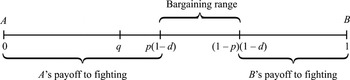
The bargaining problem
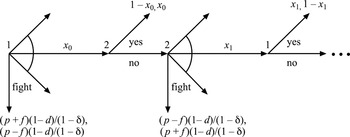
First-strike advantages and shifting power
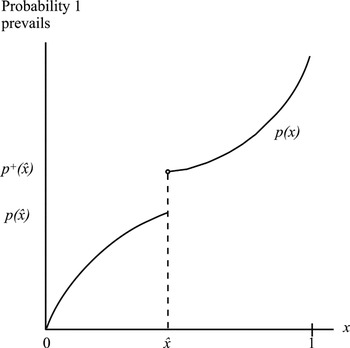
A discontinuous shift in power
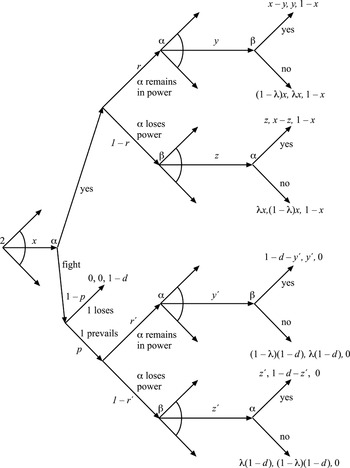
Shifts in the domestic distribution of power
 You have
Access
- 570
- Cited by