William Blundell, ‘the Recusant’
The Harkirk graveyard at Little Crosby, Lancashire, was created in 1611 by William Blundell, ‘the Recusant’ (1560-1638),Footnote 2 whose family had been associated with the village since the thirteenth century, having acquired the manor of the same name in 1362 by marriage to Agnes Molyneux of Sefton.Footnote 3 After the Reformation, they were among the many Lancastrians who resisted it. William Blundell’s father Richard (1537-1592) was among a small group of local landowners who signed an oath of loyalty to Pope Pius V, after the latter’s excommunication of Elizabeth I,Footnote 4 and was the first member of the family to be imprisoned, albeit briefly, in 1568 for harbouring priests.Footnote 5
An index of the determination of Richard Blundell’s recusancy is that his two sons, William and Richard junior, were sent to finish their education at the college for English Catholics founded at Douai in 1569 by William Allen, and removed to Rheims shortly thereafter. On William’s arrival there on 9 June 1580, aged twenty, he was described as ‘educated with ... care’ by family friends, and ‘having no relish whatever for any but the Catholic religion’.Footnote 6 His education there, as well as the continual harassment which he and his family suffered on his return to England, were the shaping factors of his response to the discovery of the coin-hoard on his land.
On 11 June 1590, the Earl of Derby, Lord Lieutenant of Lancashire, was instructed by Lord Burghley to search Crosby Hall, where he arrested Robert Woodruffe, a priest, as well as Richard and William Blundell. After two months’ imprisonment in Chester, the three were charged as felons and taken to Lancaster Castle, two-thirds of the Blundell estates being confiscated.Footnote 7 William had recently married Emilia, daughter of Sir William Norris of Speke and it would seem she shared his captivity for their son Nicholas was described as having been ‘born or at least suckled in prison, where his parents lay ... on account of their faith’.Footnote 8 Moreover their daughter Margaret was conceived during this period.
Richard Blundell died in captivity on 19 March 1592, by which time, the seized portions of Recusant estates were assigned to Crown tenants, the first of whom, John Lever, was paid a lump sum of £80 in 1590 to relinquish his claim.Footnote 9 Amidst new allegations of recusant conspiracy in November 1592,Footnote 10 renewed searches were made of Lancashire houses. At this time, William Blundell ‘was forced to lie all night abroad when pursuivants beset his house, which was once for fourteen days together’.Footnote 11 Blundell and his wife were once more arrested, Blundell appeared before Archbishop Whitgift,Footnote 12 and was imprisoned in the Gatehouse adjoining Westminster Abbey for two and a half years.Footnote 13 Attempted sequestrations of the family’s lands continued, and Blundell’s brother in law, William Norris, had to come to his sister’s help by buying out another set of rights assigned on Blundell land.Footnote 14
Finally, on 12 July 1595, William Blundell was ‘set at libertie uppon bonds to apeare and come in within 20 dayes after warneing given’.Footnote 15 But in 1598, disturbances in southwest Lancashire were blamed on local recusants who were ‘growinge … more and more dangerous for wante of due severitie’.Footnote 16 On 27 May, the Blundells’ neighbour Sir Richard Molyneux and John Nutter, Parson of Sefton, raided Crosby Hall intending to seize William for his alleged involvement. He eluded them but his wife was taken for questioning to the parsonage at Sefton, then ordered to appear before the Bishop of Chester, and committed to prison in Chester, before she was bailed by her family. The order to commit her was renewed until eventually she escaped and joined her husband at one of his several hiding places in Wales, her brother forfeiting his bond. After first moving on to Wrexham (‘where our brother Banister dwelt’) the fugitive couple returned to Lancashire, she ‘being great with childe’.Footnote 17 Blundell continued to be summonsed for priest-harbouring, and, not appearing, in August 1599 was judged guilty of a felony, in absentia, and outlawed.Footnote 18
The texture of persecutions and accusations remained dense: the following May, Blundell was accused of involvement in an incident at Childwall, near Speke, in which tenants there assaulted the High Constable of West Derby Hundred, protecting a ‘dangerous recusant’ named Hitchmough. The attack was alleged to have been organised by a priest, Thurstan Hunt, and eventually the authorities captured three of Hunt’s fellow clergy, Robert Nutter, Robert Middleton and Edward Thwing, Nutter and Thwing were executed at Lancaster Castle on 26 July. In September, Hunt led an unsuccessful attempt to free Middleton as he was being moved from Preston to Lancaster: Hunt himself was captured, and both Middleton and Hunt were executed in Lancaster Castle in April 1601.Footnote 19 A guard wounded in the affray at Childwall, Gervase Traves, was compensated by receiving (jointly with one Thomas Heaton) a grant of the confiscated two-thirds of the Blundell estates, ‘and laboured verie busilie to gett possession or Composition, but (blessed bee god) gott neither’.Footnote 20 Soon after, there were yet more arrests of ‘principall ringleaders of the popish faction’, on the charge of inciting their tenants to riotous behaviour.Footnote 21 Seventy-three people were questioned on the affray at Childwall, tenants refusing to give incriminating evidence against their landlords.Footnote 22 Blundell’s migratory life, spent in evasive peregrinations around England lasted ‘untill the Queene’s death’.Footnote 23 All of these tribulations form a compelling background to the many assertions of stability and continuity which he made in varied media after the Harkirk find.
The new king, James I, gave William a ‘free and large pardon’ for the token sum of ‘40 or 50 shillings’.Footnote 24 Still refusing to worship at the parish church at Sefton, and unable or unwilling to pay the £20 monthly fine, he once again suffered the confiscation of his goods and two-thirds of his lands. Outrageous demands ensued: one Sir Arthur Aston arrived at Little Crosby in 1607 ‘with a great Companie of men’ and attempted unsuccessfully to seize Blundell’s goods, falsely claiming to have rights as a Crown tenant.Footnote 25 Following a string of similar incidents, the Blundells’ non-cooperation with one Ambrose Astell led to a 1610 Star Chamber proceeding. Astell was found ‘to exceede his Comission and take bribes, and thereby was driven the Countrie’, but was back and active by 1613.Footnote 26
It was at this time, and against this harried background, that the Harkirk graveyard was created, the trigger being the refusal of churchyard burial to Catholics in the parish of Sefton..Footnote 27 Blundell had ‘a little peece of grownde ... enclosed within my owne demaine land in a place called of ould tyme (as it is nowe also) the Harkirke.’Footnote 28 The first of a long line of Catholics to be buried there was an old tenant named William Mathewson. ‘After this’, according to Blundell’s daughter Margaret, ‘all the poor Catholics that died thereabouts were buried there, and amongst them some had stones on their graves with crosses, according to the Catholic manner.’Footnote 29
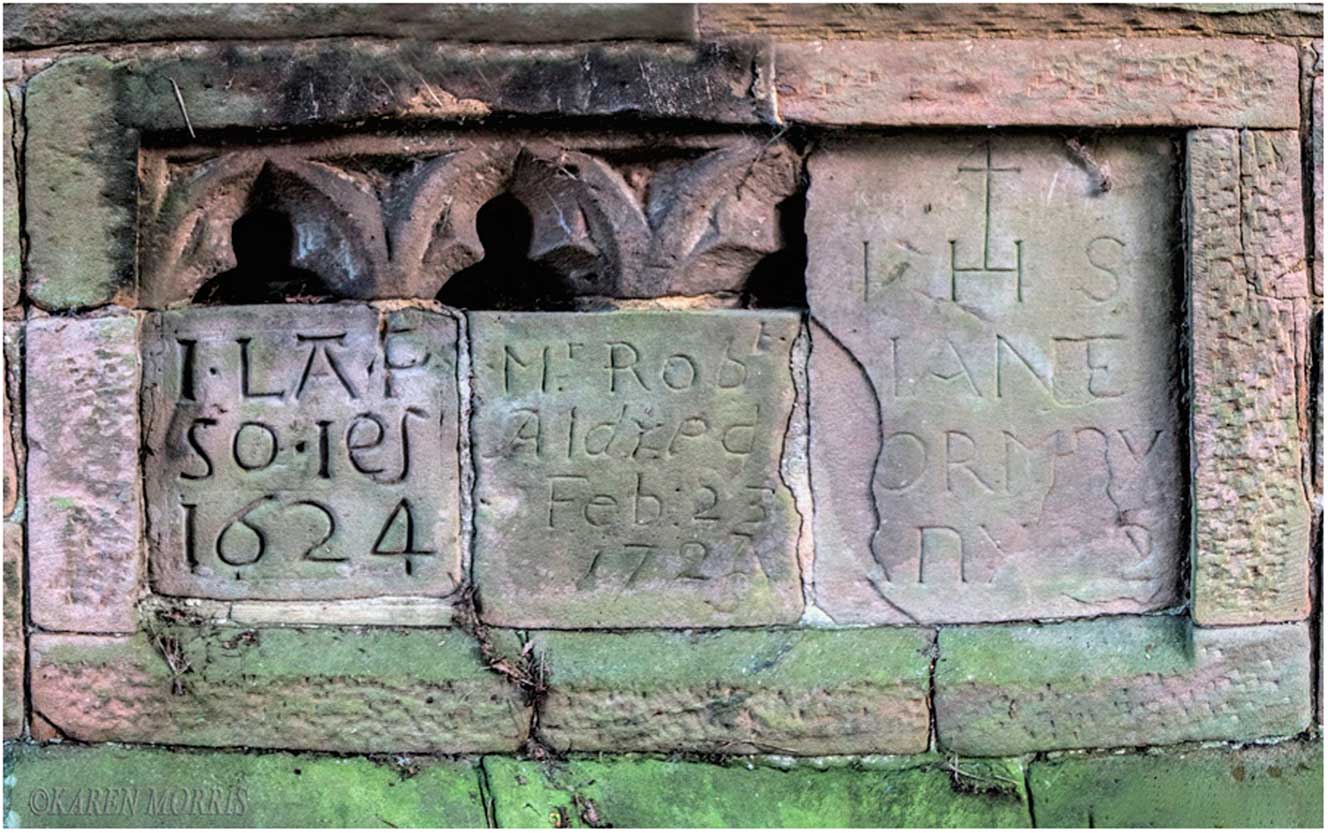
Surviving Tombstones at the Harkirk Chapel, Little Crosby. Photograph, Mark Blundell.

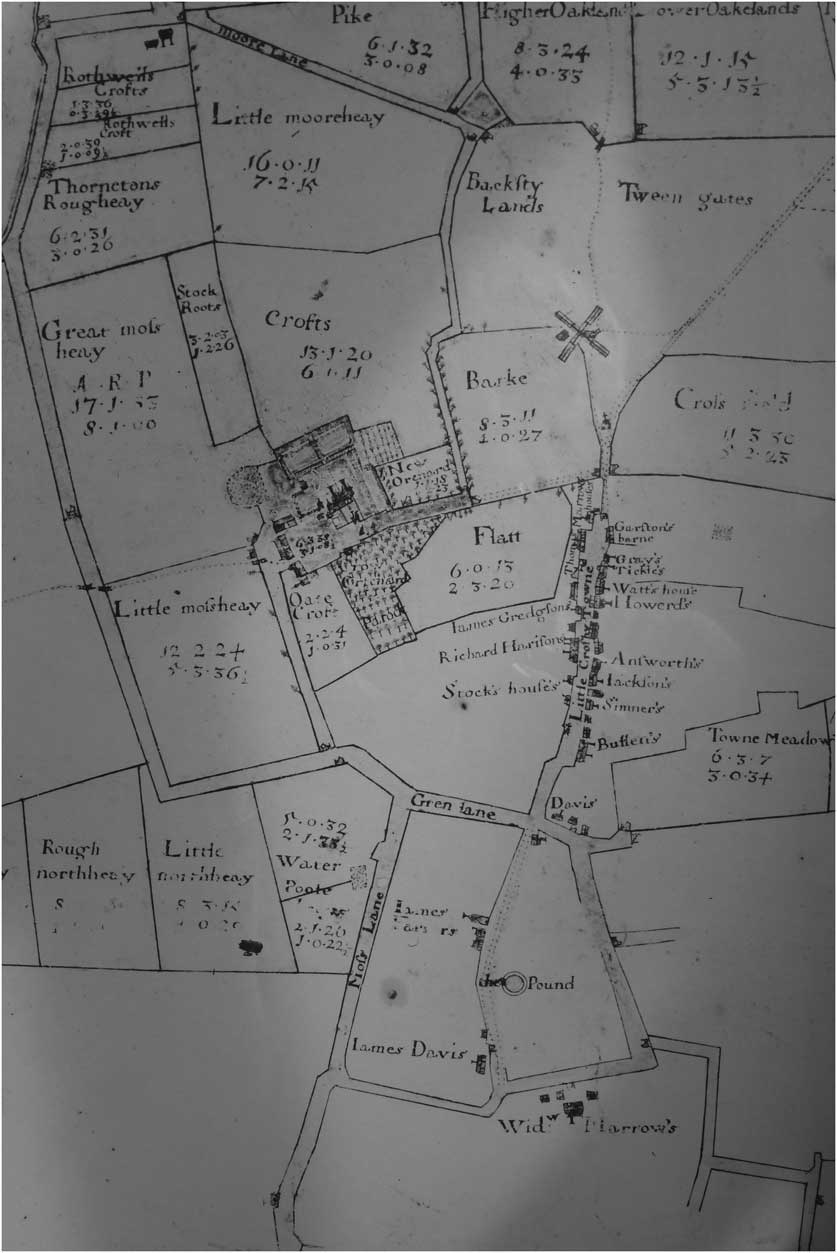
The geography of the Harkirk is significant, suggesting that the power of the name, implying past consecration, outweighed discretion: although the site is now well concealed inside the park at Crosby Hall, a road from the hall to Sefton once ran very near it, as Hawley’s map of 1702 shows.
Detail, showing Little Crosby, from Hawley’s 1702 Map of Lancashire. Photograph, Mark Blundell.

The history of the creation of the Harkirk burial ground is inextricably linked to the discovery of the Harkirk hoard. On 8 April 1611, the day after the first burial there, William Blundell recorded that a servant boy named Thomas, ‘dryvinge my Catle (which as yett did nightlie lye in the howse) to a field neare the sayde place of buriall’, found some ancient coins that had been disturbed by the gravedigging. More coins were found, to a total of about eighty, ‘none bigger than a groate, and none less than a twoe pence.’Footnote 30
William Blundell’s notebook, recording the finding of the Harkirk Coin-hoard, 99.00 mmx150.00.m. On loan from The Blundell Family to the British Museum, Loan number: PELoanIn.57. e. By courtesy of Mark Blundell. Photograph British Museum Images.

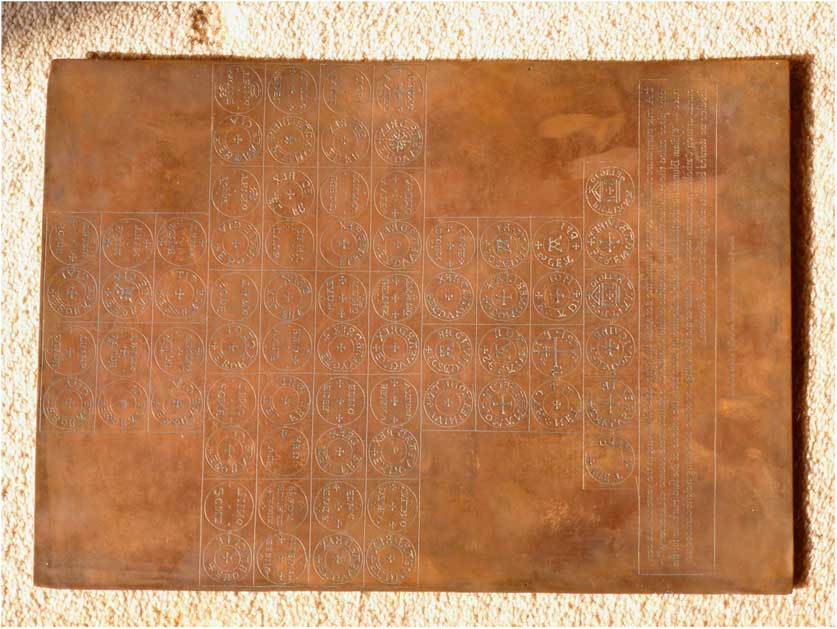
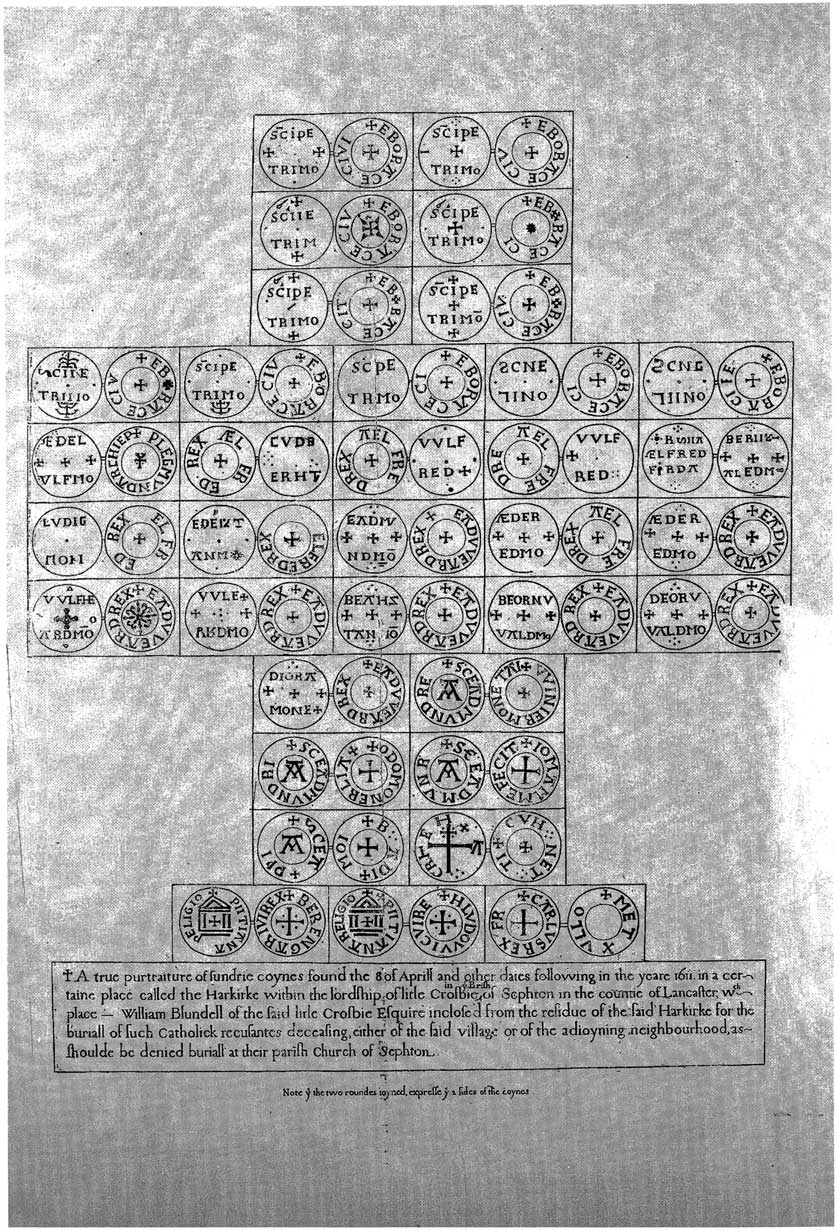
William investigated the coins’ origins, in the light of the education which he had received on the continent, and his deductions are discussed at length in the second section of this article. He carefully drew thirty-five of them, and had a copper-plate engraving made from the drawing. Prints from this, eventually numbering up to 200, ‘flew abroad in ye country’.Footnote 31
Engraved copperplate for William Blundell’s Harkirk Broadsheet, 227.00 mmx322.00 mm. On loan from the Blundell Family to the British Museum, Loan number: PELoanIn.57. c. Photograph, Mark Blundell.

Impression of William Blundell’s Harkirk Broadsheet, as reproduced in Thomas Ellison Gibson, ed. Crosby Records: A Chapter of Lancashire History (Manchester: for the Chetham Society, 1887). Public domain.

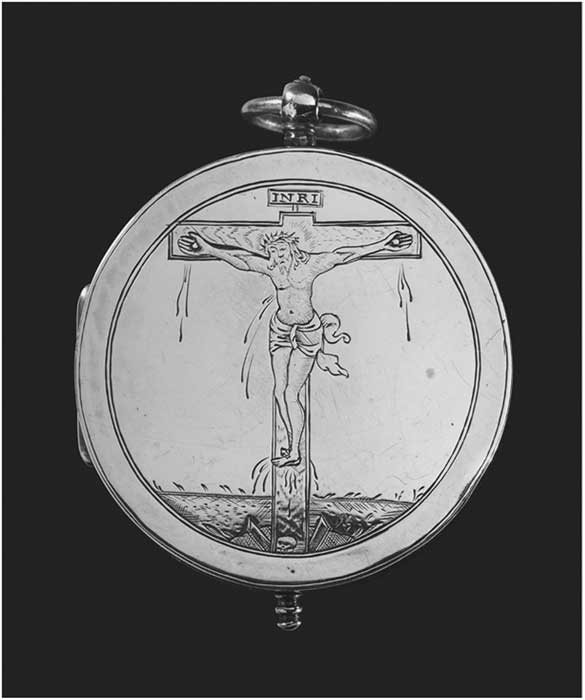
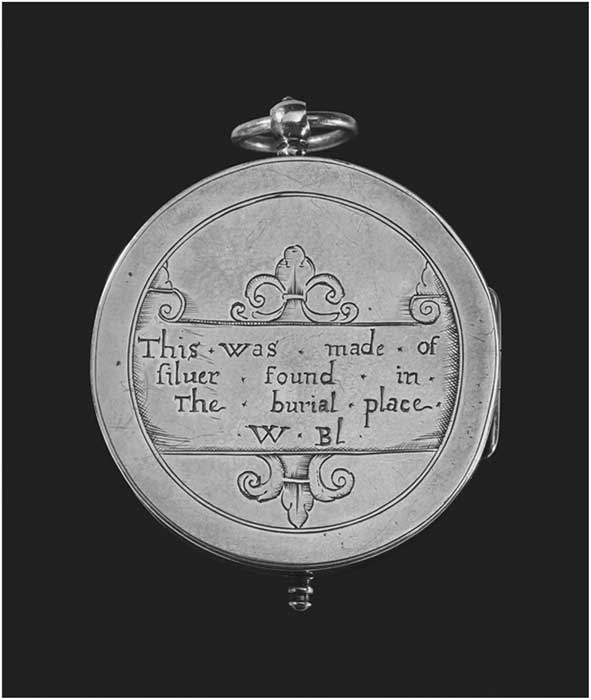
Most of the coins themselves, however, were subsequently lost when William’s grandson and namesake William ‘the Cavalier’ sent them to his relations in Wrexham, ‘for better security in ye tyme of war’. The remainder were melted down and turned into a chalice and a pyx.Footnote 32 The former is currently lost: family memory suggests that it was removed to safety in Wales in the years of World War II.Footnote 33 The pyx, known as the Blundell Pyx (see Figs 5.1, 5.2 below) is now on loan to the British Museum, and is the focus of the third part of this article.
The Blundell Pyx, front, early c17. Diameter 72.00 mm, including suspension loop. On loan from the Blundell Family to the British Museum. Loan number: PE LoanIn.57. b. By courtesy of Mark Blundell. Photograph British Museum Images.

The Blundell Pyx, back with inscription, early c17. On loan from the Blundell Family to the British Museum, Loan number: PE LoanIn.57. b. By courtesy of Mark Blundell. Photograph, British Museum Images.

[Mark Blundell]
Recusant historiography and memory
William Blundell’s narrative, and the wider circle of Blundell family writings, raise many questions concerning recusant historiography and the preservation of memory. The narrative raises especially fruitful questions about Blundell’s perception of the British past. Indeed, it is important in itself as evidence of how that past would have been apprehended by an educated member of the rural gentry, complete with a narrative of the books to which he turned in search of elucidation of the Harkirk hoard. Many of the questions which this text raises have already been addressed, in particular, considerations of the degree to which Blundell, as a recusant Roman Catholic, would have had preconceptions about the past specific to his community. It is with reason that Blundell is known as ‘the Recusant’. A member of the first post-reformation generation of English Catholics to study in an English college abroad, at Douai, his cultural formation was simultaneously English and oppositional.Footnote 34 As Mark Blundell has shown, though protestant neighbours put him under enormous pressure to conform, he remained uncompromising, and clear in his own mind that he was experiencing persecution for the sake of his religion. The work of Daniel Woolf and Phebe Jensen has offered many perspectives on the ways in which Blundell reflects Catholic perceptions of the first Christian millennium in Britain, in his selective reading of Protestant sources such as Foxe and Camden, as well as his use of specifically Catholic texts such as Richard Verstegan’s Restitution of Decayed Intelligence.Footnote 35 These studies reveal how Blundell’s antiquarian response to the coin-hoard mirrors larger published controversies of historiography between confessions, especially the Anglican identification with the church of the indigenous Britons, and the Catholic claim of the Saxons as religious forebears.Footnote 36
In identifying the Harkirk as a former religious site, Blundell was evidently aware that ‘kirk’ might signify a place of worship. He is probably correct in this identification: the form ‘x’+kirk rather than kirk+‘x’ is more typically Scottish (e.g. Selkirk, Falkirk): but is found in Northern England, e.g. at Ormskirk. Hár, perhaps signifying ‘overgrown with lichen’ is also occasionally found as an English placename element, e.g. in Harwell, Berks. The study of Old English had begun a couple of generations before Blundell’s investigations, with Laurence Nowell. His Vocabularium Saxonicum, created from 1560-70, was used in manuscript by generations of lexicographers, until it was printed as recently as 1952.Footnote 37 However, Blundell’s essay suggests that his only source of information on Old English is Verstegan: he argues, for example, that the names of King Alfred, Wulfred, Archbishop of Canterbury, and Wilfrid, Archbishop of York, are ‘all one name … for ‘frid and fred are all one, signifyinge peare’ [sic].Footnote 38 The last word should be ‘peace’, but Alfred derives from ælf+ræd, Wulfred from wulf+ræd, and Wilfrid from wil+friþ (elf-counsel, wolf-counsel, will-peace). Blundell attributes this etymology to Verstegan, but all the latter says is that ‘fred or vred as also frid, all being one, is our ancient word for peace’.Footnote 39 He does not make the further error of conflating ælf-, wil- and wulf-. Though Blundell’s grasp of Old English was evidently limited, his epigraphic skill was equal to reading the coins themselves. Since they typically give the name of the king for whom they were struck, he was able to relate them to the known succession of Anglo-Saxon kings, which he could have found in a variety of sources.
Philemon Holland, in his translation of Camden’s Britannia, published 1610, writes, ‘it is agreed upon among all learned men, that there ariseth very much light to the illustration of ancient Histories, out of ancient Coines,’ and he gives several pages of engravings, with an essay on the subject. The coins he illustrates are Celtic and Roman, from the collection of Sir Robert Cotton.Footnote 40 This essay is an interpolation in Camden’s text, thus in itself, testimony to a rising interest in coins at the time of Blundell’s discovery. The topic is not addressed in Camden’s original Latin, which Blundell was using, so the passage was not known to him. He can have had very little help in understanding his find, since despite the interest of Cotton and Prince Henry in Saxon coinage, numismatics remained a distinctly minority interest in England.Footnote 41 One work which might have been of material assistance, though he gives no indication that he was familiar with it, is John Speed’s Historie of Great Britaine, since Speed gives ‘the Saxon succession in the Monarchy of Great Britaine’, and for each king in series, he shows both the front and reverse of a coin issued by him, if he knows of one.Footnote 42
In fact, the immediate intellectual context of Blundell’s work is recusant controversial literature. The story of King Alfred and St Cuthbert originates with the anonymous twelfth-century account of the translation of St Cuthbert,Footnote 43 and was redacted by William of Malmesbury.Footnote 44 However, Blundell’s actual source, as he says himself, was Robert Parson’s highly tendentious Treatise of three conuersions of England, which is based on William of Malmesbury’s version, he quotes it verbatim.Footnote 45 Parsons engages vigorously with Fox, Bale and other protestant controversialists throughout his treatise; challenging both the facts they chose to highlight and the interpretations they put on them; some of Blundell’s occasional references to Foxe are taken from Parsons, rather than being direct responses to Foxe.
Blundell’s account of King Alfred and Wilfrid, Archbishop of York, however, must derive from Bede.Footnote 46 Despite his use of Bede, whose painstaking demonstration of Anglo-Saxon obedience to Rome was naturally valued by recusants, Blundell’s understanding of the Anglo-Saxon world was much more informed by the Elizabethan battle for the Anglo-Saxon past, claimed for Protestantism by writers such as Stowe, and for Catholics by Verstegan, than by pre-Conquest sources: he does not, for example, ever cite Alfred’s biographer, Asser, though Asser was in print by the time he was writing.Footnote 47 He made considerable use of William of Malmesbury, and must have owned Henry Savile’s Frankfurt edition, since he elsewhere cites Ingulf of Croyland and Roger of Hoveden, also published in the volume.Footnote 48 Another writer whom he regarded as an authority is Polydore Vergil (c. 1470-1555). Vergil’s Historia Anglica was not published in England (his scepticism towards the legends of Brutus and Arthur, together with his Catholicism, made his work unacceptable to post-Reformation English historians),Footnote 49 but there were three editions printed at Basel, the last of which was reprinted several times.Footnote 50 Blundell cites Vergil on the issue of the first king to pay ‘Peter’s pence’, and on King Alfred’s monastic foundations.Footnote 51 He was also familiar with John Foxe’s Actes and Monuments, but followed Parsons in being wary of Foxe’s interpretations. The writers he regards as authoritative are Catholic.
Blundell’s English sources are also supported by Continental authorities. On the evidence of his essay, he owned the massive seven-volume De probatis sanctorum historiis, a significant work of Counter-Reformation scholarship by the German Carthusian, Laurentius Surius,Footnote 52 St Robert Bellarmine’s De translatione imperii Romani a Græcis ad Francos,Footnote 53 and something by the pre-Reformation hagiographer Petrus de Natalibus, perhaps Catalogus Sanctorum et gestorum eorum, since the information he cites appears in this work.Footnote 54 It is worth observing how much of Blundell’s library was printed abroad. The only books he cites which were actually issued in England are those of John Foxe, John Stowe, and William Camden. Since so many English Catholic books were printed in centres such as Antwerp, Douai and St Omers, determined recusants such as Blundell must have been in the habit of importing the bulk of their books; and it is worth remembering that though Little Crosby is remote from London, it is only three miles from the Irish Sea.Footnote 55 Blundell evidently read Latin with ease. These citations show that he was looking beyond recusant apologetics, and perceiving English history as an aspect of Catholic and providential history more generally, in a way very different from his Protestant contemporaries. His outlook is not so much provincial, as supra-national.
Interestingly, Blundell also assigns weight to local tradition. The death of King Oswald at the hands of the pagan king Penda occurred, according to Bede, at ‘Maserfelthe’.Footnote 56 Blundell identifies this with Winwick in Lancashire,Footnote 57 for which his source is William Camden;Footnote 58 but he also supplements, and in fact, challenges, Camden with local, recusant knowledge:
A Catholique gentleman and frend of myne who had dwelte heretofore nere to the saide place ….writethe that the people thereaboute have yet in there mouthes (it may be by tradition) yt K. Oswalde beinge greevouslie wounded in a battell not farre from yt place, vowed yt if hee might wendequicke (or whicke according to there speache) he wold there builde a Church, whereupon (as they saye) it was then called Wendwhicke … Moreover on yt side of Newton parke wch is towards Winwick not eight roods (as I reᵯber saith this gentleman) from the pale, there is a little well walled wth stone wthin, wch ye people call St Oswald’s well, and neare thereunto there was an olde tree standinge in my tyme wch had (as the people say) a picture standing in it, the place shewinge when I lived there yt it might fitlie be used for such a purpose …Footnote 59
Camden in fact mentions but does not endorse the claim of Winwick, preferring the traditional site, Oswestry in Shropshire.Footnote 60 The oral testimony from Winwick is a good example of folk etymology (Winwick, which occurs in several places, probably means ‘Wina’s farm’); and the verses claiming that the church marks the site of Oswald’s death are Leonine hexameter, so post-Conquest, perhaps twelfth century. Only the (alleged) local place name, ‘a certaine precinct or libertie called even to this daye Macarfeldt’ might be regarded as conceivably evidence. Alexandra Walsham is inclined to associate this claim for Winwick with a wider phenomenon, recusants ‘staking a claim to obliterated spaces and structures and the stories of their origin on paper’.Footnote 61
There are, however, further questions which might fruitfully be raised as to how Blundell’s manuscript narratives well as other ‘memorials’ elsewhere in the Blundell papers, might have resonances with the cultural production of the recusant Catholic community more widely, in Jesuit college drama, as well as in such material objects as the imaginary portraits of Saxon Monarchs, commissioned at much the same time that Blundell was composing his narrative, for the exiled English College in Valladolid and the House of the English Brigittines at Lisbon.Footnote 62 It is no accident that these exiled English religious houses commissioned paintings of the Saxon sovereigns of England, an explicit claim to authentic, historically-continuous Englishness defined in terms of saintly royal Catholicism, and an implied rebuke to their degenerate successors.Footnote 63 The Valladolid paintings are a sequence of saintly male monarchs of early England, painted at Seville by Francisco de Pacheco in the early seventeenth century.Footnote 64 A parallel series of Saxon Kings, Queens and Princesses survives from the English Syon Abbey in Lisbon (and is now at Oscott College, Birmingham).Footnote 65 These two series of closely related paintings clearly articulate an opposition to the claims of Tudor monarchy (the feigned frames of the figures are very similar to the cartouche which surrounds the figure of Elizabeth on the title-page of the ‘Bishops’ Bible’ in the revised edition of 1572), by contrast to the figures of the canonised Saxon monarchs of England.
The Saxons also play a prominent role in the allegorical history plays written by masters and performed by pupils in the exiled Catholic colleges, often for an external audience.Footnote 66 Different possible audiences are revealed by the ‘Douai Diaries’ account of the staging of Aluredus, a play written by the master William Drury to be performed by the college boys in 1619, which had both a private and a public performance:
On January 8th the scholars privately in the refectory played a comedy written by Mr. William Drury, which so delighted the audience that it was much talked of by them in the town; and some of the chief magistrates in the name of the rest, begged the President to cause it to be performed again. The President acceded to their wish, and on the ninth of this month our students performed it publicly with great readiness and applause in the open air, because the small size of the original place was not adequate’.Footnote 67
Thus a play originally staged as a pedagogic exercise, to teach Latin and confidence in public speaking,Footnote 68 and to reinforce more direct kinds of moral teaching, doubled as a public relations exercise for the college, attracting interest and admiration from the wider community of the city of Douai.
It is this same play of Drury’s, Aluredus, which alerts us to the particular reading of history which Blundell would have developed as a recusant Catholic educated at the English College (in Rheims when he attended it, and later returned to Douai): where a distinctive historiography was already emerging, and a variety of plays on English historical themes were written and performed.Footnote 69 This suggests a very different perspective to Woolf’s sense of Blundell as a ‘struggling minor gentleman … outside the mainstream’.Footnote 70
William Drury was professor of rhetoric at the English College at Douai when his play Aluredus was staged.Footnote 71 Its topic is King Alfred’s darkest hour, in 878, when he and a handful of survivors were forced to retreat to the island of Athelney in the Somerset marshes by the pagan Danes, who seemed to have secured near-total victory over England. The theme was one to resonate with recusants, who, similarly, were being pushed towards extinction by the English state’s determined efforts to eradicate them. The title page of the play’s editio princeps inform us that it was first acted at the College in 1619 (‘thrice exhibited in the English seminary at Douai by the young men of that same college’),Footnote 72 and the Diary, quoted above, confirms that an unnamed play by Drury was performed in January that year.Footnote 73 It evidently attracted attention in print form, since it was first printed at Douai, together with Mors, another play by Drury, in 1620, under the title Dramatica Poemata, reprinted there in 1628, and was issued again, supplemented by a third play, Reparatus, at Antwerp in 1641.Footnote 74 While the two Douai editions might be put down to local piety, Pierre Bellère’s Antwerp edition is testimony that the play was noticed outside its immediate community: the Bellères were an established Antwerp printing dynasty who published a good deal that was of Catholic interest, but they specialised neither in drama nor in catering for the English Catholic community. However, they did have Douai connections, which may have brought Drury’s work to Bellère’s notice.Footnote 75
The narrative is based on the twelfth-century story from the ‘Translation of St Cuthbert’, which Blundell knew in Parson’s version. Drury, writing in or before 1619, cannot be depending on the Acta Sanctorum edition (1668), but he must have had access to a manuscript, since Aluredus includes an episode in which Cuthbert approaches the king disguised as a beggar, which is in the ‘Translation’ and also recounted by Polydore Vergil, but not included by Parsons. Drury’s Alfred cheerfully shares the last of his bread and wine with the disguised saint; an episode obviously indebted to Sulpicius Severus’s familiar story of St Martin and the beggar:
CUTH. For Christs sake, bestow some food upon me That’s ready to starve for cruell hunger.
AL. Pray, mother, if there be any bread left, Bring it out of our storehouse, that I may Give it to this poore man. This a crime To deny any thing ask’d for Christs sake. I know what misery is, and must learne By my own example to relieve The afflicted, least the heav’nly doner Should deny my own supplication.Footnote 76
This incident is passed over by William of Malmesbury, and by post-Reformation writers. Drury had certainly read Polydore Vergil’s Historia Anglica;Footnote 77 but the peasant Denewulph’s miraculous draught of fish in Aluredus is also an incident in the ‘Translation’, and it is not in Vergil.Footnote 78 The involvement of ‘Neothus’ in the narrative, as a virtuous hermit and relative of the king’s, suggests that Drury was also familiar with the eleventh-century life of St Neot.Footnote 79
The play thus emerges from a well-developed recusant historical tradition. Blundell, like Drury, evidently attaches considerable significance to writers from the eleventh and twelfth centuries: in his case, William of Malmesbury above all, but also Roger of Hoveden, Florence of Worcester, and Ingulf of Croyland. This may not be adventitious. A variety of post-Conquest writers were concerned to emphasise the importance of the Anglo-Saxon past to their new Norman overlords. These works parade a series of highly virtuous monarchs, obedient to the church, their virtues rewarded by a variety of miracles. These served contemporary agendas: they offer warning and examples to the heirs of William the Conqueror. However, they also served the ends of recusant writers, by presenting a vision of a harmonious and well-ordered Catholic world. It was one to which the Blundells felt connected: in the family tree preserved in London, British Library, MS Harley 1437, which was made in connection with the Norroy King of Arms’s visitation of Lancashire in 1613, family memory stretched back as far as William Blundell of Ince, who flourished in the twelfth century.Footnote 80
Drury’s Aluredus is highly consonant with most of Blundell’s readings of the coins, where he is insistent on presenting the kings he names as Christian monarchs whose virtue is confirmed by miracles of various kinds. Drury’s Alfred is a perfect Christian prince and obedient son of the church. The Saxons, as they are for Blundell, are the true English harried by the invading, pagan, and persecuting Danes—so much so that Alfred hides his royal robes by burying them in Act I, sc. 3. The play’s moral compass is characteristically recusant. The Danes Osbern and Gormo are restored to life by St Neot, and promptly become Christians: lost sheep are reclaimed.Footnote 81 The comic swineherd Denewulph stops being comic and displays unexpected nobility when he understands the plight of Osburga, the queen mother: his lines switch from prose to verse.Footnote 82
William Blundell’s narrative is not the only memorial recorded by the Blundells in the seventeenth century. The bound manuscript known as The Great Hodge-Podge Footnote 83 suggests that the Blundells, by family custom, were in the habit of recording both texts and events, in a way which again seems specific to their immediate community of beleaguered Catholic tenants and family members in Little Crosby. The inner circle of community for whom the Hodge Podge is shaped is almost exactly that community for whom William Blundell made the Harkirk burial ground, ‘…Catholiques either of myne owne howse or of the Neighbourhoode…during the tyme of these trobles.Footnote 84
The Hodge Podge is more than a literary compilation: it contains memorials of various kinds, including of events in the lives of the Blundell family, their community and the house of Crosby itself. And indeed, quite a number of the literary texts preserved in the ‘Hodge Podge’ are to some degree preserved as memorials, as with William Blundell’s own songs and ballads against the Reformation, starting with the frankly oppositional ballad on f.3v, ‘The Invention of the new Gospell to the tune of shall I wrestle in dispayre’
Shall I tell you by what slighteThe new ghospell came to lighte?… Luther took a great displeasureAnd was angrie owte of measure …
There are also literary texts which are a record of statements of belief, like ‘A Hymne of St Bernard to our Saviour and our Bl. Ladie, Englished by Mr James Bradshawe of the Haigh as followethe’ on f.40.r and v.; there are literary texts which commemorate secular events, as with ‘the Cavalier’ (1620-1698) William Blundell’s elegant ‘Prologue to a Play’, dated 1647 on f.48v (closely followed by two folios of notes on musket drill and a song on the siege of Chester). Memorials which are not literary texts are numerous. To give some examples, f.12v records the death of the Jesuit Henry Garnet, executed in May 1606, on which occasion a drop of his blood was said to have formed his likeness on the executioner’s straw, which straw was later shown on the continent as a relicFootnote 85 and f.60v preserves ballads which St Thomas More was believed to have written in the Tower, a clear precedent for Blundell’s own oppositional verses.
These habits of memory clearly persisted in the Blundell family: William Blundell ‘the Cavalier’ (1620-1698) wrote that his collection in his commonplace-books was made ‘for the use of those who survive me’.Footnote 86 He also recorded in the Hodge Podge, on f. 6v ‘report of the Moone rising at an unusuall tyme’ in the summer of 1648.Footnote 87 The Hodge Podge was kept up throughout the seventeenth and eighteenth centuries: on f.76v Nicholas Blundell (1669-1737) transcribed the text of ‘A Coppy of a Warrant whereby William Blundell Junior, Father to me N.B. was carried prisoner to Chester Castle 5 August, 1694.’ On f. 91, a section dated 1722 ends, ‘the three last pages contains the Names of 76 Persons who were Religious and were. . . akin to my Grandfather Will Blundell’; f. 184v gives dates of death of family members, and the very last entries appear to date from the early nineteenth century, about the time of Catholic Emancipation.
It is possible to advance some thoughts about the context in which these memorials were made in the Lancashire of the seventeenth century. Many of them are personal notes and commemorations, recorded within an assembly of those texts and anecdotes which sustain a unified and somewhat isolated family through the generations (there is much genealogical information in the latter part of the Hodge Podge). There is also an aspect to Blundell memory-making which records the sufferings of family members for their adherence to the church which Blundell articulates as the ancient church of England:
What in Sefton we endure,For no strange opinion, but that old religionAustin founded here most sure.Footnote 88
This goes beyond the memorial made to sustain the descendant unknown, and moves into a specific mode of recusant Catholic historiography: the record of all the sufferings for the faith in England, considered over a very long period of time, from St Alban, through St Thomas Becket, to Campion, Sherwin and Briant, a kind of history fixed, in precise fact, by the publication of the engraved version of wall paintings in the Venerable English College in Rome, the Tropheae Ecclesiae Anglicanae.Footnote 89
While these manuscript notes belonged to Blundell’s posterity, the second of his responses to the Harkirk hoard, the engraving which ‘flew abroad in ye country’, link it to the wider community of people interested in the British past, both Catholic and Anglican, though his decision to arrange the coins in the shape of a cross suggests its particular interest for Catholics.Footnote 90 However, a copy of the Harkirk broadsheet found its way into the collection of the Oxford antiquary Bryan Twine (d.1644), who was among other things, Official Keeper of the university records.Footnote 91 Another, interestingly, was added to the material collected during the 1613 visitation of Lancashire, as if it constituted another kind of evidence for the status of the Blundell family.Footnote 92 His third response to his find, the pyx, with its bold memorial inscription, and the currently-lost chalice, inhabit time and history in a different way. As consecrated objects, they are a thank-offering, objects offered by time (and in Blundell’s case, an understood history) to timelessness. They are objects which have moved out of time to the eternal present of the gift consecrated to God. Having appreciated and expounded the history of the silver of the coins, Blundell transformed it by having it re-fashioned, and then sent it forth, less to posterity than out of time altogether. So, in studying and researching history, William Blundell sees himself as part of a sequence of parallels with historical times and events, enacted in the eye of eternity, just as the Jesuit College plays ransacked the past for parallels and analogies with the present condition of the English Catholic community.
[Jane Stevenson and Peter Davidson]
‘Newe religions coynd each day”: exploring the context of the Blundell Pyx’
The Blundell Pyx was made from coins in the Harkirk Hoard, discovered in April 1611 on the Little Crosby estate. The Hoard, which is well-known to Anglo-Saxon numismatists and historians, was first published in 1887 by the Chetham Society,Footnote 93 while its antiquarian significance and recusant context were sensitively explored by Daniel Woolf a century later.Footnote 94 Blundell’s find is one of the earliest documented coin hoards in Britain. It comprised more than 80 coins—a mixture of Anglo-Saxon, Anglo-Scandinavian and Continental types—which are thought to have been buried around 910 AD when Lancashire was under Viking control. Its combination of coins and ‘uncoyned silver’ or bullion is characteristic of Viking hoards.Footnote 95 The coins do not survive, but were so carefully recorded by their well-educated Catholic finder that we can identify them and compare them with rare surviving examples in the British Museum collection. Documents and objects recording the Hoard have now been generously placed on loan to the British Museum by William Blundell’s direct descendants, the Blundell family of Little Crosby. They tell a remarkable story; yet the Pyx, made from melted-down silver coins from the Hoard, is almost unknown as an object, and its intellectual context, status and significance have never been clearly understood.
The Blundell Chalice
Blundell melted down some of the coins to make a chalice and a pyx for use at Little Crosby and at the Harkirk. The chalice is lost, though some evidence of what it might have looked like is provided by a group of locally surviving (though not necessarily locally produced) chalices of the same period. In a chapter on recusant silver, Charles Oman pointed out that ‘[t]he plate of an English manor house chapel was as much the property of the squire as was the loving cup and great salt on his dinner-table’: a statement borne out by surviving examples and their provenances.Footnote 96 A silver-gilt chalice of around 1600 from Sefton Hall, the seat of Lord Molyneux near to the Blundells at Little Crosby, is currently displayed in the Metropolitan Cathedral Treasury in Liverpool, with its pyx.Footnote 97 Known as the St Benet Chalice after the parish of that name, it is of typical late-Gothic form but with a larger cup, and is inscribed under the foot A+S 1603 for Father Ambrose Shirley OSB (d. 1609), chaplain at Sefton, who received it at his ordination in 1603. The Lydiate Chalice, dating from the late sixteenth century, came from the parish of Our Lady in Lydiate, near Little Crosby. It bears a close resemblance to an early-seventeenth-century example formerly in the collection of Lord Kenyon, which has an almost flat foot engraved with Instruments of the Passion.Footnote 98 Travelling chalices in pewter also survive in the locality, one at Lydiate and another in Liverpool Metropolitan Cathedral.Footnote 99 The simple pewter chalice long associated with the Lancashire Jesuit Edmund Arrowsmith and with the ‘pedlars’ trunk’ from Samlesbury Hall represents a later type made for mobile Catholic communities and priests in hiding, adopted from around 1620.Footnote 100
We do not know exactly what happened to the Blundell Chalice, though a family tradition is recounted by Mark Blundell as follows:
My father recalls being told by my great aunt Madge that shortly after the beginning of the war they were worried about being bombed at Crosby, being so close to Liverpool, and for ‘safe-keeping’ the chalice was taken to the parish church at Buckley near Mold, where Aunt Madge was living at the time. The trail stops there, and he cannot recall any efforts being made to recover the chalice after the war. I have always been told simply that it had been ‘lost’. However, prompted by your question, I phoned the parish priest at Buckley, Fr Francis Doyle. I told him the story. He was somewhat bemused, but not unhelpful, and said he would investigate and get back to me. He has not done so far. It is of course a long shot after 75 years.Footnote 101
The Blundell Pyx
The surviving Blundell Pyx was used to carry holy communion to the sick and dying, and has an attachment loop at the top so that it can be worn around the neck.Footnote 102 Its charitable function links with the making of the graveyard at the Harkirk as an act of charity on the part of William Blundell.
It is gilded inside where the inner surface would touch the consecrated host. The front is engraved with a simple image of the Crucifixion—probably derived from a banned devotional print imported from the Continent—with a skull at the foot of the cross and an emphasis on Christ’s blood streaming from his wounds. This could be held up in front of the sick or dying to be venerated or kissed: most known post-Reformation English pyxes therefore have a crucifixion scene engraved on the front: typically, they also have an Agnus Dei on the back. On the back of the Blundell Pyx, however, a decorative cartouche, like that on an estate or county map,Footnote 103 or on a church wall monument, is inscribed, with lowercase italic letters reading: ‘This was made of silver found in the burial place W Bl’.
Pyxes in the context of English Catholic material culture
Pyxes were among the items explicitly banned in the 1559 Injunctions, which demanded the destruction of the outward forms of Catholic worship, ‘so that there remain no memory of the same.’Footnote 104 A liturgical object that appears to have been made in response to the Injunctions is the Pecocke Cup, from St Martin Ludgate in the City of London and now in the Museum of London. Its foot is made from a standing pyx marked for London 1507–8, which has had its container replaced with a communion cup of the form approved for parish worship in 1559. It was given to St Martin’s Ludgate by Stephen and Margaret Pecocke ‘for the worship of the sacrament’, a phrase which perhaps hints at some sense of continuity of sacramental function from proscribed pyx to approved cup.Footnote 105 Other pyxes did not fare so well. At Braughton in Lincolnshire in 1566, for example, ‘ii pyxes — ar defaced and geven awaie by Richard Heid and Robert Lightfoot church wardens this yeare vnto a child to plaie with all.’Footnote 106
The practice of Catholicism was dependent on a considerable variety of material objects, the more so in that priests were only sporadically available to English Catholics. A useful folding sheet in the Protestant book A newe years gift dedicated to the pope’s holiness, printed in London in 1579 illustrates ‘certaine of the Pope’s merchandise lately sent over into England’, a practice forbidden by a bill of 1571 against imports of papal bulls and other Catholic ‘Instruments’. Alexandra Walsham has argued that prints such as these, intended to serve as a Protestant warning, achieved the opposite for Catholic readers by identifying objects of veneration among the Catholic faithful and creating a spiritual community around them.Footnote 107 A representation of what seems to be a pyx very like the Blundell one, with the Crucifixion on one side but with the Agnus Dei more conventionally on the other, shares a place in the print with agnus dei medallions and is mis-described as an ‘Agnus Dei’ in the caption. It is shown alongside rosaries and holy medals arranged around a devotional woodcut, with a cross on the left perhaps made from cut-out paper, recalling Blundell’s arrangement of his Anglo-Saxon coin finds.Footnote 108
Some of the objects depicted in A newe years gift match the contents of a cloak-bag that was confiscated from the Grant family in the aftermath of the Gunpowder Plot in 1605, at a Catholic safe-house at Clopton, Warwickshire, suggesting that they were genuinely part of contemporary priests’ paraphernalia. The contents of the bag belonged to Ambrose Rookwood: they include a silver pyx, a travelling Mass kit with chalices, vestments and linen (perhaps used as corporals or altar cloths); an altar stone such as is illustrated at top left in the print in A newe years gift; a bone rosary; and Latin books and devotional prints, again recalling the ‘Pope’s merchandise’ illustrated in the print.Footnote 109
Other types of material object which played a part in English Catholic culture are jewellery and talismans. Other objects depicted in the print which are also instantly recognisable are small medals or other images with the profile of Christ. Inexpensive copper-alloy and pewter medals of this type were, for example, kept by the Spanish Catholic crewmen of the wrecked Armada ship Trinidad Valencera.Footnote 110 Humble objects such as this, in the hostile Protestant context of England, could have been kept and covertly used as an act of defiance, as Oman suggests was the case with the Swinburne Pyx, discussed below.
Iconographically, there is considerable overlap between the decoration of religiously themed jewels and that of sacramental artefacts such as pyxes, especially more elaborate and expensive items. A much grander pendant with the head of Christ, for example, of late sixteenth century date and possibly Italian origin, is preserved in the Cheapside Hoard in the Museum of London. It is constructed from a white-enamelled gold hoop decorated in black with the Arma Christi. Hinging out from the hoop are two matching intaglios in bloodstone depicting the Virgin and Christ respectively, inscribed MATER.IESV.CHRISTI and EGO.SVM.VIA.VERITAS.ET.VITA: similarly, pyxes and chalices frequently have a band of inscription. When the intaglios are folded into the hoop, they form a double-sided pendant, one side showing the head of Christ suitably speckled with red spots within the green of the bloodstone, the other with the head of the Virgin on an unspotted, entirely green stone: folded out, they form a tiny diptych, and could be used for private devotion.Footnote 111 The Christ intaglio follows medallic prototypes by Antonio Abondio, and can be linked to other gems carved by the Miseroni family in Vienna and Prague. Hazel Forsyth at the Museum of London has proposed that the Cheapside Hoard was likely deposited after 1640, based on her identification of the arms—engraved on a tiny carnelian gem—of William Howard, (1614-80) the first and only Viscount Stafford, a new creation of 1640. As a Catholic, he had to flee persecution two years later, and was executed in the wake of the Titus Oates Plot in 1680. The fact that the Hoard was buried in a cellar untouched by the Great Fire, which destroyed the buildings above, also implies that it was deposited before 1666.Footnote 112 Both these important discoveries raise new questions about the status of the Hoard and those who assembled and hid it: particularly, the fascinating Catholic connections suggested not just by the Stafford gem but by the high proportion of devotional jewels and rock-crystal fragments (remade, in one case, into a salt) that it contains, which were probably taken from reliquaries broken up at the Reformation.Footnote 113
Pyxes took on a special significance within this recusant context of owning small, precious, and religiously significant objects that were hideable treasures potentially connected with the devotional life of their owners. They were essential in a hidden community that was often scattered, frequently deprived of priests and the sacraments, and were also used by priests who were on the run, in hiding or in prison. Their message was one of unity and secret resistance. Gregory Gunnis confessed to the authorities in 1585 that he had kept two consecrated hosts in a silver pyx since Queen Mary’s day ‘as the Catholique Church doth’.Footnote 114 George Napper (1550-1610), who was educated for the priesthood at Rheims, and sent on the English mission in 1603, was arrested near Woodstock, and found to possess a small reliquary and a pyx with two hosts in it, and holy oils. On this basis, he was arrested and charged with being a priest, and imprisoned in Oxford Castle, where he was executed after refusing the oath of allegiance.Footnote 115 The Jesuit John Gerard (1564-1637) managed to sustain a clandestine existence as a priest in England for several years, but was eventually arrested, and sent in turn to the Counter, the Clink, and eventually to the Tower of London. He managed to have a pyx with hosts smuggled into the Tower, so that he could celebrate secret masses while imprisoned there. He had already demonstrated his gift for creating a sacred space around himself when he recognized the first cell into which he was taken in the Tower—knowing he was to be tortured there—as the former cell of the martyr Father Henry Walpole. He mentioned that Walpole had suffered fourteen periods of torture, probably in that same cell. Though Gerard was only there for a day before he was moved, he may have carved the rough heart pierced with an arrow accompanied by the initials J. G. on the wall, where it joined earlier inscriptions by three Catholic priests, John Godsalfe, John Fixer and John Colleton.Footnote 116
A talent for improvisation similar to Gerard’s was exhibited by the servants of the Duke of Norfolk when they were imprisoned in the Tower after the Ridolfi Plot in 1571.Footnote 117 They painted the back of a playing card, the three of hearts, with a Crucifixion scene, which was cut and folded with opening doors to reveal the image for private devotion. The transformed card could easily be concealed within the pack or pocketed.Footnote 118 No less ingenious, Gerard dedicated himself to cutting rosaries out of orange peel which he sent as gifts, wrapped in paper on which he had written news of himself in orange juice, which could be read when held up against the light of a fire.Footnote 119 His efforts to acquire a pyx with hosts within it were similarly subtle and painstaking. He asked a fellow prisoner
to let his wife call at a certain place in London, having previously sent word to John Lilly what he should give her to bring. I told him, moreover, to send a pyx, and a number of small hosts, that I might be able to reserve the Blessed Sacrament. He provided all I told him, and the good lady got them safely to her husband’s cell. So on the appointed day [which he records was the Nativity of the Blessed Virgin, as he had planned] I went over with my gaoler, and stayed with my fellow prisoner that night and the next day; but the gaoler exacted a promise that not a word of this was to be said to the gentleman’s wife. The next morning then, said I Mass, to my great consolation; and that confessor of Christ communicated, after having been so many years deprived of that favour. In this Mass I consecrated also two-and-twenty particles, which I reserved in the pyx with a corporal; these I took back with me to my cell, and for many days renewed the divine banquet with ever fresh delight and consolation.Footnote 120
Comparison of the Blundell Pyx with surviving English pyxes
The sense that a pyx was property linked with a parish or a family was traditional in England before the Reformation, as Oman remarked with respect to chalices (above). For example, the Swinburne Pyx, in the Victoria and Albert Museum, dating from 1310-25, is a sophisticated example in silver-gilt originally decorated with enamel which was held by one family for seventeen generations.Footnote 121 The Swinburnes remained Catholic until the Napoleonic Wars and in describing their pyx, Oman noted that it was likely to have continued in use after the Reformation, when little new ecclesiastical silver was made in the recusant community:
It is attractive to suppose that the defacement of the side of the pyx was the unhappy inspiration of a sixteenth-century Recusant chaplain who sought to disguise the sacred character of the little box. He may also have pasted paper roundels over the top and bottom, preserving the engraving but doing irretrievable damage to the enamel! Certainly the defacement cannot have been the work of a Protestant who would hardly have failed to obliterate the figure of the Virgin [a standing Virgin with the Child in her arms decorates the top of the pyx].Footnote 122
The recusant associations placed on the pre-Reformation Swinburne Pyx by the family who owned it point to the context within which the Blundell Pyx was commissioned by William Blundell and used at the Harkirk and at Little Crosby.
A pyx, as Gerard makes clear in the account quoted above, was of particular importance to a persecuted community for whom regular celebration of the Mass was impossible, and for whom the reserved sacrament consequently took on a greater importance. Whenever pyxes were discovered, they were swiftly destroyed by Protestant authorities, which makes British pyxes of this period very rare indeed. The grandest survivor, which may be almost contemporary with the Blundell Pyx, is now preserved at Westminster Cathedral. It is a shallow round silver container with a hinged lid which is engraved on both sides and thickly gilded inside and out, probably seventeenth century in date. On the top is the crucifix seen against the backdrop of Jerusalem, finely engraved within sun’s rays and an egg-and-dart border. The figure of Christ on the Cross is similar in style and sentiment to an undated circular engraving by Hieronymus Wierix (Netherlandish, ca. 1553–1619, Antwerp) after Dürer, though the townscape of Jerusalem behind is the goldsmith’s addition, schematically rendered with parallel hatching in a skilful way that creates depth and catches the light on the gilded surface.Footnote 123 On the inside of the lid is the sacred monogram and a border of rays similar to that seen on the exterior. The underside is engraved with the Agnus Dei, with the lamb’s fleece and tail again skillfully rendered through hatching and stippling, with a double ringed border as on the lid. An ornate suspension loop is attached to the lid’s hinge. Apart from its outstanding quality, this pyx is also the only English one to bear a maker’s mark. This is stamped inside the container in a very visible position and takes the form of a unicorn’s head couped – a mark also found on a secular coconut cup hallmarked for London 1612. Oman suggested that this date would suit the pyx, which, if so, would make it only a year later than the Blundell Pyx.Footnote 124
The Westminster Cathedral Pyx survives with a contemporary custom-made burse, which is possibly French, and is tapestry-woven in silver-gilt thread and silk, lined with cream-coloured silk; though the drawstring itself is a more recent replacement, it has been attached to the original splendid tassels. The bag is woven on one side with the Jesuit emblem of a heart with IHS upon it and three nails above, with the lance and sponge of Christ’s Passion. Flanking the heart, which stands above a green sward, are stems of carnations. On the other side of the burse is a crucifix on top of a heart within a crown of thorns, flanked by stems of vines bearing grapes. The burse is probably Parisian and cannot be closely dated – due particularly to the lack of obvious parallels for it. The item which is closest is a purse made using the same technique to render the flowers and leaves, which is similarly thought to be Parisian and seventeenth century.Footnote 125 Charles Truman has dated both burse and pyx to circa 1620, no great distance from Oman’s ca. 1612: this slightly later date might allow us to link both pieces, as Jesuit commissions, to the Queen’s Chapel of Henrietta Maria or to the chapel of a Catholic ambassador to the court of Charles I.Footnote 126 In any case, they were probably made and used in a privileged and protected circle at court, or in the private chapel of a Catholic Embassy.
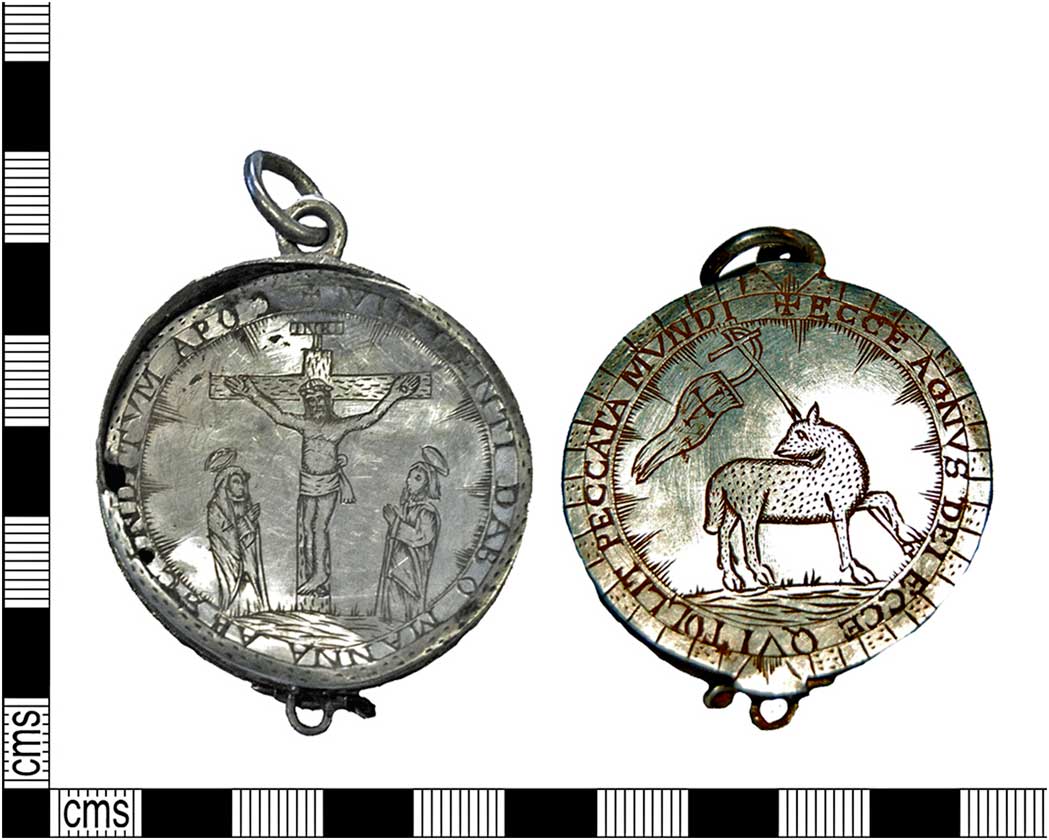
Out in the shires, particularly in Lancashire, the old faith was harder to suppress than in London, and there has been a considerable number of recent finds of pyxes in Lancashire which resemble the Blundell example. One, found by a metal detectorist at Hoghton in Lancashire, was reported though the Treasure Act in March 2015.
Seventeenth century pyx found at Hoghton in Lancashire; LANCUM-6F19D5 on the Portable Antiquities Database; image from Portable Antiquities Scheme (www.finds.org.uk). Creative Commons.

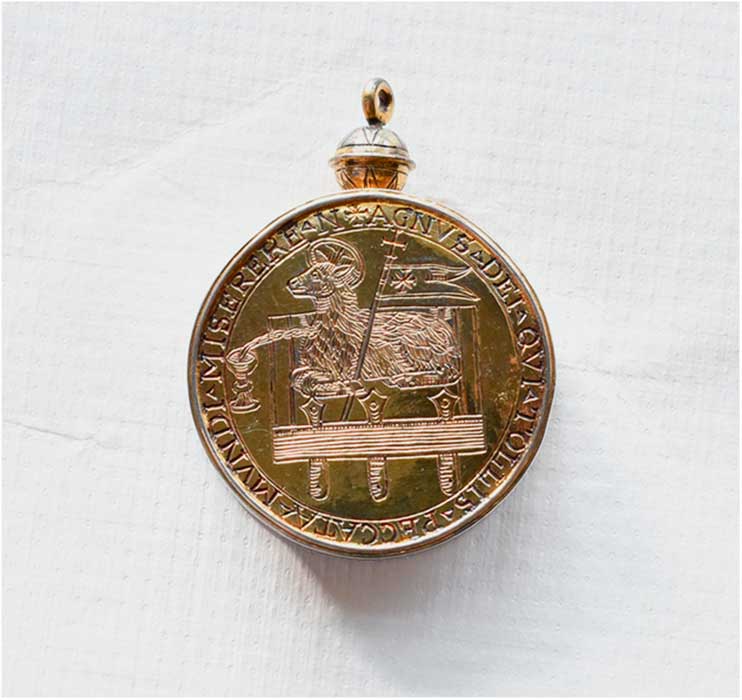
It is a simple piece, opening on silver hinges on the reverse with the Agnus Dei, held by a pin at the base. Its diameter is 53mm and it weighs 27.9g. The front, which is damaged and crushed on one side, depicts Christ on the cross and, on a label, INRI, which stands for Iesus Nazarenus, Rex Iudaeorum (‘Jesus the Nazarene, King of the Jews’). Beside the cross kneel the Virgin Mary and St John. An inscription around the scene reads VINCENTI DABO EI MANNA ABSCONDITUM APOC, from Revelations 2:17, with APOC being short for apocalypse; it can be translated as, ‘To him who overcomes I will give hidden manna’. The lamb on the reverse is standing on a grassy ledge with a cross and pennant. The inscription around its edge reads ECCE-AGNVS-DEI-ECCE-QUI-TOLLIT-PECCATA-MVNDI, or ‘Behold the Lamb of God, behold he who takes away the sins of the world’; this is derived from the point in the Mass after the symbolic breaking of the host and before the invitation to take the sacrament.Footnote 127
There is a small unmarked pyx in the Liverpool Metropolitan Cathedral Treasury, which, has the Crucifixion on the front, and as usual, the Agnus Dei on the back. It is crudely engraved and has a fringe-like edging etched around the rim on both sides. Great attention has been paid to the wood grain of the cross and to the stylised ground on which the Lamb stands. Its crude construction and decoration have led to it being attributed to a local Lancashire craftsman.Footnote 128 A similar pyx which is now in Chicago (Loyola University Museum, 1971.02) has a Crucifixion scene on the front with the words SACRO SANGUINE PXI [CHRISTI] PURGATI SUMUS A CRIMINE, i.e., ‘By the Holy Blood of Christ we are cleansed of sin/guilt’ inscribed around it. The face with the Agnus has LEARNE OF ME BECAUSE I AM MEEKE AND HUMBLE OF ♥[HEART], from Matthew 11:29.Footnote 129
A recent (2016) metal-detector find in Mawdesley, Lancashire has produced three silver objects which may be pyxes, or possibly reliquaries, or, more likely, containers for fragments of wax agnus dei medallions. The fragmentary objects within, as yet unexamined, appear to be folded in paper with writing. Two are similar to pyxes in having the Crucifixion on one side and the Agnus Dei on the other (the execution is naïve even compared to other Lancastrian pyxes), but the third differs in having crucifix on one side, and, on the other, the unmistakable I H S of the Jesuit badge with cross above and nails below.Footnote 130 The location of the find may suggest a link with the Mawdesley family, who were Catholics; a chalice and paten owned or commissioned by them is discussed below.
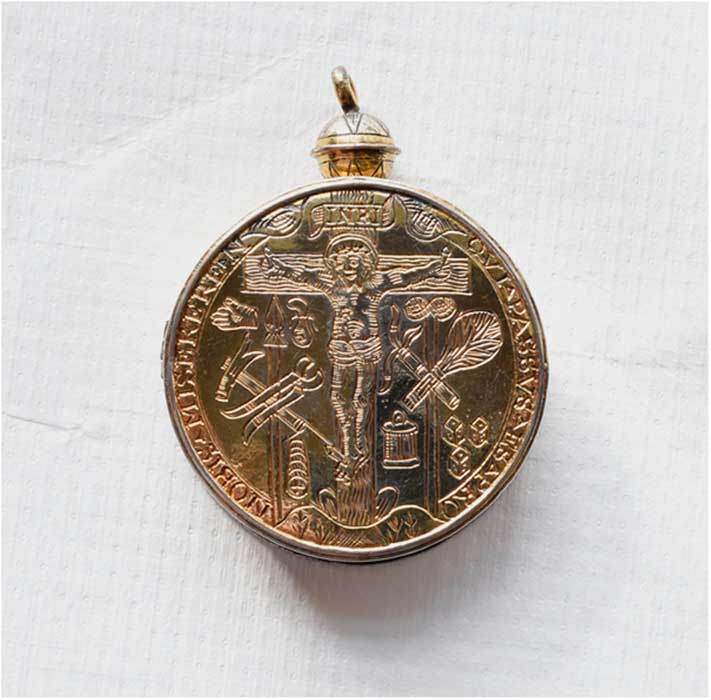
Higher in quality than these rather humble objects is a silver-gilt pyx, currently at Stonyhurst.
The Stonyhurst Pyx, front; 710.00 mm x 603.00 mm w x 140.00 mm, Stonyhurst College, Lancashire, SC 1888.16. By courtesy of the Governors of Stonyhurst College.

The Stonyhurst Pyx, back; 710.00 mm x 603.00 mm w x 140.00 mm, Stonyhurst College, Lancashire, SC 1888.16. By courtesy of the Governors of Stonyhurst College.

This shows Christ crucified with the emblems of His Passion, the Arma Christi, arranged around Him. Circling the image is the engraved inscription QVI PASSVS ES PRO NOBIS MISERERE, ‘You who suffered for us have mercy on us.’ This is from the Adoramus Te, traditionally recited during the contemplation of each stage of the Passion in the Stations of the Cross. On the underside of this pyx is engraved the Lamb of the Apocalypse, with the unusual iconography of a stream of blood pouring from the Lamb into a chalice, inscribed AGNVS DEI QVI TOLLIS PECCATA MVNDI MISERERE NOBIS: ‘Lamb of God who takes away the sin of the world have mercy on us.’ The silver band that joins the two sides of the object, thus lending it a box-like appearance, like that of the Swinburne Pyx, is engraved NON DESERET DEVS QVE[M]QVA[M] SPERANTE[M] IN SE, or ‘God will not abandon anyone who hopes in Him’—perhaps a reference to St Augustine’s ‘Deus not deserit si non derisatur’ (‘God will not abandon unless abandoned’),Footnote 131 or a paraphrase of Psalm 36: 28, ‘Dominus diligit iudicium et non derelinquet sanctos suos’ (the Lord delights in justice and does not desert his saints).
Pyxes, reliquaries, and Catholic jewels
Several features of the Stonyhurst Pyx—the presence of the Arma Christi, its form, and the inscription around its edge—link it in fascinating ways with the so-called Barnborough Jewel or ‘George Reliquary associated with Sir Thomas More.Footnote 132 The latter object is named after Barnborough Hall, the Yorkshire seat of Thomas More, where it was seen in 1728 by the antiquary George Vertue. Vertue described it as ‘A George in gold enamelld. With in which (as a case or relickquary) is in small by holben the picture of Sr.Tho. More in Water Colours faded.’Footnote 133 Though the item indeed features St George and the Dragon on one side in enamel, Vertue’s description is misleading as Sir Thomas More was never a Knight of the Garter. The jewel was first mentioned in the 1649 will of Cresacre More (1572–1649), and descended in the male line to the last male descendant of Sir Thomas More, also Thomas More (1722–1795), who joined the Society of Jesus and gave it with other More family relics to the Society at St Omer.Footnote 134 Brought by the Jesuits to Stonyhurst in 1794, it is currently on loan to the British Museum.
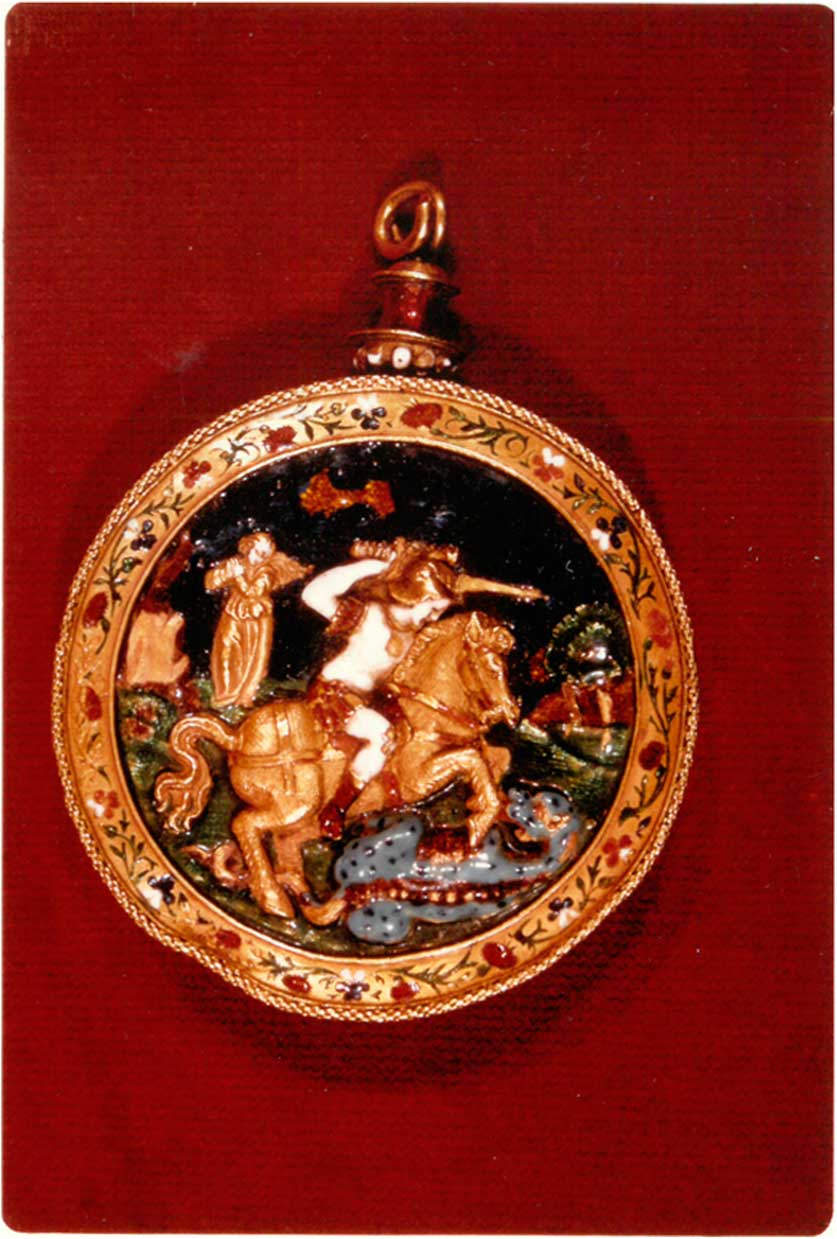
Remarkably, the jewel has never been properly studied, and its status and significance, and even its dating, remain elusive. However, all commentators agree that it is far too sophisticated in design, technique and the brilliancy of its colouring to be English. It is round in form and pyx-like in construction, with a depth, size and pendant loop very like that of the Stonyhurst Pyx. On each side is an enamelled gold roundel with a narrative scene executed in high relief, set within a separate border enamelled in basse taille with pansies and pinks.
The ‘Barnborough Jewel’ or ‘George Reliquary’, front, 700.00 x 600.00 x 150.00 mm, enamel, c.16. Stonyhurst College, Lancashire, Relic No. R.6. By courtesy of the British Province of the Society of Jesus.

On one side is the figure of St George on a rearing horse, raising his sword to slice into a brightly-enamelled spotted Dragon, with a princess praying in the background. St George was a popular subject for men’s hat-badges of the period 1520-50, particularly in England. As More was a knight from 1521 and Lord Chancellor of England from 1529, the subject and the quality of its execution would have been entirely appropriate for him. The horse’s hide is finely chased and the princess’s draperies beautifully rendered so as to catch the light. Even without seeing the back of the scene, it is evident that the relief is fully embossed in repoussé work in the Continental style, as also seen on a fine hat-badge with the same subject in the Kunsthistorisches Museum, Vienna.Footnote 135
English goldsmiths used a cruder technique to make relief jewels, in which the embossed figure group was formed from the thinnest possible gold, which was then attached with butterfly clips to a backplate. The layering and clips can be seen on the reverse of two hat-badges of Christ and the Woman of Samaria in the British Museum, which appear to derive from Hans Holbein designs for similar jewels at Chatsworth.Footnote 136 A fragmentary hat-badge of David and Goliath which was found in Lancashire in 2014 and reported through the Portable Antiquities Scheme also shows the technique clearly.Footnote 137
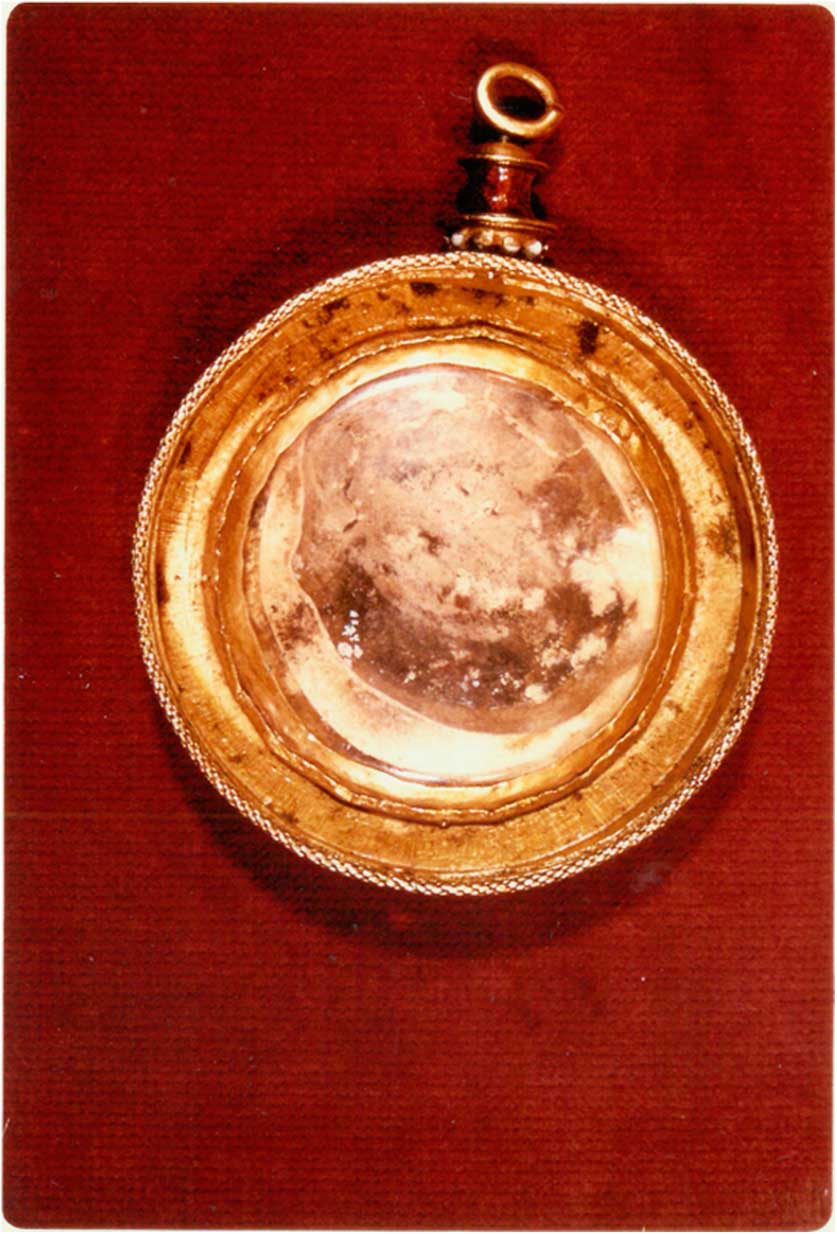
‘The ‘Barnborough Jewel’, back; 700.00 x 600.00 x 150.00 mm, enamel, c.16. Stonyhurst College, Lancashire, Relic No. R.6. By courtesy of the British Province of the Society of Jesus.

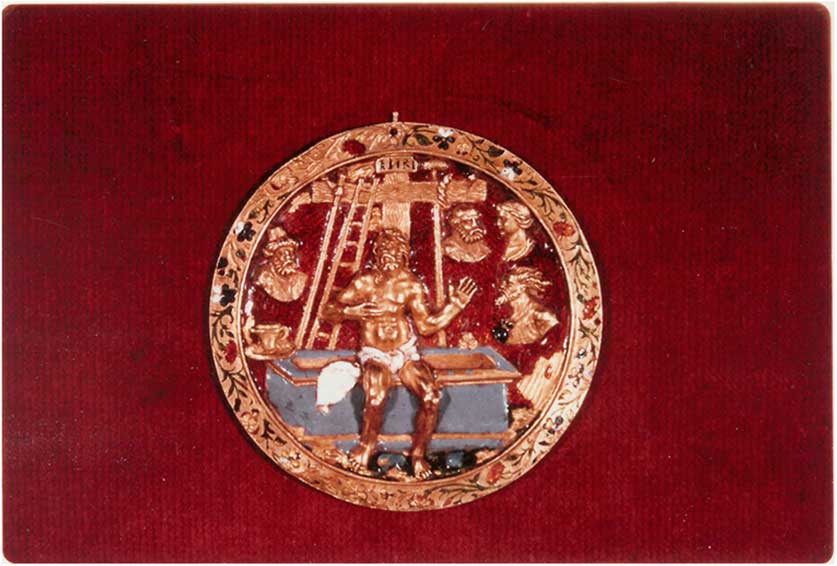
On the other side of the Barnborough Jewel is a highly sophisticated rendering in high relief—again embossed from the back into the gold—of Christ as the ‘Man of Sorrows’, seated on the empty tomb in such a way that his well-defined legs and feet project into the viewer’s space. Behind him is the cross, and set into the red enamelled ground of the composition, working against the sense of depth of the embossed figure of Christ, are the Arma Christi, as on the Stonyhurst Pyx. To the left of the cross are the ladder, the spear, the head of Pontius Pilate, and the ewer and basin with which Pilate washed his hands. On the right are the heads of St Peter and the serving woman to whom he denied Christ; the head of Judas with the money bag around his neck; and, stacked up on the edge of the open tomb on which Christ sits, the dice that were used to cast lots for Christ’s clothing by the soldiers at the Crucifixion. On the Stonyhurst pyx, all of these people and objects are much more crudely and schematically represented, and are set around Christ, as they are in many late-fifteenth-century and sixteenth-century devotional prints.Footnote 138 The imagery of Christ as the ‘Man of Sorrows’ on More’s jewel is much bolder in its invitation to the viewer to identify with Christ’s Passion. Moreover, the modelling of Christ’s torso is in the form of the latest Italianate classical nudes, breathtaking in design, conception and technique. In its humanity and sensitivity it recalls Holbein’s powerful drawing of Christ as the ‘Man of Sorrows’, dated 1519 and now in the Berlin Kupferstichkabinett.Footnote 139 The enamelling on the lower portion of the relief on the jewel is worn with handling, as to open the Jewel it is necessary to slide this relief outwards with one’s fingers. This wear adds to the force of the jewel as a devotional object.
The mood of martyrdom and suffering communicated by the iconography of the Barnborough Jewel is extended by the meaning of the Latin inscription engraved around its edge, in a way that recalls the Stonyhurst Pyx. Derived from Virgil’s Aeneid, I:199, it reads O PASSI GRAVIORA DABIT HIS QVOQVE FINEM (‘Oh you who have suffered worse things, to these things he [God] will also give an end.’ This, together with the Miles Christianus imagery of St George and the ‘Man of Sorrows’ with the Arma Christi, recalls that Christ-like sense of suffering that was explored by More in the Tower as he awaited execution, as expressed in his manuscript treatise, De Tristitia Christi. There, More described how Christ made himself weak in order to help the weak:
He had their welfare so much at heart that this whole process of His agony seems designed for nothing more clearly than to lay down a fighting technique and battle code for the fainthearted soldier who needs to be swept along, as it were, into martyrdom.Footnote 140
The Barnborough Jewel must have originated in a specialised workshop in Northern Italy or Flanders that was far ahead of any goldsmiths’ workshop in England in terms of both technique and design. Stylistically, the figurative roundels and their frames appear to date from 1520-35, which would allow the pendant to have been made for More before his execution in 1535. His correspondence from the Tower mentions gifts from his circle during his imprisonment, though nothing like this, which seems unlikely to have gone unrecorded.Footnote 141 Circular hat-badges for men and medallions for women made from embossed and enamelled reliefs with delicately worked narratives were highly fashionable in England in the 1530s and ’40s, as demonstrated by a group of surviving jewels.Footnote 142 They seem to have been described as ‘tablets’ in contemporary inventories and to have had a strong association with women, on the evidence of both documents and portraits.Footnote 143 For instance, a 1542 listing of the jewels of the future Mary Tudor includes ‘a Tablett of golde of theistory of Isac’, which might have contained a miniature or a devotional book.Footnote 144 Designs by Holbein from around 1530-40 for circular medallions to be worked in enamelled gold survive at Chatsworth, in the British Museum, and in Basel.Footnote 145 Probably in the late 1530s, Holbein even depicted a jewel made up after his own design of Lot fleeing Sodom within a portrait of a woman from the Cromwell family.Footnote 146 In the autograph version of the portrait, now in Toledo, Ohio, Holbein precisely rendered the sense of depth created by the embossed gold figures of the striding Lot and the guiding angel in the goldsmith’s work. The figures on the pendant would have been built up in relief with the central gemstone bolted on. The Cromwell portrait might therefore suggest that the Barnborough Jewel was originally made for a woman in the More family, perhaps his daughter Margaret Roper (1505–1544), to wear, soon after his execution.Footnote 147 It might have adapted a hat badge of her father’s. We cannot identify for whom it was made, though we can be certain that it was altered to serve a commemorative function. Vertue mentions a watercolour portrait on vellum—presumably of More—which has been inserted beneath a domed glass cover and which is clearly a later addition to an existing jewel.
The ‘Barnborough Jewel’ opened to show the very damaged miniature of St Thomas More. Stonyhurst College, Lancashire, Relic No. R.6. By courtesy of the British Province of the Society of Jesus.

The image is now so faded that nothing but the shape of the woollen cap and the three-quarter portrait of a Tudor man can be seen; but Vertue, writing in 1728, was happy to describe the portrait as that of More by Holbein, a very well-known image.Footnote 148 It seems likely to have been a later copy inserted into this family jewel to enhance its association with More, perhaps in the later sixteenth or early seventeenth century as his reputation for sanctity grew and various accounts of his life and death were written.Footnote 149 Cresacre More, who owned the jewel and mentioned it in his will in 1649, was Thomas More’s great-grandson. He was born at Barnborough, educated at Reims and trained for the priesthood at Douai. He took minor orders, but returned to England and married after his oldest brother died. In 1631 he published The life and death of Sir Thomas Moore Lord high Chancellour of England, which he dedicated to Charles I’s Catholic queen, Henrietta Maria.Footnote 150 Could the jewel have been altered by the addition of the portrait in Cresacre More’s lifetime? Did it originally contain a relic of More?
If the Stonyhurst Pyx has similar features to the Barnborough Jewel considered as a More reliquary, so it also shares characteristics with the silver eye-reliquary of the Jesuit Edward Oldcorne, which must date from shortly after his execution in Worcester on 7 April 1606.Footnote 151 It has an eye-like aperture in the middle mounted with glass to reveal the eye within; but everything else about it suggests that whoever made it might also have made pyxes. The Latin inscription on the back identifies the object as a Catholic, and more precisely a Jesuit, relic. The crude casing was probably made locally and rather quickly, given the nature of the relic: a boiled eye removed from the scene of the execution of someone officially regarded as a traitor, and secretly kept as a document for a contested history. A contemporary account refers to the decapitated heads of traitors being ‘thrown into hot water’ to preserve them for public display, and this was probably how the eyeball became detached.Footnote 152 John Gerard had no doubt that ‘This was a saintly martyr’s death’, and he gave a detailed account of Fr Oldcorne’s suffering and devotion.Footnote 153 All this, in the febrile atmosphere before the London execution on 3 May 1606 of Henry Garnet, Oldcorne’s fellow Jesuit and fugitive, explains the context for the making of the eye reliquary. Given the importance of Oldcorne’s local cult in Worcestershire and his execution there, the eye-reliquary made a ‘collective connection with a particular territory, a particular landscape’,Footnote 154 as well as with a particular person. As Walsham comments, the purpose of the authorities’ ‘rites of judicial violence ... was to obliterate all material trace and memory of their victims, [but] they repeatedly had the opposite effect, etching their victims in collective Catholic consciousness for many generations.’Footnote 155
The Oldcorne eye-reliquary is small, cheap and portable, something that could be carried about and hidden in a pocket. In this respect, it resembles pyxes, and also Thomas Lusher’s carved wooden altar, which opens to show the Arma Christi and is dated 1623 on its base. In 1623, Lusher was a pupil in the Jesuit school at St Omer; his ability to fashion his own devotional object in inexpensive materials was part of a long Christian tradition reaching back beyond the Reformation.Footnote 156 The object shows how the traditional medieval iconography of the Arma Christi, which is also seen on the Barnborough Jewel of the More family and on pyxes, could be repristinated for new generations and new needs in Britain.
The Oldcorne eye-reliquary, with its central glass aperture, is also similar to a silver pyx in the Victoria and Albert Museum that has a round rock-crystal or glass aperture at its centre to reveal the consecrated host within it, in circumstances of secrecy and persecution. The inscription on the front of the latter clearly defines the object as a pyx: VERBUM CARO FACTUM EST, ‘The Word was made flesh’, from the first chapter of the Gospel of John, which is the second gospel of the Tridentine rite and is read at the end of mass. On the back, unusually, is the Crucifixion, displaced from the usual place on the front by the transparent panel, with Moses and the brazen serpent on its left, and the sacrifice of Isaac on the right. Under the Crucifixion is an inscription from the processional hymn for Corpus Christi, FILIUS IMMOLATUS DATUR CIBUS VIATORIBUS, ‘The son who was sacrificed has given the bread to travellers.’ On the border is HAEC EST MENSA DOMINO NOBIS DE CAELO PARATA ADVERSUS OMNES QUI TRIBULANT NOS, ‘this is the table prepared for us by God from heaven, against all who oppress us’, which would seem to be a variant of the antiphon from the second night office for the feast of Corpus Christi.Footnote 157 It has a specifically ‘persecuted’ overtone. The scenes of the sacrifice of Isaac would seem to fit Corpus Christi typologically, while the exaltation of the brazen serpent is a common type of the Crucifixion. All of its text and imagery associate this object with the feast of Corpus Christi, which might suggest that it is a pyx intended to double as a portable monstrance. In date and in feeling, it is very close to the Oldcorne eye-reliquary, an object to be venerated within a small hidden community, though it may not have been made in England. All these objects speak of the English Catholic world; they are small, portable, easily concealed, and sometimes multipurpose, and they are agents of stubborn resistance. Henry Garnet observed, ‘Beades [rosaries] must be to our afflicted brethren in steed of all maner of armour or weapons’.Footnote 158 Pyxes, jewels, and the other artefacts discussed here were, similarly, weapons which allowed English Catholics to develop forms of devotion which did not depend on the presence of a priest or the public performance of worship.
The making of the Blundell Pyx: The Irish question
Where was the Blundell Pyx made? The Hoghton Pyx, illustrated and described above, might offer a clue. The Hoghton Pyx can be compared closely with an Irish pyx given in 2013 by the Congregation of the Sisters of Mercy/Congregacion de las Hermanas de la Misericordia at Nenagh, Co. Tipperary, to the National Museum of Ireland. It belonged to James Phelan, Bishop of Ossory from 1669 to 1695, and according to local tradition, was presented to him in 1647. The Sisters of Mercy have kept with it a chalice and paten commissioned by Phelan and dated 1689, which was presented to them on their first arrival in Nenagh in 1854 by the Bishop of Killaloe, Dr Daniel Vaughan. The sacred vessels were once assumed to have belonged to the suppressed Franciscan Abbey in Nenagh, but are now thought to be associated with patrons of Holy Cross Abbey.Footnote 159 Specifically, they were commissioned by T P and I E P, initials used by the Barons of Loughmoe in County Tipperary. The Sisters of Mercy pyx has the crucified Christ with the Arma Christi on one side, and the Agnus Dei and the Latin inscription ECCE ANGNUS DEI roughly engraved around its border in a way that recalls the Hoghton Pyx. It is also inscribed ECCE DEUS JUEM [quem] NEC YONTUS [Orcus] NE TERRA NE AETHER CONTINET IN PARUA PIXIDE TOTUS ADEST D JACOBUS PHELANUS ME FIERI FECIT (‘Behold God whom neither the netherworld nor earth nor the heavens can contain, is entirely here in a little pyx. Dom. Joseph Phelan had me made): with the date 1647.Footnote 160
That raises the question of whether the Blundell Pyx could have been made in Southern Ireland. Little Crosby is three miles from the coast of the Irish Sea, and therefore reasonably proximate to the goldsmiths who practised their trade of fashioning sacred silver freely in the coastal cities of Dublin, Wexford and Waterford.Footnote 161 Links with Ireland were not unknown to William Blundell himself: in his notebook recording burials at the Harkirk, there is a reference in his hand to the burial of John Synett,
an Irishman borne in Wexforde, master of a barke, [who] was excommunicated by the Bishop of Chester for being a Catholicke recusant, and so dying at his house in Liverpoole was denyed to bee buried at Liverpoole Churche or Chappell, and therefore was brought and buried in this sayd burial place of ye Harkircke in ye afternoon of the last day of August 1613.Footnote 162
If nothing else, this indicates the closeness of Ireland and the presence of Irish master mariners in William Blundell’s immediate circle just two years after the pyx was made. In 1691, the Irish priest Dr Thomas Martin of Kilkenny, former chaplain to Lord Molyneux, is listed in this same notebook as having been buried at the Harkirk.Footnote 163 The Irish connections continued into the following century: in 1729, Mary ‘Mally’ Blundell (1704-1734): the elder of Nicholas Blundell the Diarist’s two daughters, married John Coppinger of County Cork. Her sister Frances ‘Fanny’ Blundell (1706-1773) married Henry Peppard, of Drogheda, and lived in Liverpool; and their son Nicholas took the name Blundell when he inherited. As one might expect, connections between Ireland and Liverpool were already close.Footnote 164
A fair number of Irish chalices of ca. 1600 are preserved in cathedral treasuries in Limerick and Liverpool and in museums such as the Victoria and Albert and the Hunt Museum in Limerick. They are quite different from English ones, in that they are solid, reflecting at least a measure of tolerance of Catholic worship in Ireland. The English ones are, by contrast, designed to be taken apart for travelling or for quick concealment. Like the English ones they are not hallmarked, but are outstanding for their inscriptions recording patronage, ownership and provenance, which are often dated.Footnote 165 Irish pyxes, however, are much less well-known. There is a small but important group of them—both circular and oval, probably all seventeenth or early eighteenth century—in the Hunt Museum in Limerick. One round silver pyx, which is probably seventeenth century, has a gilded interior, like the Blundell Pyx. It has a hinged flat lid, closed via a latch mechanism, and the lid and base are decorated with the figure of Christ on the cross. Below this is the Jesuit badge of the IHS and three nails (like the Stonyhurst Pyx), and around the edge of the pyx is a sunburst motif.Footnote 166 A second silver pyx is oval in shape with a hinged, flat lid, fastened by a decorated projecting screw. Its lid also features the IHS badge, but with a pierced heart underneath. This is surrounded by a beaded ring from which a sunburst radiates. The back is inscribed with a sunburst and the Arma Christi.Footnote 167 A third silver pyx, which is circular, is decorated with an incised leaf decoration and the IHS with a cross over the head and a heart below. There is an inscription around the sides which reads: EDMUNDUS THADAEUS sacerdos, me fieri fecit 1636 (‘Edmund McTigue priest had me made in 1636’).Footnote 168 It is a very different object to the Blundell Pyx, but fascinating as a priest’s personal possession in a country where Catholic worship was tolerated by the authorities. The late-seventeenth-century silver-gilt Cashel Pyx is inscribed as having been made for the Franciscan Fr Anthony Sall, a member of a prominent local family and Guardian of the Nenagh Friary during the 1670s. Sall commissioned the pyx and presented it to the Friary as a gift.Footnote 169
A humble silver reliquary cross in the British Museum, which is seventeenth century and probably Irish, might also hint at Ireland as the origin of the Blundell Pyx.Footnote 170 It bears close comparison with another crucifix reliquary in Dublin, dated 1638, which had previously been considered Spanish work. The Dublin example has the figure of a Franciscan friar etched at the foot of the cross. Within the reliquary is a wooden cross with a Spanish prayer invoking Mother Luisa de Carrion of the Poor Clares, who had died two years earlier in 1636. Raghnall Ó Floinn comments of the British Museum’s cross that ‘the rendering of the figure and the engraved feathering of the cross-head is a feature found in Irish engraving of the period.’ Moreover, the double cross rising from the H in the middle of IHS (Jesus) on the reliquary refers to the Arthur Cross, which was commissioned to hold a relic from the True Cross, formerly in Limerick Cathedral.Footnote 171 It is inscribed with the date 1625 and the name of the Limerick silversmith Philip Lyles. Could the humble British Museum reliquary cross be of Irish make? And was it made as a container for a fragment from the Arthur Cross?
Not all attributions to Ireland for recusant silver can be sustained. In a Catholic world united by Wierix’s devotional engravings, any certain attribution—without the evidence of a hallmark—is impossible to make. At the very least, however, the Blundell Pyx is in a design continuum with objects of more certainly Irish origin.
What is exceptional about the Blundell Pyx?
The Blundell Pyx’s inscription in place of the Agnus Dei must represent a deliberate choice on the part of William Blundell as patron. It records him as the finder who is returning the ‘silver found in the burial place’ to the Church. It is unique in what it has to tell us about his sense of family and of parish—feelings more commonly expressed on Irish church silver of the period, which is often inscribed with references to individuals: marriages, deaths, the names of priests or of patrons, and of places, allowing networks of patronage to be identified and mapped onto patterns of local landholding.Footnote 172 The Blundell Pyx exudes a sense of place: topographical, spiritual and historical. Blundell seems to have regarded his extraordinary hoard of silver Anglo-Saxon coins, many of them stamped with a cross (as he recorded in his notebook on the find) almost as relics of a happier Catholic past in England. Perhaps he also saw the Harkirk Hoard as a reward for his act of charity in founding a graveyard for his local persecuted community; an ‘unexpected gyfte from Heaven’, as his grandson put it in 1686.Footnote 173 The fact that William Blundell simultaneously started one notebook recording the coins, and a second notebook of the same format recording burials at the Harkirk, shows how these two elements were entwined in his thinking. While in prison for recusancy in the 1590s, he had written a ditty lamenting the fracturing of the Catholic past in England:
The tyme hath been wee hadd one faith,And strode aright one ancient path,The thym is now that each man maySee newe Religions coynd each day.Footnote 174
Given his remarkable coin find twenty years later, the coining simile—and the fact that he identified Catholicism with custom, tradition and stability—is particularly fascinating. It gives us a good idea of his formation and thinking before he stumbled on this extraordinary hoard, which would take on such exceptional significance in his understanding of Catholic history in England. The inscription of ownership and origin on the Blundell Pyx takes us to the heart of his sensibility as a persecuted Catholic landowner in Lancashire in 1611.
[Dora Thornton]