INTRODUCTION
Historically, U.S. asylum policy has reflected both an effort to provide safe haven for deserving asylum seekers and the intent to promote national security and domestic policy priorities. A growing body of empirical evidence suggests that asylum outcomes, at least in the aggregate, have been weighted more heavily by foreign policy considerations than humanitarian concerns. Since the mid 1990s, the United States government has reformed the asylum system in response to concerns of abuse by economic migrants, burgeoning caseloads, and national security threats. Although, as Davergne (Reference Davergne2008) points out, “the most reviled of asylum seekers of the global era is the ‘economic refugee,’ under suspicion of fleeing poverty and poor prospects in search of a better life” rather than fleeing because of the fear of persecution (65), in the wake of terrorist attacks on the United States in 1993 and 2001, the fears of economic opportunists abusing the system have combined with the broader fear of potential terrorists gaining legal entry into the country through an overburdened asylum system. Since 1995, Congress has passed two major acts to reform the asylum process in reaction to these fears. Both the 1996 Illegal Immigration Reform and Immigrant Responsibility Act and the 2005 Real ID Act were passed to prevent economic migrants and individuals who may pose security risks from entering the country on false claims of asylum. Following September 11, the U.S. government has pursued prosecution for documents fraud among asylum applicants and aggressively enforced safe third country requirements. And, like our European counterparts, the United States has increasingly taken more deterrent and preventative actions to discourage asylum applicants from choosing it as a target for asylum and prevent potential applicants from reaching its ports of entry. Critics fear that the draconian measures adopted in response to these fears are overly broad and worry that worthy applicants have been turned away at the border or denied asylum with increasing frequency, thus leading them to face the real possibility of torture and other forms of persecution. In this article, we examine changes in U.S. asylum policy and whether the heightened security concerns after September 11 have significantly influenced the U.S. asylum process and outcomes in U.S. immigration courts.
U.S. ASYLUM POLICY
U.S asylum policy is based on the international norm of nonrefoulement, which requires state parties to the Geneva Convention relating to the Status of Refugees (1951) to consider asylum claims and prevents the state from forcibly returning the applicant to his or her country of origin if they have a credible fear that they will be persecuted there because of race, religion, nationality, membership in a social group, or political opinion.Footnote 1 The United States did not join the international convention originally and instead pursued its own unilateral policy. However, it did join the 1967 Protocol to the Convention, which signaled a change from previous U.S. Cold War policies and statutory commitments, which, for example, had only allowed refugees from Communist countries or the Middle East. The 1980 Refugee Act amended the Immigration and Nationality Act to explicitly address refugees and asylum seekers. It codified into U.S. law the international definition of a refugee and instructed the attorney general to establish uniform procedures for the treatment of asylum claims. Political scientists have demonstrated that Cold War geopolitical concerns continued to influence U.S. asylum policy and outcomes throughout the remainder of the Cold War (Gibney and Stohl Reference Gibney, Stohl and Gibney1988; Gibney, Dalton, and Vockell Reference Gibney, Dalton and Vockell1992; and Rosenblum and Salehyan Reference Rosenblum and Salehyan2004).
Although many critics of current U.S. asylum policy link these changes to the war on terror following September 11, in reality, significant change occurred in response to the 1993 World Trade Center bombing and was codified in the 1996 Illegal Immigration Reform and Immigrant Responsibility Act (IIRIRA; see Schoenholtz Reference Schoenholtz2005; Wasem Reference Wasem2005). The justification for this move was that the backlog of asylum applications had presumably “allowed economic migrants, unscrupulous individuals, or even potential terrorists to avoid deportation and then to abscond as their applications went unexamined” (Cianciarulo Reference Cianciarulo2006, 110). The 1996 reforms represented a massive overhaul of the U.S. asylum system well beyond mandating prompt adjudication of claims. The law initiates requirements for expedited removal procedures at ports of entry for people without legitimate fear of return, without documentation, or with documents that are viewed as fraudulent by the secondary immigration inspector. Individuals deemed to have credible fear of return are then referred to asylum officers. With few exceptions, these immediate deportations are not subject to administrative or judicial appeal. This initial selection process has been credited for the decrease of interviews with asylum officers, resulting in a subsequent decrease in asylum applicants (Schoenholtz Reference Schoenholtz2005, 326). Expedited removal was expanded to other applications at sea in 2002 and to some border situations in 2004, with further expansions in 2005 and 2006 (Siskin and Wasem Reference Siskin and Wasem2008). Concern has been raised regarding the implementation of these policies by the secondary inspectors because of the real possibility that some individuals with a legitimate fear of return have been deported under these procedures (Keller et al. Reference Keller, Rasmussen, Reeves and Rosenfeld2005). Those people who have been deported by expedited removal proceedings are banned from reentry into the United States for five years. The law also put into place the mandatory detention of people claiming asylum without appropriate documentation, which may also serve as a significant deterrent to asylum seekers. In addition, the law empowers the attorney general to permanently bar individuals from receiving asylum benefits if they knowingly filed a frivolous claim. With few exceptions, as of April 1, 1997, asylum seekers have only one year from their date of entry to apply for asylum. The Act also establishes the ineligibility of convicted criminals or dangerous or previously settled people, and imposes strict safe third country obligations. In addition, it revokes employment authorization for asylum seekers; in return, their case is supposed to be decided within 180 days, but delays that stem from the applicant stop the clock.Footnote 2 Critics of these policies note that the daunting barriers created by the reforms may deter or punish bona fide applicants from seeking help that they are entitled to under U.S. and international law. In a similar move motivated by national security concerns, days before the beginning of the war with Iraq in 2003, many asylum seekers from countries where al-Qaeda was suspected of operating were detained as part of the short-lived Department of Homeland Security's (DHS) Operation Liberty Shield (Welch and Schuster Reference Welch and Schuster2005, 404). However, this program was quickly terminated by DHS after only one month in response to sharp criticism over the potential for lengthy jail stays of asylum applicants.
Although the Patriot Act made it possible to deny asylum on the grounds of involvement in terrorism-related activities or association with a terrorist organization (Doyle Reference Doyle2002), the most far-reaching change in post–September 11 asylum policy resulted from the Real ID Act. According to the bill's author, House Judiciary Chairman James Sensenbrenner (R-WI), the intention of the bill was to prevent terrorists from gaining legal status through the asylum system.Footnote 3 The 2005 law requires asylum seekers to demonstrate that their race, religion, nationality, membership in a social group, or political opinion represents “at least one central reason” for the persecution they suffered or fear (P.L. 109-13, 119 Stat. 302). Scholars and practitioners fear that the unclear concept of centrality may create the “opportunity for adjudicators to require more proof of causation” than current case law requires. In addition, the 2005 law omits the “reasonableness” clause, potentially increasing the documentary standard for asylum beyond what case law previously required and what could reasonably be expected of someone who was forced to flee prosecution (Cianciarulo Reference Cianciarulo2006, 118). The authors' discussions with immigration attorneys practicing in the Dallas immigration courts suggest that the Real ID Act has had a tremendous effect on asylum outcomes by allowing judges to deny claims based on minor inconsistencies in the case file that may not relate to the heart of the asylum claim on the basis that these inconsistencies undermine the applicant's credibility in general.
TRENDS IN ASYLUM OUTCOMES
Table 1 presents an overview of annual cases completed in the immigration courts. These data have been obtained from the Executive Office for Immigration Review (EOIA) through Freedom of Information Act requests. The available applicant characteristics only include country of origin, language spoken, and whether or not the applicant had a lawyer. These data do not include cases granted by an asylum officer in the affirmative process. The total universe of completed cases includes all asylum cases in the immigration courts, even those that did receive a decision on their merits but were closed on grounds such as abandonment, withdrawal, and transfer. Grants refer to cases that were decided on their merits and in which the judge made a grant of asylum, a conditional grant, or offered another form of relief. The most interesting pattern to observe is a general pattern of increasing grant rates over time, along with a generally decreasing caseload. In 1996, the year that IIRIRA was passed, 72,746 cases were completed, but in 2005, when the Real ID Act was passed, only 59,328 cases were completed. In 2008, only 48,634 cases were completed, reflecting a generally decreasing caseload. Before the 1996 reform, the grant rate of cases with a judicial decision on the merits was a relatively meager 15.57%. Consistent with expectations that the new reforms would screen applicants out of the EOIR pipeline, we see that grant rates increased to approximately 40% in 2000, to over 48% in 2007, and to almost 52% in 2008. Even when we examine the full universe of completed cases, the grant rate clearly increases through time.Footnote 4
Annual Asylum Caseload and Grant Rate

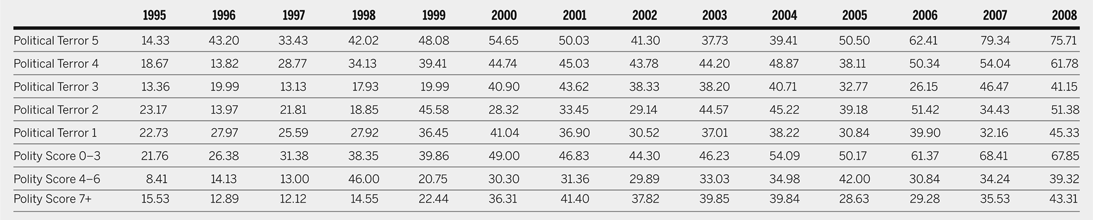
Table 2 examines grant rates by the human rights conditions in different countries of origin. To determine these conditions, we examined Gibney's Political Terror Scale (see Gibney and Stohl Reference Gibney, Stohl and Gibney1988; Gibney, Dalton, and Vockell Reference Gibney, Dalton and Vockell1992), which bases its scores on the State Department's annual country reports of human rights conditions and measures the level of state torture, killing, and disappearance of its own citizens. In general, applicants from more repressive states (higher scores) have more success in petitioning for asylum than do applicants from countries with rare or exceptional instances of state repression (lower scores). It is interesting to note that following the passage of the Real ID Act, the grant rate for applicants from the most repressive countries (Level 5) increased to 62% and then to 79% and 75% (see table 2). We see a similar trend in regard to Level 4 countries, which suggests that human rights conditions may have a stronger effect in the reformed era. In addition, we see higher success rates for applicants from less democratic countries (low Polity democracy scores) than for more democratic countries (high scores), although applicants in the middle range are sometimes less successful than applicants from more democratic countries.
Asylum Grant Rates and Human Rights Conditions

Table 3 presents the grant rates across three factors that we believe may signal judges that an applicant is a potential terrorist threat. First, it is quite interesting that applicants from countries labeled by the U.S. government as state sponsors of terrorism have a consistently high average grant rate, as do applicants from countries with known al-Qaeda activity (U.S. Department of State 1995–2003; U.S. Department of State 2004–08). This pattern is consistent with asylum policy during the Cold War, when the U.S. accepted asylum seekers from Cuba and the Soviet Union, presumably to embarrass the Communist states and signal the United States' ideological commitment. Although the designations of state sponsor are quite stable over time, the reporting of al-Qaeda activity has varied greatly, as more countries have reported activity in recent years, and none did from 1995 to 1997. Finally, table 3 also shows grant rates for Arabic speakers, and, interestingly, we find that Arabic speakers have seen an increase in their grant rates since 2000, achieving higher grant rates than even English speakers, and certainly have been favored over Spanish-speaking applicants, who have the lowest success rates.
Asylum Grant Rates and Potential Indicators of Terrorist Threat

POST-2001 CHANGES IN ASYLUM OUTCOMES
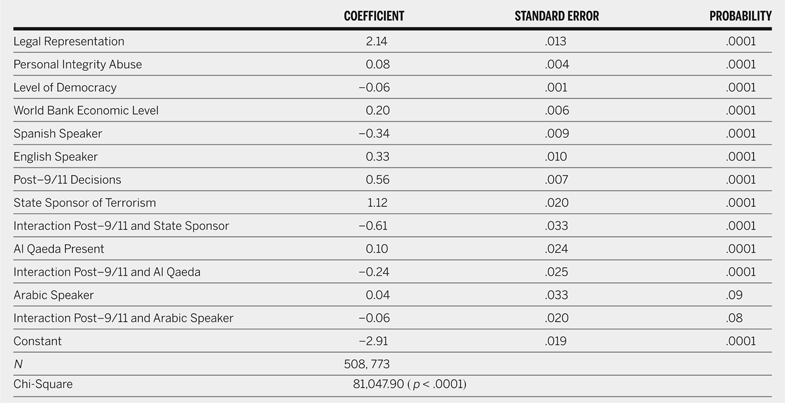
Overall, the descriptive analysis suggests few obvious changes in asylum outcomes after September 11, at least in the aggregate. However, these simple trends cannot ferret out the effect of other factors that influence these outcomes simultaneously. We ran a simple logit model to examine the interaction between the conditional effects of the post-2001 era on the three indicators that we hypothesized to be linked in the judges' minds to a potential terrorist threat (see table 4). We included in the model factors that have been demonstrated to influence the judges' decisions or the overall grant rates for particular countries of origin (Rosenblum and Salehyan Reference Rosenblum and Salehyan2004; Rottman, Fariss, and Poe Reference Rottman, Fariss and Poe2009; Keith and Holmes Reference Keith and Holmes2009). Consistent with our previous work, we see that the largest factor influencing an outcome is whether the applicant is represented by legal counsel; if the applicant has legal representation, the probability of a grant increases by 33%.Footnote 5 The level of human rights abuse in the country of origin does increase the probability of a grant, while the level of democratization decreases the probability of a grant; however, both effects are relatively small; the probability of a grant with a maximum change in human rights condition (from least repressive to most repressive) increases only by .07, and, similarly, the probability of a grant is decreased only by .11, given a change from least democratic to most democratic. The model also demonstrates that the judges' likelihood to grant asylum decreases for applicants from poorer countries and those who speak Spanish, both of which may signal to the judge the potential that the applicant is an economic migrant.Footnote 6 Most important, the three interactive terms are each negative as expected and achieve statistical significance, indicating that in the post-September 11 era, applicants who speak Arabic have a decreased probability of a obtaining a grant compared to non-Arabic speakers (−.02); applicants from countries designated state sponsors of terrorism or in which al-Qaeda is reportedly present have a decreased probability of a grant as well (−.05 and −.12, respectively). The positive coefficient on the post-2001 dummy variable suggests that claims decided in the post–September 11 era have an increased probability of a grant (.12) if the applicant is not an Arabic speaker, al-Qaeda has not been reported to be present in the country of origin, and the state has not been identified as a sponsor of terrorism. The other three constitutive terms are positive and statistically significant, which suggests that prior to September 11, speaking Arabic had a beneficial effect for an applicant, as did the presence of al-Qaeda and origin from a country that was a state sponsor of terror. Prior to September 11, the presence of these factors may have been perceived as an indicator of threat to the individual who was claiming a fear of torture or persecution. It is likely that in the post–September 11 era, potential threat to an applicant is now offset by the stronger fear or perceived likelihood that individuals from such states are potential threats.
Logit Model of Asylum Outcomes, 1995–2008

CONCLUSION
Critics initially feared that the security-driven asylum reforms would radically change asylum outcomes and lead to the rejection of many worthy applicants, leaving them to face the real possibility of torture and other forms of persecution in their home country. Our assessment of these fears is mixed. As the number of cases decided on the merits has decreased, both in response to the 1996 reform and the Real ID Act, the percentage of successful claims has increased at the defensive stage. However, we must also caution that as a result of these reforms, significant winnowing of the applicant pool has already occurred before asylum seekers reach an immigration court, and we are unable to ascertain what factors account for the filtering of applicants. Potential bona fide asylum seekers may have not make it to court if secondary immigration inspectors do not make a determination of fear to return and turn them away at the border. Numerous dimensions of the deterrent policies that have evolved after September 11 may have convinced applicants to stay away from the U.S. system. Nonetheless, even with the winnowing of the applicant pool, our simple model suggests that, on average, post–September 11 factors may indeed serve as signals of security risk to the United States for judges. Now, factors that seem irrelevant to the merits of an asylum application, including presence of al-Qaeda activity or state sponsorship of terror in the applicant's country of origin and whether or not the applicant speaks Arabic may, in the post–September 11 era, substantially decrease the success of some applicants who may be similarly situated to other applicants in terms of fear or actual threat. These results, in conjunction with the growing asylum literature, suggest that the asylum system is indeed sensitive to current security concerns, which have simply transformed from the ideological threats of the Cold War to the terrorist threats of the new millennium.