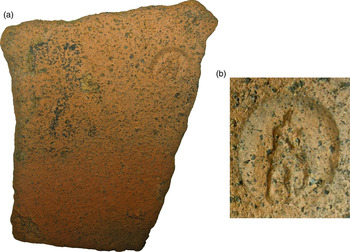
A rather unusual fragment of tile ( fig. 4) has recently come to light in the stores of the Tyne & Wear Museums.Footnote 57 The fragment is part of a tegula and carries the carefully made impression of a signet ring that had been impressed into it prior to firing. The fragment was found beside the branch wall that runs between Wallsend fort and the River Tyne, in a context associated with the robbing of the wall in the post-Roman period. The artefact is interesting firstly for the light that it sheds on the use of intaglios in Roman Britain, and secondly for the insight it provides on the tile maker.
Roman tile with intaglio impression showing Hercules wrestling the Nemean Lion. Scale: (a) 1:1; (b) 3:1. (Photos: Ian J. Marshman; © Tyne & Wear Museum Service)

The impression would appear to have been made with a glass intaglio (11 mm by 9 mm) with a flat surface and convex sides (form F2Footnote 58 ), moulded with an image of Hercules wrestling the Nemean Lion. Hercules is shown facing right using his hands to throttle the lion, whose skin was impenetrable to any human weapon. Such moulded glass intaglios frequently imitate nicolo (an onyx with blue and black layers), and are common in Britain from the first to third centuries a.d., being particularly numerous in the late second to third centuries. Footnote 59 Other examples of this image, some of which may derive from the same mould, occur in silver rings dated to the late second to third century at Barmby MoorFootnote 60 and at Thorpe Salvin in Yorkshire,Footnote 61 as well as in contemporary copper-alloy ‘trinket rings’ from SpringheadFootnote 62 and Herne BayFootnote 63 in Kent, St Albans, Herts.,Footnote 64 and Barnsley Park, Glos.,Footnote 65 and possibly also in a third-century gold ring from Caerleon, which depicted the same composition on what was probably mistakenly identified as a stone ‘of a deep-blue colour, perhaps lapis lazuli’.Footnote 66 Although it is not possible to date the tile on the basis of either its fabric or its context,Footnote 67 these comparable intaglios indicate a date in the late second to third century a.d. This is supported by the lack of detail in the moulding and also the intaglio's convex sides, which are often more angularly bevelled in earlier nicolo glass intaglios.
It has only been possible to locate one other example of a Roman tile with an intaglio impression — and unfortunately this was also found out of context — at the Governor's Palace at Aquincum, Hungary.Footnote 68 Here the impression appears to come from a gemstone intaglio, engraved with a laureate portrait of the emperor Hadrian.Footnote 69 However, it differs from the Wallsend tile in that it was evidently impressed by accident, since it bears two incomplete impressions of the gem, the ring and the wearer's knuckles. It may therefore represent the traces of a tumble taken by an official overseeing the palace's construction.Footnote 70 Also worthy of note, however, is a fragmentary tile from Richborough impressed with a sestertius of Nero, which like the Wallsend seal-impression seems to have been made deliberately.Footnote 71
Impressions from signet rings rarely survive in the Empire's North-West provinces;Footnote 72 in part this is probably the result of the different method of sealing here, which utilised beeswax rather than clay,Footnote 73 and the moister climate in which they are less likely to survive. Therefore, the only signet ring impressions from Roman Britain survive on ceramics, for example next to the name stamps of potters on sherds of Gallo-Belgic ‘eggshell’ beakers that have been unearthed at London and Richborough,Footnote 74 and in isolation on the base of a greyware vessel from Copthall Close, London.Footnote 75 There is also a single example of a sherd of legionary ware manufactured at Holt, where a signet ring depicting a female bust was used, alongside other stamps, to decorate a bowl imitating a Dragendorff 37.Footnote 76 On the Continent, intaglio impressions have infrequently been found on terra sigillata vessels,Footnote 77 and one has also been found on a sherd of late La Tène red and white painted ware at the oppidum at Mount Gellért, Hungary.Footnote 78 Later sealings on a lead alloy are more numerous, although many of these were made not with personal signet rings,Footnote 79 but with metal diesFootnote 80 belonging to officials in the military and civil authorities. The Wallsend tile is thus significant, for although it is not an actual sealing, it does demonstrate that cheaper rings set with nicolo glass intaglios could be used to make good impressed images, and so could have been employed for sealing.
Why someone chose to impress their ring into this particular tegula is not certain. The rarity of such impressions on tiles, even at this particular site, would caution against interpreting it as a more sophisticated version of the common finger-made ‘signatures’ found on tiles, which are thought to indicate how many tiles each worker had produced.Footnote 81 It should be noted that the intaglio was impressed when the clay was already leather-hard, as were the legionary tile stamps.Footnote 82 Peter Warry has suggested that the signet ring impression might have been the mark of a foreman inspecting a batch of tiles before they were fired. This would certainly explain why no other tiles with this impression have yet been uncovered at Wallsend,Footnote 83 although the assemblage must comprise only a tiny fraction of the tiles that were once used here. It is possible, however, that this marking, like many of the graffiti and footprints found on Roman tiles, had no function in the official process of production.Footnote 84 The most plausible reason for the impression may be that its wearer simply wished to make his or her mark, and leave it to posterity. This desire to leave a mark is of course also attested by the common practice of producing graffiti of names and greetings on objects, including tiles, as well as on walls and monuments throughout the Roman world.Footnote 85
The markings on tiles have long been seen as a way of understanding the lives of Romano-British non-élite individuals.Footnote 86 The Wallsend tile hints that some individuals on the lower rungs of Romano-British society had some knowledge of Graeco-Roman mythology,Footnote 87 as is supported by depictions of the Labours of Hercules on both imported samianFootnote 88 and on Nene Valley slip wares.Footnote 89 That a third-century tiler wanted such an image for a signet ring might hint at a personal attachment with Hercules. This could even have been a religious devotion towards the hero, who was popular amongst the military community in Roman Britain.Footnote 90
The Wallsend tile supports Henig's suggestion that such late second- to third-century ‘trinket rings’ were worn by those of humble means.Footnote 91 That the wearer of this ring evidently knew a moulded glass intaglio could produce a perfectly serviceable impression may also be indicative that some wearers did view these cheaper rings as signets and not, as some have suggested, merely as costume jewellery.Footnote 92 Although we cannot know exactly why Hercules' first labour appealed to this individual, or why they impressed their ring into a drying tile, their mark has survived, unlike the many thousands that must have been made in wax and clay.
ACKNOWLEDGEMENTS
I would like to thank Alex Croom, Tyne & Wear Museums Service, for showing me this artefact and for her help in preparing this note. Peter Warry kindly looked at photographs of the tile and provided comments. I am grateful to Martin Henig, and my supervisors David Mattingly and Penelope Allison for reading earlier drafts of this article and for providing references.