Introduction
Health care systems routinely face challenges associated with patient surge during disasters, public health emergencies, and large-scale incidents. Alternate Care Facilities (ACFs) represent one strategy for expanding health care capacity when hospitals become overwhelmed. ACFs have been utilized during hurricanes, wildfires, and infectious disease outbreaks like the COVID-19 pandemic, serving roles that ranged from isolation and quarantine facilities to step-down hospitals, post-acute and acute care treatment centers.1-5 Currently, the evidence supporting ACF planning and operations largely consists of retrospective descriptions of individual experiences with proposed checklists and recommended policy changes.Reference Kim, Sung and Min6-Reference Milburn, McNeill and Clay12
Recent research conducted by these authors (Team Colorado) identified variability in ACF implementation across the United States (US).Reference Ryder, Buck and Persson13, Reference Ryder, Persson and Yeskey14 The University of Colorado School of Medicine (Team Colorado), in support of a Defense Health Agency (DHA) funded project looking at modular scalable solutions for medical surge during Large Scale Combat Operations (LSCO), conducted a literature review as detailed in the prior publication.Reference Ryder, Persson and Yeskey14 This covered publications looking at experiences implementing and operating ACFs in the US. The literature review included 34 articles. Findings from this literature review were then used to develop a facilitator guide for semi-structured interviews. Subject Matter Experts (SMEs), defined as individuals who have operational experience planning and implementing ACFs in the US, were recruited from author lists of reviewed literature and national networks. Sixteen clinicians and administrator SMEs participated in 4 one-hour-long semi-structured interviews. These interviews focused specifically on the SMEs’ experiences with implementing ACFs, the successes they had, the challenges they faced, and what they perceive to be the future direction of ACFs. From the literature review and these semi-structured interviews, recurring themes emerged around flexibility, partnerships, resource availability, executive leadership support, and organizational structure.Reference Ryder, Buck and Persson13, Reference Ryder, Persson and Yeskey14
Although published literature provides valuable insight into specific ACF activations, individual reports often focus on unique local circumstances and rarely allow for comparison across multiple jurisdictions or disaster types. Furthermore, and arguably more importantly, many operational lessons remain undocumented and reside only within the institutional memory of individuals who participated in planning or response activities.
Recognizing the need to capture, synthesize, and preserve this experiential expertise, Team Colorado convened a national symposium designed to hear directly from individuals with direct ACF experience. The symposium sought to create a structured environment in which participants could compare approaches, discuss successes and challenges, identify recurring operational themes, and develop recommendations for future ACF planning.
This manuscript describes the conceptualization, planning, and execution of the 2025 Alternate Care Facility Symposium. Rather than reporting substantive findings from each of the breakout sessions, which are presented separately, this paper focuses on the methodology used to systematically gather practice-based expertise and facilitate knowledge generation among disaster medicine and emergency management experts.
Background and Rationale
The ACF symposium emerged from a broader DAH-funded initiative entitled “A Modular, Scalable Alternate Care Facility for Patient Surge,” which seeks to improve national medical surge capabilities and inform future National Disaster Medical System (NDMS) planning. Team Colorado is 1 of 3 funded teams developing innovative solutions to manage patient surge events, such as an LSCO event that would result in 1000 combat casualties returning to the US for 100 days. This would be one potential instance where an ACF may provide a viable solution. Team Colorado focused on the conversion of hotels into functional health care facilities with medical/surgical and intensive care unit (ICU) capabilities. These efforts included both proof-of-concept demonstrations and research activities.
Through the literature review and semi-structured interviews previously conducted, the planning team recognized that a traditional research approach alone would be insufficient to capture the breadth of experiential knowledge available nationwide. Many important operational lessons had never been published, and many individuals responsible for successful ACF implementation had limited opportunities to engage with peers facing similar challenges. The symposium was therefore conceived as a mechanism to aggregate distributed expertise, facilitate cross-jurisdictional learning, and generate a foundation for future consensus-building efforts. The long-term objective is to support the development of evidence-informed recommendations and ACF guideline updates. Funding for the ACF symposium came from Team Colorado’s original DHA-funded initiative, MTEC-23-09-NDMS-Modular Number W81XWH-15-9-0001.
Discussion: Symposium Conceptualization and Design
The symposium was intentionally designed as a participant-centered knowledge generation activity rather than a traditional conference. Instead of emphasizing didactic presentations, the planning team prioritized structured discussion among individuals with direct operational experience with ACFs.
The conceptual framework was informed by findings from the literature review and SME interviews.Reference Ryder, Persson and Yeskey14 Operational themes identified during prior research were organized into topic domains that reflected the major functional components required for ACF activation and sustainment. These domains were subsequently divided into two overarching categories that were the focus of Day One and Day Two, respectively: the People and the Facility. This structure ensured that discussions addressed both operational and infrastructure-related considerations while remaining grounded in real-world experiences.
Subject Matter Expert Identification and Recruitment
Participant recruitment focused on individuals with direct experience planning, activating, managing, or operating ACFs within the US. Rather than utilizing an open call for participation, the symposium employed purposive recruitment to maximize the concentration of operational expertise.
Potential participants were initially identified through authorship of publications included in the literature review and through professional disaster medicine, emergency management, public health, and health care preparedness networks. An interest and nomination form was distributed to these contacts, requesting recommendations for both clinical and non-clinical experts who possessed direct ACF experience. Recommendations from this process formed the basis of the invitation list. Additionally, the Society for Disaster Medicine and Public Health advertised the ACF symposium to their email listserv, requesting those with experience fill out an interest form. ACF symposium planners reviewed the interest forms and nominations, then sent an invitation to participate to those who qualified.
The planning team intentionally sought multidisciplinary representation, recognizing that successful ACF implementation requires expertise extending beyond clinical care. Invitations were therefore extended to health care administrators, emergency managers, physicians, nurses, public health professionals, engineers, architects, logisticians, and other personnel involved in ACF planning and operations.
Registration was by invitation only, and travel support was provided to reduce participation barriers and encourage geographic diversity among attendees. Ultimately, 56 individuals participated in the symposium, including attendees, facilitators, note takers, and planning staff. ACF experience included 9 states with geographic variability (Figure 1), and the federal government was represented over the 2 days. Informed consent to participate in the symposium was obtained through an implied-consent process. Prior to the symposium, all invited participants received a consent statement via email describing the study and indicating that participation was voluntary and that attendance constituted consent to participate. On the day of the symposium, the consent statement was displayed at the registration desk and again during the opening remarks, providing participants an additional opportunity to review the information and decline participation before symposium activities began. The Colorado Multiple Institutional Review Board approved this study (COMIRB# 26-0208).
Geographic representation of ACF symposium participants.

Topic Selection and Agenda Development
Discussion topic selection was informed directly by prior research findings. Investigators reviewed themes identified through the literature review and SME interviews and mapped these findings into operational domains representing critical aspects of ACF implementation.
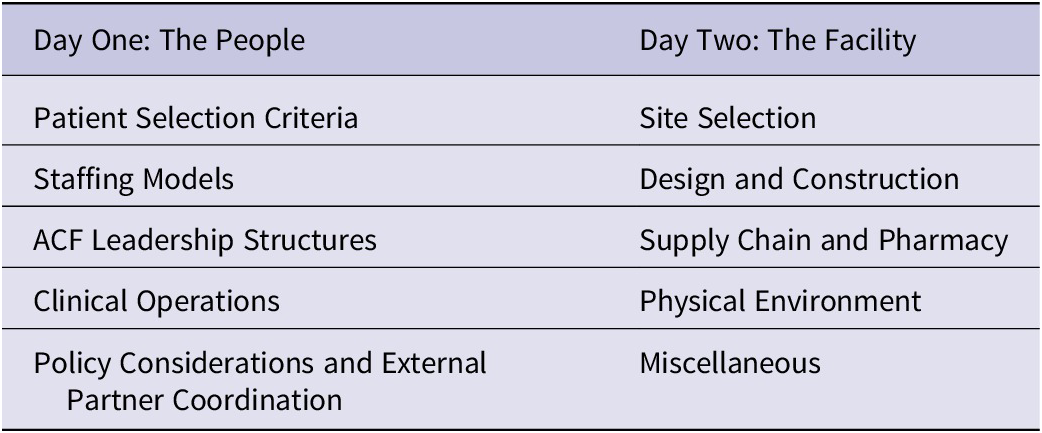
Selection criteria included frequency of discussion within prior research, operational importance, applicability across disaster types, and potential for generating actionable recommendations. The final agenda consisted of nine primary discussion domains distributed across 2 days. The first day focused on human and organizational aspects of ACF operations, while the second day emphasized facility, infrastructure, and logistical considerations. The tenth discussion was left open as a miscellaneous topic session to allow participants an opportunity to discuss anything that they felt was important but did not have the opportunity to discuss during the preceding sessions. Table 1 outlines the topic breakdown. This approach ensured alignment between the symposium objectives and existing evidence while allowing participants to expand upon topics insufficiently addressed in the literature.
ACF symposium discussion topics by day

Table 1. Long description
The table is organized into two main headers.
Column one is titled Day One: The People and includes the following five topics listed vertically:
* Patient Selection Criteria
* Staffing Models
* A C F Leadership Structures
* Clinical Operations
* Policy Considerations and External Partner Coordination
Column two is titled Day Two: The Facility and includes the following five topics listed vertically:
* Site Selection
* Design and Construction
* Supply Chain and Pharmacy
* Physical Environment
* Miscellaneous
A footer note defines A C F as Alternate care facility.
ACF: Alternate care facility.
Facilitator Guide Development
A central design principle was standardization across breakout sessions. To accomplish this, the planning team developed a comprehensive facilitator guide that provided structure for the facilitators and participants while preserving flexibility for discussion.
Each breakout session was organized around 4 core questions:
-
1. What approaches were utilized?
-
2. What successes were observed and how were these sustained?
-
3. What challenges were encountered and how were these mitigated?
-
4. What recommendations would you provide for future implementation of ACFs?
These questions mirrored the domains explored during the prior qualitative interviews and provided a consistent framework across all discussion topics. Additional probing questions were developed for each topic area to support facilitators if conversations stalled or required deeper exploration. The use of a standardized facilitator guide enhanced comparability across sessions while minimizing facilitator-driven variation. The specific questions that guided each topic’s discussion are outlined in the separately published breakout session summaries.
Facilitators and Note Takers
Each breakout group included both a trained facilitator and a dedicated note taker. Facilitators were provided by All Clear Emergency Management Group, LLC. They were selected based on experience leading discussions, familiarity with emergency preparedness concepts, and ability to encourage balanced participation among attendees. The primary role of facilitators was not to contribute content expertise but rather to guide discussion, ensure equitable participation, maintain adherence to the discussion framework, and keep sessions on schedule. All facilitators participated in a one-hour facilitator training prior to the symposium.
Dedicated note takers were utilized to maximize data capture and reduce the cognitive burden on facilitators. Note takers documented key discussion points, recurring themes, examples, and recommendations. The use of separate facilitators and note takers allowed each individual to focus on their specific function and improved the completeness of documentation.
Zoom® audio recordings and transcripts were collected to supplement written notes and support subsequent synthesis activities.
Symposium Logistics and Operations
The symposium was conducted over 2 days in Denver, Colorado. Each day was similarly structured, beginning with a plenary session, then proceeding to five small group discussion sessions, and concluding with a summary of the day. Participants were preassigned to discussion tables to ensure balanced distribution of expertise within each session. Rather than assigning participants to fixed breakout groups for the duration of the event, attendees rotated between groups throughout the event. Group composition changed between sessions to maximize interaction among participants and encourage cross-pollination of ideas across disciplines and jurisdictions.
The symposium incorporated limited plenary content to start each day. On Day One, Dr. Asha Devereaux and Dr. Chuck Wright led a didactic session looking at the evolution of ACFs from 2005 to 2025. On Day Two, Dr. Jason Persoff highlighted Team Colorado’s research around rapidly converting a hotel into a functional inpatient hospital. Dr. Jessica Ryder discussed the findings from the background research, including the literature review and semi-structured interviews,Reference Ryder, Persson and Yeskey14 that led to the ACF symposium development. These presentations were intentionally used to establish shared context and provide a common foundation for subsequent discussions. Most of the participants’ time was reserved for facilitated discussions rather than didactic lectures.
Each breakout session lasted approximately 50 minutes and was followed by transition periods that allowed participants to move between groups. This duration was selected to provide sufficient time for meaningful discussion while maintaining participant engagement and allowing coverage of multiple topics within the 2-day format. During these 50-minute sessions, participants discussed a specific ACF operational topic (Table 1) in groups of 5 to 6 people guided by a facilitator.
At the conclusion of each day, participants reconvened in large-group sessions to summarize discussions, identify recurring themes, and highlight areas warranting future exploration. These summary sessions provided an opportunity for reflection and synthesis while allowing participants to hear perspectives from discussions in which they had not directly participated.
Documentation and Data Capture
Discussion content was documented through a combination of structured note-taking and audio recording. The use of both facilitators and note takers improved documentation quality while minimizing disruption to discussions. Audio recordings served as a secondary source for clarification and verification of key observations. Data from the symposium included all recordings, notes, and transcripts, which were then stored in a password-protected Dropbox environment accessible only to members of the research team.
ACF Symposium Findings
Following the symposium, notes from each session were consolidated and reviewed by Team Colorado to identify recurring topics, areas of agreement, differing perspectives, and key considerations raised by participants. These data were synthesized into individual breakout-session summaries intended to provide a descriptive account of the discussions rather than a formal qualitative analysis. The summaries collectively provide a record of the symposium findings, with emphasis on recurring themes and discussions among participants. Further analysis and synthesis across symposium topics will be conducted during subsequent phases of the research project to inform development of updated best-practice recommendations for ACF planning.
The main findings of each topic discussed are summarized in separately published “Breakout Session” summaries. These summaries include the facilitator questions for the specific topic as well as the main findings with examples from each of the four main domains discussed: what was done, successes, challenges, and future directions.
Limitations
Several limitations should be considered when interpreting the symposium methodology. Participation was invitation-based and relied heavily on professional networks and authors identified through prior research activities. Consequently, perspectives from individuals who declined participation or who lacked connections to established networks are likely to be underrepresented.
The majority of participants possessed experience with ACFs activated during the COVID-19 pandemic. Although many lessons are transferable across hazards, discussions may have disproportionately reflected pandemic-related experiences rather than other disaster scenarios.
The symposium was designed to generate and synthesize expert opinion rather than establish consensus. While recurring themes emerged across discussions, the methodology did not include formal consensus-building techniques such as Delphi processes or nominal group methods.
Despite efforts to standardize facilitation, some variation among facilitators and discussion groups was unavoidable. Differences in participant composition, professional backgrounds, and operational experiences likely influenced the content and depth of individual discussions.
Finally, the symposium focused primarily on United States-based experiences. International ACF models may provide additional perspectives regarding governance structures, staffing approaches, resource allocation, and community integration that were not represented.
Conclusion
The 2025 Alternate Care Facility Symposium represents a novel effort to systematically convene and capture experiential expertise related to health care surge operations. By integrating findings from prior research with structured, facilitated discussions among individuals with direct operational experience, the symposium created a mechanism for preserving institutional knowledge and generating practice-informed recommendations.
The planning strategies described in this manuscript—including targeted SME recruitment, standardized facilitator guides, dedicated note takers, rotating discussion groups, and structured synthesis sessions—may provide a reproducible framework for future disaster medicine and public health preparedness initiatives. As health care systems continue to confront increasingly complex surge events, structured expert convenings may serve an important role in advancing knowledge, informing policy, and strengthening preparedness.
Author contribution
Jessica Ryder: Initial draft, full review; Jenny Schmitz: Data analysis, symposium summary draft, final edits, draft review; JoAnne Huie: Data analysis, symposium summary draft, final edits, draft review; Elaina Huffman: Final edits, draft review; Amy Herron: Final edits, draft review; Charles Little: Final edits, draft review; Jason Persoff: Final edits, draft review; Maria G Frank: Final edits, draft review.
Competing interests
None.