Introduction
Without exception, all Western countries face the ageing of their population. In 2011 the first post-war baby-boomers reached retirement age, foretelling a rapid growth of the retired population. Extending people's working life is seen as a key element in dampening or curtailing the rising costs associated with an ageing population. Most governments have adopted longer-work policies and have implemented pension reforms that limit opportunities for an early exit from the workforce. In the Netherlands, for example, all facilities (including tax incentives) to stop working before age 65 were abolished in 2006, and the age at which people are eligible for a public pension will be increased gradually to age 67 by 2025. As a result of these reforms, the financial opportunity structure for an early exit from the labour force will become much more restrictive in coming decades. Retirement decisions of older workers are not only determined by financial considerations though. A host of other factors at home and at work play a role too. Both within the household and within their labour organisation, older workers may face forces that increase or decrease their propensity to remain in the labour force.
The notion that the household or work context of older workers affects decision making around retirement is not new (Beehr and Bennett Reference Beehr, Bennett, Shultz and Adams2007; Moen Reference Moen1996; Szinovacz Reference Szinovacz, Adams and Beehr2003). Previous research of Henkens (Reference Henkens1999), for example, clearly shows that early retirement is motivated not only by financial or health considerations but also by a lack of spousal support to remain in the workforce. Many studies have investigated the association between work and job characteristics (e.g. experienced work pressure, challenge and growth opportunities) and retirement plans and/or behaviour of older workers (see e.g. Blekesaune and Solem Reference Blekesaune and Solem2005; Schreurs et al. Reference Schreurs, Van Emmerik, De Cuyper, Notelaers and De Witte2010).
Much less attention is paid in the literature to the broader organisational context. This is remarkable, given the fact that it is precisely at this level that opportunities and constraints for career extension are shaped (Vickerstaff et al. Reference Vickerstaff, John, Cox and Keen2004). Research among European employers shows that they tend to be scantly committed to encouraging their older workers to remain active in the labour force (Conen, Henkens and Schippers Reference Conen, Henkens and Schippers2011, Conen, Van Dalen and Henkens Reference Conen, Van Dalen and Henkens2009). As a result, organisational policies supporting longer working lives are not very well developed yet.
This article particularly focuses on the role of organisations in the retirement decision-making process of older workers. We distinguish between two dimensions of the organisational context that are deemed of interest: organisational human resources (HR) policies regarding older workers and organisations' normative climate regarding retirement. The underlying assumption is that organisations create opportunities and conditions for career extension via their personnel instruments (e.g. customising work or working times, retaining knowledge). The normative climate refers to the social context of work and the extent to which this context encourages or discourages retirement.
The objective of this study is to advance the existing literature on retirement decision making and the factors that contribute to older workers' propensity to continue working. Although this article focuses on organisational policies and practices, decision making about retirement cannot be studied in isolation of the financial context that facilitates or restricts retirement. We also acknowledge that characteristics of older workers' jobs (e.g. heavy or light) affect the decision as to whether or not to stop working.
The study is based on data from the Netherlands Interdisciplinary Demographic Institute (NIDI) Work and Retirement Panel, an on-going longitudinal survey of older workers (50 years and over) of three private-sector organisations and among civil servants in the Netherlands. We examined a subset of 1,461 individuals who were aged 50–59 and in a career job at the time of the first interview in 2001 and who participated in at least two of the three study waves undertaken in 2006 and 2011. The panel nature of the research allowed us to examine two aspects of the retirement decision-making process. In addition to the planned retirement age (also known as retirement intention), which was asked in 2001 to all participants, the study also provides insight into actual retirement age. Observed retirement behaviour may, however, differ considerably from retirement intentions (Anderson, Burkhauser and Quinn Reference Anderson, Burkhauser and Quinn1986; Henkens and Tazelaar Reference Henkens and Tazelaar1997; Prothero and Beach Reference Prothero and Beach1984), and these discrepancies may point to circumstances that place restrictions on the realisation of work-retirement intentions. Many older workers stop working earlier than initially anticipated, and this is not always voluntary (Szinovacz and Davey Reference Szinovacz and Davey2005; Van Solinge and Henkens Reference Van Solinge and Henkens2007). This suggests that the factors that play a role in the formation of pension plans may differ from the forces that guide actual retirement.
Theoretical background
There is a rich history of research on the retirement decision-making process. The subject has been studied from a variety of scientific disciplines, such as economics, sociology and psychology. Most theories about retirement decision-making implicitly or explicitly employ a cost–benefit framework, assuming that individuals choose to retire once the benefits of retirement exceed those of working (Feldman and Beehr Reference Feldman and Beehr2011). The particular factors that are assumed to play a role in the cost–benefit considerations do vary by discipline. In this study we integrate insights from economic and sociological research on retirement decision making with insights from organisational psychology.
The key assumption underlying micro-economic research is that individual retirement decisions are governed by income/leisure considerations. Retirement is seen as a decision regarding the optimal age to stop working given the individual's environment and relative preference for income and leisure (Leonesio Reference Leonesio1996). Financial incentives, particularly expected retirement income or replacement rates,Footnote 1 are deemed to influence retirement choices (Gruber and Wise Reference Gruber and Wise2004). Older workers' own pension entitlements are, however, just one aspect in the financial retirement context. Other relevant financial factors are spousal (retirement) income, and wealth and property. Non-economic factors, particularly health, are deemed to influence income/leisure choices too. Poor health is assumed to increase the preference for leisure (Gustman and Steinmeier Reference Gustman and Steinmeier2009).
The economic literature tends to ignore the social context of retirement decisions. This is in contrast with much of the more recent sociological literature, which emphasises the contextual embeddedness of the retirement decision-making process. This literature stresses that attitudes and decisions about retirement are not formed in a social vacuum but evolve from a variety of contextual influences at the household, organisational and societal levels (Beehr and Bennett Reference Beehr, Bennett, Shultz and Adams2007; Moen Reference Moen1996; Szinovacz Reference Szinovacz, Adams and Beehr2003). The family is an important life sphere that interacts with employment (Szinovacz Reference Szinovacz, Adams and Beehr2003). There is a growing recognition of the important role of the household, the partner in particular, in the retirement decision-making process (e.g. Henkens and Van Solinge Reference Henkens and Van Solinge2002). One of the main discontinuities associated with full retirement is the lack of social interaction with others. For married older workers, social interaction with the spouse can at least partially substitute for continued interaction with colleagues; for unmarried workers staying in the career job is likely to be more critical in maintaining social contacts with others. The partner's work status may play a role as well, in the sense that non-working partners may stimulate (early) retirement. Likewise, the economic literature so far has paid little attention to job and organisational factors (such as HR policies) and their impact on the work/retirement considerations of older workers (Shultz and Wang Reference Shultz and Wang2011). We assume that retirement decisions are influenced by older workers' financial context and health, and their work context. How the various work-related factors are assumed to impact work/retirement positions is elaborated below.
Work/job characteristics
Discontent with one's work and working environment reinforces a worker's propensity to withdraw from the workplace (Adams and Beehr Reference Adams and Beehr1998; Estryn-Behar et al. Reference Estryn-Behar, Van der Heijden, Fry and Hasselhorn2010). The literature suggests that intrinsic work values have gained importance in recent decades (e.g. Twenge et al. Reference Twenge, Campbell, Hoffman and Lance2010). For example, a Dutch study revealed that employees favoured immaterial aspects of their jobs (aspects that allow for self-expression such as job variety and autonomy, and challenge) over material aspects (e.g. salary). Only for a small minority of employees did work have a merely instrumental value, that is, no other benefits than money (Van Hoof Reference Van Hoof2002).
In this study we examine the impact of job characteristics on retirement decision making. We consider two aspects of job characteristics, relating to the extent to which work is experienced either as a burden or as a challenge. Demerouti et al. (Reference Demerouti, Bakker, Nachreiner and Schaufeli2001) make a similar distinction between ‘job demands’ and ‘job resources’ in their Job Demands–Resources (JD-R) model. Demands refer to aspects of the job that require sustained physical and/or psychological effort and are therefore associated with physiological and/or psychological costs. These demands are negative aspects of the job and include burdens such as overload and job pressure. Job resources or rewards, on the other hand, are positive aspects of the job that keep people healthy and motivated and contribute to personal development and growth (Bakker and Demerouti Reference Bakker and Demerouti2007). Rewards include such characteristics as challenges, autonomy and job control. The JD-R model posits that job demands and job resources initiate two different psychological processes, which eventually affect important organisational outcomes. In the first place there is the health impairment process. Through this process, poorly designed jobs or chronic job demands exhaust employees' mental and physical resources. This might lead to a depletion of energy and health problems, and eventually dropping off from work. In the second place there is the motivational process, through which job resources exert their motivating potential and lead to high work engagement, low cynicism, excellent performance and low turnover intentions. Schreurs et al. (Reference Schreurs, Van Emmerik, De Cuyper, Notelaers and De Witte2010) and Henkens and Leenders (Reference Henkens and Leenders2010) have applied this model to retirement research. They found a negative association between ‘job demands’ and retirement intentions (workers with high job demands preferred an earlier exit from the labour force). Job resources are assumed to have the opposite effect (see also Kubicek et al. Reference Kubicek, Korunka, Hoonakker and Raymo2010). We include five job characteristics in our model. Three of these – physically demanding work, irregular work/shift work and perceived job pressure – are hypothesised to be unfavourable or demanding job attributes. The other attributes – perceived job challenge and perceived growth opportunities – are assumed to be favourable or rewarding.
• Hypothesis 1a: Demanding job characteristics – physically demanding work, irregular work/shift work and job pressure – are associated with lower (planned) retirement ages.
• Hypothesis 1b: Rewarding job characteristics – job challenge and growth opportunities – are associated with higher (planned) retirement ages.
Organisational policies
Organisational policies influence the way employees operate in organisations. HR policies are deemed to serve an organisation's strategic goal in terms of maintaining a good personnel structure, achieving an optimal combination of skills and knowledge, and keeping labour costs acceptable (Van der Heijden, Schalk and Van Veldhoven Reference Van der Heijden, Schalk and Van Veldhoven2008). In recent decades, age-related HR policies within organisations have strongly focused on facilitating early retirement as a strategy to cope with the contingencies of the labour market. Within HR practices a distinction can be made between general HR instruments and age-related personnel instruments. The first type involves investments in human capital such as training and schooling opportunities, and job mobility activities as well as work–life balance arrangements that target all employees, not just older workers. The second type involves instruments that particularly match the needs of older workers. We include three types of HR instruments in our model to predict retirement decisions. Two of these (training and schooling, and flexible working opportunities) are general instruments, the other (phased or partial retirement) is age-related. We assume that both types of instruments contribute to extending the working lives of older adults.
Stimulating training and lifelong learning is generally regarded as an investment in an organisation's human capital (Becker Reference Becker1975; Thurow Reference Thurow1975). Training not only enhances the employability of individual workers, it also has a positive effect on organisational commitment (Armstrong Stassen and Ursel Reference Armstrong Stassen and Ursel2009; Taylor and Walker Reference Taylor and Walker1998). In practice, however, organisations tend to invest less in training older workers than their younger peers. The underlying assumption is that an investment in older workers will not pay, since they are close to their retirement date (Taylor, Brooke and di Biase Reference Taylor, Brooke, di Biase and Naegele2010; Taylor and Urwin Reference Taylor and Urwin2001). So far, there is little research examining the impact of schooling and training on retirement decisions. Available studies do suggest that older adults who get the opportunity to learn new skills intend to stay longer with their companies (e.g. Armstrong Stassen and Ursel Reference Armstrong Stassen and Ursel2009; Herrbach et al. Reference Herrbach, Mignonac, Vandenberghe and Negrini2009). In this article we study the effect of perceived training opportunities on retirement decisions and hypothesise that:
• Hypothesis 2: Older workers who perceive greater access to training and schooling opportunities have higher (planned) retirement ages.
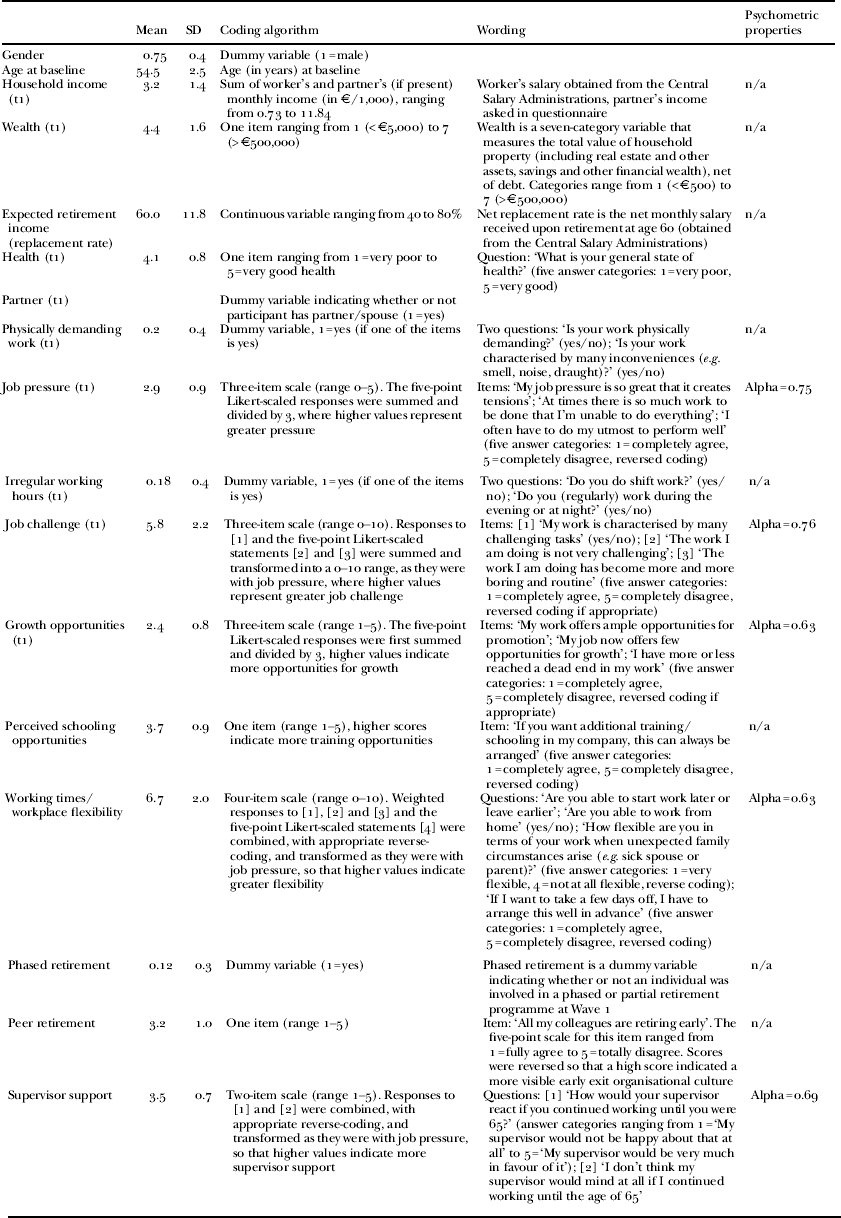
When older workers are consulted about the conditions under which they would like to continue working longer, flexible working arrangements, opportunities for part-time work and extra leave are rated high (e.g. Patrickson Reference Patrickson, Weisner and Millet2003; Phillipson Reference Phillipson2004; Van Loo, De Grip and Montziaan Reference Van Loo, De Grip and Montziaan2006). Hedge, Borman and Lammlein (Reference Hedge, Borman and Lammlein2006) noted that older employees often want to continue working, but on different terms that include more flexible work arrangements and reduced hours. In recent years, work–life balance initiatives have been developed by industrial countries around the world. Initiatives to give workers more control over their working time, such as the Netherlands' Adjustment of Hours Law and Denmark's amendments to the Act on Part-time Work, assist workers in improving their work–life balance, e.g. by allowing them to devote more time to care-giving and to pursue other interests outside work. The underlying assumption is that work–life balance arrangements help reduce stress in the workplace. This can lead to a more motivated and loyal workforce, increased productivity, reduced absenteeism and less early retirement. Relatively little research has examined the effects of such arrangements on pension decisions, and the available evidence is ambiguous. Armstrong Stassen and Ursel (Reference Armstrong Stassen and Ursel2009; in the United States of America) and Herrbach et al. (2009; in France), for example, did not find a significant association between opportunities for flexible work in terms of time and place and actual or planned retirement age. This is in contrast with Bal et al. (2011; in the Netherlands), although it should be noted that, with an average age of 42 years, their sample is significantly younger. We examine the impact of flexible work arrangements using a compound measure reflecting the degree of flexibility in work (see also Table 1). We assume the following:
• Hypothesis 3: Older workers who have more opportunities to work flexibly in terms of time and place have higher scheduled or planned retirement ages.
Many collective labour agreements in the Netherlands include phased (or partial) arrangements. The basic idea behind phased retirement is that a worker remains with his employer while gradually reducing working hours and effort. It is generally assumed that this can not only provide a more satisfying path to full retirement, but can also preserve specific human capital and thereby enhance productivity (Hutchens and Grace-Martin Reference Hutchens and Grace-Martin2006). Not much is known, however, about whether and how these arrangements affect the attitudes and behaviour of older employees. Research on the effectiveness of phased retirement arrangements as a tool for postponing retirement age is limited (Greller and Stroh Reference Greller, Stroh, Adams and Beehr2003) and not univocal. For example, a study by Ghent, Allen and Clark (Reference Ghent, Allen and Clark2001) among faculty members in 15 campuses of the University of North Carolina revealed that persons choosing the phased retirement option would have likely remained working full-time at their universities had the phased retirement option not been available. We look at whether using the option of part-time retirement in the years before a worker is eligible for full-time retirement reduces the propensity for full-time retirement. Although the expected effects of these arrangements on retirement are not systematically supported in the empirical literature, we assume the following:
• Hypothesis 4: Older workers who make use of phased retirement arrangements have higher (planned) retirement ages.
Means, standard deviations (SD), coding algorithms, wording of survey questions and psychometric properties of the independent variables (N=1,458)

Notes: t1: time 1. n/a: not applicable.
Workplace norms
In this study, we examine the impact of organisations' workplace norms and attitudes regarding retirement along two lines: older workers' perception of the organisation's customs and practices regarding retirement timing and supervisors' support for extending working life, as perceived by the older workers.
Life transitions, including retirement, are subject to social norms about appropriate timing. Age norms are woven into the fabric of many social institutions in both formal and informal ways (Settersten Reference Settersten1998). Formal age norms are codified in diverse laws and rules; norms about the ‘right time’ to retire are formally expressed in age boundaries established by public and private pension schemes. Scholars suppose that informal age norms, defined as shared judgements or expectations regarding age-appropriate behaviour, exert significant influence on the behaviour of group members (Settersten and Hagestad Reference Settersten and Hagestad1996). Like other social groups, work organisations have shared expectations about ages at which particular transitions ought to occur (Lawrence Reference Lawrence1996). Organisational or workplace norms regarding retirement will signal older employees when they should move out of the workplace (e.g. Feldman and Beehr Reference Feldman and Beehr2011; Potocnik, Tordera and Peiró Reference Potocnik, Tordera and Peiró2009; Van Dam, Van der Vorst and Van der Heijden Reference Van Dam, Van der Vorst and Van der Heijden2009). Lawrence (Reference Lawrence1996) has argued that even in the absence of explicit age norms, a person's age relative to the organisational age distribution may influence individual decisions. Age distribution constitutes an implicit timetable, and there is evidence that people use their perceptions of this timetable to assess whether their careers are on or off schedule (see also McCann and Giles Reference McCann, Giles and Nelson2003). In this article, workplace norms regarding retirement are identified by examining the retirement of older workers' peers in the organisation. We posit that organisational customs with respect to retirement timing influence the plans and expectations of individual workers.
• Hypothesis 5: Older employees who work in organisations where working beyond the eligible age for early retirement is an exception will have lower (planned) retirement ages.
Particularly relevant aspects of this normative context are the opinions and attitudes held by older workers' supervisors, who operate as links between organisational goals and the work environment. With the deinstitutionalisation of retirement, variation in workplace support for working longer may become an increasingly important aspect of older workers' opportunity structure. Although supervisors may not always have a final say in older workers' retirement, their attitudes may be influential in the decision-making process (Armstrong-Stassen Reference Armstrong-Stassen1994; Vecchio Reference Vecchio1993). Lack of managerial support can push older workers into premature and involuntary retirement (Van Solinge and Henkens Reference Van Solinge and Henkens2007). Indirectly, managers' attitudes towards older workers' employment can determine a work environment that either supports prolonged employment or channels workers into retirement.
• Hypothesis 6: Older workers who have the feeling that their direct supervisor supports postponement of retirement will have higher actual or planned retirement ages.
Method
Data
To answer the research questions this study used data from the NIDI Work and Retirement Panel. This is a multi-actor panel study, where older workers and their spouses have been followed for a period of ten years. The first wave of this longitudinal study was carried out in 2001. In three large Dutch multinational companies in the private sector (Unilever, IBM, VendexKBB), and in the public sector (Civil Service), data were collected in collaboration with the HRM (Human Resource Management) departments. The companies provided the random sample as well as financial background information (such as salary, replacement rate). The mailing was carried out by the companies, under supervision of the researchers. A random sample of employees aged 50 years and over working in the different operating companies of these multinationals (for the Civil Service: different ministries) received an envelope with the company's logo, including a questionnaire for themselves and a separate questionnaire for their married or unmarried partner, if present. The questionnaire included questions with respect to the older worker's financial, work, health and family situation, as well as their work-retirement plans. The data show a large variability with respect to different occupational settings and individual characteristics. The mail questionnaire was sent to 3,899 older workers; in total 2,403 questionnaires were completed (response rate 62%). In 2006, a follow-up survey was conducted (Wave 2), in which all surviving Wave 1 participants were re-surveyed, once again by mail questionnaire. The Wave 2 survey asked respondents about changes in employment status, including retirement and retirement plans and behaviour, since Wave 1. There was some attrition due to company takeovers (N = 116), mortality (N = 44) and untraceable participants (N = 4). A total of 2,239 questionnaires were mailed out, of which 1,678 were returned providing complete or virtually complete data (response rate 75%). In 2011, all surviving respondents have been re-interviewed, again by way of a mail questionnaire. There was some attrition due to mortality (N = 39) and untraceable participants (N = 3). A total of 1,636 questionnaires were sent to surviving Wave 2 participants; 1,276 surveys were returned, providing complete or virtually complete data (response rate 78%). The Wave 3 survey asked respondents about changes in employment status, including retirement since Wave 2. Information regarding events and behaviour between Waves 1, 2 and 3 are collected using the anchored retrospective approach (Bumpass and Raley Reference Bumpass, Raley, Hofferth and Casper2006).
For this particular study, we examined a subset of respondents who were in a career job at the time of the first interview and who participated in at least two of the three study waves undertaken in 2006 and 2011. Of the total potential sample of 1,461, we excluded respondents who did not answer any of the retirement intention (N = 3) or retirement behaviour (N = 11) questions. This resulted in an analytical sample of 1,458/1,450 individuals. Item non-response was low (on average less than 3%). Missing data were imputed using the multiple imputation option in Stata.
Age, gender as well as mortality information was available from the administrative records of each of the participating companies.Footnote 2 Sensitivity analysis revealed limited selective non-response. Neither age, nor mortality (which can be considered as a proxy for health status), predicted participation in Wave 1; there were no significant differences in non-response between the companies. Male older workers were somewhat more likely to participate in Wave 1. Wave 2 participation was not related to gender and mortality between Waves 2 and 3, but younger respondents and employees that worked for the company that experienced many takeovers between 2001 and 2006 were somewhat less likely to participate in the first follow-up. Wave 3 participation was only related to age, in the sense that older participants were somewhat less likely to participate.
Measures
In the first wave of the study older employees were asked about their retirement intentions. Participants were asked ‘At what age do you plan to stop working?’ (continuous variable). In the follow-ups participants were asked whether they had retired between survey waves. Individuals who responded affirmatively were then asked in what year and month. On the basis of this information the actual timing of retirement was determined. The time-span between turning 50 and taking mandatory or early retirement (in years) was used as the dependent measure. Participants who had not retired between Waves 1 and Wave 3, or exited from the study, were treated as right-censored. Table 1 presents means, standard deviations, coding algorithms and the wording of the survey questions for the independent variables, as well as the psychometric properties of the scales.
Statistical analysis
Linear regression models were estimated to test the links between conditions at work and retirement intentions. The hypotheses regarding actual retirement timing were tested using Cox proportional hazards regression models. In our study older workers were sampled through their employers, hence observations may not be independent. In order to control for this design effect we adjusted for clustering at the company level as well as the branch level, using a stratified multiple-stage design (Stata 2005: svy set). Without controlling for design effects, it is likely that biased standard errors would be produced. In the Cox model the stratification method was applied, which implies that for every organisation a different unspecified baseline hazard function was allowed, while the coefficients of the other covariates were assumed to be constant across the organisations (Blossfeld and Rohwer Reference Blossfeld and Rohwer1995).
Results
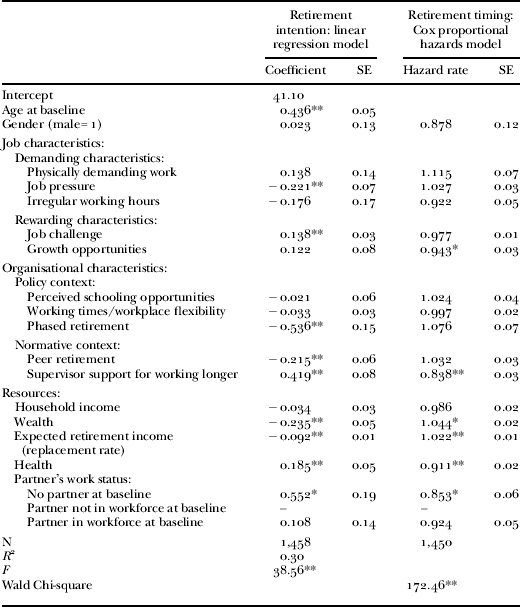
The older workers in the panel had a clear preference for taking early retirement. Average planned retirement age at baseline was 60.2 years. Only a small minority planned to remain working until mandatory retirement age (65 years); 85 per cent of workers retired between 2001 and 2011. The results of the multivariate linear regression analyses and the Cox proportional hazards regression analyses to explain retirement intentions and actual retirement timing of older workers are presented in Table 2.
Models of retirement intentions and timing, coefficients and standard errors (SE)
Notes: In all models ‘organisation’ is controlled for, either by using a cluster approach (intention models) or by stratifying by organisation and branch within organisation (actual timing models). Retirement timing: Duration between age 50 and taking mandatory or early retirement (in years). Participants who had not taken early retirement between Waves 1 and 2 were treated as right-censored.
Significance levels: * p<0.05, ** p<0.01.
Retirement intentions
Column 2 in Table 2 provides the results for the linear regression model explaining retirement intentions, i.e. planned retirement age. The central explanatory variables of interest are job characteristics, organisational policies, and workplace norms and attitudes.
With regard to work/job characteristics, we assumed that demanding job characteristics will be associated with a lower planned retirement age (hypothesis 1a), and that rewarding job characteristics will have the opposite effect (hypothesis 1b). The results of the analyses support these hypotheses to a some extent. Older workers who experience higher levels of challenge in their career jobs were less inclined to retire early. Among the demanding job characteristics in our model, only perceived job pressure showed a significant relationship with planned retirement age. As older workers experience more job pressure, they plan to retire earlier. We did not find support for our hypothesis that demanding work and irregular working hours are related to retirement intentions.
We examined two dimensions of the organisational context: organisational HR policies for older workers and the organisation's normative climate regarding retirement. We hypothesised that the organisational HR instruments considered (phased retirement, working times/workplace flexibility and training) would have a positive effect on older workers' retirement intentions in the sense that those who have access to this type of arrangement will be more inclined to retire later. Results in this respect are ambiguous though. We did find a statistically significant association with phased retirement, albeit in the opposite direction (hypothesis 4). Older workers who participated in a phased retirement arrangement at baseline (2001) had lower planned retirement ages. Our results do not provide evidence that training opportunities (hypothesis 2) and time/workplace flexibility (hypothesis 3) are associated with later planned retirement.
We examined the impact of the organisation's normative climate regarding retirement along two lines: older workers' perception of the organisation's customs and practices regarding retirement timing, and supervisors' support for extending working life. We hypothesised that workplace norms and supervisors' attitudes toward older workers and retirement have an impact on retirement plans. Our results show a strong positive association between the organisational retirement culture and retirement intentions. Older workers in organisations where early exit is commonplace are themselves much more inclined to retire early as well (hypothesis 5). In addition, and in line with our expectations, supervisor support for prolonged labour force participation is positively associated with planned retirement age. Older workers with strong perceived managerial support for them to remain in their jobs intend to retire later (hypothesis 6). Some nuancing is in order here though: only 9 per cent of older workers perceived their supervisor's attitude with regard to working longer as particularly positive, the majority experienced indifference.
Personal resources served as control variables in our analysis. Results are consistent with earlier findings and stress the importance of social (partner) and economic resources (wealth) and health with regard to retirement planning. Access to financial resources in terms of accumulated wealth and higher expected retirement income (replacement rate) are associated with lower planned retirement ages. Workers in good health are more likely to report higher intended retirement ages, whereas older workers who do not have a partner are more inclined to delay retirement than older workers with a partner. This is irrespective of partner's labour force status: retirement intentions of older workers in dual earner couples did not significantly differ from that of older workers with a non-working spouse.
Retirement timing
Column 3 in Table 2 presents the results of a Cox regression model, with timing of retirement as the dependent variable. The presented figures are hazard rates. For example, a hazard ratio of 0.943 for perceived growth opportunities indicates that, other factors kept constant, an increase of one entity on the scale for growth reduces the chances of retirement by 5.7 per cent (1–0.943). A hazard ratio of 1.044 for wealth indicates that the chances of retirement increased by 4.4 per cent for every higher wealth class.
When we compare the results for pension behaviour with the results discussed earlier for pension intention, we witness several similarities but also remarkable differences. With respect to the primary explanatory variables, we establish that many of the factors that predicted retirement intentions do not appear to have an effect on actual timing of retirement. The most striking result is the small impact of job characteristics on actual retirement behaviour (hypotheses 1a and 1b). Whereas high job pressure and limited job challenge were associated with lower planned retirement age, we do not find effects for actual retirement age. In the retirement behaviour model, the only job characteristic that was significantly related to retirement timing is growth opportunities. Older adults who – at baseline – perceived more potential for growth in their organisations turned out to retire later. None of the three examined HR instruments had an effect on retirement timing (hypotheses 2 and 3). Phased retirement, which was associated with exit intentions, does not seem to predict actual retirement timing. Organisations' normative climate clearly plays a role in explaining actual retirement timing. Lack of managerial support for remaining in the workforce is associated with earlier retirement (hypothesis 6). No significant association was found for organisations' workplace norms regarding retirement (hypothesis 5). Older workers in organisations where remaining in the workforce up to age 65 is more exceptional do not retire earlier than workers in organisations where remaining in the workforce beyond early retirement age was more common. The findings confirm the impact of economic and social resources and health on actual retirement timing. The chances of an older worker retiring in the survey period are smaller for older workers in good health and for those with a partner. Wealth has the opposite effect, indicating that it may be partly used to facilitate early retirement.
Counter-factional analyses
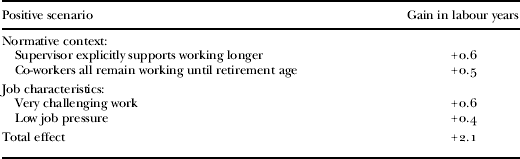
Employers are supposed to play a key role in the implementation of strategies to encourage older workers to remain in the workforce. In order to gain insight into the potential benefits of a supportive organisational climate for older workers, we carried out a simple scenario analysis that examined the effects of an organisational context supporting working longer. Table 3 sketches the estimated delay in the planned retirement age in a such a context. The planned retirement age is estimated on the basis of the regression model presented in Table 2. Model calculation shows that explicit supervisor support for continued labour force participation results in an increased planned retirement age by approximately 0.6 years. Co-workers who serve as an example have an effect too – albeit smaller. Table 3 further shows that attractive conditions at work, in terms of challenging work and a low job pressure, may produce a delay in retirement of approximately half a year. In an extreme scenario where all stimuli are maximal, we find a delay of more than two years.
Potential benefits on intended retirement age of a supportive organisational climate for older workers
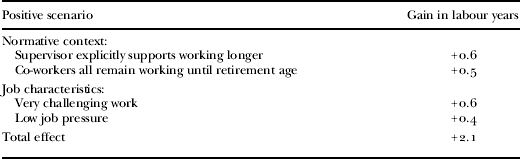
Note: Average planned retirement age in the model is 60.2 years.
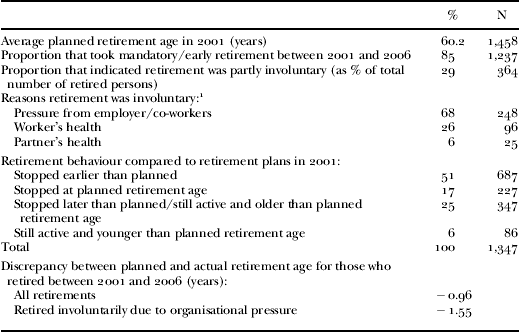
Additional analysis (Table 4) comparing older employees' retirement intentions and behaviour discloses a substantial discrepancy between stated and revealed preferences. The data suggest that there is a huge tendency to advance the moment of retirement: on average, older employees retired almost one year earlier than originally intended. This partly reflects the socio-economic climate in the Netherlands during the survey period. In the period of observation of our study, many organisations offered early retirement programmes that were designed in such a way that leaving the labour force at an early retirement age was an offer employees could not refuse. An important observation is that more than one-quarter of retired older workers indicated that their exit was not entirely voluntary. Pressure put on them by their employer and/or colleagues was the reason indicated most often.
Additional descriptive results for retirement intentions and retirement behaviour
Note: 1. More than one reason allowed, as a result totals may not count to 100.
Conclusion
Understanding the forces that encourage or discourage older workers to remain employed is of eminent importance for governments and organisations dealing with an ageing workforce. We examined work influences on both retirement intentions and actual retirement behaviour, using a ten-year follow-up study among 1,460 older employees in the Netherlands aged 50–59 at baseline. Our study suggests that older workers are very sensitive to the social approval earned from their co-workers and supervisor when they intend to work longer. A social climate that supports working up to a higher age seems to be an important requisite for reducing the attractiveness of the early retirement option. Retirement intentions – formed in the years prior to retirement – are strongly shaped by workplace norms and supervisors' attitudes in this respect. A social climate supporting the extension of working lives is, however, not self-evident. Although recent research reveals a growing awareness of the challenges of an ageing society for labour organisations, employers seem to hold a double standard toward increasing the number of older workers and postponing retirement (Conen, Henkens and Schippers Reference Conen, Henkens and Schippers2011). While agreeing that working longer may well become necessary in the future, employers still do not think it will apply to their own organisations. The fact that those older workers who live together with a partner or spouse prefer earlier retirement ages underscores the importance of social stimuli in the retirement process.
In this article we also examined whether popular age-related policy instruments, in particular phased retirement, have an impact on retirement decisions. We found that individuals who make use of phased retirement before they are eligible for full-time retirement prefer to retire earlier than individuals who do not make use of these arrangements. As such, our results provide additional evidence for the earlier findings of Ghent et al. (Reference Ghent, Allen and Clark2001), who showed that phased retirement arrangements promote rather than delay retirement. Several explanations could be explored here. One reason may be that phased retirement affects the work–leisure balance. Older workers acclimatise to a life where work is no longer in the lead. Positive experiences with leisure life may affect the retirement decision-making process, hence phased retirement may mark the start of the retirement adjustment process. The most obvious reason though may be that phased retirement arrangements are particularly popular among older workers with a preference for early retirement. In the absence of eligibility for full-time retirement, these older workers may use phased retirement to reduce their working hours.
Besides the social climate and the policy context within the organisation, our study provides further empirical evidence that unfavourable job characteristics increase the propensity to retire early, whereas favourable job characteristics have the opposite effect. Challenging work in a context that does not overload older workers' mental capacity is an important factor for workers in delaying retirement plans. Surprisingly, we did not find an association between physically demanding (heavy) work and preferences for early retirement.
The large-scale panel study on retirement reported in this article also has limitations. First, although the sample does contain substantial variation in terms of important individual-level and organisational variables, the data are not nationally representative and may not be entirely generalisable to the Dutch population as a whole. A second point that warrants attention concerns some of the measurement instruments that have been used. Several instruments are based on a limited number of items, which reduces the reliability of the scales. Further, the number of HR instruments considered was also restricted. We examined the impact of several popular HR instruments on extending working life. The relevant HRM instrumentation is however much broader, as it also includes policies on wellness, health and employability. Future studies on the organisational influence on retirement may include a wider range of organisational policy instruments, such as mobility, demotion and health prevention.
We also recommend that future studies collect additional objective information on work and organisational characteristics. The subjective appraisal by respondents about aspects like their work being ‘physically heavy’ does not necessarily run parallel with the way an ergonomist would assess a workload. To what extent more objective measures will lead to other outcomes is an interesting question for follow-up studies.
The success of policies on working longer is dependent on many factors and actors. The retirement decisions of older workers are, to a large extent, shaped by their financial position and the possibilities and uncertainties of their pension schemes. Whether people will work longer, and how much longer, will also depend on the demand side of the labour market. Employers may or may not create opportunities for career extension. Our research shows that – at least in the recent past – employers have put the brakes on older employees' ambitions to continue working. This paper shows that, in the period under study, older workers have had much less influence on the timing of their retirement than generally presumed, and that the choice space with regard to prolonged labour force participation was often very limited. The results of this paper indicate that in order to delay retirement, policy initiatives cannot be reduced to altering financial restrictions surrounding retirement, but need to address the forces at the organisational level that channel workers out of employment.