INTRODUCTION
Sorghum (Sorghum bicolour (L.) Moench) ranks fifth among the World's major cereals following wheat, maize, rice and barley (House Reference House1995; FAO 1999). This dry land summer cereal is a staple crop in arid and semi-arid areas in Ethiopia. It is also a staple food for more than 500 million people in more than 30 countries, although maize has often replaced its use. In Ethiopia, where traditional agriculture predominates, the average yield is very low, ranging between 200 and 1500 kg/ha compared to developed countries such as the USA where commercial yields were 3775–4400 kg/ha in the 1980s (House Reference House1995). According to a recent report (FAOSTAT 2005), sorghum yields in 2005 were 9800 kg/ha in the USA but only 1800 kg/ha in Ethiopia. Diseases caused by fungal pathogens (Huluka & Esele Reference Huluka, Esele, De-Millano, Frederiksen, Mughogo and Bengston1992; Davis & Bockus Reference Davis and Bockus2001) and unavailability of essential nutrients such as phosphorous and iron (Rodriguez & Fraga Reference Rodriguez and Fraga1999; Igual et al. Reference Igual, Valverde, Cervantes and Velazquez2001) are among some of the major causes of the low sorghum yield in developing countries.
Beneficial bacteria can be a significant component in the management of the soil environment so as to achieve attainable crop yield (Cook Reference Cook2002). These beneficial bacteria live in the rhizosphere, the region around the root, which is rich in nutrients due to the exudation of 0·40 of plant nutrients from the roots (Nelson Reference Nelson2004). By benefiting from the nutrients secreted by plant roots within the rhizosphere, the bacteria influence the plants in a direct or indirect way. One influence may be stimulation of plant growth (Bloemberg & Lugtenberg Reference Bloemberg and Lugtenberg2001). Bacteria inhabiting the rhizosphere and positively influencing plant growth are referred to as plant growth promoting rhizobacteria (PGPR) (Kloepper et al. Reference Kloepper, Scher, Laliberté, Tipping and Swinburne1986).
Significant yield increases have been achieved in crops such as maize, rice, potato, wheat and canola after inoculation with PGPR (Khalid et al. Reference Khalid, Arshad, Zahir and Khaliq1997; Zahir et al. Reference Zahir, Akram, Arshad and Khalid1998; Bertrand et al. Reference Bertrand, Nalin, Bally and Cleyet-Marel2001; Thakuria et al. Reference Thakuria, Talukdar, Goswami, Hazarika, Boro and Khan2004) which resulted in increased interest in PGPRs (Asghar et al. Reference Asghar, Zahir and Arshad2004; Thakuria et al. Reference Thakuria, Talukdar, Goswami, Hazarika, Boro and Khan2004). There are several hypotheses about the mechanisms by which rhizobacteria enhance growth. One direct mechanism is production of the auxin indoleacetic acid (IAA) (Patten & Glick Reference Patten and Glick1996, Reference Patten and Glick2002). Another direct mechanism may be increased availability of nutrients in the rhizosphere by means of solubilization of unavailable forms of nutrients and/or production of siderophores (Glick Reference Glick1995; Rodriguez & Fraga Reference Rodriguez and Fraga1999). Free living diazotrophic bacteria such as Azosprillum also are involved in promoting the growth of many tropical grasses, by fixing nitrogen asymbiotically and transferring it to the plant (Saubidet et al. Reference Saubidet, Fatta and Barneix2002).
Although there is a growing interest in replacing chemical fertilizers and pesticides with bacterial inoculants (Mayak et al. Reference Mayak, Tirosh and Glick2001), there have been few laboratory or field studies of the potential role of PGPRs as plant growth promoting agents in Ethiopia and South Africa. The objectives of the present study are therefore to isolate bacteria from the rhizosphere of sorghum and other grasses in Ethiopia and South Africa, evaluate them for growth promotion of sorghum under greenhouse conditions and investigate selected modes of action used by the bacteria. It is anticipated that the study will provide important information toward application of PGPRs as inoculants in agriculture.
MATERIALS AND METHODS
Soil sample collection and isolation of bacteria
Soil samples were collected from the rhizosphere of sorghum in two fields in Ethiopia, in the Meeson and Jijiga areas in the Eastern part of the country. The soils have been frequently cropped with sorghum and differ in their texture. Sorghum plants were uprooted and all the soil adhering to the roots and which represent rhizosphere soil were shaken from the roots and collected in plastic bags. The soil samples were then transported to the microbiology laboratory of the Department of Biology, Alemaya University, Ethiopia for immediate processing.
To isolate bacteria, each soil sample was mixed and one gram was transferred to 9 ml quarter strength sterile Ringer's (Merck, Halfway House, South Africa) solution and was serially diluted. Diluted suspensions were spread-plated on King's B medium (King et al. Reference King, Ward and Ranney1954) and Nutrient agar medium (Biolab, Wadeville, South Africa) in triplicate and were incubated for 24 h at 28°C. Representative colonies were randomly selected from the countable plates and re-streaked onto new plates of the same media to obtain pure colonies. A total of 142 isolates obtained in this manner were maintained on agar slants and transported to the Plant Pathology Laboratory at the Department of Microbiology and Plant Pathology, University of Pretoria, South Africa. Because many isolates were morphologically indistinguishable in culture, preliminary characterization procedures including Gregersen's KOH (Gregersen Reference Gregersen1978), cytochrome oxidase (Kovacs Reference Kovacs1956), oxidation fermentation (Hugh & Leifson Reference Hugh and Leifson1953), catalase and motility tests were conducted. Based on these preliminary characterizations, 78 isolates were chosen from the original 142 isolates. For short term use, pure cultures of these isolates were stored at −70°C in nutrient broth supplemented with 150 mg/g glycerol. Replicate stocks of the cultures were lyophilized and stored for long term use.
Samples also were collected from ten selected sites of the virgin soil from the rhizosphere of grasses in the Nylsvlei Nature Reserve in South Africa. The 4000 ha reserve lies east of the Waterberg Mountains between Nylstroom and Naboomspruit possessing a unique biodiversity of plant and animal communities. Soil samples were collected as described before from the rhizosphere of seven grass species viz. Aristida canescens subsp. canescens (perennial), Cyprus esculentus L. (perennial), Eragrostis biflora (annual), Eragrostis sp. (annual), Sporobolus fimbriatus (perennial), Stipaggrotis zeyheri subsp. zericans (perennial), Themeda triandra (perennial) of the typical bushveld savannah surrounding the grassveld flood plain. The samples were transported to the Laboratory at the Department of Microbiology and Plant Pathology, University of Pretoria, South Africa. Each sample of rhizosphere soil was sieved to remove plant debris.
To isolate bacteria from samples obtained from the rhizosphere of grasses, the soil samples were baited with sorghum seeds in the greenhouse. The soils were deposited in 500 ml plastic pots and planted with five sorghum seeds. Three weeks later, emerged sorghum seedlings were removed from the pots and their roots were gently shaken to collect the adhered soil. Serial dilution, plating and incubation conditions were conducted as described before for Ethiopian samples.
Bacteria also were isolated from the rhizoplane, i.e. those adhering to the surface of the roots by placing 1 g root in 9 ml 1 m MgSO4 solution which was shaken manually for 1 min. Ten fold serial dilutions of this solution were made after which a 0·1 ml aliquot of the serially diluted suspension from each sample was plated on the two media described before. All plates were incubated at 28±2°C for 24 h. A total of 160 bacterial colonies randomly selected were preliminary characterized as described before and 86 isolates were chosen.
Bacterial inoculum preparation
Bacterial isolates were grown in nutrient broth (Biolab) on a rotary shaker (Labotech) at 28°C for 24 h. The suspension was centrifuged in 50 ml capacity sterile plastic tubes at 5000 rpm for 10 min using an Avanti TM J-25 Beckman centrifuge. The pellets were re-suspended in quarter strength sterile Ringer's (Merck) solution and the suspension was adjusted to give a final concentration of 106–108 cfu/ml (OD550=0·5–1·5) using the viable plate count method and optical density measurement.
Evaluation of bacterial isolates for growth promotion
Prior to the greenhouse pot experiment, a preliminary screening of 78 bacterial isolates from Ethiopia and 86 isolates from South Africa was conducted for early root and shoot development in sorghum in 96 cavity styrofoam seedling trays filled with steam-pasteurized sandy loam topsoil. Sorghum seeds (Ethiopian variety, Meko) were surface sterilized with 70% ethanol (736 ml/l) for 5 min, 10 mg/g sodium hypochlorite in distilled water for 1 min and rinsed five times in sterile water. Three adjacent cavities in the tray, each planted with four seeds constituted one replicate. Therefore in each replicate, there were 12 plants in a completely randomized design. The bacterial inoculum (30 ml of the 106–108 cfu/ml suspension) was applied as a soil drench once a week for two weeks. The temperature of the greenhouse was maintained at 28°C and watering was done twice daily regularly. The plants were harvested 3 weeks after the first inoculation. Shoot and root length as well as fresh and dry weight measurements were compared with the uninoculated control (data not shown).
Based on the results from the screening experiment in the seedling tray, 20 Ethiopian and 39 South African isolates were chosen for the greenhouse pot trial. Eight surface sterilized seeds were sown in a 120×100 mm diameter pot containing steam-pasteurized topsoil. The seeds were watered regularly until the emergence of the first shoot. Five days later, 30 ml of the bacterial inoculum was applied to the pots as a soil drench and a second application was made 1 week later. The pots were watered twice daily with an automatic watering system. The experiment was arranged in a complete randomized design with three replications and was repeated twice. Plants were harvested 35 days after planting and 30 days after inoculation. Growth promoting ability of the bacterial isolates was determined based on the data collected on shoot height, shoot dry and fresh weight, root length and root dry weight, leaf width and leaf chlorophyll content as measured with a Minolta SPAD 502 chlorophyll meter (Minolta, Japan) and expressed in spad units.
Root colonization
Root colonization was assessed according to the procedure described by Han et al. (Reference Han, Coplin, Bauer and Hoitink2000). The same plants and experimental layout used in the pot trial experiment described before were used when detecting root colonization by the bacterial isolates. Briefly, 1 g root per pot in each replication were surface sterilized as described before for sorghum seeds and macerated in 3 ml 0·1 m Phosphate buffer (pH 7) using a homogenizer. The suspension was serially diluted in quarter strength Ringer's solution (Merck). Aliquots of 0·1 ml were plated on Nutrient agar amended with 50 μg rifampicin/ml. The plates were incubated at 28±2°C for 24 h. The number of colonies was recorded and root colonization expressed as cfu/g root.
Modes of action for growth promotion
Siderophore production
Siderophore production was detected by the universal chemical assay using chrome-azurol S (CAS) agar (Schwyn & Neilands Reference Schwyn and Neilands1987). Cultures of isolates that resulted in significant growth promotion in greenhouse pot experiments were grown in a modified minimal medium (under iron restricted and high iron condition) at 27±1°C for 48 h and at 180 rpm on a rotary shaker. Each culture was centrifuged at 10 000 g for 10 min and the supernatant was collected. Three wells were made equidistantly on the CAS agar plate using 5 mm cork borer after which 30 μl of the culture supernatant was deposited into the wells. Control plates received sterile broth media without bacteria under both low and high iron conditions. The plates were incubated at room temperature for 8 h after which any colour change in the medium was recorded.
IAA production
The production of IAA-like compounds was detected from the culture supernatants of the bacterial isolates selected based on their growth promoting efficiency following the procedure described by Thakuria et al. (Reference Thakuria, Talukdar, Goswami, Hazarika, Boro and Khan2004). Briefly, pure colonies from a 24 h culture were inoculated into nutrient broth with 2 mg trypthophan/g of nutrient broth solution and in the absence of trypthophan, and were incubated at 28±2°C for 48 h. Five ml culture was removed from each tube and centrifuged at 10 000 rpm for 15 min. Two millilitre aliquots of the supernatant were transferred to a fresh tube and washed with ethyl acetate to extract free IAA-like substance. The extractions were then treated with 4 ml Salkowsky reagent (1 ml 0·5 m FeCl in 50 ml HClO4) and incubated at room temperature for 25 min. The absorbance of the solution (pink colour developed) was read at 530 nm. For the control experiment, sterile nutrient broth was used. The concentration of IAA in the culture supernatants was determined using a calibration curve of pure IAA as a standard.
Phosphate solubilization
Phosphate solubilization activity of the bacterial isolates was detected by means of a plate assay using Pikovskaya (PVK) agar (Pikovskaya Reference Pikovskaya1948) which results in a formation of a clear halo. PVK medium contained per litre: glucose, 10 g; Ca3(PO4)2, 5 g; (NH4)SO4, 0·5 g; NaCl, 0·2 g; MgSO4.7H2O, 0·1 g; KCl, 0·2 g; NaCl, 0·2 g; MnSO4.H2O, 0·002 g; FeSO4.7H2O, 0·002 g; yeast extract, 0·5 g. To compare the reproducibility of the halo formation, isolates were also tested on PVK agar supplemented with 1 mg/l bromophenol blue (Gupta et al. Reference Gupta, Singal, Sankar, Chander and Kumar1994) and a modified PVK medium devoid of yeast extract, i.e. NBRIY medium (Nautiyal Reference Nautiyal1999). A pure colony from a fresh culture of each isolate was stab inoculated in duplicate into each of the three-agar media using a sterile needle. Plates were incubated for 14 days at 28°C after which the diameter of the clear halo was measured. Control plates were inoculated with sterile broth.
Identification of bacterial isolates
Identification by API test strips
Isolates were chosen and further identified to species level by means of the API identification system with the API Plus computer software (bioMèrieux). Gram-positive, endospore forming rods were identified to the species using API® 50 CH test strips. Gram-negative rod isolates with fermentative reaction in the Hugh & Leifson O/F test were identified using the API® 20 E test strip while those with oxidative reaction were identified using the API 20 NE test strip.
Identification by 16S rDNA sequencing
Identification of isolates with less than 0·80 similarity of the species on the API data base was clarified by means of PCR amplification of the bacterial 16S rDNA. DNA from Gram-positive isolates was extracted using the DNeasy Tissue Kit (Qiagen) or from Gram-negative isolates, the boiling method (Mohran et al. Reference Mohran, Arthur, Oyufo, Perusky, Wasfy, Ismael and Murphy1998). A portion of the 16S rDNA gene (corresponding to positions 8-1541 in E. coli of each bacterial isolate was amplified using forward primer pA (5′-AGAGTTTGATCCTGGCTGAG-3′) and reverse primer pH (5′-AAG GAG GTG ATC CAG CCG CA-3′) (Coenye et al. Reference Coenye, Falsen, Vancanneyt, Hoste, Govan, Kersters and Vandamme1999). PCR amplification was confirmed by size fractionation on a 10 mg/g agarose gel. Amplification products were sequenced using primer *pD (5′-CAG CAG CCG CGG TAA TAC-3′) (Inqaba Biotech, South Africa). BLAST search of NCBI data libraries was used to establish the identification of the isolates.
Statistical analysis
The experiments were designed as completely randomized. One way analysis of variance (ANOVA) was applied to the data to test for differences between isolate effects using the statistical program Genstat® (Genstat Committee Reference Payne2005). The data were mostly normally distributed but with heterogeneous treatment variances. Therefore significance was assessed at P⩽0·10. Fresh and dry shoot weight was square root transformed to stabilize isolate variances. Data on root colonization of the bacterial isolates were log transformed before subjecting to ANOVA. Based on the results of fresh and dry weight of shoots, the best set of isolates were grouped according to the Multiple t-distribution test procedure of Gupta & Panchapakesan (Reference Gupta and Panchapakesan1979) at the P⩽0·99. Pearson's linear correlation coefficient was used to evaluate the relationship between phosphate solubilization and root/shoot dry weight as well as the relationship between IAA concentration and root/shoot length.
RESULTS
Greenhouse pot trial
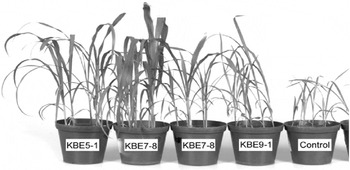
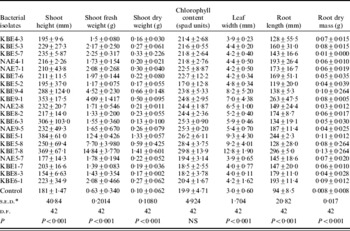
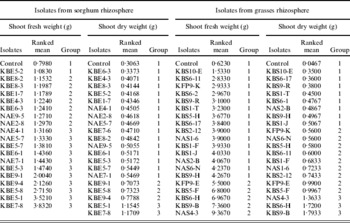
Three isolates from the rhizosphere of sorghum in Ethiopia resulted in a significant increase in at least two growth parameters. Two isolates (KBE5-1 and KBE7-8) resulted in a significant increase in at least five parameters (Table 1). Isolate KBE5-1 displayed increases in all parameters tested except chlorophyll content and root length. KBE7-8, on the other hand resulted in a significant increase in all seven parameters (Table 1; Fig. 1), the highest increases being in shoot and root biomass. According to the grouping of isolates using the multiple t-test distribution, 11 isolates resulted in an increase in shoot fresh weight. The highest increase was achieved by isolates KBE5-1 and KBE7-8 which increased shoot fresh weight by 2·7 and 3 g respectively over the uninoculated control (0·63 g). Compared with other less effective isolates, the two isolates increased shoot fresh weight between 2·5 and 2·75 g. Similarly only KBE5-1 and KBE7-8 were grouped together as the best isolates in terms of increase in shoot dry weight (Table 5). The increase due to inoculation with KBE7-8 ranged from 0·4 to 0·86 g compared to other isolates and the uninoculated control (0·306 g). KBE5-1 similarly resulted in shoot dry weight increase of between 0·37 and 0·85 g (Table 5).
Shoot growth enhancement in five weeks old sorghum plants by rhizobacterial isolates from Ethiopia. Plants in the control treatment showed retarded growth in comparison with plants treated with bacterial isolates Bacillus cereus strains KBE5-1, KBE7-8 and KBE9-1.

Inoculation of bacterial isolates from Ethiopia and their effect on shoot height, shoot fresh and dry weight, chlorophyll content, leaf width, root length and root dry weight of sorghum under greenhouse conditions. Values are means±s.d.

* s.e.d. is the standard error of difference.
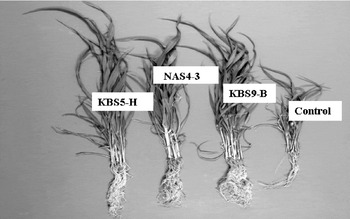
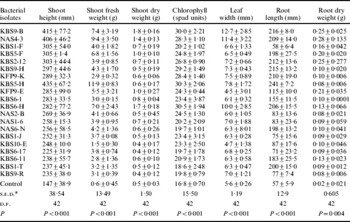
Among isolates obtained from the rhizosphere of grasses in South Africa, KBS9-B and NAS4-3 resulted in significant increases in all seven parameters measured (Table 2; Fig. 2). Another isolate (KBS5-H) also rendered significant increases in shoot and root length (Table 2; Fig. 2). This isolate increased shoot and root length significantly but it had less effect on shoot and root dry weights than isolates KBS9-B and NAS4-3. Other isolates which stimulated growth in sorghum were isolates KBS6-H, KBS5-F, KBS2-12 and KFP9-E all of which resulted in significant increases in five parameters. The remaining isolates resulted in significant increases in at least three parameters except for isolates KBS1-T and KBS10-E which resulted in increases in two parameters. Most of the isolates which resulted in significant growth promotion mainly affected plant biomass (fresh and dry weights of shoots and roots), root length and chlorophyll content. Compared to the control, these isolates had no effect on shoot length and leaf width.
Shoot and root growth enhancement in five weeks old sorghum plants by B. cereus KBS5-H and NAS4-3 and Stenotrophomonas maltophilia KBS9-B isolated from the rhizosphere of grasses at Nylsvlei Nature Reserve in South Africa in comparison with the un-inoculated control.

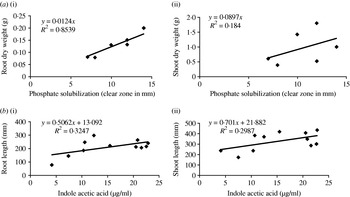
(a) Relationship between phosphate solubilization and shoot/root dry weight: (i) r is significant (P=0·0005) for root dry weight and P-solubilization. (ii) r is not significant (P=0·05) for shoot dry weight and P-solubilization. (b) Relationship between Indole-3-acetic acid concentration and root/shoot length: (i) r is significant (P=0·05) for root length and IAA concentration. (ii) r is significant (P=0·05) for shoot growth and IAA concentration.

Inoculation of bacterial isolates from South Africa and their effect on shoot height, shoot fresh and dry weight, chlorophyll content, leaf width, root length and root dry weight of sorghum under greenhouse conditions. Values are means±s.d.

* s.e.d. is the standard error of difference.
Five isolates viz. KFP9-E, KBS5-F, KBS6-H, KBS9-B and NAS4-3 have been grouped as the best performing isolates in terms of increase in fresh and dry weight of the shoots, the highest being by KBS9-B and NAS4-3 (Table 5). The increase in shoot fresh weight ranged from 5 to 9 g for NAS4-3 and from 3 to 6·7 g for KBS9-B compared to other isolates and the control (0·623 g) (Table 5). These two isolates and another isolate KBS6-H also resulted in the highest increase in shoot dry weight. The highest increase in this case was obtained with KBS9-B ranging from 0·8 to 1·75 g. The shoot dry weight of the control was 0·0467 g. Isolates which were antagonistic to growth in the preliminary screening of this experiment (data not shown) were not used in the subsequent experiments.
Root colonization
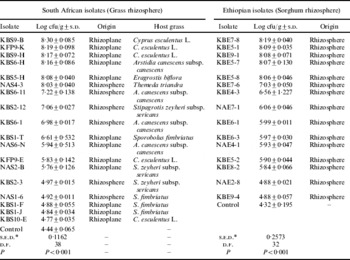
All the initially applied bacterial isolates grew on the rifampicin augmented medium and were different from the control plates both morphologically and quantitatively. Only very few colonies which probably escaped the steam pasteurization process were retrieved on the control plates. Both Ethiopian and South African isolates, which resulted in significant growth promotion in sorghum, were able to colonize roots successfully. Six isolates from the rhizosphere of grasses in South Africa and five isolates from sorghum rhizosphere in Ethiopia colonized sorghum roots with a concentration of ⩾105 cfu/g root. The count of bacterial colonies similar to the inoculated ones for each of the isolates KBS9-B, KFP9-K, KBS9-H, KBS6-H, KBS5-H and NAS4-3 was 108 cfu/g compared to the uninoculated control which had only ⩽104 cfu/g (Table 3). Similarly Ethiopian isolates KBE7-8, KBE5-1, KBE9-1, KBE5-7 and KBE5-8 were detected at levels ⩾108 cfu/g root. Most of the other isolates were however detected at a lower level than the initial inoculum level of 108–109 cfu/g and the decrease from the initial inoculum level ranged between 101 and 104 cfu/g.
Origin of rhizobacterial isolates from Ethiopia and South Africa and their ability to colonize sorghum roots under greenhouse conditions. Values are means±s.d.

* s.e.d. is the standard error of difference.
Modes of action for growth promotion
Siderophore production
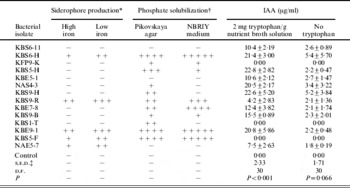
Five bacterial isolates, two from sorghum rhizosphere and three from the rhizosphere of grasses, were able to produce siderophores on CAS agar plates (Table 4). This was confirmed by a change in the colour of the CAS agar plates from blue to orange/yellow as a result of the siderophores sequestering and binding iron from the medium. Only one of the two isolates from the rhizosphere of sorghum in Ethiopia that produced siderophores in culture (KBE9-1) enhanced growth as measured by a significant increase in root length and root dry weight. On the other hand, of all the isolates from the rhizosphere of grasses obtained within South Africa, only isolates KBS6-H, KBS5-F, KBS9-R and KBS6-17 tested positive for the production of siderophores on CAS agar plates (Table 4). Isolates KBS9-R and KBS6-17 did not however result in any significant increase in the growth of sorghum according to the parameters measured in this study (Tables 1 and 2).
Measurements of siderophore production, phosphate solubilization and IAA production by selected bacterial isolates from the sorghum and grasses rhizosphere. Values are means±s.d.

* Siderophore production was compared among the bacterial isolates by measuring the diameter of yellow/orange halo produced on CAS agar plates: +=halo diameter ⩽3 mm, ++=3–5 mm, +++=>5 mm.
† Diameter of clear zone formed around the bacterial colony as a result of solubilization of tri-calcium phosphate on Pikovskaya and NBRIY agar medium: +=⩽3 mm clear zone, ++=3–5 mm clear zone, +++=5–8 mm clear zone, ++++=8–10 mm clear zone, +++++=>10 mm clear zone.
‡ s.e.d. is the standard error of difference.
IAA production
Of the 15 isolates tested for the production of the hormone IAA, 11 (a proportion of 0·73) were capable of producing the hormone in liquid culture with concentrations ranging between 4·2 and 22·8 μg/ml in the presence of 2 mg tryptophan/g of nutrient broth solution (Table 4). This concentration however decreased significantly in the absence of tryptophan ranging between 1·82 and 5·43 μg/ml IAA. The highest amount of IAA was produced by isolate KBS5-H (22·8 μg/ml) followed by isolates KBS9-H (22·6 μg/ml), KBS6-H (21·4 μg/ml), KBE9-1 (20·8 μg/ml) and NAS4-3 (20·5 μg/ml) in the presence of tryptophan. In the absence of tryptophan the amount produced by these isolates decreased to 2·24, 5·21, 5·43, 2·17, 3·4 μg/ml respectively. Isolates KBS5-F, KFP9-K and KBS1-T all of which affected some aspect of sorghum growth under greenhouse condition (Table 2) were unable to produce IAA in culture (Table 4).
Phosphate solubilization
Thirteen isolates (a proportion of 0·86) were able to solubilize tri-calcium phosphate on PVK agar medium. Nine of these isolates also were capable of solubilizing phosphate on NBRIY medium. Isolates KBS5-F, KBE9-1 and KBS6-H resulted in the greatest level of phosphate solubilization, resulting in 10 mm diameter clear zone followed by isolate KBS5-H that gave a clear zone of 7 mm in diameter (Table 4). Eight other isolates showed some ability to solubilize phosphate on PVK medium resulting in a clear zone ranging between 0·5 and 5 mm in diameter. The same isolates, which effectively solubilized phosphate on PVK medium, displayed improved phosphate solubilization ability on NBRIY medium with clear zone diameters of 12 mm (KBS6-H, KBS9-1) and 14·5 mm (KBS5-F). Similarly isolates KBS9-R and KBE7-8, both of which tested positive for phosphate solubilization on PVK medium (clear zone of 5 mm in diameter each) solubilized phosphate better on NBRIY medium (clear zone of 8·5 mm and 10 mm diameter, respectively) (Table 4).
Identification of bacterial isolates
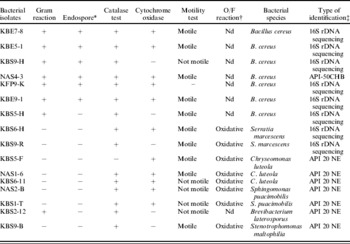
The three isolates obtained from the sorghum rhizosphere in Ethiopia and which resulted in significant growth promotion in sorghum in the present study have been identified as Bacillus cereus. The proportions of species identified as effective isolates from the rhizosphere of grasses and rhizoplane of roots (South African isolates) were 0·30 B. cereus, 0·23 Chryseomonas luteola, 0·15 each of Serratia marcescence and Sphingomonas paucimobilis and 0·08 each of Stenotrophomonas maltophilia and Brevibacterium laterosporus (Table 6).
LS means for shoot fresh weight and dry weight and grouping of isolates according to the multiple t-distribution test Note: Groups 1, 2 and 3 were formed by applying the multiple t-distribution tests of Gupta & Panchapakesan (Reference Gupta and Panchapakesan1979) at P⩽0·01

Identification of the most effective South African and Ethiopian rhizobacterial isolates based on the API system and 16S rDNA sequencing

* +, endospore present; −, endospore absent.
† Nd=oxidation fermentation test not conducted.
‡ Sequencing of the bacterial 16S rDNA was performed for those isolates identified by the API system with less than 0·08 identity with the isolates on the database.
DISCUSSION
The role of plant growth promoting bacteria in increasing the growth and yield of various crops such as wheat (Khalid et al. Reference Khalid, Arshad and Zahir2004), rice (Thakuria et al. Reference Thakuria, Talukdar, Goswami, Hazarika, Boro and Khan2004), maize (Berge et al. Reference Berge, Heulin and Balandreau1991) and many others has been reported in the past. Pacovsky (Reference Pacovsky1990) reported the effect of inoculation of Azosprillum sp. on sorghum growth, indicating that the presence of Azosprillum in the endorhizosphere of sorghum had a positive impact on host growth. Later, Rashad et al. (Reference Rashad, Ragab, Salem, Horst, Schenk, Burkert, Claassen, Flessa, Frommer, Goldbach, Olfs, Romheld, Sattelmacher, Schmidhalter, Schubert, Wiren and Wittenmayer2002) investigated the growth promoting effects of Rhizobium and Bradyrhizobium inoculation in sorghum. However, other reports on the occurrence of PGPRs in the sorghum rhizosphere, and their effect on the growth of this crop are scarce.
Three isolates obtained from the rhizosphere of sorghum and 16 isolates from the rhizosphere of grasses resulted in significant growth increase in sorghum under greenhouse conditions as measured by the parameters in this study. Isolates KBE7-8, KBE5-1 and KBE9-1 from sorghum rhizosphere and isolates NAS4-3, KBS5-H, KBS9-H and KFP9-K from the rhizosphere and rhizoplane of grasses, all of which resulted in significant growth increase in one or more parameters were identified as B. cereus. The results obtained in the current study concur with several other studies which elucidated the growth promoting activity of isolates of B. cereus. Chen et al. (Reference Chen, Mei, Lu, Liu, Kloepper, Gupta and Utkhede1994) reported that inoculation with B. cereus increased grain yield in rapeseed. In a similar study, Xia et al. (Reference Xia, Ding, Li and Mei1990) reported that B. cereus strain 83-10 promoted growth and increased grain yield of rapeseed in a repeated field trial. In the current study, the B. cereus isolates significantly promoted early growth of sorghum. The results indicate that the mechanisms involved in the enhancement of growth in sorghum in the current study include the production of the auxin IAA, siderophores and the ability to solubilize phosphate (Kloepper et al. Reference Kloepper, Lifshitz and Zablotowicz1989).
All seven strains of B. cereus were efficient in colonizing sorghum roots and significantly increased root length. The stimulation of root growth may be attributed to the production of IAA in culture at a concentration ranging between 4·2 and 22·8 μg/ml in the presence of 2 mg tryptophan/g of nutrient broth solution. Patten & Glick (Reference Patten and Glick2002) reported the production of IAA by wild type Pseudomonas putida from as little as 0·5 μg/ml in the absence of tryptophan to as much as 32·7 μg/ml in the presence of 500 μg/ml tryptophan which resulted in the development of the host plant root system.
Many root-associated bacteria have been reported to produce IAA in culture media (Patten & Glick Reference Patten and Glick1996, Reference Patten and Glick2002). In the present study, we have observed a positive linear relationship with significant r value (r=0·57, P<0·05) between the in vitro IAA production and increase in root length. Asghar et al. (Reference Asghar, Zahir, Arshad and Khaliq2002) and Khalid et al. (Reference Khalid, Arshad and Zahir2004) have previously reported a positive correlation between in vitro auxin production and increased growth following application of PGPR. The ability to produce IAA by the most effective isolates in our study might have contributed to the successful root colonization by these isolates (Suzuki et al. Reference Suzuki, He and Oyaizu2003) and resulted in significant increase in root growth. In addition to IAA production, the solubilization of phosphate in the rhizosphere is the most common mode of action which may increase nutrient availability to host plants (Vessey Reference Vessey2003). Clear zone formation on Pikovskaya (PVK) medium has been effected by B. cereus strains KBE7-8, KBE9-1, KBS9-H and KBS5-H all of which increased growth in sorghum in the current study.
In the current study, the majority of the bacteria isolated from the rhizosphere of sorghum were Bacillus spp., whereas the rhizosphere of grasses from the Nylsvlei Nature Reserve also was colonized by Gram-negative isolates such as Serratia marcesence, C. luteola, S. maltophilia and S. paucimobilis. Sorghum is an annual crop, while the majority of grasses tested were perennials. Furthermore, the continuous rhizodeposition of carbon from plant roots results in complex chemical and biological interactions in the soil resulting in microbial diversity (Singh et al. Reference Singh, Munro, Potts and Millard2007). Thus, more growth promoting bacteria were isolated from the grassland soils than from sorghum fields in the current study.
The Gram-negative isolates exhibited one or more of the properties that are associated with growth promotion. S. maltophilia, Serratia marcescens and C. luteola have been reported as members of the naturally occurring rhizosphere community (Lottman et al. Reference Lottman, Heuer, Smalla and Berg1999; Donnate-Correa et al. Reference Donnate-Correa, Leon-Barrios and Perez-Galdona2004) and show plant growth promotion properties and biocontrol activities against plant pathogens (Weller Reference Weller1998; Whipps Reference Whipps2001). However as several members of these genera exist as potential human pathogens in the rhizosphere of diverse plants (Berge et al. Reference Berge, Eberl and Hartman2005), the necessary toxicological tests would need to be conducted before developing these strains for commercial applications.
Gram-negative isolates that resulted in significant increase in growth of sorghum in this study also showed the ability to solubilize phosphate on PVK medium by producing clear zones ranging from 3 to 10 mm in diameter. Clear zone formation was greater when C. luteola KBS5-F and S. marcescence KBS6-H were inoculated on a modified PVK medium. These results are in agreement with the findings of Nautiyal (Reference Nautiyal1999), who demonstrated that by omitting yeast extract from PVK medium, higher phosphate solubilization was achieved by Pseudomonas sp. For some isolates such as S. maltophilia KBS9-B, phosphate solubilization was similar with and without yeast extract. For other isolates like B. cereus KBS5-H and S. paucimobilis KBS1-T, the extent of solubilization (observed from the clear zone formation) decreased or was not observed when yeast extract was removed from the medium. The main effect of phosphate solubilization on plant growth is an increase in biomass and P content (Bashan & de-Bashan Reference Bashan, de-Bashan and Hillel2004) and in this study a positive linear correlation was obtained between phosphate solubilization and root dry weight (r=0·92, P<0·005) with the most effective bacterial isolates.
S. marcescens strain KBS6-H resulted in growth promotion of sorghum by increasing shoot fresh and dry weights, chlorophyll content as well as root length. Strains of Serratia spp. have previously been reported by other researchers (Zhang et al. Reference Zhang, Dashti, Hynes and Smith1996; Dashti et al. Reference Dashti, Zhang, Hynes and Smith1997; Ryu et al. Reference Ryu, Hu, Locy and Kloepper2005) to promote growth in different crops by a variety of modes of action under controlled conditions. In the current study, S. marcescens (KBS6-H) colonized the roots at a higher level (108 cfu/g) than the control and other non effective isolates and tested positive for the production of siderophores, IAA and phosphate solubilization. Interestingly, the other S. marcescens strain (KBS9-R) did not stimulate plant growth although it produced siderophores, IAA and solubilized phosphate. This probably indicates that the ability to manifest these modes of actions by a given bacterium may not necessarily mean that the bacterium is a PGPR (Vessey Reference Vessey2003). Cattelan et al. (Reference Cattelan, Hartel and Fuhrmann1999), for instance, found that out of five rhizosphere isolates which tested positive for P solubilization, only two had a positive effect on soybean seedling growth. In a separate study we conducted, S. marcescens (KBS9-R) proved to be very effective in the suppression of Pythium ultimum (Idris et al. Reference Idris, Labuschagne and Korsten2008) and Fusarium oxysporum (unpublished data) associated with soil-borne diseases of sorghum.
Although previous reports on S. maltophilia focussed mainly on their biocontrol activity (Kobayashi et al. Reference Kobayashi, Guglielmoni and Clarke1995, Reference Kobayashi, Reedy, Bick and Oudemans2002; Zhang et al. Reference Zhang, Yuen, Sarath and Penheiter2000), in this study, we isolated one strain (S. maltophilia strain KBS9-B) which resulted in a significant increase in all the seven parameters tested to evaluate growth promotion in sorghum. This strain showed a high root colonization ability (108 cfu/g), phosphate solubilization and production of IAA. Sturz et al. (Reference Sturz, Matheson, Arsenault, Kimpniski and Christie2001) recovered plant growth promoting strains of S. maltophilia from the root zones of quack grass (Agropyron repens (L.) Beauv) which significantly increased the biomass of shoots and roots in in vitro bacterization studies. Our result also concurs with that of Donnate-Correa et al. (Reference Donnate-Correa, Leon-Barrios and Perez-Galdona2004) who previously isolated IAA producing strains of S. maltophilia and C. luteola from the rhizosphere of the perennial legume tagasate. C. luteola KBS5-F did not however produce IAA in this study. Their growth promoting ability in the current study may therefore be associated with production of siderophores and solubilization of phosphate (Glick Reference Glick1995; Rodriguez & Fraga Reference Rodriguez and Fraga1999).
Enhanced iron nutrition resulting in increased plant growth can also be achieved due to the ability of some plants to bind and release iron from bacterial iron-siderophore complexes and utilizing the iron for growth (Bashan & de-Bashan Reference Bashan, de-Bashan and Hillel2004). Of the isolates that resulted in significant growth promotion in the current study, S. marcescens KBS6-H, C. luteola KBS5-F and B. cereus KBE9-1 produced siderophores with characteristic yellow halo formation on CAS agar plates. The results suggest that the bacterial isolates might have increased sorghum growth by the action of siderophores which is known to sequester iron from the soil and provide it to the plant (Katiyar & Goel Reference Katiyar and Goel2004).
The main conclusions from the current study are that rhizobacteria isolated from the rhizosphere and rhizoplane of grasses in South Africa and from the rhizosphere of sorghum in Ethiopia have the ability to enhance growth of sorghum under greenhouse conditions. It is also concluded that perennial grasses harbour more growth promoting bacteria in their rhizosphere than sorghum occurring in commercial fields. The present study also provides information on the application of rhizobacteria as inoculants in agriculture in Ethiopia and South Africa. However, in order to develop the best performing PGPR strains for commercial applications, further selection and screening in field trials is being conducted. Additional studies on modes of action need to be conducted to elucidate the role of the bacterial isolates in increasing phosphorous and iron uptake by the plants.