The composition in macro- and micro-nutrients of goats’ milk depends on the main production factors constituting the farming system: genotype, reproduction and sanitary characteristics of animals, agro-climatic conditions and socio-economical environment and farming methods such as feeding (Addis et al. Reference Addis, Cabiddu, Pinna, Decandia, Piredda, Pirisi and Molle2005a; Morand-Fehr, Reference Morand-Fehr2005).
Cheese quality strongly depends on the composition and quality of milk. Many authors have pointed out the important influence of the diet of cows or goats on the quality of milk and cheeses produced. Thus, Galina et al. (Reference Galina, Osnaya, Cuchillo and Haenlein2007) have deduced that the cheese from grazing cows and goats was better in quality parameters for human nutrition than that produced from milk of indoor fed animals. Amenu et al. (Reference Amenu, Cowan, Deeth and Moss2006) found that cow's diet based on maize/barley silage and Lucerne hay reached higher milk yields and milk with higher protein than rain grown tropical grass pasture and oat diets. Cheese fat and cholesterol contents for grazing goats were lower than those contents obtained for indoor fed goats (Lucas et al. Reference Lucas, Coulon, Agabriel, Chilliard and Rock2008).
The concentrations of macro-minerals and trace elements in milk may not fluctuate much, but they vary depending on the breed, diet, individual animal, stage of lactation, and status of udder health (Park & Chukwu, Reference Park and Chukwu1989). Substantial changes in contents of the major minerals in goat milk were found during the first 7 weeks of lactation by Maraval & Vignon (Reference Maraval and Vignon1982).
There are numerous studies that relate the type of diet fed to dairy goats with different macro and micronutrients in milk and cheese but there is very little information concerning the mineral composition. Studies on the influence of the ruminants’ feeding programme on the chemical composition and sensorial characteristics of a cheese are particularly important when the product has been designated a Protected Designation of Origin (PDO). This is because the feeding plan is one of the bases of the PDO which is connected to the land where cheeses are produced (Coulon et al. Reference Coulon, Delacroix-Buchet, Martin and Pirisi2005).
On the other hand the cheese-making process can also modify milk composition in a more or less important way depending on the manufacturing parameters such as rennet, and thereby influence cheese composition.
Rennet pastes produced by macerating the stomachs of suckling ruminants have been used in the elaboration of traditional Spanish cheeses (Bustamante et al. Reference Bustamante, Chávarri, Santisteban, Ceballos, Hernández, Miguélez, Aranburu, Barrón, Virto and De Renobales2000; Irigoyen et al. Reference Irigoyen, Izco, Ibáñez and Torre2002). For generations, cheese-makers of traditional cheeses have used kid rennet paste preparations for curdling goats’ milk, which seems to be an essential element in the development of the unique taste and texture of traditional cheeses (Fresno et al. Reference Fresno, Pino, Álvarez, Darmanin, Fernández and Guillén2005).
Nevertheless, cheese-makers find some difficulties when using it: the complexity and variability of composition, depending on source (animal age) and extraction mode, in addition to poor microbiological quality are the main disadvantages associated with rennet pastes produced in this traditional style. In addition, difficulty in the standardisation of both milk-clotting and lipase activities could be a limitation in their use (Harboe, Reference Harboe1994). In reponse to these difficulties, some manufacturers of Palmero cheese have gradually introduced commercial calf rennets, mainly those that have a mix of pepsin and chymosin.
Chemometric classification studies of analytical parameters are commonly used to determine the geographic origin or quality brand of food products. Application of discriminant analysis to isotopic and molecular biomarkers made possible the authentication of milk according to production zone and type of feeding of cow (Engel et al. Reference Engel, Ferlay, Cornu, Chilliard, Agabriel, Bielicki and Martin2007). Besides, visible NIR spectra coupled with the factorial discriminant analysis (FDA) is a powerful tool to identify sheep milk from different genotypes and feeding systems (Mouazen et al. Reference Mouazen, Dridi, Rouissi, De Baerdemaekerl and Ramon2007). The FDA provided better discrimination of differences attributed to feeding compared with those attributed to genotypes. Besides, we found that the factor and linear discriminant analysis applied to the mineral and trace element contents in cheeses make it possible to distinguish fresh and semi-hard cheeses (Herrera García et al. Reference Herrera García, Peláez Puerto, Fresno Baquero, Rodríguez Rodríguez, Darias Martín and Díaz Romero2006). Additionally, in this paper a moderate classification of fresh and semi-hard cheeses was obtained according to the season of production and the fibre in feeding of cattle (Herrera García et al. Reference Herrera García, Peláez Puerto, Fresno Baquero, Rodríguez Rodríguez, Darias Martín and Díaz Romero2006).
This study is part of a project aimed at demonstrating the effects of the traditional practices (diets based on local products and the use of natural kids rennet) on cheese quality. Therefore, we aimed to investigate the influence of the goats’ diet and the type of rennet used on the chemical composition (major components, minerals and trace elements) of goats’ milk, and in fresh, semi-hard and hard cheeses produced from this milk. This information is useful to establish better conditions for production of quality cheeses with PDO. Factor and linear discriminant analysis were additionally applied in order to classify the milk samples according to the type of dairy product, goats’ diet and rennet used.
Material and Methods
Experimental design
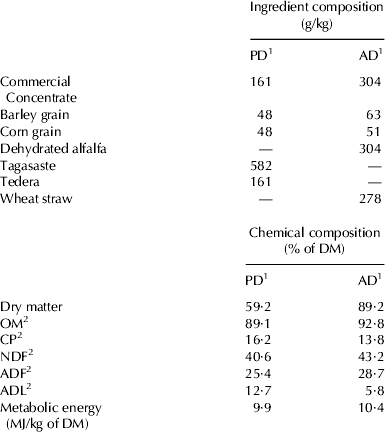
Forty multiparous Palmero goats were divided into two randomized groups based on their lactation number, milk production and kidding number. These animals had kidded in the traditional season (December), and the trial began in March (mid-lactation period). Experimental period lasted five weeks and the milk samples were obtained in the last week. One group (PD, Palmero diet) was fed on a diet using “tedera” (Bituminaria bituminosa) and “tagasaste” (Chamaecytisus proliferus var. palmensis), and the other group (AD, actual diet) received wheat straw as the main fibre source. The two diets were supplemented with a commercial concentrate for lactating goats and a mixture of corn and barley grain; the AD diet was also complemented with dehydrated alfalfa. The amount of concentrates given was determined for the whole experiment, so as to fulfil the same maintenance and milk production requirements according to INRA (1990) recommendations. These quantities remained unchanged throughout the experiment, although they differed between one group and the other. The concentrates made up 35% (group PD) and 65% (group AD) of the total dry matter in diet. The characteristics of the different feeds are shown in Table 1. The quantities of each diet provided were calculated and controlled during the experimental period, to ensure an identical supply of energy and protein.
Characteristics of the used diets

1 Diet: PD=Palmero diet and AD=Concentrate diet
2 DM=Dry matter; OM=Organic matter; CP=Crude protein; NDF=Neutral detergent fibre; ADF=Acid detergent fibre; ADL=Acid detergent lignin
Cheese samples
Eighty seven cheeses were made according to the specifications of the Palmero Cheese Denomination of Origin Regulatory Board. Milk was not pasteurised and no starter culture was added. The milk produced each day by the two experimental groups was used to make cheese for 6 consecutive days during the experimental period. Four vats were filled with 25 kg milk every day, two with PD milk, and the other two with AD milk. Therefore, a total of 24 cheese-making trials were completed in the semi-traditional factory located in the Animal Production Unit (ICIA, Tenerife). From each vat, half the milk was clotted using commercial animal rennet (commercial rennin powder, Marshall® rennet power 50% chymosin and 50% pepsin) and the other half, using artisan rennet. Several units (3–4 chesses) were made for each type of cheese. The cheeses obtained were stored in a ripening chamber at 10–12°C and 85 to 86% relative humidity, during 2, 15 and 60 d to obtain fresh, semi-hard and hard cheeses, respectively. After ripening, the cheeses were sent to the laboratory in refrigerated boxes and immediately analysed by basic chemical analysis. Cheese samples were vacuum packed and stored at –20°C for mineral and trace element analysis. Immediately before analysis, they were defrosted and stored overnight at 20°C.
Commercial rennet was prepared according to the instructions of the manufacturer and the artisan rennet was obtained from the stomachs of Palmera kid goats slaughtered during the first week of life, which were cleaned, salted, dried, ground and dissolved in water (Fresno et al. Reference Fresno, Álvarez, Rodríguez, Castro and Argüello2006). Both rennet solutions were prepared to have the same rennet strength (Calvo & Fontecha, Reference Calvo and Fontecha2004), and added to the vats in order to complete the clotting in 30–35 min at 30±1°C.
Physicochemical analysis
Three replicates of each cheese sample were analysed with a near infrared spectroscopy (Instalab 600, Foss Electric, Slangerupgad, Denmark), previously calibrated for: total solids by IDF Standard 4A (1982), fat by IDF Standard 52 (1991) and total nitrogen by IDF Standard 220B (1993). The pH value was determined at room temperature (20°C) using a pH-meter inoLab pH Level 1.
Determination of minerals and trace elements
Methods for the determination of minerals and trace elements were similar to those described in a previous paper (Rodríguez Rodríguez et al. Reference Rodríguez Rodríguez, Sanz Alaejos and Díaz Romero2002). Phosphorous was measured by a colorimetric method using Vanadate-Molybdate reagent (BOE, 1995). Powdered skimmed milk (BCR-063R) was routinely analyzed as a reference material in order to perform quality control of the measurements. Acceptable mean recoveries (10 replicates) were obtained for all the minerals and trace elements: P, 97·8±4·4%; Na, 97·3±3·6%; K, 89·6±2·9; Ca, 85·7±2·9%; Mg, 89·8±3·5%; Fe, 98·5±5·1%; Cu, 100·4±5·2%; Zn, 95·2±6·5%; and Se, 99·5±4·9%. The inter-day precision was always lower than 7·0%, ranging between 3·2% and 6·8% for K and Zn respectively.
Statistical analysis
Statistical analyses were performed by means of the SPSS (V14) software for Windows (SPSS Inc. Chicago, IL). The Kolmogorov-Smirnov test was applied to verify whether the distribution of the variables was normal (P<0·05). When the statistical distribution was not normal, the variables were transformed by applying neperian logarithms to convert them into normal distributions. The Levene test was applied to verify the homogeneity of the variances. Mean values obtained for the variables studied in the different groups were compared by One-Way ANOVA (Duncan's multiple range) assuming there were significant differences among them when the statistical comparison gave P<0·05. The effect of diet, rennet and interaction between them (diet x rennet) were analyzed by two way ANOVA considering the three types of cheeses independently. Discriminant analysis (DA), stepwise or previous introduction of all independent variables, is based on the extraction of linear discriminant functions of the independent variables by means of a qualitative dependent variable and several quantitative independent variables.
Results and Discussion
Physicochemical characterisation
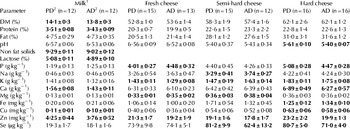
Table 2 contains the mean values for the analytical parameters analyzed in milk and cheeses expressed in respect of wet weight for the two diets studied: PD, diet rich in long fibre with local forage, and AD, diet poor in long fibre with a high concentrate rate. As regards to the major components of the milk, all parameters fell within the range of values expected for this type of milk.
Mean±standard deviation and minimum and maximum values of the mineral and trace element concentrations (wet weight) analysed in the goats’ dairy products grouped according to diet1

Bold letter indicated that pairs of figures (PD & AD diets) relating to each product (milk or different cheeses) were significantly different (P<0·05)
1* Results for milk are per 100 ml or per litre
2 Diet: PD=Palmero diet; AD=Actual diet
Milk yields (data not shown) and concentrations (expressed in wet weight) of the basic chemical components, except the percentage of fat, were significantly higher in milk from goats fed with PD diet. The results of this experience, in agreement with Buchin et al. Reference Buchin, Martin, Dupont, Bornard and Achilleos1999 and Pirisi et al. Reference Pirisi, Piredda, Scintu and Fois2001, showed no significant differences in the fat content of the milk. However, other authors (Bugaud et al. Reference Bugaud, Buchin, Coulon, Hauwuy and Dupont2001; Álvarez et al. Reference Álvarez, Fresno, Darmanin, Briggs, Castro and Méndez2007) have observed changes in fat content when the different diets were compared. This could be explained from a greater influence of genetic factors in this type of rustic goats (Capote et al. Reference Capote, López, Fresno and Delgado1992). Ramos & Juárez (Reference Ramos and Juárez1981) indicated that inadequate rations produced a decrease in milk production without substantially altering the milk composition; so that goats had a strong tendency to produce milk with uniform chemical composition (Sachdeva et al. Reference Sachdeva, Sempar, Singh and Lindahl1974). Moreover, Sanz Sampelayo et al. (Reference Sanz Sampelayo, Pérez, Boza and Amigo1998), comparing forages of different physical forms, found that goats appeared to be more sensitive to energy intake than to the chemical characteristics of the diet.
Even with relatively low protein values for both diets, a significant difference between both types of milk was observed (P<0·001). As in other ruminants, nutritional factors in goats minimally change the relative proportions of the different proteins and amino acids in milk (Morand-Fehr et al. Reference Morand-Fehr, Sanz Sampelayo, Fedele, Le Frileux, Eknaes, Schmidely, Giger Reverdin, Bas, Rubino, Havrevoll and Sauvant2000). However, we observed that the inclusion in the diet of rich forage shrubs (tagasaste and tedera), with a significant proportion of digestible protein (Alvarez et al. Reference Álvarez, Méndez, Díaz, Fresno, García-Criado, García-Ciudad, Vázquez de Aldana and Zabalgogeazoua2004a, Reference Álvarez, Méndez, Díaz, Fresno, García-Criado, García-Ciudad, Vázquez de Aldana and Zabalgogeazouab), was able to induce a higher mean protein concentration in the milk obtained from goats fed with the PD diet. This result agrees with that of Calamari et al. (Reference Calamari, Pallavicini, Foglia and Bertoni1983) who found that dietary changes modified protein and tritable acidity, affecting also the rennetability of milk. The pH values of milk were similar for both groups of goats, although, as reported, coagulation properties can change due to differences in the protein content (Bertoni et al. Reference Bertoni, Calamari and Maianti2001).
When the goats' diets were compared, only the hard cheeses made with PD fed goats had a mean pH value significantly lower than the corresponding cheeses obtained from AD fed goats. This could be related to possible qualitative and quantitative differences in the protein fraction in the corresponding milks, the proteolysis and production of basic amino-acids that occurs during the ripening of cheeses can be associated with this difference in pH values (Romero del Castillo & Mestres, Reference Romero del Castillo and Mestres2004).
With respect to mineral and trace elements, the milk from goats fed with the PD diet had higher mean Ca, Cu and Zn concentrations than the milks from goats fed with the AD diet. Copper and Zn might be related to chemical characteristics of the forage in the PD diet. This could be due to the fact that these elements are mainly associated with the protein fraction of the milk, and to the casein micelles in particular (Ortuño et al. Reference Ortuño, Ros, Periago, Martínez and López1996).
The main difference between both diets assayed is that the PD diet has native forages (tagasaste and tedera) while the AD diet contains cereal straw and dehydrated alfalfa. The higher mineral and trace elements contents in milk obtained with the PD diet can be explained because the concentrations of these elements in native forages are higher than those in cereal straw. (Álvarez et al. Reference Álvarez, Fresno, Darmanin, Briggs, Castro and Méndez2007 & Reference Álvarez, Méndez, Díaz, Briggs and Fresno2008).
When milk is transformed into fresh cheese there is an increase of the mineral and trace element concentrations as a consequence of water loss. The increase in concentration varied between 2·6 and 5·5-fold for Mg and Fe, respectively with the following exceptions: the Na concentration that increased 7·4 times due to the addition of NaCl in the salting process, and the K concentration that did not change. Losses of K in the whey have been pointed out by some authors (Park, Reference Park2000; Herrera García et al. Reference Herrera García, Peláez Puerto, Fresno Baquero, Rodríguez Rodríguez, Darias Martín and Díaz Romero2006), and could balance the concentration of K in cheeses. The content of Ca, P, Mg, and particularly Zn of the cheeses studied were higher than the corresponding contents found for Rocamadour cheese (Lucas et al. Reference Lucas, Coulon, Agabriel, Chilliard and Rock2008). In contrast, the levels of electrolytes were similar for both cheeses, which is in agreement with the fact that the fresh cheeses produced in this study have lower water content.
Many significant differences in mineral and trace element contents were obtained in the three types of cheeses. In general the PD hard cheeses were richer in minerals and trace elements than the hard cheeses obtained from goats fed with the AD diet.
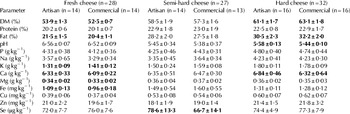
The analyzed parameters (expressed in wet weight) in fresh, semi-hard and hard cheeses differentiated by type of rennet used are presented in Table 3. Calandrelli et al. (Reference Calandrelli, Rubino, Masoero, Clementi, Morone, Pizillo and Nicastro1997) did not find effects of three different rennets on protein and fat percentages in semi-hard goat cheeses. Besides, Moatsou et al. (Reference Moatsou, Moschopoulou, Georgala, Zoidou, Kandarakis, Kaminarides and Anifantakis2004) did not find differences comparing a mixed of lamb and kid's whole abomasa with commercial calf rennet in Feta cheeses. However, some differences in major components and minerals were observed in this study. Fresh cheeses presented higher differences than the semi-hard and hard cheeses. So, the fresh cheeses made using artisan rennet showed higher dry matter and fat. Gross composition changes during ripening were due to the natural and progressive loss of moisture (Pirisi et al. Reference Pirisi, Pinna, Addis, Piredda, Mauriello, de Pascale, Caira, Mamone, Ferrantini, Addeo and Chianes2007). Similar decrease of moisture was observed in PDO Pecorino Romano Cheeses made with different lamb rennet pastes (Addis et al. Reference Addis, Pireda, Pes, Salvo, Scintu and Pirisi2005b). Besides, the mineral and trace element contents (except K and Se) in cheeses made with artisan rennet were higher than in those made with commercial rennet, with significant differences for K, Ca, Mg and Fe. The differences tended to be lower for the semi-hard and hard cheeses. The variability of the mineral composition of cheese, especially Ca, P, Mg and Zn, depends on the cheese technology. The higher concentration of minerals in natural rennet cheeses can be related with a higher pH value because the milk acidification produces a higher proportion of minerals and trace elements in the whey (Lucas et al. Reference Lucas, Rock, Chamba, Verdier-Metz, Brachet and Coulon2006). As reported in other studies (Virto et al. Reference Virto, Chavarri, Bustamante, Barron, Aramburu, Vicente, Pérez-Elortondo and de Renobales2003), little influence on the pH of the cheeses was observed. In agreement with Irigoyen et al. (Reference Irigoyen, Izco, Ibáñez and Torre2002), higher pH values were found in cheeses produced with artisan rennet, although significant differences were only observed in hard cheeses.
Mean±standard deviation and minimum and maximum values of the mineral and trace element concentrations (wet weight) analysed in goats’ dairy products differentiating the type of rennet used1

Bold letter indicated that pairs of figures (rennet type) relating to each product (milk or different cheeses) were significantly different (P<0·05)
1 Type of rennet: Artisan=kids rennet paste; Commercial=chymosin and pepsin animal rennet
Results of two way ANOVA for all the quantitative variables, considering the three types of cheeses independently, revealed as significant some effects due to the interaction diet x rennet. Significant interactions (diet x rennet) were found for pH, Ca and Fe in fresh cheese, and for Zn in hard cheese. So, the highest differences for pH and Fe between the rennet used were observed in cheese samples obtained from goats fed with AD. In these cheeses, the pH and Fe concentration were lower (P<0·001) in the cheeses made with commercial rennet. The behaviour of Ca was different with greater differences in goats fed with PD; showing higher (P<0·001) contents in cheeses made with artisan rennet. The Zn concentration of hard cheeses obtained from PD using commercial rennet was higher (P<0·05) in those cheeses made with artisan rennet; and the opposite was found in hard cheeses from AD.
Multivariate analysis
The 13 quantitative parameters (fat, protein, dry matter, pH, P, Na, K, Ca, Mg, Fe, Cu, Zn and Se) used for the multivariate analysis were expressed in wet weight in order to eliminate the influence of the aqueous content.
Linear discriminant analysis (LDA) was applied to the matrix of the quantitative parameters analyzed to differentiate the dairy products. A high percentage (97·7%, 95·4% after cross-validation) of correct classification was obtained. Only one hard cheese and one semi-hard cheese were erroneously included as semi-hard cheese and hard cheese respectively. The quantitative variables selected were: dry matter, fat, pH, K and Fe. When the LDA was applied including all the variables, the classification improved with a 98·9% of the total dairy products being well classified (with a cross-validation of 96·6%).
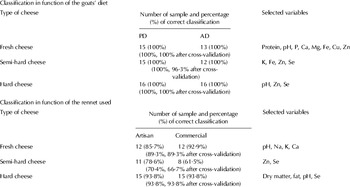
A subsequent stepwise LDA was carried out on the three types of cheeses in an independent manner using the 13 quantitative parameters analyzed, to classify the samples according to type of foodstuff of the goat and type of rennet used as criteria for comparison (Table 4). A complete classification of all the cheese according to the type of diet used was found. Therefore, the application of LDA on the concentrations of the parameters analyzed facilitated the differentiation of dairy products according to the goat's diet. The parameters selected were different for the three types of cheeses. When the stepwise LDA was applied to the three cheeses in an independent manner to differentiate the samples according the type of rennet used, low or moderate percentages of correct classification were obtained. These percentages improved when all the variables were introduced, reaching 100% for the hard cheeses.
Results of the stepwise DA to differentiate the samples (expressed in wet weight) according the type of diet of the goat1 and the type of rennet used

1 Diet: PD=Palmero diet and AD=Actual diet
Conclusions
The dairy products analyzed, milk and fresh cheeses, presented differential characteristics, in the analyzed parameters. The type of diet decisively influenced the physicochemical characteristics of milk, and of the fresh, semi-hard and hard cheeses produced. Milk from goats fed with a diet rich in forage (PD diet) had a better nutritional quality than the goat's milk obtained from goats fed with a diet based on foodstuff (AD diet). The linear discriminant analysis correctly classified all the dairy products. LDA distinguished the dairy products according to the diet used; however, the differentiation of the three types of cheeses according to the type of rennet used was moderate.
This work was financed for INIA project RTA 01-02 and DOQUECAN Canary Government project, both with FEDER founds, and for a Structuring Project, Reference ULL APD-08/01, Canary Government, Spain. The authors gratefully acknowledge the students of the final year of Agronomic Engineer, Vanesa Rodríguez and Leticia Ledesma, for their help in the cheese making and mineral and trace element analyses. Besides, the authors acknowledge the help of Patrick Dennis for improving the English in this paper.